Security like the 80s: How I stole your RF
Ayyappan Rajesh (Student · University of Massachusetts Dartmouth)
Car Hacking Village @ DEF CON 30 · Day 1 · Car Hacking Village
Overview
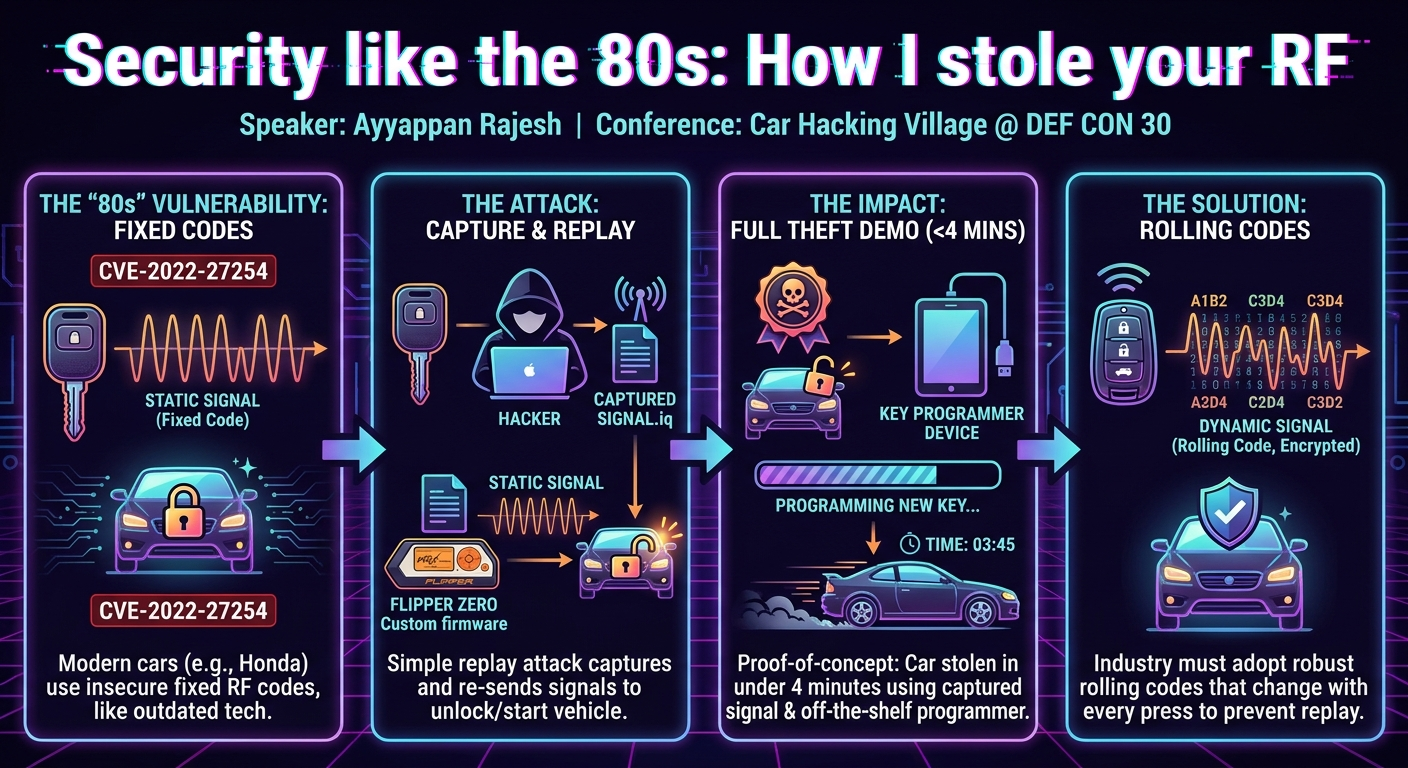
In "Security like the 80s: How I Stole Your RF," Ayyappan Rajesh, an aspiring security researcher and student at the University of Massachusetts Dartmouth, along with a co-author who works on sub-gigahertz radio at Flipper Devices, delves into the pervasive vulnerabilities of Remote Keyless Entry (RKE) systems in modern vehicles. The talk focuses on CVE-2022-27254, a critical replay attack vulnerability discovered in a 2018 Honda Civic, which extends to other Honda and Acura models. Rajesh demonstrates how easily an attacker can unlock and even remotely start a vehicle by simply replaying captured RF signals from its key fob, highlighting a severe lapse in automotive security that echoes outdated, "fixed code" communication protocols from decades past.
Key moments
- 0:00 Introduction and CVE 2022-27254 discovery
- 4:30 Understanding fixed vs. rolling keyless entry
- 10:10 Live demo: remote start and unlock replay
- 17:30 Flipper Zero custom firmware in action
- 20:10 Kevin's 'Rolling Pwn' breaks rolling code encryption
- 23:00 Full car theft demo: driving away with car
- 28:00 Future threats, legislative action, and community engagement
Security like the 80s: How I Stole Your RF
Speakers: Ayyappan Rajesh (Student, University of Massachusetts Dartmouth)
Conference: Car Hacking Village @ DEF CON 30
YouTube: https://www.youtube.com/watch?v=AxkRnUnvYWw
Overview
In "Security like the 80s: How I Stole Your RF," Ayyappan Rajesh, an aspiring security researcher and student at the University of Massachusetts Dartmouth, along with a co-author who works on sub-gigahertz radio at Flipper Devices, delves into the pervasive vulnerabilities of Remote Keyless Entry (RKE) systems in modern vehicles. The talk focuses on CVE-2022-27254, a critical replay attack vulnerability discovered in a 2018 Honda Civic, which extends to other Honda and Acura models. Rajesh demonstrates how easily an attacker can unlock and even remotely start a vehicle by simply replaying captured RF signals from its key fob, highlighting a severe lapse in automotive security that echoes outdated, "fixed code" communication protocols from decades past.
This research is particularly significant because it not only confirms a straightforward method for unauthorized vehicle access but also directly challenges automotive manufacturers' assertions about the difficulty of exploiting such flaws. Rajesh and his co-author meticulously detail the technical process of identifying, capturing, and analyzing these RF signals, culminating in a proof-of-concept that shows a car being stolen in under four minutes. The presentation serves as a stark reminder that despite advancements in vehicle technology, fundamental security principles, such as robust rolling codes, are often neglected, leaving millions of vehicles susceptible to basic, yet highly effective, attacks.
Background
▶ Watch: Introduction and CVE 2022-27254 discovery (0:00)
The concept of keyless entry systems dates back to 1982 with the Renault Fuego. These systems typically operate at frequencies like 315 MHz, 433 MHz, or 868 MHz, depending on the region and manufacturer. The core vulnerability explored in this talk lies within Remote Keyless Entry (RKE) systems, which are inherently one-way communication protocols. As quoted by Mr. Clements in an article referenced by Rajesh, it's "similar to yelling your password across the room and hoping no one happens to be listening." This contrasts sharply with more secure Passive Keyless Entry (PKE) systems, which employ a challenge-response mechanism to prevent simple replay attacks.
The fundamental flaw exploited here is the use of fixed codes rather than rolling codes. In a fixed-code system, every time a button is pressed on the key fob (e.g., lock, unlock, remote start), the same RF signal is transmitted. This makes it trivially easy for an attacker to capture this signal and replay it later to achieve the same action. In contrast, rolling codes utilize a pseudo-random number generator to ensure that a unique, synchronized code is transmitted with each press, rendering a simple replay attack ineffective. Previous work by renowned security researchers like Sammy Kamkar, with his "Open Sesame" and rolling code attacks, has long demonstrated the dangers of fixed codes. Furthermore, Victor Cazares initially reported a similar vulnerability in a 2017 Honda CRV, which served as the inspiration for Rajesh's investigation into his own 2018 Honda Civic, leading to the discovery of CVE-2022-27254. Despite these long-standing concerns, the talk highlights that over 72% of cars manufactured after 2014 still exhibit these vulnerabilities, indicating a widespread failure in adopting modern security practices within the automotive industry.
Key Findings
▶ Watch: Live demo: remote start and unlock replay (10:10)
The primary discovery of this research centers on the confirmation and expansion of CVE-2022-27254, demonstrating that a simple replay attack can compromise the Remote Keyless Entry (RKE) systems of a 2018 Honda Civic, and by extension, other Honda and Acura models utilizing similar fixed-code key fob technology. Ayyappan Rajesh's initial motivation stemmed from observing that his 2018 Honda Civic was not listed in existing CVEs for similar Honda vehicles, leading him to independently verify the vulnerability.
The talk meticulously details how an attacker can:
- Capture RF signals: Using readily available Software Defined Radios (SDRs) or specialized sub-gigahertz devices, the RF signals corresponding to actions like "lock," "unlock," and "remote start" can be intercepted when a legitimate key fob is used.
- Replay signals: These captured signals can then be retransmitted, tricking the vehicle into performing the commanded action, such as unlocking its doors or initiating the remote start sequence.
Beyond merely demonstrating the replay attack, the research, in collaboration with his Flipper Devices co-author, delved into a technical deep dive of the key fob itself. By opening the key fob and analyzing the PCF7900 series chip via Serial Peripheral Interface (SPI), they were able to extract precise operational parameters. This included identifying the exact operating frequencies (e.g., 433.657070 MHz and 434.176948 MHz), confirming the Frequency Key Shifting (FSK) modulation, determining the signal deviation, and calculating the baud rate (approximately 15380 bits per second). A crucial discovery was the use of Manchester encoding for data transmission, despite the RF chip internally interpreting it as NRZ, highlighting the need for accurate demodulation.
This detailed analysis was instrumental in developing a custom firmware for the Flipper Zero, a popular sub-gigahertz device. This firmware enabled the Flipper Zero to accurately capture and replay the Honda RKE signals, making the attack more accessible and portable. The most alarming finding, however, was the comprehensive proof-of-concept for vehicle theft. In response to Honda's statement downplaying the exploitability of the vulnerability for actual car theft, Rajesh and Kevin2600 demonstrated that after gaining entry via a replay attack, an attacker could use an off-the-shelf key programmer (costing between $3000-$4000) to program a new key for the car and drive it away, all within a shocking four minutes. This directly refutes manufacturers' claims and underscores the severe real-world implications of these "simple" vulnerabilities. The talk also acknowledges related research, such as Kevin2600's "Rolling Pwn," which demonstrates that even supposedly secure rolling codes can be broken, indicating a broader, systemic security issue across the automotive industry.
Technical Deep Dive
▶ Watch: Flipper Zero custom firmware in action (17:30)
The technical exposition of this talk provides a comprehensive guide to understanding and exploiting fixed-code RKE systems, leveraging a suite of open-source and specialized hardware tools.
The first step in analyzing any RF device is identifying its operational parameters. For this, FCCID.io proved invaluable. By simply knowing the key fob's FCC ID (e.g., KRV52X for the 2018 Honda Civic EX), researchers could access public documentation, which often reveals the approximate operating frequency and, through visual inspection of signal characteristics, the likely modulation scheme. In this case, it was quickly determined to be Frequency Key Shifting (FSK).
For signal capture and transmission, various RF transceivers were utilized:
- Software Defined Radios (SDRs) like the HackRF and USRP offer broad frequency coverage (e.g., 1 MHz to 6 GHz for HackRF) and the flexibility to capture any signal within their range without prior knowledge of modulation. They essentially act as highly configurable radio front-ends.
- Computer-controlled devices such as the Flipper Zero and Yardstick One are sub-gigahertz devices, perfect for RKE systems operating at 315, 433, or 868 MHz. However, unlike SDRs, these require precise knowledge of the target's modulation and frequency to operate effectively.
To visualize and identify RF signals, GQ_RX and SDR++ (SDR#) were employed. These tools allowed the researchers to observe the key fob's transmissions, clearly showing two distinct peaks around 433.6 MHz and 434.1 MHz, confirming FSK modulation.
For signal analysis and processing, two primary software tools were discussed:
- Universal Radio Hacker (URH): Recommended for beginners due to its user-friendly interface, offering capabilities for demodulation, capture, and analysis.
- GNU Radio: Preferred by the speaker for its granular control and deeper understanding of signal processing. Built in C++, GNU Radio uses a drag-and-drop block interface to construct complex signal flowcharts.
The GNU Radio capture flowchart involved an Osmocom Source block (representing the HackRF), configured with the estimated channel frequency and a suitable sample rate. The output was fed into a QT GUI Sink for real-time spectral visualization (showing the two distinct peaks) and a File Sink to save the raw In-phase/Quadrature (IQ) data for later analysis and replay.
The GNU Radio transmission flowchart was even simpler: a File Source block loaded the previously saved IQ data for "lock," "unlock," or "start" signals, which was then fed directly into an Osmocom Sink block to transmit through the HackRF.
A significant portion of the deep dive involved key fob analysis at the hardware level. The PCF7900 series chip inside the Honda key fob was targeted. By referring to the chip's datasheet, specific pins and functionalities could be identified. The chip was then interfaced using Serial Peripheral Interface (SPI), a synchronous serial communication interface developed by Motorola. The speaker used a 3-wire SPI configuration, consisting of MOSI (Master Output Slave Input), MISO (Master Input Slave Output), and SCLOCK (Serial Clock).
Analysis of the data stream on the MISO line yielded critical information. For instance, a sequence like 0b011011 was identified as selecting the baud rate. By cross-referencing these binary patterns with the datasheet, precise parameters were extracted:
- Frequency Low: Correlated to
0b10000100, resulting in a precise frequency of 433.657070 MHz. - Frequency High: Determined to be 434.176948 MHz.
- Modulation: Confirmed as FSK, with the exact deviation value also identified.
- Baud Rate: A baud rate division of 51 was found, which, through calculation, yielded a baud rate of approximately 15380 bits per second.
Another crucial discovery was the use of Manchester encoding. Despite the key fob's RF chip (CC1011101) internally operating under the assumption of NRZ (Non-Return-to-Zero) encoding, the actual data was Manchester encoded. Manchester encoding represents each bit with a transition in the middle of the bit period, which helps with clock recovery. The Manchester bitrate was calculated by dividing one second by the shortest distance between signal peaks (e.g., 62.81 microseconds), yielding approximately 7961 kilobits per second. This precise bitrate was essential for correct demodulation.
Finally, this detailed chip-level analysis directly informed the development of custom firmware for the Flipper Zero. His co-author integrated the precise frequencies (433.65 MHz and 434.17 MHz) and a specialized modulation profile, dubbed "Honda One," into the Flipper Zero's firmware. This allowed the Flipper Zero, a device that is not a full SDR, to accurately capture and replay the Honda RKE signals. While the Flipper Zero capture might exhibit slightly more noise due to the characteristics of the CC1011101 chip, it proved perfectly capable of executing the replay attack, making this sophisticated vulnerability accessible to a broader audience.
Demo / Proof of Concept
▶ Watch: Full car theft demo: driving away with car (23:00)
The presentation featured several compelling demonstrations, escalating from a basic replay attack to a full-blown vehicle theft scenario, directly challenging manufacturer claims.
The initial demonstration showcased the core replay attack using a HackRF and GNU Radio. Ayyappan Rajesh first captured the RF signals emitted by a legitimate Honda key fob when the "remote start" and "unlock" buttons were pressed. Subsequently, he replayed these captured .iq files, successfully demonstrating the ability to remotely start the 2018 Honda Civic and unlock its doors. Rajesh humorously highlighted the practical (and potentially mischievous) applications of this, such as cooling down a black car in the hot New England summer or playing a prank by activating the remote start in snowy weather.
Building on the success of the technical deep dive, a further demonstration involved the Flipper Zero running the custom firmware developed with his co-author. A video was presented, previously shared on Twitter, showing the Flipper Zero successfully unlocking and starting a Honda Civic. This proof-of-concept emphasized the accessibility of the attack, as the Flipper Zero is a relatively inexpensive and portable device, making the vulnerability a more tangible threat.
The most impactful and alarming demonstration, however, was the full car theft scenario, which directly refuted Honda's official statement that the vulnerability "has no indication that you can actually drive an Acura or a Honda vehicle." In collaboration with Kevin2600, the team executed a multi-stage attack:
- Gaining Entry: The replay attack was used to unlock the vehicle's doors.
- Key Programming: Once inside, an off-the-shelf key programmer was introduced. Rajesh noted these devices, costing between $3000 to $4000, are readily available and, in Massachusetts, can be purchased without a license.
- Driving Away: The key programmer was used to program a new key for the vehicle, effectively bypassing the immobilizer. The demonstration concluded with the car being driven away, all accomplished in just under four minutes.
This comprehensive proof-of-concept unequivocally proved that the fixed-code RKE vulnerability, when combined with commonly available tools, presents a direct and efficient pathway to vehicle theft, contrary to the automotive industry's dismissive stance.
Defensive Implications
▶ Watch: Future threats, legislative action, and community engagement (28:00)
The findings presented in "Security like the 80s" carry significant defensive implications for vehicle owners, manufacturers, and policymakers. The immediate, though temporary, advice for vehicle owners is the use of Faraday pouches for key fobs. These pouches block RF signals, preventing unauthorized capture and replay. However, Rajesh correctly identifies this as a "temporary fix" rather than a fundamental solution, as it relies on user diligence and doesn't address the underlying vulnerability.
The most critical long-term solution lies in the universal adoption and proper implementation of rolling codes in all RKE systems. The talk highlights that the fixed-code vulnerability has been known for years, with researchers like Sammy Kamkar demonstrating its dangers over seven years ago, leading to rolling codes becoming standard in garage door openers. The continued prevalence of fixed codes in modern vehicles, affecting over 72% of cars after 2014, represents a severe oversight by automotive manufacturers.
The automotive industry's response to such vulnerabilities is a significant concern. Manufacturers often deny the severity or exploitability of these issues. For example, Honda's statement claiming the vulnerability wouldn't allow someone to "drive an Acura or a Honda vehicle" was directly debunked by the presented proof-of-concept. This pattern of denial and downplaying impedes progress toward more secure vehicle systems. The speaker notes that other researchers have faced similar resistance, with companies acknowledging vulnerabilities but failing to implement fixes.
The talk also touches upon the broader landscape of car security and future threats. The current state allows for sophisticated car thieves, who are likely already employing these methods, to exploit known flaws. The potential for CAN bus attacks is also raised, where reversing engineering key programmer code could lead to even faster defeats of immobilizers or new key programming, potentially integrating into tools like J-Scan/Tau.
Encouragingly, there's growing external pressure for change. Senator Markey recently sent letters to 20 different automotive companies, questioning the security of their keyless entry systems. This political attention is crucial for compelling manufacturers to address these long-standing security deficiencies. The financial impact of vehicle theft is substantial, with the NHTSA approximating the cost of stolen vehicles in the US at $7 billion for 804,000 vehicles in 2020 alone. This underscores the economic imperative for improved security.
Ultimately, the defensive implications call for a paradigm shift within the automotive industry:
- Prioritize robust security design: Implement rolling codes correctly and consider other cryptographic measures.
- Acknowledge and fix vulnerabilities: Transparently address reported security flaws rather than downplaying them.
- Continuous security research: Recognize that even rolling codes can be broken (as shown by Kevin2600's "Rolling Pwn"), necessitating ongoing vigilance and innovation in vehicle security.
- Collaboration with the security community: Engage with researchers and embrace open-sourced findings to collectively enhance vehicle safety and security.
Key Takeaways
- CVE-2022-27254 Confirmed: The research confirms a critical replay vulnerability in 2018 Honda Civic RKE systems, extending to other Honda and Acura models, allowing for unauthorized unlocking and remote starting of vehicles due to the use of fixed codes.
- Easy Exploitation: A simple replay attack, performed with readily available RF transceivers like a HackRF or a custom-firmware Flipper Zero, is sufficient to compromise vulnerable vehicles.
- Deep Technical Analysis: Detailed chip-level analysis via SPI, coupled with GNU Radio for signal processing, allowed for the precise identification of frequencies, modulation, baud rates, and encoding (Manchester encoding despite NRZ assumption), which was crucial for developing effective attack tools.
- Full Vehicle Theft Demonstrated: Contrary to manufacturer claims, a comprehensive proof-of-concept showed that combining the RKE replay attack with an off-the-shelf key programmer enables full vehicle theft in under four minutes, highlighting a severe real-world risk.
- Industry-Wide Problem: The persistence of fixed-code RKE systems in a significant percentage of modern vehicles, despite long-standing awareness of their insecurity, points to a systemic failure in the automotive industry's approach to cybersecurity.
- Urgent Need for Rolling Codes: Implementing robust, properly designed rolling codes is the fundamental solution to mitigate replay attacks, though continuous research (e.g., "Rolling Pwn" for breaking rolling codes) indicates that security is an ongoing challenge requiring constant innovation.
About the Speaker(s)
Ayyappan Rajesh is an aspiring security researcher and a student at the University of Massachusetts Dartmouth. His journey into cybersecurity was inspired by prominent figures and organizations like Sammy Kamkar, Hack5, and DEF CON. Rajesh's work on CVE-2022-27254 brought him significant attention, including interviews with Fox 11 LA and ABC's Good Morning America. He is committed to open-sourcing his research and making it accessible to the community, with his work available on his GitHub repositories and personal website.
Reviews
Dr. Zero (Offensive Security Researcher) — STRONG ACCEPT
Honda shipped fixed-code RKE in a 2018 Civic, which is an absolute joke, but Rajesh and his co-author didn't just stop at pressing record on a HackRF. They dumped the PCF7900 chip via SPI, calculated the exact FSK parameters, and chained the replay with a physical key programmer to steal the car in four minutes. A masterclass in calling a vendor's bluff.
Heather Calloway (CISO) — MUST SEE
A stark demonstration of what happens when manufacturers prioritize cost over basic security and then lie about the exposure. By linking a simple RF replay attack to an off-the-shelf key programmer, the researchers prove Honda’s PR denials regarding vehicle theft were flatly false. This is a crucial reality check for anyone managing executive protection or corporate fleets.