Root, root.... boom
Tokala
Christchurch Hacker Conference 2025 · Main Stage
Overview
In this insightful CHCon presentation, Tokala, a hardware hacking enthusiast, delves into the practicalities of reverse engineering a common, inexpensive Internet of Things (IoT) camera. Titled "Root, root.... boom," the talk meticulously details the process of gaining root access to a $30 IP camera, circumventing physical and software barriers to expose its underlying architecture and potential vulnerabilities. The speaker's journey, motivated by a desire to understand the security posture of consumer-grade "Made in China" devices, serves as a compelling demonstration of accessible hardware hacking techniques.
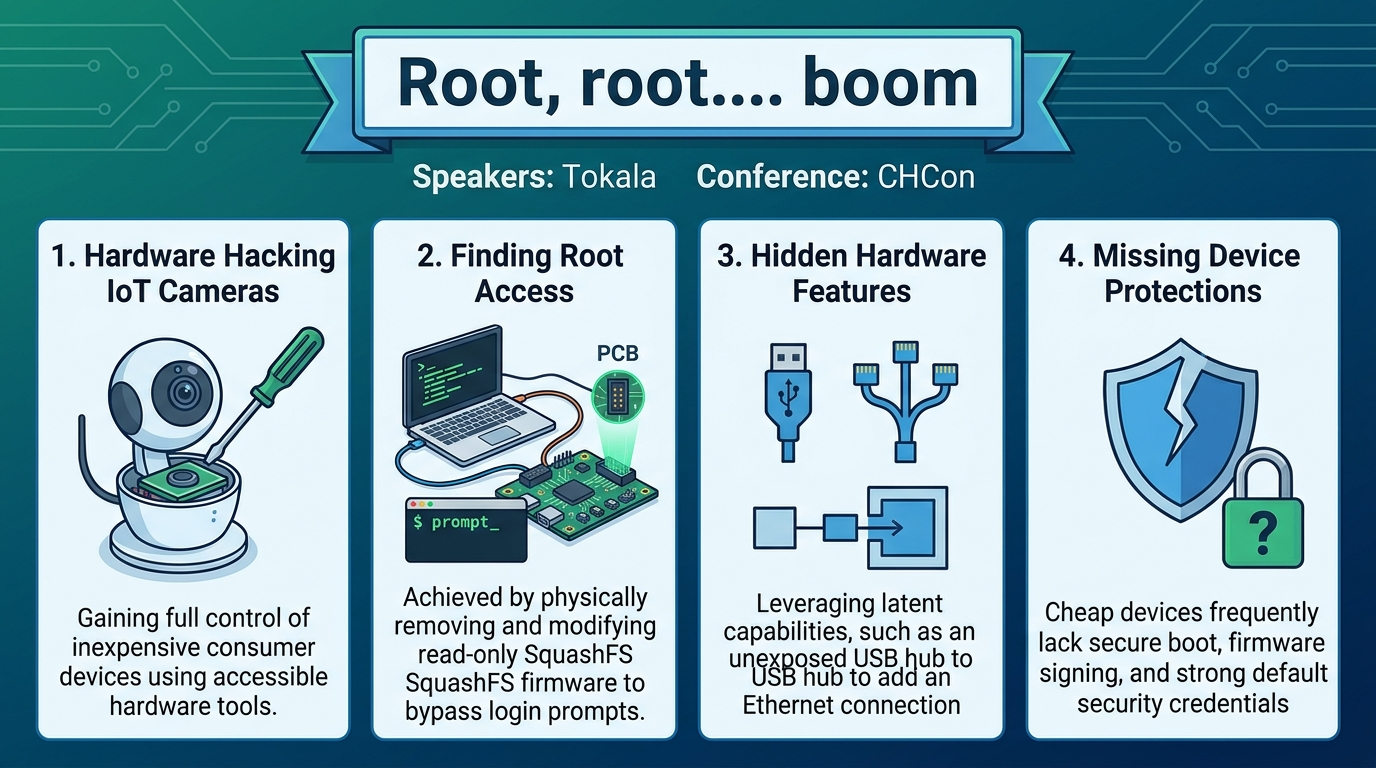
Key moments
- 1:00 Initial reconnaissance: identifying chips and datasheets
- 3:00 Bypassing component removal with X-rays and pin board
- 4:50 Capturing UART output, encountering login challenge
- 6:00 Desoldering and dumping the camera's flash memory
- 8:00 Analyzing firmware with Binwalk and modifying init tab
- 11:00 Gaining root access and expanding BusyBox capabilities
- 14:00 Adding Ethernet and creating a custom Wi-Fi access point
- 16:10 Future plans: software reverse engineering and API analysis
Root, root.... boom
Speakers: Tokala
Conference: CHCon
YouTube: https://www.youtube.com/watch?v=t62JwzNWBEc
Overview
In this insightful CHCon presentation, Tokala, a hardware hacking enthusiast, delves into the practicalities of reverse engineering a common, inexpensive Internet of Things (IoT) camera. Titled "Root, root.... boom," the talk meticulously details the process of gaining root access to a $30 IP camera, circumventing physical and software barriers to expose its underlying architecture and potential vulnerabilities. The speaker's journey, motivated by a desire to understand the security posture of consumer-grade "Made in China" devices, serves as a compelling demonstration of accessible hardware hacking techniques.
The core of Tokala's presentation revolves around the systematic deconstruction of the camera, from initial reconnaissance and datasheet analysis to desoldering flash memory, modifying firmware, and ultimately re-flashing the device to achieve full control. This talk is particularly relevant in an era dominated by ubiquitous IoT devices, many of which originate from manufacturers with opaque security practices. By showcasing how easily such a device can be compromised and repurposed, Tokala highlights critical security implications for both consumers and defenders, underscoring the importance of understanding the hardware and software foundations of the technology we integrate into our lives.
Background
▶ Watch: Initial reconnaissance: identifying chips and datasheets (1:00)
The pervasive nature of inexpensive IoT devices presents a significant security challenge. Many consumer-grade gadgets, particularly those sourced from overseas manufacturers, often operate with unknown security standards, potentially exposing users to privacy risks or becoming vectors for broader cyberattacks. Tokala's motivation for this research stemmed from a personal experience: a $30 IP camera purchased by his mother to monitor her house while overseas. Upon its return, the speaker, driven by curiosity and a healthy skepticism towards devices that "send everything back to China" (as explicitly stated on the box), decided to investigate its inner workings.
The initial phase of the investigation involved standard hardware reconnaissance. This included physically inspecting the printed circuit board (PCB), identifying key components such as the System-on-Chip (SoC) and flash memory chip, and then meticulously searching for their respective datasheets. Datasheets, as Tokala emphasizes, are invaluable resources, providing detailed information on chip functionality, internal architecture, and crucial pinouts. However, a common tactic employed by manufacturers to deter reverse engineering became apparent: the deliberate omission of small, surface-mount components (like resistors or capacitors) on critical debug pads, rendering direct electrical probing ineffective. To overcome this, Tokala employed an X-ray machine to visualize the internal PCB traces, revealing the hidden connections and allowing him to re-establish access points using a specialized pin board. This initial hurdle underscored the need for creative problem-solving in hardware hacking, moving beyond simple software analysis.
Upon establishing electrical contact, Tokala connected a serial converter to the camera's UART (Universal Asynchronous Receiver/Transmitter) pins, expecting to observe the device's boot sequence. The UART output provided a wealth of information, including details about the manufacturer, the SoC type, and the memory layout. However, the boot process culminated in a login prompt, effectively blocking direct command-line access. This roadblock shifted the focus from direct interaction to a more invasive approach: extracting and modifying the device's firmware. This problem—a cheap, ubiquitous device with a locked interface—is precisely why such hardware hacking is crucial, revealing the hidden layers of control and potential vulnerabilities.
Key Findings
▶ Watch: Capturing UART output, encountering login challenge (4:50)
Tokala's detailed analysis of the $30 IoT camera yielded several significant findings, demonstrating both the inherent vulnerabilities in such devices and the practical methods for exploiting them.
Firstly, the device utilizes a specialized System-on-Chip (SoC), specifically designed for camera applications, incorporating features like motor drives for pan/tilt functionality and integrated audio. The core operating system and applications are stored on an 8MB flash memory chip, which functions much like a miniature hard drive or SSD.
A crucial discovery was the camera's reliance on SquashFS for its primary file system. SquashFS is a compressed, read-only file system widely used in embedded and IoT devices due to its small footprint and efficiency. While its read-only nature might seem like a security feature, Tokala demonstrated that by physically extracting the flash chip, the entire file system could be accessed, modified, and subsequently re-flashed.
The most impactful finding was the successful achievement of root access to the device. This was accomplished by extracting the SquashFS partition, decompressing it, and modifying the /etc/inittab file. Specifically, Tokala changed the entry responsible for launching the login prompt (/bin/login) to directly execute /bin/ash, a lightweight shell, thereby bypassing authentication entirely and granting an immediate root shell upon boot.
Post-root access, further investigation revealed the presence of BusyBox, a collection of common Unix utilities combined into a single executable, also prevalent in IoT devices for its efficiency and small size. While the manufacturer had stripped down the BusyBox installation to a limited set of commands, Tokala discovered that by mounting an SD card containing a full version of BusyBox, he could effectively restore all 400+ utilities, significantly expanding his control and interaction capabilities with the device.
Beyond software, Tokala uncovered hardware capabilities not exposed to the end-user. The camera's SoC included a functioning USB hub, enabling him to connect external USB devices. He successfully demonstrated this by attaching a USB Ethernet adapter, providing the camera with wired network connectivity it was not originally designed to have. Furthermore, he was able to leverage the device's Wi-Fi capabilities to create a custom Wi-Fi access point using hostapd, effectively repurposing the camera as a rogue network gateway, bypassing the manufacturer's intended setup and data transmission mechanisms.
Ultimately, the key finding is the complete subversion of a cheap IoT device, transforming it from a potentially insecure surveillance tool into a fully controlled, repurposed platform capable of running custom services, expanding its connectivity, and demonstrating the profound implications of unsecure hardware and firmware design.
Technical Deep Dive
▶ Watch: Analyzing firmware with Binwalk and modifying init tab (8:00)
Tokala's presentation provides a masterclass in practical hardware reverse engineering, meticulously detailing each step taken to compromise the IoT camera.
The process began with reconnaissance, which involved a physical inspection of the camera's PCB. Key components identified included a main System-on-Chip (SoC) and an 8MB flash memory chip. The next critical step was obtaining datasheets for these components. Datasheets are technical manuals that provide comprehensive information about a chip's functionality, electrical characteristics, and most importantly, its pinouts—the mapping of each physical pin to its specific function (e.g., power, ground, data lines, debug interfaces like UART). This allowed Tokala to identify potential debug ports.
A significant hurdle emerged when attempting to connect to the identified debug pins. Using a multimeter, Tokala found that several crucial pins appeared "dead." This is a common tactic by manufacturers to deter easy access. To overcome this, he utilized an X-ray machine to peer through the PCB layers, revealing internal traces that connected the SoC pins to pads where components had been intentionally removed. With these hidden connections identified, he used a specialized pin board—a precise probing tool—to establish direct electrical contact with the individual SoC pins, bypassing the missing components.
Once physical access was established, a serial converter was connected to the camera's UART (Universal Asynchronous Receiver/Transmitter) interface. This allowed Tokala to capture the device's boot output, which provided valuable information about the firmware, memory layout, and the operating system (a Linux variant). However, the boot process halted at a login prompt, preventing direct command execution.
To bypass the login, Tokala shifted to firmware extraction. This involved carefully desoldering the 8MB flash memory chip from the PCB. Desoldering delicate surface-mount components requires significant skill and specialized tools, as excessive heat can damage the chip or surrounding components. Once removed, the chip was placed into an adapter, which was then inserted into an inexpensive flash reader. This setup allowed him to dump the entire 8MB contents of the flash memory into a hexadecimal file on his computer.
Analyzing this raw hexadecimal data would be impractical manually. Tokala employed Binwalk, a powerful firmware analysis tool, to automatically identify file system partitions and embedded files within the flash dump. Binwalk successfully identified several partitions, most notably a SquashFS partition. SquashFS is a compressed, read-only file system commonly used in embedded systems due to its efficiency and small size. Understanding the exact offsets (decimal numbers indicating start positions) of these partitions within the overall flash image was crucial, as the SoC relies on these precise locations to boot correctly.
The next step was firmware modification. Using the dd (data duplicator) command, a standard Unix utility, Tokala extracted the SquashFS partition into a separate file. This file, still in a compressed, unreadable format, was then processed with unsquashfs, which decompressed and mounted it as a standard Linux file system. This allowed him to navigate the file system structure, revealing directories like /bin, /etc, and /lib.
The target for gaining root access was the /etc/inittab file. This file is central to the Linux boot process, defining what processes the system starts when it boots. Tokala identified a line in inittab that executed /bin/login on the ttyS0 (UART) console, which was responsible for the login prompt. He strategically modified this line to execute /bin/ash (a lightweight shell) instead. This simple change meant that instead of prompting for a password, the device would immediately drop into a root shell upon booting via UART.
After modification, the file system needed to be re-packaged. The mksquashfs command (not explicitly mentioned but implied for re-squashing) would be used to re-create the SquashFS image from the modified file system. If the modified SquashFS partition was now a different size than the original, Tokala explained the need to pad it with zeros to maintain the correct overall firmware size and partition offsets. Finally, the modified SquashFS partition was concatenated back into the original flash image, replacing the old partition.
The modified firmware was then re-flashed onto the desoldered chip, and the chip was carefully resoldered back onto the PCB. Upon powering up the camera, connecting via UART now presented an immediate root shell, granting full control over the device.
With root access, Tokala performed post-exploitation activities. Using the ps command, he listed all running processes, identifying network services like Telnet, a web server, a Wi-Fi client, a DHCP server, and a Wi-Fi access point. He also explored the capabilities of BusyBox, noting that while the manufacturer had compiled a limited version, a full version could be loaded from an SD card, significantly expanding the available command-line utilities.
Finally, Tokala demonstrated hardware expansion and network manipulation. He successfully plugged a USB Ethernet adapter into the camera's internal USB hub, instantly providing wired network capabilities. Furthermore, he configured and launched hostapd, a user-space daemon for access point and authentication servers, to create a custom Wi-Fi access point on the camera, completely independent of its original firmware's network configuration. This showcased the profound ability to repurpose the device beyond its intended functionality.
Demo / Proof of Concept
▶ Watch: Gaining root access and expanding BusyBox capabilities (11:00)
Tokala's talk was rich with practical demonstrations and proofs of concept, illustrating each stage of his hardware hacking journey. The initial demonstration involved connecting to the camera via a serial converter and displaying the UART boot output, showing the detailed system information and the eventual login prompt that needed to be bypassed.
The core proof of concept was the successful re-flashing of the modified firmware and subsequent attainment of root access. After explaining the steps of desoldering, modifying the inittab file, and re-flashing, Tokala showed the live output from the UART connection after rebooting the camera. Instead of a login prompt, a direct command prompt appeared, confirming that the device was now running with root privileges. He then executed the ps command to list the running processes, visually confirming the system's operational state and the various services active on the compromised device.
Further demonstrations highlighted the expanded capabilities achieved post-root. While not explicitly shown live, Tokala described and provided evidence of connecting a USB Ethernet adapter to the camera's internal USB hub, instantly adding wired network functionality. He also detailed the creation of a custom Wi-Fi access point using hostapd, demonstrating the ability to take full control of the device's wireless capabilities and establish an independent network interface.
The ultimate "boom" of the presentation was the successful repurposing of the camera to host a web server and access it from a standard web browser. Although he humbly noted that the browser was "doing the heavy lifting" in terms of rendering, the fact that the tiny $30 camera could be commanded to serve web content underscored the complete control achieved. This demonstrated the device's potential for arbitrary code execution and its transformation into a fully customizable embedded Linux system, far beyond its initial surveillance purpose.
Defensive Implications
▶ Watch: Future plans: software reverse engineering and API analysis (16:10)
Tokala's work on the $30 IoT camera carries significant defensive implications for manufacturers, security professionals, and end-users alike. The ease with which a common, inexpensive device can be compromised highlights several critical vulnerabilities in the IoT ecosystem.
Firstly, physical security is often overlooked. While the manufacturer attempted to deter reverse engineering by removing critical components from debug pads, Tokala demonstrated that such measures are merely speed bumps. Tools like X-rays and precision pin boards can bypass these physical obfuscations, making it clear that relying solely on minor physical deterrents is insufficient. Manufacturers should consider more robust physical tamper detection or tamper-evident seals if physical access is a concern.
Secondly, the lack of secure boot and firmware signing is a glaring vulnerability. The ability to desolder the flash chip, modify the firmware, and re-flash it without any cryptographic verification means that the device can be easily subverted. Implementations of Secure Boot would ensure that only cryptographically signed and trusted firmware can execute, significantly raising the bar for attackers. Firmware updates should also be signed and verified before installation.
Thirdly, the presence of a default or easily bypassed login mechanism (or lack thereof) via debug interfaces is a major risk. Manufacturers must ensure that debug interfaces are either entirely disabled in production devices or protected by strong, unique, and ideally user-configurable credentials, along with robust lockout mechanisms. The default credentials problem remains a persistent issue in IoT.
Fourthly, the use of stripped-down utilities like BusyBox to reduce the attack surface is a good practice, but it's not foolproof. As Tokala showed, if an attacker gains root access, they can simply load a full version of BusyBox (or any other tool) from an external storage device like an SD card, negating the initial security measure. This emphasizes the need for a defense-in-depth strategy, where multiple layers of security are present.
Finally, the inherent design choices in these devices, such as the inclusion of a USB hub or powerful Wi-Fi capabilities that are not fully exposed to the user, create an expanded attack surface once root is achieved. Attackers can leverage these latent hardware features to repurpose the device for malicious activities, such as creating rogue access points, sniffing network traffic, or integrating new hardware for further compromise. Defenders need to understand the full capabilities of the underlying hardware, not just the exposed features.
From a user perspective, this research underscores the importance of scrutinizing the security claims and provenance of cheap IoT devices. The speaker's observation that the camera "sends everything back to China" (as stated on the box) highlights potential privacy and data sovereignty concerns. Users should be wary of connecting such devices to their home networks without understanding their security posture. Network segmentation, such as placing IoT devices on a separate VLAN, can help mitigate risks by limiting their access to sensitive internal networks.
Key Takeaways
- Hardware hacking is accessible and powerful for cheap IoT devices: Even inexpensive, mass-produced consumer electronics are susceptible to hardware reverse engineering techniques using readily available tools.
- Datasheets and X-rays are invaluable: Physical inspection, coupled with detailed datasheets, provides critical insight into chip functionality and pinouts. X-ray imaging can reveal hidden PCB traces, bypassing manufacturer attempts to obscure debug interfaces.
- Firmware modification grants deep control: By extracting, modifying (e.g., changing
/etc/inittabto bypass login), and re-flashing firmware, attackers can achieve full root access and repurpose the device. - BusyBox and latent hardware features are potent post-exploitation tools: A compromised device's limited BusyBox functionality can be expanded via external storage, and hidden hardware capabilities (like USB hubs) can be leveraged for unexpected functionality (e.g., adding Ethernet).
- Lack of secure boot and firmware signing is a critical vulnerability: The ability to freely modify and re-flash firmware without cryptographic verification is a major security flaw, enabling complete device subversion.
- Cheap IoT devices pose significant privacy and security risks: These devices often come with unknown security postures, potential backdoors, and can be easily repurposed for surveillance, network attacks, or data exfiltration, highlighting the need for caution and robust defensive strategies.
About the Speaker(s)
Tokala is a passionate hardware hacking enthusiast based in Christchurch, New Zealand. He openly shares his journey of learning and exploring the intricacies of hardware reverse engineering, finding immense enjoyment in the process. Recognizing the value of collaborative learning, Tokala expressed a keen interest in establishing a hardware/reverse engineering meetup group in Christchurch. He highlighted his connections within the local electronics industry, suggesting a strong foundation for such a community to thrive. His presentation style is engaging and practical, emphasizing hands-on techniques and problem-solving, all while maintaining a good sense of humor, as evidenced by his self-proclaimed "SUPER GENIUS" status.
Reviews
Dr. Zero (Offensive Security Researcher) — SOLID
Competent intro-to-hardware-hacking walkthrough on a cheap IP camera. Nothing novel for anyone who's done embedded work before, but well-executed and honest about what it is. Would've been a strong blog post; fills a slot fine at a regional con.
Heather Calloway (CISO) — SOLID
Competent walkthrough of commodity IoT camera exploitation. Useful for anyone building awareness of supply chain hardware risk, but the findings confirm known problems rather than reveal new ones. Worth 20 minutes if you're briefing a team on why cheap IoT belongs on a segmented network.