Digital Sanctuary: Learning Threat-Informed Defence from Nature Conservation
Greg Mason (Security Operations Engineer · Contact Energy)
Christchurch Hacker Conference 2025 · Main Stage
Overview
In his compelling CHCon talk, "Digital Sanctuary: Learning Threat-Informed Defence from Nature Conservation," Greg Mason, a Security Operations Engineer at Contact Energy, draws a profound analogy between the ecological challenges of a nature reserve and the complex landscape of cybersecurity. Mason skillfully leverages his experience as a former volunteer at Zealandia, a predator-proof eco-sanctuary in Wellington, New Zealand, to illustrate the principles of threat-informed defense. The talk posits that the meticulous planning, construction, and ongoing maintenance of a physical sanctuary's defenses—designed to exclude invasive species—offer invaluable lessons for building robust and resilient digital environments.
Key moments
- 0:00 Introduction and "Digital Sanctuary" concept
- 6:30 Iterative fence design for agile threats (mice, rats)
- 8:50 Adversary behavior: lateral movement and digital parallels
- 16:20 Applying nature's lessons with MITRE ATT&CK
- 20:40 Real-world incident response: the stoat hunt
- 23:50 The importance of continuous re-evaluation of defense strategies
Digital Sanctuary: Learning Threat-Informed Defence from Nature Conservation
Speakers: Greg Mason, Security Operations Engineer, Contact Energy
Conference: CHCon
YouTube: https://www.youtube.com/watch?v=T3lKf4spB2M
Overview
In his compelling CHCon talk, "Digital Sanctuary: Learning Threat-Informed Defence from Nature Conservation," Greg Mason, a Security Operations Engineer at Contact Energy, draws a profound analogy between the ecological challenges of a nature reserve and the complex landscape of cybersecurity. Mason skillfully leverages his experience as a former volunteer at Zealandia, a predator-proof eco-sanctuary in Wellington, New Zealand, to illustrate the principles of threat-informed defense. The talk posits that the meticulous planning, construction, and ongoing maintenance of a physical sanctuary's defenses—designed to exclude invasive species—offer invaluable lessons for building robust and resilient digital environments.
Mason's presentation is a call to action for cybersecurity professionals to adopt a holistic, adaptive, and deeply analytical approach to defense. By dissecting the design and evolution of Zealandia's predator-proof fence, he demonstrates how understanding diverse adversary behaviors, implementing multi-layered controls, and maintaining continuous vigilance are critical for safeguarding valuable assets, whether they are endangered birds or sensitive corporate data. This talk matters because it provides a fresh, accessible framework for understanding complex security challenges, translating abstract digital threats into tangible, relatable concepts derived from the natural world.
Background
▶ Watch: Introduction and "Digital Sanctuary" concept (0:00)
The core premise of Mason's talk revolves around the Zealandia Eco-Sanctuary, a pioneering conservation project initiated in the 1990s. This urban sanctuary is encircled by an 8.6 km predator-proof fence, meticulously designed to exclude invasive mammalian predators like stoats, ferrets, rats, and possums, thereby allowing native New Zealand flora and fauna to thrive within its protected valley. The challenge was multifaceted: how to design a barrier that could withstand a wide array of threats, each with unique capabilities (climbing, burrowing, jumping), while also accounting for environmental factors and human interaction.
Mason directly parallels this conservation effort with the establishment of a "digital sanctuary" – a secure network environment designed to protect critical digital assets. Just as Zealandia protects species like Kaka, Tuatara, and native Weta, a digital sanctuary aims to safeguard customer information, corporate intellectual property, source code, reputation, and even the "people in a digital safety sense." The talk highlights that both physical and digital environments share fundamental questions: What are we protecting? What are the legitimate interactions or "moving parts" (staff, customers, APIs)? And what are the environmental constraints (cloud/on-prem, industry regulations, user devices)? This foundational understanding forms the "architecture" upon which a secure defense can be built, emphasizing that security must be an integral part of design, not an afterthought. The talk argues that a threat-informed defense approach is essential, moving beyond generic security measures to specifically counter known and anticipated adversary tactics.
Key Findings
▶ Watch: Adversary behavior: lateral movement and digital parallels (8:50)
The central discovery of this talk is the profound applicability of natural conservation strategies to cybersecurity. Mason meticulously demonstrates that the principles guiding the design, implementation, and maintenance of Zealandia's predator-proof fence directly translate into effective cybersecurity practices.
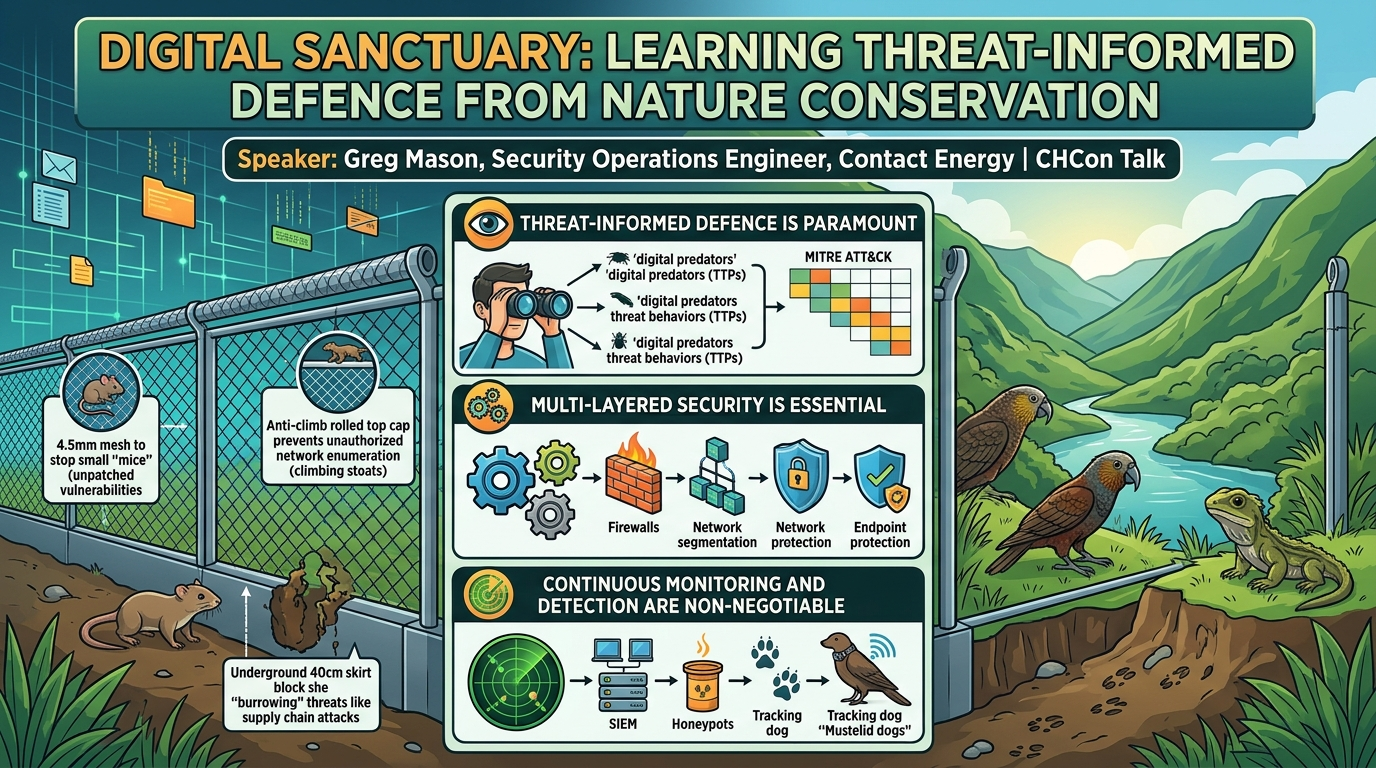
Firstly, the talk underscores the critical importance of detailed threat modeling. By analyzing a diverse range of "predators" (goats, mice, cats, stoats) and their specific behaviors (grazing, climbing, burrowing, leaping), Zealandia developed targeted countermeasures. This mirrors the digital world's need to identify specific adversaries and their tactics, techniques, and procedures (TTPs), rather than relying on generic security solutions. The evolution of the fence design, from initial concepts to refined details like the 4.5mm mesh (to stop juvenile mice) and mouse plates (to prevent climbing leverage on bolts), illustrates an iterative, adaptive defense strategy.
Secondly, Mason emphasizes multi-layered and adaptive defenses. No single defense mechanism is sufficient. The fence incorporates height, mesh density, anti-climb features (top cap), and subterranean barriers (the 40cm skirt). This holistic approach directly maps to defense-in-depth in cybersecurity, where firewalls, intrusion detection systems, endpoint protection, and secure configurations all work in concert. The example of the double-gate system for human access highlights the need for secure ingress/egress points and checks for unintended introductions.
Thirdly, the talk reveals that understanding adversary behavior is paramount. The observation that burrowing animals move sideways when blocked, eventually giving up, provides a powerful metaphor for digital attackers enumerating endpoints. If consistently blocked, they may move on to an easier target or an adjacent, less secure network. This insight underscores the value of consistent, robust defenses across the entire attack surface.
Finally, Mason highlights the necessity of continuous monitoring, detection, and tailored incident response. The conservation world uses tracking tunnels, perimeter patrols, and even "mustelid dogs" to detect incursions. In the digital realm, Security Information and Event Management (SIEM) systems, honeypots, and user reporting serve similar functions. The Otakanoi Eco Sanctuary case study, detailing an 11-month stoat eradication effort, starkly illustrates that effective incident response requires specific tools and sustained effort, and that delays can lead to irreversible losses (e.g., the entire Tīeke bird population). The talk concludes by stressing that defenses are not static; Zealandia's fence, designed for 25 years, is now undergoing a redesign, mirroring the continuous need to re-evaluate and update cybersecurity strategies against evolving threats.
Technical Deep Dive
▶ Watch: Applying nature's lessons with MITRE ATT&CK (16:20)
The technical deep dive into building a "digital sanctuary" begins with a detailed deconstruction of Zealandia's physical fence design, each element meticulously translated into a cybersecurity control.
The initial fence design considered threats like goats, pigs, sheep, and deer. These are analogous to common, less sophisticated digital threats or opportunistic attackers. The proposed 1.9 to 2-meter tall fence was a primary deterrent, but initial budget-driven decisions suggested a 1-meter fence, a choice that later proved insufficient. This highlights the danger of compromising on fundamental security requirements for short-term cost savings.
The introduction of mice and rats, capable of climbing and squeezing through gaps, necessitated significant design enhancements. The initial idea of a "solid wall" was rejected due to environmental factors (Wellington's high winds) and aesthetic/public perception concerns, demonstrating the trade-offs between absolute security, usability, and operational feasibility. Similarly, a widespread "electric current" was deemed impractical due to maintenance and public safety risks. The refined solution involved a mesh fence with a precise 4.5mm gap (reduced from an insufficient 6mm after juvenile mice bypassed it) and a rolled metal top cap to prevent climbing. The discovery of mice leveraging bolts on supports led to the invention of the mouse plate – a small, specific design fix for an observed bypass technique. In digital terms, this is akin to meticulous vulnerability patching, input validation, and hardening specific components that attackers might exploit. The 4.5mm mesh represents granular network segmentation and access control lists (ACLs), ensuring only authorized traffic/entities can pass. The top cap functions as an anti-climb mechanism, such as robust endpoint detection and response (EDR) solutions or web application firewalls (WAFs) that block common attack vectors.
The threat of burrowing animals like rabbits and rats introduced the concept of the 40cm underground skirt. This physical barrier prevents attackers from simply going "under" the primary defense. Mason uses this to illustrate digital adversaries attempting to bypass perimeter controls through less obvious means, such as supply chain attacks, cloud misconfigurations, or shadow IT. The observation that these adversaries move "sideways" when blocked, probing for weaknesses, directly translates to attackers performing reconnaissance and enumeration of endpoints, seeking an easier entry point or even lateral movement from an adjacent, less secure network. This underscores the need for consistent security across the entire digital estate and the dangers of "weak neighbors."
The "big guns" – feral cats, possums, and mustelids (weasels, stoats, ferrets) – required further refinement. Cats, known for their powerful leaps, necessitated a 3-meter clearance around the fence to prevent them from jumping from external perches. This is analogous to securing external-facing assets, ensuring no adjacent systems or public-facing applications can be used as a launchpad into the core network. Possums, expert climbers and grazers, required the top cap to be sufficiently wide, approximately 250mm. This represents strengthening privileged access management and securing critical infrastructure components from unauthorized access. The mustelids, described as dangerously effective predators, were largely deterred by the cumulative defenses designed for other threats, highlighting that a comprehensive, multi-layered approach often defends against the most sophisticated adversaries without requiring entirely new mechanisms.
Beyond the main fence, Mason emphasizes "moving parts" and environmental constraints. Drains with meshes allow necessary "flow" (e.g., legitimate network traffic) while filtering threats. Acrylic sheets for high-voltage power lines prevent environmental hazards (e.g., a power surge electrifying the entire fence) from compromising the defense. The double-gate system for human entry is a practical demonstration of secure authentication and authorization, requiring a two-step process to ensure no threats are inadvertently introduced.
For the digital world, Mason introduces the MITRE ATT&CK framework as the ultimate tool for threat-informed defense. This framework provides a standardized taxonomy of adversary tactics and techniques, allowing organizations to map their defenses against known threat behaviors. By creating a "heat map" of techniques commonly used by relevant adversaries (based on industry, organization size, or past attacks), security teams can prioritize their defensive efforts. This is crucial in a rapidly evolving digital landscape, ensuring resources are focused on the most likely and impactful threats.
Finally, the talk delves into digital monitoring and incident response. The analogy of "tracking tunnels" (bait, ink pads, paper to capture footprints) translates to honeypots – decoy systems or files designed to attract and detect attackers. SIEM systems are presented as the "shiny magical box" that aggregates logs from diverse systems, correlates events, and identifies known patterns of malicious behavior, generating alerts for security teams. User reporting (emails, tickets) and "digital breadcrumbs" (forensic investigations) complete the picture. The Otakanoi Eco Sanctuary's 11-month stoat hunt vividly illustrates that incident response must be targeted, employing specific tools (e.g., "mustelid dogs," specialized traps) based on the identified threat, and requires persistent effort and continuous monitoring long after initial containment.
Demo / Proof of Concept
▶ Watch: Real-world incident response: the stoat hunt (20:40)
While this talk does not feature a live software demonstration or a traditional proof of concept exploit, the entire presentation serves as a conceptual demonstration. Greg Mason meticulously "builds" the predator-proof fence for Zealandia, step-by-step, in front of the audience. Each design decision—from the initial height to the intricate details of the mesh, top cap, mouse plates, and underground skirt—is presented as a direct response to a specific "threat actor" and their "techniques." This extended analogy functions as a powerful, illustrative proof of concept for the principles of threat-informed defense, demonstrating how a deep understanding of adversary capabilities leads to highly effective, layered security controls in both physical and digital realms.
Defensive Implications
▶ Watch: The importance of continuous re-evaluation of defense strategies (23:50)
The lessons from Zealandia provide clear, actionable insights for cybersecurity defenders:
- Adopt a Threat-Informed Defense Mindset: Move beyond generic security checklists. Understand who might attack you, why, and how. Utilize frameworks like MITRE ATT&CK to identify the most relevant adversary tactics, techniques, and procedures (TTPs), creating a "heat map" to prioritize defenses against the most probable and impactful threats.
- Implement Multi-Layered and Adaptive Controls: Just as Zealandia's fence has multiple physical features (height, mesh, top cap, skirt), digital defenses must be layered. This includes perimeter controls (firewalls, WAFs), internal segmentation, endpoint protection, robust authentication (MFA), and secure configurations. Be prepared to adapt and refine these controls as new threats emerge or existing ones evolve (e.g., the 6mm to 4.5mm mesh refinement).
- Prioritize Granular Defense Against Stealthy Threats: The discovery of juvenile mice bypassing the 6mm mesh highlights the need for meticulous attention to detail. Defenders must secure not only obvious entry points but also subtle bypasses, such as misconfigurations, unpatched vulnerabilities, or weak links in the supply chain. Regular penetration testing and red teaming can uncover these "mouse plate" equivalents.
- Secure All Attack Surfaces, Including "Underground" and "Adjacent" Paths: The underground skirt and the discussion of attackers moving laterally to adjacent, weaker networks emphasize the need for comprehensive security. Don't neglect obscure access vectors, cloud misconfigurations, or third-party integrations. Ensure consistent security posture across the entire digital estate, including shadow IT and legacy systems.
- Establish Robust Monitoring and Detection Capabilities: Implement Security Information and Event Management (SIEM) systems to collect, correlate, and analyze logs from all critical systems. Deploy honeypots and honeytokens to detect anomalous internal activity. Leverage user reporting and conduct thorough digital forensics ("autopsies") to understand how breaches occurred and what indicators of compromise (IoCs) to look for.
- Develop Tailored and Persistent Incident Response Plans: The Otakanoi stoat incident demonstrates the necessity of having specific tools and strategies for identified threats. Incident response plans should detail how to detect, contain, eradicate, and recover from specific types of attacks. Critically, response efforts must be persistent, often requiring prolonged monitoring and verification ("three more months" after stoat capture) to ensure complete eradication and prevent re-entry.
- Regularly Review and Modernize Defenses: Zealandia's 25-year fence redesign underscores that security is not a one-time project. Digital environments and threat landscapes evolve constantly. Organizations must regularly review their threat models, assess the effectiveness of existing controls, and invest in modernizing their security architecture to maintain resilience against current and future threats.
Key Takeaways
- Threat-informed defense is paramount: Understand specific adversaries and their TTPs (e.g., using MITRE ATT&CK) to prioritize and design effective, targeted security controls, much like tailoring a fence to stop specific predators.
- Multi-layered security is essential: No single defense is sufficient. A combination of controls (perimeter, network segmentation, endpoint protection, access management) creates a robust "digital sanctuary" that deters diverse attack vectors.
- Adversary behavior dictates defense: Observing how attackers bypass controls (e.g., moving laterally, enumerating endpoints) helps anticipate their next moves and build more resilient defenses, including securing "adjacent networks" and preventing "burrowing" bypasses.
- Continuous monitoring and detection are non-negotiable: Tools like SIEMs, honeypots, and user reporting are vital for early detection of incursions, providing the necessary visibility to respond quickly and effectively.
- Incident response must be specific and persistent: Identifying the exact nature of a breach allows for targeted and efficient response. Eradication and recovery require sustained effort and verification to ensure the threat is fully neutralized.
- Security is an ongoing, adaptive process: Just as Zealandia's fence requires periodic redesign, digital defenses must be continuously reviewed, updated, and improved to counter evolving threats and maintain long-term resilience.
About the Speaker(s)
Greg Mason is a Security Operations Engineer at Contact Energy, bringing over four years of experience in defensive security to his role. Beyond his professional capacity, Mason is also an ex-volunteer at Zealandia, where he dedicated over six years to conservation service. This unique blend of experience in both digital security and environmental conservation provides him with a distinctive perspective, enabling him to draw compelling and insightful parallels between the two fields, which he masterfully articulates in his talk.
Reviews
Dr. Zero (Offensive Security Researcher) — SOLID
A well-constructed analogy talk that uses Zealandia's predator-proof fence to teach basic threat modeling and defense-in-depth. Accessible and clearly presented, but the security content itself is 101-level stuff dressed in a clever metaphor. Fine for newer practitioners; experienced folks won't learn anything they didn't know in 2015.
Heather Calloway (CISO) — WEAK
Clever framing, thin substance. The nature sanctuary analogy is charming but doesn't deliver anything a competent defender doesn't already know. If your team needs 'defense in depth' explained through bird conservation metaphors, you have a hiring problem, not a training gap.