Fortifying DoD Operational Technology: Securing the Cyber Battlefield Against Nation-State Threats
Kathryn Wang (SandboxAQ), Alison King (Forescout Technologies)
Critical Effect DC 2025 · Day 1 · Track II: Strategic Effect
Overview
In an era defined by escalating global cyber threats, Kathryn Wang of SandboxAQ and Alison King of Forescout Technologies delivered a critical address at Critical Effect DC 2025, titled "Fortifying DoD Operational Technology: Securing the Cyber Battlefield Against Nation-State Threats." This presentation meticulously dissected the profound vulnerabilities embedded within the Department of Defense’s (DoD) Operational Technology (OT) infrastructure and its broader implications for national security. The speakers underscored that the traditional divide between Information Technology (IT) and OT is no longer sustainable, particularly when facing sophisticated nation-state adversaries.
Key moments
- 0:00 Introduction: OT vulnerabilities and national security
- 5:00 Core Problem: Prioritizing speed over security
- 7:50 Systemic Challenges: Policy gaps and cyber war definitions
- 10:00 AI and Quantum: Emerging threats to security
- 14:00 Actionable Strategies for Fortifying OT Security
- 16:00 Policy & Advocacy: Integrating OT into DoD standards
- 27:00 Q&A: Quantum threat is happening now
- 28:30 Q&A: The critical need for cyber-informed workforce
Fortifying DoD Operational Technology: Securing the Cyber Battlefield Against Nation-State Threats
Speakers: Kathryn Wang (SandboxAQ); Alison King (Forescout Technologies)
Conference: Critical Effect DC 2025
YouTube: https://www.youtube.com/watch?v=WMnfqewxWiw
Overview
In an era defined by escalating global cyber threats, Kathryn Wang of SandboxAQ and Alison King of Forescout Technologies delivered a critical address at Critical Effect DC 2025, titled "Fortifying DoD Operational Technology: Securing the Cyber Battlefield Against Nation-State Threats." This presentation meticulously dissected the profound vulnerabilities embedded within the Department of Defense’s (DoD) Operational Technology (OT) infrastructure and its broader implications for national security. The speakers underscored that the traditional divide between Information Technology (IT) and OT is no longer sustainable, particularly when facing sophisticated nation-state adversaries.
The talk highlighted that the rapid integration of advanced technologies like Artificial Intelligence (AI) and quantum computing, coupled with decades of technical debt and cryptographic debt, has created an unprecedented threat landscape. This environment is ripe for exploitation, threatening not only military readiness but also the critical infrastructure vital for national function and public safety. Wang and King articulated a compelling call to action, emphasizing the urgent need for a unified, proactive, and resilient cybersecurity strategy that transcends conventional IT boundaries and embraces the unique challenges of OT.
The core message revolved around the escalating frequency and severity of OT attacks, moving beyond mere data theft to direct impacts on uptime, health, and safety within lifeline sectors. The speakers argued that the current approach, often prioritizing speed over security, has left critical systems exposed. They offered tangible strategies for remediation, policy reform, and cultural shifts necessary to fortify these essential systems against the sophisticated and persistent threats posed by nation-state actors, stressing that without immediate and comprehensive action, the United States risks significant strategic disadvantage.
Background
▶ Watch: Introduction: OT vulnerabilities and national security (0:00)
The concept of Operational Technology (OT), initially coined by Gartner over a decade ago, has notoriously confused the industrial sector it sought to define. While IT professionals recognize the term, the engineers who manage industrial processes often perceive it as an external, unwelcome intrusion, famously stating, "don't touch my stuff." This cultural chasm is exacerbated by a significant gap in education; approximately 98% of engineering students graduate without a single cybersecurity course, perpetuating a siloed approach that adversaries readily exploit.
The historical context of OT vulnerabilities is stark, with the Stuxnet worm, now 15 years old, serving as a grim anniversary marker for the advent of sophisticated industrial control system attacks. However, contemporary threats extend far beyond the traditional IT concerns of IP theft and ransomware. Nation-state actors are increasingly targeting OT to affect uptime and compromise lifeline sectors such as power grids, water treatment plants, and transportation networks. This shift introduces severe health and safety issues, transforming cyberattacks into direct threats to human well-being and national stability. Many critical assets, like rail, ports, and airports, are dual-use infrastructure, serving both civilian and military purposes, making their security paramount for DoD operations.
The problem is further compounded by rampant supply chain vulnerabilities. Recent revelations, such as a Reuters article during RSA, exposed pre-loaded, trojanized malware in renewable energy inverters, highlighting how malicious components can be embedded deep within critical infrastructure before deployment. This issue extends even to consumer electronics, where manufacturers prioritize being the cheapest supplier, often at the expense of security, sometimes pre-loading devices like smart TVs with malware. This pervasive lack of security-by-design, prioritizing "speed over security," is a fundamental flaw.
Underlying these vulnerabilities is a massive accumulation of technical debt. Legacy systems, unsupported hardware and firmware, and infrastructure often built in 2008 and never updated – despite being designed for a 10-year lifespan but remaining in commission for 50 – present brittle environments easily compromised. Coupled with this is cryptographic debt, characterized by poor access and credential hygiene, including hard-coded credentials, and a severe lack of centralized key management or encryption for vast amounts of sensitive data. This allows adversaries to conduct lateral movement and exfiltrate data undetected, living "off the land." Operational constraints, often due to a lack of resources or understanding, frequently deter essential patching and updates.
The frequency and severity of OT intrusions are rapidly accelerating, with the presentation noting four significant incidents in 2024 alone, a stark increase from the singular Stuxnet event. Compounding these technical and operational challenges is a geopolitical landscape lacking clear definitions of cyber war, making attribution difficult and consequences for nation-state attacks rare. Policy gaps, such as the absence of standards for prioritizing Software Bill of Materials (SBOM) analysis, further exacerbate the problem. Finally, a pervasive lack of dedicated funding for OT security remediation, coupled with the emerging, existential threat of AI and quantum computing, has created an "open season" for national security vulnerabilities within the United States.
Key Findings
▶ Watch: Systemic Challenges: Policy gaps and cyber war definitions (7:50)
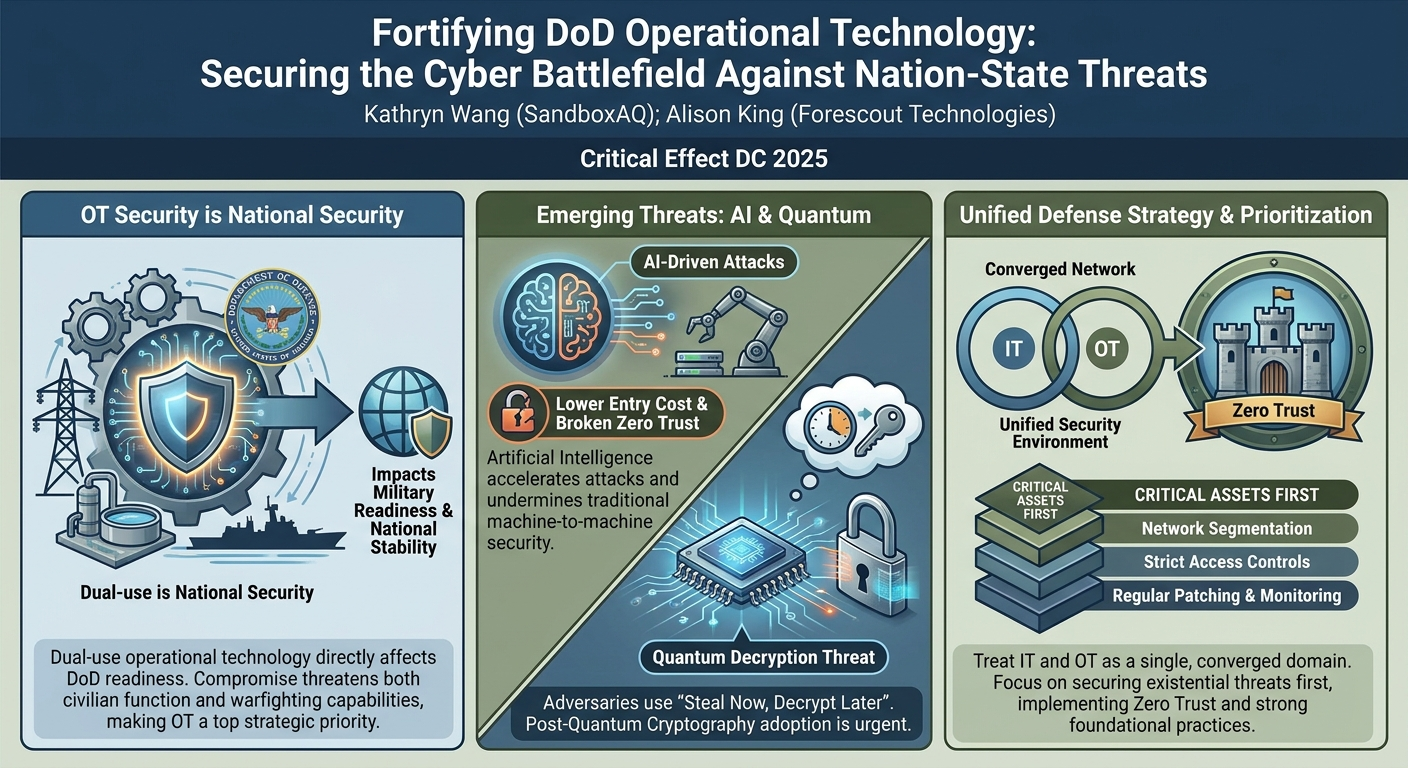
The talk revealed several critical findings that underscore the gravity of the OT security crisis and the urgent need for a paradigm shift in defensive strategies. First and foremost, OT security is not merely an industrial concern but an undeniable national security imperative. The interconnectedness of civilian critical infrastructure with military operational capabilities means that attacks on dual-use systems directly impair DoD readiness and resilience.
A significant finding is that the convergence layer between IT and OT represents a critical and often neglected attack surface. Adversaries are actively exploiting the seams between these historically disparate domains. The speakers emphasized the need to view IT and OT as a singular, unified entity for security purposes, recognizing that a compromise in one can rapidly cascade into the other.
The most alarming finding concerns the profound impact of Artificial Intelligence (AI) and Quantum computing as existential threat multipliers. AI, now embedded in nearly every vendor solution, has lowered the cost of entry for adversaries, enabling sophisticated attacks at a fraction of the cost of traditional methods. For instance, an agentic AI can crack systems for as little as $14, compared to the $14,000 average cost of an American insider threat. Crucially, AI-driven machine-to-machine (M2M) connections often operate outside traditional Zero Trust principles, creating unfettered access points that widen the threat landscape considerably.
Regarding quantum, while fully capable quantum computers are estimated to be 5 to 20 years away, the threat is immediate. Adversaries are already engaging in "steal now, decrypt later" tactics, exfiltrating encrypted high-value assets today with the intent of decrypting them once quantum computational power becomes available. This highlights the severe cryptographic debt within existing infrastructures, where the location of high-value assets and the cryptographic methods protecting them are often unknown or outdated. The NSM-10 OM memo 23-02 specifically calls for identifying cryptography on high-value assets, underscoring this urgency.
The talk identified common intrusion vectors that exploit these systemic weaknesses. Service accounts, often overlooked, have been pivotal in major breaches, such as the Target breach via an HVAC system or the SolarWinds attack. Similarly, unsecured IoT devices provide easy entry points, exemplified by the MGM hack initiated through a fish tank thermostat connected to the internet. Other common vectors include bots and container workloads, demonstrating a broad spectrum of opportunistic and targeted attacks.
Finally, a key finding is that a comprehensive, prioritized approach is essential. The sheer scale of vulnerabilities means that "boiling the ocean" is impractical. Instead, organizations must identify and secure their most critical assets first, focusing on those that pose an existential threat to national security, warfighting advantage, or business continuity. This prioritization, combined with aggressive policy advocacy, international collaboration, and fundamental security practices, forms the bedrock of a resilient defense strategy.
Technical Deep Dive
▶ Watch: Actionable Strategies for Fortifying OT Security (14:00)
The technical exposition of the talk highlighted the intricate vulnerabilities pervasive in DoD OT environments, exacerbated by historical oversight and emerging technologies. At the heart of the problem lies extensive technical debt, manifesting as legacy systems with unsupported hardware and firmware. Much of this infrastructure, built as far back as 2008, was designed for a 10-year operational life but remains in commission for over 50 years, creating inherently brittle environments susceptible to modern attacks. This outdated foundation often lacks the resilience and security features required for contemporary threats.
Compounding this is severe cryptographic debt. Many high-value assets lack centralized key management or adequate encryption, leaving data vulnerable during lateral movement and exfiltration. A significant portion of this sensitive data is not only unencrypted but its very location within the vast DoD network remains unknown. This provides adversaries with an open invitation to steal data today, knowing that they can decrypt it at a later date.
Artificial Intelligence (AI) was identified as a critical threat multiplier that fundamentally redefines the security landscape. AI-driven tools enable adversaries to significantly lower the cost and increase the speed of attacks. Traditional Zero Trust principles, designed for human-centric access, are being broken by the proliferation of machine-to-machine (M2M) connections that often operate with unfettered access and without stringent identity verification. This creates new, wide-open threat vectors that existing security architectures are ill-equipped to handle. The talk underscored that while AI is crucial for innovation, its integration demands immediate and ubiquitous security requirements for both human and non-human identities.
The looming threat of quantum computing transforms cryptographic debt into an immediate crisis. While general-purpose quantum computers capable of breaking current encryption are estimated to be 5 to 20 years away, the "steal now, decrypt later" strategy means that data exfiltrated today can be stored indefinitely and decrypted in the future. To counteract this, the adoption of Post-Quantum Cryptography (PQC) is imperative. The speakers described a "double wrap burrito" method, where existing cryptographic protections are augmented with PQC ciphers, such as lattice-based ciphers, to provide enhanced resilience against future quantum attacks. The NSM-10 OM memo 23-02 is a direct response to this, mandating the identification of all cryptography on high-value assets to prepare for this transition.
Specific technical vulnerabilities and attack methods were detailed:
- Service accounts: Often privileged and poorly managed, these accounts have been exploited in high-profile breaches, such as the Target breach (via an HVAC system) and SolarWinds.
- IoT devices: The proliferation of internet-connected operational devices, sometimes with obscure functions like a fish tank thermostat, can serve as an initial access vector, as demonstrated in the MGM hack.
- Bots and container workloads: These are increasingly used for automated intrusion, lateral movement, and data exfiltration, leveraging the inherent complexities and misconfigurations of modern cloud-native environments.
In terms of defensive strategies, the talk advocated for several technical implementations:
- Zero Trust Architecture: Re-emphasizing its importance, adapted to include non-human identities and M2M communications.
- Network Segmentation: A foundational practice to contain breaches and prevent lateral movement, ensuring that a compromise in one segment does not grant adversaries "keys to the kingdom."
- Access Controls: Strict enforcement of least privilege and continuous verification for all entities.
- Regular Patching: Despite operational constraints, a non-negotiable requirement for reducing known vulnerabilities.
- Continuous Monitoring and Detection: Beyond simply looking for anomalies, this involves identifying and analyzing "noise" in the network to detect subtle indicators of compromise.
Policy instruments like the Cyber Security Maturity Model Certification (CMMC) were discussed as evolving mechanisms, though currently focused more on compliance ("you're lying to us") than on robust nation-state threat protection. The Comply to Connect program, a DoD initiative with over $100 million invested, was presented as a valuable framework that could be scaled to include OT, particularly for international allies. Furthermore, extending the Cyber Operational Readiness Assessment (KORA) to encompass OT was proposed as a powerful motivator for DoD base commanders, linking security posture directly to operational funding. These technical and policy measures collectively aim to address the multifaceted challenges of securing DoD OT.
Demo / Proof of Concept
▶ Watch: Policy & Advocacy: Integrating OT into DoD standards (16:00)
The speakers explicitly stated that due to the sensitive nature of the topic, a live demonstration or proof of concept would not be provided. Kathryn Wang noted, "I can't show you, but I can tell you," underscoring the focus on conveying critical information and strategic implications rather than showcasing technical exploits or defensive tools in action.
Defensive Implications
▶ Watch: Q&A: The critical need for cyber-informed workforce (28:30)
The detailed analysis of OT vulnerabilities provided a clear roadmap for defenders, emphasizing a multi-faceted approach encompassing technical, policy, and cultural shifts.
Prioritization and Focus: The first and most critical implication is to stop trying to "boil the ocean." Defenders must meticulously identify their most critical assets and prioritize securing them based on their potential impact on national security, warfighting advantage, or business continuity. This strategic focus ensures that limited resources are allocated effectively to mitigate existential threats first.
Unified Security Architecture: The convergence of IT and OT demands a unified security strategy. Defenders must treat the entire converged network as a single entity, ensuring that Zero Trust principles and secure-by-design methodologies are applied ubiquitously across all new access instances, whether human or machine. This includes mandating Multi-Factor Authentication (MFA) for all accounts.
Supply Chain Resilience: The prevalence of pre-loaded malware necessitates aggressive supply chain security. Implementing Software Bill of Materials (SBOM) requirements and holding third-party vendors accountable for their security posture are crucial steps to prevent compromised components from entering critical infrastructure.
Leveraging Incentives and Policy: Defenders should actively advocate for and leverage policy changes. The inclusion of OT in frameworks like CMMC and other standardization criteria will drive broader adoption of security best practices. Furthermore, demonstrating robust security resilience can be used as a negotiating point for cyber insurance, potentially buying down premiums and incentivizing investment in security.
Information Sharing and Collaboration: Overcoming the reluctance to share threat intelligence is paramount. Adversaries thrive on siloes, while collective data and shared insights can significantly enhance defensive capabilities across the entire ecosystem, even among competitors. This collaborative approach is vital for staying ahead of rapidly evolving threats.
International Modernization: For international partners, particularly within NATO, there's a strong call to action to modernize cyber investments. The push for NATO members to increase GDP investment from 2% to 5% must prioritize cyber security for critical infrastructure supporting military missions. Leveraging existing U.S. investments, such as the Comply to Connect program (over $100 million invested), can provide allies with scalable OT security solutions, especially for shared bases.
DoD-Specific Actions: Within the DoD, extending the Cyber Operational Readiness Assessment (KORA) to include OT is a tangible and actionable step. By tying KORA compliance to operational funding, it creates a powerful incentive for base commanders to prioritize and invest in OT security, driving competition and innovation in solution development.
Fundamental Security Practices: The talk reinforced several foundational technical controls:
- Network Segmentation: Isolate critical OT networks to contain potential breaches and prevent lateral movement.
- Access Controls: Implement stringent controls based on Zero Trust principles, continuously verifying identity and authorization.
- Regular Patching: Establish robust patching regimes, even for brittle OT environments, to address known vulnerabilities.
- Continuous Monitoring and Detection: Deploy advanced monitoring capabilities to detect anomalies and subtle indicators of compromise within OT environments.
Proactive Quantum Defense: The "steal now, decrypt later" threat demands immediate action on Post-Quantum Cryptography (PQC). Defenders must conduct a comprehensive MRI of their infrastructure to identify high-value assets and their current cryptographic protections, then implement "double wrap burrito" encryption strategies using PQC ciphers to protect data from future quantum decryption.
Workforce Development: A critical long-term implication is the need for comprehensive cyber-informed engineering education. Integrating cybersecurity into all engineering curricula, from undergraduate to post-graduate levels, is essential. Additionally, raising awareness among SVPs of operations about the direct link between OT security and uptime, rather than just abstract firewall concepts, will drive executive buy-in and resource allocation. At a societal level, early education on media literacy and cyber safety for children is crucial to build a cyber-aware populace.
Ultimately, these defensive implications coalesce into a strategy of continuous improvement, aggressive policy advocacy, and foundational technical hygiene, all aimed at building resilience against a rapidly evolving and increasingly dangerous threat landscape.
Key Takeaways
- OT Security is National Security: The security of Operational Technology, particularly dual-use infrastructure, directly impacts DoD readiness and national stability, making it a critical focus area.
- AI and Quantum are Immediate Threats: AI significantly lowers the barrier to entry for adversaries and breaks traditional Zero Trust models for machine-to-machine connections, while quantum computing necessitates immediate adoption of Post-Quantum Cryptography to prevent "steal now, decrypt later" attacks.
- Technical and Cryptographic Debt is Pervasive: Decades of legacy systems, unpatched hardware, and a lack of centralized key management create vast attack surfaces readily exploited by nation-state actors.
- Prioritized and Unified Defense is Essential: Organizations must identify and secure their most critical assets first, treating IT and OT as a single, converged environment for security planning and implementation.
- Collaboration and Policy Reform are Crucial: Information sharing among entities and aggressive policy advocacy (e.g., including OT in CMMC, extending KORA) are vital to build collective resilience and incentivize security investments.
- Foundational Practices and Workforce Development: Implementing network segmentation, robust access controls, regular patching, continuous monitoring, and fostering cyber-informed engineering education are non-negotiable for long-term defense.
About the Speaker(s)
Kathryn Wang serves as the Principal of the Public Sector Team within SandboxAQ. Her work focuses on the strategic intersection of Artificial Intelligence (AI) and quantum technology, specifically as it pertains to operational technology vulnerabilities and national security. Wang's expertise lies in identifying emerging threats and translating complex technological challenges into tangible, actionable strategies for government and public sector entities.
Alison King is the VP of Government Affairs at Forescout Technologies, a company with over 25 years of experience in network visibility, control, and automated compliance. King is a prominent advocate for policy changes related to OT security, working to ensure that critical infrastructure protection is prioritized in legislative and regulatory frameworks. Her insights often bridge the gap between technical cybersecurity challenges and their broader policy implications, particularly within the defense industrial base (DIB) and international alliance contexts.
Reviews
Dr. Zero (Offensive Security Researcher) — WEAK
Two vendors stood on stage to tell us Stuxnet was bad, Target's HVAC got hacked a decade ago, and quantum computers might eventually break RSA. It’s a thinly veiled pitch for SandboxAQ's crypto-agility wrappers and Forescout's network visibility, dressed up in DoD policy acronyms. If you need to be told in 2025 that OT is brittle and default credentials are bad, you shouldn't be running critical infrastructure.
Heather Calloway (CISO) — SOLID
Wang and King deliver a clear-eyed assessment of operational technology risk, moving past localized anecdotes to focus on systemic institutional failure. They correctly identify that securing legacy OT requires policy and funding levers, not just new tools. Worth the time for any leadership team overseeing manufacturing, logistics, or defense supply chains.