The Volt-Bolt: UnDisruptable27 and the work to be done over the next 18 months
Joshua Corman (Institute for Security and Technology)
Critical Effect DC 2025 · Day 1 · Track II: Strategic Effect
Overview
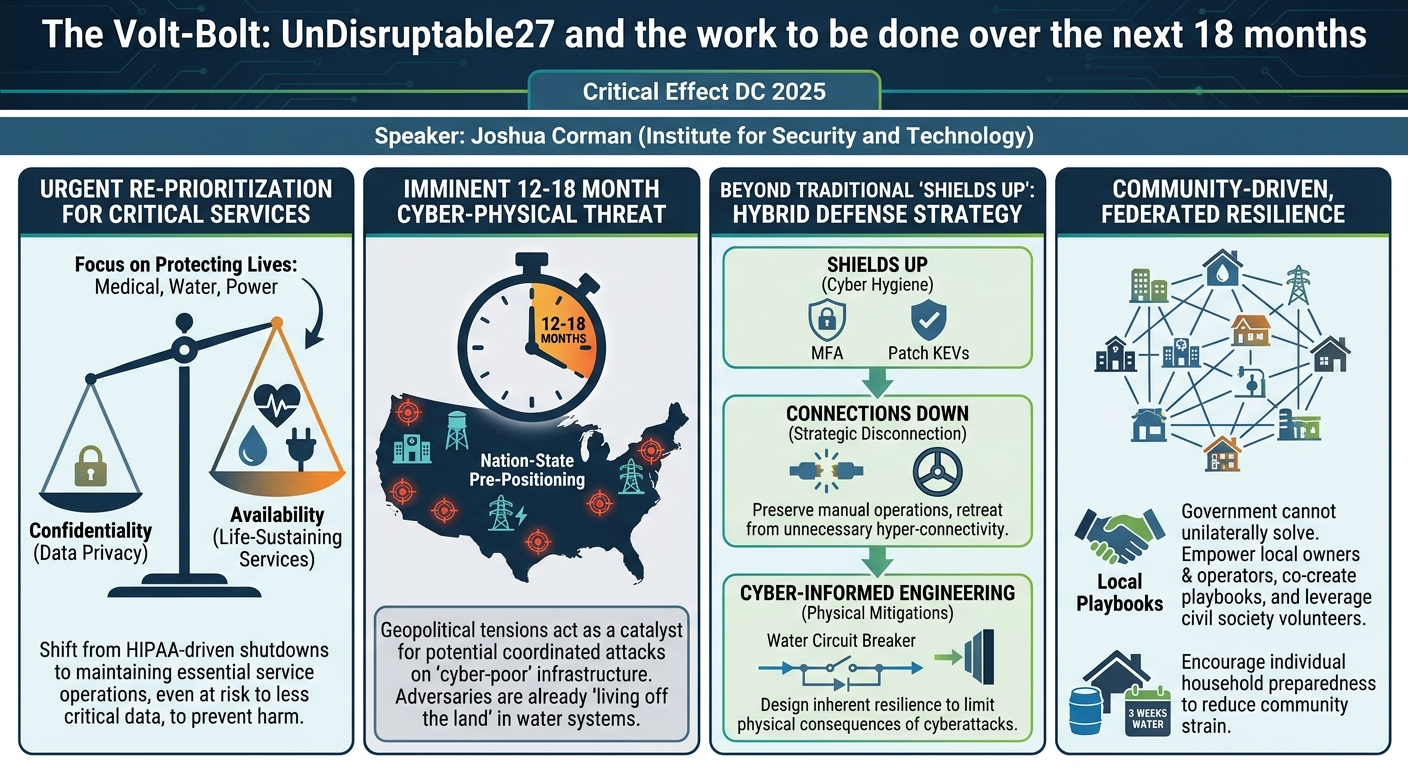
Joshua Corman's talk, "The Volt-Bolt: UnDisruptable27 and the work to be done over the next 18 months," delivers an urgent and stark warning: the United States faces an imminent and existential cyber-physical threat to its critical infrastructure, particularly water and healthcare, within the next 12 to 18 months. Corman, a prominent voice in cybersecurity and critical infrastructure, argues that current defense strategies and priorities are dangerously misaligned, focusing on corporate assets and data confidentiality while neglecting the availability of life-sustaining services, often with fatal consequences. The "Volt-Bolt" metaphor encapsulates the rapid, decisive action required, emphasizing that the time for incremental change has passed.
Key moments
- 0:00 Introduction: Prioritizing life over data confidentiality
- 2:00 Prioritizing critical functions with Maslow's hierarchy
- 3:30 Quantifiable harm: Ransomware deaths and hospital closures
- 11:30 The 2027 threat: Why critical infrastructure is vulnerable
- 17:00 Rethinking defense: Connections down or physical mitigations
- 20:00 Hard choices: Prioritizing water for critical medical facilities
- 22:00 Ransomware's financial revolution and the 'cyber poverty line'
- 29:00 Call to action: Individual and community resilience
The Volt-Bolt: UnDisruptable27 and the work to be done over the next 18 months
Speakers: Joshua Corman (Institute for Security and Technology)
Conference: Critical Effect DC 2025
YouTube: https://www.youtube.com/watch?v=9inpHQ70uo8
Overview
Joshua Corman's talk, "The Volt-Bolt: UnDisruptable27 and the work to be done over the next 18 months," delivers an urgent and stark warning: the United States faces an imminent and existential cyber-physical threat to its critical infrastructure, particularly water and healthcare, within the next 12 to 18 months. Corman, a prominent voice in cybersecurity and critical infrastructure, argues that current defense strategies and priorities are dangerously misaligned, focusing on corporate assets and data confidentiality while neglecting the availability of life-sustaining services, often with fatal consequences. The "Volt-Bolt" metaphor encapsulates the rapid, decisive action required, emphasizing that the time for incremental change has passed.
The talk serves as a clarion call to action for the cybersecurity community, urging a fundamental shift in mindset from protecting corporate interests to safeguarding human lives and community resilience. Corman highlights the vulnerability of "cyber-poor" critical infrastructure entities—small, rural, and under-resourced organizations that form the backbone of essential services but lack the means to defend against sophisticated nation-state attacks. He posits that traditional "shields up" cyber defenses are insufficient, advocating for a multi-pronged approach that includes strategic disconnections, physical mitigations, and a federated, community-driven defense model.
Corman's presentation at Critical Effect DC 2025 is more than a technical exposition; it's a moral imperative, challenging the audience to re-evaluate their professional priorities in the face of a looming national crisis. By dissecting the systemic failures in current policy, economic incentives, and defense paradigms, he lays bare the collective vulnerability and outlines a path forward that relies on empathy, grassroots innovation, and a profound re-prioritization of what truly matters when lives are on the line. The urgency is underscored by intelligence community assessments pointing to a critical window of vulnerability tied to geopolitical events, demanding immediate and decisive action from all stakeholders, from individual citizens to federal agencies.
Background
▶ Watch: Introduction: Prioritizing life over data confidentiality (0:00)
The premise of Corman's talk is rooted in a critical re-evaluation of cybersecurity priorities, challenging the long-standing industry focus on data confidentiality over service availability. He illustrates this cognitive dissonance with a series of thought experiments, asking audiences to weigh the importance of PCI data versus protected health information (PHI), or intellectual property versus life-saving medical care. The intuitive response—that life and timely access to care are paramount—stands in stark contrast to the industry's historical emphasis, particularly at large corporate-focused conferences like RSA. Corman provocatively states that HIPAA, while well-intentioned for privacy, "kills people" when its strictures lead hospitals to shut down operations in an "abundance of caution" during a breach, thereby introducing an availability attack that jeopardizes patient outcomes.
This misprioritization has tangible, tragic consequences. Corman references CISA's work, including statistical proof of excess deaths (2, 4, and 6 weeks post-incident) in communities affected by hospital ransomware attacks. Qualitative analysis, such as the Wall Street Journal's front-page story on an infant's death in Alabama due to lack of access to imaging and critical NICU devices during a ransomware event, further underscores the human cost. Beyond direct impacts, the "blast radius" effect, demonstrated by incidents like the Scripps Institute in San Diego, shows how ransomware can overwhelm neighboring hospitals, leading to increased wait times and worsened outcomes across an entire region. Financially, ransomware can be catastrophic; most small to medium-sized rural hospitals only have 4-6 weeks of cash flow, and an attack exceeding this duration can lead to permanent closure, with over 1,000 US hospitals having closed since 2015, many due to financial insolvency exacerbated by cyber incidents.
Corman extends this re-prioritization to National Critical Functions (NCFs), a list of 55 essential functions identified by CISA. He argues that these need to be stratified not just by their general importance, but by their latency tolerance—how long a society can endure their absence before civil unrest and widespread harm ensue. He identifies about a dozen NCFs, such as providing drinking water, medical care, and electricity, that have a downtime tolerance of 48 hours or less. These functions are not only atomically important but also deeply interdependent; the disruption of one can cascade, affecting others, including the critical infrastructure workforce itself, as seen in the Jackson, Mississippi water crisis during the pandemic.
The urgency of Corman's message is amplified by a looming geopolitical threat. He cites intelligence community consensus, particularly from January 31, 2024, hearings with leaders like NSA's General Nakasone, FBI's Christopher Wray, ONCD's Harry Coker, and CISA's Jen Easterly, pointing to a critical 12-18 month window of vulnerability. This timeline is linked to potential Chinese aggression toward Taiwan in 2027, with the expectation that China would conduct retaliatory cyberattacks on US critical infrastructure to deter intervention. Corman notes that Chinese actors are already "living off the land" within US water systems, indicating pre-positioning for future attacks. Other nation-state actors, such as Iran's Cyber Avengers targeting Unitronics PLCs in US water facilities (e.g., Pennsylvania) with defacements, and Russia's cyber army overflowing tanks in Texas, demonstrate the existing capabilities and willingness of adversaries to disrupt these vital services.
A significant barrier to defense is the reality that 85% of US critical infrastructure is privately owned and operated, and a large portion of this comprises "target-rich, cyber-poor" entities. These organizations often operate "below the cybersecurity poverty line," lacking the budget, expertise, and participation in public-private partnerships necessary for robust defense. They are often price-fixed, making it impossible to fund adequate security. Furthermore, Corman cautions against relying on traditional safety nets: government agencies like CISA primarily "inform and advise," Congress moves too slowly, insurance policies often exclude "acts of war" and lack concurrent capacity for widespread attacks, and peacetime mutual aid systems cannot scale to an "everything everywhere all at once" scenario. This confluence of misprioritized defenses, imminent threats, and systemic vulnerabilities creates the "Volt-Bolt" situation, demanding a radical shift in approach.
Key Findings
▶ Watch: Quantifiable harm: Ransomware deaths and hospital closures (3:30)
The central thesis of Corman's "Volt-Bolt" talk revolves around several critical findings that challenge conventional cybersecurity wisdom and demand immediate action:
- Re-prioritization of Availability Over Confidentiality for Life-Sustaining Services: The most profound finding is the urgent need to fundamentally re-prioritize cybersecurity efforts. For critical infrastructure directly impacting human life—such as water, medical care, food, and electricity—the availability of service must take precedence over data confidentiality. Corman forcefully argues that the current emphasis, often driven by regulations like HIPAA, can lead to operational shutdowns that directly cause illness, injury, and death. This isn't about abandoning privacy, but ensuring people are "alive to enjoy it."
- Imminent and Existential Cyber-Physical Threat: Corman highlights a consensus among US intelligence and security leaders regarding a looming, severe cyber-physical threat to critical infrastructure within the next 12 to 18 months. This threat is directly tied to geopolitical tensions, particularly the potential for China to retaliate against US intervention in a Taiwan conflict by targeting US infrastructure. The presence of Chinese actors "living off the land" in US water systems underscores the immediacy and seriousness of this pre-positioning.
- Systemic Vulnerability of the "Cyber-Poor": A vast segment of US critical infrastructure—predominantly privately owned and operated—exists "below the cybersecurity poverty line." These "target-rich, cyber-poor" entities, including small, rural water utilities and hospitals, lack the financial resources, technical expertise, and operational capacity to defend against sophisticated nation-state adversaries. This collective vulnerability represents a critical national security gap that cannot be addressed by traditional, top-down approaches.
- Beyond "Shields Up": Embracing Connections Down and Cyber-Informed Engineering: Corman argues that simply "cyber-ing up" (e.g., implementing MFA, patching Known Exploited Vulnerabilities (KEVs), securing internet-facing assets) is necessary but insufficient. Effective defense must incorporate additional strategies:
- Connections Down: The strategic option to retreat from hyper-connectivity, preserve manual operational capabilities, and disconnect systems that cannot be adequately protected.
- Physical Mitigations / Cyber-Informed Engineering (CIE): Employing engineering solutions to drive down the consequences of a successful cyberattack, even if the likelihood of compromise cannot be eliminated. This includes concepts like "water circuit breakers" or designing systems with inherent physical resilience.
- The Imperative for Federated, Community-Led Defense: Given the limited time, budget, and scale of the problem, Corman concludes that government and traditional institutions cannot unilaterally solve this crisis. Instead, a federated, community-driven approach is essential. This involves empowering local owners and operators, meeting them with empathy, co-creating localized playbooks, and leveraging civil society and volunteer efforts to build resilience from the ground up. This "innovate narrowly, replicate widely" strategy is crucial for scaling effective defenses.
These findings collectively paint a grim but actionable picture, demanding a radical re-thinking of how the nation approaches critical infrastructure security.
Technical Deep Dive
▶ Watch: Rethinking defense: Connections down or physical mitigations (17:00)
Corman's talk delves into specific technical vulnerabilities and defensive strategies, moving beyond abstract concepts to concrete examples and proposed solutions. At the core of the problem is the misapplication of cybersecurity priorities, where data confidentiality often overshadows service availability for critical systems. He highlights that while CISA identifies 55 National Critical Functions (NCFs), a more granular analysis using Maslow's hierarchy of needs and latency tolerance reveals about a dozen functions (e.g., provide drinking water, provide electricity, provide medical care) that have a downtime tolerance of 48 hours or less. These functions are not only individually vital but also intricately interdependent; disruption in one can cripple others, such as a water outage preventing a hospital from providing care.
Ransomware attacks, often perceived as data breaches, are fundamentally availability attacks in critical infrastructure. Corman cites CISA's work, which provided the first statistical proof of loss of life, showing excess deaths 2, 4, and 6 weeks after ransomware incidents in healthcare. Beyond direct impact, the "overflow blast radius" phenomenon means that even un-hit hospitals experience increased wait times and worsened outcomes when nearby facilities are compromised. This underscores the systemic, regional nature of the threat.
Water infrastructure is a primary focus of the "Volt-Bolt" initiative due to its extreme vulnerability and criticality. Corman explains that these systems are susceptible to physical damage induced by cyber means, specifically mentioning water hammers. A water hammer is a pressure surge or wave caused when a fluid in motion is forced to stop or change direction suddenly. While small-scale water hammers are common in household plumbing, cyber-induced, sudden over- or under-pressurization of large 12-inch, 24-inch, or 36-inch water mains can cause catastrophic pipe bursts, leading to widespread water outages. This concern emerged directly from empathetic engagement with plant operators and professional engineers.
The exposure of water systems is alarmingly high. Corman references a recent SANS publication by Silus Cutler (Census), which identified 400 water facilities with unauthenticated direct access to their cyber-physical controls on the internet. This direct exposure allows adversaries to manipulate systems without even needing to bypass traditional network defenses. Real-world incidents further illustrate this:
- Iran's Cyber Avengers group targeted Israeli-made Unitronics PLCs in several US states, including Pennsylvania, defacing them and demonstrating the ability to reach and manipulate these devices. While the payload was defacement, the capability for more destructive actions was evident.
- The "cyber army of Russia" was implicated in overflowing tanks in Texas, another example of direct manipulation of water infrastructure.
A terrifying technical trend Corman highlights is the increasing prevalence of modern industrial control systems (ICS) that lack manual overrides. He describes new pumps, for example, that are entirely computer-driven and internet-connected, with "no wheel on them" to manually turn them on or off. This removes a crucial fallback mechanism that historically provided resilience against cyber failures, making systems entirely dependent on their digital controls.
For "cyber-poor" entities, Corman advocates for CISA's "Bad Practices" initiative. Instead of overwhelming them with exhaustive "best practices," CISA focused on three critical, easily understandable vulnerabilities:
- Use of unsupported, end-of-life operating systems in critical infrastructure, especially when internet-facing.
- Use of known, fixed hard-coded passwords.
- Direct internet exposure of assets (e.g., "Get your stuff off search. Your assets are showing" – a reference to tools like Shodan).
Additionally, Corman emphasizes focusing remediation efforts on Known Exploited Vulnerabilities (KEVs), a targeted approach to patching that prioritizes threats actively being leveraged by adversaries.
The proposed solution often leans towards Consequence-Informed Engineering (CIE), a concept from Idaho National Labs (INL). While "cyber up" strategies aim to reduce the likelihood of a hack (e.g., MFA, patching), CIE focuses on driving down the consequences if a hack occurs. This means designing physical systems with inherent resilience, such as implementing "water circuit breakers"—physical mechanisms that can halt or reroute water flow to prevent catastrophic damage or ensure continuity to critical points (like a trauma center) in the event of a cyberattack. These engineering solutions are deemed more feasible within the 12-18 month timeframe than a complete overhaul of cyber defenses for thousands of under-resourced entities.
Finally, Corman stresses the complexity of restoration, particularly for interdependent systems. In a widespread attack, decisions about which facilities to restore first (e.g., a dialysis center versus a trauma center, or a county with a single hospital versus one with three) become incredibly difficult equity conversations that must be made at regional or state levels, and crucially, before an attack. This necessitates pre-defined playbooks and regional coordination that currently largely do not exist.
Demo / Proof of Concept
▶ Watch: Hard choices: Prioritizing water for critical medical facilities (20:00)
During the presentation, the speaker referenced several videos demonstrating the impact of infrastructure outages, including a healthcare scenario highlighting the rapid onset of adverse outcomes (e.g., 4.4 minutes for heart-related issues, 1-3 hours for stroke) when timely care is unavailable. He also mentioned a "hammer time" video, illustrating the destructive potential of water hammers caused by sudden pressure changes in water mains. Due to time constraints, these videos were not played during the live presentation but were described and linked in event materials. The qualitative and quantitative analysis of ransomware's impact on communities, including the statistical proof of excess deaths and the detailed account of the infant's death in Alabama, served as powerful anecdotal evidence of the real-world consequences being addressed.
Defensive Implications
▶ Watch: Call to action: Individual and community resilience (29:00)
Corman's talk outlines a urgent and multi-faceted defensive strategy, moving beyond the traditional "shields up" approach to address the unique challenges of the "Volt-Bolt" timeframe and the "cyber-poor" landscape. The core defensive implications are:
- Re-prioritize for Availability: Defenders must fundamentally shift their focus from solely protecting data confidentiality to ensuring the availability of life-sustaining services. This means re-evaluating security investments and operational procedures to minimize downtime for water, medical care, and electricity, even if it means accepting a higher risk to less critical data. The lesson from HIPAA's unintended consequences is clear: an "abundance of caution" leading to shutdowns can cost lives.
- Embrace Hybrid Defense Strategies: No single approach will suffice. Defenders need to integrate three key pillars:
- Shields Up (Cyber Up): Continue to implement essential cyber hygiene. This includes turning on multi-factor authentication (MFA), patching Known Exploited Vulnerabilities (KEVs), and securing internet-facing assets. CISA's "Bad Practices" (unsupported OS, hard-coded passwords, internet exposure) provide a targeted starting point for under-resourced entities.
- Connections Down: Strategically evaluate and implement disconnections. For systems that cannot be adequately protected, especially those recently connected, consider retreating from hyper-connectivity. Crucially, preserve and train for manual operations capabilities, ensuring that critical functions can still run without computer control, especially for modern pumps that might lack physical overrides.
- Physical Mitigations / Cyber-Informed Engineering (CIE): This is paramount for driving down consequences. Implement engineering solutions like "water circuit breakers" that can physically isolate or reroute water flow to prevent catastrophic damage or maintain service to critical facilities (e.g., trauma centers) during an attack. This approach acknowledges that some cyberattacks may succeed, but the physical impact can be controlled.
- Proactive Regional Planning for Restoration: Decisions about which critical services to restore first during a widespread outage are ethically complex and must be made before an attack. Regional, county, and state-level planning is essential to define priorities for facilities like dialysis centers versus trauma centers, or single-hospital towns versus multi-hospital cities. This involves hard equity conversations to avoid being "blindsided" during a crisis.
- Community-Led, Federated Resilience: The government cannot save everyone. Defenders, particularly in civil society and local communities, must step up. This involves:
- Meeting Owners and Operators Where They Are: Engage with critical infrastructure personnel using empathy, understanding their language, and co-creating solutions. The "Volt-Bolt" project aims to innovate narrowly with a dozen towns, capturing lessons, and replicating widely.
- Empowering Local Action: Provide tools and guidance for local communities to protect their own towns, leveraging initiatives like the Cyber Civil Defense Cyber Resilience Core. This includes understanding local Good Samaritan laws to ensure volunteer efforts are lawful and effective.
- Learning from Other Sectors: Collaborate with sectors like energy (e.g., Edison Electric Institute, NRCA) that have more mature public-private partnerships and CEO-level engagement.
- Individual Household Preparedness: Citizens have a role to play. Corman encourages individuals to ensure their households have at least three weeks of water resilience (e.g., life straws, water barrels, iodine tablets), mirroring recommendations from governments like the UK. This reduces the burden on community resources during a crisis.
- Advocate for Economic Alignment: The current economic incentives are "wrong," monetizing unavailability but not valuing the defense of the "cyber poor." Long-term, this implies the need for policy changes like software liability to shift the burden of security onto manufacturers and developers.
By adopting these integrated strategies, defenders can move towards building a more resilient critical infrastructure capable of "taking a punch" and minimizing losses in the challenging 12-18 month window ahead.
Key Takeaways
- Urgent Re-prioritization: The cybersecurity community must immediately re-prioritize the availability of life-sustaining critical infrastructure (water, medical care, electricity) over data confidentiality, recognizing that current approaches can lead to preventable deaths.
- Imminent Threat Window: The US faces a severe, nation-state-level cyber-physical threat to its critical infrastructure within the next 12-18 months, driven by escalating geopolitical tensions and demonstrated adversary pre-positioning.
- Vulnerability of the "Cyber-Poor": A vast segment of critical infrastructure is "target-rich, cyber-poor," lacking the resources and expertise for adequate defense, making them the most exposed and requiring a tailored, empathetic approach.
- Beyond Traditional Cyber Defenses: Effective resilience demands a multi-pronged strategy that integrates "shields up" (cyber hygiene like MFA, KEV patching) with strategic "connections down" (preserving manual operations, disconnecting vulnerable systems) and robust "cyber-informed engineering" (physical mitigations like "water circuit breakers").
- Federated, Community-Driven Action: Government and traditional institutions cannot solve this crisis alone. A grassroots, empathetic, and co-creative approach, empowering local owners, operators, and civil society volunteers, is essential for building scalable resilience.
- Proactive Planning and Individual Preparedness: Regional planning for service restoration priorities must occur before an attack, alongside encouraging individual citizens to build household resilience (e.g., three weeks of water supply) to reduce community strain.
About the Speaker(s)
Joshua Corman is a leading voice in cybersecurity and critical infrastructure resilience, currently affiliated with the Institute for Security and Technology. He has a distinguished career at the intersection of technology, policy, and national security, including a pivotal role at CISA (Cybersecurity and Infrastructure Security Agency) during the pandemic, where he contributed to publishing the first statistical proof of loss of life due to ransomware in healthcare. Corman is also a co-founder of the CyberMed Summit, an initiative dedicated to improving cybersecurity in healthcare. He is known for his work with The Cavalry, a grassroots organization he helped establish 13 years prior to this talk, advocating for the responsible disclosure of vulnerabilities and the security of connected devices. His expertise spans from technical vulnerabilities to the broader policy and economic incentives driving cybersecurity outcomes, consistently advocating for a focus on human safety and community well-being in the face of evolving threats.
Reviews
Dr. Zero (Offensive Security Researcher) — MUST SEE
Corman drops the technical theater and delivers a grim, intelligence-backed timeline for critical infrastructure collapse. It forces the industry to admit that zero-trust doesn't mean a damn thing if a hospital can't turn on a dialysis machine. A mandatory reality check for an industry addicted to data privacy over human survival.
Heather Calloway (CISO) — STRONG ACCEPT
Josh Corman delivers a stark warning about imminent cyber-physical threats to critical infrastructure, diagnosing our industry's fatal flaw: prioritizing data confidentiality over operational availability. This is required viewing for leadership teams managing physical footprints, regional supply chains, or OT environments.