Conveying the Looming Threat of Critical Infrastructure Hacking
Lily Hay Newman (WIRED), Andy Greenberg (WIRED), Derek Johnson (CyberScoop), Joshua Corman (Institute for Security and Technology)
Critical Effect DC 2025 · Day 2 · Track I: Critical Mass
Overview
This panel discussion, "Conveying the Looming Threat of Critical Infrastructure Hacking," at Critical Effect DC 2025, brought together prominent cybersecurity journalists and an expert to dissect the complex challenge of communicating the true peril of critical infrastructure (CI) cyberattacks to the public and policymakers. Moderated by Lily Hay Newman of WIRED, the panel featured her colleague Andy Greenberg (WIRED), Derek Johnson (CyberScoop), and Joshua Corman (Institute for Security and Technology). The core of their discussion revolved around how public understanding of cyber threats has evolved, why current communication strategies often fall short, and what approaches might more effectively catalyze action against these existential risks.
Conveying the Looming Threat of Critical Infrastructure Hacking
Speakers: Lily Hay Newman (WIRED); Andy Greenberg (WIRED); Derek Johnson (CyberScoop); Joshua Corman (Institute for Security and Technology)
Conference: Critical Effect DC 2025
YouTube: https://www.youtube.com/watch?v=tv0yHf_SGvU
Overview
This panel discussion, "Conveying the Looming Threat of Critical Infrastructure Hacking," at Critical Effect DC 2025, brought together prominent cybersecurity journalists and an expert to dissect the complex challenge of communicating the true peril of critical infrastructure (CI) cyberattacks to the public and policymakers. Moderated by Lily Hay Newman of WIRED, the panel featured her colleague Andy Greenberg (WIRED), Derek Johnson (CyberScoop), and Joshua Corman (Institute for Security and Technology). The core of their discussion revolved around how public understanding of cyber threats has evolved, why current communication strategies often fall short, and what approaches might more effectively catalyze action against these existential risks.
The talk highlighted a persistent disconnect between the escalating reality of state-sponsored cyber warfare and the public's ability to internalize these threats beyond abstract warnings or concerns about personal data. The panelists explored the historical trajectory of cyber reporting, from hypothetical "stunt hacks" to the current demand for tangible, real-world impacts, often necessitating a "if it bleeds, it leads" approach. The conversation underscored the critical need for clearer, more human-centric storytelling that transcends technical jargon and political navel-gazing, particularly as advanced persistent threats like Volt Typhoon continue to preposition in vital US systems.
This discussion is profoundly relevant because effective defense against critical infrastructure hacking hinges not just on technical solutions, but on public and political will, which in turn depends on accurate and impactful understanding of the threat landscape. The panelists collectively argued that overcoming public "numbness" and political "reactionary" tendencies requires a concerted effort to portray cyberattacks not as distant, theoretical events, but as direct threats to life, essential services, and national stability. Their insights offer a roadmap for journalists, policymakers, and security professionals to bridge this crucial communication gap and foster a more proactive defensive posture.
Background
The evolution of cybersecurity reporting and public perception forms a crucial backdrop to the panel's discussion. Andy Greenberg recalled a time, nearly two decades ago, when theoretical attacks, such as researcher stunts or Jeep hacks, were sufficient to capture public attention. The media then focused on "what could happen," painting scenarios of catastrophic events like power grid attacks. However, as cyber threats became more commonplace and real, the public grew "jaded" and "bloodthirsty," demanding stories of actual incidents with tangible victims. This shift forced journalists to dig deeper, often seeking out victims in places like Ukraine, which became a "canary in the coal mine" for sophisticated state-sponsored cyberattacks not yet seen elsewhere.
This demand for real-world impact collided with a significant communication failure, particularly at the government level. The panelists pointed to the Russian GRU's Sandworm attacks on Ukraine between 2014 and 2022, culminating in not one but two blackouts affecting civilians. Despite these being the "first ever cyberattack that caused a blackout," the Obama administration's "absolute crickets" in publicly attributing and condemning these acts stood in stark contrast to its vocal response to the Sony Pictures Entertainment hack or the Biden administration's naming of ransomware in 2021. This silence, the panelists argued, emboldened adversaries and contributed to a public perception that these "science fictional" threats weren't truly real, even when they were.
Joshua Corman introduced the concept of a "cognitive psychological barrier," where society moved from "ignorant or hopeful inaction" to "informed but numb inaction." He cited the example of ransomware attacks on hospitals, where peer-reviewed scientific literature demonstrated a clear link between tech disruption and loss of life, yet the public and even some policymakers still questioned if anyone had "died yet." This desensitization was further exacerbated by a history of hyperbole in the cybersecurity industry, with terms like "cyber 9/11" or "cyber Pearl Harbor" being overused to the point of losing meaning. Derek Johnson noted that policymaking is "notoriously reactionary," often requiring a "problem punch you in the face" like Colonial Pipeline to spur action, rather than proactive warnings. This historical context of unheeded warnings, public numbness, and political inertia sets the stage for the current struggle to convey the gravity of emergent threats like Volt Typhoon.
Key Findings
The panel identified several critical findings regarding the communication of critical infrastructure hacking threats:
- Public and Policy Understanding is Improving, but Lagging: While there's a higher baseline fluency in cyber concepts today than a decade ago, particularly in the "beltway" (DC policy circles), the depth of understanding among the general public and even some policymakers remains insufficient to spur proactive action.
- The "If It Bleeds, It Leads" Imperative: The audience for cyber news has evolved from being interested in theoretical vulnerabilities to demanding stories of real attacks with "real victims." This has raised the bar for reporting but also pushes journalists to find tangible human impacts.
- Government Attribution and Discourse are Pivotal: The public naming of threats by high-level officials (e.g., Biden on ransomware) significantly elevates the issue's prominence and perceived seriousness. Conversely, government silence on major incidents (e.g., Obama administration's response to Ukraine blackouts) can inadvertently downplay their significance and hinder public understanding.
- A "Cognitive Psychological Barrier" to Action: Even with clear evidence of harm, including statistical proof of loss of life from hospital cyberattacks, a psychological barrier prevents the public from internalizing the threat. This leads to "informed but numb inaction," where people acknowledge the danger but default to reassuring routines or assumptions of insurance/mutual aid.
- The "Looming Hypothetical" Problem: Threats like Volt Typhoon, which involve adversary prepositioning for future disruption, struggle to gain public traction because they haven't yet resulted in overt, disruptive attacks in the US. This places them back in the realm of "what could happen" stories, which the public has become jaded by.
- Espionage vs. Destructive Attacks: Espionage operations (e.g., Salt Typhoon, SolarWinds) often receive disproportionately more attention than destructive attacks (e.g., NotPetya), partly because they affect "powerful people" or political insiders, leading to more government hearings and media focus, despite destructive attacks having broader societal impact.
- Hyperbole Breeds Skepticism: Years of "crying wolf" with terms like "cyber 9/11" have eroded public trust and created skepticism towards legitimate warnings. This makes it harder for credible threats to penetrate public consciousness without being dismissed as "FUD" (Fear, Uncertainty, and Doubt).
- Ukraine as a Regulatory Model: Ukraine's experience with Russian cyberattacks has led to a more regulated critical infrastructure sector, which has proven more resilient. This suggests a contrast with the US's largely private sector-owned and less regulated CI, highlighting a potential area for policy reform.
Technical Deep Dive
While the panel discussion was primarily focused on communication and policy, it referenced several significant technical incidents and concepts that underpin the looming threat of critical infrastructure hacking. A key actor frequently mentioned was Sandworm, the notorious Russian GRU hacking group. Sandworm was responsible for unprecedented data-destroying cyberattacks against Ukraine, which notably culminated in two blackouts in December 2015 and 2016, directly impacting hundreds of thousands of civilians. These attacks demonstrated the capability of nation-state actors to leverage cyber means for physical disruption of Operational Technology (OT) systems controlling essential services like power grids.
The discussion also heavily featured NotPetya, a destructive supply chain attack unleashed by Sandworm in 2017. Although originating in Ukraine, NotPetya rapidly spread globally, causing an estimated $10 billion in damages. It crippled major international corporations, including shipping giants and pharmaceutical manufacturers like Merck in New Jersey, whose HPV vaccine production was severely disrupted. Critically, NotPetya also impacted hospital medical records across the United States, leading to incomplete patient data and jeopardizing care. This incident underscored how a cyberattack against one entity, particularly within a supply chain, can have cascading, far-reaching effects on diverse critical infrastructure sectors.
More recent incidents cited included Colonial Pipeline in 2021, a ransomware attack that disrupted fuel supplies in the US, and WannaCry, another widespread ransomware event. These domestic impacts served as stark examples of how cyberattacks can directly affect daily life and economic security. The panel also touched upon Volt Typhoon, a group of Chinese state-sponsored hackers currently prepositioning in US critical infrastructure. This involves gaining persistent access to networks, remaining undetected, and potentially laying the groundwork for future disruptive or destructive operations, with some intelligence estimates pointing to a potential culmination around 2027. This strategy, described by some as "setting cyber time bombs," represents a significant shift from traditional espionage to potential sabotage.
In contrast, Salt Typhoon was mentioned as a Chinese telecom hacking operation, primarily focused on espionage, targeting high-level political campaigns. The panel debated why espionage operations like Salt Typhoon or the SolarWinds supply chain attack (attributed to Russian hackers, primarily for espionage) often garnered more attention than destructive attacks like NotPetya. The argument was that the former often impacted "powerful people" or political insiders, while the latter, despite its massive economic and social cost, was viewed as a more distant, less personal threat by some. The discussion further broadened to include the compromise of water facilities by Iran's Cyber Avengers and overflow tanks in Texas by the Cyber Army of Russia, emphasizing the diverse array of adversaries and targets within critical infrastructure.
The role of data centers and the emerging concept of AI as critical infrastructure were also explored. The panelists acknowledged that as compute becomes more vital, especially with the rise of Large Language Models (LLMs), data centers represent a growing attack surface. Joshua Corman, however, noted that data centers are often better funded and more resilient due to their cloud-native, distributed architectures, making direct disruption more challenging than, for instance, a water facility. A poignant example of AI's indirect critical role came from the Nuance speech-to-text software used by hospitals. When Nuance, which had an office in Ukraine, was "completely wrecked" by NotPetya, it silently failed to transcribe doctors' notes into medical records, leading to incomplete patient histories across the US. This illustrated how seemingly innocuous productivity tools, especially those leveraging AI, can become single points of failure with life-threatening consequences when their underlying infrastructure is compromised. The conversation also highlighted the inadequacy of the US government's broad "16 critical infrastructure sectors" classification, advocating for a focus on more granular "national critical functions" or "lifeline functions" that, if disrupted for 24-48 hours, lead to immediate societal collapse.
Demo / Proof of Concept
This event was a panel discussion focused on communication strategies and public perception rather than a technical presentation. Therefore, no live demonstrations or proofs of concept were presented during the talk.
Defensive Implications
The panel discussion, while focused on communication, implicitly and explicitly outlined several crucial defensive implications for critical infrastructure. Foremost is the urgent need to transition from "informed but numb inaction" to proactive and decisive action. This requires a fundamental shift in how threats are perceived and prioritized.
A primary defensive strategy highlighted is effective communication. Defenders, policymakers, and journalists must move beyond technical jargon and hyperbole ("cyber 9/11") to focus on the human impact of cyberattacks. Stories should emphasize "who they hurt" and "the services they deny," making the consequences tangible and relatable to the public. This approach aims to break through the "cognitive psychological barrier" that prevents internalization of threats. Transparency about the true effects of attacks, including specific numbers of affected systems or individuals, can build credibility.
Government leadership in attribution and public messaging is also critical. When high-level officials clearly name adversaries and condemn their actions (e.g., Biden on ransomware), it elevates the issue and signals a serious response, potentially deterring future attacks and galvanizing domestic defensive efforts. Conversely, silence can be perceived as weakness or a downplaying of the threat.
Learning from international examples, particularly Ukraine, was strongly advocated. Ukraine's experience with persistent Russian cyberattacks has led to a more regulated critical infrastructure sector. The US, with its "almost completely private sector-owned critical infrastructure with very little government regulation," could benefit from exploring similar regulatory frameworks or incentives to ensure a baseline level of security across vital systems. The panel also emphasized that effective mitigations don't always require massive investment; some "simple mitigations" costing as little as $2,000 could prevent significant damage.
To overcome public skepticism stemming from past hyperbole, there's a need for forthright and credible storytelling. This involves avoiding exaggeration and focusing on factual accounts of what happened and its exact effects. Furthermore, the panel acknowledged the challenge of rewarding good actors and telling positive stories of prevention. While difficult to prove a negative, increased transparency from organizations about what went well, how they recovered, or what they prevented could build trust and provide valuable lessons. This requires executives to be "vulnerable with a reporter," which is a significant ask.
Finally, a more refined approach to risk stratification is essential. The current broad categorization of "16 critical infrastructure sectors" is often "too coarsely grained." Instead, focusing on "national critical functions" or "lifeline critical functions" (e.g., the "12 or so lifeline functions" mentioned) that, if disrupted, would cause immediate societal collapse, allows for more targeted and effective defensive investments. The panel also cautioned against the emerging topic of AI as critical infrastructure "sucking all the oxygen" out of crucial, foundational cyber hygiene problems that affect numerous critical infrastructure sectors.
Key Takeaways
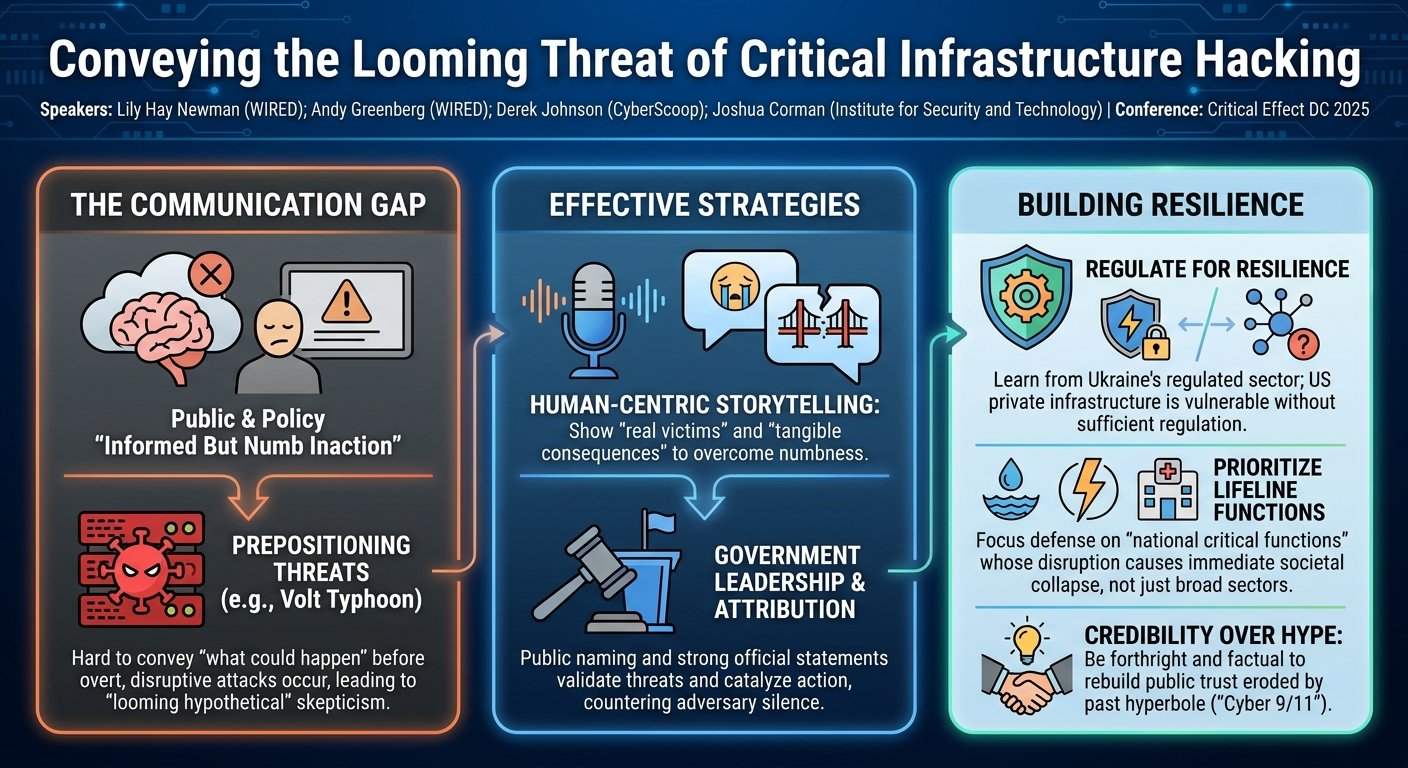
- Humanize the Threat: To overcome public numbness and political inertia, communication about critical infrastructure hacking must shift from abstract technical details and hyperbole to vivid, human-centric stories that highlight real victims and tangible consequences on daily life and essential services.
- Government Leadership Matters: Public attribution and strong statements from high-level government officials are crucial for raising awareness, legitimizing the threat, and catalyzing both public and private sector action against cyber adversaries.
- Beware the "Looming Hypothetical": Threats like Volt Typhoon, which involve adversary prepositioning for future disruption rather than immediate attacks, struggle to gain public and political traction. Effective communication strategies are needed to convey the urgency of these "silent" threats.
- Regulate for Resilience: The US can learn from Ukraine's experience, where a more regulated critical infrastructure sector has shown greater resilience against sophisticated cyberattacks. A largely private sector-owned and minimally regulated US critical infrastructure faces inherent vulnerabilities.
- Prioritize Lifeline Functions: Instead of broadly addressing 16 critical infrastructure sectors, defense efforts should prioritize "lifeline critical functions" – the essential services whose disruption for even 24-48 hours would lead to catastrophic societal breakdown.
- Credibility Over Hype: Years of "crying wolf" with exaggerated "cyber 9/11" rhetoric have eroded public trust. Future communication must be forthright, factual, and avoid sensationalism to rebuild credibility and ensure genuine warnings are taken seriously.
About the Speaker(s)
- Lily Hay Newman (WIRED): A prominent cybersecurity reporter for WIRED and the moderator of this panel. She focuses on the evolving landscape of cyber threats and how they are communicated to a broad audience, noting changes in audience interest over time.
- Andy Greenberg (WIRED): A senior writer for WIRED, known for his in-depth reporting on cybersecurity, including authoring the book "Sandworm." He specializes in uncovering real-world cyberattacks and their victims, particularly highlighting Ukraine's role as a "canary in the coal mine" for advanced state-sponsored hacking.
- Derek Johnson (CyberScoop): A reporter for CyberScoop, focusing on the intersection of cybersecurity and policy within the "beltway" (Washington D.C.). He tracks how federal agencies, Congress, and policymakers engage with cyber issues, including critical infrastructure and Operational Technology (OT) security.
- Joshua Corman (Institute for Security and Technology): A distinguished security expert who is not a journalist, Corman brings a perspective focused on frameworks, rubrics, and the psychological aspects of cybersecurity. He has extensively researched the cognitive barriers to understanding cyber risks, particularly the link between tech disruption and loss of life in healthcare, and advocates for a focus on national critical functions.
Reviews
Dr. Zero (Offensive Security Researcher) — SOLID
Three journalists and Josh Corman spending an hour discussing how hard it is to write about hacking. It's a competent meta-analysis of security communications and policy lag, but you aren't going to learn how to defend a single system here.
Heather Calloway (CISO) — SOLID
This media and policy panel diagnoses why the public and politicians ignore infrastructure threats until things physically break. It is a sharp look at the failure of cyber storytelling, but for security leaders, the real value lies in its regulatory forecasting and its argument for narrowing focus to core lifeline functions.