No Water, No Hospitals: Emergency Response Under Fire
Joshua Corman (Executive in Residence for Public Safety and Resilience · Institute for Security and Technology), Jonathan Horowitz (Deputy Head, Legal Department · International Committee of the Red Cross (ICRC)), Kevin Morley (Manager, Federal Relations · American Water Works Association (AWWA)), Blake Scott (Senior Public Health Emergency Preparedness Planner · Coconino County Health and Human Services), Jennifer Lyn Walker (Director of Infrastructure Cyber Defense · WaterISAC)
Critical Effect DC 2025 · Day 1 · Track I: Critical Mass
Overview
The "No Water, No Hospitals" panel at Critical Effect DC 2025 delivered a stark and urgent examination of the cascading failures that could cripple critical infrastructure, particularly the symbiotic relationship between water utilities and healthcare facilities, under the duress of cyber warfare or widespread disruption. Moderated by Joshua Corman, this discussion brought together diverse perspectives from public health emergency planning, international humanitarian law, and water sector cybersecurity and advocacy. The central premise, vividly framed by Corman, posits a future where a major disruption to water services directly renders hospitals inoperable, leading to devastating loss of life.
Key moments
- 0:00 Framing the 'no water, no hospitals' problem and its impacts
- 18:25 ICRC introduces International Humanitarian Law for cyber conflict
- 25:20 Water utilities' lack of awareness about being wartime targets
- 30:00 Local emergency management's use of NIMS for community lifelines
- 33:00 Challenging assumptions: Insurance, mutual aid, and 'act of war'
- 36:30 The crucial role of 'circuit riders' for technical assistance
- 42:00 ICRC's 'digital emblem' initiative to protect digital medical assets
- 44:20 Audience question: Funding for cybersecurity in disadvantaged water communities
No Water, No Hospitals: Emergency Response Under Fire
Speakers: Joshua Corman (Executive in Residence for Public Safety and Resilience, Institute for Security and Technology); Jonathan Horowitz (Deputy Head, Legal Department, International Committee of the Red Cross (ICRC)); Kevin Morley (Manager, Federal Relations, American Water Works Association (AWWA)); Blake Scott (Senior Public Health Emergency Preparedness Planner, Coconino County Health and Human Services); Jennifer Lyn Walker (Director of Infrastructure Cyber Defense, WaterISAC)
Conference: Critical Effect DC 2025
YouTube: https://www.youtube.com/watch?v=D72uNUdQ-ds
Overview
The "No Water, No Hospitals" panel at Critical Effect DC 2025 delivered a stark and urgent examination of the cascading failures that could cripple critical infrastructure, particularly the symbiotic relationship between water utilities and healthcare facilities, under the duress of cyber warfare or widespread disruption. Moderated by Joshua Corman, this discussion brought together diverse perspectives from public health emergency planning, international humanitarian law, and water sector cybersecurity and advocacy. The central premise, vividly framed by Corman, posits a future where a major disruption to water services directly renders hospitals inoperable, leading to devastating loss of life.
The talk underscored that the threat landscape has evolved beyond conventional criminal activity or espionage, now encompassing hybrid conflict and warfare where cyberattacks can have kinetic, life-threatening consequences. The panelists collectively highlighted the profound vulnerabilities inherent in the interconnectedness of modern critical infrastructure and the insufficient preparedness of many communities and utilities for such large-scale, cross-sector events. The discussion aimed not merely to present a dire scenario but to provoke immediate action, challenging long-held assumptions about resilience, insurance coverage, and mutual aid in the face of sophisticated nation-state adversaries.
The critical importance of this conversation stems from documented statistical proofs linking delayed or degraded access to care with worsened outcomes and elevated mortality rates. As Corman emphasized, even indirect impacts, where a hospital in a neighboring zip code is affected, can lead to a tenfold decrease in favorable outcomes for patients in adjacent communities. This talk served as a crucial call to action for defenders, policymakers, and industry stakeholders to proactively address these systemic vulnerabilities before a localized incident escalates into a catastrophic national crisis.
Background
▶ Watch: Framing the 'no water, no hospitals' problem and its impacts (0:00)
The premise for this urgent discussion is rooted in a growing body of evidence and real-world observations regarding the fragility of interconnected critical infrastructure. Joshua Corman opened by invoking the concept of a water hammer leading to cascading failures, a metaphor for how a single point of failure can propagate across essential services. Studies from Corman's work on CISA's COVID-19 task force provided the first statistical proof of loss of life directly attributable to delayed and degraded access to care. Specifically, a mere 4.4-minute longer ambulance ride was shown to affect heart survival rates after 30 days, while the "golden hour" for strokes could determine long-term mobility or survival.
Further peer-reviewed studies by Dr. Christian NEF and Jeff Tully, co-founders of CyberMed Summit, revealed a broader "blast radius" effect. Even if a hospital is not directly attacked, the overflow of patients to unaffected facilities can worsen outcomes for individuals in those communities, leading to a tenfold decrease in favorable outcomes for heart conditions. These disruptions, Corman noted, are irrespective of cause, whether a ransomware attack, power outage, or large-scale water disruption.
The historical context of water system vulnerabilities was also touched upon, with Kevin Morley of AWWA referencing a 1941 article in the Journal AWWA discussing the susceptibility of water systems to "saboteurs" during escalating global conflicts. This historical awareness, however, has not fully translated into modern preparedness for cyber warfare. The panel highlighted that the emergency management community predominantly views cyber incidents as "internal events" rather than widespread community disasters, leading to a critical gap in cross-sector planning and response. Furthermore, conventional assumptions about resilience, such as reliance on insurance or mutual assistance, were aggressively challenged, with Corman pointing out that acts of war and utility outages are often excluded from cyber insurance policies, rendering traditional safety nets ineffective in a major conflict scenario. The talk explicitly framed the discussion around a hypothetical "2027 plus or minus" scenario involving nation-state disruption, drawing parallels to incidents like the NotPetya attacks, which escaped their intended blast radius and caused $10 billion in damages globally, including $1 billion on U.S. soil.
Key Findings
▶ Watch: Water utilities' lack of awareness about being wartime targets (25:20)
The panel unveiled several critical findings regarding the state of cyber resilience in the water and healthcare sectors:
- Profound Interdependencies and Vulnerabilities: Hospitals are complex systems reliant on "stuff, staff, space, and services" (including water, power, and medical gas). A disruption to any of these, particularly water, can lead to immediate and severe consequences, as demonstrated by an internal water event at a small hospital in Blake Scott's jurisdiction, which took two days to relocate 30 patients. For larger facilities, this task becomes exponentially more challenging, with the nearest peer-level care potentially hours away.
- Cyber Poverty in the Water Sector: Despite 151,000 water facilities in the U.S. (with 6,000 supporting hospitals), participation in critical information-sharing organizations like the WaterISAC is extremely low (650 members, representing only 4% of facilities). Kevin Morley noted that while 73% of systems surveyed by AWWA now prioritize cybersecurity, 26% of small systems explicitly state they lack the capacity to address it. Many are target-rich, cyber-poor, making them vulnerable to even common attack vectors.
- Underestimated Nation-State Threats: Jennifer Lyn Walker of WaterISAC emphasized that while large, mature utilities may be preparing for nation-state actors like those behind Volt Typhoon, many smaller utilities lack the visibility and resources to do so. The "three musketeers approach" (protecting against the "one" like Russia/China prepares for "all," or protecting against "all" prepares for the "one") suggests that fundamental hygiene addresses many threats. However, the patient, lurking nature of advanced persistent threats (APTs) like Volt Typhoon, which aim for undetected presence, exploits the lack of visibility in many smaller systems.
- Supply Chain and Integrator Risks: A significant concern raised was the vulnerability introduced by integrators and service providers who may not possess adequate cybersecurity expertise or fail to provide it, leaving small utilities unknowingly exposed. These providers often assume the utilities are handling cyber, and vice-versa, creating dangerous blind spots.
- International Humanitarian Law (IHL) Applies to Cyber: Jonathan Horowitz of the ICRC underscored that international humanitarian law (IHL), or the laws of armed conflict (LOAC), unequivocally applies to cyber actors engaged in activities connected to armed conflict. It prohibits attacks against critical infrastructure devoted solely to civilians, such as hospitals. However, the increasing entanglement of civilian and military digital infrastructure means that systems serving civilians (like water plants) could become legitimate military objectives if they also provide support to military forces, a risk not currently assessed by most utilities.
- Gaps in Emergency Management for Cyber: Blake Scott highlighted that while frameworks like the National Incident Management System (NIMS), Emergency Support Functions (ESFs), and FEMA Community Lifelines exist for managing physical disasters, the emergency management community has not yet universally adopted the view of cyberattacks as widespread community disasters causing cascading failures.
- Assumptions Under Fire: The talk systematically dismantled common assumptions:
- "It won't happen to me": The interconnected nature of infrastructure means even indirect impacts are devastating.
- "We're insured": Most cyber insurance policies contain exclusions for acts of war or utility outages.
- "We have mutual assistance": While valuable for localized events, widespread, concurrent disruptions would overwhelm existing mutual aid networks.
Technical Deep Dive
▶ Watch: Challenging assumptions: Insurance, mutual aid, and 'act of war' (33:00)
The technical discussion centered on identifying vulnerabilities, existing frameworks, and proposed solutions for enhancing resilience. Joshua Corman began by illustrating the concept of water hammer as a physical example of cascading failure, setting the stage for cyber-physical interdependencies.
Blake Scott detailed the operational challenges within healthcare, emphasizing that hospitals are a delicate balance of "stuff, staff, space, and services." The "services" component directly implicates critical infrastructure like water, power, and medical gas. His department utilizes healthcare coalitions to coordinate patient relocation during internal disruptions, but acknowledged the immense difficulty in finding beds for even 30 patients, let alone hundreds. Local emergency management relies on frameworks like the Emergency Support Functions (ESFs) and FEMA Community Lifelines, which categorize American society into seven critical sectors, allowing for the flagging and restoration of interrupted services. The universal adoption of the National Incident Management System (NIMS) provides a standardized language and structure for disaster response, regardless of geographic location or specific incident type.
Jennifer Lyn Walker outlined the role of the WaterISAC in providing proactive and reactive threat intelligence across all hazards (physical, natural, health, cyber) to its members. She noted that while larger utilities are more "cyber responsible" and prepared for advanced threat actors, smaller, cyber-poor utilities lack the visibility and resources. She highlighted the commonality of attack behaviors, suggesting that focusing on foundational cyber hygiene can defend against a wide array of threats, including sophisticated nation-state actors like Volt Typhoon, whose primary distinction is their patience and ability to remain undetected. A significant concern is the reliance on integrators and service providers who often do not adequately secure the operational technology (OT) environments of water utilities.
Kevin Morley detailed the American Water Works Association (AWWA)'s strategic efforts, including pushing for cybersecurity in the water sector for over a decade. He cited their annual state of the industry report, indicating that 73% of systems now prioritize cybersecurity. AWWA provides guidance based on the NIST Cybersecurity Framework, focusing on the "first mile" – basic hygiene and fundamentals. He emphasized the need for force multipliers to get technical capacity into the field, particularly for the 26% of small systems that lack it.
Jonathan Horowitz introduced the critical intersection of cybersecurity and International Humanitarian Law (IHL). He explained that IHL, also known as the laws of armed conflict (LOAC), applies to cyber operations during armed conflict, prohibiting direct attacks on civilian objects and essential services solely dedicated to civilians, such as hospitals and water plants. He also brought up the challenging reality of dual-use infrastructure, where civilian systems may also support military functions, potentially rendering them legitimate military objectives in a conflict. To address this, the ICRC is developing a Digital Emblem initiative at the IETF, aiming to create a standardized marking for digital assets that are protected under IHL, similar to the physical Red Cross emblem. This initiative, while not a short-term solution, represents a forward-looking technical approach to a complex legal and operational problem.
Addressing the practical implementation of cyber defenses, the panel discussed the concept of circuit writers. Kevin Morley described them as technical assistance personnel who can visit utilities and provide hands-on help for tasks like implementing Multi-Factor Authentication (MFA). Jennifer Walker elaborated on the National Rural Water Association (NRWA)'s cybersecurity circuit rider program, a USDA-funded pilot in Oregon and Vermont, which deploys operators and engineers with cyber expertise to assist smaller utilities. Other initiatives mentioned include cyber clinics (like those from Berkeley) and a cross-nonprofit cyber resilience corps aiming to mobilize volunteers. The Defcon Franklin project, which has successfully helped cyber-up water facilities, was also cited as an example of community-driven technical assistance. The importance of consequence-informed engineering (to be discussed in later talks by Gus and Ginger) was highlighted for physically mitigating cyber exposures.
Regarding funding, Kevin Morley identified State Revolving Loan Funds (SRF) for drinking water and wastewater as the primary existing resource where cybersecurity is an eligible activity. However, complexities arise around distinguishing capital expenditures (CAPEX) from operational expenditures (OPEX) for cyber solutions. Other programs mentioned were the State and Local Cybersecurity Grant Program, FEMA's BRIC program, and the Hazard Mitigation Plan (offering a 4:1 federal-to-local match). Blake Scott confirmed the scarcity of direct state and local funds for water utilities for "rip and replace" activities.
Finally, Corman highlighted the immediate threat of exposed cyber-physical systems. He referenced a recent EPA effort, aided by the Shodan and Censys IO search engines, which identified 400 Human-Machine Interfaces (HMIs) in water facilities directly exposed on the internet without any authentication. This underscores that even basic hygiene issues remain prevalent due to legacy systems and supplier practices.
Demo / Proof of Concept
▶ Watch: The crucial role of 'circuit riders' for technical assistance (36:30)
While the panel discussion did not feature a live demonstration or a direct proof-of-concept of an attack or defense mechanism, it extensively referenced real-world incidents, ongoing pilot programs, and established frameworks that serve as evidence for the concepts discussed.
For instance, the panel's framing was built upon statistical proofs of loss of life from studies like those by CISA's COVID-19 task force and the CyberMed Summit, which demonstrated the tangible impact of delayed healthcare access. The example of an internal water event at a small hospital in Coconino County, requiring two days to relocate 30 patients, provided a concrete illustration of the operational challenges.
The ICRC's work on the Digital Emblem at the IETF represents a conceptual proof-of-concept for marking protected digital assets under international law, although it is still in development. Similarly, the National Rural Water Association (NRWA)'s cybersecurity circuit rider program, piloted in Oregon and Vermont, serves as an ongoing proof-of-concept for delivering hands-on cyber assistance to small, rural utilities. The Defcon Franklin project was also cited as successfully "cyber-upping" a water facility, demonstrating the effectiveness of volunteer technical assistance.
Finally, the EPA's use of Shodan and Censys IO to identify 400 internet-exposed HMIs in water facilities provided a compelling real-world example of critical vulnerabilities and the immediate actions being taken to address them. These references, while not live demos, served to validate the urgency and technical feasibility of the issues and solutions presented.
Defensive Implications
▶ Watch: Audience question: Funding for cybersecurity in disadvantaged water communities (44:20)
The insights from "No Water, No Hospitals" offer critical guidance for defenders across multiple sectors, emphasizing a shift towards proactive, cross-sector, and internationally informed resilience strategies:
- Prioritize Foundational Cyber Hygiene: For the vast majority of cyber-poor utilities, the immediate defensive action is to implement basic cyber hygiene. This includes addressing exposed Human-Machine Interfaces (HMIs) by taking them off the internet and implementing Multi-Factor Authentication (MFA). As Jennifer Lyn Walker noted, attackers often rely on common behaviors, so robust fundamentals can defend against a broad spectrum of threats. Tools like Shodan and Censys IO can be used proactively to discover and remediate internet-exposed systems.
- Integrate Wartime Risk Assessments: Utilities and healthcare facilities must expand their risk assessments beyond criminal activity and espionage to include the potential for armed conflict and hybrid warfare. Jonathan Horowitz's point about dual-use infrastructure is critical: facilities that incidentally support military operations, even if primarily civilian, could become legitimate targets under International Humanitarian Law (IHL). Defenders need to understand their potential role in a conflict scenario and assess this risk.
- Leverage Force Multipliers for Technical Assistance: Given the widespread capacity gaps, particularly in small and rural utilities, defenders should actively seek and support force multiplier initiatives. This includes state-level circuit rider programs (like NRWA's cybersecurity pilot), cyber clinics (e.g., Berkeley's model), and volunteer cyber resilience corps. Larger, more cyber-mature organizations should engage in mentorship programs to assist smaller, less-resourced entities.
- Advocate for Policy and Funding Reform: The current funding landscape (e.g., State Revolving Loan Funds (SRF), State and Local Cybersecurity Grant Program) is often insufficient or difficult to access for smaller utilities. Defenders should advocate for policy changes that streamline access to grants, expand eligible activities to include OPEX for cybersecurity, and create targeted funding mechanisms, such as the proposed fund for assessing and securing pressure zones serving the 6,000 hospitals.
- Enhance Cross-Sector Coordination: The emergency management community must evolve its perception of cyber incidents from "internal events" to community-wide disasters with cascading failures. This requires better integration of cyber into existing frameworks like the National Incident Management System (NIMS), Emergency Support Functions (ESFs), and FEMA Community Lifelines. Regular cross-sector crisis simulations and exercises are crucial for challenging assumptions and developing robust, coordinated response plans.
- Address Supply Chain and Third-Party Risks: Acknowledge and mitigate the significant vulnerabilities introduced by integrators and service providers. Utilities must demand cybersecurity assurances from their vendors and ensure these providers are held accountable for securing the systems they manage. This includes clear contractual obligations and regular audits.
- Prioritize Critical Customer Resilience: In scenarios of widespread disruption, not every facility can be immediately restored. Defenders should work with local emergency planners to identify and prioritize the resilience of critical customers, such as trauma centers, major hospitals, and communities with limited alternative care options. This "surgical resilience" approach can minimize loss of life during large-scale events.
- Explore Engineering-Down Consequences: Beyond purely cyber solutions, defenders should investigate consequence-informed engineering approaches. Physical mitigations and resilient system designs can reduce the impact of cyberattacks, for example, by designing systems to fail safely or to be more easily recoverable.
- Understand and Support International Norms: While not an immediate defensive action, understanding initiatives like the ICRC's Digital Emblem and advocating for the application of IHL in cyberspace contributes to a more stable and predictable international environment, potentially reducing the likelihood of attacks on protected civilian infrastructure in future conflicts.
Key Takeaways
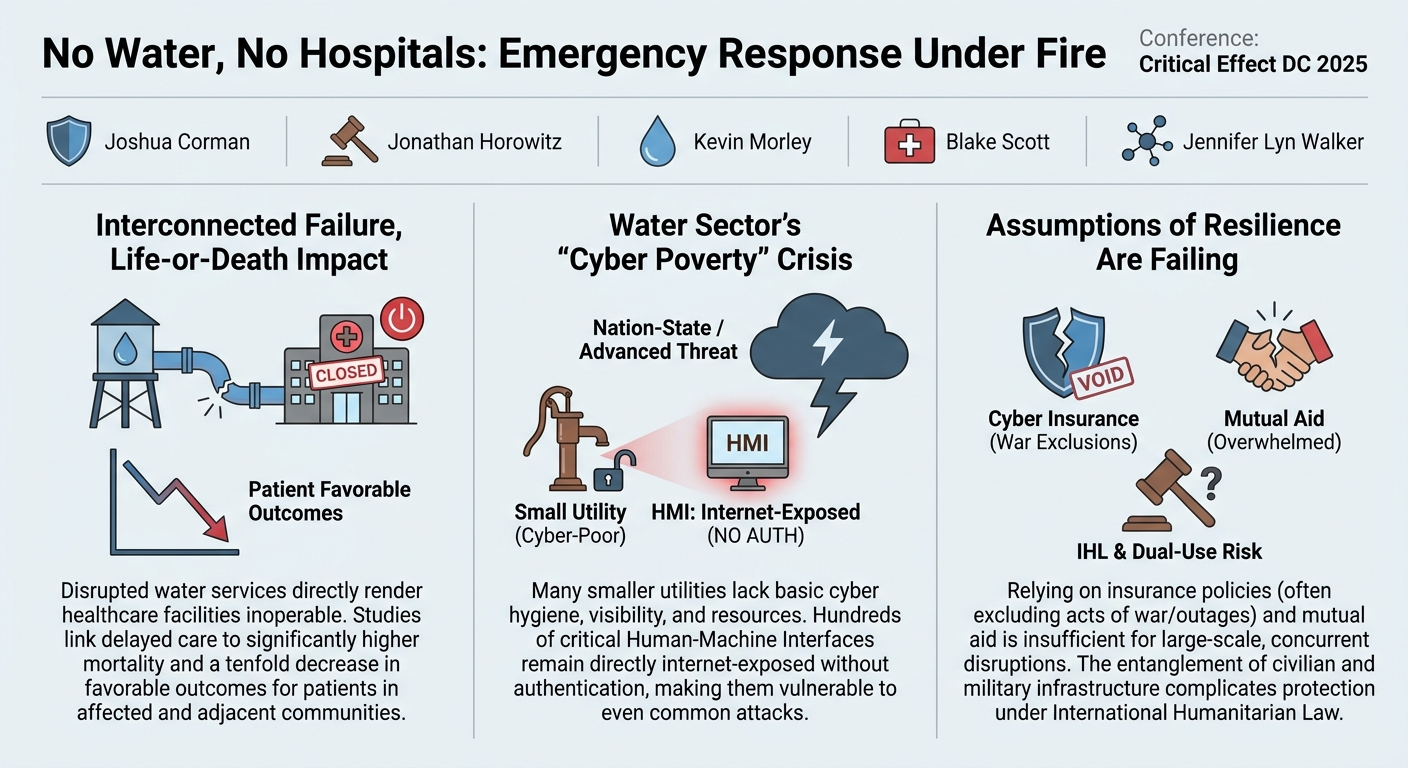
- The Interdependency of Water and Hospitals is a Life-or-Death Matter: Disruptions to water services can immediately cripple hospitals, leading to significant loss of life, as demonstrated by studies showing increased mortality rates with even minor delays in care and a tenfold decrease in favorable outcomes for patients in indirectly affected communities.
- The Water Sector Faces a "Cyber Poverty" Crisis: A vast majority of water utilities, particularly smaller ones, lack the resources, visibility, and capacity to defend against modern cyber threats, including sophisticated nation-state actors, making them highly vulnerable.
- International Humanitarian Law Applies to Cyber Warfare: Cyber operations during armed conflict are governed by IHL, prohibiting attacks on civilian infrastructure like hospitals and water plants. However, the entanglement of civilian and military infrastructure can complicate this protection, a risk most utilities are not assessing.
- Assumptions About Resilience are Failing: Traditional reliance on cyber insurance (which often excludes acts of war or utility outages) and mutual aid (which can be overwhelmed by widespread concurrent events) is insufficient for large-scale, nation-state-level cyberattacks.
- Enhanced Cross-Sector Coordination and Technical Assistance are Urgent: The emergency management community needs to treat cyberattacks as community-wide disasters, leveraging frameworks like NIMS and Fema Community Lifelines. Programs like "circuit writers" and volunteer cyber resilience corps are critical for delivering hands-on help to under-resourced utilities in the next 12-18 months.
- Immediate Action on Basic Hygiene and Exposed Systems is Paramount: Hundreds of critical cyber-physical systems, like HMIs in water facilities, are directly exposed to the internet without authentication. Addressing these fundamental vulnerabilities and securing the supply chain is an immediate, high-impact defensive priority.
About the Speaker(s)
Joshua Corman is an Executive in Residence for Public Safety and Resilience at the Institute for Security and Technology. He is a prominent voice in cybersecurity, having previously worked on CISA's COVID-19 task force, which provided statistical proof of loss of life due to degraded access to care. He is a co-founder of CyberMed Summit and a key driver behind initiatives like "UnDisruptable27," focusing on cross-sector resilience.
Jonathan Horowitz serves as the Deputy Head of the Legal Department for the International Committee of the Red Cross's (ICRC) regional delegation for the United States and Canada. Based in Switzerland, the ICRC is a neutral, independent, and impartial organization dedicated to protecting civilians and victims of armed conflict, with a strong focus on the application of international humanitarian law to modern challenges like cyber warfare.
Kevin Morley is the Manager of Federal Relations at the American Water Works Association (AWWA). With extensive experience in the water sector, he has been deeply involved in pushing for cybersecurity and strategic resilience for water infrastructure for over a decade, representing a network of thousands of members.
Blake Scott is a Senior Disaster Planner for a public health department in Arizona. He possesses seven years of experience in responding to and preparing for a range of disasters, including wildfires, snowstorms, and public health crises like COVID-19, with a focus on local crisis management and healthcare coalition coordination.
Jennifer Lyn Walker is the Director of Infrastructure Cyber Defense for the WaterISAC (Information Sharing and Analysis Center). Her role involves monitoring and distilling threat intelligence across all hazards – physical, natural, health, and cyber – to inform and protect the water sector's critical infrastructure members.
Reviews
Dr. Zero (Offensive Security Researcher) — MUST SEE
Corman and his panel dragged the water sector's cyber poverty out into the daylight. This wasn't a technical exploit drop, but a brutally honest policy session proving that when nation-state actors hit the PLCs, patients die. Strong, concrete discussion that dismantles the delusion of cyber insurance and mutual aid in an active conflict.
Heather Calloway (CISO) — MUST SEE
This panel provides statistical proof that cyber disruptions to regional utilities—specifically water—result in immediate, quantifiable loss of life at dependent healthcare facilities. It dismantles standard business continuity assumptions by showing that cyber insurance and mutual aid agreements will fail during a systemic infrastructure event. Mandatory viewing for any executive managing systemic risk.