Practicing for Disaster: MITRE’s Multi-Sector CyberSecurity Exercise
Mark Bristow (Director, Cyber Infrastructure Protection Innovation Center · MITRE), Sharla Artz (AVP, Security and Resilience Policy · Xcel Energy), Charles R. Goodwin (Commissioner, Department of Emergency Communications & Management · City of Worcester, MA), Tariq Habib (CISO · New York Metropolitan Transportation Authority), Robert Morgus (Senior Adviser, Risk and Resilience · Berkshire Hathaway Energy)
Critical Effect DC 2025 · Day 1 · Track I: Critical Mass
Overview
This talk delves into the critical insights gleaned from a groundbreaking, classified tabletop exercise orchestrated by MITRE in December. Titled "Practicing for Disaster," the exercise simulated a domestic cyber war with China, specifically a Taiwan Strait scenario, designed to explore the cascading effects of non-kinetic attacks on U.S. critical infrastructure. Mark Bristow, Director of MITRE's Cyber Infrastructure Protection Innovation Center, led a distinguished panel of industry and government leaders—representing energy, transportation, and emergency management sectors—to discuss the exercise's profound implications.
Key moments
- 0:00 Introduction: MITRE's multi-sector cyber war exercise
- 6:40 Exercise design: 5 sectors, 5 cities, 4 phases
- 11:00 Panel: Critical interdependencies and national response gaps
- 22:00 The communications breakdown: Salt Typhoon and prioritization
- 25:00 Ruthless prioritization when resources are scarce
- 35:00 Why cross-sector planning is failing: 'Sectors are a social construct'
- 52:00 Hopeful shift: 'Prepared for cyber attack, not cyber war'
- 69:00 Call for a civil defense mindset and operating without systems
Practicing for Disaster: MITRE’s Multi-Sector CyberSecurity Exercise
Speakers: Mark Bristow (Director, Cyber Infrastructure Protection Innovation Center, MITRE); Sharla Artz (AVP, Security and Resilience Policy, Xcel Energy); Charles R. Goodwin (Commissioner, Department of Emergency Communications & Management, City of Worcester, MA); Tariq Habib (CISO, New York Metropolitan Transportation Authority); Robert Morgus (Senior Adviser, Risk and Resilience, Berkshire Hathaway Energy)
Conference: Critical Effect DC 2025
YouTube: https://www.youtube.com/watch?v=4RxhZuisuWk
Overview
This talk delves into the critical insights gleaned from a groundbreaking, classified tabletop exercise orchestrated by MITRE in December. Titled "Practicing for Disaster," the exercise simulated a domestic cyber war with China, specifically a Taiwan Strait scenario, designed to explore the cascading effects of non-kinetic attacks on U.S. critical infrastructure. Mark Bristow, Director of MITRE's Cyber Infrastructure Protection Innovation Center, led a distinguished panel of industry and government leaders—representing energy, transportation, and emergency management sectors—to discuss the exercise's profound implications.
The discussion moved beyond conventional cyber incident response, highlighting systemic vulnerabilities that emerge when widespread, long-duration cyberattacks push critical infrastructure past its breaking point. The panelists underscored that such a scenario quickly transitions from a technical cybersecurity challenge to a multifaceted humanitarian problem, demanding an integrated "all-hazards" approach that extends far beyond individual sector capabilities. The exercise served as a stark reminder of the urgent need for cross-sector collaboration, robust communication strategies, and a fundamental shift in national preparedness.
Why this talk matters is evident in its unflinching examination of a plausible, high-impact threat. Unlike many narrowly focused exercises, MITRE's simulation brought together 200 participants from 70 diverse organizations across five critical sectors and five major U.S. regions. The findings revealed that current planning often falls short in addressing the scale, duration, and pervasive interdependencies characteristic of a full-scale cyber conflict. The insights shared by the panelists offer a crucial roadmap for organizations and governments to re-evaluate their resilience strategies, foster necessary partnerships, and prepare for a future where digital warfare has tangible, devastating real-world consequences.
Background
▶ Watch: Introduction: MITRE's multi-sector cyber war exercise (0:00)
Traditional cybersecurity exercises often suffer from a narrow scope, focusing either on internal organizational vulnerabilities, specific sector challenges, or primarily governmental responses. As Mark Bristow noted, these exercises frequently omit key stakeholders, such as local emergency managers, and rarely simulate the nationwide, cascading effects of a major cyber conflict. This creates a significant gap in national preparedness, as critical infrastructure sectors, while often robust in their individual incident response plans, are deeply interdependent.
The underlying problem is that national adversaries, exemplified by the Chinese government actors associated with Volt Typhoon, are actively gaining persistent access to U.S. critical infrastructure, particularly core communications networks. Their intent is not merely disruption but potentially destructive, long-duration impacts aimed at causing societal panic and undermining national resilience during a geopolitical crisis. Current planning horizons, often set at 30 days, are insufficient to address the reconstitution of multiple critical infrastructure sectors across the nation, which the exercise projected could take 45 days or more. This necessitates a move beyond merely addressing "cyber attacks" to preparing for "cyber war," where the consequences extend beyond technical outages to encompass widespread life-safety and humanitarian crises.
MITRE initiated this exercise as part of its "long-term measures" program, specifically targeting critical infrastructure resiliency. The goal was to overcome the limitations of past exercises by fostering a truly integrated understanding of risk across the entire national fabric. By bringing together diverse private sector operators, IT and Operational Technology (OT) professionals, and emergency managers, MITRE sought to expose the intersections of risk and the profound implications of "non-kinetic effects" on infrastructure at a national scale, thereby addressing why this problem exists and why current approaches are inadequate.
Key Findings
▶ Watch: Panel: Critical interdependencies and national response gaps (11:00)
The MITRE-led exercise uncovered several critical vulnerabilities and systemic challenges in the face of a widespread cyber conflict:
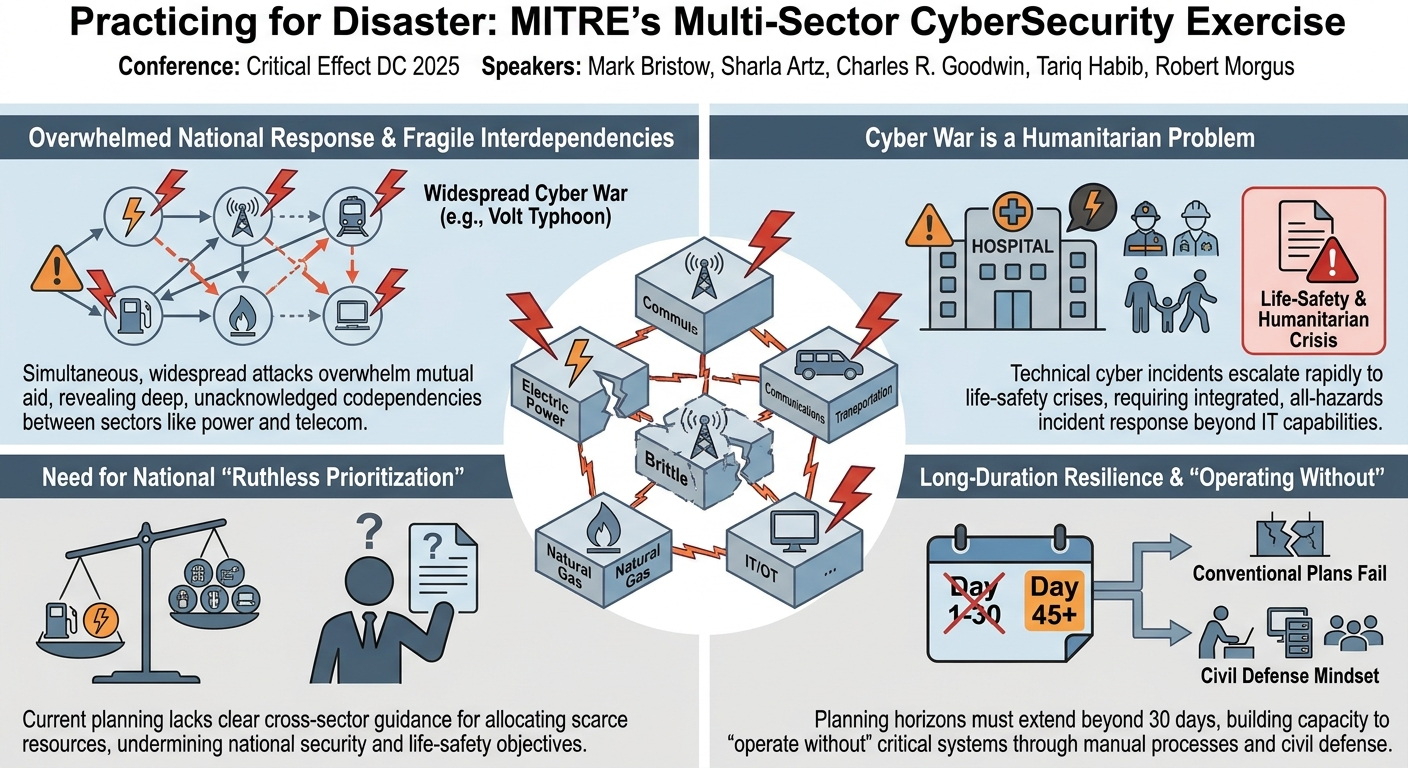
- Overwhelmed National Response Capacity: Even during the initial "nuisance attacks" phase, the sheer scale of the simulated incidents—affecting multiple sectors and regions simultaneously—overwhelmed the nation's ability to respond. As Mark Bristow highlighted, "when the hurricane is everywhere, it breaks some of our mutual aid kind of concepts," demonstrating that existing support structures are ill-suited for a non-geographically constrained threat.
- Profound Codependencies Between Sectors: A major revelation was the deep and often unacknowledged codependency between critical sectors. Rob Morgus emphasized the inextricable link between the electric sector and telecommunications, noting how much power companies rely on commercial networks and vice-versa. Similarly, the grid's heavy reliance on natural gas pipelines for generation emerged as a critical vulnerability. These interdependencies mean that an attack on one sector rapidly cascades into failures in others.
- Lack of National-Level Crisis Response Mechanisms: Panelists, particularly Rob Morgus, pointed out that while frameworks like UCGs and CRGs exist, effective mechanisms to bring directly impacted asset owner-operators into real-time national crisis response discussions are largely absent, hindering coordinated action.
- Overconfidence and Denial Regarding Resilience: Tariq Habib observed a dangerous overconfidence among some critical infrastructure entities regarding their resilience and recovery capabilities. Many organizations, having not experienced a large-scale, long-duration incident, struggled to imagine or plan beyond initial day-one responses, extending to 45 days or more.
- Critical Gap in Communication Resilience: A central and alarming finding was the vulnerability of communication infrastructure. The scenario specifically targeted comms, demonstrating how denial or injection of invalid communications could render primary pathways untrustworthy. While communications providers had internal plans, there was no clear cross-sector guidance on ruthless prioritization for shedding subscribers or maintaining essential services when networks were under attack. This undermined nearly all other response efforts.
- Rapid Shift to Humanitarian Problem: The exercise vividly illustrated how quickly cyber disruptions escalate from technical issues to life-safety and humanitarian problems. Charles Goodwin's example of a trauma center losing power and then diesel fuel for its generator, leading to patient diversion and a breakdown of emergency services, underscored this transition. Emergency managers, initially perplexed by the cyber focus, became central figures as the scenario progressed.
- Undefined Ruthless Prioritization: A recurring theme was the lack of a clear, pre-defined methodology for ruthless prioritization of services and resources when not enough was available for everyone. Who gets power, fuel, or communications? Panelists agreed that asset owners should not be solely responsible for these decisions, which require guidance aligned with national security, health, and economic needs, but such guidance is currently lacking.
- Sector Silos as an Impediment: Rob Morgus articulated that organizing public-private partnerships around "sectors" has become a "social construct" that does "more harm than good." These silos impede cross-sector awareness and planning, preventing a holistic view of interdependencies and collective resilience.
Technical Deep Dive
▶ Watch: Ruthless prioritization when resources are scarce (25:00)
The "Practicing for Disaster" exercise was meticulously designed to stress-test the nation's critical infrastructure and response mechanisms under an extreme, multi-faceted cyber warfare scenario.
Exercise Design and Scope:
The two-day, secret-level tabletop exercise brought together approximately 200 participants from 70 different organizations. It focused on five key critical infrastructure sectors: electric power, natural gas pipelines, rail, IT, and communications. The simulation spanned five distinct U.S. geographic areas: the greater Boston area, New York City, Hampton Roads (Virginia), Chicago, and Colorado. The classified nature of the exercise allowed for the use of sensitive intelligence regarding adversary capabilities and intentions, with some participants requiring one-day read-ins to access the material.
Scenario - China-Taiwan Strait Conflict:
The core scenario posited a domestic cyber war with China, occurring concurrently with a hypothetical Taiwan Strait scenario. This provided a geopolitical backdrop for widespread, coordinated cyberattacks against U.S. infrastructure. The exercise was structured into four progressive phases:
- Nuisance Attacks (Phase 1): This initial phase involved widespread, disruptive but not immediately destructive attacks. A key element was the simulated "killing" of access to major cloud providers like Azure and the disruption of communication platforms such as Zoom. The objective was to render core communications infrastructure "not available or not trustworthy." This phase alone, when executed at a national scale, demonstrated the capacity to "overwhelm the nation's ability to respond to cyber incidents," as mutual aid concepts broke down when all regions were simultaneously affected.
- Destructive Attacks (Phase 2): Following the nuisance phase, the adversary escalated to intentional disruptions of control systems environments. These attacks aimed for specific effects, including widespread outages and the injection of false information to create societal panic. This phase marked the transition point where the problem shifted decisively from a "cyber problem" to a broader "disaster management" challenge, requiring a FEMA NIMS (National Incident Management System)-style response.
- Jugular Attacks (Phase 3): Staged 15 days after the hypothetical invasion of Taiwan, this phase represented the most severe and widespread destructive attacks. The adversary focused on critical infrastructure targets across the entire country, aiming for maximum impact and prolonged disruption.
- Reconstitution (Phase 4): This final phase, set 45 days after the start of the war, focused on the immense challenge of restarting and rebuilding critical infrastructure. This extended timeline was crucial, as many organizations' planning horizons typically only extend to 30 days, proving insufficient for the national-scale, multi-sector recovery envisioned in the exercise.
Adversary Tactics and OT Vulnerabilities:
The scenario was implicitly informed by real-world threats, such as the activity of Volt Typhoon, a Chinese government-backed actor group known for gaining persistent access to U.S. critical communications infrastructure. This access enables capabilities like denying communications, injecting invalid data, and undermining trust in primary communication pathways, a core element of the exercise's initial phases.
Tariq Habib highlighted significant vulnerabilities within Operational Technology (OT) environments. He noted that many industrial control systems suffer from "very soft inside" environments with "rudimentary controls," making them susceptible once an adversary breaches initial defenses. Practical challenges, such as the difficulty of changing default passwords without disrupting live operations, underscore the need for vendors to provide more practical and secure solutions tailored for OT environments.
Resilience Engineering and Interdependencies:
The exercise highlighted the critical role of proactive resilience engineering. Sharla Artz mentioned Xcel Energy's efforts to build its own private LTE network to mitigate dependencies on commercial telecommunications, and the strategic use of diverse substation equipment (different technology platforms) to enable recovery.
The profound interdependencies were a central technical concern:
- The electric sector's reliance on telecommunications for grid operations (SCADA, telemetry) and vice-versa (data centers needing power).
- The electric grid's dependency on natural gas pipelines for fuel, especially in regions with high gas-fired generation.
- Transportation systems' reliance on power, communications, and fuel, with cascading impacts on emergency services and logistics. Charles Goodwin's example of a level one trauma center's reliance on diesel generators, which in turn rely on fuel delivery via transportation, illustrated complex multi-point failure scenarios.
- The impact of weather events (e.g., "bombogenesis" in Colorado) exacerbating cyber effects, highlighting the need to consider combined natural and man-made disasters.
Demo / Proof of Concept
▶ Watch: Why cross-sector planning is failing: 'Sectors are a social construct' (35:00)
This particular event was a tabletop exercise, not a live technical demonstration or a proof of concept involving code or systems. Its primary function was to simulate a complex, multi-sector cyber warfare scenario and observe the human, organizational, and systemic responses. Therefore, there was no traditional "demo" in the sense of a technical showcase.
Instead, the "proof of concept" derived from the exercise was the demonstration of systemic failure and the profound gaps in national preparedness. The simulated breakdown of communications, the overwhelming of response capacities, and the challenges in cross-sector coordination served as a powerful, albeit negative, validation of the hypothesis that current approaches are inadequate for a long-duration, geographically widespread cyber conflict. The exercise itself was the demonstration, revealing the vulnerabilities and interdependencies that require urgent attention and different modes of planning and collaboration.
Defensive Implications
▶ Watch: Call for a civil defense mindset and operating without systems (69:00)
The "Practicing for Disaster" exercise provided critical insights for strengthening national cybersecurity and resilience, shifting the focus from individual incident response to a comprehensive, multi-layered defense strategy.
- Shift from "Cyber Attack" to "Cyber War" Mindset: Defenders must move beyond preparing for isolated cyber incidents and adopt a "cyber war" mindset. This entails understanding that adversaries may seek to cause widespread, long-duration destruction with humanitarian consequences, requiring an "all-hazards incident response" approach, integrating principles from FEMA NIMS.
- Break Down Sector Silos and Foster Cross-Sector Planning: The exercise unequivocally demonstrated that sector-specific planning is insufficient. Organizations must proactively engage across sectors—electric, gas, telecom, rail, IT—and crucially, with local, state, and federal emergency managers. This involves identifying and mapping critical interdependencies, understanding cascading failure points, and developing integrated response plans. Rob Morgus emphasized that "sectors are like a social construct" that can impede effective planning.
- Extend Planning Horizons for Long-Duration Events: Traditional 30-day recovery plans are inadequate for a national-scale cyber war. Organizations must develop and practice plans for 45 days or more of sustained disruption and reconstitution. This includes considering resource depletion, personnel fatigue, and the challenges of restarting complex systems from a cold start.
- Prioritize Communication Resilience: Given the adversary's targeting of communications infrastructure (as seen with Volt Typhoon), robust, redundant, and out-of-band communication strategies are paramount. This includes exploring private networks (like Xcel Energy's private LTE network), satellite communications, and low-tech alternatives. Critically, pre-defined plans for prioritizing and shedding subscribers or services during widespread comms outages are needed, aligning with national security and life-safety objectives.
- Establish Ruthless Prioritization Frameworks: When resources are scarce (power, fuel, water, communications), organizations cannot "save everything." There is an urgent need for national, state, and local guidance on ruthless prioritization—who gets what, and why. These decisions should be made in peacetime, involving government authorities, to align with national security, health, and economic imperatives, rather than leaving operators to make ad-hoc decisions under duress.
- Develop Operational Resilience for "Operating Without": The most challenging defensive implication is the need to develop operational plans for "operating without" critical systems. This requires a deep dive into manual operations, degraded modes, and alternative processes. It's not about preventing every attack, but about building the capacity to "muddle through" when prevention fails. This includes engineering systems away from single points of cyber dependency where feasible.
- Address the Human Element: Defensive strategies must account for the human factor. Plans need to include the protection, sustenance, and rotation of critical personnel—line workers, emergency responders, and operators—who will be working in dangerous and stressful conditions during prolonged outages. This requires collaboration with law enforcement and community support structures.
- Foster a "Civil Defense Mindset": Mark Bristow and Rob Morgus advocated for a return to a "civil defense mindset" across the citizenry. This involves educating communities and individuals to be prepared for self-sufficiency for extended periods (30-60 days), reducing the immediate burden on overwhelmed public services and critical infrastructure providers.
- Drive Vendor Solutions for OT Security: Tariq Habib underscored the need for OT vendors to step up and provide more practical, resilient security solutions. This includes addressing fundamental issues like secure default configurations and enabling easier, less disruptive security updates and password management within industrial control system environments.
- Continuous Relationship Building and Tactical Exercises: The exercise highlighted that formal plans are only as good as the relationships supporting them. Regular, tactical-level, cross-sector exercises are crucial to test plans, identify gaps, and build the trust and familiarity necessary for effective coordination when a real crisis hits. This includes maintaining up-to-date contact information amidst high turnover rates.
Key Takeaways
- The simulated cyber war exposed critical vulnerabilities in national preparedness, primarily due to complex interdependencies, lack of communication resilience, and insufficient long-duration planning across critical infrastructure sectors.
- A "cyber war" fundamentally transforms into a "humanitarian problem," requiring a holistic, all-hazards incident response approach that integrates emergency management from the outset, moving beyond a purely technical cybersecurity focus.
- Current sector-specific planning and mutual aid models are inadequate for geographically widespread, simultaneous, and long-duration attacks, necessitating a shift to ruthless prioritization of services guided by national-level objectives rather than individual organizational decisions.
- Effective solutions are less about new cyber widgets and more about operational resilience, robust communication strategies, breaking down organizational silos, and fostering a "civil defense mindset" across the populace to cope with extended disruptions.
- Proactive relationship building and regular, tactical-level exercises involving diverse stakeholders (public and private critical infrastructure, local/state/federal government, and emergency services) are crucial for developing actionable plans and overcoming the observed "overconfidence and denial" regarding true resilience.
- The exercise revealed that while pockets of excellence exist in resilience planning, the challenge lies in knitting these capabilities together at a national scale, addressing profound interdependencies, and preparing for the human element of prolonged crisis.
About the Speaker(s)
- Mark Bristow: The Director of the Cyber Infrastructure Protection Innovation Center at MITRE. His extensive background includes 14 years running incident response at DHS, CISA, and NPPD, where he focused on tracking national adversaries targeting critical infrastructure. He led the design and execution of the multi-sector exercise discussed.
- Sharla Artz: Serves as the Security and Resilience Area Vice President for Xcel Energy, a major utility operating across eight U.S. states (including Texas, Colorado, and Minnesota) with approximately 4 million electric and 2 million natural gas customers, as well as nuclear and wind generation assets. Her role includes managing national security partnerships and supporting the CEO on the Electricity Sub-sector Coordinating Council.
- Charles R. Goodwin: The Commissioner for Emergency Management and Emergency Communications for the City of Worcester, Massachusetts. With about 15 years of experience in emergency management and communications, he oversees both private and public critical infrastructure, as well as 911 communications for central Massachusetts. He previously served in law enforcement.
- Tariq Habib: The Chief Information Security Officer (CISO) for the Metropolitan Transportation Authority (MTA) in New York. He is responsible for ensuring the safety and uninterrupted service of the MTA's extensive network, which serves over 6 million daily customers across trains, buses, bridges, tunnels, and thousands of facilities.
- Robert Morgus: A Senior Adviser for Risk and Resilience at Berkshire Hathaway Energy. His work centers on managing strategic threats to the business, including those from nation-states and emerging technologies, and developing resilience programs for the company's various energy businesses in the U.S., UK, and Canada. Prior to this role, he spent several years at the Cyberspace Solarium Commission.
Reviews
Dr. Zero (Offensive Security Researcher) — MUST SEE
I usually skip tabletop exercise recaps, but MITRE actually brought the receipts on this one. This isn't a vendor pitching a dashboard; it's a sobering, secret-level look at what happens when Volt Typhoon pops the grid, the gas lines, and the telecom networks all at once. If you defend critical infrastructure, this is mandatory viewing for understanding how quickly a digital problem becomes a body-bag problem.
Heather Calloway (CISO) — MUST SEE
This is a masterclass in institutional realism. MITRE’s tabletop forces leaders to abandon the fantasy that a national-scale cyber conflict is an IT outage rather than a cascading humanitarian crisis. It is mandatory viewing for any board risk committee overseeing critical infrastructure.