Code in the Combine: Protecting Agriculture in the Age of Cyber Conflict
Matt Hayden (Vice President of Cyber and Emerging Threats; Former Assistant Secretary of Homeland Security for Cyber, Infrastructure, Risk and Resilience Policy · General Dynamics Information Technology), Scott C. Algeier (Executive Director · IT-ISAC), James Johnson (CISO · John Deere), Jiwon Ma (Senior Policy Analyst, Center on Cyber and Technology Innovation · Foundation for Defense of Democracies)
Critical Effect DC 2025 · Day 1 · Track I: Critical Mass
Overview
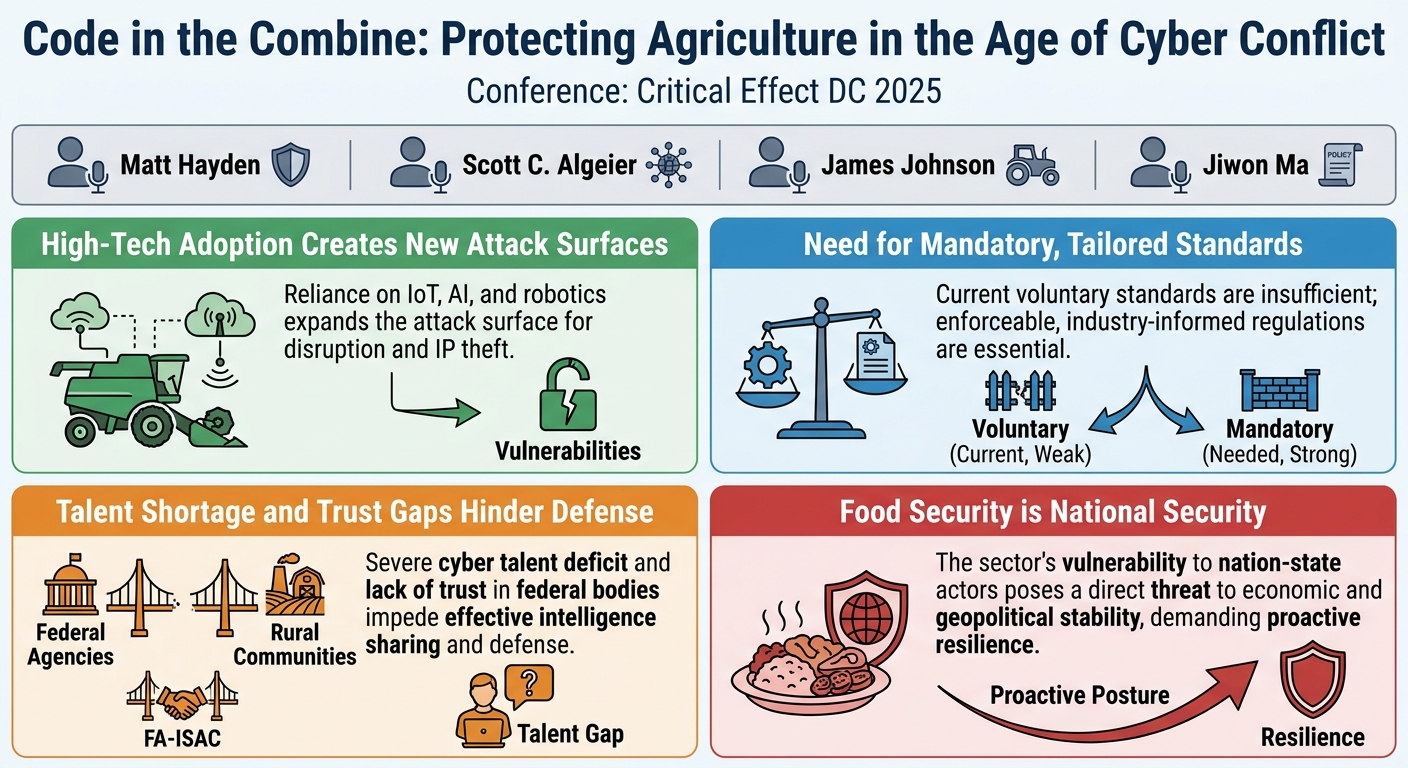
The "Code in the Combine: Protecting Agriculture in the Age of Cyber Conflict" panel at Critical Effect DC 2025 delivered a crucial examination of the rapidly evolving cybersecurity landscape within the food and agriculture (FA) sector. Featuring a diverse group of experts—Matt Hayden, former Assistant Secretary of Homeland Security; Scott C. Algeier, Executive Director of the Food and Agriculture ISAC (FA-ISAC); James Johnson, CISO of John Deere; and Jiwon Ma, Senior Policy Analyst at the Foundation for Defense of Democracies—the discussion highlighted the profound implications of increasing technological integration in agriculture, from precision farming to advanced supply chain logistics.
Key moments
- 0:00 Agriculture's high-tech evolution and emerging cyber risks
- 5:30 Why voluntary cyber standards fail for critical infrastructure
- 8:30 Food & Ag ISAC's role in threat intelligence sharing
- 12:00 Leveraging federal programs; addressing trust in rural areas
- 15:30 Critical gap: No federal cyber threat intelligence for agriculture
- 30:30 Cyber Tractor Hacking Challenge develops talent for heavy equipment
- 32:00 Food security is national security: supply chain and foreign tech
- 39:00 Industry's ask: Faster intelligence sharing, better funding
Code in the Combine: Protecting Agriculture in the Age of Cyber Conflict
Speakers: Matt Hayden (Vice President of Cyber and Emerging Threats; Former Assistant Secretary of Homeland Security for Cyber, Infrastructure, Risk and Resilience Policy, General Dynamics Information Technology); Scott C. Algeier (Executive Director, IT-ISAC); James Johnson (CISO, John Deere); Jiwon Ma (Senior Policy Analyst, Center on Cyber and Technology Innovation, Foundation for Defense of Democracies)
Conference: Critical Effect DC 2025
YouTube: https://www.youtube.com/watch?v=Bl6hdL5idDE
Overview
The "Code in the Combine: Protecting Agriculture in the Age of Cyber Conflict" panel at Critical Effect DC 2025 delivered a crucial examination of the rapidly evolving cybersecurity landscape within the food and agriculture (FA) sector. Featuring a diverse group of experts—Matt Hayden, former Assistant Secretary of Homeland Security; Scott C. Algeier, Executive Director of the Food and Agriculture ISAC (FA-ISAC); James Johnson, CISO of John Deere; and Jiwon Ma, Senior Policy Analyst at the Foundation for Defense of Democracies—the discussion highlighted the profound implications of increasing technological integration in agriculture, from precision farming to advanced supply chain logistics.
This talk underscored that the FA sector, traditionally seen as less technologically advanced than others, is now a highly digitized and interconnected critical infrastructure, facing an array of cyber risks comparable to, and in some ways exceeding, those in finance or energy. The panelists collectively argued that food security is national security, and the vulnerability of modern agricultural systems to cyberattacks, espionage, and disruption poses a direct threat to economic stability, social order, and geopolitical influence. The conversation emphasized the urgent need for a proactive, collaborative, and well-resourced approach to securing this vital sector, moving beyond reactive postures to establish robust defense mechanisms and foster a culture of cyber resilience.
The discussion navigated the complex interplay of technological innovation, regulatory gaps, information sharing challenges, and the unique socio-economic dynamics of the agricultural community. It detailed the inherent risks of advanced automation and Internet of Things (IoT) devices on farms, the complexities of securing a global supply chain, and the critical shortage of specialized cyber talent. Ultimately, the panel presented a compelling case for treating agricultural cybersecurity as a top-tier national priority, demanding concerted efforts from government, industry, academia, and individual stakeholders to safeguard the future of food production.
Background
▶ Watch: Agriculture's high-tech evolution and emerging cyber risks (0:00)
The agriculture sector is currently undergoing a profound technological revolution, transforming traditional farming practices into highly automated, data-driven operations. This shift involves the widespread adoption of precision agriculture, IoT devices for monitoring livestock and crops, advanced robotics, and artificial intelligence (AI)-driven analytics. As James Johnson of John Deere noted, farmers are increasingly dependent on these computer components for efficiency, to the point where traditional manual indicators (like planter discs) are now special-ordered rather than standard. While these innovations have dramatically increased productivity—enabling more people to be fed with fewer farmers and less land—they have simultaneously introduced significant cybersecurity vulnerabilities and risks.
Historically, the FA sector has lagged behind other critical infrastructure sectors like energy and finance in terms of cybersecurity maturity and regulatory oversight. Jiwon Ma highlighted that agriculture is effectively operating where the energy sector was 20 years ago. The 2003 Ohio transmission line blackout, which impacted 50 million Americans and nuclear reactors, led to the mandatory NERC Critical Infrastructure Protection (CIP) standards in 2005. In contrast, the FA sector still largely relies on voluntary cybersecurity standards, which the panelists argued are insufficient given the scale of the threat. This regulatory void, coupled with a diverse ecosystem ranging from large enterprises like John Deere to small family farms, creates a fragmented and uneven security posture.
The problem is further compounded by several factors: a severe shortage of cyber talent, particularly for small and medium-sized enterprises (SMEs) and individual farms; a lack of trust in federal agencies like CISA in rural communities, contrasting with greater trust in the Department of Agriculture (USDA), which often lacks specialized cyber resources; and the complex, global nature of agricultural supply chains, both physical and software. Moreover, the industry's low-margin nature often means limited resources for cybersecurity investments. These factors collectively create a fertile ground for adversaries, ranging from criminal organizations seeking ransomware payments to nation-state actors engaged in intellectual property (IP) theft and economic espionage, making the sector a prime target for disruption.
Key Findings
▶ Watch: Food & Ag ISAC's role in threat intelligence sharing (8:30)
The panel identified several critical findings regarding the state of cybersecurity in the agriculture sector:
- Ubiquitous Technological Integration and Associated Risk: Modern agriculture is heavily reliant on Operational Technology (OT) and IoT devices, from processing plants to individual farms monitoring livestock and deploying precision chemical applications. This integration, while efficient, introduces extensive new attack surfaces and vulnerabilities that require sophisticated protection strategies.
- Inadequate Regulatory Frameworks: Unlike mature sectors such as energy and finance, the FA sector predominantly relies on voluntary cybersecurity standards. Panelists asserted that this approach is ineffective, placing the sector at a significant disadvantage and leaving it highly susceptible to systemic risks. The call for enforceable, yet thoughtfully implemented, standards was a recurring theme.
- Fragmented Trust and Information Sharing Challenges: While the Food and Agriculture Information Sharing and Analysis Center (FA-ISAC), established in May 2023 and incubated by the IT-ISAC since 2008/2009, facilitates robust threat intelligence sharing among its members, a broader trust deficit exists between federal cybersecurity agencies (like CISA) and the rural farming community. The USDA, though trusted, is often not equipped with the necessary cyber expertise, creating a critical gap in federal support.
- Critical Cyber Talent Shortage: The sector faces a severe deficit of cybersecurity professionals. This issue is particularly acute for smaller farms and businesses, which struggle to attract and retain talent in competition with higher-paying jobs in other sectors. Innovative approaches to talent development, such as the "Cyber Tractor Hacking Challenge," are recognized as vital.
- National Security Imperatives: The discussion firmly established that food security is national security. Beyond direct cyberattacks, the sector is a prime target for nation-state IP theft (e.g., seed technology), economic espionage, and disruption of global supply chains. Reliance on foreign-made critical infrastructure components, such as the 80% of ship-to-shore cranes from China mentioned, poses significant strategic vulnerabilities.
- Proactive vs. Reactive Posture: There is a pervasive need to shift from a reactive incident response posture (e.g., responding after a SolarWinds-like event) to a proactive one focused on preparedness and mitigation. This requires strategic investments in R&D, security by design principles, and robust tabletop exercises that simulate real-world scenarios.
Technical Deep Dive
▶ Watch: Critical gap: No federal cyber threat intelligence for agriculture (15:30)
The technical discussion highlighted several key areas of vulnerability and mitigation strategies within the digitized agriculture sector. Operational Technology (OT) is a primary concern, embedded in everything from large-scale processing plants to individual farm equipment. These systems, often proprietary and long-lived, present unique challenges for patching and securing compared to traditional IT environments. James Johnson of John Deere emphasized that while their equipment is designed for resilience—allowing a tractor to be driven even if its self-driving computer components fail, similar to a Tesla—the increasing dependency on technology means that efficiencies are lost without these digital systems.
John Deere employs a comprehensive security by design approach. This involves integrating security early in the product development lifecycle through static code testing, dynamic code testing, and rigorous secret scanning. Engineers receive specialized training to develop code securely, fostering a mindset where security is an inherent aspect of product quality. For existing products, the company leverages penetration testing and continuous attack surface testing to identify and remediate vulnerabilities. A bug bounty program further incentivizes external researchers to report findings, enhancing overall product security.
Addressing the software supply chain, particularly the emerging focus on Software Bills of Materials (SBOMs), John Deere is actively mapping out components within its products. Within its manufacturing facilities, network segmentation is a critical defense mechanism. Johnson explained that welding lines are isolated from paint lines, for instance, to prevent a cyber incident in one area from cascading across the entire factory and limiting the blast radius. The rapid integration of Artificial Intelligence (AI) into existing tools, such as advanced search queries, was acknowledged as a new and evolving challenge that requires continuous adaptation of security strategies.
Scott Algeier elaborated on the Food and Agriculture ISAC (FA-ISAC)'s approach to threat intelligence. In partnership with IT-ISAC analysts, they monitor approximately 230-240 threat actors globally. Through this extensive monitoring, they have identified the 50 most active and relevant threat actors specifically targeting the FA sector. This focused analysis allows the FA-ISAC to develop tailored playbooks for these 50 actors, providing actionable intelligence and Tactics, Techniques, and Procedures (TTPs) that are immediately relevant to member companies, reducing the burden of sifting through overwhelming amounts of generic threat data.
The panel also touched upon the critical balance between the "right to repair" movement and the need for cryptographically designed trusted software. Johnson clarified that John Deere provides extensive access for customers to repair their equipment. However, certain safety, emissions, and performance parameters require secure code, secure configuration, and secure boot mechanisms to prevent modifications that could render the equipment unsafe for humans or the environment, or alter performance characteristics like horsepower without authorization. This highlights the complex engineering challenge of maintaining both usability and robust security in heavy equipment.
Demo / Proof of Concept
▶ Watch: Cyber Tractor Hacking Challenge develops talent for heavy equipment (30:30)
While the talk itself did not feature a live technical demonstration, James Johnson highlighted a significant initiative that serves as a practical, hands-on proof of concept for cybersecurity in agricultural technology: the Cyber Tractor Hacking Challenge.
This annual event, now in its fourth year, is hosted at Iowa State University, which boasts strong agriculture and cybersecurity programs. The challenge is designed to immerse students in the intricate world of modern farm equipment. Participants spend the first part of the event learning about the inner workings of a tractor—its electronic systems, the code it utilizes, and how it responds to various inputs. This foundational understanding is critical for developing effective security strategies.
Following this educational phase, students are given two days to actively attempt to "break" the equipment. This involves red teaming and penetration testing the tractor systems to identify vulnerabilities. The creative results of these challenges range from simple manipulations, like making the lights flash, to more playful demonstrations, such as synchronizing the lights to dance music. On the final day, students present their findings, demonstrating the vulnerabilities they discovered and how they exploited them.
The Cyber Tractor Hacking Challenge serves multiple vital functions:
- Talent Development: It exposes students to the unique cybersecurity challenges and opportunities within the heavy equipment and agriculture sectors, inspiring them to pursue careers in this critical field. As Johnson noted, many students leave the challenge realizing the "cool" and impactful nature of this specialized cybersecurity work.
- Vulnerability Discovery: It provides a real-world environment for identifying potential weaknesses in agricultural machinery, feeding valuable insights back into product security.
- Industry Collaboration: Initially a John Deere-only event, it has evolved into an industry-wide challenge, inviting competitors and fostering a collaborative environment to enhance security across the agricultural machinery landscape.
This initiative is a powerful example of how practical, educational "hacking" can contribute directly to improving the security posture of critical infrastructure and nurturing the next generation of cyber defenders for the agriculture sector.
Defensive Implications
▶ Watch: Industry's ask: Faster intelligence sharing, better funding (39:00)
The discussion outlined several critical defensive implications for stakeholders in the agriculture sector, urging a shift towards more proactive and collaborative security strategies:
- Mandatory, Thoughtful Cybersecurity Standards: The most significant implication is the need to move beyond voluntary guidelines. Jiwon Ma argued for enforceable standards, drawing parallels with the energy sector's NERC CIP mandate after the 2003 blackout. However, implementation must be tailored, potentially starting with larger operators and gradually expanding to smaller entities, similar to approaches in the water sector where market-based incentives and free resources are provided to smaller utilities. Industry involvement in shaping these standards is crucial to ensure they are practical and effective.
- Enhanced, Trust-Based Information Sharing: Leveraging and expanding the role of ISACs like the FA-ISAC is paramount. Scott Algeier highlighted the FA-ISAC's work in curating threat intelligence, focusing on the 50 most relevant threat actors for the sector and developing specific playbooks. To address the trust gap with federal agencies, the USDA's cooperative extension program and CISA's regional offices should be better leveraged as trusted intermediaries, providing cyber expertise through familiar channels. Renewing legislation like CISA 2015, which incentivizes threat intelligence sharing, is also essential.
- Strategic Investment in Cyber Talent: Addressing the severe talent shortage requires a multi-pronged approach. Existing federal and state programs (e.g., USDA cooperative extension, CISA regional offices) should be empowered to deliver cyber education and resources. Models like the US Cyber Trust Program from the FCC, which encourages vendors to embed security into IoT devices, could be adapted for farm equipment. Furthermore, initiatives like the Cyber Tractor Hacking Challenge at Iowa State University are vital for attracting and training young talent, bridging the gap between academic knowledge and real-world agricultural cybersecurity needs.
- Prioritize Security by Design and Operational Resilience: Manufacturers like John Deere must continue to embed security from the earliest stages of product development through static and dynamic code testing, secret scanning, and engineer training. For operational environments, implementing robust network segmentation (e.g., isolating manufacturing lines) is crucial to limit the blast radius of attacks. Regular, challenging tabletop exercises that simulate incidents during critical periods (e.g., harvest season, earnings reports) and involve leadership up to the board level are essential for testing and refining incident response and communication plans.
- Advocate for Increased Government Funding and Resources: Jiwon Ma highlighted the vast disparity in funding for Sector Risk Management Agencies (SRMAs), with the energy sector receiving $200 million compared to the FA sector's mere $500,000. Advocating for significantly increased funding and personnel for the USDA to fulfill its SRMA duties for cybersecurity is critical.
- Frame Cyber as an Empowerment Mechanism: To gain traction with policymakers and stakeholders, cybersecurity initiatives should be presented not just as a defensive measure, but as an enabler for adopting new technologies like AI and automation securely. This "empowerment argument" can garner more attention and resources than a purely "security argument."
- Address Supply Chain Risks: Both software (SBOMs) and physical supply chain vulnerabilities (e.g., reliance on foreign-made critical components like drones and cranes) must be systematically identified and mitigated through diverse sourcing and domestic manufacturing where possible.
Key Takeaways
- Agriculture is a High-Tech, High-Value Target: Modern agriculture's deep reliance on OT, IoT, and AI creates extensive cyberattack surfaces, making it a critical target for both criminal and nation-state actors seeking disruption, IP theft, or economic leverage.
- Mandatory Standards Are Essential: Voluntary cybersecurity standards are insufficient for the FA sector; a shift towards enforceable, yet carefully tailored and industry-informed, mandatory standards is necessary to elevate baseline security across the diverse ecosystem.
- Trust and Tailored Intelligence are Paramount: Effective cybersecurity in agriculture hinges on building trust, particularly between federal agencies and rural communities. Curated, sector-specific threat intelligence, like that provided by the FA-ISAC focusing on the 50 most active threat actors, is crucial for informed risk management by resource-constrained entities.
- Invest in Talent and Public-Private R&D: Addressing the severe cyber talent shortage requires innovative approaches like the Cyber Tractor Hacking Challenge and leveraging existing USDA extension programs. Increased federal and private investment in R&D specifically tailored to agricultural cybersecurity challenges is vital.
- Security Must Be Built-In and Tested: Manufacturers must adopt security by design principles, integrating robust testing (static/dynamic code analysis, bug bounties) and resilience features (network segmentation, secure boot) into products and operations. Regular, high-pressure tabletop exercises are critical for preparedness.
- Food Security is National Security: The cybersecurity of the food and agriculture sector is a direct national security concern, with implications for economic stability, social unrest, and geopolitical power. Proactive government funding for Sector Risk Management Agencies (like USDA) and policies addressing critical component supply chain risks are urgently needed.
About the Speaker(s)
- Matt Hayden serves as the Vice President of Cyber and Emerging Threats at General Dynamics Information Technology (GDIT). Prior to this role, he held a significant position in government as the Assistant Secretary of Homeland Security for Cyber, Infrastructure, Risk and Resilience Policy, bringing a wealth of experience in national cybersecurity strategy and critical infrastructure protection.
- Scott C. Algeier is the Executive Director of two pivotal organizations in the cybersecurity landscape: the IT-ISAC (Information Technology Information Sharing and Analysis Center) and the Food and Agriculture Information Sharing and Analysis Center (FA-ISAC). He played a key role in the establishment of the FA-ISAC in May 2023, after having incubated a community of food and agriculture companies through the IT-ISAC's special interest group since 2008/2009.
- James Johnson is the Chief Information Security Officer (CISO) at John Deere, a global leader in agricultural machinery. His extensive background in cybersecurity spans almost 25 years, including previous experience as CISO at Honeywell and starting his career as a pentester, providing him with deep technical and leadership insights into securing complex industrial environments.
- Jiwon Ma is a Senior Policy Analyst at the Center on Cyber and Technology Innovation, part of the Foundation for Defense of Democracies. Her work primarily focuses on the Cyberspace Solarium Commission 2.0, indicating her expertise in national cyber policy, strategic foresight, and addressing critical technology challenges from a policy perspective.
Reviews
Dr. Zero (Offensive Security Researcher) — SOLID
For a DC policy panel, this is actually tolerable. You get the usual 'food security is national security' platitudes, but the speakers back them up with concrete budget disparities and hard segmentation examples instead of just reciting a press release.
Heather Calloway (CISO) — STRONG ACCEPT
This panel signals the end of the voluntary compliance era for the agricultural sector. Between the maturation of the FA-ISAC and the direct comparisons to the energy sector's NERC CIP mandate, boards in the food supply chain need to prepare for imminent regulatory enforcement. It is required viewing for leadership teams managing physical logistics, OT environments, or heavy equipment.