Fireside Chat with Rep. Nick Begich
Nick Begich (U.S. Representative (AK-1) · U.S. House of Representatives), Bryson Bort (ICS Village)
Critical Effect DC 2025 · Day 1 · Track I: Critical Mass
Overview
In a candid fireside chat at Critical Effect DC 2025, U.S. Representative Nick Begich (AK-1) offered a unique perspective on the pressing challenges of securing critical infrastructure, bridging the often-disparate worlds of technology and federal policy. Moderated by Bryson Bort of ICS Village, the discussion delved into the complexities faced by a nation grappling with an increasingly interconnected and vulnerable operational technology (OT) landscape. Rep. Begich, leveraging his extensive 25-year career in the tech sector, articulated a vision for a more unified, proactive, and industry-led approach to cybersecurity, emphasizing the critical nexus between national security, economic stability, and technological resilience.
Key moments
- 0:00 Rep. Begich's tech background and motivation for public service
- 4:18 Major challenges in securing critical infrastructure: mission confusion
- 5:50 Air traffic control running on Windows 95 highlighting risks
- 8:09 Driving industry standards and open-source for better security
- 10:40 Alaska's remote environment and strategic national defense importance
- 16:06 Advocating stronger offensive cyber capabilities for national security
- 18:10 Call to action: Practitioners must provide policy solutions to Congress
Fireside Chat with Rep. Nick Begich
Speakers: Nick Begich (U.S. Representative (AK-1), U.S. House of Representatives); Bryson Bort (ICS Village)
Conference: Critical Effect DC 2025
YouTube: https://www.youtube.com/watch?v=ECAKL-paeOg
Overview
In a candid fireside chat at Critical Effect DC 2025, U.S. Representative Nick Begich (AK-1) offered a unique perspective on the pressing challenges of securing critical infrastructure, bridging the often-disparate worlds of technology and federal policy. Moderated by Bryson Bort of ICS Village, the discussion delved into the complexities faced by a nation grappling with an increasingly interconnected and vulnerable operational technology (OT) landscape. Rep. Begich, leveraging his extensive 25-year career in the tech sector, articulated a vision for a more unified, proactive, and industry-led approach to cybersecurity, emphasizing the critical nexus between national security, economic stability, and technological resilience.
The talk underscored the urgent need for a cohesive national strategy to defend against sophisticated state-sponsored adversaries, highlighting critical deficiencies such as dangerously outdated systems, fragmented governmental efforts, and a pervasive lack of prioritized funding. Begich’s insights, particularly concerning Alaska's strategic importance as a "front line" in national defense and a vital source of critical minerals and energy, painted a vivid picture of the multifaceted threats facing the United States. He issued a clear call to action for the cybersecurity practitioner community, urging them to actively engage with policymakers and provide the expert-driven solutions necessary to fortify the nation's most vital assets.
Background
▶ Watch: Rep. Begich's tech background and motivation for public service (0:00)
Rep. Nick Begich's journey to Congress is rooted deeply in the technology sector, providing him with an atypical and invaluable lens through which to view national security challenges. His career began in college, running Cat 5 cable and installing network infrastructure, progressing through software development, a global technology management role at Ford Motor Company, and ultimately founding his own software development company that scaled to 150 people across three countries. This extensive hands-on experience instilled in him a profound understanding of technological lifecycles, maintenance burdens, and the inherent vulnerabilities of complex systems. His entry into politics was driven by a skepticism toward government competence in navigating the "hyper accelerated technology environment of the 21st century," compelling him to "get in the game" rather than merely observe.
The foundational problem addressed in the talk is the radical shift in national defense paradigms. Decades ago, the vast Atlantic and Pacific oceans served as formidable natural barriers, providing a geographic buffer against external threats. However, the advent of global interconnectedness, driven by digital networks and the Internet, has rendered these physical defenses largely obsolete in the cyber domain. As Begich succinctly put it, "you can wake up in Moscow or Beijing and be angry and do something about it." This interconnectedness, while offering immense economic and functional advantages, simultaneously introduces a vast and easily exploitable attack surface across the nation's critical infrastructure.
Begich highlighted several systemic issues exacerbating this vulnerability. Firstly, he pointed to a "whole of government" problem characterized by a proliferation of agencies and groups—including military, intelligence, and domestic entities—each claiming responsibility for critical infrastructure security. This leads to significant overlap and "mission confusion," preventing the formation of a cohesive national strategy. Secondly, there is a chronic lack of prioritized funding for upgrading and modernizing critical infrastructure. A stark illustration of this neglect is the revelation that some air traffic control systems are still running on Windows 95. As Begich emphasized, such systems have been "unpatched for probably longer than a decade," creating a "whole host of vulnerabilities, zero-day exploits, the whole thing, the whole gamut," posing a severe risk to national safety.
Furthermore, the federalist structure of the U.S. government introduces complexities, with potentially conflicting regulations and capabilities at federal and state levels. The existing critical infrastructure, particularly in energy and grid systems, has evolved over a century, resulting in a "one of everything" scenario. This means that "every piece of technology that was ever introduced to the market is now sitting inside of the critical infrastructure envelope," creating an immense technical debt and an incredibly challenging maintenance burden, akin to the legacy systems Begich encountered at a 100-year-old company like Ford. This patchwork of aging, disparate systems, combined with a lack of unified standards and a reactive defensive posture, sets the stage for the vulnerabilities that adversaries are actively exploiting.
Key Findings
▶ Watch: Air traffic control running on Windows 95 highlighting risks (5:50)
The fireside chat yielded several critical insights into the state of critical infrastructure security and the path forward:
- Fragmented National Strategy: A significant finding is the absence of a cohesive national strategy for managing critical infrastructure security. Rep. Begich identified "mission confusion" and a lack of unified efforts across various government agencies (military, intelligence, domestic) and industry, leading to inefficient resource allocation and an incomplete defense posture.
- Pervasive Technical Debt and Outdated Systems: The prevalence of dangerously obsolete technology within critical systems is a major concern. The example of Windows 95 running air traffic control systems serves as a potent symbol of widespread technical debt, highlighting an unpatched, unsupported attack surface ripe for exploitation by foreign adversaries. This extends to the "one of everything" problem within energy and grid infrastructure, where a century of diverse technologies creates an unmanageable maintenance and security challenge.
- Industry Must Lead on Standards: A pivotal realization is that government is inherently too slow to drive timely and effective cybersecurity standards. Begich asserted that "government will never be capable of driving those standards. Their standards will be 10 years old by the time they're introduced." Instead, industry must take the lead in developing and adopting harmonized standards and open frameworks, particularly advocating for open-source hardware and software, as the "security through obscurity model has failed."
- Alaska as a National Security "Front Line": Alaska's unique geographic and strategic position makes it a critical, albeit often overlooked, component of national security. Despite not being a "high-tech state," it hosts significant national defense infrastructure, including early warning missile defense capabilities and the highest concentration of fifth-generation fighters globally. Its proximity to Russia and China, coupled with its vast natural resources (49 of the 50 critical minerals, significant energy reserves), positions it as a vital economic and military asset, making its critical infrastructure a prime target.
- Need for Stronger Offensive Cyber Capabilities: Current U.S. policy, focused primarily on hardening systems and defending against attacks, is insufficient. Begich argued for a shift towards a stronger offensive cyber capability to "shut down the pivot points and offensive capabilities that the adversaries have." This proactive approach is deemed essential for deterrence and effective response against persistent threats.
- Intertwined Economic and National Security: The discussion highlighted that critical infrastructure security is not solely a national defense issue but also a fundamental matter of economic security. Protecting energy infrastructure (oil, natural gas) and the supply chains for critical minerals, especially in the context of decoupling from China, is crucial for maintaining U.S. economic independence and resilience.
Technical Deep Dive
▶ Watch: Driving industry standards and open-source for better security (8:09)
While the fireside chat primarily focused on policy and strategy, Rep. Begich's tech background allowed for a clear articulation of underlying technical challenges and proposed solutions. The technical deep dive centers on the critical vulnerabilities inherent in legacy systems, the strategic importance of standardization, and the implications of remote operations and offensive postures.
The most glaring technical vulnerability highlighted is the continued operation of critically outdated software in vital systems. The example of air traffic control systems still running on Windows 95 is not merely an anecdote; it represents a profound technical debt. Windows 95, having reached its end-of-life status decades ago, is entirely unsupported by its vendor, Microsoft. This means it receives no security updates, no patches for newly discovered vulnerabilities, and no technical support. Such systems are inherently susceptible to a "whole host of vulnerabilities," including easily discoverable exploits, zero-day exploits that remain unknown to defenders, and general instability. An adversary targeting such a system would find a significantly reduced barrier to entry, potentially leading to widespread disruption or catastrophic failure. The risk profile is extreme, making these systems low-hanging fruit for state-sponsored actors.
Beyond specific operating systems, the broader challenge lies in the nature of the nation's critical infrastructure, particularly in energy and grid systems, which Begich described as having "one of everything" built over a century. This implies an incredibly diverse and heterogeneous environment comprising a vast array of proprietary systems, custom solutions, and technologies spanning multiple generations. From a technical perspective, this creates an unmanageable attack surface. Each unique system, protocol, and hardware component introduces its own set of potential vulnerabilities, configuration complexities, and maintenance requirements. Patching, monitoring, and securing such a diverse landscape become exponentially difficult, consuming immense resources and often failing to keep pace with evolving threats. The lack of a "critical infrastructure cycle plan" means that systems are often run until failure, rather than being proactively upgraded to modern, more secure alternatives.
To address this technical chaos, Begich strongly advocated for driving standards and embracing open frameworks. From a technical standpoint, standardization simplifies the security problem by reducing the number of unique configurations and proprietary components. If critical infrastructure components adhere to a common set of security standards, protocols, and architectural patterns, it becomes easier to develop universal security tools, implement consistent policies, and train a workforce capable of defending these systems. Begich specifically championed open-source hardware and software, arguing that the "security through obscurity model has failed." This is a fundamental technical principle: open-source projects benefit from community scrutiny, allowing a wider pool of experts to identify and fix vulnerabilities, leading to more robust and transparent security. In contrast, proprietary systems often hide their inner workings, making it difficult for external researchers or even internal security teams to fully assess their security posture.
Alaska's unique geography presents distinct technical challenges. Its remote and geographically disparate critical infrastructure often relies on remote operating environments. While remote access provides operational efficiency, it inherently expands the attack surface. Every remote connection point, every VPN gateway, and every networked device becomes a potential entry vector for adversaries. Begich's experience on the board of an Alaskan telecom company revealed the critical importance of hardening "edge nodes" and long-haul fiber that carry sensitive defense infrastructure circuits. These edge nodes are often less protected than core network components but serve as vital conduits for national security communications, making their technical resilience paramount. Adversaries, using the same remote access methods as legitimate operators, can exploit vulnerabilities to "cause mischief" or gain control.
Finally, the call for a stronger offensive cyber capability represents a significant technical strategic shift. Rather than solely focusing on defensive hardening (patching, firewalls, intrusion detection), an offensive posture involves developing capabilities to proactively identify, access, and disrupt adversary infrastructure. This includes technical intelligence gathering on adversary tools and methods, developing zero-day exploits for adversary systems, and establishing persistent access to disrupt their command-and-control (C2) networks or pivot points. This technical strategy aims to deter attacks by increasing the cost and risk for adversaries, creating a more dynamic and proactive defense-in-depth.
Demo / Proof of Concept
▶ Watch: Advocating stronger offensive cyber capabilities for national security (16:06)
This fireside chat was a high-level discussion on policy and strategic considerations for critical infrastructure security. As such, it did not include any live demonstrations, technical proofs of concept, or disclosures of specific vulnerabilities or tools. The focus was on identifying systemic issues and proposing strategic directions rather than showcasing technical exploits or defensive mechanisms.
Defensive Implications
▶ Watch: Call to action: Practitioners must provide policy solutions to Congress (18:10)
The insights shared by Rep. Begich offer critical guidance for cybersecurity defenders across government and industry:
- Prioritize Technical Modernization: The immediate and most pressing implication is the urgent need to address dangerously outdated systems. Defenders must conduct comprehensive audits to identify all instances of unsupported software and hardware, particularly operating systems like Windows 95 that present extreme risk. A dedicated, prioritized funding and upgrade cycle plan must be established to systematically replace or isolate these legacy components.
- Advocate for and Adopt Open Standards: Defenders should actively participate in and contribute to the development and adoption of open standards and open frameworks for critical infrastructure. By advocating for open-source hardware and software, security teams can leverage community-driven transparency and peer review to build more robust and auditable systems, moving away from the vulnerabilities inherent in "security through obscurity."
- Push for Unified National Strategy: While primarily a governmental responsibility, defenders can contribute by highlighting the "mission confusion" and advocating for a more harmonized, "whole of government" approach. This includes fostering better information sharing channels and collaborative exercises between federal agencies, state entities, and private sector operators. Initiatives like the Jack Voltaic project (mentioned by Bryson Bort at 14:00) exemplify the necessary interdependencies between civilian critical infrastructure and military force projection.
- Harden Edge Nodes and Remote Access: Given the reliance on remote operations, especially in geographically dispersed areas like Alaska, defenders must place a heightened focus on securing edge nodes and all remote access pathways. This involves implementing robust authentication mechanisms (e.g., multi-factor authentication), continuous monitoring for anomalous activity, network segmentation, and hardening all devices that provide remote connectivity to critical infrastructure.
- Embrace a Proactive Stance: While foundational defensive measures remain crucial, defenders should also consider how to integrate more proactive and even offensive cyber capabilities into their broader security strategy. This doesn't necessarily mean launching attacks, but rather developing advanced threat intelligence, actively hunting for adversaries within networks, understanding adversary pivot points, and preparing for rapid response and disruption capabilities to deny adversaries their objectives.
- Engage with Policymakers: Rep. Begich's explicit call to action for practitioners is paramount. Defenders are uniquely positioned to provide actionable, expert input on policy and regulatory frameworks. They should proactively reach out to congressional offices with specific problem statements and, crucially, well-thought-out solutions. This direct engagement is vital to ensure that legislation and funding decisions are informed by real-world technical challenges and effective defensive strategies.
- Recognize Economic Security Nexus: Defenders must understand that their work directly contributes to national economic security. Protecting critical infrastructure related to energy production, supply chains for critical minerals, and other vital economic sectors is as important as traditional national defense. This broader perspective can help justify resources and strategic importance for cybersecurity initiatives.
Key Takeaways
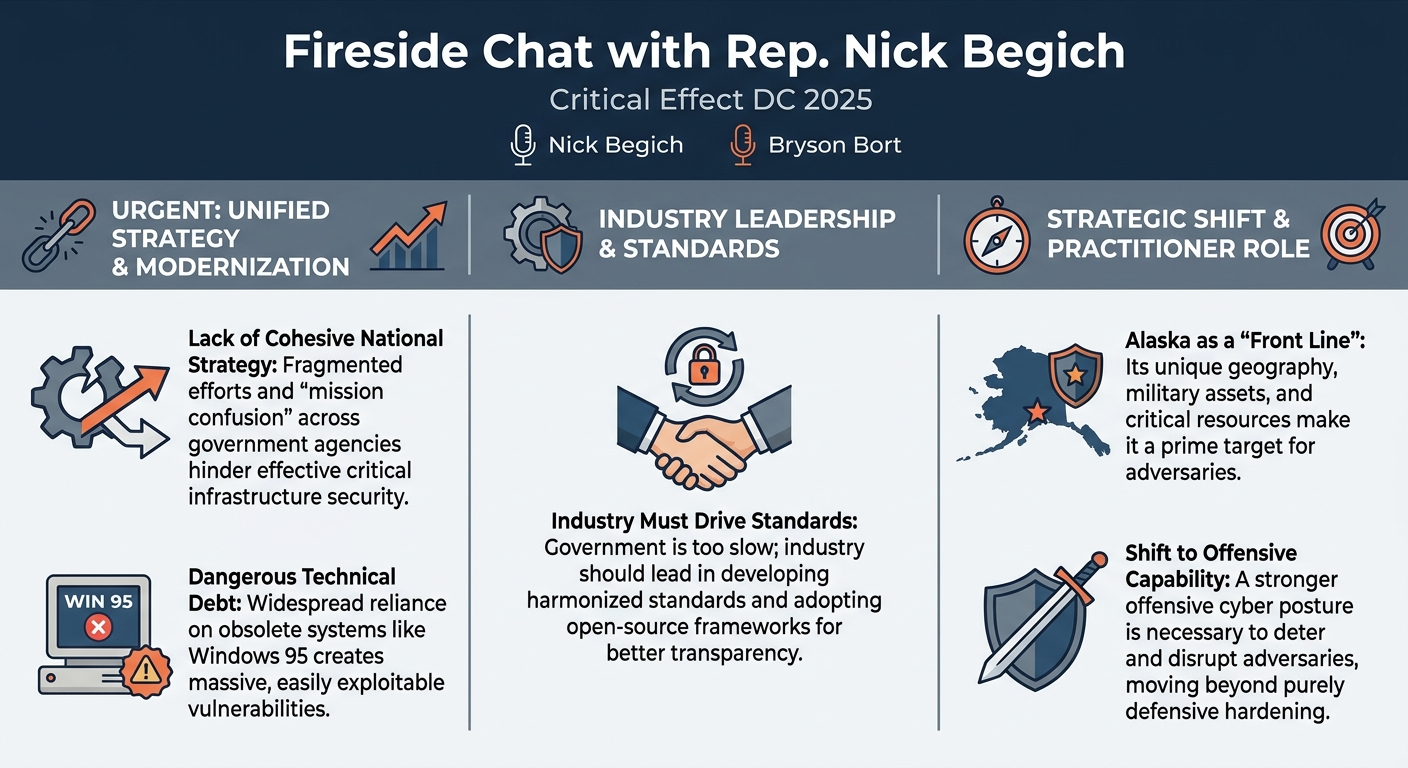
- Urgent Need for Unified Strategy: The U.S. lacks a cohesive national strategy for critical infrastructure security, suffering from fragmented efforts and "mission confusion" across government agencies.
- Dangerous Technical Debt: Widespread reliance on dangerously outdated and unsupported systems, such as Windows 95 in air traffic control, creates massive, easily exploitable vulnerabilities.
- Industry Must Lead on Standards: Government is too slow to set effective standards; industry must take the lead in driving harmonized standards and adopting open-source hardware and software to reduce attack surface and improve security transparency.
- Alaska's Strategic Importance: Alaska is a critical "front line" for national defense and economic security, housing vital military assets and critical mineral/energy resources, making its infrastructure a prime target.
- Shift to Offensive Posture: A stronger offensive cyber capability is necessary to deter and disrupt adversaries, moving beyond a purely defensive hardening strategy.
- Practitioners Must Engage: Cybersecurity professionals are urged to actively engage with policymakers, providing expert-driven policy ideas and solutions to inform legislative action and secure critical infrastructure.
About the Speaker(s)
Nick Begich is a U.S. Representative for Alaska's at-large congressional district (AK-1) in the U.S. House of Representatives. Before his political career, Rep. Begich spent approximately 25 years in the technology sector. His experience ranges from foundational network infrastructure work (running Cat 5 cable, dropping hubs and switches) to software development, a global technology manager role at Ford Motor Company, and eventually founding and growing his own software development company to 150 employees across three countries. He currently serves on three key House committees: Natural Resources, Transportation and Infrastructure, and Science, Space, and Technology. Within these, he holds vice chairmanships for the subcommittees on Energy and Mineral Resources, and Railways, Pipelines, and Hazardous Materials, giving him direct oversight on critical infrastructure issues. A Republican, he comes from a family with a long history in Democratic politics, bringing a unique, bipartisan perspective to his role.
Bryson Bort is a prominent figure in the cybersecurity community and served as the moderator for this fireside chat. He is associated with the ICS Village, an organization dedicated to improving the security of industrial control systems through hands-on education and awareness. Bort has a background that includes work with the Army Cyber Institute, where he was involved in projects such as Jack Voltaic, which examines the interdependence of civilian critical infrastructure and military force projection. His expertise lies in operational technology (OT) security and the strategic implications of cyber threats on national security.
Reviews
Dr. Zero (Offensive Security Researcher) — SOLID
Congressmen talking cyber usually means an hour of meaningless buzzwords, but Begich actually knows his shit. He admits the government is too slow to regulate ICS standards and explicitly tells the industry to build open-source frameworks themselves. Solid policy chat, even if half of it was standard political stumping for his home state's infrastructure budget.
Heather Calloway (CISO) — SOLID
Representative Begich delivers a clear-eyed assessment of critical infrastructure policy, correctly identifying that the government moves too slowly to define operational security standards. For any CISO in energy, transport, or manufacturing, this is a highly relevant briefing that validates the need to self-regulate and aggressively manage legacy technical debt before federal mandates force chaotic compliance.