Why Critical Effect? Why Now?
Bryson Bort (ICS Village), Joshua Corman (Institute for Security and Technology)
Critical Effect DC 2025 · Day 1 · Track I: Critical Mass
Overview
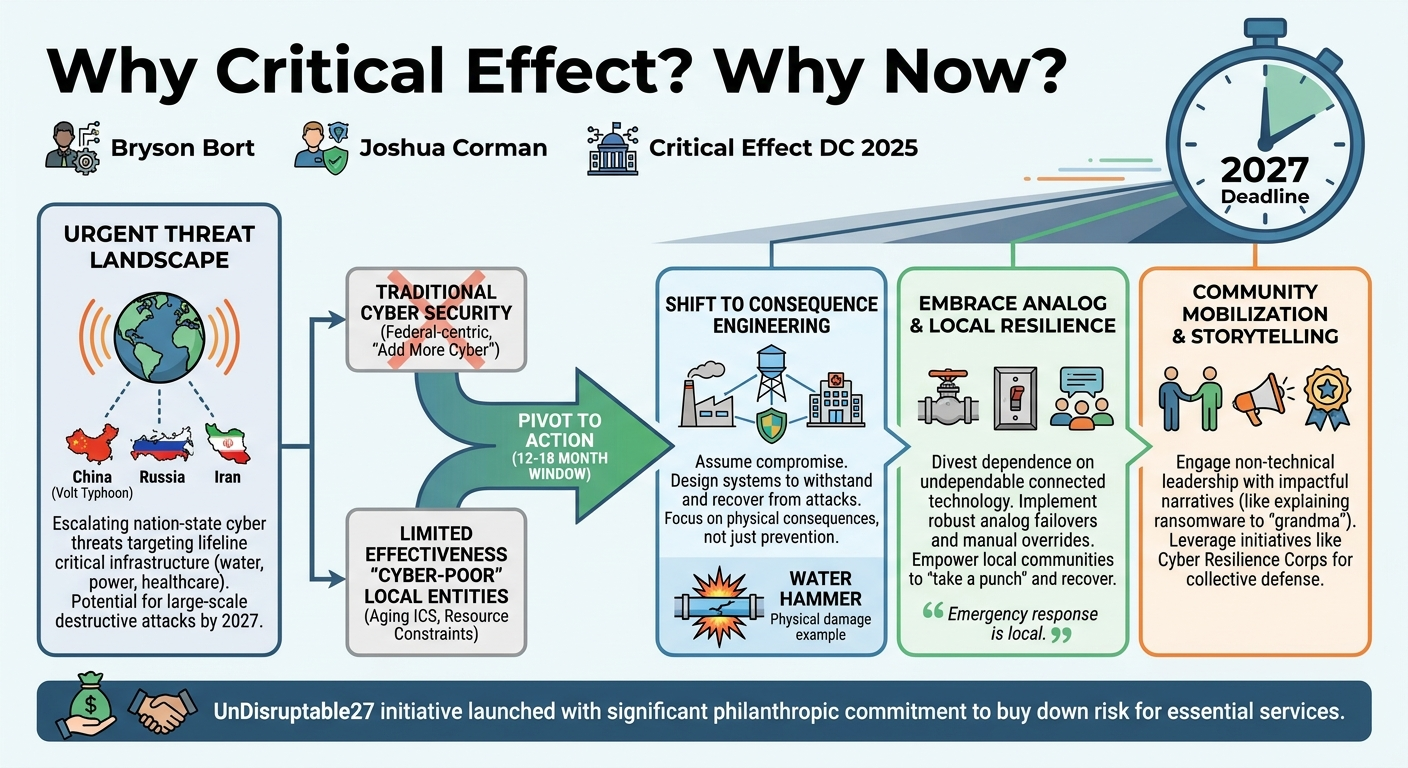
This talk, delivered by Bryson Bort of ICS Village and Joshua Corman of the Institute for Security and Technology, serves as a powerful call to action, launching the Critical Effect conference and the "UnDisruptable27" initiative. The core message revolves around the urgent and escalating threat posed by nation-state adversaries to critical infrastructure, particularly water, power, and healthcare systems, with a looming deadline of 2027. The speakers emphasize that traditional, federal-centric cybersecurity approaches are insufficient, especially for the vast majority of "cyber-poor" local communities and asset owners operating aging industrial control systems.
Key moments
- 0:00 Storytelling: Explaining cyber risks to 'grandma'
- 5:30 Joshua Corman: The urgent 'UnDisruptable27' project
- 7:50 Interdependencies of basic human needs: water, power, healthcare
- 10:00 The 'water hammer' example: Physical consequences of cyber attacks
- 12:00 'UnDisruptable27' video: The threat and resilient solutions
- 16:00 Call to action: Local resilience, being ready to 'take a punch'
- 17:00 Craig Newmark announces $3.2M funding for UnDisruptable27
Why Critical Effect? Why Now?
Speakers: Bryson Bort (ICS Village); Joshua Corman (Institute for Security and Technology)
Conference: Critical Effect DC 2025
YouTube: https://www.youtube.com/watch?v=uf_CHjAm9RQ
Overview
This talk, delivered by Bryson Bort of ICS Village and Joshua Corman of the Institute for Security and Technology, serves as a powerful call to action, launching the Critical Effect conference and the "UnDisruptable27" initiative. The core message revolves around the urgent and escalating threat posed by nation-state adversaries to critical infrastructure, particularly water, power, and healthcare systems, with a looming deadline of 2027. The speakers emphasize that traditional, federal-centric cybersecurity approaches are insufficient, especially for the vast majority of "cyber-poor" local communities and asset owners operating aging industrial control systems.
The talk articulates a pivot from broad cybersecurity discussions to focused, actionable strategies for building local resilience against potentially destructive attacks within an aggressive 12-18 month timeline. It highlights the critical need for better storytelling to engage non-technical leadership, a shift towards "consequence engineering" that assumes compromise, and the implementation of practical, often non-cyber, analog solutions. The initiative, significantly bolstered by a multi-million dollar commitment from philanthropist Craig Newmark, aims to mobilize communities and individuals to protect essential services, recognizing that the "cavalry isn't coming" in time.
Background
▶ Watch: Storytelling: Explaining cyber risks to 'grandma' (0:00)
The foundation of this critical discussion is rooted in the long-standing challenges plaguing Industrial Control Systems (ICS) and critical infrastructure. Bryson Bort opens by humorously, yet pointedly, noting that many ICS are "at least 20 years old," often running outdated operating systems like Windows 95 or Windows XP. This legacy infrastructure, built to last for decades, inherently slows down cybersecurity improvements, creating a significant vulnerability landscape that technical solutions alone cannot swiftly address. The core problem, as Bort identifies, is not merely technical, but one of effective communication and "storytelling" to convey complex cyber risks to non-technical leadership, comparing it to explaining ransomware to a grandmother. The Colonial Pipeline incident is cited as a stark example of a "bad thing" that finally made "ransomware" a household term, illustrating the need for impactful narratives.
Joshua Corman expands on this historical context, referencing his 13 years with I Am The Cavalry.org, an initiative that advocated for security in connected technologies. He points to the slow pace of regulatory change, noting it took nine years to pass minimum regulations for medical devices and four years for an IoT law. This underscores a prevailing "patiently impatient" disposition within the cybersecurity community, which Corman now declares unsustainable. The shift to urgency is driven by a stark reality: people experience "disruptions"—to payroll, flights, patient care—rather than abstract "breaches" or Indicators of Compromise (IOCs) and Tactics, Techniques, and Procedures (TTPs). These disruptions are increasing in frequency, scale, and life-safety implications, exacerbated by the introduction of "weapons of war" into the cyber domain.
A pivotal moment arrived on January 31st of the preceding year, when the "four horsemen of the cyber apparatus of the US government" delivered an unclassified briefing on Volt Typhoon. This Chinese state-sponsored cyber actor has been "routinely compromised lifeline critical infrastructure" in the US, with stated intentions towards Taiwan and a desire for the US to remain uninvolved. This credible, imminent threat, coupled with the systemic vulnerabilities of aging infrastructure and the "cyber poverty line" – a concept coined by Wendy Nather in 2013 describing the vast majority of organizations lacking adequate resources – forms the urgent backdrop for the "UnDisruptable27" project. The project's goal, therefore, is to identify and implement measures to "buy down risk in 12 to 18 months," specifically targeting the interdependencies between power, water, and emergency healthcare.
Key Findings
▶ Watch: Interdependencies of basic human needs: water, power, healthcare (7:50)
The talk presents several critical findings that collectively paint a sobering, yet actionable, picture of the current cybersecurity landscape for critical infrastructure:
- Imminent Nation-State Threat: The most pressing finding is the confirmed, credible threat of destructive cyberattacks by nation-state adversaries, specifically China's Volt Typhoon, but also including Russia and Iran. These actors have already "routinely compromised lifeline critical infrastructure" and are believed to be capable of escalating attacks to a "large-scale destructive" level as early as 2027. This timeline dictates an urgent, focused response within the next 12 to 18 months, moving beyond theoretical discussions to immediate, practical action.
- The "Cyber Poverty Line" and Resource Disparity: A significant portion of critical infrastructure, particularly the estimated 150,000 water systems across the US (with 50,000 servicing communities and 6,000 supporting hospitals), operates "below the security poverty line." These "target-rich, cyber-poor" entities, often small, isolated communities or single IT departments at electric co-ops, lack the time, resources, and expertise to implement complex cybersecurity measures or even attend conferences. This disparity necessitates solutions that "meet people where they are" rather than imposing top-down, federal mandates.
- Critical Interdependencies and Cascading Failures: The talk highlights the dangerous interdependencies between essential services. For example, "No water means no hospitals in about four to six hours," and "No power means no pumps. No pumps means no pressure. No pressure means no hospitals, no fire hydrants." An attack on one sector can rapidly cascade into others, leading to widespread societal disruption, affecting basic human needs like water, food, power, and timely access to patient care, with direct implications for mortality rates.
- Ineffectiveness of Traditional Cyber Solutions for Urgent Needs: Given the legacy nature of ICS (often 20+ years old) and the limited resources of many operators, traditional "add more cyber" approaches are often impractical within the urgent 12-18 month window. The speakers emphasize that "cyber people are holding a cyber hammer and everything looks like a cyber nail," but for many critical infrastructure facilities, adding cyber is not feasible. This necessitates a shift towards consequence engineering – designing systems to withstand or rapidly recover from attacks, rather than solely preventing initial compromise.
- The Power of Local Resilience and Non-Cyber Solutions: Many creative and effective solutions emerge from the asset owners and operators themselves, focusing on practical, often analog, measures. The emphasis is on enabling communities to "take a punch" and recover quickly. This involves divesting reliance on "undependable technology," better securing existing systems, and crucially, ensuring robust analog solutions are in place when digital systems fail. This localized approach is critical because "emergency response and disaster management is local."
- The Need for Better Storytelling and Engagement: Effective communication with non-technical leadership is paramount. The industry must move beyond technical jargon and create compelling narratives that explain the impact of cyber threats on everyday life, similar to how the Colonial Pipeline incident made "ransomware" understandable to "grandma." This communication is essential to garner support and resources for resilience efforts.
Technical Deep Dive
▶ Watch: The 'water hammer' example: Physical consequences of cyber attacks (10:00)
The technical exposition within the talk focuses less on novel attack techniques and more on the inherent vulnerabilities of Industrial Control Systems (ICS) and the devastating physical consequences that can arise from cyber exploitation. A central theme is the age and fragility of these systems, with Bryson Bort noting that many ICS are "at least 20 years old" and commonly run legacy operating systems like Windows 95 or Windows XP. These systems, designed for longevity rather than rapid updates, present a significant attack surface that is costly and time-consuming to secure through traditional means.
Joshua Corman introduces Volt Typhoon, identified by US government cybersecurity leaders as a People's Republic of China state-sponsored cyber actor. This adversary is not merely probing networks but has "already routinely compromised lifeline critical infrastructure," indicating a persistent presence and capability for pre-positioning within critical systems. While the talk does not detail Volt Typhoon's specific Tactics, Techniques, and Procedures (TTPs), its association with "weapons of war" and the threat of "large-scale destructive attacks" underscores a shift from espionage to potential kinetic effects.
A key technical vulnerability highlighted is the water hammer effect. This is not a cyberattack in itself, but a severe physical consequence that can be triggered by manipulating water control systems through cyber means. A water hammer occurs when there is a "sudden change" in water flow, such as an abrupt stop or reversal, which sends a destructive "shock wave" through pipelines. This physical phenomenon can lead to "destructive or explosive damage," bursting water mains. The video demonstration graphically illustrates how such an event, if orchestrated concurrently across the "pressure zones of all the US hospitals," would be catastrophic, disrupting water supply for critical medical functions like sterilization, surgery, and laboratories, and rendering fire hydrants useless. This highlights the concept of operational technology (OT) attacks leading to physical world impact.
The talk also underscores the profound interdependencies between critical infrastructure sectors. The technical vulnerability of one system can cascade rapidly into others. For instance, an attack on the power grid would directly impact water systems: "No power means no pumps. No pumps means no pressure." This loss of pressure would then prevent water delivery to hospitals and emergency services, creating a domino effect. This intricate web of connections means that a seemingly isolated cyberattack on one utility can have widespread, cross-sectoral physical consequences, akin to a natural disaster.
Given these realities, the proposed "UnDisruptable27" project moves beyond purely cyber defenses. It advocates for consequence engineering, designing systems and processes to "engineer down the consequences of those attacks." This includes a focus on analog solutions and divesting reliance on connected technology where it is not absolutely necessary. For instance, if a digital control system is compromised, having manual overrides or physically separated backup systems becomes a critical resilience measure. The challenge is immense, with approximately 150,000 water facilities nationwide, of which 50,000 service communities and 6,000 support hospitals. Securing these diverse and often resource-constrained environments requires innovative, practical solutions that acknowledge the limitations of "adding cyber" within a short timeframe.
Demo / Proof of Concept
▶ Watch: Call to action: Local resilience, being ready to 'take a punch' (16:00)
While no live hacking demonstration was performed, the talk effectively utilized a "moving storyboard draft" video to serve as a powerful conceptual demonstration of the threats and their devastating consequences. This visual aid was explicitly designed to "meet people where they are" and communicate complex cyber-physical risks without relying on technical jargon, making it accessible to non-experts, including community leaders and the general public.
The video vividly depicted the water hammer attack scenario. It illustrated how an intentional, abrupt stop or reversal of water flow could send a destructive shockwave through water systems, leading to burst water mains. Beyond the immediate physical damage, the video then showcased the cascading effects of such an attack on essential human needs and critical services:
- Daily Life Disruption: No water would mean "no coffee, no toilets, no laundry," impacting the basic quality of life for communities.
- Emergency Services Impairment: Crucially, "no water also means no hydrants to put out fires," severely hindering the ability of emergency responders to combat urban conflagrations.
- Healthcare Catastrophe: The most impactful part of the demonstration highlighted the complete incapacitation of healthcare facilities. "The hospital can't run without clean water" was a stark message, followed by the specific implications: "no sterilization, no surgery scrubbing, no laboratories, and eventually no access to life-saving care." This powerfully conveyed the direct link between water infrastructure and patient mortality.
The video also reinforced the context of the threat, mentioning that "foreign actors are already weaponizing these vulnerabilities" and specifically named Volt Typhoon (People's Republic of China), along with Russia and Iran, as aggressors. It underscored the potential for escalation from disruption to "large-scale destructive attacks" by 2027. The demonstration concluded by advocating for defensive strategies such as "divesting our reliance on connected technology," "better securing our existing systems where we cannot disconnect," and ensuring "analog solutions are in place when those systems fail," effectively illustrating the multi-faceted approach of the "UnDisruptable27" initiative. This "storyboard" served as a compelling visual argument for the urgency and severity of the problem, and the need for immediate, localized resilience efforts.
Defensive Implications
▶ Watch: Craig Newmark announces $3.2M funding for UnDisruptable27 (17:00)
The talk offers a paradigm shift in defensive strategy, moving away from a sole focus on preventing breaches to an emphasis on resilience and consequence engineering. Given the inevitability of compromise for many critical infrastructure entities, the core defensive implication is to "assume we're going to get compromised" and ensure that "the worst punch thrown isn't that bad or that you can take that punch."
Here are the key defensive implications:
- Prioritize Local Resilience and Response: The federal government or "the beltway" cannot solve this problem alone. "Emergency response and disaster management is local." Defenders must focus on empowering state and local entities to build resilience within their communities. This involves connecting with municipal leadership, emergency response, and crisis management teams, teaching them about cyber risks, but also learning from their existing disaster preparedness expertise.
- Shift to Consequence Engineering: Instead of just "adding cyber," the focus must be on engineering down the consequences of attacks. This means identifying critical interdependencies (e.g., power-water-healthcare) and designing systems and processes that can withstand or rapidly recover from a loss of service. This approach is particularly vital for the "target-rich, cyber-poor" entities that cannot afford extensive cybersecurity investments.
- Embrace Analog Solutions and Disconnection: A critical defensive strategy is to "divest our reliance on connected technology" where possible. For systems that cannot be disconnected, the focus is on "better securing our existing systems." Crucially, defenders must ensure "analog solutions are in place when those systems fail." This could involve manual overrides, physically separated backup systems, or non-digital communication methods to maintain essential services during a cyber-induced outage. The mantra is clear: "If you can't afford to protect it, you can't afford to connect it."
- Meet Asset Owners Where They Are: Effective defense requires understanding the practical constraints of asset owners and operators. Instead of dictating solutions, defenders should engage by asking, "What's the worst you could do?" or "What's the worst case that could happen?" and then collaboratively identify solutions "within the time, the budget, the skill that we have." This bottom-up approach fosters creativity and ensures solutions are implementable.
- Community Mobilization and Personal Responsibility: Cybersecurity for critical infrastructure is no longer solely a government or private sector responsibility. Individuals are urged to "make this personal," engage with local leadership, attend town hall meetings, ask pertinent questions about local infrastructure resilience, and "offer your assistance." Initiatives like the Cyber Resilience Corps are being developed as "one-stop shops" to connect volunteers with communities needing help, fostering a collective defense effort.
- Focus on Specific, Urgent Lifelines: The "UnDisruptable27" project prioritizes the safety, security, and resilience of three specific "lifeline basic human needs": water, power, and timely access to emergency care, particularly at the local level. This narrow focus within the 12-18 month timeline allows for concentrated effort and measurable risk reduction against the specific threat posed by actors like Volt Typhoon.
- Improved Storytelling and Communication: To garner support and drive action, defenders must improve their ability to tell compelling stories about cyber risks and their real-world impact. This means translating complex technical details into simple, relatable narratives that resonate with non-technical leadership and the broader public, akin to explaining ransomware to a grandmother.
Key Takeaways
- Imminent Nation-State Threat: Critical infrastructure, especially water, power, and healthcare, faces an urgent and credible threat from nation-state adversaries like China's Volt Typhoon, with destructive attacks possible by 2027.
- Local Resilience is Paramount: Traditional federal-centric cybersecurity is insufficient; the focus must shift to empowering "cyber-poor" local communities and asset owners to build resilience and respond effectively to disruptions.
- Consequence Engineering over Prevention: Given the legacy nature of ICS and the urgency, defenders should assume compromise and prioritize "engineering down the consequences" of attacks, ensuring systems can "take a punch" and recover quickly.
- Embrace Analog and Disconnect: Practical solutions include divesting reliance on undependable connected technology, securing existing systems, and critically, implementing robust analog solutions as failovers when digital systems are compromised.
- Community Mobilization is Essential: Individuals are called to action to engage with local leadership, offer assistance, and leverage initiatives like the Cyber Resilience Corps to build community-level defense and resilience.
- Interdependencies Drive Risk: Attacks on one sector (e.g., power) can cascade rapidly to others (e.g., water, healthcare), leading to widespread societal disruption, emphasizing the need for a holistic, interconnected view of resilience.
About the Speaker(s)
Bryson Bort is a prominent figure in the cybersecurity community, known for his work with the ICS Village, a nonprofit organization dedicated to improving the security of industrial control systems. He has extensive experience working with "hundreds of asset owners throughout the world," giving him a deep understanding of the practical challenges faced by critical infrastructure operators. Bort is the driving force behind the Critical Effect conference, which he rebranded after seven years of organizing the "Hack the Capitol" event, signifying a renewed focus on impactful outcomes and actionable strategies. His perspective emphasizes the need for better storytelling in the industry to bridge the gap between technical experts and non-technical leadership.
Joshua Corman is a distinguished security strategist and a founding member of the Institute for Security and Technology. He is also widely recognized for co-founding I Am The Cavalry.org 13 years prior to this talk, an advocacy group focused on the security of technologies that impact public safety and human life, such as medical devices and IoT. Corman has a long-standing commitment to driving urgency in cybersecurity, having consistently pushed for faster action at conferences for many years. He is the lead visionary behind the "UnDisruptable27" project, an initiative aimed at rapidly buying down risk in critical infrastructure against nation-state threats. His work emphasizes shifting the focus from abstract cyber threats to tangible disruptions and mobilizing communities for local resilience. Corman's efforts for the "UnDisruptable27" project received significant philanthropic funding from Craig Newmark, initially a $700,000 pilot, followed by a generous commitment of $3.2 million over two years to scale the initiative.
Reviews
Dr. Zero (Offensive Security Researcher) — STRONG ACCEPT
Bort and Corman aren't here to drop CVEs; they're here to scream that Volt Typhoon is already sitting in our municipal water systems and the 2027 kinetic threat is real. It’s a strategic talk, but one rooted in the ugly reality that you can’t patch a 25-year-old PLC. Their conclusion—abandoning the 'buy more cyber' delusion in favor of analog fallbacks—is exactly the bitter pill the industry needs to swallow.
Heather Calloway (CISO) — SOLID
Bort and Corman deliver a necessary reality check on the limits of technical mandates for critical infrastructure. This shifts the executive conversation from preventing compromise to surviving it. If your business relies on local utilities or municipal services, this completely changes your business continuity assumptions.