The Future of Cybersecurity Policy and Regulations: A Multiverse Approach
Evan Wolff (Partner · Crowell & Moring LLP), Megan Stifel (Chief Strategy Officer · Institute for Security and Technology), Jeanette Manfra (Global Director of Risk and Compliance · Google Cloud), Randy Sabett (Special Counsel · Cooley LLP)
Critical Effect DC 2025 · Day 1 · Track I: Critical Mass
Overview
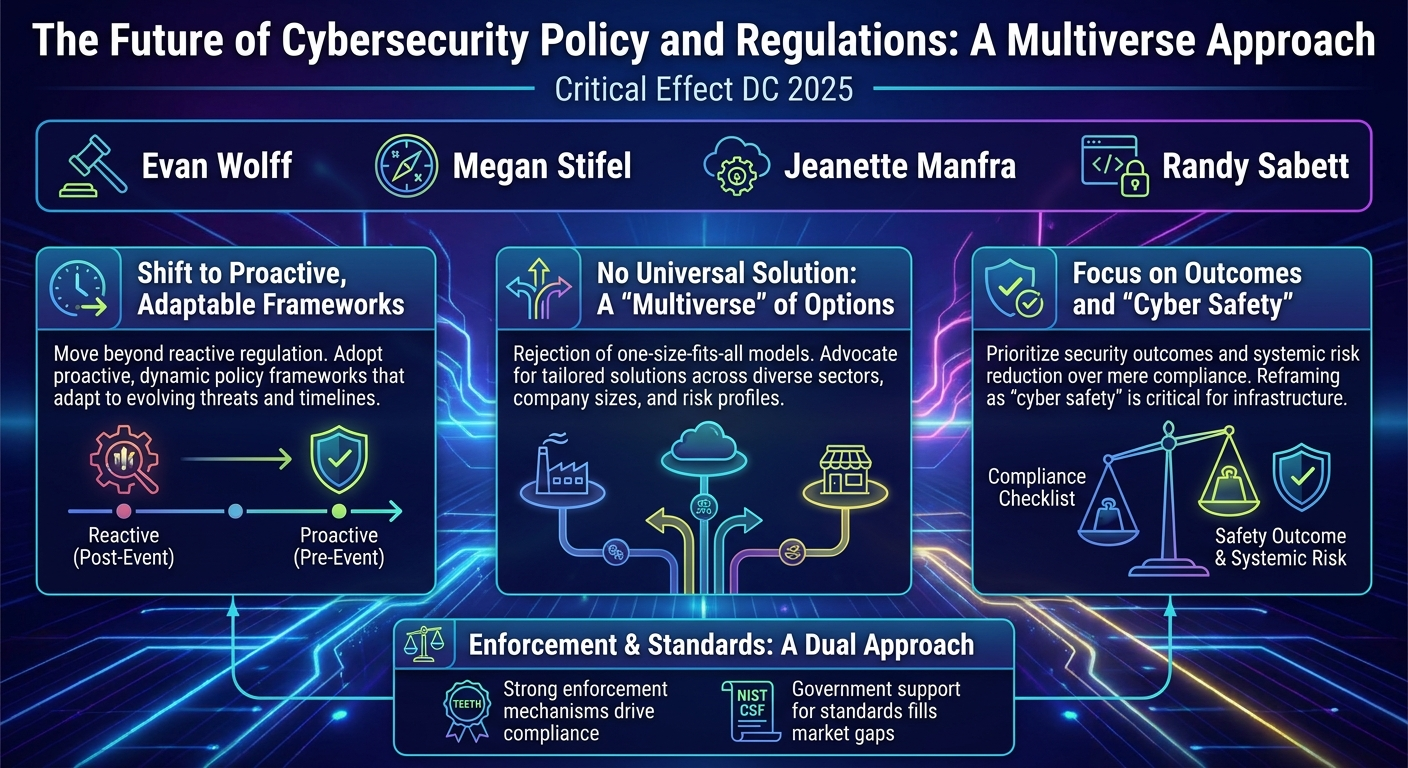
This talk, "The Future of Cybersecurity Policy and Regulations: A Multiverse Approach," presented at Critical Effect DC 2025, delves into the pressing need for a proactive and adaptable framework for cybersecurity governance. Moderated by Evan Wolff, the panel — comprising distinguished experts Jeanette Manfra, Megan Stifel, and Randy Sabett — challenges the traditional reactive approach to regulation, often only spurred by catastrophic events like 9/11. The discussion frames cybersecurity policy not as a monolithic challenge, but as a complex, multi-faceted problem requiring a "multiverse" of solutions tailored to diverse contexts and timelines.
Key moments
- 0:00 Introduction to 'multiverse' approach for proactive regulation
- 19:00 Challenging self-regulation: Does PCI DSS work without a breach?
- 26:30 Critical entities need higher responsibility; understanding systemic risk
- 30:00 Effective regulation requires strong enforcement (DFS, SEC examples)
- 36:00 Reconsidering compliance: achieving security outcomes, not just rules
- 53:00 Shifting cybersecurity policy to focus on human safety standards
- 63:00 Building dynamic regulation and program evaluation into cyber policy
- 68:00 Policy challenge: Designing enforcement without disrupting critical operations
The Future of Cybersecurity Policy and Regulations: A Multiverse Approach
Speakers: Evan Wolff (Partner, Crowell & Moring LLP); Megan Stifel (Chief Strategy Officer, Institute for Security and Technology); Jeanette Manfra (Global Director of Risk and Compliance, Google Cloud); Randy Sabett (Special Counsel, Cooley LLP)
Conference: Critical Effect DC 2025
YouTube: https://www.youtube.com/watch?v=kc00UR0_q4Y
Overview
This talk, "The Future of Cybersecurity Policy and Regulations: A Multiverse Approach," presented at Critical Effect DC 2025, delves into the pressing need for a proactive and adaptable framework for cybersecurity governance. Moderated by Evan Wolff, the panel — comprising distinguished experts Jeanette Manfra, Megan Stifel, and Randy Sabett — challenges the traditional reactive approach to regulation, often only spurred by catastrophic events like 9/11. The discussion frames cybersecurity policy not as a monolithic challenge, but as a complex, multi-faceted problem requiring a "multiverse" of solutions tailored to diverse contexts and timelines.
The core premise of the discussion is that current regulatory models are ill-equipped to handle the intricate and ever-evolving landscape of cyber threats. The panelists, drawing from their extensive backgrounds in law, government, intelligence, and industry, explore four distinct regulatory models, dissecting their strengths, weaknesses, and applicability. The talk emphasizes the critical distinction between general cybersecurity hygiene and the imperative of securing national critical infrastructure, advocating for a nuanced approach that prioritizes systemic risk and human safety.
The significance of this discussion lies in its urgent call for foresight in policy development. By analyzing the shortcomings of existing frameworks and proposing integrated, dynamic solutions, the panel aims to foster a more resilient and secure digital future. The insights offered are crucial for policymakers, industry leaders, and cybersecurity professionals striving to navigate the complexities of governance in an increasingly interconnected and vulnerable world.
Background
▶ Watch: Introduction to 'multiverse' approach for proactive regulation (0:00)
The foundational problem addressed by the panel is the United States' historical tendency to adopt a reactive stance toward cybersecurity regulation. As Evan Wolff highlights, major policy shifts, such as the creation of the Department of Homeland Security or the Patriot Act after 9/11, typically arise after a significant event, leading to hastily constructed and often suboptimal frameworks. The challenge is to conceive and implement effective regulations in advance of a major cyber catastrophe, a task complicated by the inherently cross-cutting nature of cybersecurity, which impacts disparate sectors, company sizes, and types of sensitive information.
The panelists' diverse "origin stories" underscore the multi-disciplinary nature of the problem. Jeanette Manfra, with her background in the Army, intelligence, and building CISA at DHS before moving to Google Cloud, emphasizes the evolving dynamic between industry and government. She passionately believes in a non-intelligence, non-regulatory agency focused on civilian defense but acknowledges the implementation challenges. Randy Sabett, a former crypto engineer at NSA who worked on PKI before it was widely understood, transitioned to law, observing that cyber is unique because it cuts across so many different verticals, making a universal regulatory model difficult. Megan Stifel, whose career spans national security from the House Intelligence Committee to the Department of Justice (working on FISA and policy) and then the NYSE and the Institute for Security and Technology (IST), points to the influence of lawyers in policy decisions and the often-frustrating nature of regulatory work. Evan Wolff, a data scientist, red teamer, and early DHS official involved in foundational policies like PDD63 and HSPD7, highlights the historical lack of clarity around "critical infrastructure" in the U.S., contrasting it with state-owned models in places like China.
The panel then explores four regulatory models, each presenting its own set of challenges and opportunities:
- Industry Self-Certification and Standards-Based Approach (Jeanette Manfra): This model relies on voluntary engagement, often driven by procurement or vendor assessments, utilizing standards like the NIST framework. Manfra notes its prevalence, particularly for software and other vendors. However, she identifies significant drawbacks: the absence of a clear standard of care for companies to benchmark against, and the conflation of the desire for better overall security with the need to mitigate systemic risk. Multinational companies face the burden of triangulating numerous, often conflicting, international standards, offering limited assurance of actual security posture. The question arises whether such self-regulation works without an external stressor, as seen with PCI DSS – a standard that emerged without direct government regulation, yet its enforcement often appears after a breach, rather than proactively preventing one. Randy Sabett challenges the efficacy of self-regulation without "teeth," arguing that enforcement is what truly makes regulations stick.
- Outcome-Based Regulations with Criminal and Civil Penalties (Randy Sabett): This model focuses on regulating incidents and applies strong enforcement mechanisms. Sabett cites New York's Department of Financial Services (DFS) cybersecurity regulations and the SEC cyber rules as prime examples. DFS, in particular, is noted for its "heavy duty enforcement" by teams skilled in both law and technology, compelling companies to proactively improve security to avoid penalties. The SEC rules, with their potential for criminal penalties, create a strong "negative incentive" for public companies. While Evan Wolff acknowledges the effectiveness of enforcement, he pushes back on the idea that it's the only driver for compliance, arguing that many companies comply with regulations even in the absence of strong enforcement. Manfra adds that the purpose of regulation is to fill market gaps and the purpose of compliance is to demonstrate objective achievement; mere compliance for compliance sake often neglects actual security outcomes.
- Traditional Command-and-Control, Sector- and Market-Size-Based Model (Megan Stifel): This approach involves assigning specific regulatory agencies to sectors, often relying on NIST standards. Stifel uses HIPAA as a primary example, questioning its effectiveness in achieving true security or privacy outcomes, citing the widespread use of systems like Epic in healthcare and the inherent vulnerabilities. She argues that if the goal is patient safety and information availability, HIPAA may not be the right model, leading to "bring a rock" scenarios where companies struggle to meet vague or misaligned compliance demands. Stifel also questions whether regulation is always the right incentive, suggesting that market incentives where companies profit from being more secure might be more effective. Evan Wolff clarifies that regulations internalize externalities (e.g., insecure networks, poor data lifecycle management), and while incentives are important, they don't work uniformly across all sectors. He advocates for "NIST-ifying" solutions through peer-based frameworks like the NIST Cybersecurity Framework (CSF), which has become a prolific voluntary framework. Megan Stifel adds that government's role is to set the environment for standards to succeed, drawing a parallel to the US withdrawal from international standards organizations, which China and Huawei subsequently filled. Jeanette Manfra further pushes for clarity on the "externality" or "public good" the government is trying to address, particularly where systemic risk isn't managed by a single organization (the commons effect).
The discussion highlights the immense scale of the problem: Evan Wolff notes that 221,286 companies are impacted by government contracting regulations alone, yet this is only a fraction of businesses online. The panel grapples with the disparity between large entities like Google and small municipal water facilities, emphasizing that a one-size-fits-all approach is impractical. The complexity of supply chains, where a 20-person company could be a single point of failure for systemic risk, further complicates the regulatory landscape.
Key Findings
▶ Watch: Critical entities need higher responsibility; understanding systemic risk (26:30)
The conference talk yielded several critical findings regarding the future of cybersecurity policy and regulations:
- No Universal Solution; A "Multiverse Approach" is Essential: The most prominent finding is the unanimous rejection of a one-size-fits-all regulatory model. Instead, the panelists advocate for a "multiverse approach" that integrates elements from various regulatory paradigms, tailored to specific sectors, company sizes, data sensitivities, and systemic risk profiles. This acknowledges the vast diversity of the digital ecosystem, from Google Cloud to a 20-person company that might be a critical supply chain component.
- Enforcement is a Powerful Driver, But Not the Sole One: While strong enforcement mechanisms, exemplified by New York's DFS and the SEC cyber rules, are highly effective in compelling compliance and improving security postures, they are not the only path. The panel recognized that many companies also comply with regulations voluntarily or due to market pressures. However, for regulations to truly "stick," particularly in areas of high systemic risk, enforcement with "teeth" is often necessary.
- Focus on Outcomes and Systemic Risk to Fill Market Gaps: Effective regulation should be purpose-driven, aiming to fill market gaps where natural incentives fail. There's a critical need to differentiate between general cybersecurity improvements (e.g., basic cyber hygiene) and addressing systemic risk that impacts national security or critical infrastructure. Regulations should strive for clear security outcomes, rather than mere compliance for compliance's sake, which can burden companies without yielding tangible security benefits.
- The Imperative of "Cyber Safety": A significant finding, particularly championed by the audience, is the need to shift the policy narrative from "cybersecurity" to "cyber safety." This reframing connects cyber risks directly to human safety and property damage, leveraging centuries of engineering history in establishing standards of care for physical safety. Unlike cybersecurity, which can be "value-engineered away," cyber safety introduces non-waivable CEO liability, making it a mandatory consideration for critical systems that can kill people or cause widespread damage.
- Government's Role in Setting Conditions for Standards and Addressing "Commons Effect": While industry self-regulation and market incentives are important, government plays a crucial role in creating the environment where standards and frameworks (like the NIST CSF) can succeed. This includes active participation in international standards bodies and a clear focus on addressing the "commons effect" – systemic risks where no single entity is responsible for managing the overall risk to a country or region.
- Need for Dynamic and Evaluated Policies: Cybersecurity is a rapidly evolving domain, necessitating regulatory paradigms that are equally dynamic. This requires mechanisms for continuous evaluation of policy effectiveness (program evaluation) and the ability to adapt controls without constant legislative overhaul. Policies must balance prescriptive inputs with desired outcomes and consider the differing stringencies required for safety-directed versus privacy-directed or monetarily-directed risks.
Technical Deep Dive
▶ Watch: Reconsidering compliance: achieving security outcomes, not just rules (36:00)
While the talk primarily focused on policy frameworks, it implicitly and explicitly touched upon several technical concepts and their implications for regulation. The panelists' backgrounds in fields like crypto engineering, data science, and national security infrastructure provided a practical lens through which to view these policy discussions.
Randy Sabett's early career as a crypto engineer at NSA, working on PKI (Public Key Infrastructure), highlights the foundational technical elements underlying secure communications. His involvement in drafting digital signature guidelines and PKI assessment guidelines demonstrates how deeply technical concepts are translated into policy and legal frameworks to ensure trust and authenticity in digital interactions. The very notion of a "standard of care" in cybersecurity often traces back to such technical specifications and best practices.
The discussion extensively referenced NIST (National Institute of Standards and Technology) frameworks, which are inherently technical in their recommendations. NIST 800-171, for example, is a set of 110 controls designed to protect Controlled Unclassified Information (CUI) in non-federal systems. Evan Wolff cited an incident where a contractor was questioned about which of these 110 controls they failed to implement after a spear-phishing attack. This illustrates the technical specificity of compliance requirements and the challenge of linking control implementation directly to breach prevention, especially against sophisticated attacks. The panel also mentioned the NIST Cybersecurity Framework (CSF), developed through a five-city tour, as a highly successful voluntary framework that provides a common language for organizations to manage and reduce cyber risk. The CSF, while a framework, guides organizations in implementing a range of technical and organizational security controls.
The concept of data footprint was raised by Evan Wolff, discussing a small company with less than 20 employees holding millions of records. This highlights a critical technical-economic imbalance: the volume and sensitivity of data often do not correlate with a company's capacity for security investment or the commensurate insurance coverage. This technical reality drives the need for outcome-based regulations that link security requirements to the actual data risk.
Jeanette Manfra pointed to the technical complexity of supply chains, where even a 20-person company can be a single point of failure for systemic risk within a larger sector. This speaks to the technical interdependencies of modern systems, where vulnerabilities in one small component can cascade into widespread disruption. Understanding these technical dependencies is crucial for identifying and mitigating systemic risks in critical infrastructure.
The state of software security was another technical area of concern. The panelists acknowledged that despite advancements, fundamental issues persist. Evan Wolff mentioned the ritual of "Patch Tuesday" and the ongoing challenge of vulnerability management – identifying and patching vulnerabilities across complex networks – as one of the hardest requirements in any NIST standard. The discussion touched on the need to pressure software companies to release more secure software, rather than using the "world as a global test market" for insecure products (e.g., $300 unencrypted laptops). Josh Corman's reference to SBOM (Software Bill of Materials) further underscores the technical need for transparency and accountability in software components to assess and manage supply chain risk.
The comparison of the FAA's safety culture with its cybersecurity posture provided a fascinating technical paradox. Evan Wolff noted the FAA's perfected safety culture, built on redundancies and human/information system checks, making it the safest aviation system despite using outdated technology like 2600 baud modems in its infrastructure. However, he also pointed out that the FAA is exempt from many traditional federal security regulations (FAR), indicating a strong safety culture doesn't automatically translate to a strong security posture. This highlights a disconnect between operational safety (technical resilience against failure) and cyber security (technical resilience against malicious intrusion), suggesting distinct technical and policy approaches are needed for each.
Finally, the talk briefly mentioned quantum and AI as emerging technical challenges that will necessitate new business incentives and regulatory considerations, reinforcing the dynamic nature of the cybersecurity landscape and the continuous evolution of technical threats.
Demo / Proof of Concept
▶ Watch: Shifting cybersecurity policy to focus on human safety standards (53:00)
This talk was a panel discussion focused on theoretical and practical approaches to cybersecurity policy and regulation, rather than demonstrating a specific technical tool or proof of concept. The "social experiment" aspect of the panel was to collectively explore different regulatory models and their implications through expert commentary and debate. No live demonstration of software, exploit, or system was presented.
Defensive Implications
▶ Watch: Policy challenge: Designing enforcement without disrupting critical operations (68:00)
The detailed discussion on cybersecurity policy and regulation provides several critical defensive implications for various stakeholders:
For Companies and Organizations:
- Proactive Risk Management: Companies should move beyond reactive compliance and adopt a proactive, outcome-based approach to security. This means understanding actual security outcomes desired, rather than just ticking boxes for vague regulatory requirements.
- Commensurate Security Investment: Organizations, regardless of size, must ensure their cybersecurity investments and insurance coverage are commensurate with their data footprint and the potential impact of a breach. Evan Wolff's example of a small company with millions of records but inadequate insurance highlights this gap.
- Supply Chain Resilience: Identify and address single points of failure within their supply chains, especially those involving smaller, less resourced vendors that could pose systemic risk. Jeanette Manfra emphasized the need to understand these technological dependencies.
- Baseline Cyber Hygiene: Implement fundamental cyber hygiene practices, such as MFA (Multi-Factor Authentication) and robust vulnerability management, as non-negotiable baselines. While vulnerability management remains challenging, it's a critical defensive measure.
- Strategic Purchasing Decisions: Leverage purchasing power to demand secure products and services. For government contractors, this could mean opting for FedRAMP moderate solutions (like Google Cloud's GCC High) that inherently meet specific NIST standards.
- Incident Response Preparedness: Acknowledge that breaches are inevitable. Companies are often criticized for their response to an incident, not just the incident itself. Robust incident response plans and capabilities are paramount, leading to executive understanding and investment post-incident.
- Embrace "Cyber Safety": For organizations operating in critical infrastructure sectors where human life or significant property damage is at stake, shift the internal narrative and defensive strategy to "cyber safety." This frames security as a non-waivable liability, akin to traditional engineering safety standards, potentially driving deeper investment and accountability.
For Policymakers and Regulators:
- Tailored Regulatory Approaches: Abandon the one-size-fits-all mentality. Develop a "multiverse" of regulatory models that are flexible and adaptable to different sectors, company sizes, and risk profiles. This includes considering light regulation for startups versus stringent standards for critical infrastructure.
- Focus on Systemic Risk and Market Gaps: Direct regulatory efforts toward addressing systemic risks and market failures where natural incentives for security are absent. The "commons effect," where no single entity manages collective risk, is a prime area for government intervention.
- Empowerment of Standards: Actively support and participate in the development and adoption of industry standards and frameworks (e.g., NIST CSF). Government can set the conditions for these standards to succeed, providing clarity and common ground for industry.
- Effective and Practical Enforcement: Design enforcement mechanisms (like DFS and SEC rules) that have "teeth" but are also practical and do not paralyze critical services. This may involve graduated enforcement penalties and focusing on the most critical entities.
- Invest in Cybersecurity as a Purchaser: As the largest purchaser of IT globally, the government should leverage its buying power to demand and pay for robust cybersecurity in its procurements, making it an allowable cost for contractors.
- Dynamic Policy Evaluation: Integrate program evaluation into cybersecurity policy frameworks. Regularly assess whether policies are achieving their intended security outcomes and be prepared to adapt or remove ineffective controls.
- Prioritize Cyber Safety: Develop policies that explicitly address cyber safety for lifeline critical infrastructure, leveraging established engineering safety principles and focusing on risks that can cause human harm or property damage.
Key Takeaways
- A "Multiverse Approach" is Necessary: Cybersecurity policy cannot rely on a single model; a diverse, adaptable "multiverse" of regulatory frameworks is required to address the varied landscape of threats, sectors, and company sizes.
- Enforcement Drives Compliance, But Not Exclusively: While strong enforcement (e.g., DFS, SEC cyber rules) is highly effective in ensuring compliance, many companies also engage in voluntary security improvements. Effective policy combines both incentives and consequences.
- Shift to "Cyber Safety" for Critical Infrastructure: For systems impacting human life and property, the focus must move from general "cybersecurity" to "cyber safety," leveraging established engineering principles and introducing non-waivable liability to compel mandatory action.
- Outcome-Based Regulation Fills Market Gaps: Regulations should be designed to achieve specific security outcomes and address market failures or systemic risks (the "commons effect") where industry incentives alone are insufficient.
- Government's Role in Standards and Conditions: Government plays a crucial role not just in direct regulation, but in setting the conditions for industry standards (like NIST CSF) to thrive and in actively participating in global standards development.
- Dynamic Policies and Continuous Evaluation are Key: Given the constantly evolving threat landscape, cybersecurity policies must be dynamic, allowing for adaptation and continuous program evaluation to ensure they remain effective and relevant.
About the Speaker(s)
- Evan Wolff is a Partner at Crowell & Moring LLP, where he co-chairs the privacy and cyber practice group. His background includes a Master's in physics and numerical modeling, serving as a data scientist for the government building secure communications overseas, and a red teamer for MITRE. He was instrumental in the early days of the Department of Homeland Security (Office of Homeland Security), working on foundational cyber policy initiatives such as PDD63 and HSPD7. He also holds a professorship at Columbia University.
- Jeanette Manfra serves as the Global Director of Risk and Compliance for Google Cloud, a position she has held for over five years. Prior to her role at Google, she spent a significant tenure at DHS, where she was instrumental in building CISA. Her career began in the US Army, where she served as a signal system support specialist and later in intelligence. Manfra is a passionate advocate for non-intelligence, non-regulatory agencies focused on civilian defense.
- Megan Stifel is the Chief Strategy Officer at the Institute for Security and Technology (IST), a co-sponsor of the Critical Effect DC event. Her career in national security began as a Hill staffer, followed by a role on the House Intelligence Committee. She pursued law school and interned at the Office of Intelligence Policy and Review (OIPR) at DOJ, later working on FISA and cyber policy at the NYSE before joining IST.
- Randy Sabett is a Special Counsel at Cooley LLP, specializing in cyber data privacy practice. He began his career as a crypto engineer at the NSA, where he worked on PKI-related technologies and assembly language programming. He later transitioned to law, co-reporting on the digital signature guidelines and PKI assessment guidelines. Sabett was also a part of the Commission for Cybersecurity for the 44th presidency and often asserts that the current system for cyber regulation is "broken" due to its cross-cutting nature.
Reviews
Dr. Zero (Offensive Security Researcher) — SOLID
This is a policy panel heavy on pedigree but light on novel solutions. Manfra, Sabett, and the rest know exactly where the bodies are buried, but spending an hour concluding that the current regulatory system is broken isn't exactly breaking news.
Heather Calloway (CISO) — SOLID
A sober, heavy-hitting panel on the trajectory of cyber regulation, focusing on the shift from voluntary frameworks to outcome-based enforcement. Worth your general counsel and risk committee's time to understand where executive liability is heading.