Peace through Cyber Strength – What Needs to Change in U.S. Cyber Posture
Lucian Niemeyer (CEO · BuildingCyberSecurity.org), Christopher Cleary (President · Military Cyber Professional Association), Matt Hayden (Vice President of Cyber and Emerging Threats; Former Assistant Secretary of Homeland Security for Cyber, Infrastructure, Risk and Resilience Policy · General Dynamics Information Technology), Michael G. McLaughlin (Co-Leader, Cybersecurity and Data Privacy Practice Group; Principal Policy Advisor · Buchanan Ingersoll & Rooney PC), Mark Montgomery (Senior Director, Center on Cyber and Technology Innovation · Foundation for Defense of Democracies)
Critical Effect DC 2025 · Day 2 · Track I: Critical Mass
Overview
In a candid and thought-provoking panel discussion at Critical Effect DC 2025, a distinguished group of cyber security and national defense experts convened to dissect the current state of U.S. cyber posture and advocate for urgent, transformative change. Titled "Peace through Cyber Strength – What Needs to Change in U.S. Cyber Posture," the talk featured Lucian Niemeyer, Christopher Cleary, Matt Hayden, Michael G. McLaughlin, and Mark Montgomery, each bringing extensive experience from military, government, and private sector roles. The panel's central thesis was clear: the United States must fundamentally rethink its approach to cyber defense, moving beyond reactive measures and fragmented efforts to establish a truly robust and unified cyber strength capable of deterring adversaries and protecting critical national assets.
Key moments
- 1:00 Private sector proactive cyber defense: Letters of Mark
- 9:50 Why isn't cyber security funding landing?
- 14:00 Coast Guard model for a unified cyber force
- 22:00 Cabinet members must prioritize cyber for funding
- 25:00 Localizing cyber threats to drive appropriations
- 35:00 Separate business IT from operational technology
- 40:45 Call to action: Document ideas for policy
- 48:00 Operational technology (OT) is about cyber safety
Peace through Cyber Strength – What Needs to Change in U.S. Cyber Posture
Speakers: Lucian Niemeyer (CEO, BuildingCyberSecurity.org); Christopher Cleary (President, Military Cyber Professional Association); Matt Hayden (Vice President of Cyber and Emerging Threats; Former Assistant Secretary of Homeland Security for Cyber, Infrastructure, Risk and Resilience Policy, General Dynamics Information Technology); Michael G. McLaughlin (Co-Leader, Cybersecurity and Data Privacy Practice Group; Principal Policy Advisor, Buchanan Ingersoll & Rooney PC); Mark Montgomery (Senior Director, Center on Cyber and Technology Innovation, Foundation for Defense of Democracies)
Conference: Critical Effect DC 2025
YouTube: https://www.youtube.com/watch?v=uATv4lfysdQ
Overview
In a candid and thought-provoking panel discussion at Critical Effect DC 2025, a distinguished group of cyber security and national defense experts convened to dissect the current state of U.S. cyber posture and advocate for urgent, transformative change. Titled "Peace through Cyber Strength – What Needs to Change in U.S. Cyber Posture," the talk featured Lucian Niemeyer, Christopher Cleary, Matt Hayden, Michael G. McLaughlin, and Mark Montgomery, each bringing extensive experience from military, government, and private sector roles. The panel's central thesis was clear: the United States must fundamentally rethink its approach to cyber defense, moving beyond reactive measures and fragmented efforts to establish a truly robust and unified cyber strength capable of deterring adversaries and protecting critical national assets.
The discussion underscored a pervasive sense of frustration with the status quo, highlighting the disconnect between the acknowledged severity of cyber threats and the political will and financial resources allocated to address them. The experts challenged the audience and each other to coalesce around actionable recommendations, emphasizing the need for a new executive order or legislative initiatives that can drive meaningful policy shifts. Their collective call to action focused on practical, implementable changes, from reforming force generation models and securing critical infrastructure to fostering stronger collaboration between government and industry.
Ultimately, this talk served as a critical examination of the vulnerabilities inherent in the nation's current cyber strategy, offering a roadmap for a more secure and resilient future. It highlighted that achieving "peace through cyber strength" requires not just technological advancements, but a complete overhaul of how the U.S. government, military, and private sector perceive, prioritize, and fund cyber security, particularly in the face of sophisticated nation-state actors and persistent cybercrime.
Background
▶ Watch: Private sector proactive cyber defense: Letters of Mark (1:00)
The panel painted a stark picture of the current U.S. cyber landscape, characterized by a fragmented and often ineffective defense posture. A core issue identified was the bifurcated nature of national cyber defense, with disparate agencies and entities operating in silos, lacking a cohesive strategy or unified command. This structural deficiency is compounded by a severe force generation model problem, wherein the U.S. struggles to recruit, train, and retain a sufficiently skilled cyber workforce. Mark Montgomery starkly noted, "If we're going to have peace through cyber strength, we actually have to have strength," advocating for an independent cyber service to address this deficit.
The discussion frequently returned to the vulnerability of critical infrastructure, which Matt Hayden described as an "all boats to rise together" problem, where an expectation of collective investment and improvement often falls short. Existing policy frameworks and funding mechanisms are not adequately structured to support a community-based approach at the state level, leaving vital sectors exposed. Furthermore, the panel lamented the breakdown in communication between industry and Capitol Hill, citing the lack of a strong, unified industry voice and a "sleepy" cyber caucus that struggles to champion effective legislation and secure necessary appropriations. While past efforts like the Selenium Commission provided valuable recommendations, a sustained, proactive engagement model is currently absent.
A significant psychological barrier to progress is what the panel termed "risk fatigue" among appropriators. Lawmakers are constantly bombarded with warnings of various "doomsday" scenarios, leading to desensitization and a preference for reactive spending after a major event, rather than proactive investment. Christopher Cleary articulated this challenge by questioning how to "make the argument stick" when the threat is acknowledged, capabilities exist, but resources remain scarce. The panel emphasized that the current approach often prioritizes immediate, tangible costs over the abstract, long-term investments required for robust cyber security, leading to a pervasive underfunding of critical initiatives.
Key Findings
▶ Watch: Coast Guard model for a unified cyber force (14:00)
The panel's deliberations coalesced around several critical findings, illuminating the path forward for enhancing U.S. cyber strength:
- Urgent Need for Policy Reform: The existing policy framework is insufficient. There's a strong call for a new, impactful executive order or robust legislative action that can provide clear direction and funding, moving beyond the perceived shortcomings of recent directives. Lucian Niemeyer even challenged the audience to contribute ideas for a new executive order.
- National Security as the Anchor: To overcome "risk fatigue" and gain political traction, cyber initiatives must be framed with a clear national security narrative. Mark Montgomery proposed starting with securing military mobility (rail, highway, ports, aviation) as a pilot, demonstrating tangible national security benefits that also accrue economic and public safety advantages.
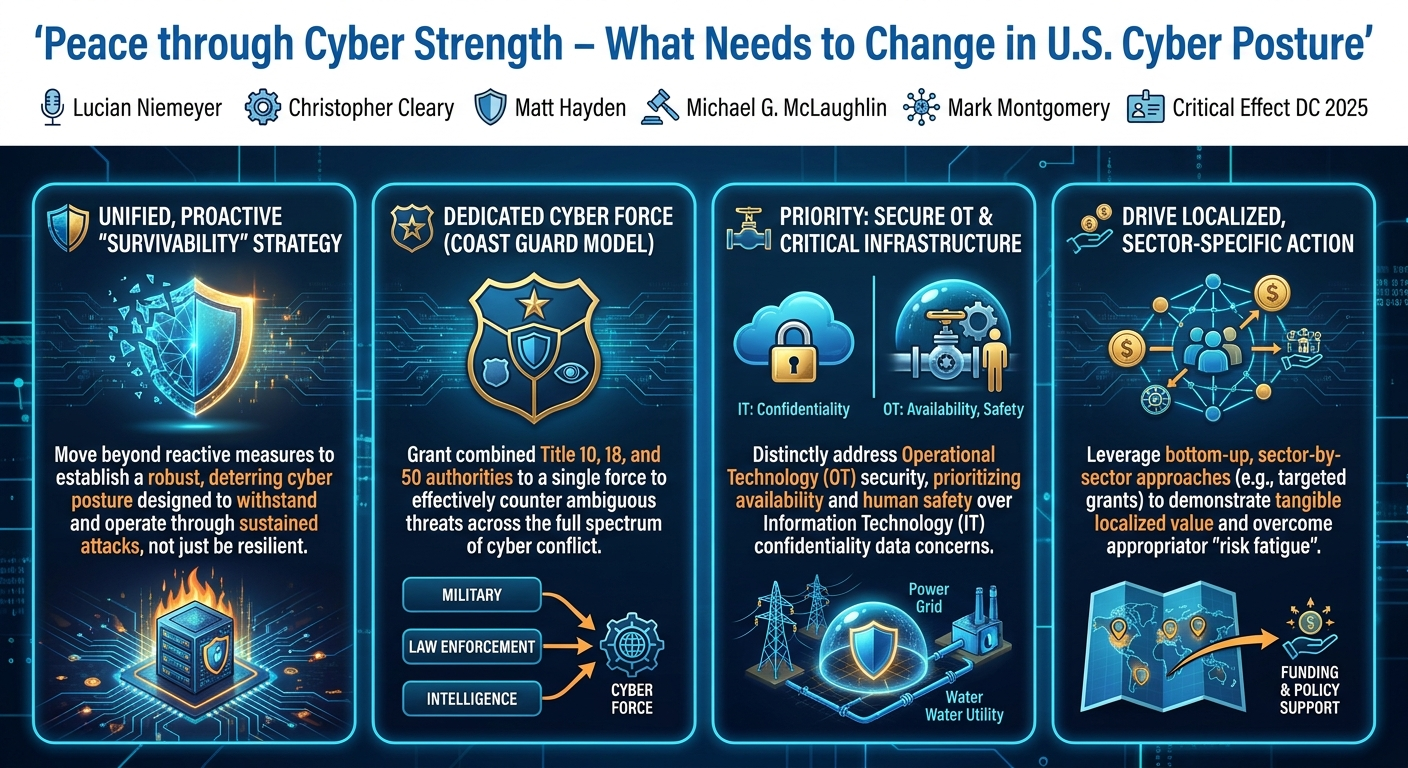
- A Unified Cyber Force with Broad Authorities: The current force generation model is broken. Michael McLaughlin championed adopting a Coast Guard model for a cyber force, granting it Title 10 (military), Title 18 (law enforcement), and Title 50 (intelligence) authorities. This fluidity would enable more effective responses to adversaries who deliberately blur the lines between intelligence, criminal, and military operations.
- Shift to "Survivability" for Critical Systems: Christopher Cleary introduced the concept of moving beyond "secure by design" or mere "resilience" to "survivability." This paradigm shift acknowledges that critical assets face dedicated, well-resourced adversaries and require investments comparable to military assets like an Arleigh Burke destroyer, designed to operate even under attack.
- Targeted, Sector-Specific Funding and Action: Broad, top-down executive orders have proven less effective. The panel advocated for a bottom-up, sector-by-sector approach for critical infrastructure, starting with highly vulnerable areas like water systems. This localized focus, combined with grant programs tied to assessed standards (e.g., NIST), aims to demonstrate tangible results at the constituent level, thereby incentivizing appropriators.
- Distinction Between IT and OT: A critical finding was the profound difference between Information Technology (IT) and Operational Technology (OT). Michael McLaughlin and Lucian Niemeyer stressed that legislators and appropriators often conflate the two. While IT focuses on confidentiality and data protection, OT security is paramount for availability, integrity, and, crucially, human safety, demanding distinct regulatory and investment approaches.
Technical Deep Dive
▶ Watch: Localizing cyber threats to drive appropriations (25:00)
The panel delved into several technical and architectural considerations crucial for bolstering U.S. cyber strength, emphasizing a shift from abstract policy to actionable implementation.
A central theme was the reform of the force generation model for cyber personnel. Michael McLaughlin articulated the vision for a U.S. cyber force inspired by the Coast Guard model. This approach is not about the Coast Guard's scale, but its unique legal framework, which grants its personnel simultaneous Title 10 (military), Title 18 (law enforcement), and Title 50 (intelligence) authorities. In the context of cyberspace, where adversaries like Chinese MSS or military units employ proxies, ransomware groups, and activists to create ambiguity, a cyber force with these combined authorities could fluidly switch hats. This would enable the U.S. to respond effectively across the full spectrum of cyber conflict, from intelligence gathering and law enforcement actions to overt military operations, breaking down the "iron silos" that currently hinder effective responses.
For critical infrastructure security, Mark Montgomery proposed anchoring new directives in a clear national security narrative. He suggested an executive order or National Security Memorandum directing federal agencies involved in military mobility – specifically rail, highway, ports, and aviation systems – to ensure their proper cyber security. This focus provides a clear mission, a defined target set, and a pathway to demonstrating success that can then be expanded. Matt Hayden expanded on this, advocating for a joint cyber operations mindset for these sectors, fostering forced collaboration at a tactical level to operate with a shared understanding of the threat landscape.
The discussion also highlighted the need to fundamentally redefine "security." Christopher Cleary argued for a shift from "secure by design" and basic "resilience" to "survivability." Using the analogy of an Arleigh Burke destroyer, which costs billions not just to float but to remain operational "when it's on fire with holes in it trying to defend itself against a dedicated adversary," he emphasized that critical infrastructure needs comparable investment. This means acknowledging that specific systems face persistent, dedicated attacks and must be engineered and funded to withstand and recover from severe compromise, rather than merely being "out the door" compliant. The current underfunding is stark: the Navy's request of $1.5 billion over the FIDup (Future Years Defense Program), or $300 million a year for cyber security, was considered a mere "rounding error" compared to the $1.3 trillion budget, representing only 0.00007% of the total.
A pivotal technical concept discussed was the distinction between Information Technology (IT) and Operational Technology (OT). The panel stressed that legislators and even some within the executive branch conflate these. IT, encompassing laptops, email, and M365 systems, primarily deals with confidentiality and data breaches. These systems can often be managed by standard hardening processes and managed service providers. In contrast, OT, which controls physical processes in critical infrastructure like water treatment plants or power grids, prioritizes availability and integrity. A compromise here can lead to physical damage, environmental harm, and, most critically, human safety risks. Lucian Niemeyer emphasized, "When we talk OT as a cyber community, we are talking cyber safety. Stop talking cyber security for OT at that point, it's human safety." This distinction demands separate frameworks, regulations, and investment strategies that acknowledge the real-world, kinetic consequences of OT compromise.
Finally, the panel touched upon grant programs and their efficacy. Mark Montgomery noted that while programs exist, like CISA's allocation of $2.2 million to Maryland for statewide cyber security, this amount is "nothing" for widespread impact. Instead, grants should target vulnerable sectors, like water utilities, for initial capex investments, contingent on adherence to established standards (e.g., NIST). This approach, if properly managed with organizations like the AWWA (American Water Works Association), could provide tangible, localized improvements, creating a bottom-up demand for further funding.
Demo / Proof of Concept
▶ Watch: Separate business IT from operational technology (35:00)
While the panel did not conduct a live technical demonstration, they highlighted existing and proposed initiatives that serve as crucial proofs of concept for their recommendations, demonstrating what "good looks like" in practice.
A key example cited was the Mosaic effort within the Department of Defense. This Joint Capability Technology Demonstration (JCTD), spearheaded by the Navy, applied advanced cyber defense concepts to a power station at North Island in California. The Mosaic effort successfully demonstrated a practical zero trust model for critical infrastructure, defining specific pillars and identifying products that meet stringent security criteria. This construct, which involves running various products like Tenable, Armis, and Dragos through rigorous analysis, is now housed at the Applied Physics Laboratory, sponsored by the DoD. The panel emphasized that this DoD-developed framework is "universally applicable across critical infrastructure" but currently underutilized by civilian sectors. The implication is that this proven model could be a blueprint for securing critical infrastructure nationwide.
Beyond existing demonstrations, the panel proposed several "petri dish" scenarios for future proofs of concept. Guam was frequently mentioned, particularly in the context of the Volt Typhoon attack. With the U.S. Navy still owning the island's water system and the Guam Power Authority providing electricity, Guam represents a "relatively small geographical area" with all interested parties present, making it an ideal location to "pull this all together" and demonstrate integrated cyber defense. The panel also cited Charleston and Jacksonville as excellent candidates for pilot programs. These locations offer a rich mix of critical infrastructure – ports, rail junctures, water utilities – allowing for a comprehensive demonstration of integrated cyber-physical security measures, particularly those supporting military mobility. The aim is to generate "groundswell" support from constituents and local authorities who can then advocate for expanded programs to their appropriators, validating the sector-by-sector, bottom-up approach.
Defensive Implications
▶ Watch: Operational technology (OT) is about cyber safety (48:00)
For cybersecurity defenders and organizations, the insights from this panel underscore several critical shifts in strategy and focus:
- Embrace a "Survivability" Mindset: Defenders in critical infrastructure and organizations handling high-value assets must move beyond basic compliance and "resilience" to a "survivability" posture. This means designing systems to withstand and operate through sustained, sophisticated attacks, recognizing that adversaries are dedicated and well-resourced. Investments should reflect the true cost of maintaining operations under duress, similar to military-grade systems.
- Differentiate IT and OT Security: It is imperative for defenders, especially those overseeing critical infrastructure, to establish distinct and tailored security programs for Information Technology (IT) and Operational Technology (OT). While IT focuses on confidentiality and data protection, OT security must prioritize availability and integrity to ensure human safety and prevent physical damage. This requires specialized tools, expertise, and a focus on "cyber safety" rather than just "cyber security."
- Localize and Articulate the Threat: To secure necessary funding and political will, defenders must actively translate abstract cyber threats into concrete, localized impacts. Engage with local city managers, utility operators, and community leaders to document specific vulnerabilities and the tangible benefits of proposed security investments. This localized data can then be leveraged to influence appropriators by demonstrating direct constituent benefit.
- Leverage DoD Innovation for Civilian Infrastructure: Defenders should proactively explore and adapt successful military-grade cyber defense models, such as the Mosaic effort and its zero trust model, for civilian critical infrastructure. These frameworks, often developed with significant resources, offer proven methodologies and product evaluations that can be applied to enhance organizational security.
- Advocate for Policy Change: While often seen as a high-level government function, defenders have a crucial role in advocating for policy reform. By articulating specific needs, demonstrating gaps in current regulations, and highlighting successful local initiatives, they can contribute to the "bottom-up" pressure needed to revive congressional interest, inform new executive orders, and secure long-term legislative fixes.
- Explore Enhanced Authorities and Collaboration: The controversial concept of Letters of Mark and Reprisal for the private sector suggests a radical need for increased capacity in cyber defense. While the direct implementation remains uncertain, it highlights the demand for innovative models of public-private collaboration that might grant the private sector greater authority or clearer legal frameworks to engage in proactive defense. Similarly, fostering joint cyber operations mindset with government agencies (like Northcom models) for collective defense is critical.
- Strengthen Workforce Development: The panel's emphasis on a broken force generation model implies that organizations must invest heavily in training, upskilling, and recruiting cybersecurity talent. This includes supporting initiatives like the National Guard's cyber capabilities, which could serve as a valuable state-level resource for critical infrastructure protection.
Key Takeaways
- The U.S. cyber posture requires a fundamental shift from reactive, fragmented efforts to a proactive, unified strategy focused on achieving "peace through cyber strength."
- Establishing a dedicated cyber force with comprehensive Title 10, 18, and 50 authorities, similar to the Coast Guard model, is essential to effectively counter sophisticated, ambiguous cyber threats.
- Securing critical infrastructure must be prioritized with a clear national security narrative, starting with vulnerable sectors like military mobility (rail, ports) and water systems, and adopting a "survivability" mindset over mere "resilience."
- A critical distinction between IT (confidentiality) and OT (availability, integrity, human safety) must be made in policy, funding, and defensive strategies, recognizing the kinetic consequences of OT compromise.
- To overcome "risk fatigue" among appropriators, cyber initiatives need to demonstrate tangible, localized successes at the district and state levels, driving bottom-up demand for funding and policy support.
- Leveraging proven DoD innovations, such as the Mosaic effort's zero trust model, and fostering public-private collaboration are crucial for scaling effective cyber defenses across the nation's critical infrastructure.
About the Speaker(s)
The panel comprised a formidable group of experts with diverse backgrounds spanning government, military, and the private sector.
Lucian Niemeyer, serving as the CEO of BuildingCyberSecurity.org, brought his extensive experience as a former Senate staffer for 11 years and a three-and-a-half-year tenure in the Department of Defense overseeing installations. He acted as an arbitrator for the panel, challenging participants to focus on actionable future recommendations.
Christopher Cleary is the Vice President of Cyber at Mantech International and also leads the Military Cyber Professional Association, an organization dedicated to representing the cyber community. A retired naval officer, his most significant role in the Department of Defense was as the Principal Cyber Adviser for the Department of the Navy.
Matt Hayden is the Vice President of Cyber and Emerging Threats at General Dynamics Information Technology (GDIT). His prior public service includes a significant role as the Assistant Secretary of Homeland Security for Cyber, Infrastructure, Risk and Resilience Policy, positioning him at the intersection of homeland security, critical infrastructure, and intelligence.
Michael G. McLaughlin is a cyber security attorney and Co-Leader of the Cybersecurity and Data Privacy Practice Group at Buchanan Ingersoll & Rooney PC, where he also serves as Principal Policy Advisor. Before his legal career, he spent 15 years in the Navy as a counter intelligence officer, notably as the senior counter intelligence adviser for US Cyber Command and chief of counter intelligence and human intelligence for the Cyber National Mission Force.
Mark Montgomery is a Senior Director at the Center on Cyber and Technology Innovation at the Foundation for Defense of Democracies. A retired Navy admiral, he previously ran the cyberspacearium mission, bringing a wealth of strategic and operational cyber experience to the discussion.
Reviews
Dr. Zero (Offensive Security Researcher) — SOLID
Another DC policy panel where former operators complain about the structural nightmares they couldn't fix while they were inside. It's competent, and they actually name real programs and funding gaps instead of just waving their hands at 'public-private partnerships,' but you've heard a lot of this before.
Heather Calloway (CISO) — SOLID
This panel accurately diagnoses federal cyber dysfunction, but their legislative solutions won't materialize in time to protect your margins. If you operate critical infrastructure or manufacturing, this talk is worth your leadership team's time to understand the government's shifting expectation from baseline resilience to active survivability.