Keynote with Rep. Rich McCormick
Rich McCormick (U.S. Representative (GA-7) · U.S. House of Representatives)
Critical Effect DC 2025 · Day 2 · Track I: Critical Mass
Overview
In a compelling keynote address at Critical Effect DC 2025, U.S. Representative Rich McCormick delivered a stark assessment of the evolving landscape of national security, emphasizing the paramount role of cyber warfare in modern conflict. Drawing from his extensive background as a Marine and Navy officer, pilot, and physician, McCormick underscored the critical shift from traditional military might—like tanks and heavy artillery—to advanced cyber capabilities. His talk served as a powerful call to action, highlighting the immediate and long-term threats posed by state-sponsored adversaries and the urgent need for a proactive, unified approach to cybersecurity across government, military, and the private sector.
Key moments
- 0:00 Introduction; cyber threats in healthcare and global conflict
- 2:40 Modern warfare: tanks obsolete, cyber is the new battlefield
- 9:00 Addressing Taiwan/Volt Typhoon and critical infrastructure protection
- 14:30 Challenges to national cyber resilience and government funding
- 19:00 Improving communication between cyber experts and Congress
- 28:00 DoD modernization challenges, autonomous systems, and future threats
- 34:00 Proactive cyber strategy and the evolution of military tech
Keynote with Rep. Rich McCormick
Speakers: Rich McCormick (U.S. Representative (GA-7), U.S. House of Representatives)
Conference: Critical Effect DC 2025
YouTube: https://www.youtube.com/watch?v=lxBAymoP5Cs
Overview
In a compelling keynote address at Critical Effect DC 2025, U.S. Representative Rich McCormick delivered a stark assessment of the evolving landscape of national security, emphasizing the paramount role of cyber warfare in modern conflict. Drawing from his extensive background as a Marine and Navy officer, pilot, and physician, McCormick underscored the critical shift from traditional military might—like tanks and heavy artillery—to advanced cyber capabilities. His talk served as a powerful call to action, highlighting the immediate and long-term threats posed by state-sponsored adversaries and the urgent need for a proactive, unified approach to cybersecurity across government, military, and the private sector.
McCormick's address transcended typical political discourse, offering a pragmatic and often candid perspective on the challenges facing the United States. He connected geopolitical tensions, such as the conflict in Israel and the rising threat from China, directly to the daily realities of cyber defense and economic stability. By sharing personal anecdotes and leveraging his diverse professional experience, the Congressman articulated why cybersecurity is not merely a technical concern but a foundational element of national resilience, economic prosperity, and individual safety, particularly in an era where critical infrastructure remains alarmingly vulnerable.
The keynote ultimately aimed to bridge the gap between the technical expertise of the cybersecurity community and the often-slow-moving machinery of government. McCormick advocated for a collaborative ecosystem where innovation is fostered, regulations are streamlined, and a proactive defense strategy is prioritized. His message resonated with the audience, stressing that the future of warfare is already here, fought not on traditional battlefields but in the digital realm, demanding continuous learning, adaptability, and an unwavering commitment to securing the nation's digital frontiers.
Background
▶ Watch: Introduction; cyber threats in healthcare and global conflict (0:00)
Representative Rich McCormick's keynote grounded the discussion of cybersecurity in a palpable sense of geopolitical urgency and historical context. He opened by referencing the immediate situation in Israel, framing it as a direct consequence of expansionist threats and drawing a parallel to the United States as the "big Satan" in the eyes of adversaries, asserting that isolationism is not an option in modern global conflicts. This perspective immediately established the high stakes of the discussion, linking abstract cyber threats to tangible national security implications. He invoked Ronald Reagan’s 40-year-old warning from Point du Hoc that "isolationism never was and never will be the answer to expansionist tyrannical governments," reinforcing the enduring nature of geopolitical challenges.
McCormick then pivoted to the foundational shifts in military strategy, citing Sun Tzu's ancient text, The Art of War, particularly Chapter 13 on spies. He argued that modern warfare is no longer defined by "tanks and LAVs" but by information, crypto, and cyber capabilities. As evidence, he noted the U.S. Marine Corps' decision to divest from tanks and snipers, instead investing in future technologies. This strategic pivot highlights a fundamental change in military doctrine, where digital dominance increasingly outweighs conventional firepower.
The Congressman provided concrete examples of the impact of cyber threats, both domestically and internationally. He recounted the Emory Healthcare system hack which cost "a million dollars per day" and was never fully resolved, forcing the system to "start the entire system over." This incident vividly illustrates the devastating financial and operational consequences of cyberattacks on critical infrastructure. On the international stage, McCormick referenced the sophisticated use of encryption to introduce a virus into Iranian centrifuges, implicitly referring to the Stuxnet attack, which disrupted uranium enrichment. This example showcased the precision and strategic effectiveness of advanced cyber operations.
Furthermore, McCormick highlighted the pervasive nature of cyber threats in daily life, from phones being compromised by viruses at airport charging stations to credit card information being stolen at gas pumps. He also pointed to the economic significance of securing digital transactions, noting that "70% of the world's fintech is done through Georgia," with a significant portion in his own district. This statistic underscores the direct link between cybersecurity and economic stability, making it a critical concern for policymakers.
The Congressman also addressed the challenges posed by foreign adversaries, particularly China. He cited China's "Made in China 2025" initiative, which has seen its economy triple since 2015, largely through what he termed "cheating," having lost 27 cases at the World Trade Organization. This aggressive economic expansion, combined with China's significant investment in AI (50% of all AI researchers globally reside in China), positions them as a formidable and "for real" adversary. The ongoing threat of Volt Typhoon, a Chinese state-sponsored group targeting U.S. water facilities, further exemplifies the direct and immediate dangers to critical American infrastructure. These examples collectively painted a picture of a world where cyber capabilities are central to national power, economic competition, and military dominance, setting the stage for the need for robust and visionary cybersecurity strategies.
Key Findings
▶ Watch: Addressing Taiwan/Volt Typhoon and critical infrastructure protection (9:00)
Representative McCormick's keynote revealed several critical findings regarding the current state and future trajectory of cybersecurity and national defense. Foremost among these is the unequivocal assertion that cyber warfare has supplanted traditional military engagements as the primary battlefield. He stated that tanks are "almost obsolete" and cyber offense and defense represent "the biggest weapon we have right now," capable of "cutting the head off the snake" by disrupting communication, launch capabilities, and countermeasures. This fundamental shift necessitates a complete re-evaluation of defense spending and strategy.
A significant finding is the profound economic impact of cyberattacks. The example of the Emory Healthcare system losing "$1 million per day" and being forced to rebuild its entire system highlights the staggering financial and operational costs. McCormick also underscored the vulnerability of the financial sector, noting that the security of information in fintech—an industry critical to Georgia's economy—is essential for both prosperity and safety. This indicates that cybersecurity is not just a defense issue, but a core component of economic stability and growth.
The vulnerability of critical infrastructure emerged as a recurring and alarming theme. The specific mention of Volt Typhoon targeting U.S. water facilities and the immediate cascading effects—such as "no water means no hospitals in two, four, six hours"—underscores the fragility of essential services. This vulnerability extends to healthcare systems, as evidenced by the Emory hack, emphasizing that disruptions can have immediate and severe public health consequences.
McCormick also highlighted the advanced and "devious" capabilities of adversaries. China's rapid technological advancement, with "50% of all AI researchers" residing there and a history of economic "cheating," positions it as a sophisticated threat. The historical use of viruses (implied Stuxnet) against Iranian centrifuges demonstrates the high level of technical prowess deployed in state-sponsored cyber operations. The Congressman also introduced the chilling prospect of tiny, autonomous drones capable of delivering lethal payloads, illustrating the rapid evolution of offensive capabilities.
The talk emphasized the transformative potential of emerging technologies like Artificial Intelligence (AI) and quantum computing. McCormick declared that the first nation to effectively deploy quantum computing will gain a "major advantage" in areas like code cracking, fundamentally reshaping the landscape of cyber warfare. He stressed that these technologies will force the cybersecurity community to "relearn again everything that you know" in a short timeframe, highlighting the imperative for continuous adaptation and foresight.
Furthermore, the Congressman identified significant governmental challenges hindering effective cybersecurity. These include over-regulation, with "50 different states with 50 different regulations" stifling technological advancement, and a pervasive political division that prevents visionary, proactive policy-making. He criticized the "sleepy cyber caucus" in Congress and the lack of a collective industry voice, leading to a reactive political environment. The revelation that "30% of the Air Force budget is absolutely wasted on things that we don't need" points to systemic inefficiency and a misallocation of resources that could otherwise bolster national cyber defenses and resilience.
Finally, McCormick stressed the importance of resilience—the ability to recover from attacks—but acknowledged its extreme cost and the rapid obsolescence of stockpiled technologies. He argued for a shift from a reactive "Indicators of Compromise (IoC)" approach to a more preemptive and proactive cybersecurity strategy. This proactive stance is already being developed within military cyber cells, but the challenge lies in scaling this across the nation and within a government often hampered by legacy thinking and bureaucratic inertia.
Technical Deep Dive
▶ Watch: Challenges to national cyber resilience and government funding (14:30)
Representative McCormick's keynote, while primarily policy-focused, touched upon several critical technical aspects of modern cyber warfare and defense, emphasizing the rapid evolution of capabilities and threats. He underscored that the digital domain is the contemporary battlefield, where sophisticated techniques can achieve strategic objectives.
One foundational technical concept discussed was the use of secure communications. McCormick, referencing his time as an "Anglicico guy" (a special unit focused on encrypted information transfer), highlighted the importance of frequency hopping and scrambling to ensure communications remain inaccessible to adversaries and resistant to jamming. This foundational element of military communication is now equally critical in civilian infrastructure, particularly in the fintech sector where "70% of the world's fintech is done through Georgia," necessitating robust security for transactions.
The talk alluded to advanced state-sponsored cyber operations, particularly the use of encryption to deliver a virus into Iranian centrifuges, a clear reference to the Stuxnet attack. This sophisticated form of cyber sabotage demonstrates the power of targeted malware to disrupt physical infrastructure without kinetic force. In a similar vein, the ongoing threat from Volt Typhoon, a Chinese state-sponsored group, illustrates the focus on critical infrastructure, specifically targeting "water facilities" to achieve strategic disruption.
McCormick also highlighted common, yet effective, initial access vectors for cyberattacks. He warned against seemingly innocuous actions like plugging a phone into a charger at an airport, which could lead to a supply chain compromise or direct virus infection that "compromises you." Similarly, the theft of credit card information via skimmers at gas stations exemplifies the pervasive nature of data exfiltration threats.
A significant portion of the technical discussion centered on emerging technologies and their impact. Artificial Intelligence (AI) was presented as a dual-use technology, capable of enhancing both offensive and defensive capabilities. The Congressman emphasized that the combination of AI with quantum computing would revolutionize "code cracking" and future warfare. He explicitly stated that the first entity "online" with practical quantum computing would gain a "major advantage," forcing cybersecurity professionals to "totally transform the way you think" about encryption and security.
The discussion also delved into autonomous systems and their role in future warfare. McCormick described highly advanced, miniaturized drones capable of "analyzing everybody, identifying you visually... and then fly to your temple and explode and kill you." This chilling scenario highlights the precision and lethality of autonomous weapons. He also mentioned the obsolescence of traditional artillery (e.g., 155 rounds) due to triangulation counter fires, necessitating the development of "maneuverable weapon systems that can drive themselves"—i.e., autonomous systems for navigation. A critical concern raised was the potential for nuclear arms to be controlled by autonomous systems, citing Russia as a country that has not agreed to disengage from such a dangerous paradigm. The theoretical defense system, Golden Dome, was dismissed as ineffective against a salvo of "100 missiles heading your way" at "Mach 15."
In terms of defense, McCormick acknowledged the shift from traditional, reactive Indicators of Compromise (IoC), which he deemed "inherently reactive and generally useless," to a more preemptive and proactive approach in cybersecurity. He noted that military "cyber cells" are actively employing and learning new tactics, though some advanced capabilities are intentionally withheld to avoid revealing their "hand" to adversaries. The use of "fly-by-wire" as a "throwback" countermeasure against satellite jamming for drones also illustrated the adaptive and sometimes unconventional nature of defensive innovation.
Finally, the Congressman touched on the challenges of modernizing the Department of Defense (DoD). He contrasted the slow, 30-year development cycles of "legacy systems" by large defense contractors (like Lockheed) with the rapid innovation exemplified by figures like Palmer Luckey, who can design and deploy advanced weapon systems "off the shelf" and outperform legacy systems in a single year. This highlights a fundamental technical and organizational challenge within the DoD: the need to embrace agile development and integrate cutting-edge, commercially available technologies. The mention of the ISV (Infantry Squad Vehicle), which was "renovated" in 10 days for training, serves as a proof point that rapid modernization is possible, yet it struggles against entrenched bureaucracy and outdated mindsets (e.g., a staff sergeant "still printing out emails for his boss").
Demo / Proof of Concept
▶ Watch: DoD modernization challenges, autonomous systems, and future threats (28:00)
As a keynote address, Representative McCormick's presentation was primarily conceptual and policy-oriented, focusing on strategic insights, geopolitical context, and legislative challenges rather than technical demonstrations. The talk did not include any live demonstrations, code examples, or specific proof-of-concept showcases of cyber tools or vulnerabilities. The Congressman's role was to articulate the broader implications of cybersecurity for national defense and economic stability, drawing on his experience and knowledge to emphasize the urgency of the issues at hand.
Defensive Implications
▶ Watch: Proactive cyber strategy and the evolution of military tech (34:00)
Representative McCormick's keynote provided a wealth of insights into the defensive implications of the evolving cyber landscape, offering both strategic guidance and practical recommendations for individuals, organizations, and the government.
A paramount implication is the urgent need for a shift from reactive to proactive cybersecurity strategies. McCormick explicitly stated that traditional "Indicators of Compromise (IoC)" are "inherently reactive and generally useless" in the face of sophisticated adversaries. Instead, defenders must embrace a preemptive and proactive approach, anticipating threats and hardening targets before attacks occur. This requires continuous intelligence gathering, threat modeling, and a forward-thinking mindset.
Investment in resilience is critical. The Emory Healthcare hack, which necessitated starting "the entire system over," serves as a stark reminder of the importance of robust recovery plans. However, McCormick acknowledged that resilience is "extremely expensive" and that "stockpiled" technological solutions can quickly become obsolete. This implies a need for dynamic resilience strategies that incorporate continuous updates and adaptability, rather than static stockpiling. Organizations must invest not just in prevention, but also in the capacity to detect, respond to, and recover from breaches with minimal downtime and data loss.
Hardening targets and eliminating "weak links" is another key takeaway. McCormick's analogy from rugby and the Marines—"a good defense is a good offense"—underscores that strengthening defenses makes an organization less appealing to attackers. This involves comprehensive security audits, patching known vulnerabilities, implementing strong access controls, and educating employees on best practices to prevent common attack vectors like phishing or physical device compromise (e.g., airport chargers).
For the government and the wider cybersecurity community, fostering innovation and collaboration is non-negotiable. McCormick criticized "over-regulation" at the state level (50 states, 50 regulations) for stifling technological advancement. He advocated for a more streamlined regulatory environment that encourages, rather than impedes, the development of cutting-edge cybersecurity solutions. He also called for a stronger, more inclusive "cyber caucus" in Congress and a collective industry voice to effectively communicate needs and ideas to lawmakers. This implies that the technical community must actively engage with policymakers through lobbying and direct communication, providing concise and impactful arguments about the economic and security implications of cyber threats.
The Congressman also highlighted the need for modernizing defense spending and recruitment. He revealed that "30% of the Air Force budget is absolutely wasted," diverting funds from critical infrastructure and resiliency efforts. Defenders must advocate for reallocating these resources towards advanced cyber capabilities, research into AI and quantum computing defenses, and rapid development cycles that can compete with agile innovators like Palmer Luckey. Furthermore, the military and government must actively recruit and retain tech-savvy individuals, moving away from outdated mindsets and bureaucratic inertia (e.g., staff sergeants printing emails). The establishment of offensive and defensive cyber training programs, like those for Marines operating "without ever leaving DC," is a positive step that needs expansion.
Finally, McCormick stressed the importance of open testing and competition. He suggested that the cybersecurity community should be "freed up to test each other" against "OP force" (optimal adversaries) in open arenas. This continuous, realistic testing environment, mirroring military training, allows for rapid improvement and the discovery of new defensive techniques, ensuring that capabilities evolve at pace with, or ahead of, adversary advancements. Ultimately, effective defense requires a holistic approach that integrates technological innovation, strategic policy-making, robust resilience planning, and continuous human capital development, all while overcoming political divisions and bureaucratic hurdles.
Key Takeaways
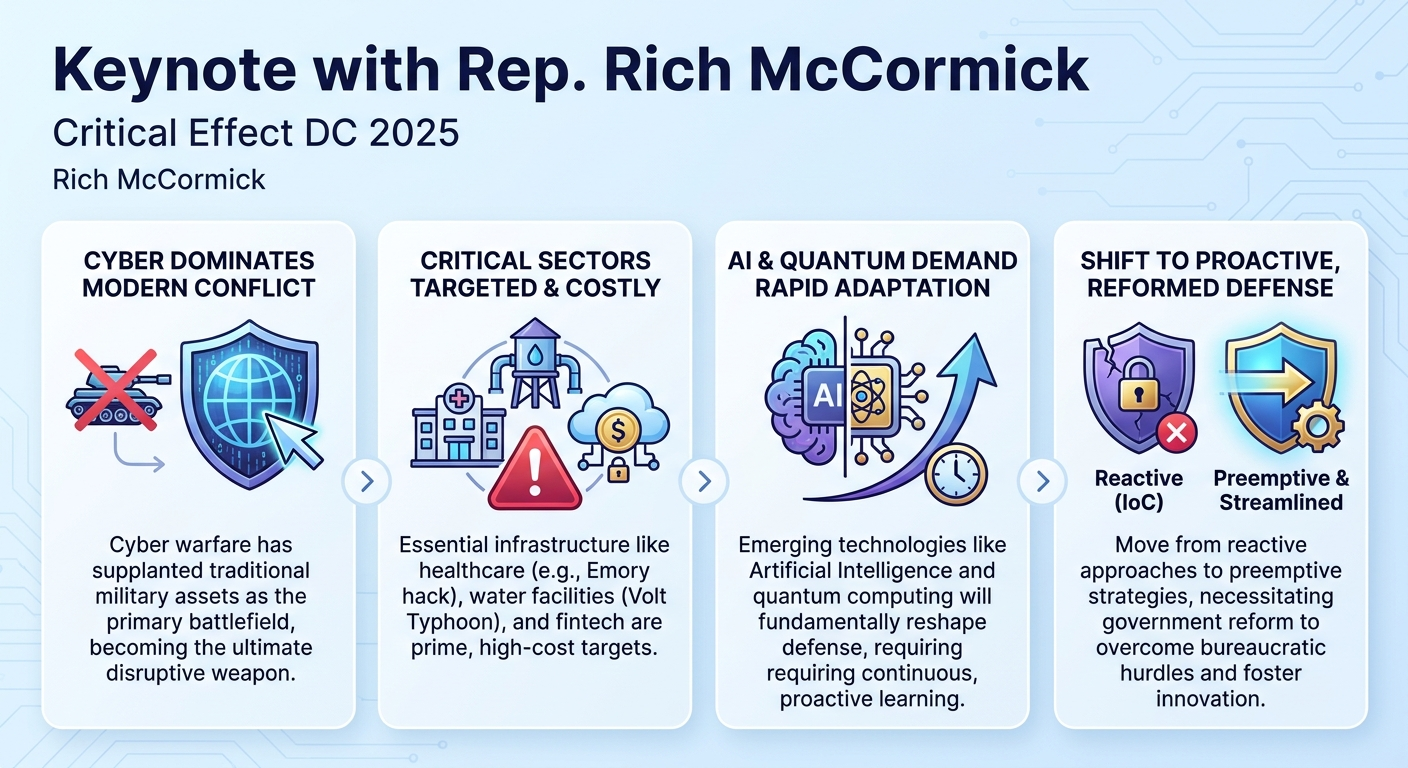
- Cyber Warfare is the Dominant Battlefield: Traditional military assets like tanks are becoming obsolete, with cyber capabilities now serving as the "biggest weapon." National defense and economic stability are inextricably linked to robust offensive and defensive cyber strategies.
- Critical Infrastructure is Highly Vulnerable: Essential services such as healthcare (Emory hack costing $1 million/day), water facilities (Volt Typhoon), and financial systems (70% of global fintech in Georgia) are prime targets, necessitating urgent and sustained protection efforts.
- Emerging Technologies Demand Rapid Adaptation: The advent of AI and quantum computing will fundamentally reshape cybersecurity, requiring continuous learning, proactive defense development, and significant investment to maintain a strategic advantage in areas like code cracking.
- Government Needs Systemic Reform: Over-regulation, political division, and bureaucratic waste (e.g., 30% of the Air Force budget) hinder effective cybersecurity. There is an urgent need for streamlined policies, cross-party collaboration, and a more tech-savvy Congress.
- Resilience is Paramount but Challenging: The ability to recover from cyberattacks is crucial, but it is expensive and constantly challenged by the rapid obsolescence of technology. Strategic, dynamic investment in resilience, rather than static stockpiling, is essential.
- Proactive Engagement is Key: The technical community must actively engage with lawmakers through concise, persistent communication to advocate for policy changes, foster innovation, and ensure that cybersecurity remains a top national priority, shifting from reactive (IoC-based) to preemptive strategies.
About the Speaker(s)
Rich McCormick is a U.S. Representative for Georgia's 7th congressional district. His background is remarkably diverse, bringing a unique perspective to national security and technology discussions. He served for over 16 years in the U.S. Marine Corps and over four years in the U.S. Navy, including deployments to the Persian Gulf, North Africa, and Korea. His military career encompassed roles as a pilot and airborne officer. Beyond his military service, McCormick is a physician, having served as the head of emergency medicine in Afghanistan in 2016 and as a physician during the COVID-19 pandemic. He holds both an MBA and an MD.
In his current role in Congress, Representative McCormick is deeply committed to understanding and addressing the complexities of modern technology and cybersecurity, which he approaches with the intensity of a "PhD course." He has served on the AI Task Force and is involved in cyber-related committees, indicating his dedication to bridging the gap between technical expertise and legislative action. His candor and pragmatic approach, often flavored with humor and military analogies, aim to stimulate productive dialogue on critical national security challenges.
Reviews
Dr. Zero (Offensive Security Researcher) — PASS
Congress just discovered Sun Tzu and Stuxnet. This was an hour of political bingo masquerading as a strategic keynote, offering zero concrete policy proposals, zero funding commitments, and zero reasons for any actual practitioner to tune in.
Heather Calloway (CISO) — WEAK
Representative McCormick delivers a standard macro-level threat briefing from a Washington perspective. He accurately diagnoses the pain of regulatory fragmentation, but drifts too far into sci-fi hypotheticals to be operationally useful for a security program. I wouldn't send this to my board, but I'd note his point on state-level compliance overhead for our general counsel.