Hunting the Intruder: Detecting and Mitigating Rogue Master Devices in ICS
Andre Vianna (Norsk Hydro)
Critical Effect DC 2025 · Day 1 · Track III: Tactical Mastery
Overview
In the critical realm of Industrial Control Systems (ICS), securing operational continuity against increasingly sophisticated threats is paramount. Andre Vianna, a Cyber Security Specialist at Norsk Hydro, delivered a compelling talk at Critical Effect DC 2025, shedding light on a specific, yet often underestimated, vector of attack: the rogue master device. Titled "Hunting the Intruder: Detecting and Mitigating Rogue Master Devices in ICS," Vianna's presentation provided a deep dive into the nature of these threats, their potential impact on critical infrastructure, and practical strategies for detection and mitigation. Drawing from extensive research and real-world field experience, the talk underscored the urgent need for a paradigm shift in how OT environments approach security, moving beyond traditional IT mindsets to embrace process-driven, context-aware defenses.
Key moments
- 0:00 Introduction to rogue master device threat
- 2:45 Evolution of industrial security and growing threats
- 6:00 What defines a master device in ICS?
- 8:00 Rogue master device definition and real-world examples
- 10:45 Rogue master device attack methodology
- 12:15 Passive detection approach and maturity levels
- 14:00 Requirements and process for detection implementation
- 16:40 Conclusion: OT security is about process and alignment
Hunting the Intruder: Detecting and Mitigating Rogue Master Devices in ICS
Speakers: Andre Vianna (Norsk Hydro)
Conference: Critical Effect DC 2025
YouTube: https://www.youtube.com/watch?v=YDrB5MmNJBE
Overview
In the critical realm of Industrial Control Systems (ICS), securing operational continuity against increasingly sophisticated threats is paramount. Andre Vianna, a Cyber Security Specialist at Norsk Hydro, delivered a compelling talk at Critical Effect DC 2025, shedding light on a specific, yet often underestimated, vector of attack: the rogue master device. Titled "Hunting the Intruder: Detecting and Mitigating Rogue Master Devices in ICS," Vianna's presentation provided a deep dive into the nature of these threats, their potential impact on critical infrastructure, and practical strategies for detection and mitigation. Drawing from extensive research and real-world field experience, the talk underscored the urgent need for a paradigm shift in how OT environments approach security, moving beyond traditional IT mindsets to embrace process-driven, context-aware defenses.
The core of Vianna's discussion revolved around clarifying what constitutes a master device in an ICS network, how an unauthorized entity can become a "rogue" master, and the devastating consequences of such an intrusion. He highlighted that while many talks address general OT cybersecurity, the specific nuances of rogue master devices and their detection often remain unaddressed. This oversight creates a significant blind spot in the defense of industrial environments, where an attacker impersonating a legitimate controller can issue malicious commands, disrupt operations, or compromise data integrity. The presentation aimed to equip attendees with the knowledge to understand this threat, analyze its lifecycle, and implement robust detection strategies to safeguard critical infrastructure.
Vianna emphasized that protecting ICS goes beyond patching and traditional IT security tools; it requires a deep understanding of operational technology, a collaborative approach with engineering teams, and a focus on process alignment. His insights are particularly relevant for organizations managing legacy systems, where traditional security updates are often impractical or impossible. By dissecting the attack methodology, exploring passive detection approaches, and outlining tangible implementation requirements, Vianna provided a comprehensive framework for identifying and neutralizing rogue master devices, ensuring the safe and continuous operation of essential industrial processes.
Background
▶ Watch: Introduction to rogue master device threat (0:00)
The evolution of industrial control systems, from the isolated mechanical operations of Industry 1.0 to the interconnected networks of Industry 3.0 and beyond, has brought unprecedented efficiency but also a burgeoning threat landscape. As Andre Vianna pointed out, early industrial systems (Industry 1.0 and 2.0) had little to no security considerations, largely due to their physical isolation. However, with the advent of Industry 3.0 and the integration of networking capabilities, the need for robust security became undeniable. The speaker illustrated this with a simple yet profound observation: as industrial growth has escalated, so too have the threats, mirroring each other's upward trajectory.
A critical challenge in securing ICS environments, particularly those housing legacy systems, is their inherent design. These systems, often built for decades of continuous operation, were not conceived with cybersecurity in mind. This translates to environments where patching is rare, maintenance windows are years apart, and operational continuity takes absolute precedence over security updates. The consequence is a vast attack surface ripe for exploitation, where a cyberattack can lead to large-scale disruption, impacting not just production but potentially human safety and environmental integrity.
Vianna cited the example of an attack attributed to the "GREeski Dendi" cyber threat group, which targeted a steel boiler system. This incident underscored a crucial defensive mindset: the sophistication of threat actors can range from script kiddies to state-sponsored entities, and no single set of tools will provide universal coverage. The effectiveness of security measures is intrinsically linked to the business being protected and the specific ICS environment. This highlights the necessity for tailored, context-specific security strategies rather than a one-size-fits-all approach. Furthermore, Vianna referenced real-world incidents like the Maroochy Water Bridge intrusion and the Dallas Siren Attack. While he clarified these were not strictly rogue master device attacks but rather "rogue activities" or "fake devices" performing unauthorized actions, they powerfully demonstrated the potential for malicious control over critical infrastructure. In Maroochy, an employee caused a problem by sending false data instructions to a pumping station, leading to the discharge of raw sewage. In Dallas, an attacker used a rogue master-like approach to send commands that activated 1,056 disturbed sirens across the city, causing widespread panic. These incidents serve as stark reminders of the profound impact unauthorized control can have on public services and safety, emphasizing the urgency of addressing rogue device threats.
Key Findings
▶ Watch: What defines a master device in ICS? (6:00)
Andre Vianna's research and field experience brought to light several critical findings concerning rogue master devices in ICS environments. The primary observation was a significant gap in the broader OT cybersecurity discourse: despite its criticality, the specific threat of rogue master devices and their detailed detection strategies are rarely discussed in depth. This silence leaves many organizations vulnerable, operating under an assumption of security that doesn't account for this specific attack vector. Vianna's motivation for this talk stemmed directly from implementing detection strategies across various regions globally and noticing an increased interest and need for such specific defenses, yet finding a lack of public knowledge.
A central finding is the inherent security weakness in most OT protocols. As Vianna explicitly stated, "the most part of the OT protocols don't have a security to avoid these type of problems." These protocols, designed for reliability and real-time communication in isolated environments, often lack authentication, encryption, or integrity checks, making them susceptible to manipulation by an unauthorized master device. This fundamental vulnerability means that an attacker who gains network access can potentially impersonate a legitimate master without significant cryptographic hurdles.
Another key finding is the clear distinction between a legitimate master device and a rogue master device. A master device is designed to send or collect information, issue commands, and perform read/write operations to slave devices, which in turn interface with field devices like pumps, sensors, and actuators. A rogue master, as defined by Homeland Security and MITRE ATT&CK, is an "unauthorized, stealthy, and dangerous" entity that operates by "hijacking control, issuing commands, or impersonating trusted logic." This device can stop operations, capture/modify/replay control data, inject inaccurate data, or manipulate databases and time clocks. The intentions behind such an attack are broad, ranging from disruption to data manipulation and espionage.
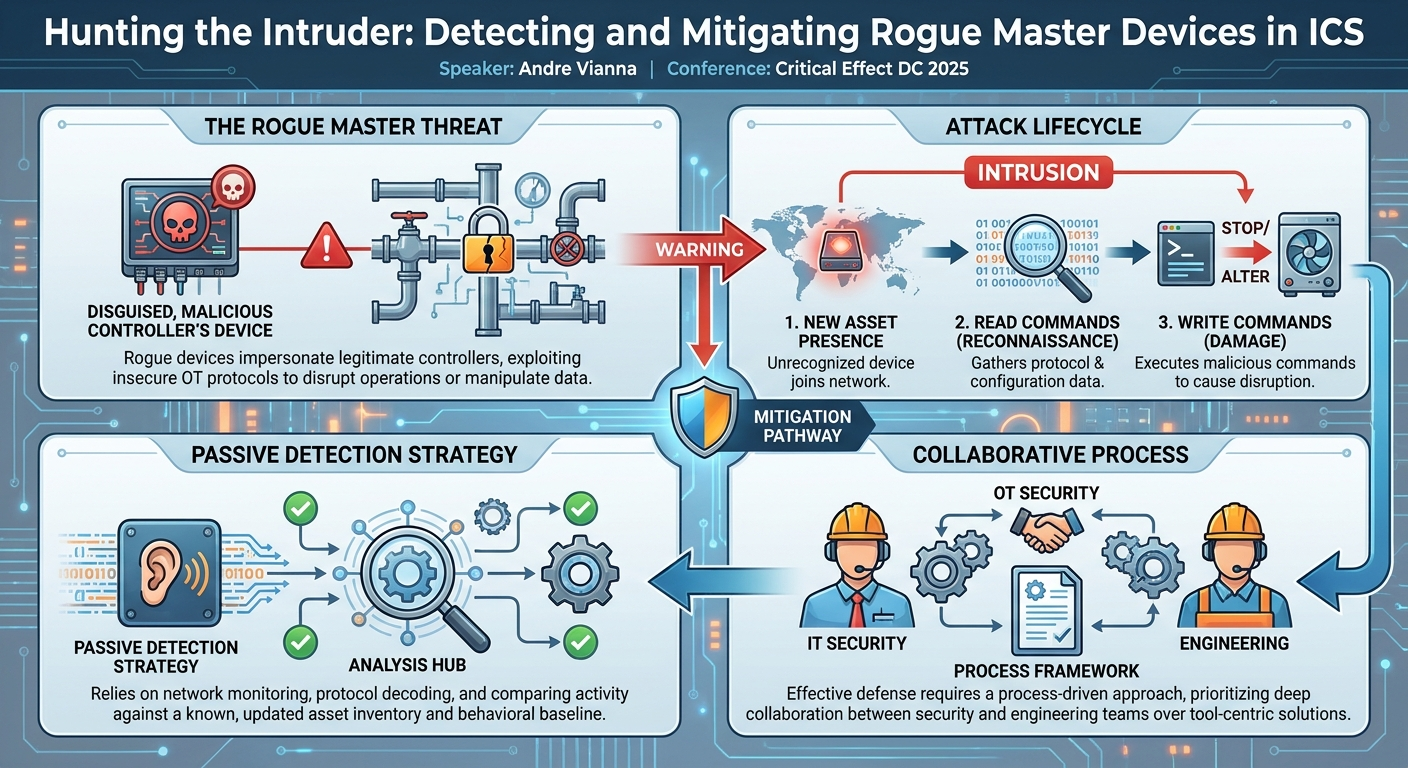
Vianna outlined a clear, three-phase attack lifecycle for rogue master devices:
- New Asset Presence: The rogue device first appears on the network as an unrecognized asset.
- Read Commands (Reconnaissance): The attacker sends read commands to understand protocols, device configurations, and operational parameters.
- Write Commands (Damage/Manipulation): Once reconnaissance is complete, the attacker sends write commands to cause damage, change parameters, or disrupt operations.
The presentation also highlighted that the rogue master device is just one type of "rogue" threat. Vianna enumerated other potential rogue entities, including rogue slave devices, rogue radio signals, rogue HMIs, rogue engineering workstations, rogue mobile devices, and even predictions for future rogue AI agents, underscoring the breadth of unauthorized device threats in OT. The underlying principle remains the same: an unauthorized entity gaining control or injecting malicious data into the operational process.
Finally, Vianna's work demonstrated that detecting rogue master devices is doable but requires a structured, process-driven approach. He advocated for passive detection approaches, where network traffic is monitored without active intervention, allowing for the identification of new, unauthorized devices and suspicious command patterns. This approach, combined with a clear understanding of the baseline environment and robust incident response procedures, forms the bedrock of an effective defense strategy against this insidious threat.
Technical Deep Dive
▶ Watch: Rogue master device attack methodology (10:45)
The technical core of Vianna's presentation revolved around understanding the mechanics of master-slave communication in ICS and then leveraging this understanding for detection. In a typical ICS architecture, a master device (e.g., a PLC, RTU, or even a specialized computer) is responsible for initiating communication. It sends commands (like "read temperature" or "set pressure") and collects data from slave devices. These slave devices are often connected directly to field devices such as water pumps, thermostats, centrifuges, and sensors, which perform physical actions or provide real-time operational data. The master device effectively orchestrates the industrial process by reading metrics and issuing instructions.
A rogue master device exploits the trust-based nature of many OT protocols. The speaker emphasized that "most part of the OT protocols don't have a security to avoid these type of problems." This refers to protocols like Modbus, DNP3, Ethernet/IP, and others that were often designed for speed and efficiency in closed-loop systems, lacking modern security features like strong authentication, authorization, or encryption. An attacker can leverage this vulnerability to insert an unauthorized device into the network, which then mimics a legitimate master. This rogue device can perform actions such as:
- Intercepting traffic: Eavesdropping on legitimate communications.
- Replaying attacks: Capturing and re-sending valid commands for malicious purposes.
- Reading/Writing data: Unauthorized access to operational data or issuing commands to manipulate field devices. This is the most dangerous aspect, as it can directly impact physical processes.
The attack sequence typically follows three distinct phases:
- New Asset Introduction: The rogue device connects to the network, appearing as an unknown entity.
- Reconnaissance (Read Commands): The rogue master begins by sending "read" commands to discover network topology, identify slave devices, and understand the operational parameters and data points. This phase allows the attacker to map the environment and identify targets for manipulation.
- Manipulation (Write Commands): Once sufficient information is gathered, the rogue master initiates "write" commands to alter setpoints, stop processes, or inject false data. This is where the real damage or disruption occurs.
To counter these threats, Vianna advocated for a passive detection approach. This involves deploying passive network sensors or monitoring points that listen to all network traffic without actively interacting with the devices. These sensors perform packet listening and protocol decoding to understand the communications. Key aspects of this approach include:
- New Device Detection: Identifying any new or unauthorized IP addresses or MAC addresses appearing on the network that are not part of the established asset inventory. Tools like DHCP snooping and Network Access Control (NAC) can aid in this Level 1 detection.
- Unauthorized Command Patterns: Monitoring for unexpected or anomalous read/write commands. For example, a device that suddenly starts issuing write commands when it's typically a read-only sensor, or a new device attempting to control critical processes.
- Protocol-Specific Rule Sets: Developing and implementing specific detection rules for each OT protocol in use (e.g., Modbus, DNP3). This requires deep understanding of the protocol's structure and typical command flows.
- Baseline Deviation: Establishing a comprehensive baseline of normal network activity, including which assets are allowed to perform specific actions, at what times, and with what parameters. Any deviation from this baseline triggers an alert.
- Threat Intelligence Correlation: Cross-referencing detected activities with threat intelligence databases to identify known malicious IP addresses, command patterns, or techniques associated with threat actors targeting specific industries (e.g., mining, aluminum).
- Business Segmentation Context: Understanding the operational context of different network segments. An unauthorized read command in a low-priority segment might be less critical than a write command in a safety-critical zone.
Implementing these detections requires several foundational technical requirements:
- Passive Traffic Visibility: The ability to capture and analyze all relevant network traffic.
- Protocol Decoding: Tools or capabilities to parse and understand various OT protocols.
- Updated Asset Inventory: A comprehensive, accurate, and up-to-date list of all legitimate devices, their roles, and their expected behaviors.
- Timestamp Synchronization: Critical for accurate log correlation and incident analysis across different systems.
- Log Telemetry: Ensuring all relevant logs are collected and sent to a central security information and event management (SIEM) system.
The implementation strategy can involve signature-based detection (looking for known malicious patterns), behavior-based detection (identifying deviations from normal behavior), and anomaly-based detection (using machine learning to flag unusual activities). Vianna stressed the importance of deploying passive monitoring points, setting appropriate thresholds for alerts, and continuously tuning and validating rules to minimize false positives, which are a common challenge in OT environments due to their unique operational dynamics.
Demo / Proof of Concept
▶ Watch: Passive detection approach and maturity levels (12:15)
While Andre Vianna's presentation was rich in practical advice and grounded in real-world experience, it did not include a live demonstration or a specific proof of concept during the conference talk. The speaker instead referenced his extensive background in "creating some detections doing some research" and having "implement[ed] several in several regions around the globe." This indicates that the strategies and findings presented were derived from actual deployments and operational insights rather than a simulated environment or a live hacking demonstration.
The absence of a direct demo does not diminish the technical value of the talk, as Vianna's detailed explanation of the rogue master device lifecycle, the vulnerabilities in OT protocols, and the passive detection methodologies served as a comprehensive conceptual framework. His discussion of "Level 1 detections" using tools like DHCP and NAC, and higher-level detections involving analysis of read/write commands and threat intelligence, implicitly points to existing, implementable solutions rather than theoretical constructs. The focus was on conveying actionable strategies born from practical application in industrial settings, emphasizing the "how-to" of detection rather than showcasing a specific tool in action.
Defensive Implications
▶ Watch: Conclusion: OT security is about process and alignment (16:40)
The insights shared by Andre Vianna carry significant defensive implications for any organization operating Industrial Control Systems. The overarching message is that defending against rogue master devices, and by extension, other rogue elements in OT, requires a departure from traditional IT security mindsets and a greater emphasis on process, collaboration, and contextual understanding.
- Integrate OT and IT Security Teams with Engineering: Vianna stressed that "the cyber security to in OT team is different. We have to involve the engine team often make them our first make them understand that we are here to help them." This is perhaps the most critical defensive implication. Engineering and operations teams possess invaluable knowledge about system behavior, normal operations, and critical processes. Security teams must build trust and collaborate closely with them to establish accurate baselines, understand operational constraints, and validate detection rules. Without this collaboration, security measures risk generating excessive false positives or even disrupting operations.
- Prioritize Process Over Tools: Unlike IT, where a tool-driven approach is common, OT security demands a process-first strategy. "Cyber security is about process and align first before jumping to the action," Vianna stated. This means defining clear procedures for asset management, incident response, change control, and security monitoring before deploying any technology. Understanding "who needs to do what" when an alert fires is as crucial as the alert itself.
- Implement Robust Passive Detection: Given the inherent insecurity of many OT protocols and the challenges of active scanning in sensitive environments, passive monitoring is a cornerstone of defense. Organizations should deploy passive sensors to gain full traffic visibility across their OT networks. These sensors must be capable of protocol decoding for all relevant industrial protocols to identify anomalous commands (e.g., unexpected write commands from a new or unauthorized device).
- Maintain a Comprehensive and Updated Asset Inventory: A detailed and accurate asset inventory is fundamental. Defenders must know every device on their network, its role, its expected behavior, and who is authorized to interact with it. This forms the baseline against which rogue devices or unauthorized activities can be detected. Unauthorized IPs and new asset connections should be immediately flagged.
- Establish a Clear Baseline of Normal Behavior: Beyond just inventory, understanding "who is allowed to perform activities" and "what is the assets your crowd should map it also" is vital. This involves profiling normal communication patterns, typical command sequences, and expected data ranges. Any deviation from this contextual baseline should trigger alerts, which can then be refined with thresholds to reduce false positives.
- Synchronize Timestamps and Centralize Logs: For effective incident detection and response, all OT devices and security tools must have synchronized timestamps. This enables accurate correlation of events across different systems. Furthermore, log telemetry must be running, ensuring that security logs are collected and centralized for analysis.
- Leverage Threat Intelligence and Business Context: Defenders should integrate threat intelligence specific to their industry (e.g., mining, aluminum) to understand common attack techniques and threat actor profiles. This allows for more targeted detection rules. Additionally, understanding business segmentation helps prioritize alerts based on the criticality of the affected industrial process.
- Develop and Tune Detection Rules Continually: Detection rules, whether signature-based, behavior-based, or anomaly-based, require continuous tuning and validation. This iterative process helps to reduce false positives and improve the accuracy of detections as the operational environment evolves.
- Define and Practice Incident Response Procedures: Knowing that "if something happening who ring the bell or who needs to do what" is crucial. Organizations must have clearly defined incident response procedures specifically tailored for OT environments, including who is responsible for investigation, containment, eradication, and recovery.
By adopting these defensive implications, organizations can proactively identify and mitigate the threat posed by rogue master devices, safeguarding their critical infrastructure against potentially catastrophic disruptions.
Key Takeaways
- Rogue Master Devices are Underestimated Threats: The specific threat of unauthorized devices impersonating legitimate master controllers in ICS environments is often overlooked in broader OT security discussions, creating significant vulnerabilities.
- Inherent OT Protocol Insecurity: Most operational technology protocols lack fundamental security features like authentication and encryption, making them highly susceptible to manipulation by rogue devices.
- Passive Detection is Key: Given the sensitivity of OT networks, passive monitoring of network traffic, coupled with robust asset inventory and baseline behavioral analysis, is the most effective approach for detecting rogue master devices.
- Collaboration with Engineering is Paramount: Successful OT security, particularly against nuanced threats like rogue masters, hinges on deep collaboration and trust between IT security, OT security, and operational engineering teams.
- Process-Driven Security is Essential: Unlike IT's often tool-centric approach, OT security demands a structured, process-first methodology, focusing on clear procedures, roles, and responsibilities before tool deployment.
- Continuous Tuning and Contextual Awareness: Effective detection requires ongoing tuning and validation of rules, alongside a deep understanding of the business context and operational baselines to minimize false positives and maximize threat visibility.
About the Speaker(s)
Andre Vianna is a seasoned cybersecurity professional with a wealth of experience, currently serving as a Cyber Security Specialist at Norsk Hydro. Born and raised in São Paulo, Brazil, Vianna describes himself as a "typical nerd" with an 18-year background in cyber security. His expertise spans various domains, with a particular focus on the unique challenges of Industrial Control Systems (ICS) environments, where he has spent the last three years.
Vianna's academic and professional credentials are extensive, including graduations in system analysis, postgraduate studies in cyber security, computer forensics, and cyber threat intelligence. He is also a certified 62443 cyber security fundamental specialist, demonstrating his commitment to industry best practices in industrial automation and control systems security. His talk on rogue master devices is a direct result of his practical research and experience implementing detection strategies globally, highlighting his dedication to addressing critical, yet often overlooked, security challenges in the OT space.
Reviews
Dr. Zero (Offensive Security Researcher) — WEAK
This is an ICS 101 awareness session masquerading as a specific threat briefing. Telling a room in 2025 that Modbus lacks authentication and that defenders need passive network monitoring is beating a horse that died a decade ago. It's basic network hygiene, not conference-grade defensive research.
Heather Calloway (CISO) — SOLID
Vianna outlines the operational reality of securing legacy OT environments where protocols lack basic authentication and rogue devices can issue physical commands. It’s a grounded look at implementing passive network monitoring and cross-functional incident response in critical infrastructure. Worth a watch for teams managing manufacturing or ICS footprints, though mature OT programs will find this foundational.