Secure By Default: Closing the Loop
Andrew Kling (Schneider Electric)
Critical Effect DC 2025 · Day 1 · Track III: Tactical Mastery
Overview
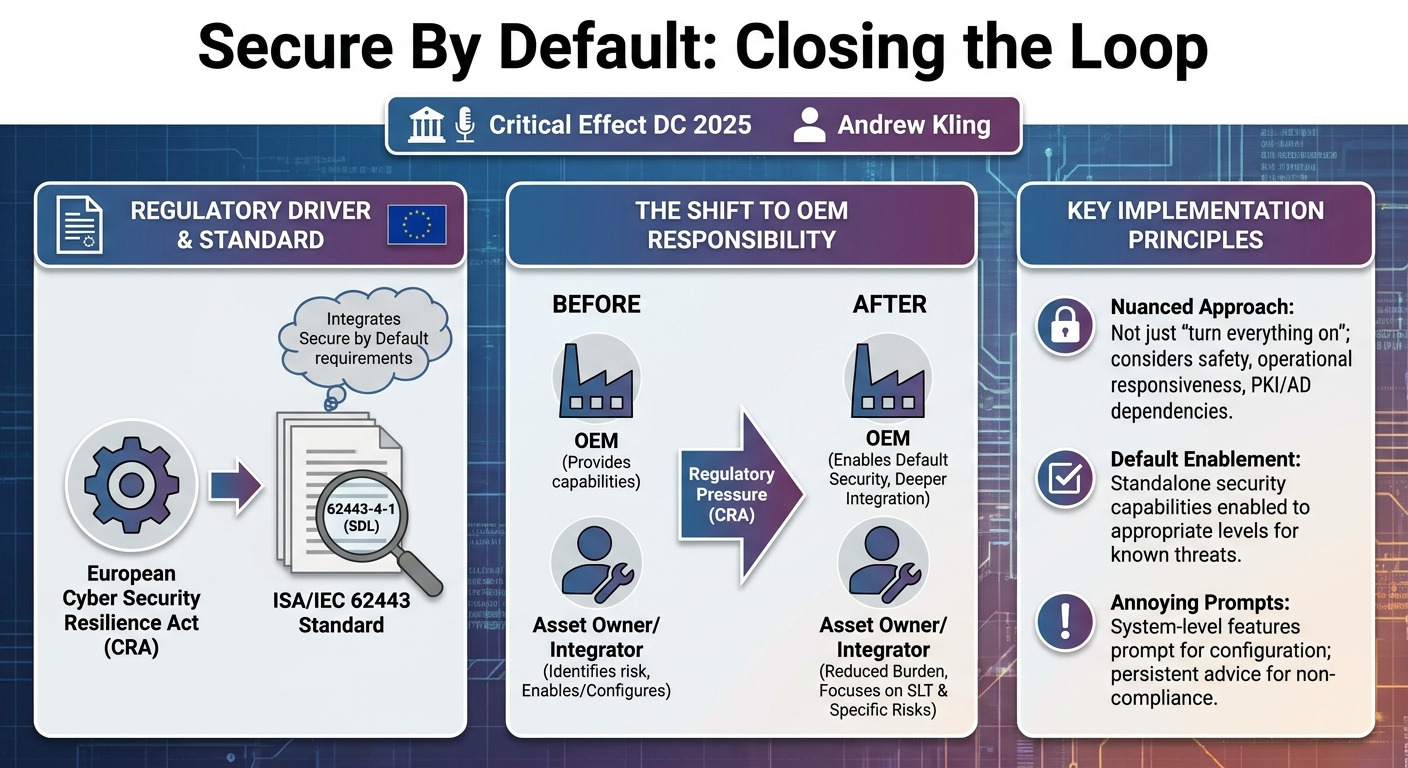
In this insightful talk from Critical Effect DC 2025, Andrew Kling of Schneider Electric, who co-chairs the global joint ISA/IEC 62443-4-1 workgroup, addresses the critical and evolving concept of "secure by default" in the context of Industrial Control Systems (ICS) and Operational Technology (OT). Kling highlights a significant shift in the industry, driven primarily by new regulatory pressures, that is finally compelling manufacturers to deliver products with security features enabled out-of-the-box. This movement aims to fundamentally rebalance the responsibility for cybersecurity, moving it upstream to the original equipment manufacturers (OEMs).
Key moments
- 0:00 Introduction and the push for secure by default
- 2:00 Regulatory compliance as the strongest driver for security
- 11:00 Deficiencies in the current security responsibility model
- 14:00 CRA and 62443 driving secure by default adoption
- 18:40 How secure by default will be implemented in 62443
- 20:00 'Be freaking annoying': advice for non-default states
- 21:00 Rebalancing security responsibility and future impact
Secure By Default: Closing the Loop
Speakers: Andrew Kling (Schneider Electric)
Conference: Critical Effect DC 2025
YouTube: https://www.youtube.com/watch?v=4Hi2mk5r6YE
Overview
In this insightful talk from Critical Effect DC 2025, Andrew Kling of Schneider Electric, who co-chairs the global joint ISA/IEC 62443-4-1 workgroup, addresses the critical and evolving concept of "secure by default" in the context of Industrial Control Systems (ICS) and Operational Technology (OT). Kling highlights a significant shift in the industry, driven primarily by new regulatory pressures, that is finally compelling manufacturers to deliver products with security features enabled out-of-the-box. This movement aims to fundamentally rebalance the responsibility for cybersecurity, moving it upstream to the original equipment manufacturers (OEMs).
Historically, attempts to mandate secure by default practices faced considerable market resistance, with OEMs perceiving it as "too much work" or an unnecessary burden. However, the landscape has changed dramatically. Kling points to the European Cyber Security Resilience Act (CRA) as a primary catalyst, which explicitly mandates that OEMs "shall ship products that are secure by default." While the CRA's definition of this term is still under development, Kling is actively working with European regulators to align it with the evolving interpretations within the ISA/IEC 62443 standard, which is widely adopted by major industrial vendors. This talk outlines the strategic, albeit complex, path to integrating secure by default principles into the very fabric of industrial product development and deployment.
Background
▶ Watch: Introduction and the push for secure by default (0:00)
The journey towards "secure by default" in industrial systems has been fraught with challenges. Andrew Kling recalls a decade-old attempt to introduce such principles into the ISA/IEC 62443 standard, which was met with strong resistance from the marketplace. The prevailing sentiment was that security was an optional add-on, a customer-specific configuration, or simply too complex and costly to implement as a default. This left a significant gap, where security capabilities were often built into products but rarely enabled, leaving asset owners and system integrators with the onerous task of activating and configuring them, if they even knew they existed or understood their necessity.
Kling emphasizes that the primary driver for this paradigm shift is no longer fear, uncertainty, and doubt (FUD) or even competitive pressure, but rather regulatory compliance. He explicitly states that the Cyber Security Resilience Act (CRA) is the strongest force compelling change. The CRA's mandate for "secure by default" products is not merely a suggestion but a legal requirement that OEMs must meet. The strategic goal, as Kling explains, is to establish ISA/IEC 62443 as the de facto standard for CRA conformance. By achieving this alignment, adherence to 62443 would directly demonstrate compliance with the regulation, creating a powerful incentive for OEMs to adopt secure by default practices.
The current deficiency in the industrial cybersecurity ecosystem, as highlighted by Kling, stems from a misallocation of responsibility. OEMs, guided by current interpretations of 62443, are primarily responsible for embedding security capabilities into their products. However, the onus then falls on integrators and asset owners to identify their specific risks, select appropriate capabilities, and then enable them. This "blame game" often results in security features remaining dormant, leaving systems vulnerable. The evolving understanding is that OEMs, with their deep knowledge of product design and intended use, are uniquely positioned to understand and mitigate generalized risks at the source, making "secure by default" a logical and necessary evolution.
Key Findings
▶ Watch: Deficiencies in the current security responsibility model (11:00)
The central finding of Andrew Kling's talk is that the industrial sector is finally at a tipping point where "secure by default" is not only a desirable goal but an imminent reality, primarily driven by regulatory mandates like the European Cyber Security Resilience Act (CRA). This marks a profound shift from previous efforts that faced significant industry inertia.
Kling highlights that simply "turning on all capabilities" is an oversimplified and often detrimental approach to secure by default. Such a blanket enablement could compromise safety, degrade operational responsiveness, introduce unforeseen costs, or fail to account for system-level security considerations like Public Key Infrastructure (PKI) or Active Directory (AD) integration. True secure by default requires a nuanced understanding of product context, intended use, and the broader system architecture.
A crucial development is the formal adoption of the "secure by default" need within the ISA/IEC 62443 standard. Kling, as co-chair of the 62443-4-1 (Secure Development Lifecycle) workgroup, confirms that this concept is being actively integrated. This means that the standard, which influences major OEMs globally, will soon include practices mandating decisions about the default state of security capabilities. This internal recognition within the standards body, coupled with external regulatory pressure, creates a "perfect storm" for change.
The ultimate impact of this integration will be a significant rebalancing of responsibility for cybersecurity. OEMs will no longer merely provide security capabilities but will be required to enable them by default, thereby pulling them "a little bit further into the conversation" and demanding more direct involvement in securing their products. This shift is anticipated to ease the burden on asset owners and integrators, enhancing overall security preparedness and promoting consistency across the industrial landscape.
Technical Deep Dive
▶ Watch: CRA and 62443 driving secure by default adoption (14:00)
The technical core of Andrew Kling's argument revolves around the ISA/IEC 62443 standard and its ongoing evolution to incorporate "secure by default" principles. The 62443 standard is a globally recognized series of standards for securing industrial automation and control systems (IACS). It comprises various parts addressing different aspects, such as policies and procedures (2-x series), system-level requirements (3-x series), and component-level requirements and secure product development (4-x series). Kling specifically co-chairs the 62443-4-1 workgroup, which focuses on the Secure Development Lifecycle (SDL) for IACS product suppliers. This position gives him unique insight into how secure by default will be woven into the standard.
The current SDL process within 62443-4-1 already mandates that OEMs perform threat modeling and security context setting, which involves defining the intended use of a product and identifying generalized risks. This foundational knowledge is key. OEMs understand the threats their products might face and how they are designed to be used. The critical missing piece, historically, has been the mandate to act on this knowledge by enabling relevant security capabilities by default.
Kling meticulously outlines the current distribution of risk and responsibility across the industrial supply chain:
- Product Suppliers (OEMs):
- Utilize an SDL process.
- Possess generalized awareness of risks and intended product use.
- 62443 currently directs OEMs to embed security capabilities into products (e.g., secure protocols). Major OEMs conform to this.
- However, the standard doesn't always mandate enablement. An OEM might "check the box" for a secure protocol, but if it's never turned on, the capability is useless.
- OEMs also build systems, and some capabilities (e.g., a secure protocol) require infrastructure to function, such as a Public Key Infrastructure (PKI) for key management, or alignment with an engineering workstation or HMI supporting the same protocol version.
- Service Providers (Integrators and Maintainers):
- Have a responsibility to assess security performance needs in the field.
- They deploy capabilities based on identified risks.
- Asset Owners:
- Must determine the specific risks they face in their unique operational environment.
- They are currently responsible for selecting security capabilities and making decisions about the Security Level Target (SLT) for their systems.
- They must then deploy these capabilities.
- Kling stresses that this is a continuous process, as risks constantly evolve.
The core deficiency in this existing model is that the primary onus for enabling security is placed on integrators and asset owners. OEMs merely provide the capabilities. This leads to the problem where products are shipped with robust security features, but they remain dormant because the downstream parties lack the full context, resources, or mandate to activate them.
Kling then introduces the proposed principles for integrating "secure by default" into 62443, which will land primarily in 62443-4-1 (SDL) and propagate to 62443-4-2 (components) and 62443-3-3 (systems):
- Default Enablement for Standalone Capabilities: "Each self-contained, standalone security capability should be enabled to the appropriate level to address known threats and risks." This is the straightforward "turn it on" principle for features that don't require external dependencies.
- Guidance for System-Level Capabilities: For capabilities that are not self-contained and require external infrastructure (e.g., PKI, Active Directory for roles and user accounts), the component should prompt the system during setup. It should ask, "Have you enabled my secure protocol yet?"
- "Annoying" Advice for Non-Compliance: If the minimum "secure by default" state is not met, the system should actively and persistently advise the user of the exposure to risk. Much like a car's seatbelt warning, it should be "freaking annoying" and provide clear advice on how to resolve the issue. Crucially, it must also allow the asset owner the ability to explicitly "accept the risk," acknowledging that ultimate operational decisions rest with them.
This strategic integration into 62443 aims to close the loop, ensuring that the OEM's knowledge of generalized risks translates directly into products that are secure from the moment they are deployed, fundamentally shifting the industry's approach to ICS/OT security.
Demo / Proof of Concept
▶ Watch: 'Be freaking annoying': advice for non-default states (20:00)
The talk by Andrew Kling focused on the conceptual framework, regulatory drivers, and the strategic integration of "secure by default" principles into the ISA/IEC 62443 standard. It did not include a live demonstration or a proof of concept of a product or system implementing these new guidelines. The emphasis was on the policy, standards, and process changes required to achieve this vision across the industrial sector.
Defensive Implications
▶ Watch: Rebalancing security responsibility and future impact (21:00)
The push for "secure by default" in industrial systems, as championed by Andrew Kling and the ISA/IEC 62443 workgroup, carries significant defensive implications for all stakeholders in the ICS/OT ecosystem.
For Asset Owners and Integrators, the most immediate benefit will be a substantial reduction in the burden of securing industrial systems. Currently, they are tasked with identifying specific risks in their environments and then manually enabling and configuring security capabilities often provided but not activated by OEMs. With secure by default, systems will ship with a foundational level of security already enabled, addressing common and generalized threats. This means fewer misconfigurations, fewer overlooked security features, and a higher baseline security posture from day one. While asset owners will still need to assess their unique operational risks and make decisions about their Security Level Target (SLT), the starting point will be significantly more robust. The "annoying" prompts for system-level security features (like PKI or Active Directory integration) will provide clear guidance, preventing critical dependencies from being ignored.
For Original Equipment Manufacturers (OEMs), this initiative represents a fundamental shift in responsibility. It moves beyond merely providing security capabilities to actively ensuring they are enabled. This means more "fingers on keyboards" within OEM R&D and engineering teams, as they will be directly responsible for configuring and validating the default secure state of their products. This increased accountability will drive deeper integration of security into the entire Secure Development Lifecycle (SDL), from design to deployment. While this may initially involve higher development costs and complexity for OEMs, it will ultimately lead to more trustworthy and resilient products, enhancing their market credibility and reducing their long-term liability associated with insecure defaults.
Collectively, this paradigm shift will enhance security preparedness across the industrial sector. By making security an "expected level" rather than an "optional" add-on, it fosters a proactive security mindset. The consistent application of secure by default principles, driven by a harmonized ISA/IEC 62443 standard aligned with regulations like the CRA, will promote consistency in security implementations. This consistency will simplify security assessments, improve interoperability between secure components, and make it harder for adversaries to exploit common, easily preventable vulnerabilities. The industry will move towards a more mature state where security is an intrinsic characteristic of industrial products, rather than an afterthought.
Key Takeaways
- Regulatory Imperative: The European Cyber Security Resilience Act (CRA) is the primary driver compelling OEMs to ship products that are "secure by default," marking a significant shift from past market resistance.
- ISA/IEC 62443 Adaptation: The global ISA/IEC 62443 standard, particularly the 62443-4-1 (SDL) workgroup co-chaired by Andrew Kling, is actively integrating "secure by default" requirements to align with new regulations and rebalance security responsibility.
- Nuanced Approach: "Secure by default" is not simply "turn everything on." It requires careful consideration of cost, safety, operational responsiveness, and system-level dependencies like PKI and Active Directory.
- Shifted OEM Responsibility: OEMs will transition from merely providing security capabilities to being responsible for enabling them by default, necessitating deeper integration of security into their product development processes.
- New Standard Principles: Upcoming 62443 guidance will mandate default enablement for standalone capabilities and introduce "annoying" prompts and clear advice for configuring system-level security features, while still allowing asset owners to accept risk.
- Enhanced Industry Security: This initiative promises to significantly ease the burden on asset owners and integrators, improve overall ICS/OT security preparedness, and promote consistent security postures across the industrial landscape.
About the Speaker(s)
Andrew Kling is a prominent figure in industrial cybersecurity, currently affiliated with Schneider Electric. His expertise and leadership are evident in his role as the co-chair of the global joint ISA/IEC 62443-4-1 workgroup. This particular workgroup is responsible for defining the Secure Development Lifecycle (SDL) within the comprehensive 62443 series of standards for Industrial Automation and Control Systems (IACS) security. Kling is actively engaged in aligning the evolving 62443 standard with new regulatory mandates, specifically working directly with European authorities to define what "secure by default" means in the context of the European Cyber Security Resilience Act (CRA). His work is instrumental in driving the industry towards more inherently secure industrial products and systems.
Reviews
Dr. Zero (Offensive Security Researcher) — MUST SEE
Kling isn't a marketer; he's the guy holding the pen for IEC 62443-4-1. He outlines exactly how the EU's Cyber Resilience Act is forcing OT vendors to stop treating security as an optional DLC, making this mandatory viewing if you build or defend industrial systems.
Heather Calloway (CISO) — SOLID
Kling details how the European Cyber Resilience Act is forcing ICS vendors to ship secure-by-default products, shifting the configuration burden away from asset owners. If you operate OT environments, this directly changes how your procurement and vendor risk teams should write contracts.