Defending the Digital Core: Cyber Ranges and the Future of Operational Technology Security
Dennis Grimsley (Head of Sales, Federal · Cyber Ranges)
Critical Effect DC 2025 · Day 1 · Track III: Tactical Mastery
Overview
In an era defined by the convergence of Information Technology (IT) and Operational Technology (OT), securing critical infrastructure has become paramount. This talk, delivered by Dennis Grimsley, Head of Sales, Federal, at Cyber Ranges, alongside a co-presenter identified only as David, delved into the evolving landscape of OT security and the pivotal role of advanced cyber ranges in defending against sophisticated threats. The presentation underscored the increasing vulnerability of OT systems – ranging from dams and bridges to power plants – to persistent nation-state actors, highlighting the potential for physical and kinetic effects from cyberattacks.
Key moments
- 0:00 Introduction and Cyber Command background
- 2:00 Nation-state targeting and OT's physical impact
- 4:30 Defining a cyber range and its purpose
- 6:00 Realistic attack simulations and full drill exercises
- 9:00 Modern cyber range architecture for OT integration
- 13:50 Designing custom attack flows: behavior as code
- 17:30 Scalability and large-scale cyber drill capabilities
- 19:00 Critical applications and IT/OT convergence call
Defending the Digital Core: Cyber Ranges and the Future of Operational Technology Security
Speakers: Dennis Grimsley (Head of Sales, Federal, Cyber Ranges)
Conference: Critical Effect DC 2025
YouTube: https://www.youtube.com/watch?v=Avi95edo5lU
Overview
In an era defined by the convergence of Information Technology (IT) and Operational Technology (OT), securing critical infrastructure has become paramount. This talk, delivered by Dennis Grimsley, Head of Sales, Federal, at Cyber Ranges, alongside a co-presenter identified only as David, delved into the evolving landscape of OT security and the pivotal role of advanced cyber ranges in defending against sophisticated threats. The presentation underscored the increasing vulnerability of OT systems – ranging from dams and bridges to power plants – to persistent nation-state actors, highlighting the potential for physical and kinetic effects from cyberattacks.
The core message revolved around the necessity of realistic, immersive training environments that can accurately replicate complex OT infrastructures. Grimsley, drawing on his extensive background from U.S. Cyber Command, articulated a red teamer's perspective, emphasizing the constant "cat and mouse game" between attackers seeking vulnerabilities and defenders striving to layer defenses. The talk argued that traditional training methods fall short in preparing defenders for the real-world chaos of an OT cyberattack, advocating instead for dynamic, scenario-based simulations within a digital twin of an organization's actual network.
This discussion is particularly critical as OT systems, once air-gapped, are now increasingly interconnected, expanding their attack surface. The speakers demonstrated how modern cyber ranges can provide a safe, destructible sandbox for organizations to practice defense, incident response, and strategic decision-making against tailored, real-world attack vectors, thereby elevating the readiness of critical infrastructure operators and military units alike.
Background
▶ Watch: Introduction and Cyber Command background (0:00)
The evolution of cyber warfare has brought a stark realization: the digital realm now directly impacts the physical world, especially concerning Operational Technology (OT). Historically, OT systems, which control industrial processes like power grids, water treatment plants, and manufacturing facilities, were largely isolated from public networks. However, the push for efficiency, remote management, and IT/OT convergence has blurred these lines, connecting once-isolated systems to the internet. This connectivity, while offering significant operational benefits, introduces unprecedented security risks.
Dennis Grimsley, a veteran who retired from U.S. Cyber Command after playing a key role in its establishment in 2010, provided a unique perspective rooted in offensive cyber operations. His experience in "targeting school" and developing "cyber attack plans" instilled in him a mindset focused on identifying gaps and exploiting vulnerabilities. He highlighted that sophisticated adversaries, particularly nation-state actors, possess the resources and persistence to target these critical systems. These actors often acquire legacy OT hardware from the dark web to reverse-engineer and develop precise attack methodologies, underscoring the need for defenders to similarly understand and replicate their own environments for effective defense.
The challenge for defenders is immense. Unlike IT systems, where the impact of a cyberattack might be data loss or service disruption, a successful attack on OT can lead to catastrophic physical damage, environmental harm, and even loss of life. Grimsley stressed that while IT manipulations might "turn off websites," OT attacks can "shut down power plants," leading to tangible, real-world consequences for people. Furthermore, many OT environments rely on aging, legacy systems that were not designed with modern cybersecurity in mind, making them inherently more vulnerable. The speaker noted that defending these interconnected systems is "very hard unless you separate stuff from the internet, which nothing is anymore." This creates a constant "cat and mouse game" where attackers exploit connectivity and legacy vulnerabilities, and defenders struggle to layer defenses effectively. The talk posits that traditional, often "boring training" methods are insufficient to prepare personnel for the high-stakes, dynamic environment of an actual OT cyberattack, necessitating a more realistic and immersive approach.
Key Findings
▶ Watch: Defining a cyber range and its purpose (4:30)
The central premise and key finding of this talk is that advanced cyber ranges are indispensable tools for addressing the complex security challenges posed by the convergence of IT and OT. The speakers presented a compelling case for moving beyond theoretical training to practical, hands-on simulation within a highly realistic and destructible environment.
The main discoveries and contributions highlighted include:
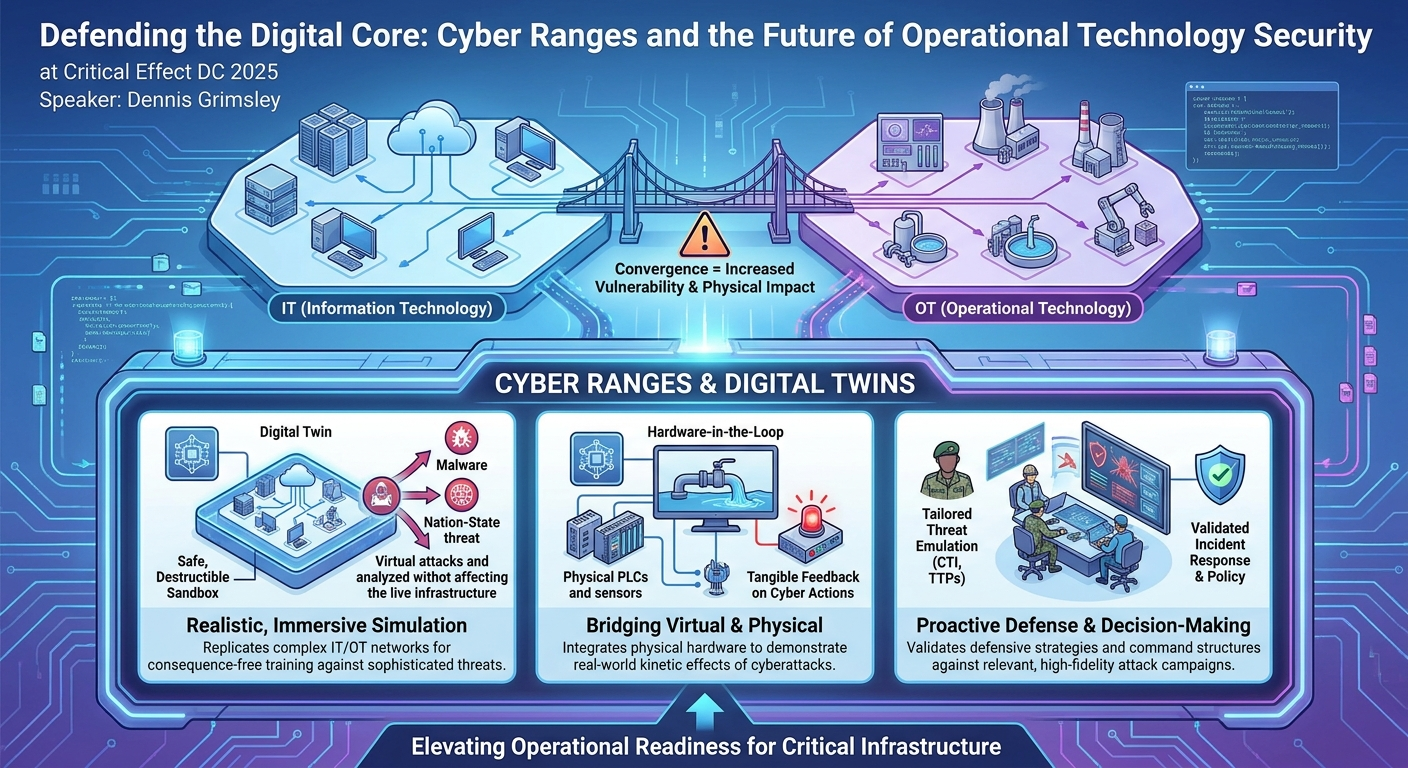
- The Digital Twin Concept for OT: The talk underscores the critical importance of creating a virtual digital twin of an organization's actual IT and OT networks. This digital replica, complete with virtual machines emulating current environments, identical tools, and protocols, serves as a safe sandbox. This allows organizations to conduct full-scale simulations of real-world attacks without risking their live infrastructure.
- Comprehensive Threat Emulation: The cyber range discussed is designed to facilitate both automated and red team attacks, drawing from a vast repository of CVEs and enabling the recreation of specific, previously experienced compromises. This capability ensures that training scenarios are not generic but tailored to an organization's unique threat landscape and potential vulnerabilities.
- Physical Emulation and Hardware-in-the-Loop: A significant advancement detailed is the integration of physical emulation for OT components. This involves connecting real-world hardware, such as Programmable Logic Controllers (PLCs), Human-Machine Interfaces (HMIs), sensors, and sub pumps, directly into the virtual range environment. This bridges the gap between virtual simulation and the tangible physical effects of OT cyberattacks, providing a truly immersive training experience where participants can observe and react to actual physical changes triggered by cyber actions.
- Modular, Scalable, and Vendor-Agnostic Architecture: The cyber range is built on modern technologies like OpenStack and various microservices, ensuring it is modular, highly orchestrated, and scalable both vertically and horizontally. This architecture supports multi-vendor environments and allows for easy integration of diverse OT systems and tools, offering unparalleled flexibility to meet specific industry or organizational needs (e.g., energy, water, oil and gas).
- Advanced Attack Scenario Generation: Through tools like the Scenario Composer and the Injector Engine v3, the platform enables the creation of highly sophisticated and realistic attack flows. This includes leveraging CTI reports, TTPs (Tactics, Techniques, and Procedures), IOCs (Indicators of Compromise), and actual malware to reverse-engineer and replay nation-state level campaigns, such as those developed in partnership with the CERT team in Ukraine based on SVR campaigns. This "behavior as code" approach allows for granular control over attack simulation, from basic traffic generation to complex multi-stage phishing and compromise scenarios.
These findings collectively demonstrate a robust and innovative approach to OT cybersecurity training, moving beyond theoretical knowledge to practical, experiential learning that directly addresses the unique challenges of defending critical infrastructure in an interconnected world.
Technical Deep Dive
▶ Watch: Modern cyber range architecture for OT integration (9:00)
The cyber range architecture presented is a testament to modern, scalable, and modular design principles aimed at delivering highly realistic and customizable training environments for both IT and, critically, OT security. Built upon robust foundational technologies, the platform is designed to emulate complex network infrastructures and simulate sophisticated cyberattacks with precision.
At its core, the cyber range is built on OpenStack and a suite of microservices, allowing for significant scalability both vertically and horizontally. This distributed architecture facilitates the deployment of vast, intricate network environments, as evidenced by the platform's ability to host the Guinness World Record-holding largest on-site cyber drill involving 116 nations. The modularity of the system is a key design principle, allowing for API-driven connections and customizability to integrate various tools and functionalities.
The primary components that enable this advanced functionality include:
- Scenario Composer: This intuitive, drag-and-drop interface empowers users to design and deploy custom network topologies. Within the composer, users can virtualize a wide array of IT and OT components, including virtual machines (VMs), switches, routers, and essential SCADA systems. This capability allows organizations to create a "digital twin" that precisely mirrors their actual operational environment, from the network layout to the specific protocols in use. The ease of use ensures that even non-developers can build complex training scenarios tailored to their unique infrastructure and defensive needs.
- Injector Engine (Version 3): This is the powerhouse for attack simulation. The Injector Engine translates real-world threat intelligence into actionable attack scenarios. The team behind the range constantly processes CTI (Cyber Threat Intelligence) reports, extracts TTPs (Tactics, Techniques, and Procedures), IOCs (Indicators of Compromise), and analyzes actual malware. This intelligence is then reverse-engineered and integrated into the engine, allowing for the emulation of cutting-edge attacks, including sophisticated nation-state campaigns (e.g., SVR campaigns developed with the Ukraine CERT team).
The Injector Engine operates on a "behavior as code" paradigm. Users can construct complex attack flows by dragging and dropping individual nodes representing specific actions (e.g., traffic generation, sending phishing emails, emulating a user opening an email, downloading files, cloning repositories, achieving compromise). Each node is configurable, allowing for granular control over the attack's parameters and progression. This enables the simulation of multi-stage attacks, from initial access to lateral movement and impact on target systems, all validated and tested within a single pane of glass.
- Physical Emulation / Hardware-in-the-Loop (HIL): A critical differentiator for OT security training is the ability to integrate physical hardware. While the range can completely virtualize OT systems, it also supports HIL integration. This means actual PLCs (Programmable Logic Controllers), HMIs (Human-Machine Interfaces), sensors, and physical actuators (like sub pumps) can be connected to the virtual environment. This allows trainees to witness and interact with the physical consequences of cyber actions. For instance, compromising a virtual SCADA system could trigger a real sub pump to overflow, providing immediate, tangible feedback on the impact of their defensive or offensive maneuvers. This capability supports a wide range of simulated processes, including electrical substations, water systems, and oil and gas plants, making the training exceptionally realistic. The system is also vendor-agnostic, accommodating hardware from various manufacturers, which is crucial given the diverse landscape of industrial control systems.
- Scoring and Reporting & Competency Management: Beyond mere simulation, the platform includes robust mechanisms for assessing performance. It generates detailed after-action reports for both individual and team-based exercises. These reports are tied into a competency management system that maps training content and performance against various industry frameworks and specific job roles. This allows organizations to identify skill gaps, direct individuals to targeted content for improvement, and track the development of their cybersecurity workforce over time.
- Platform Administration and Instructor Tools: The range provides comprehensive tools for managing resources, configuring environments, and facilitating remote or on-site training sessions. Instructors can monitor trainee progress, introduce new challenges dynamically, and provide real-time feedback, ensuring an adaptive and effective learning experience.
The integration of these technical components creates a holistic and dynamic environment where defenders can not only observe but actively engage with realistic cyber threats, understand their physical ramifications, and hone their skills in a safe, controlled setting. The ability to import custom images and containers, supporting various operating system versions (from Windows 7 upwards), further enhances its flexibility, allowing organizations to train on their specific software configurations.
Demo / Proof of Concept
▶ Watch: Designing custom attack flows: behavior as code (13:50)
While a live, interactive demonstration of the cyber range in action was not performed during the talk, the speakers extensively described and illustrated the platform's capabilities through detailed architectural diagrams, user interface snapshots, and conceptual scenarios. They effectively conveyed the operational mechanics and user experience of their advanced cyber range for OT security.
The presentation showcased the Scenario Composer interface, depicting how users could visually design and deploy complex IT and OT network topologies using a drag-and-drop mechanism. This included the placement of virtual machines, switches, routers, and virtualized SCADA systems, demonstrating the ease with which a "digital twin" of a real-world environment could be constructed.
Emphasis was also placed on the Injector Engine version 3, with a snapshot illustrating its "behavior as code" interface. This visual representation showed how individual nodes, representing actions like traffic generation, email sending, phishing attempts, macro execution, and repository cloning, could be chained together to form intricate, multi-stage attack flows. The speakers explained how these flows are built by reverse-engineering CTI reports, TTPs, IOCs, and malware, allowing for the precise emulation of sophisticated nation-state campaigns.
Furthermore, the talk provided compelling visual and conceptual proof of the physical emulation and hardware-in-the-loop capabilities. Slides depicted setups featuring real-world OT hardware such as sub pumps, PLCs, HMIs, and various sensors connected to the virtual range environment. The speakers articulated scenarios where compromising a virtual SCADA system would trigger a tangible physical effect, like the activation or overflow of a real sub pump. This effectively demonstrated how the range bridges the gap between cyber actions and their physical consequences, offering an unparalleled level of realism for training on critical infrastructure like electrical substations, water systems, and oil and gas plants. The mention of working with partners like IC Village and other emulators further underscored the platform's plug-and-play capability for integrating diverse physical components.
In essence, the presentation served as a comprehensive conceptual demonstration, illustrating through visuals and detailed explanations how their cyber range functions as a dynamic, realistic, and destructible environment for OT security training and mission rehearsal.
Defensive Implications
▶ Watch: Critical applications and IT/OT convergence call (19:00)
The insights and capabilities presented by Cyber Ranges carry profound implications for organizations responsible for defending critical infrastructure and military operational technology. The core message is clear: proactive, realistic training is no longer optional but a fundamental requirement for effective defense in the face of escalating threats.
- Enhanced Operational Preparedness: By providing a digital twin of an organization's actual network, cyber ranges enable operational teams to conduct mission rehearsals against threats that precisely mimic real-world scenarios. This moves beyond theoretical knowledge to practical application, allowing defenders to experience the chaos and pressure of a live attack in a safe environment. This includes practicing incident response, developing communication protocols, and testing their ability to reconstitute systems post-compromise.
- Bridging the IT/OT Skill Gap: The convergence of IT and OT demands that personnel understand both domains. The range facilitates training for utility operators to recognize IT anomalies that could signal an attack on their OT systems. Conversely, IT security teams can gain a deeper understanding of the physical impacts of their cyber actions on OT, fostering a more holistic security mindset across disciplines.
- Tailored Threat Intelligence and Response: The ability to recreate specific, past compromises using actual TTPs, IOCs, and malware from CTI reports allows organizations to train against threats they have already faced or are most likely to encounter. This ensures that defensive strategies, tools, and procedures are validated against highly relevant attack vectors, including sophisticated nation-state campaigns (like those from SVR). This proactive validation helps fine-tune defenses before a real incident occurs.
- Strategic Decision-Making and Policy Validation: Beyond technical skills, the range forces organizations to exercise their command and control (C2) structures. During simulated attacks, leadership must make critical decisions regarding policy changes, resource allocation, and communication with stakeholders. This allows for the evaluation and refinement of incident response plans, crisis management protocols, and overall cybersecurity governance in a high-fidelity environment.
- Understanding "Cyber Terrain": For military units and critical infrastructure operators, the concept of cyber terrain is analogous to physical terrain. Just as a military commander understands the hills and valleys of a battlefield, defenders need to comprehend the intricate components and interdependencies of their digital and operational networks. The range provides a platform to map, visualize, and train on this cyber terrain, improving situational awareness and strategic planning for both defensive and offensive cyber operations.
- Continuous Improvement through Performance Metrics: The integrated scoring and reporting coupled with competency management allows organizations to identify specific skill gaps within their teams and individuals. This data-driven approach enables targeted training and development, ensuring that personnel continuously improve their capabilities against evolving threats. It also provides a clear feedback loop for evaluating the effectiveness of training programs and security investments.
Ultimately, the defensive implications underscore a shift from reactive security measures to a proactive, highly trained, and adaptable defense posture. By investing in such advanced cyber ranges, organizations can significantly bolster their resilience against the increasingly complex and physically impactful threats targeting critical IT and OT infrastructure. The speakers highlighted the importance of collaboration and investment in IT/OT convergence, citing events like the Dreamport TAC's "attack the airport" exercise, which brought together 400 OT professionals, as critical steps forward.
Key Takeaways
- IT/OT Convergence Demands Integrated Security Training: The increasing interconnectedness of Information Technology and Operational Technology creates a vast attack surface with potential for severe physical consequences, necessitating a unified and comprehensive approach to cybersecurity training.
- Cyber Ranges are Essential for Realistic OT Defense: Traditional, theoretical training is insufficient. Advanced cyber ranges provide a safe, destructible sandbox where organizations can conduct highly realistic simulations of attacks on their actual IT and OT infrastructure.
- Digital Twins and Physical Emulation Bridge the Gap: The creation of virtual digital twins of an organization's network, coupled with hardware-in-the-loop physical emulation (PLCs, HMIs, sensors), allows defenders to experience and react to the tangible, real-world effects of cyberattacks.
- Customizable, Nation-State-Level Threat Emulation is Crucial: Modern ranges leverage CTI, TTPs, IOCs, and actual malware to recreate sophisticated attack campaigns, including those from nation-state actors, enabling organizations to train against highly relevant and specific threats.
- Training Extends Beyond Technical Skills to Decision-Making: Effective cyber defense requires not only technical proficiency but also robust command and control, strategic decision-making, and policy validation, all of which can be rigorously tested and refined within a cyber range environment.
- Collaboration and Investment are Vital: Continued collaboration between government, industry, and academia, along with sustained investment in advanced training infrastructure, is critical for enhancing the collective resilience of critical infrastructure against evolving cyber threats.
About the Speaker(s)
Dennis Grimsley is a highly experienced professional with a unique background spanning both military operations and cybersecurity. He retired from U.S. Cyber Command, where he played a foundational role in its establishment in 2010. During his tenure, he served as the Deputy Chief of Fire for the Office of Operations, adapting traditional military planning concepts (like air attack plans) to the cyber domain. His responsibilities included managing the deployment of cyber mission forces and undergoing extensive targeting school, which shaped his perspective on identifying and exploiting vulnerabilities. Currently, Dennis serves as the Head of Sales, Federal, at Cyber Ranges, leveraging his extensive operational and strategic experience to advance the adoption of sophisticated cyber training solutions.
David (full name not provided in the transcript) is a co-presenter who contributed significantly to the technical deep dive on the OT aspects of the cyber range. His expertise lies in the architecture and implementation of these specialized ranges, particularly concerning physical emulation and the integration of diverse OT components. He detailed the modular, API-driven design, the functionality of the Scenario Composer and Injector Engine, and the practical application of hardware-in-the-loop for systems like electrical substations, water systems, and oil and gas plants. David's insights underscored the technical sophistication and vendor-agnostic nature of the presented cyber range solution.
Reviews
Dr. Zero (Offensive Security Researcher) — PASS
When the 'Head of Sales' takes the stage to walk you through UI screenshots of his company's product, you're not at a security conference anymore. You're in a timeshare presentation. This is a feature-by-feature pitch for the Cyber Ranges platform dressed up in 'digital twin' marketing speak.
Heather Calloway (CISO) — PASS
This is a vendor pitch disguised as a strategic briefing. While the premise that OT environments require specialized, hardware-in-the-loop training is correct, the presentation is simply a feature walkthrough for a commercial cyber range product. Your leadership team’s time is better spent reviewing your actual incident response plans.