Bridging the Gap: ICS Cybersecurity Awareness and Public Education
Laura Scherling (Columbia University)
Critical Effect DC 2025 · Day 1 · Track III: Tactical Mastery
Overview
In a compelling presentation at Critical Effect DC 2025, Laura Scherling from Columbia University illuminated a critical, yet often overlooked, dimension of national security: public education in Industrial Control Systems (ICS) and Operational Technology (OT) cybersecurity. Her talk, "Bridging the Gap: ICS Cybersecurity Awareness and Public Education," underscored the urgent need to extend cybersecurity literacy beyond the confines of specialized industry training to the general public. Scherling, who also leads the Cyber Care Institute, argued that effective public preparedness is the bedrock of robust cyber resilience, particularly for the vital infrastructure that underpins modern society.
Key moments
- 0:00 Introduction and the ICS education gap
- 2:00 Public preparedness and memorable awareness campaigns
- 4:00 Cyber Care Institute pilot program for older adults
- 6:00 Popular curriculum topics and student feedback
- 8:00 Placemaking and activating public-facing partners
- 10:00 Addressing lingo, silos, and making trainings engaging
- 14:00 Q&A: Key takeaways from awareness class effectiveness
Bridging the Gap: ICS Cybersecurity Awareness and Public Education
Speakers: Laura Scherling (Columbia University)
Conference: Critical Effect DC 2025
YouTube: https://www.youtube.com/watch?v=_JcschtfErg
Overview
In a compelling presentation at Critical Effect DC 2025, Laura Scherling from Columbia University illuminated a critical, yet often overlooked, dimension of national security: public education in Industrial Control Systems (ICS) and Operational Technology (OT) cybersecurity. Her talk, "Bridging the Gap: ICS Cybersecurity Awareness and Public Education," underscored the urgent need to extend cybersecurity literacy beyond the confines of specialized industry training to the general public. Scherling, who also leads the Cyber Care Institute, argued that effective public preparedness is the bedrock of robust cyber resilience, particularly for the vital infrastructure that underpins modern society.
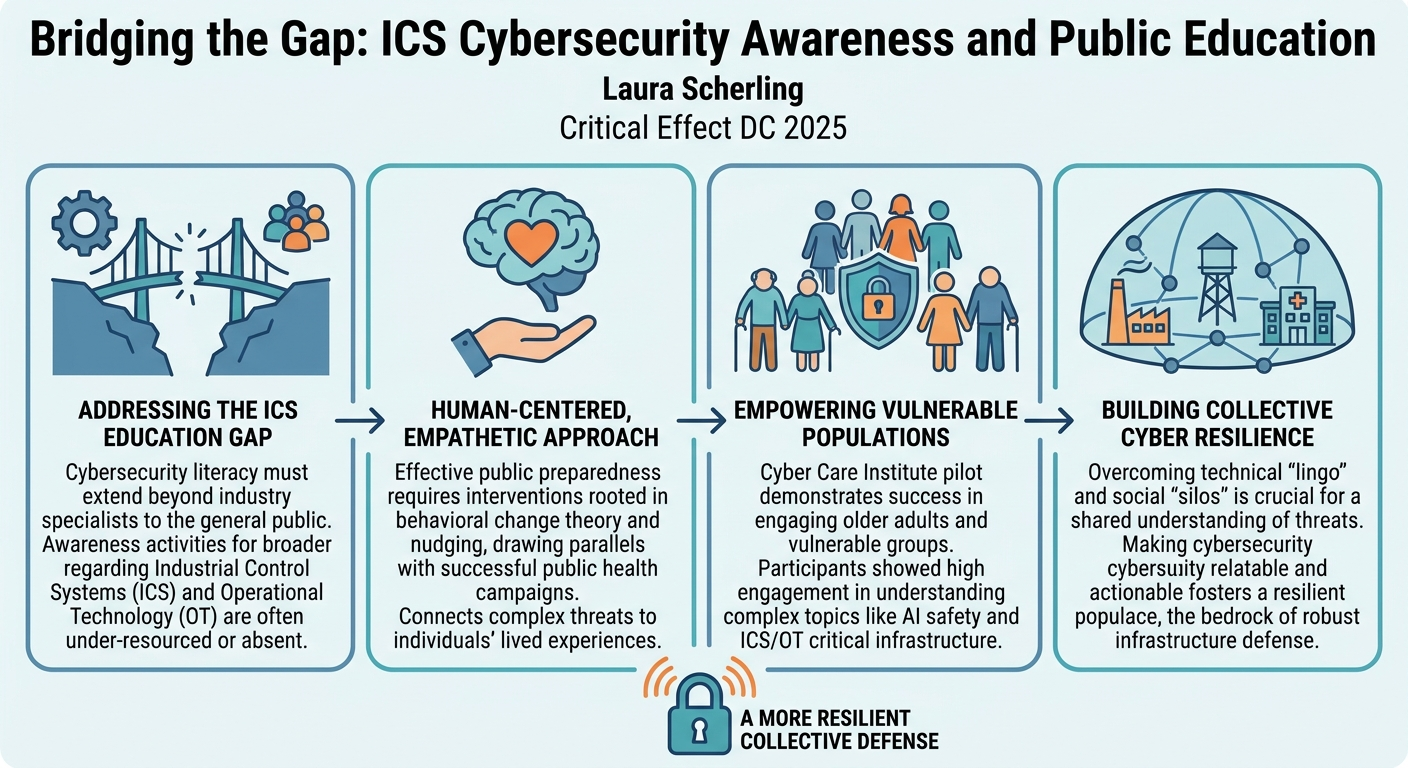
Scherling highlighted a significant ICS education gap, where awareness activities for the broader community are often under-resourced or entirely absent. She proposed that by drawing parallels with successful public health and safety campaigns, and by adopting a human-centered, empathetic approach, it is possible to demystify complex cyber threats and empower everyday citizens to become part of the defensive solution. Her work with the Cyber Care Institute, focusing on vulnerable populations like older adults, serves as a powerful proof of concept for this transformative approach to cybersecurity awareness.
The talk emphasized that while technical solutions and expert training are indispensable, they are incomplete without a populace equipped with foundational cyber literacy. Scherling challenged the cybersecurity community to overcome its inherent "lingo" and "silos" to foster a shared understanding of threats to critical infrastructure, from power grids and water systems to healthcare facilities. By making cybersecurity relatable, memorable, and actionable for everyone, she posisted, society can build a more resilient collective defense against an ever-evolving threat landscape.
Background
▶ Watch: Introduction and the ICS education gap (0:00)
The concept of public preparedness is deeply ingrained in societal consciousness when it comes to natural disasters, medical emergencies, or public health crises. Campaigns like "This is your brain on drugs" or "Only you can prevent forest fires" (featuring Smokey Bear) are testament to the power of widespread, memorable public education in shaping behavior and fostering collective resilience. However, as Laura Scherling pointed out, this crucial framework is conspicuously absent or underdeveloped in the realm of Industrial Control Systems (ICS) and Operational Technology (OT) cyber resilience. Despite the profound implications of cyberattacks on critical infrastructure—ranging from power outages to compromised supply chains—there remains a notable lack of public-facing campaigns that resonate with the average citizen.
Scherling identified a pervasive ICS education gap, noting that many organizations, while investing in internal security trainings, frequently overlook broader public awareness initiatives. This oversight is compounded by several systemic issues. Firstly, the cybersecurity domain is often characterized by dense lingo and acronyms (e.g., PBD for Privacy by Design, SBD for Secure by Design), which act as significant barriers to entry for non-technical audiences. Secondly, social silos within the industry can compartmentalize information, hindering effective community engagement and cross-sector collaboration. Thirdly, a common pitfall in existing awareness efforts is the prevalence of "boring, lackluster generic content" that fails to engage or educate effectively, as highlighted in Julia Paney's work for NIST.
Furthermore, Scherling underscored the critical importance of addressing vulnerable populations, including older adults, people with disabilities, and low-income communities. These groups are often disproportionately targeted by cyber fraud and may lack the digital literacy to protect themselves, inadvertently creating broader vulnerabilities that can be exploited by adversaries. A prevalent and damaging practice within the cybersecurity discourse is victim blaming, which deters individuals from seeking help or reporting incidents, thus eroding trust and hindering collective defense efforts. Scherling argued that a holistic approach to ICS/OT cybersecurity awareness must fundamentally integrate principles like privacy by design and secure by design into the very fabric of public education, making security an inherent, accessible component of everyday digital life.
Key Findings
▶ Watch: Cyber Care Institute pilot program for older adults (4:00)
Laura Scherling's research and the ongoing pilot of the Cyber Care Institute have yielded several critical insights into effective public cybersecurity education, particularly for Industrial Control Systems (ICS) and Operational Technology (OT). A foundational finding is that public preparedness efforts are significantly enhanced by strong interventions rooted in nudging and behavioral change theory. By understanding how people form associations and adopt sustainable behaviors, awareness campaigns can be designed to be far more impactful than traditional, dry trainings.
A key discovery from the Cyber Care Institute pilot is the inherent capacity of individuals to connect with complex cyber threats. Scherling observed that people often possess "lived experiences through various emergencies, tragedies, war, and... survived fraud," which provides a valuable, often underestimated, base knowledge and emotional anchor for understanding cyber risks. This suggests that educators can "start a level higher than you expect," building on existing personal safety metaphors rather than beginning from scratch.
The pilot program itself, primarily targeting older adults and vulnerable people, demonstrated remarkable success. It achieved a high attendance rate and strong engagement, with everyday community members expressing a genuine desire to comprehend "fairly complex attacks" related to ICS/OT and AI safety. The introduction of dedicated modules on AI safety (integrating realistic recreations of "grandparent scams" using audio/images) and ICS safety proved particularly popular. Participants readily grasped concepts like critical infrastructure, the supply chain's role in daily life, and the notion that "products and services are not necessarily secure by design."
Scherling also highlighted the "ICS/OT advantage" in education: connecting abstract cyber data and threats to tangible, local anchors such as hospitals or specific community systems. This "placemaking" approach imbues the subject matter with greater relevance and memorability. Furthermore, the research underscored the importance of activating public-facing partners—including clinics, cities, towns, libraries, museums (like the Spy Museum), and even underutilized mixed-use spaces—to broaden reach and foster community buy-in. Ultimately, the findings emphasize that overcoming the "language and lingo" barrier, breaking information silos, and making education dynamic and emotionally resonant are paramount to fostering a truly cyber-resilient public.
Technical Deep Dive
▶ Watch: Popular curriculum topics and student feedback (6:00)
While "Bridging the Gap" is primarily focused on pedagogical innovation, its implications for technical cybersecurity are profound, especially concerning how complex concepts related to Industrial Control Systems (ICS), Operational Technology (OT), and emerging threats like AI-powered attacks are communicated to a non-technical audience. The "technical deep dive" here lies in the methodology of translating highly technical, often abstract, security challenges into actionable public knowledge.
The Cyber Care Institute's curriculum design exemplifies this translation. Instead of shying away from complexity, the program strategically introduces advanced topics like AI safety and ICS safety in accessible, relatable modules (60-minute and 75-minute formats). For AI safety, the "technical" core involves explaining sophisticated social engineering techniques that leverage AI. Scherling described recreating realistic "grandparent scams" using integrated audio and images, effectively demonstrating how deepfakes or AI-generated voices could manipulate individuals. This approach technically demystifies the threat of AI by showing its practical, malicious application in a way that resonates personally.
Regarding ICS safety, the curriculum tackles the fundamental principles of critical infrastructure and its vulnerabilities. The core "technical" understanding imparted is the interconnectedness of the supply chain and the concept that "products and services are not necessarily secure by design." While not delving into SCADA protocols or PLC vulnerabilities, the education empowers individuals to understand that the systems delivering their electricity, water, or goods are susceptible to attack, and that this has direct implications for their daily lives. This foundational awareness is a critical first step towards a populace that understands why ICS security matters and might support initiatives to bolster it.
A significant "technical" challenge addressed is the pervasive issue of IoT security. Scherling noted that older adults, paradoxically, often exhibit better security hygiene with IoT devices, being more inclined to "turn everything off" and take "breaks" from always-on connectivity. This contrasts sharply with younger generations who may resist basic security practices like running updates or powering down devices. The educational effort here is to explain the attack surface presented by insecure IoT devices—that "all products are not secure by design"—and to instill basic operational security (OpSec) principles relevant to smart homes and connected environments.
The talk implicitly advocates for a human-centered security architecture for public education. This involves applying principles like Privacy by Design (PBD) and Secure by Design (SBD) not just to software or systems, but to the design of information itself. The goal is to make security information inherently private (respecting user data in learning contexts) and secure (built to be understood and acted upon effectively from the outset). This pedagogical architecture leverages behavioral science, such as nudging and behavioral change theory, to foster sustainable security practices, drawing lessons from successful public health campaigns. The "technical" aspect here is the scientific rigor applied to influencing human behavior for security outcomes.
Finally, the "technical deep dive" extends to the strategic breaking of information silos and the de-lingo-fication of cybersecurity. Scherling highlighted that acronyms and jargon are technical barriers to public understanding. The initiative's success hinges on translating these into plain language, fostering information sharing between technical experts and the community. This includes collaborating with professional marketers and advertisers to create sophisticated public service announcements that can compete with commercial messaging, thereby achieving better metrics and wider impact for cybersecurity awareness campaigns. This approach treats public perception and engagement as a technical problem requiring engineered communication solutions.
Demo / Proof of Concept
▶ Watch: Addressing lingo, silos, and making trainings engaging (10:00)
The core "demo" or proof of concept for Laura Scherling's methodology is the Cyber Care Institute pilot program. This initiative, which has been running for "a couple of years," serves as a practical demonstration of how effective public cybersecurity education can be implemented, particularly for typically underserved and vulnerable populations.
The pilot primarily targets older adults and other vulnerable individuals, addressing a critical demographic often at high risk for cyber fraud and less engaged with traditional cybersecurity messaging. The program utilizes a hybrid delivery model, offering both in-person trainings and Zoom sessions, demonstrating adaptability and accessibility. Scherling emphasized that the program operates on a "very low budget," largely relying on her time, highlighting its cost-effectiveness and replicability.
The curriculum is designed for flexibility, offering 60-minute and 75-minute sessions, with specialized modules on AI safety and ICS safety. The engagement levels have been remarkably high, with participants showing "good high attendance rate" and a genuine eagerness to comprehend "fairly complex attacks" related to ICO/OT. Scherling noted that students are particularly receptive to understanding concepts like critical infrastructure, the supply chain, and the inherent lack of secure by design principles in many products.
The success of the pilot is further evidenced by the positive feedback received, with participants expressing satisfaction and requesting additional topics (e.g., Medicare fraud) and more interactive formats. The program also involves community data collection to continually refine the curriculum based on participants' knowledge gaps regarding scams and cyber situations. Key partnerships, such as with the Identity Theft Resource Center (ITRC), have been instrumental, providing crucial "handholding" and step-by-step support for victims, which enhances the program's practical utility. The Cyber Care Institute effectively demonstrates that a human-centered, context-aware, and accessible approach can significantly bridge the cybersecurity awareness gap for the general public.
Defensive Implications
▶ Watch: Q&A: Key takeaways from awareness class effectiveness (14:00)
Laura Scherling's insights offer crucial defensive implications for cybersecurity professionals, organizations, and policymakers. The primary takeaway is the necessity of expanding the defensive perimeter beyond technical controls and internal training to encompass proactive public engagement and education.
- Broaden the Defensive Scope: Critical infrastructure operators and government agencies must recognize that public ignorance of ICS/OT threats is a significant vulnerability. A cyber-aware populace is less susceptible to social engineering attempts that could target critical infrastructure personnel or indirectly impact system resilience. Defenders should view public education as an essential layer of defense.
- Translate Technical Risks: Security professionals need to develop the skill set to translate highly technical concepts—such as AI-enabled deepfake scams, IoT vulnerabilities, or the impact of supply chain disruptions on daily life—into relatable, actionable information for the general public. This requires moving beyond jargon and acronyms to clear, empathetic communication.
- Invest in Human-Centric Security Education: Following principles like Privacy by Design (PBD) and Secure by Design (SBD) in educational content means creating programs that are inherently trustworthy, effective, and respectful of the learner. Adopting behavioral science strategies (like nudging) and making education "dynamic" and "memorable" can significantly improve retention and behavioral change, leading to a more resilient user base.
- Prioritize Vulnerable Populations: Defenders must specifically tailor outreach and defensive strategies for older adults, individuals with disabilities, and low-income groups. These populations are often targets for cyber fraud and may have less access to traditional security resources. Empowering them directly strengthens the overall security posture by reducing the pool of easily exploited victims.
- Foster Community Partnerships: Establishing collaborations with local entities—libraries, community centers, museums, and non-profits like the Identity Theft Resource Center—can amplify defensive messages and provide crucial support networks for victims. These partnerships create trusted channels for information dissemination and incident response that traditional security organizations might lack.
- Combat Victim Blaming: Creating an environment where individuals feel safe reporting cyber incidents without fear of blame is paramount. This fosters trust, encourages reporting, and provides valuable intelligence for threat actors and attack vectors, ultimately aiding in broader defensive strategies.
- Professionalize Awareness Campaigns: Just as sophisticated adversaries employ advanced techniques, public awareness campaigns should leverage professional marketing and advertising expertise. Investing in high-quality, impactful public service announcements ensures that critical security messages cut through the noise and achieve widespread adoption, leading to a more informed and resilient public.
By adopting these defensive implications, the cybersecurity community can build a stronger, more informed human firewall against the evolving threats to critical infrastructure and personal digital safety.
Key Takeaways
- Public education is indispensable for ICS/OT cyber resilience: Beyond specialized training, a cyber-aware general public is a crucial, often overlooked, layer of defense for critical infrastructure.
- Effective awareness leverages existing associations and emotions: Campaigns that are memorable, relatable, and tap into shared consciousness (like public health campaigns) are far more impactful than dry, technical training.
- Vulnerable populations are key targets for empowerment: Initiatives like the Cyber Care Institute demonstrate that tailored, human-centered education can successfully engage older adults and other vulnerable groups in understanding complex threats like AI safety and ICS safety.
- Bridging the "lingo gap" is paramount: Overcoming technical jargon, acronyms, and information silos is essential to make cybersecurity concepts accessible and actionable for everyday citizens.
- Community partnerships amplify impact: Collaborating with local organizations, libraries, museums, and professional marketers can create trusted channels for disseminating critical security information and fostering collective resilience.
- Defenders must embrace a human-centric approach: This involves integrating Privacy by Design and Secure by Design into educational strategies, combating victim blaming, and professionalizing public awareness efforts to build a more informed and resilient society.
About the Speaker(s)
Laura Scherling is a distinguished academic and practitioner working at the intersection of technology, policy, and public education. She is affiliated with the applied analytics program at Columbia University and serves as a lecturer in its tech policy and innovation concentration. Scherling is also the founder of the Cyber Care Institute, a project dedicated to enhancing cybersecurity awareness, particularly for vulnerable populations. An accomplished author, she has penned books such as "Future of Hacking" and conducts research on emerging topics including AI and cyber-enabled human trafficking. Throughout her work, Scherling consistently champions the integration of privacy by design, secure by design, human-centered UX/UI, and evolving digital transformation literacies, striving to make complex technological concepts understandable and actionable for a broad audience.
Reviews
Dr. Zero (Offensive Security Researcher) — WEAK
Scherling pitches a scam awareness program for older adults but somehow claims it bolsters ICS and critical infrastructure resilience. Teaching seniors about deepfake grandparent scams is noble community service, but pretending it builds a 'human firewall' for the power grid is academic delusion. The threat model here is deeply flawed.
Heather Calloway (CISO) — SOLID
This is a public policy talk, not a corporate governance mandate, but the methodology matters. If your security awareness program still relies on annual compliance videos and punitive phishing tests, your awareness lead needs to watch this. It proves that behavioral science and relatable context work better than technical scolding.