Resilience Now: Translating How Different Sectors Mitigate the Risk of Legacy Infrastructure
Matthew Rogers (CISA)
Critical Effect DC 2025 · Day 1 · Track III: Tactical Mastery
Overview
In an era defined by escalating cyber threats to critical infrastructure, Matthew Rogers, leading the Secure Design for Operational Technology (OT) work at CISA, delivered a pivotal talk at Critical Effect DC 2025. Titled "Resilience Now," his presentation squarely addressed the urgent need to enhance the resilience of foundational systems within a challenging 12 to 18-month timeframe. Rogers, situated within CISA's Office of Technical Director, oversees the agency's guidance and services, aiming to improve their technical direction. The core premise of his talk was to transcend the traditional, long-term view of "secure by design" and instead identify actionable, immediate steps for securing legacy OT environments by drawing lessons from diverse sectors.
Key moments
- 0:00 Introduction: The challenge of securing critical infrastructure
- 6:00 Three pillars of resilience: Defense, Engineering, Recovery
- 6:45 Leveraging system-aware components for resilience (aircraft example)
- 12:00 Challenges and lessons from encrypting OT network traffic
- 15:00 Targeted MFA: Securing critical changes in OT environments
- 17:45 Recovery strategies: Gold disks, containerization, portable software
- 19:30 Key recommendations for improving OT resilience
Resilience Now: Translating How Different Sectors Mitigate the Risk of Legacy Infrastructure
Speakers: Matthew Rogers (CISA)
Conference: Critical Effect DC 2025
YouTube: https://www.youtube.com/watch?v=n7GTl93WDIs
Overview
In an era defined by escalating cyber threats to critical infrastructure, Matthew Rogers, leading the Secure Design for Operational Technology (OT) work at CISA, delivered a pivotal talk at Critical Effect DC 2025. Titled "Resilience Now," his presentation squarely addressed the urgent need to enhance the resilience of foundational systems within a challenging 12 to 18-month timeframe. Rogers, situated within CISA's Office of Technical Director, oversees the agency's guidance and services, aiming to improve their technical direction. The core premise of his talk was to transcend the traditional, long-term view of "secure by design" and instead identify actionable, immediate steps for securing legacy OT environments by drawing lessons from diverse sectors.
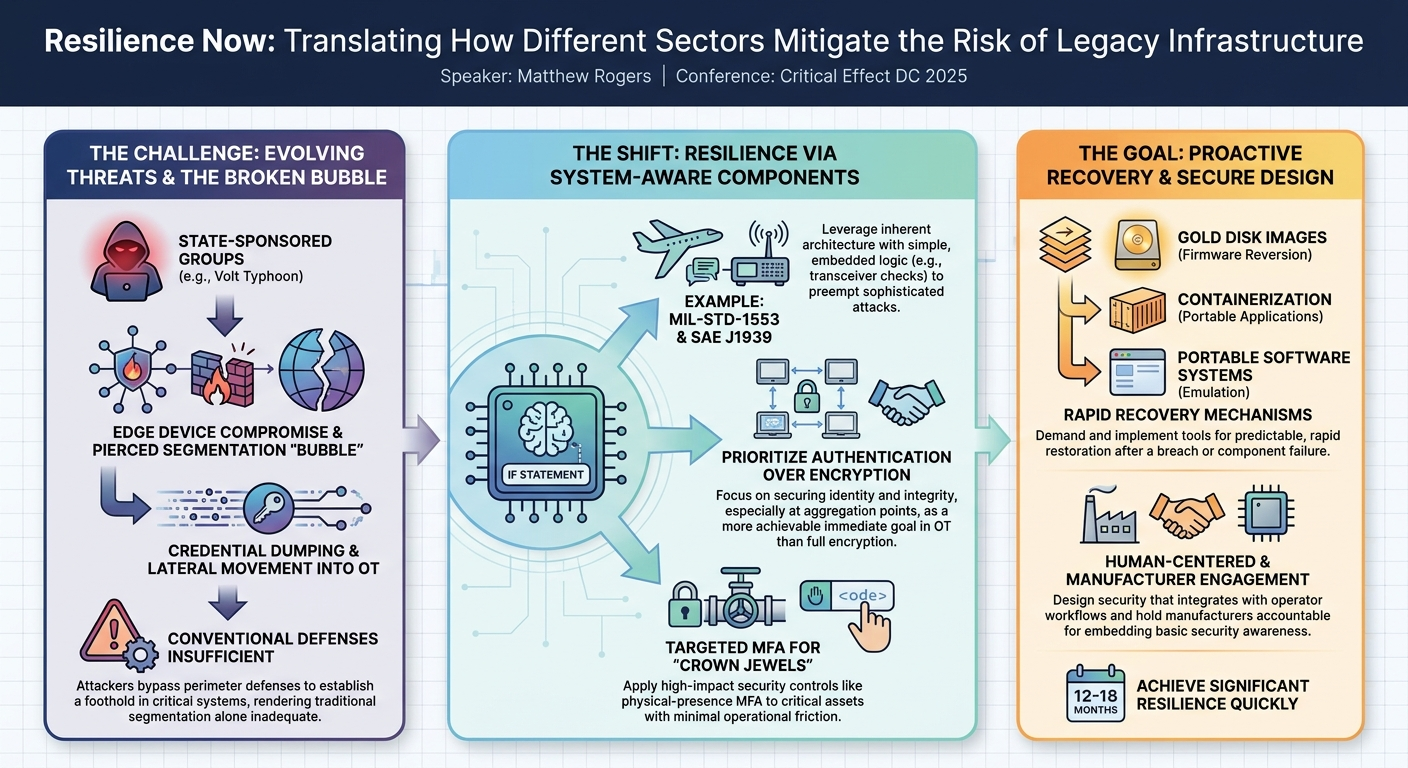
The urgency stems from the evolving threat landscape, particularly the sophisticated tactics employed by state-sponsored groups like Volt Typhoon. These adversaries commonly compromise edge devices, dump credentials, and leverage legitimate access to pivot into or preposition within OT networks. This strategy renders conventional defenses, primarily segmentation and continuous monitoring, potentially insufficient. Rogers argued that while segmentation remains sound advice, it creates a "bubble" that, once pierced, leaves critical systems vulnerable. The talk thus explored what truly works across different industries, seeking "bang for buck" cybersecurity efforts that can be adapted to critical infrastructure, emphasizing thoughtful integration rather than wholesale replication.
Background
▶ Watch: Introduction: The challenge of securing critical infrastructure (0:00)
The prevailing security posture in many critical infrastructure organizations, as frequently observed by CISA, hinges on a few core tenets: network segmentation (or, less commonly, air gaps), continuous monitoring, and existing engineering safety controls. Asset owners often express that they cannot justify further security investments beyond these measures due to perceived high costs and operational friction. This perspective, however, clashes directly with the sophisticated methodologies of advanced persistent threat (APT) groups like Volt Typhoon. Their standard operating procedure involves compromising edge devices—such as firewalls or network access points—which are often responsible for enforcing segmentation. Once these devices are breached, attackers can extract credentials and use them to move laterally, either directly into OT networks if credentials are shared, or to conduct reconnaissance to facilitate future pivots. This means that a security strategy heavily reliant on a network perimeter can be bypassed through legitimate-looking access, leaving the OT network exposed beyond its initial "bubble."
From a vendor and academic perspective, historical assumptions about industrial control systems (ICS) have further complicated security integration. These assumptions include an inability to tolerate downtime, limited staff for security operations, and the impracticality of duplicating systems for secure testing or phased replacement of legacy equipment. Consequently, security solutions have often been designed to be non-intrusive, avoiding modifications, operator friction, or significant network re-architecture beyond basic segmentation. This has led to widespread adoption of unobtrusive network taps exporting data to third-party Security Operations Centers (SOCs), with an emphasis on isolating OT from IT networks. While these practices are not inherently bad, they often result in a fragile security model where, once the initial layer of segmentation is breached, the only remaining defenses are often insufficient safety systems and continuous monitoring that may detect, but not prevent, malicious actions. The crucial question then becomes: who will fix these problems, especially when resources are scarce and vulnerabilities are abundant? Rogers' talk sought to answer this by defining resilience not just as defense, but also as proactive design and effective recovery.
Rogers categorized resilience into three main approaches:
- Defense in Depth: The traditional approach of adding multiple layers of security, akin to the "Star Wars" philosophy of "just add more." The challenge here is making these layers effective and cost-efficient.
- Cyber-Informed Engineering: A more proactive approach focused on designing the impact of cyberattacks out of the system. This involves making systems inherently resilient so that even a successful attack results in a "bad day" rather than a "really bad day." Rogers specifically emphasized this at the component level.
- Recovery: The ability of a system to quickly bounce back after an attack, minimizing downtime and operational disruption.
Key Findings
▶ Watch: Leveraging system-aware components for resilience (aircraft example) (6:45)
The central thesis of Rogers' talk is that significant improvements in critical infrastructure resilience can be achieved within a tight timeframe (12-18 months) by focusing on small, strategic changes at the component level, rather than massive, system-wide overhauls. This approach challenges the conventional wisdom that "secure by design" is an exclusively long-term endeavor.
Key findings and contributions include:
- System-Aware Components: Many legacy OT protocols and components, while lacking inherent security, possess architectural characteristics that can be leveraged for enhanced resilience. By embedding simple, context-aware logic directly into components (e.g., an "if statement" on a transceiver), it's possible to pre-empt sophisticated attacks that would otherwise require extensive network monitoring and analysis. This shifts the burden from complex detection systems to inherent device intelligence.
- Targeted, Usable Security: Instead of attempting to apply ubiquitous security controls (like MFA or full encryption) across entire complex OT environments, a more effective strategy involves identifying "crown jewel" components—those whose compromise would lead to the most severe operational impacts—and applying targeted, human-centered security measures to them. This provides a high "bang for buck" by protecting the most critical assets without introducing prohibitive operational friction.
- Prioritizing Authentication over Encryption: While encryption is often seen as a panacea in IT, its implementation in latency-sensitive OT environments with legacy components and limited technical proficiency presents significant challenges. Rogers' research suggests that focusing on authentication for network traffic, particularly at aggregation points (e.g., field bus to central server), is a more achievable and immediately impactful goal than widespread encryption, which often faces usability and compatibility roadblocks.
- Proactive Recovery Mechanisms: Despite the focus on preventing attacks, the ability to recover quickly and predictably is paramount. Underutilized technological solutions like gold disk images, containerization, and portable software systems can drastically reduce recovery times and costs after a breach or component failure. The lack of their ubiquitous adoption is often due to insufficient demand during procurement processes.
- Human-Centered Design is Crucial: Any security measure, no matter how technically sound, is ineffective if it disrupts operator workflows or requires excessive technical expertise to manage. Rogers highlighted that usability and integration with existing operational processes are fundamental to the successful adoption and maintenance of security controls in OT environments.
- Manufacturers' Role in Secure Design: Component manufacturers often claim they cannot design for end-system security because they don't know how their components will be deployed. Rogers countered this by asserting that manufacturers do understand their components' primary roles and potential attack vectors, and should therefore be accountable for embedding basic security awareness into their designs.
Technical Deep Dive
▶ Watch: Challenges and lessons from encrypting OT network traffic (12:00)
Rogers delved into several technical examples to illustrate how these resilience principles can be applied, moving beyond abstract concepts to concrete, actionable strategies.
System-Aware Components: Leveraging Inherent Architecture
The concept of system-aware components is perhaps the most novel and impactful technical finding. Rogers posited that instead of treating components as isolated entities, they should be designed with an understanding of their role within the broader system, particularly concerning critical functions and potential attack vectors.
He provided a compelling example using Mil-Std-1553, a military standard protocol from the 1970s, updated in 1978 and again in 2018. This protocol, common in transportation and aerospace, notably lacks authentication and encryption, allowing anyone to spoof messages. A critical vulnerability lies in its "mode code" emergency protocol, designed for safety purposes (e.g., shutting off a broken transmitter). Malicious use of this code can shut down all computers on a plane, even in flight, or fire weapon systems.
From a defensive standpoint, the system operates with a single bus controller (similar to a Modbus client) that dictates all communications; no other device speaks unless addressed. Rogers highlighted that if a manufacturer had embedded a simple "if statement" on the transceiver, it could detect if any device other than the known, singular bus controller was attempting to send commands from that controller's address. Such a simple logical check could trigger an alarm, effectively replacing a complex continuous monitoring apparatus that would otherwise be needed to detect anomalous timings or physically impossible events. This "if statement" leverages the inherent, unchangeable architectural truth of a single bus controller, providing robust security without a complete overhaul.
Another example came from the trucking industry, involving the SAE J1939 protocol. A 2016 attack demonstrated that by simply telling an engine that a "new engine" was being plugged in while the vehicle was in motion, the original engine would disconnect itself. From an operational perspective, there's no legitimate scenario where an engine control module is swapped while a truck is actively driving on a highway. A system-aware component could incorporate this contextual logic, refusing to disconnect based on real-time operational parameters. The power of this approach lies in its ability to preempt the need for complex, network-wide security solutions like Public Key Infrastructure (PKI) by addressing vulnerabilities at their architectural root.
Challenges with OT Protocol Security: "Yada Sam Can't Encrypt"
Rogers then addressed the persistent struggle with implementing advanced security features, specifically encryption and authentication, for OT protocols. He referenced CISA's ongoing research, playfully dubbed "Yada Sam Can't Encrypt" (a nod to Bruce Schneier's "Why Johnny Can't Encrypt"), which investigates why secure versions of OT protocols like Modbus over TLS, DNP3 Secure, OPC UA SIP Secure, and SIP Secure are rarely adopted in the field.
Voice of customer research revealed several pain points:
- Fear of Breaking Systems: A significant concern among asset owners is that implementing encryption or PKI will cause system instability or downtime.
- Expired Certificates: The operational overhead and potential for disruption caused by expired certificates are major deterrents.
- Technical Proficiency: A general lack of specialized technical staff proficient in cryptography and PKI management within OT environments.
- High CAPEX/OPEX: The initial capital expenditure and ongoing operational costs associated with setting up and maintaining a PKI infrastructure are often prohibitive for many organizations.
- Vendor Compatibility Issues: Even when vendors claim compliance with secure standards, real-world interoperability often falls short, leading to frustration and abandonment of security initiatives.
The key recommendation from this research was to prioritize authentication over full encryption. While encryption ensures confidentiality, authentication guarantees the identity of communicating parties, which is often the more critical security requirement in OT. Furthermore, success has been found in "wrapping" protocols at the field bus or higher levels, sending authenticated traffic back to a central SCADA server or historian. This approach minimizes latency impacts on time-critical field devices while still securing data in transit. Full end-to-end encryption down to the field level will require better components and procurement practices in the future.
Targeted MFA Usage
Multi-Factor Authentication (MFA) is a cybersecurity staple in IT but faces significant operational pushback in OT due to concerns about operator friction and latency. Rogers argued for targeted MFA, applying it strategically to "crown jewel" assets rather than broadly across the entire environment.
He provided an example from the freight rail industry. Wayside signaling stations, which control vital signaling logic (e.g., red-to-green lights, train spacing), often have a physical "local presence" button. To make changes to this logic, an operator must physically press the button and then input a code. While not a perfectly secure, cryptographically robust MFA solution, this method effectively enforces change management by requiring both physical presence and knowledge of a secret. This targeted approach, applied to devices whose compromise would lead to a "very, very bad day," provides significant resilience without the operational overhead of ubiquitous MFA. It guarantees that, short of a sophisticated CVE or administrator compromise, critical configurations cannot be altered without known human intervention.
Recovery Mechanisms
Finally, Rogers emphasized the often-overlooked aspect of resilience: recovery. He highlighted several technological solutions that, despite existing, are not ubiquitously adopted in OT:
- Gold Disk / Gold Images: The practice of creating and maintaining known-good firmware images. In case of a failed firmware upload or compromise, systems can be reliably reverted to a pristine state.
- Containerization: Encapsulating applications and their dependencies into portable, isolated containers. This allows for rapid deployment, hot-swapping during updates, and significantly reduces downtime and recovery time by making systems easier to spin up.
- Portable Software Systems: The ability to emulate critical system components in software if hardware fails. This allows operations to continue, albeit potentially degraded, until an operator can assert manual control or replace the faulty hardware.
The primary reason for the lack of widespread adoption of these solutions is often a failure in procurement. Asset owners are not consistently asking for these capabilities from vendors, leading to their sporadic inclusion in product lines. Rogers stressed that focusing on predictable recovery mechanisms is crucial, especially given the threat of adversaries "bricking" components through malicious firmware uploads, which can be just as devastating as physical destruction, but far more insidious to recover from.
Demo / Proof of Concept
▶ Watch: Recovery strategies: Gold disks, containerization, portable software (17:45)
While Matthew Rogers' talk did not feature a live, interactive demonstration in the traditional sense, the presentation effectively served as a conceptual proof of concept through its detailed technical examples. The scenarios involving the Mil-Std-1553 and SAE J1939 protocols, coupled with the proposed "if statement" logic and contextual awareness for engine control, acted as compelling architectural demonstrations. These examples illustrated how seemingly minor, component-level design changes, rooted in an understanding of inherent system behavior and operational context, could provide robust security benefits that would otherwise require complex and costly network-wide solutions. The CISA research into OT protocol encryption ("Yada Sam Can't Encrypt") also functions as a "proof of problem," highlighting the real-world usability challenges that hinder the adoption of theoretically sound security technologies.
Defensive Implications
▶ Watch: Key recommendations for improving OT resilience (19:30)
The insights shared by Matthew Rogers offer critical guidance for defenders grappling with securing legacy OT infrastructure:
- Assume the "Bubble" Will Be Pierced: Defenders must move beyond relying solely on network segmentation as the primary defense. Given the capabilities of threat actors like Volt Typhoon, assume that edge devices can be compromised and that adversaries will gain access to the OT network. Focus on security within the OT environment, not just at its perimeter.
- Prioritize Component-Level "Secure by Design": Actively identify opportunities for embedding "system-aware" logic directly into critical components. This means understanding the inherent architectural truths of your systems (e.g., single controllers, specific operational contexts) and working with manufacturers or internal teams to implement simple, yet powerful, security checks at the device level.
- Conduct "Crown Jewels" Analysis for Targeted Security: Invest in identifying the most critical assets and functions within your OT environment—those whose compromise would lead to the most severe operational or safety impacts. Apply targeted, high-impact security controls, such as specialized MFA or custom system-aware logic, to these "crown jewels" rather than attempting to blanket the entire network with difficult-to-implement measures.
- Demand and Procure Recovery Capabilities: When acquiring new OT components or systems, explicitly request features that facilitate rapid and predictable recovery. This includes capabilities like gold disk images for firmware reversion, support for containerization for faster deployment and hot-swapping, and the availability of portable software systems for emulation during hardware failures. Make these non-negotiable procurement requirements.
- Focus on Usable Authentication for OT Protocols: For existing OT networks, prioritize implementing authentication for critical protocol traffic, especially at aggregation points (e.g., field bus gateways to central historians or SCADA servers). Acknowledge the challenges of full encryption in OT and build towards it incrementally, but secure identity and integrity first.
- Engage with Manufacturers on Secure Design: Challenge the notion that component manufacturers cannot contribute to end-system security. Demand that manufacturers articulate how their components are designed with an awareness of their role in the overall system, what inherent security features they offer, and how they address common attack vectors. Refer to resources like the CISA "Secure by Design" paper (cisive.gov/securebydesign) to guide these discussions.
- Embed Human-Centered Design: All security implementations in OT must consider the operator workflow. Security that creates excessive friction or requires specialized, unavailable expertise will be bypassed or ignored. Design security solutions that are intuitive, integrate seamlessly with existing processes, and minimize disruption.
- "Secure First, Legacy Second" for New Deployments: When replacing or upgrading systems, prioritize secure communication and design from the outset. While backwards compatibility is often necessary, ensure that the new system is configured to be inherently secure by default, rather than relying on operators to "flip a switch" later—a step that often never happens.
Key Takeaways
- Small, Targeted Component Changes Yield High Returns: Significant resilience improvements in OT can be achieved within 12-18 months by focusing on strategic, component-level changes that leverage inherent system architecture.
- Leverage System Awareness for Simpler Security: Embed contextual intelligence directly into components (e.g., "if statements") to preempt attacks, reducing reliance on complex, resource-intensive network monitoring.
- Prioritize Authentication Over Encryption in OT: Given the operational challenges, focus on securing the identity and integrity of OT communications through authentication, especially at aggregation points, as a more achievable and impactful immediate step than widespread encryption.
- Implement Targeted MFA for "Crown Jewel" Assets: Apply Multi-Factor Authentication strategically to critical devices whose compromise would lead to severe consequences, using human-centered approaches like local presence buttons to minimize operational friction.
- Demand and Integrate Robust Recovery Mechanisms: Proactively procure components and systems with features like gold disk images, containerization, and portable software systems to ensure rapid, predictable, and cost-effective recovery from cyber incidents.
- Embrace Human-Centered "Secure by Design" from Procurement Onwards: Security solutions must be usable and integrated into existing workflows. Engage with manufacturers and demand components designed with an understanding of their role in overall system resilience, setting the stage for inherently more secure systems.
About the Speaker(s)
Matthew Rogers leads the Secure Design for Operational Technology (OT) work at CISA, operating within the agency's Office of Technical Director. In this role, he is responsible for overseeing and improving the technical direction of CISA's guidance and services related to OT security. His professional background includes a period in academia, experience as a continuous monitoring vendor for critical systems across planes, trains, and tanks, and a tenure at MITRE. This diverse experience provides him with a deep understanding of both theoretical security challenges and practical implementation hurdles in complex industrial and critical infrastructure environments.
Reviews
Dr. Zero (Offensive Security Researcher) — SOLID
CISA talks are usually a graveyard of 'public-private partnership' buzzwords, but Rogers actually brought concrete protocol analysis to the stage. He correctly identifies that slapping PKI on legacy OT is a pipe dream and advocates for practical, component-level logic checks over overpriced network monitoring. It's a strategic keynote, but one rooted in actual field reality.
Heather Calloway (CISO) — MUST SEE
This is the most pragmatic CISA guidance on OT security I've seen in years. Rogers stops pretending we can patch our way out of legacy industrial debt and instead hands defenders a 12-to-18-month roadmap focused on component-level logic, targeted authentication, and procurement standards. If you have OT in your footprint, this changes your immediate capital planning.