Impact-Centric Cyber Resilience Quantification (CRQ): Estimating Cyber-Physical Damage at Scale
David White (Axio), Daniel Brown (Axio), Brendan Fitzpatrick (Axio)
Critical Effect DC 2025 · Day 1 · Track III: Tactical Mastery
Overview
In an era where cyber threats increasingly manifest in the physical world, organizations with operational technology (OT) dependencies face a critical challenge: quantifying the tangible impact of cyber-physical events and securing adequate insurance coverage. The talk, "Impact-Centric Cyber Resilience Quantification (CRQ): Estimating Cyber-Physical Damage at Scale," presented by David White, Daniel Brown, and Brendan Fitzpatrick of Axio, addresses this urgent need. It unveils a pioneering methodology designed to help large, geographically distributed organizations and their insurers understand, measure, and ultimately mitigate cyber-physical risk exposure.
Key moments
- 0:00 Introduction: Uninsured cyber-physical damage gap
- 2:00 Methodology for quantifying cyber-physical risk
- 5:00 Context-aware scenario generation using LLMs
- 10:00 Case study: Poultry production cyber-physical scenarios
- 14:00 Interpreting CRQ loss curves and investment insights
- 16:20 Assessing vulnerability and inherent risk
- 20:50 Framing cyber as operational risk
- 22:00 Resilience: Financial wherewithal to fight another day
Impact-Centric Cyber Resilience Quantification (CRQ): Estimating Cyber-Physical Damage at Scale
Speakers: David White (Axio); Daniel Brown (Axio); Brendan Fitzpatrick (Axio)
Conference: Critical Effect DC 2025
YouTube: https://www.youtube.com/watch?v=zbO1Wovgbwc
Overview
In an era where cyber threats increasingly manifest in the physical world, organizations with operational technology (OT) dependencies face a critical challenge: quantifying the tangible impact of cyber-physical events and securing adequate insurance coverage. The talk, "Impact-Centric Cyber Resilience Quantification (CRQ): Estimating Cyber-Physical Damage at Scale," presented by David White, Daniel Brown, and Brendan Fitzpatrick of Axio, addresses this urgent need. It unveils a pioneering methodology designed to help large, geographically distributed organizations and their insurers understand, measure, and ultimately mitigate cyber-physical risk exposure.
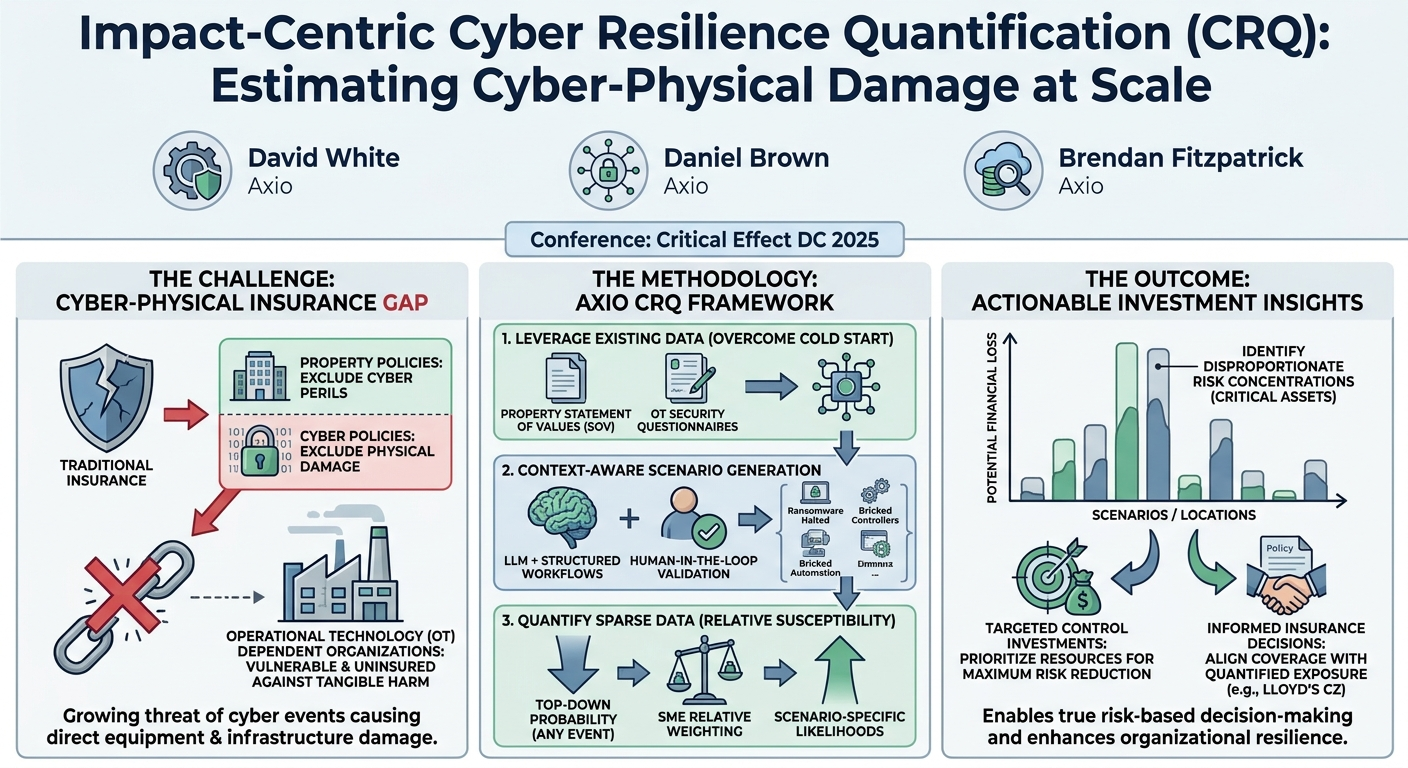
The speakers highlight a significant gap in the traditional insurance market, where property policies often exclude cyber perils and cyber insurance policies explicitly exclude tangible physical damage. This leaves organizations vulnerable and uninsured against a growing category of threats that can cause direct harm to equipment, infrastructure, and production. Axio's CRQ methodology, born out of a competitive process within the Lloyd's Lab incubator, provides a structured, data-driven approach to bridge this gap, offering a framework for estimating potential cyber-physical damage and guiding strategic investments in resilience.
Background
▶ Watch: Introduction: Uninsured cyber-physical damage gap (0:00)
The genesis of Axio's Cyber Resilience Quantification (CRQ) methodology lies in a fundamental shift within the global insurance market, particularly at Lloyd's of London. A few years prior to the conference, Lloyd's, the world's largest insurance market, mandated that all policies sold within its market must explicitly clarify how they address cyber perils. This directive had an immediate and profound impact: property insurers began to affirmatively exclude cyber-related damages from their policies, while cyber insurance policies, designed to cover breach costs, notifications, and ransomware, continued to exclude tangible physical damage. This created a critical insurance gap for organizations heavily reliant on Operational Technology (OT), leaving them exposed to significant financial losses from cyber-physical events with no clear path to coverage.
To address this burgeoning problem, Lloyd's introduced a new insurance code, CZ (Cyber Physical Damage), specifically for policies covering tangible damage resulting from cyber incidents. However, a significant hurdle remained: underwriters, traditionally adept at assessing physical perils like floods, fires, and earthquakes based on geographic location, lacked the experience and methodologies to evaluate risks that could spread virally across a network, impacting multiple locations simultaneously. Consequently, organizations seeking CZ policies had no objective basis to determine their coverage needs, and insurers struggled to accurately price such risks.
Axio's involvement in the Lloyd's Lab incubator was a direct response to this challenge. The company was tasked with developing a robust methodology that could empower both insureds and insurers to better understand and quantify this novel class of risk. A common impediment to effective cyber risk quantification is the "cold start problem" – the difficulty organizations face in initiating the process due to extensive data collection requirements. Axio's approach sought to overcome this by leveraging data inputs that organizations already maintain for other purposes, streamlining the assessment and making it more accessible and scalable. This foundation was critical for building a practical and repeatable framework for impact-centric cyber resilience quantification.
Key Findings
▶ Watch: Context-aware scenario generation using LLMs (5:00)
Axio's CRQ methodology delivers several key findings that fundamentally transform how organizations can assess and manage cyber-physical risk:
First, the methodology provides a scalable and objective framework for quantifying potential tangible damage from OT cyber events. By moving beyond subjective qualitative assessments, it offers a concrete, financial understanding of risk exposure across an entire organization, regardless of its size or geographic distribution. This objectivity is crucial for both internal decision-making and external discussions with insurers.
Second, a significant innovation is the leveraging of existing, readily available data sources. Instead of demanding new, complex data collection, Axio's approach utilizes information already compiled for other business functions, such as Property Statement of Values (SOV) and OT security questionnaires from cyber insurance applications. This drastically reduces the "cold start problem" and ensures that the data inputs are standardized, objective, and regularly updated through existing renewal processes.
Third, the methodology employs a novel context-aware scenario generation process that combines the power of Large Language Models (LLMs) with structured workflows and essential human-in-the-loop validation. This hybrid approach ensures that the generated cyber-physical scenarios are not only comprehensive and tailored to specific location types but also technically sound, plausible, and free from AI hallucinations, thereby increasing their fidelity and relevance.
Fourth, to address the inherent scarcity of historical data for cyber-physical events, Axio introduces the concept of relative susceptibility. This technique allows for the estimation of scenario likelihoods by first establishing a top-down probability of any cyber-physical event for a given organization type and size. Subsequently, subject matter experts (SMEs) provide relative weightings of scenario plausibility against each other, enabling a bottom-up derivation of scenario-specific likelihoods. This pragmatic approach offers a viable solution where traditional actuarial data is insufficient.
Finally, the output of the CRQ analysis generates impact-centric loss curves that are not merely aggregate figures but detailed distributions of potential financial losses. These "lumpy" charts, as described by the speakers, are a critical insight, revealing disproportionate risk concentrations in specific locations or asset types. This granular visibility allows organizations to identify their most critical assets and prioritize control investments where they will yield the greatest reduction in potential damage, moving beyond a blanket approach to truly risk-based decision-making.
Technical Deep Dive
▶ Watch: Interpreting CRQ loss curves and investment insights (14:00)
Axio's CRQ methodology is built upon a structured, multi-step process that intelligently combines existing organizational data with advanced modeling techniques and expert human oversight. The technical foundation is designed for scalability, objectivity, and actionable insights, particularly for complex, multi-site organizations with significant OT footprints.
The process begins with the identification and ingestion of data inputs that are typically already available within an organization. The primary input is the Property Statement of Values (SOV). This document, usually maintained for property insurance purposes, provides granular details for each physical location, including:
- Building reinstatement cost: The cost to rebuild a structure.
- Equipment values: The monetary worth of machinery and industrial equipment within a location.
- Average stock or work-in-progress (WIP) values: The value of inventory or partially completed goods.
- Business income generated: The revenue stream produced by a specific location.
- High-level overview of location purpose: A description of what the location serves (e.g., manufacturing, distribution, hatchery).
Complementing the SOV is the OT security questionnaire submitted for cyber insurance applications. While often sparse due to competitive pressures among insurers to minimize questions, this questionnaire provides a baseline understanding of the organization's existing OT security controls. The benefit of these data sources is their inherent objectivity, standardization, and regular updates during policy renewals, ensuring the CRQ results reflect current organizational status.
Once data is collected, locations are classified using NAICS codes (North American Industry Classification System). NAICS is chosen for its granularity, particularly for industrial sectors, which is crucial for tailoring scenarios to specific operational contexts. This classification helps in understanding the critical function of each location and the connected technologies that support it.
The core of the methodology lies in its context-aware scenario generation process. This process, initially manual, evolved to integrate Large Language Models (LLMs) with structured workflows to enhance scalability and fidelity. The steps involve:
- Critical Function Identification: Based on the NAICS classification and location purpose, the critical business function of each site is determined.
- Critical Connected Technologies: The specific OT systems and technologies essential to that critical function are identified.
- Historical Research Integration: This involves drawing from:
- Cyber-physical events: Data from actual incidents in similar locations, though acknowledged as not comprehensive.
- Past physical risks: Historical data on non-cyber physical incidents relevant to the location type (e.g., fires, equipment failures).
- Common cyber intrusion pathways: Plausible cyber attack vectors that could lead to physical consequences. The focus here is on possibility of physical impact via cyber means, rather than only on observed past events.
- Scenario Generation Engine: All this context (location purpose, physical risks, cyber pathways) is fed into an engine that leverages LLMs to output plausible "candidate scenarios" for cyber-physical damage.
A critical component of this process is the human-in-the-loop validation. Recognizing the propensity of LLMs for hallucinations, technical subject matter experts (SMEs) constantly review the generated candidate scenarios to ensure their technical soundness, plausibility, and operational feasibility. This quality control step is vital for maintaining the integrity and usefulness of the output.
For each distinct location type within a multi-site organization, scenarios are generated. These scenarios then undergo a final subject matter expert (SME) review to assess their plausibility in light of the specific controls reported in the organization's OT cyber insurance application. This review is pivotal for the relative susceptibility technique.
Given the scarcity of data for directly estimating the likelihood of specific cyber-physical events (e.g., "a ransomware event causing this type of damage at this location has X% probability in a year"), Axio employs relative susceptibility. This involves:
- Top-down Probability: Establishing a high-level probability for any cyber-physical event occurring within an organization of a given type and size.
- Relative Weighting: Operational technology SMEs then provide relative weightings for the plausibility of individual scenarios. For instance, an SME might determine that "Scenario A is significantly more likely than Scenario B, which is slightly more likely than Scenario C." This expert judgment allows Axio to "back into a scenario-level estimate of the likelihood" by distributing the top-down probability across the relatively weighted scenarios.
The underlying risk modeling team, led by Brendan Fitzpatrick and informed by David White's background, draws inspiration from established methodologies such as Hubbard's methods, Carnegie Mellon's OCTAVE, and FAIR (Factor Analysis of Information Risk). While Axio uses its own terminology and ontology, the core principles of quantitative risk analysis from these frameworks inform their approach, even influencing terms like "susceptibility" which has recently seen adoption in the FAIR ontology. This blend of established risk quantification principles with novel data utilization and AI-assisted scenario generation forms the robust technical backbone of Axio's CRQ.
Demo / Proof of Concept
▶ Watch: Assessing vulnerability and inherent risk (16:20)
The speakers presented a compelling real-world case study to illustrate the application and benefits of their CRQ methodology. The example focused on a client in the poultry production industry, a sector with significant OT dependencies and potential for cyber-physical damage.
The organization operated across six distinct location types, of which three were identified as having critical cyber-physical risk exposure:
- Poultry Hatcheries: Where eggs are incubated and chicks are hatched.
- Poultry Processing Facilities: Where chickens are slaughtered and prepared for consumption.
- Refrigerated Warehousing and Storage: Distribution centers for finished products.
For these three critical location types, Axio modeled five distinct cyber-physical scenarios:
- Hatchery Automation Disrupted via Ransomware: This scenario posits a ransomware attack impacting automated systems responsible for vaccinating chicks and identifying diseased ones immediately after hatching. The impact would include a shift to intensive manual labor, significant operational delays, loss of potential chicks, and physical damage to the automation systems themselves.
- Incubator Bricking: Specific to hatcheries, this scenario involves a threat actor gaining access to the main hatchery control system and deliberately "bricking" the large industrial incubators. This would lead to the complete loss of entire batches of eggs, resulting in substantial chicken losses and physical damage to the specialized incubator equipment.
- Disruption of Processing Automation Systems: In the processing facilities, this scenario targets the highly configured and precisely tuned robotic arms that slice and prepare chicken pieces. A threat actor altering these configurations could cause severe physical damage to the equipment, render chicken products unusable, and lead to significant business interruption and stock loss.
- Bricking of Computer Vision or X-ray for QA and Foreign Object Screening: This scenario focuses on the critical quality assurance (QA) stage at processing plants, where high-speed computer vision or X-ray systems detect foreign objects (e.g., plastic, metal) in chicken products. If these machines are compromised and bricked, operations would revert to slow, manual checking, potentially leading to product recalls (for items processed before the compromise was detected), extensive delays, business interruption, and stock loss.
- Disruption of Cold Storage Systems: A more generalized but critical scenario for refrigerated warehouses, this involves a cyber attack disabling the cold storage infrastructure. This would result in significant business interruption, massive stock loss due to spoilage, and potential physical damage to the cold storage systems themselves. The speakers noted that this particular scenario has real-world precedent, though not specifically in poultry distribution centers.
The output of the analysis was presented through several compelling visualizations. For each scenario, a full scenario narrative was generated, detailing the threat actor, execution method, and anticipated business and operational impacts. Crucially, the methodology produced simulated loss curves across all applicable locations for each scenario. These charts displayed the minimum, maximum, and mean financial loss, alongside the scenario's estimated probability.
A key insight highlighted by the speakers was the "lumpy" nature of these loss curves, rather than smooth distributions. This lumpiness is not a flaw, but a deliberate feature, indicating varying location sizes or importance within the organization. For example, in the cold storage scenario, the analysis showed that out of nine distribution centers, five or six might incur less than $5 million in losses, but two or three critical locations could lead to losses between $20 million and $30 million. This granular detail is invaluable for guiding targeted control investments. An organization with a limited budget could use this output to identify precisely which high-impact distribution centers should be prioritized for enhanced security controls.
Finally, the demonstration included an overall organizational view of cyber-physical risk exposure. The bottom-up quantification approach ensures that the data can be aggregated and disaggregated to support decision-making at any scope – from individual locations, to specific scenarios across all relevant sites, to a holistic enterprise-wide risk profile. This flexibility provides a comprehensive and actionable understanding of cyber-physical resilience.
Defensive Implications
▶ Watch: Resilience: Financial wherewithal to fight another day (22:00)
The Axio CRQ methodology provides profound and actionable insights for cybersecurity defenders, moving beyond abstract risk discussions to concrete, financially quantified impacts.
Foremost, the output directly facilitates prioritization of investments. By demonstrating specific financial losses associated with different locations and scenarios (as exemplified by the "lumpy" loss curves), organizations can identify their most vulnerable and impactful assets. Instead of a uniform security spend, defenders can advocate for targeted resource allocation – for instance, "shoring up this manufacturing facility, this hatchery, and this refrigerated warehouse" first, as these are identified as points of disproportionately high potential loss. This enables security leaders to make data-driven decisions on where to invest limited budgets for maximum risk reduction.
Secondly, this methodology is a powerful enabler of a true risk-based approach to security. For over a decade, the cybersecurity community has advocated for risk-based strategies, yet often struggles with objective quantification. Axio's CRQ provides the "real insight into the risks" that is necessary to implement such an approach. It moves organizations beyond compliance-driven security to a posture focused on protecting critical assets from financially impactful events.
Thirdly, David White articulated a crucial philosophical shift: framing cyber risk as a component of broader operational risk. He argued that the term "cyber" can sometimes act as a "blockade" or "barrier" for non-cyber stakeholders. By re-contextualizing cyber defense expenses within the realm of operational risk, it highlights how shoring up cyber defenses can yield "enormous benefit for all operational risks." This reframing can foster better collaboration with operational teams and leadership, demonstrating the integrated value of cybersecurity investments.
Ultimately, the methodology directly addresses organizational resilience. As White emphasized, "the bottom line on any organization's resilience is whether they have the financial wherewithal to live and fight another day." Cyber-physical events have driven organizations into liquidation and bankruptcy. By quantifying potential financial damage, CRQ provides the critical information needed to ensure an organization's financial viability in the face of a significant incident. This empowers defenders to not only protect assets but also contribute directly to the long-term survival and stability of the enterprise.
Finally, for those navigating the new Lloyd's CZ insurance code, the CRQ provides an objective basis for determining how much cyber-physical damage insurance to buy. This removes guesswork and allows organizations to align their coverage with their actual quantified risk exposure, ensuring they are adequately protected against tangible losses.
Key Takeaways
- Addressing the Insurance Gap: Axio's CRQ methodology directly tackles the critical insurance gap for OT-dependent organizations, where traditional policies exclude tangible damage from cyber-physical events.
- Leveraging Existing Data: The approach innovatively uses readily available organizational data, such as Property Statement of Values and OT security questionnaires, to overcome the "cold start problem" in risk quantification.
- Context-Aware Scenario Generation: A hybrid method combining LLMs with structured workflows and essential human-in-the-loop validation ensures the generation of plausible and technically sound cyber-physical damage scenarios.
- Quantifying Sparse Data: The "relative susceptibility" technique provides a pragmatic solution for estimating scenario likelihoods when direct historical data for cyber-physical events is scarce, using expert judgment for relative weighting.
- Actionable Investment Insights: The methodology produces detailed, "lumpy" loss curves that pinpoint specific high-impact locations and assets, enabling organizations to prioritize and strategically allocate limited security resources for maximum risk reduction.
- Cyber as Operational Risk: The talk advocates for viewing cyber risk as an integral component of broader operational risk, fostering a more holistic approach to resilience and demonstrating the far-reaching benefits of cyber defense investments.
About the Speaker(s)
David White is the President and Co-founder of Axio. He is a prominent evangelist for risk quantification techniques and has a strong background in the field, having been trained in Hubbard's methods and having worked at Carnegie Mellon in the group that developed the OCTAVE framework.
Daniel Brown is associated with Axio and played a significant role in building and presenting the methodology for impact-centric cyber resilience quantification discussed in the talk.
Brendan Fitzpatrick is the Head of Axio's risk modeling team. He was instrumental in building the presented methodology and is also trained in Hubbard's methods, contributing his expertise to the quantitative aspects of cyber risk assessment.
Reviews
Dr. Zero (Offensive Security Researcher) — WEAK
This is actuarial math wearing a cybersecurity trench coat. It's a vendor pitch designed to help companies calculate how much Lloyd's of London CZ insurance they need to buy. If you're a CFO buying policy coverage, it's relevant. If you're a defender actually trying to stop an OT environment from getting bricked, there's nothing here.
Heather Calloway (CISO) — SOLID
A highly practical framework for quantifying uninsured cyber-physical risk and determining how much Lloyd's CZ coverage to buy. By linking OT cyber scenarios to standard Property Statements of Value, it gives CISOs a defensible way to justify targeted control investments to the CFO.