Better Attack Surface Management: What Attackers See That You Don’t
Ray Blasko (BreakPoint Labs)
Critical Effect DC 2025 · Day 1 · Track III: Tactical Mastery
Overview
In the realm of cybersecurity, a fundamental disconnect often exists between how defenders perceive their organization's attack surface and how adversaries actually exploit it. Ray Blasko, Technical Director of Offensive Operations at BreakPoint Labs, addresses this critical gap in his Critical Effect DC 2025 talk, "Better Attack Surface Management: What Attackers See That You Don’t." Blasko, drawing from his extensive experience as a red team operator for a DoD-certified team specializing in Operational Technology (OT) and critical infrastructure, highlights that traditional perimeter defenses and IT/OT segmentation, while crucial, no longer suffice against a sophisticated threat landscape.
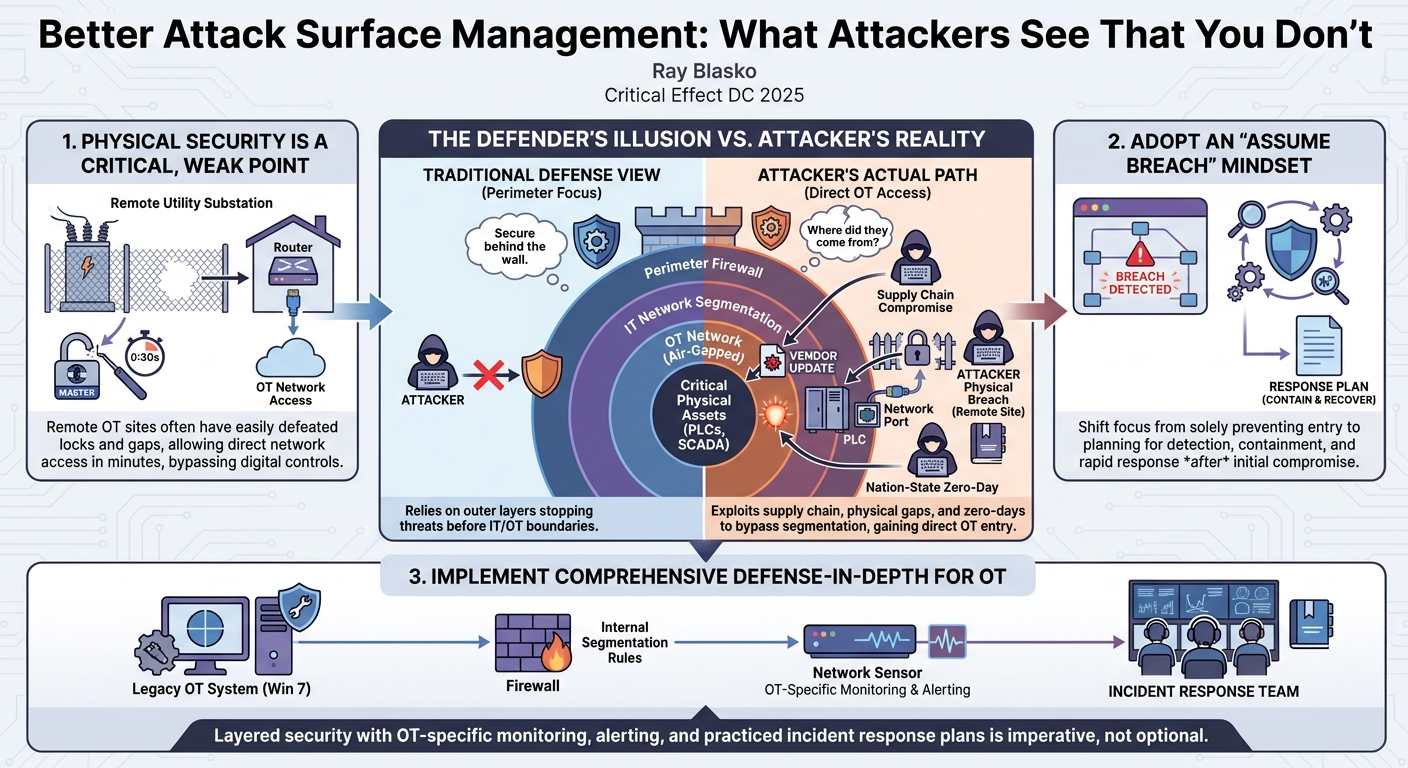
Key moments
- 0:00 Introduction and speaker's unique perspective
- 4:00 Attacker's expanded view of the attack surface
- 7:55 Real-world physical security compromise example (water utility)
- 15:00 Importance of Defense in Depth for OT networks
- 17:00 Leveraging security assessments with an attacker mindset
- 20:30 Validating security posture beyond policies and procedures
- 22:30 Summary: Proactive security and the assume breach mindset
Better Attack Surface Management: What Attackers See That You Don’t
Speakers: Ray Blasko (BreakPoint Labs)
Conference: Critical Effect DC 2025
YouTube: https://www.youtube.com/watch?v=wW99qVB92jQ
Overview
In the realm of cybersecurity, a fundamental disconnect often exists between how defenders perceive their organization's attack surface and how adversaries actually exploit it. Ray Blasko, Technical Director of Offensive Operations at BreakPoint Labs, addresses this critical gap in his Critical Effect DC 2025 talk, "Better Attack Surface Management: What Attackers See That You Don’t." Blasko, drawing from his extensive experience as a red team operator for a DoD-certified team specializing in Operational Technology (OT) and critical infrastructure, highlights that traditional perimeter defenses and IT/OT segmentation, while crucial, no longer suffice against a sophisticated threat landscape.
The presentation challenges conventional security paradigms by introducing a broader, multi-layered view of the attack surface, extending far beyond external network perimeters and phishing vectors. Blasko argues that modern attackers, particularly nation-state actors and those leveraging supply chain attacks or physical compromise, bypass these traditional defenses entirely, gaining initial access directly into sensitive OT environments. This shift necessitates a profound re-evaluation of defense strategies, emphasizing defense-in-depth, proactive security assessments, and a persistent "assume breach" mindset to identify and mitigate vulnerabilities at every conceivable layer.
This article delves into Blasko's insights, dissecting the evolving attacker methodologies and outlining actionable strategies for defenders to adopt a more comprehensive and adversarial perspective on their security posture. By understanding the attacker's lens, organizations can prioritize security improvements, validate existing controls, and build resilience against threats that often go unnoticed by traditional security frameworks.
Background
▶ Watch: Introduction and speaker's unique perspective (0:00)
The traditional understanding of an organization's attack surface often aligns with a "turtles all the way down" analogy, where layers of defense are built outward from the most critical assets. In the context of OT, this typically follows a model like Purdue, delineating external assets, the IT network, the OT network (comprising SCADA assets, RTUs, PLCs), and ultimately, physical assets. Defenders historically focus on securing external perimeters, implementing robust IT segmentation, and providing phishing training as primary lines of defense. The prevailing assumption is that if an attacker breaches the external perimeter or bypasses user awareness via social engineering, they will land in the IT network, where further segmentation protects the more sensitive OT environment.
However, Blasko asserts that this defensive mindset, while logical, is increasingly outdated. As traditional defenses have improved, attackers have evolved, becoming more creative and sophisticated. They no longer exclusively target the well-defended perimeter but seek alternative, less-protected entry points. This shift is driven by the realization that many organizations, despite strong IT defenses, exhibit significant weaknesses in areas that are not typically monitored or prioritized by conventional security teams. The problem is exacerbated by the often-stagnant nature of OT environments, which may run on older operating systems like Windows 7 and lack modern monitoring, alerting, or incident response capabilities, creating a soft underbelly for determined adversaries.
The talk highlights that the very structure of OT environments, with numerous remote sites and reliance on a multitude of vendors, inherently expands the attack surface in ways often overlooked. This expanded view includes supply chain vulnerabilities, the ease of physical compromise, the insidious nature of insider threats, and the formidable capabilities of nation-state actors wielding zero-day exploits. These vectors allow attackers to bypass established perimeter defenses and segmentation, gaining direct and often undetected access to critical OT infrastructure, rendering traditional security efforts less effective than presumed.
Key Findings
▶ Watch: Real-world physical security compromise example (water utility) (7:55)
Blasko’s presentation reveals several critical findings regarding the true nature of the attack surface, particularly within OT environments:
- Evolved Attack Vectors Bypass Traditional Defenses: The most significant finding is that modern attackers are no longer constrained by perimeter defenses or IT/OT segmentation. Instead, they exploit vectors such as supply chain attacks, physical compromise, insider threats, and nation-state capabilities leveraging zero-days. These methods allow for initial access at virtually any layer of an organization's infrastructure, often directly into the OT network, circumventing the very controls defenders spend most of their resources on.
- Physical Compromise is Undervalued and Often Easy: Blasko emphasizes that physical access, especially to remote OT sites, is frequently far easier to achieve than organizations realize. Simple, inexpensive locks (e.g., Master padlocks), inadequate fencing, lack of comprehensive camera coverage, and poor lighting create glaring opportunities for attackers. Once physical access is gained, an adversary can bypass digital defenses entirely, plugging directly into critical network devices like PLCs or routers.
- Vendors are a Significant, Underestimated Risk: A recurring theme is the inherent risk posed by vendors in OT environments. Organizations grant dozens or hundreds of vendors varying levels of trust and privileges. Attackers frequently target the "weakest link" among these vendors, inheriting their access and trust to infiltrate the target network. This supply chain vulnerability is pervasive and often goes unmanaged, as vendor security standards may lag behind the client's current posture.
- OT Environments Lack Defense-in-Depth: While IT networks often feature robust multi-layered defenses, Blasko observes a stark absence of defense-in-depth within OT. Many OT networks lack basic monitoring, alerting, and incident response plans. The reliance on outdated operating systems (e.g., Windows 7) and unpatched software further compounds this vulnerability, leaving critical infrastructure exposed once initial access is achieved.
- The "Assumed Breach" Mindset is Essential: Given the inevitability of highly sophisticated attacks (especially from nation-states with zero-days), Blasko stresses the importance of an "assume breach" mindset. Defenders must plan for what happens after an initial compromise. This involves having layers of defense, monitoring, and response capabilities within the network to detect lateral movement and prevent malicious activity, rather than solely focusing on preventing initial entry.
- Defenders and Attackers Have Different Perspectives: A core insight is that defenders inherently look for strengths and build defenses, while attackers actively seek gaps and weaknesses. Without specific attacker-minded training, internal security assessments by defenders may overlook critical vulnerabilities that an adversary would immediately identify, as demonstrated by the water utility example.
Technical Deep Dive
▶ Watch: Importance of Defense in Depth for OT networks (15:00)
The technical core of Blasko's talk dissects the various non-traditional attack vectors and the specific technical weaknesses attackers exploit, contrasting them with standard defensive assumptions.
Supply Chain Attacks
While not detailing specific examples (acknowledging their prevalence in news), Blasko highlights the fundamental challenge of supply chain attacks. These are technically complex because they leverage the inherent trust relationships between organizations and their vendors. An attacker might compromise a hardware manufacturer, embedding malicious components or backdoors into devices before they even reach the target organization. Similarly, software vendors can be compromised, leading to malicious updates or code being pushed to clients. The technical implication is that initial access can materialize anywhere within the network, bypassing perimeter firewalls. This necessitates a deep understanding of every vendor's security posture and the specific privileges granted to them within the environment.
Physical Compromise
Blasko provides a detailed account of the technical ease and effectiveness of physical compromise, particularly at remote OT sites.
- Locks: Standard Master padlocks, commonly found on gates and facilities, are easily picked by an amateur in approximately 30 seconds. In contrast, more secure options like ASA locks can deter attackers, potentially taking 10-15 minutes for a skilled lock picker, increasing the risk of detection.
- Perimeter Security: Fences with large gaps (e.g., an adult-sized gap) or low heights (e.g., 7 feet tall with a 5-foot brick wall nearby for assistance) without deterrents like barbed wire are trivial to bypass.
- Network Access: Once inside a facility, an attacker can directly plug into exposed network ports on devices like routers or PLC cabinets. This immediate physical access often grants direct connectivity to the OT network and potentially back to the main environment, bypassing all digital perimeter controls.
- Weaponized USBs and Wireless HID Attacks: Blasko notes the evolution of physical attack tools:
- USB devices: Beyond simply plugging in infected drives, attackers weaponize USB charging cables or other devices with USB plugs to establish backdoors.
- Wireless Human Input Device (HID) attacks: Techniques like mouse jacking or Logitech attacks exploit vulnerabilities in wireless mice and keyboards and their associated dongles. These attacks can inject keystrokes or commands, bypassing USB blocking mechanisms because they are not recognized as storage drives. This method is particularly effective for gaining and maintaining access to highly secure or even air-gapped networks, demonstrating a sophisticated bypass of traditional network segmentation.
Insider Threats
Technically, insider threats exploit trusted access. This can range from an employee directly installing malicious software to inadvertently (or intentionally) providing credentials or access to external parties. The challenge lies in the difficulty of detection, as actions may appear legitimate due to the individual's authorized access. Blasko highlights that insider threats are not always malicious; they can be individuals tricked, forced, or blackmailed into compromise, making detection through behavioral analysis paramount.
Nation-State Sophistication and Zero-Days
This represents the apex of technical challenge. Nation-state actors possess immense resources, expertise, and time. They develop or acquire zero-day exploits – vulnerabilities unknown to the software vendor or defenders – which by definition have no existing patch or signature for detection. The technical implication is that even perfectly patched and configured systems can be compromised. Defense against zero-days shifts from prevention of initial access to rapid detection of post-exploitation activity, lateral movement, and the implementation of robust defense-in-depth strategies.
Defense-in-Depth and Validation
Blasko stresses that defense-in-depth is not a cop-out but a critical technical necessity, especially in OT. He points out that many OT environments lack basic security layers beyond initial segmentation:
- Monitoring and Alerting: Absence of monitoring tools and alerting systems means post-compromise activity goes undetected.
- Incident Response Plans: Lack of defined incident response plans for OT breaches leads to chaotic and ineffective reactions.
- Outdated Systems: Prevalent use of Windows 7 and other unsupported or unpatched systems creates easily exploitable vulnerabilities.
Technical validation processes are crucial:
- Privilege Management: Organizations often accumulate privilege debt, granting privileges without revoking them when no longer needed, violating the principle of least privilege. Regular audits and automated privilege management are technically challenging but essential.
- Port Security: Ports opened for management, testing, or vendor access are frequently left open, creating persistent backdoors that contradict documented security policies.
- Wireless Technologies: Older RFID and radio communication protocols (10+ years old) are often cryptographically broken, providing no real security. Regular technical assessments are needed to verify their integrity or plan for upgrades.
In essence, the technical deep dive reveals that attackers leverage a combination of low-tech physical exploits, sophisticated digital bypasses, and human elements to penetrate layers that defenders often consider secure, necessitating a complete paradigm shift in technical security implementation.
Demo / Proof of Concept
▶ Watch: Validating security posture beyond policies and procedures (20:30)
Ray Blasko effectively illustrates the concept of physical compromise and the disparity between defender and attacker perspectives through a compelling real-world example involving a water utility assessment. This scenario serves as a powerful proof of concept for the ease with which critical infrastructure can be breached physically.
The security manager of the water utility site proudly presented their defenses:
- A perimeter fence with a vehicle gate secured by three different locks, each belonging to a separate entity, demonstrating a theoretical separation of privileges.
- Locks on the water tower itself, both at the base ladder and the top access point, to prevent tampering with the water supply.
- A consistently locked front door to the management facility, equipped with a camera.
From the defender's viewpoint, these measures represented a reasonable attempt at security for an unmanned remote site, focusing on deterrence and access control.
However, Blasko, adopting the attacker's mindset, quickly identified numerous critical weaknesses:
- Lock Vulnerabilities: The three locks on the gate were all standard, inexpensive Master padlocks. An amateur lock picker could bypass any one of them in approximately 30 seconds. The front door lock was similarly basic, taking another 30 seconds to pick.
- Perimeter Bypass: A significant gap under the fence allowed an adult to easily slide through. Alternatively, the 7-foot-tall fence lacked barbed wire, and a nearby 5-foot brick wall provided an easy boost to climb over.
- Unsecured Critical Assets: Crucially, the locks on the water tower, despite being present, were not even locked. The back door to the management facility was also found to be completely unlocked.
- Immediate Network Access: Upon entering the unlocked facility, Blasko discovered a PLC cabinet and a router. By simply plugging his laptop into the router, he gained immediate access not only to the local digital assets but also to a connection back to the main OT environment.
This demonstration highlighted that within one to two minutes, an attacker could gain physical access to the water tower for potential tampering and simultaneous digital access to the broader OT network. The "defenses" in place were largely superficial and easily circumvented, proving that the perceived security posture was vastly different from the actual vulnerability landscape. This real-world scenario perfectly encapsulates how attackers find the path of least resistance, often bypassing layers of digital security through simple physical exploits that go unnoticed by traditional defensive assessments.
Defensive Implications
▶ Watch: Summary: Proactive security and the assume breach mindset (22:30)
Blasko's talk offers concrete, actionable defensive implications for organizations, shifting the focus from mere compliance to genuine security resilience.
- Implement Comprehensive Defense-in-Depth for OT: This is the most critical implication. Defenders must extend defense-in-depth strategies, typically applied to IT, across every layer of the OT environment. This means:
- Layered Security: Do not rely solely on IT/OT segmentation. Assume it will be bypassed.
- OT-Specific Monitoring and Alerting: Deploy monitoring tools and establish alerting mechanisms within the OT network itself to detect anomalous activity, lateral movement, and post-exploitation behaviors.
- OT Incident Response Plans: Develop and regularly test specific incident response plans tailored for OT environments, outlining steps for containment, eradication, and recovery.
- Patching and Updates: Ensure a robust and followed patching process for all OT systems, including older operating systems where feasible, or implement compensating controls. Address the prevalence of Windows 7 and other unsupported systems.
- Adopt an Attacker Mindset for Security Assessments:
- Proactive Security Assessments: Regularly conduct internal or external security assessments (penetration tests, red team exercises) with a specific focus on the attacker's perspective.
- Train Internal Staff: Provide attacker training to internal security teams to help them identify gaps and weaknesses rather than just validating strengths.
- Creative and Cooperative Assessments: Be open to custom, creative assessments targeting specific concerns (e.g., RFID controls, legacy radio communications) and leverage cooperative assessments to maximize efficiency and foster collaboration between red and blue teams.
- Strengthen Physical Security at Remote Sites:
- Deterrence over Impenetrability: Focus on layered deterrence. Upgrade easily defeated locks (Master padlocks) to more secure options (ASA locks) that require significant time and skill to pick.
- Perimeter Reinforcement: Eliminate physical gaps (e.g., under fences) and add deterrents like barbed wire to fences.
- Enhanced Surveillance: Deploy multiple cameras with adequate lighting to increase the risk of detection and provide evidence.
- Early Warning Systems: Implement physical security alarms and sensors to provide early warnings of unauthorized access.
- Manage and Validate Third-Party Risk:
- Vendor Security Audits: Regularly audit vendors to ensure their security standards meet current organizational requirements, not just those from when the contract began (e.g., 2006).
- Principle of Least Privilege for Vendors: Strictly enforce the principle of least privilege for all vendor access and connections.
- Asset Inventory and Impact Assessment: Maintain a comprehensive inventory of all vendor software and hardware, and understand the potential impact if a specific vendor is compromised.
- Embrace the "Assume Breach" Philosophy:
- Post-Compromise Planning: Shift focus from solely preventing initial access to planning for what happens after a breach. How will you detect, contain, and respond to an adversary who has gained initial access?
- Internal Segmentation and Controls: Implement granular internal segmentation and controls to limit lateral movement and prevent an attacker from reaching critical assets even after breaching an initial point.
- Prioritize Continuous Validation and Privilege Management:
- Regular Audits: Continuously audit and validate security controls, especially for privileges (reverting to least privilege), port security (ensuring opened ports are closed), and patching processes (ensuring they are followed).
- Wireless Technology Review: Periodically assess and upgrade or verify the security of wireless technologies like RFID and radio communications, as protocols can become broken over time.
By integrating these defensive implications, organizations can move beyond a reactive, perimeter-focused security posture to a proactive, resilient framework that anticipates and mitigates the sophisticated, multi-faceted threats of today.
Key Takeaways
- Attack Surface is Broader Than Perceived: Attackers leverage supply chain, physical compromise, insider threats, and nation-state zero-days to bypass traditional perimeter defenses and IT/OT segmentation, gaining direct access to critical OT environments.
- Physical Security is a Critical Weak Point: Remote OT sites are often highly vulnerable to physical compromise due to weak locks, inadequate fencing, and lack of surveillance, allowing direct network access within minutes.
- Defense-in-Depth is Non-Negotiable for OT: OT networks frequently lack the layered monitoring, alerting, and incident response plans common in IT, making them highly susceptible once initial access is gained.
- Adopt an Attacker's Mindset: Proactive security assessments, ideally with attacker-trained personnel, are essential to identify overlooked gaps and weaknesses that defenders, focused on strengths, might miss.
- Embrace "Assume Breach": Organizations must plan for what happens after an initial compromise, implementing internal controls, monitoring, and response capabilities to limit damage from sophisticated adversaries.
- Continuous Validation is Key: Security is not static. Regular audits of privileges, vendor security, port configurations, patching processes, and wireless technologies are crucial to prevent security drift and maintain a secure posture.
About the Speaker(s)
Ray Blasko is the Technical Director of Offensive Operations at BreakPoint Labs, a company with both offensive and defensive cybersecurity capabilities. In this role, he leads offensive security initiatives and fosters collaboration between red and blue teams. Blasko also serves as a red team operator for one of the 12 DoD-certified red teams, specifically tasked with assessing and securing Operational Technology (OT) assets and critical infrastructure. His extensive experience spans highly secure environments such as Pentagon DoD military networks, national healthcare infrastructure (through the Department of Health and Human Services), and local city, county, and government utilities. This diverse background has provided him with unique insights into common security patterns and vulnerabilities across various critical sectors, which he leverages to inform his work and presentations.
Reviews
Dr. Zero (Offensive Security Researcher) — WEAK
Blasko took the stage in 2025 to announce that Master padlocks are garbage and OT networks need defense-in-depth. If your CISO is just now discovering that a threat actor can step over a chain-link fence and plug directly into an unpatched PLC cabinet, you need this talk. For the rest of the industry, this is an entry-level time capsule.
Heather Calloway (CISO) — SOLID
This is a ground-truth look at how OT environments actually fail, focusing on physical compromise and vendor access rather than digital perimeter bypass. The core takeaway is that millions spent on IT/OT segmentation evaporate when an attacker can walk into an unmonitored substation and plug into a PLC. It is worth your OT security director's time, but the leadership takeaway is about converging cyber and physical risk ownership.