Crown Jewels Analysis for Control Systems
Cedric Carter (MITRE)
Critical Effect DC 2025 · Day 1 · Track III: Tactical Mastery
Overview
In an era where critical infrastructure faces escalating and sophisticated threats, the ability to prioritize defensive efforts is paramount. Cedric Carter of MITRE, in his talk "Crown Jewels Analysis for Control Systems" at Critical Effect DC 2025, presented a robust, scalable methodology for identifying the most critical assets within complex operational technology (OT) environments. This capability, known as Crown Jewels Analysis (CJA), originated at MIT in the early 2000s and has since been extensively developed and transitioned across various U.S. government entities, including the Department of Defense, Department of Transportation, and the Intelligence Community.
Key moments
- 0:00 Introduction and problem statement
- 3:45 Defining Crown Jewels and the 4-tier approach
- 7:00 Scoring methodology for mission impact
- 9:00 Application to electrical distribution systems
- 13:00 Identifying human crown jewels
- 14:00 Analysis phases and actionable recommendations
- 21:00 Considering scale, time, and workarounds in analysis
- 24:00 Future of analysis: Public tools and AI integration
Crown Jewels Analysis for Control Systems
Speakers: Cedric Carter (MITRE)
Conference: Critical Effect DC 2025
YouTube: https://www.youtube.com/watch?v=kHmAow4f6U0
Overview
In an era where critical infrastructure faces escalating and sophisticated threats, the ability to prioritize defensive efforts is paramount. Cedric Carter of MITRE, in his talk "Crown Jewels Analysis for Control Systems" at Critical Effect DC 2025, presented a robust, scalable methodology for identifying the most critical assets within complex operational technology (OT) environments. This capability, known as Crown Jewels Analysis (CJA), originated at MIT in the early 2000s and has since been extensively developed and transitioned across various U.S. government entities, including the Department of Defense, Department of Transportation, and the Intelligence Community.
Carter emphasized that CJA is not merely a theoretical framework but a battle-tested analytic, refined over nearly a decade. Its core purpose is to provide a data-driven narrative that allows organizations to understand which technological and even human assets, if compromised or failed, would lead to a mission-objective failure. By systematically mapping dependencies from high-level missions down to individual assets, CJA enables defenders to focus their limited resources on protecting what truly matters, thereby enhancing overall mission survivability and resilience against both kinetic and non-kinetic adversarial actions.
The talk underscored the inherent complexity of critical infrastructure, which encompasses a vast array of interconnected systems and assets. Recognizing that defending "everything" is an unachievable goal, Carter positioned CJA as a critical intelligence analytic designed to cut through this complexity. It offers a structured approach to identify those specific points of failure that could cascade into catastrophic mission impacts, providing a clear roadmap for strategic defense investments and operational adjustments.
Background
▶ Watch: Introduction and problem statement (0:00)
The genesis of Crown Jewels Analysis can be traced back to the early 2000s at MIT, with initial conceptualization attributed to Jim Waters. However, its application and refinement within the context of control systems gained significant momentum more recently. Cedric Carter's involvement began in 2018, shortly after his transition from Sandia National Labs to MITRE Corporation. He recounted a pivotal moment when Michael Kilcoin from the U.S. Navy approached him with a pressing challenge: how to effectively defend control systems across numerous locations without infinite resources. Kilcoin, already leveraging advanced capabilities like MOSAICS for threat sensing, found himself overwhelmed by the sheer scale of potential targets and the inability to monitor everything. He sought an analytic that could illuminate the most crucial elements for mission success.
This problem statement highlights a fundamental dilemma in cybersecurity, particularly within critical infrastructure: the asymmetry between defenders and attackers. Defenders must protect everything, while attackers only need to find one critical vulnerability. In OT environments, this challenge is amplified by the unique characteristics of industrial control systems (ICS) – their often legacy nature, deep physical interdependencies, and direct links to real-world operations. Traditional risk assessments often provide a broad overview but struggle to pinpoint the granular, mission-critical assets whose failure would halt operations.
CJA emerged as a solution to this prioritization problem. It shifts the focus from merely identifying vulnerabilities to understanding the direct impact of asset failure on overarching mission objectives. By providing a systematic, data-driven method to delineate these "crown jewels," the analysis offers a strategic lens for resource allocation, enabling organizations to move beyond reactive defense to proactive, mission-centric security postures. This approach acknowledges that not all assets are created equal in terms of their impact on mission continuity, thereby providing a crucial framework for intelligent defense spending and operational planning.
Key Findings
▶ Watch: Scoring methodology for mission impact (7:00)
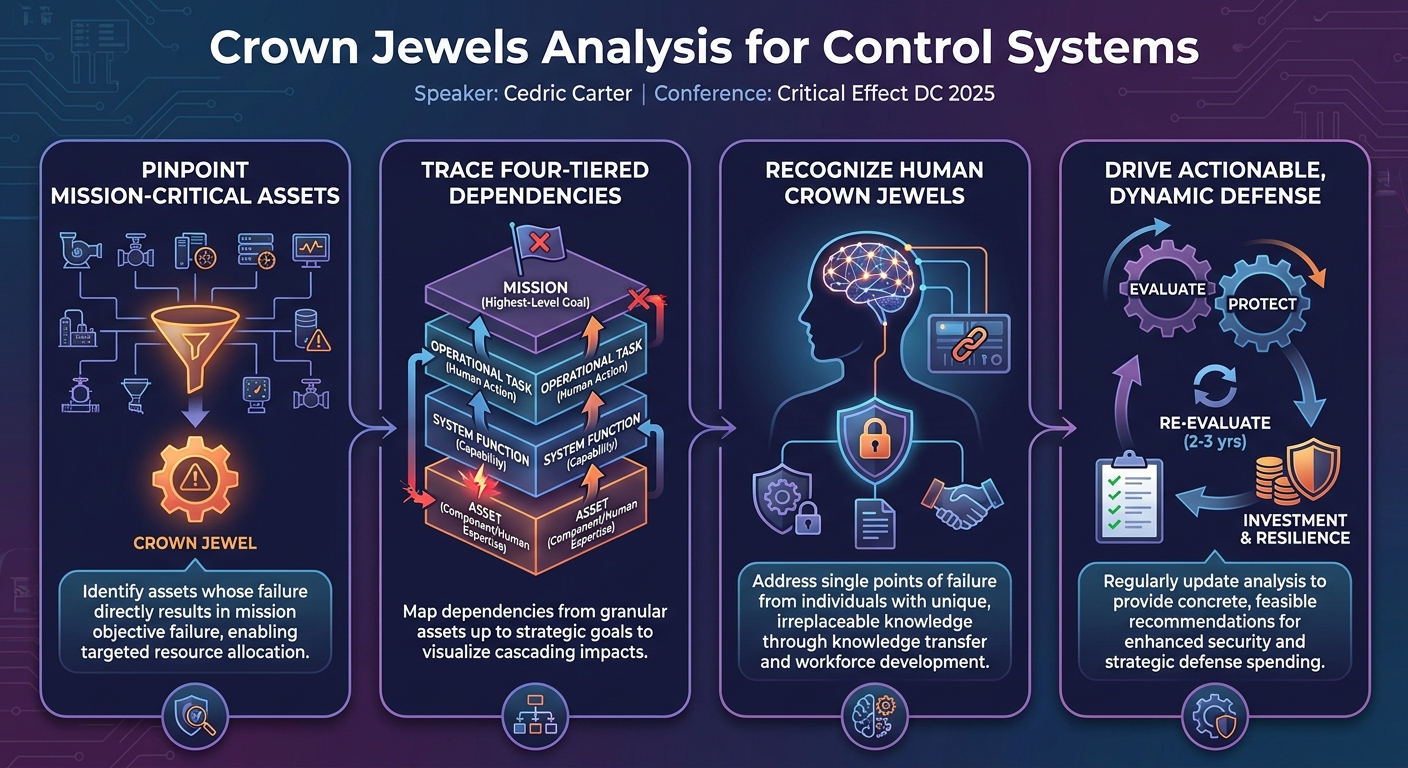
The central finding of Crown Jewels Analysis is the precise identification of crown jewels – assets (whether cyber, physical, or informational) whose failure to perform as intended directly causes a mission objective failure. This definition forms the bedrock of the entire methodology. The talk outlined a hierarchical, four-tiered approach to achieve this identification: Mission, Operational Task, System Function, and Asset. This structured decomposition allows for a comprehensive mapping of dependencies from the highest strategic goals down to the most granular components.
A significant contribution of CJA is its demonstrable scalability and broad applicability across diverse critical infrastructure sectors. Carter explicitly stated that the methodology has been successfully applied within the Department of Defense (DoD), Department of Transportation (DoT), and the Intelligence Community (IC). He also provided specific examples of its application in the energy sector (electrical distribution systems), building automation systems, and water systems, showcasing its versatility. The framework is designed to be adaptable, allowing organizations to tailor the decomposition to their specific operational context.
Another crucial finding is the paramount importance of objectivity and physical introspection in conducting the analysis. Carter stressed that while data-driven assessments and automated tools are valuable, they must be augmented by direct engagement with operators and on-site physical inspections. He cited instances where field observations revealed critical dependencies or assets not captured in initial assessments, underscoring the limitations of purely theoretical or data-only approaches. Objectivity is further ensured by involving multiple mission operators and cross-functional teams in the scoring workshops, mitigating individual biases and agendas.
Perhaps one of the most striking and novel findings presented was the identification of human crown jewels. Carter shared a concerning discovery where a single individual, possessing unique and irreplaceable knowledge of a complex system's operations, interconnections, and vulnerabilities, was deemed a crown jewel. The failure or compromise of this individual (e.g., through death, exploitation, or information operations) could inherently manipulate or disrupt the control system, leading to mission failure. This finding led to actionable recommendations for the organization, including hiring more personnel and implementing robust knowledge transfer programs to de-risk single points of human failure. This expands the traditional scope of asset identification beyond purely technological components.
Technical Deep Dive
▶ Watch: Identifying human crown jewels (13:00)
The Crown Jewels Analysis methodology is built upon a rigorous, multi-tiered dependency evaluation process, designed to systematically trace the impact of asset failure up to mission objectives. The core of this process involves defining and mapping four distinct layers:
- Mission: This represents the highest-level objective or goal as defined by the operators or stakeholders. It establishes what success looks like for the organization. To ensure objectivity, multiple mission operators are consulted to achieve consensus on the importance and definition of various missions. An identity matrix is used at this layer to define mission importance.
- Operational Task: These are the specific human actions or processes undertaken to accomplish the mission objectives. This layer links human activity directly to mission success.
- System Function: This layer describes the capabilities or services that assets perform as intended. It bridges the gap between human tasks and the underlying technology.
- Asset: These are the tangible or intangible items that the organization is trying to protect, or that adversaries might target. Assets can range from physical components like breakers and switches to logical entities like IT/OT gateways, and even human expertise.
The analysis proceeds by performing a dependency evaluation across these layers. This involves asking, "If this element fails, what type of effect would it have on the next higher layer?" This question is answered using a quantitative scoring system, which maps the impact of failure:
- 0: No impact on achievement.
- 30: Slight degradation, but with a workaround available.
- 70: Significant degradation, but still with an adaptive workaround.
- 95: Mission objective failure (no effective workaround).
This scoring is applied iteratively: from assets to system functions, from system functions to operational tasks, and finally from operational tasks to missions. If a failure at the asset level can be systematically traced through the layers to a mission objective failure (a score of 95), that asset is identified as a crown jewel. Carter highlighted that the analysis considers elements like scale and time by incorporating the concept of workarounds and backup mechanisms directly into the scoring (e.g., a '30' or '70' score implies a workaround, suggesting that even if an asset fails, the system might have alternative means to achieve its function, albeit with degradation).
The process itself is structured into four distinct phases:
- Reconnaissance: This initial phase involves extensive data collection without disrupting ongoing operations. It includes reviewing existing assessments and network diagrams, and crucially, conducting interviews with personnel to gather firsthand knowledge. Carter stressed the importance of respectful engagement, acknowledging operators' busy schedules.
- Verification: In this phase, the collected knowledge is verified with Subject Matter Experts (SMEs) from the customer organization. This also involves Open Source Intelligence (OSINT) gathering, which can be combined with closed-source and classified information for a more objective and comprehensive view of the operational terrain. The initial mission-focused artifacts are presented for feedback to ensure accuracy before modeling begins.
- Modeling & Revision: This is where the core dependency graphs are built and refined. The analysis team works collaboratively with the customer to continuously revise models and increase their objectivity. A critical component is the scoring workshop, where multiple individuals from across the organization collectively assign impact scores (0, 30, 70, 95), ensuring consensus and reducing bias, especially when influencing funding decisions. Preliminary results are presented for further feedback.
- Reporting & Recommendations: The final phase involves generating a comprehensive report. Crucially, if crown jewels are identified, MITRE's role extends to providing actionable recommendations. These are not generic suggestions but specific, technically feasible, and achievable steps for the organization to enhance its defensive posture or improve resiliency. For instance, in the case of human crown jewels, recommendations included specific hiring strategies and knowledge transfer plans.
The analysis is supported by a tool, initially Excel-based and later transitioning to a web-based version, designed for ease of use. This tool allows users to stress particular nodes (assets, functions, tasks) to visualize the cascading effects on higher layers, providing a dynamic understanding of dependencies. Carter also briefly touched upon future enhancements, including the potential integration of Large Language Models (LLMs) to accelerate the analysis process, particularly in scaling and automating data interpretation. He also acknowledged that while MITRE has its own CJA methodology, other organizations like Dragos also implement similar analyses, encouraging collaboration and diverse approaches to achieve mission survivability.
Demo / Proof of Concept
▶ Watch: Analysis phases and actionable recommendations (14:00)
While Cedric Carter's presentation did not include a live demonstration of the Crown Jewels Analysis tool, he extensively described its capabilities and provided conceptual examples of its application. The tool, available in both Excel-based and web-based versions, allows for the visual representation of complex dependency graphs, ranging from high-level missions down to individual assets.
Carter explained that a key feature of the tool is its ability to "stress particular nodes to see the actual effects." This implies a simulation or modeling capability where analysts can hypothetically "fail" an asset, system function, or operational task and observe the cascading impact across the interconnected layers, ultimately tracing it back to potential mission objective failures. This functionality is crucial for identifying crown jewels by quantifying the direct and indirect consequences of compromise or disruption.
He illustrated this with an example of an electrical power distribution system, detailing how the analysis breaks down a sector into segments, plants, critical functions, and specific systems like IT/OT gateways, main switches, and breakers. For each asset, the tool maps its functional contributions, the human operational tasks it supports, and ultimately, its role in achieving mission objectives. Although no live demo was shown, the detailed explanation of this "stress testing" capability served as a conceptual proof of concept, demonstrating how the CJA framework translates abstract dependencies into tangible, quantifiable impacts on mission success.
Defensive Implications
▶ Watch: Future of analysis: Public tools and AI integration (24:00)
The Crown Jewels Analysis framework offers profound defensive implications for organizations operating critical infrastructure, moving beyond generic security practices to a highly targeted, mission-centric defense strategy.
Firstly, CJA directly addresses the challenge of resource prioritization. By explicitly identifying the assets whose failure leads to mission objective failure, organizations can allocate their limited security budgets, personnel, and technological defenses to the most critical points. This ensures that the most impactful assets receive the highest level of protection, preventing the common pitfall of "defending everything equally" and inadvertently leaving critical components vulnerable.
Secondly, the analysis provides a robust mechanism for increasing resiliency posture. Carter emphasized that CJA is not a one-time activity but a process that should be revisited every two to three years, or whenever significant technological changes occur within the system. As new technologies are integrated or old ones retired, the crown jewels may shift. Regular re-evaluation ensures that defensive strategies remain aligned with the current operational reality, preventing outdated defenses from protecting non-critical assets while new crown jewels emerge. If an identified crown jewel is no longer critical, it indicates an increased resiliency posture for the organization.
A particularly impactful defensive implication is the identification and mitigation of human crown jewels. The finding that a single individual's unique knowledge can be a critical point of failure highlights a often-overlooked aspect of operational security. Defenders should actively identify such individuals and implement strategies such as:
- Hiring additional personnel to distribute critical knowledge and responsibilities.
- Executing robust knowledge transfer programs to document expertise and train new generations of operators and defenders. This reduces single points of failure and builds institutional resilience against personnel loss or compromise.
Furthermore, the CJA process, particularly its emphasis on actionable recommendations, provides concrete steps for improvement. MITRE's role extends beyond identification to proposing feasible and technically achievable solutions. This means organizations receive not just a list of critical assets but also a strategic roadmap for how to protect them, integrate workforce components, and enhance overall security.
Finally, the inherent objectivity built into the CJA process – through multi-stakeholder workshops and consensus-driven scoring – ensures that defensive investments are made based on agreed-upon, unbiased assessments. This is crucial for securing funding lines and influencing organizational investment in defense technologies or capabilities, as the rationale is clearly tied to mission survivability rather than individual agendas. By understanding which assets are critical, organizations can better justify and implement security controls that directly contribute to their core mission success.
Key Takeaways
- Prioritize with Purpose: Not all assets are equally critical. Crown Jewels Analysis (CJA) provides a systematic, data-driven methodology to identify the specific assets (cyber, physical, information, or human) whose failure leads to mission objective failure, enabling targeted defense.
- Multi-Tiered Approach: CJA utilizes a four-tiered hierarchy (Mission, Operational Task, System Function, Asset) to map dependencies, allowing for a comprehensive understanding of how granular failures cascade up to strategic impacts.
- Objectivity and Human Insight are Key: While data-driven, CJA heavily relies on physical introspection, operator interviews, and multi-stakeholder scoring workshops to ensure objectivity, reduce biases, and capture real-world operational nuances not present in assessments alone.
- Human Elements are Crown Jewels Too: The analysis revealed that individuals with unique, irreplaceable knowledge can be single points of failure. Organizations must proactively identify and mitigate these "human crown jewels" through knowledge transfer and workforce development.
- Dynamic and Actionable Defense: CJA is not static. It recommends regular re-evaluation (every 2-3 years or with technological changes) to maintain relevance. The output includes actionable, feasible recommendations to enhance resilience and inform strategic security investments.
- Scalable Across Critical Infrastructure: The methodology has been successfully applied across diverse sectors, including energy, water, building automation, and various government agencies (DoD, DoT, IC), proving its adaptability and broad utility.
About the Speaker(s)
Cedric Carter is a distinguished expert from MITRE Corporation, specializing in critical infrastructure security and control systems. Prior to his tenure at MITRE, he contributed his expertise at Sandia National Labs. Carter has been instrumental in the development and transition of the Crown Jewels Analysis (CJA) capability across various U.S. government departments, including the Department of Defense, Department of Transportation, and the Intelligence Community. In his talk, he identified himself as a "wingman for OTA" for the capability owner of CJA at MITRE, highlighting his deep involvement in its operational application and evolution over nearly a decade. His work focuses on providing objective, data-driven analytics to help organizations understand and defend their most critical assets.
Reviews
Dr. Zero (Offensive Security Researcher) — SOLID
MITRE repackaged standard Business Impact Analysis for OT environments and slapped a 'Crown Jewels' label on it. It’s a competent, highly formalized methodology for federal agencies to figure out what physically breaks when a switch trips, but it's fundamentally an Excel-driven risk framework, not a security breakthrough.
Heather Calloway (CISO) — SOLID
MITRE’s approach to Crown Jewels Analysis provides a rigorous, defensible way to prioritize OT security spend based on mission failure rather than vulnerability severity. If your organization has an industrial footprint, your risk committee needs to see how this model maps physical and human assets directly to business continuity.