Stop Applying IT Fixes to OT Problems: The OT Security Wake-up Call
Debbie Lay (TXOne Networks)
Critical Effect DC 2025 · Day 1 · Track III: Tactical Mastery
Overview
In the rapidly evolving landscape of cybersecurity, the convergence of Information Technology (IT) and Operational Technology (OT) presents unique challenges that demand specialized solutions. Debbie Lay, an experienced Solutions Engineer from TXOne Networks, delivers a compelling "wake-up call" in her talk, "Stop Applying IT Fixes to OT Problems." This presentation critically examines the fundamental differences between IT and OT environments and highlights why a "lift and shift" approach of IT security tools to OT infrastructure is not only ineffective but potentially dangerous, leading to operational disruption, safety hazards, and increased risk.
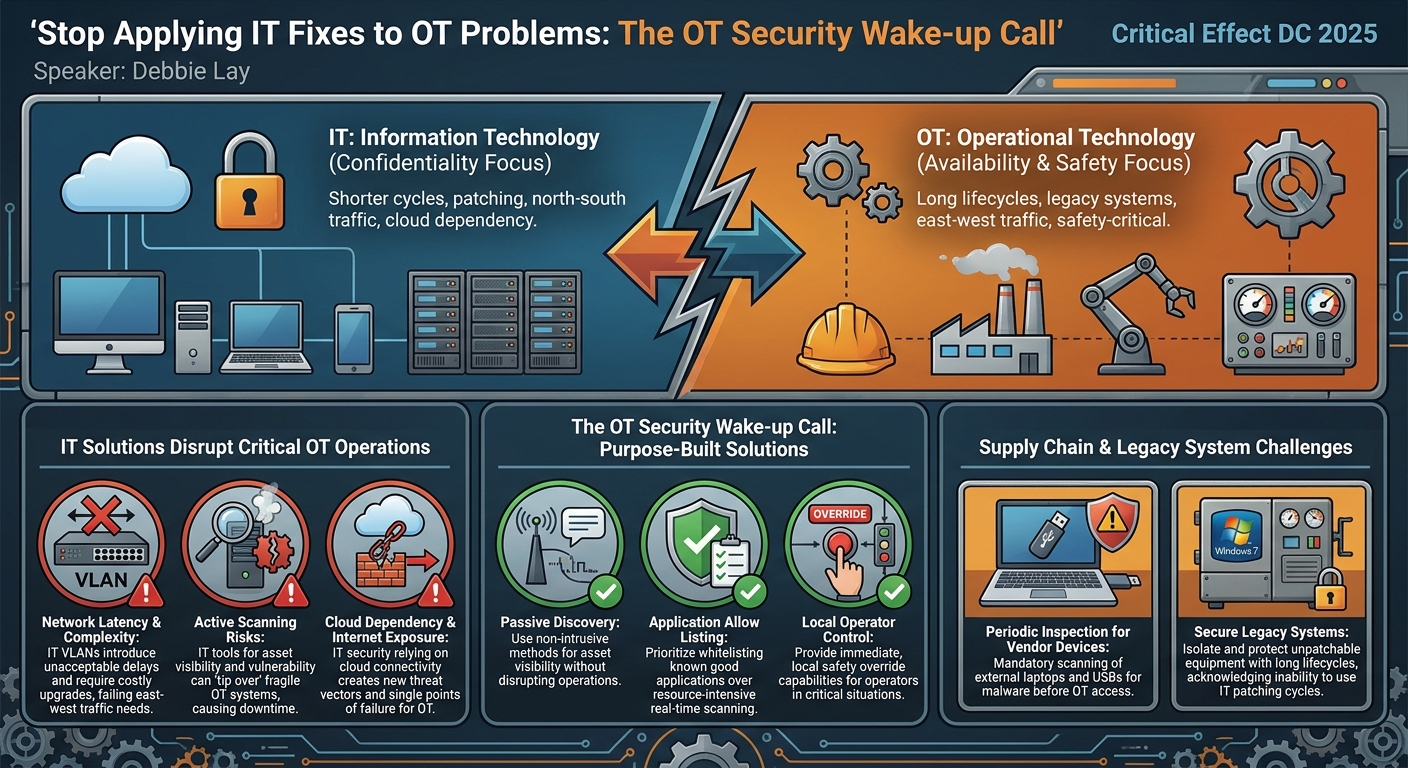
Key moments
- 0:00 Confession: IT fixes break OT systems
- 2:00 Positive trends: IT/OT collaboration & OT frameworks
- 7:00 Network segmentation: Why IT VLANs fail in OT
- 10:00 Active scanning risks for OT asset visibility
- 12:00 OT patching cycles: Months vs. IT's weeks
- 14:00 Cloud-based AV risks and OT operational control
- 19:50 Key takeaways for effective OT security solutions
Stop Applying IT Fixes to OT Problems: The OT Security Wake-up Call
Speakers: Debbie Lay (TXOne Networks)
Conference: Critical Effect DC 2025
YouTube: https://www.youtube.com/watch?v=i77VI9mhC2c
Overview
In the rapidly evolving landscape of cybersecurity, the convergence of Information Technology (IT) and Operational Technology (OT) presents unique challenges that demand specialized solutions. Debbie Lay, an experienced Solutions Engineer from TXOne Networks, delivers a compelling "wake-up call" in her talk, "Stop Applying IT Fixes to OT Problems." This presentation critically examines the fundamental differences between IT and OT environments and highlights why a "lift and shift" approach of IT security tools to OT infrastructure is not only ineffective but potentially dangerous, leading to operational disruption, safety hazards, and increased risk.
Lay's central thesis, underscored by a personal anecdote from her previous role at an endpoint security company, is that while IT solutions might "technically" function in an OT setting, they often interfere with critical industrial processes. The talk advocates for a paradigm shift towards purpose-built OT security solutions that respect the unique operational constraints, long lifecycles, and safety-critical nature of industrial control systems. It serves as a crucial guide for organizations grappling with the complexities of securing their OT assets, emphasizing the need for tailored strategies that prioritize availability, integrity, and safety above all else.
Background
▶ Watch: Confession: IT fixes break OT systems (0:00)
For decades, IT and OT operated in distinct silos, each with its own priorities, technologies, and personnel. OT environments, encompassing industrial control systems (ICS), SCADA, and manufacturing execution systems (MES), were traditionally air-gapped or isolated, relying on physical security and proprietary protocols for protection. Their primary concerns were availability and safety, often dealing with equipment that had operational lifecycles spanning 10, 20, or even 30 years. In contrast, IT environments prioritized confidentiality, with shorter technology refresh cycles and a constant need to adapt to new threats and business demands.
This historical separation fostered an "us versus them" mentality, where OT teams viewed IT interventions as potential threats to their stable, mission-critical operations. However, the drive for increased efficiency, remote access, and data analytics has led to a rapid convergence of these two worlds, exposing OT networks to the same cyber threats that have plagued IT for years. Initially, organizations attempted to apply familiar IT cybersecurity frameworks, such as Zero Trust, directly to OT. As Lay explains, "it just didn't make sense. It didn't work the same way." This misapplication often led to solutions that were either too aggressive for sensitive OT systems, causing downtime, or simply inadequate for the unique threat landscape.
Recognizing this gap, the industry has made significant strides in the last three to five years, with teams beginning to collaborate more effectively and dedicated OT security frameworks emerging. Standards like IEC 62443, NERC CIP, NIST, and TSA guidelines have been specifically designed with OT's unique challenges in mind. These frameworks emphasize core requirements such as network segmentation, asset visibility, vulnerability management, anti-malware, change control, and application allow listing. These fundamental shifts acknowledge that securing OT requires a deep understanding of its operational nuances, moving beyond generic IT solutions to embrace purpose-built strategies that safeguard critical infrastructure without compromising its core functions.
Key Findings
▶ Watch: Network segmentation: Why IT VLANs fail in OT (7:00)
The central finding of Lay's presentation is that the fundamental differences between IT and OT environments render many standard IT cybersecurity solutions unsuitable for industrial control systems. While these solutions might be "technically" deployable, their operational impact on OT can be catastrophic, leading to system instability, downtime, and safety risks. This critical insight is illustrated by Lay's personal "confession" from her time at an endpoint security company like Carbon Black. Tasked with deploying an endpoint agent on an OT asset, she initially believed the solution would work because the system ran Windows 7 and allowed necessary firewall holes for cloud communication. However, upon installation, the IT-centric agent "broke some legitimate applications" in the OT environment, demonstrating that technical compatibility does not equate to operational suitability.
Lay elaborates on several key areas where IT approaches fail in OT:
- Risk of Operational Disruption: IT security tools are often designed with a tolerance for minor service interruptions during updates or scans, which is unacceptable in OT where even momentary downtime can have severe safety, environmental, or economic consequences. Active network scanning tools, common in IT for asset visibility and vulnerability management (e.g., Land Sweeper, Qualys, Tenable, Rapid7, Nessus), can "tip over a system" in OT, creating a critical safety issue.
- Incompatibility with Legacy Systems and Long Lifecycles: OT environments frequently feature legacy operating systems like Windows XP or Windows 7 and hardware that remain operational for decades. IT solutions, designed for modern, regularly patched systems, often lack the compatibility or stability required for these older platforms. Patching cycles in OT are often six months to a year, or even longer, making frequent IT-style vulnerability management impractical or impossible.
- Network Architecture and Traffic Patterns: IT networks typically exhibit north-south traffic patterns, with clients communicating with centralized servers. OT networks, conversely, are characterized by east-west traffic, with devices communicating laterally within zones. IT segmentation technologies like VLANs, while effective for north-south traffic, can introduce unacceptable latency and complexity in OT, especially with older, unmanaged switches.
- Cloud Dependency and Internet Exposure: Many modern IT security solutions, including advanced Endpoint Detection and Response (EDR) and anti-malware tools (e.g., CrowdStrike, Defender, SentinelOne, Carbon Black), rely on cloud connectivity for threat intelligence and management. Introducing internet exposure by "poking holes through the firewall" for these solutions creates new, significant threat vectors for OT. The example of a SentinelOne cloud outage highlighted how even agent-controlled updates can be undermined by backend cloud issues, leading to a loss of security visibility and incident response capabilities.
- Lack of Operator Control and Safety Overrides: IT security prioritizes robust, often centralized, control. In OT, local operator control and the ability to immediately disable a system for safety reasons (the "red button on the wall") are paramount. IT security solutions rarely offer such immediate, local override capabilities, leading to potential delays in critical situations.
- Supply Chain Vulnerabilities: New OT equipment often sits on vendor shelves for years, potentially shipping with outdated operating systems like Windows 7, introducing vulnerabilities from the outset. IT-centric periodic inspection methods for vendor devices (e.g., USB sticks, laptops) are often seen as too burdensome for OT environments, leading to unverified external devices connecting to critical systems.
These findings collectively underscore the urgent need for a shift from general-purpose IT security to specialized, purpose-built OT security solutions that address these unique operational realities.
Technical Deep Dive
▶ Watch: Active scanning risks for OT asset visibility (10:00)
The core of Debbie Lay's presentation lies in dissecting specific IT security approaches and detailing why they falter when applied to an Operational Technology (OT) context. This section provides a comprehensive technical breakdown of these mismatches, highlighting the unique requirements of OT environments.
Network Segmentation: Beyond VLANs
In IT, network segmentation is commonly achieved using VLANs (Virtual Local Area Networks), which logically separate network traffic. This approach is well-suited for IT's typical north-south traffic patterns, where client devices in different departments (e.g., finance, HR) communicate with centralized servers via a firewall. However, Lay points out that in OT, traffic patterns are predominantly east-west, meaning devices within a specific operational zone communicate directly with each other.
Applying VLANs in OT can introduce several problems:
- Increased Latency: Routing east-west traffic through a centralized firewall, as often happens with VLANs, can introduce unacceptable latency for time-sensitive OT processes. Even "minute bits of latency" can cause safety issues or trigger false alarms in systems like windmill sensors.
- Costly Downtime and Legacy Hardware: Many OT environments still utilize unmanaged switches that do not support VLANs. A forklift upgrade of this legacy infrastructure to managed switches capable of VLANs is a significant capital expenditure and requires extensive downtime, which is often infeasible for 24/7 operations.
- Ransomware Threat: Despite perceived segmentation via VLANs or basic firewalls, ransomware propagating from the IT side remains the "number one threat vector to OT" for the last two years. This indicates that traditional IT segmentation is insufficient to fortify the IT-OT convergence point.
Instead, OT environments require segmentation strategies that account for zones (as defined by IEC 62443), minimize latency, and are compatible with existing infrastructure, often necessitating purpose-built solutions that don't rely on VLANs.
Asset Visibility and Vulnerability Management: Passive Approaches for Sensitive Systems
In IT, asset visibility is crucial for budgeting and lifecycle management, typically achieved through active network scanning tools like Land Sweeper or Qualys. These tools actively probe devices to identify open ports, operating systems, and installed software versions. While effective in IT, this active scanning poses a significant risk in OT. Lay warns that "in an OT environment, that could tip over a system," leading to a safety issue or production halt. OT systems are often fragile and cannot withstand the aggressive querying of active scans.
Furthermore, IT vulnerability management relies heavily on frequent patch management cycles (weekly, with emergency patches as needed), facilitated by tools like Tenable, Rapid7, and Nessus. Domain administrators in IT environments typically have the authority and resources to test and deploy patches rapidly. This contrasts sharply with OT realities:
- Extended Patch Cycles: OT patch cycles are notoriously long, often "six months" at the least, and "traditionally a year." Lay humorously notes, "I can save you $100,000. You have vulnerabilities." This is because the risk of downtime from a bad patch often outweighs the risk of an unpatched vulnerability.
- Lack of Test Environments: Unlike IT, where shadow servers or virtual environments allow for patch testing, OT environments rarely have duplicate systems to test vendor-supplied patches (e.g., a Rockwell patch) before deployment. Operators are forced to "trusting the vendor that it's not going to crash your system."
- Focus on Risk Avoidance and Mitigation: Given the inability to patch frequently, OT vulnerability management shifts focus to risk avoidance (e.g., isolating a Windows XP legacy system) and risk mitigation through other controls, rather than direct patching.
Therefore, OT requires passive asset discovery and vulnerability assessment methods that do not interfere with operations, coupled with compensatory controls for unpatchable systems.
Antivirus and EDR: Weighing Operational Risk Against Security Benefits
Traditional IT antivirus solutions (e.g., CrowdStrike, Defender, SentinelOne, Carbon Black) are designed for environments with constant changes, new executables, and user interactions. They perform real-time scanning and often require continuous internet connectivity for threat intelligence updates.
- Real-time Scanning Impact: While important, real-time scanning on an OT asset that has been running "the same software for the last five years" is less critical and can consume valuable resources, potentially impacting performance.
- Cloud Dependency and Threat Vectors: Requiring "internet requirement like CrowdStrike to say poke the holes through the firewall" opens up a "new threat vector" for OT, which should minimize internet exposure. Lay highlights the operational risk of cloud-dependent solutions, citing a SentinelOne outage where a "back-end component that was really old" and a "new user credential" brought down the entire cloud environment, rendering endpoint security data and incident handling inaccessible. Even if the agent can be controlled locally, the backend dependency remains a critical single point of failure.
Endpoint Detection and Response (EDR), a more advanced IT security capability, records "every single file create, mod, netcon" and uploads it to a "big data lake" for analysis. While powerful for detecting unknown attacks in IT, EDR introduces:
- Resource Intensity and Complexity: The continuous monitoring and data collection of EDR add significant overhead and complexity to already resource-constrained OT endpoints.
- Lack of Local Operator Control: A critical flaw in IT-centric EDR for OT is the absence of a local "red button" for operators. If an OT operator suspects the security system is causing an outage, they need immediate control to "stop it but keep the operation running." Waiting for a ticket to be processed by an IT SOC (Security Operations Center) is unacceptable when safety is at stake.
Purpose-built OT endpoint solutions prioritize application allow listing (whitelisting known, legitimate applications) over real-time scanning, and offer local override capabilities to ensure operational continuity and safety.
Change Control and Periodic Inspection: Securing the Human Element and Supply Chain
Change control in IT often includes robust rollback solutions and scheduled maintenance windows. In OT, "they don't have these systems just sitting there shadow... that I can test the Rockwell patch before I deployed it." Rollback is often not an option. Unauthorized changes, even seemingly innocuous ones like installing Wireshark for troubleshooting, can "tip over the system."
A significant risk comes from vendors updating equipment. Lay describes scenarios where vendors arrive with USBs or laptops, perform updates "outside change control windows," and potentially introduce malware.
- Periodic Inspection: While IT might consider USB inspection a best practice, OT requires mandatory periodic inspection solutions for vendor devices and USBs. This is crucial for mitigating supply chain risk, as new equipment can arrive running outdated, vulnerable operating systems like Windows 7. Without proper inspection, these devices can introduce malware or unvalidated changes directly into critical OT networks.
In summary, the technical deep dive reveals that IT solutions, built on assumptions of modern hardware, internet connectivity, rapid patching, and IT-centric operational priorities, fundamentally clash with the realities of OT. The emphasis must shift to solutions that are passive, robust, locally controllable, and designed to maintain operational integrity and safety above all else.
Demo / Proof of Concept
▶ Watch: Cloud-based AV risks and OT operational control (14:00)
While the speaker, Debbie Lay, referenced having "some of our equipment in the other room" at the conclusion of her presentation, the talk itself did not include a live technical demonstration or proof of concept of any specific solution or exploit. The session was primarily a conceptual and analytical discussion on the differences between IT and OT security approaches. Attendees were invited to view physical equipment outside the main presentation hall.
Defensive Implications
▶ Watch: Key takeaways for effective OT security solutions (19:50)
The insights presented by Debbie Lay offer clear and actionable defensive implications for organizations securing their Operational Technology (OT) environments. The overarching theme is the necessity of moving away from a "lift and shift" mentality of IT solutions and embracing purpose-built, OT-centric security strategies.
- Prioritize Purpose-Built OT Security Solutions: The most critical implication is to invest in security solutions specifically designed for OT. These solutions understand the unique constraints of industrial systems, such as long lifecycles, legacy operating systems (Windows 7, Windows XP), and low-latency requirements. They should be engineered to minimize operational impact and prioritize availability and safety over other security tenets. This includes OT-aware network segmentation that goes beyond basic VLANs, passive asset visibility tools that don't risk tipping over systems, and endpoint protection that uses application allow listing rather than aggressive real-time scanning.
- Fortify the IT-OT Convergence Point: Given that ransomware from the IT side is the primary threat vector, organizations must significantly enhance security at the IT-OT boundary. This involves more robust segmentation than traditional firewalls or VLANs, implementing strict access controls, and potentially deploying specialized unidirectional gateways or deep packet inspection for industrial protocols to prevent lateral movement of threats from IT to OT.
- Minimize Internet Exposure for OT Assets: Cloud-dependent security solutions introduce new threat vectors and points of failure for OT. Defenders should prioritize on-premise or highly air-gapped security solutions for OT assets. If internet connectivity is absolutely necessary for specific functions, it must be rigorously controlled, monitored, and limited to essential services, avoiding the "poking holes through the firewall" approach for IT-centric cloud agents.
- Implement Robust Change Control with Operator Empowerment: OT environments require stringent change control mechanisms that are understood and adhered to by both internal teams and external vendors. This includes validating patches in isolated environments (if available) and ensuring vendors update equipment only during approved windows. Crucially, any security solution deployed on an OT endpoint must incorporate a local "safety button" or override capability, allowing operators to disable the security component (while maintaining operations) if they suspect it's causing an issue. This acknowledges the paramount importance of safety and operational continuity.
- Address Supply Chain Risk and Vendor Access: The risk introduced by vendors bringing unverified devices (laptops, USBs) or new, potentially vulnerable equipment into OT environments is substantial. Defenders must implement mandatory periodic inspection solutions for all external devices connecting to OT networks, scanning them for malware and vulnerabilities before they are allowed access. This also extends to verifying the security posture of new equipment from the supply chain, which may arrive with outdated software.
- Adopt OT-Specific Frameworks and Foster Collaboration: Leverage industry-specific security frameworks like IEC 62443, NERC CIP, NIST, and TSA guidelines, which are tailored to OT's unique requirements. Furthermore, continue to foster collaboration between IT and OT teams, establishing a unified security operations center (SOC) with subject matter experts (SMEs) for OT, and potentially giving priority to OT security incidents due to their critical nature.
- Reduce Complexity and Failure Points: When selecting security solutions for OT, prioritize those that can "check off more than one box." Overly complex security architectures with numerous disparate tools introduce more failure points and management overhead. Look for integrated solutions that can provide multiple security functions (e.g., asset visibility, application whitelisting, change control) within a smaller footprint to avoid "OT consolidation in 10 years from now."
By implementing these defensive strategies, organizations can build a resilient security posture that effectively protects their critical OT infrastructure without compromising its operational integrity or safety.
Key Takeaways
- IT Fixes Break OT Systems: Standard IT security solutions, while technically deployable, often cause operational disruptions, increase latency, or introduce new risks in sensitive OT environments due to fundamental differences in priorities (availability/safety vs. confidentiality) and operational characteristics.
- Purpose-Built Solutions are Essential: OT security demands solutions specifically designed for its unique context, including long asset lifecycles, fragile legacy systems, east-west traffic patterns, and critical safety requirements. Generic IT tools are inadequate and potentially dangerous.
- Network Segmentation and Asset Visibility Need OT Context: Traditional IT segmentation (VLANs) can introduce latency and is often incompatible with legacy OT hardware. Active scanning for asset visibility and vulnerability management can "tip over" OT systems. Passive, OT-aware methods are crucial.
- Cloud Dependency and Internet Exposure are High Risk: Many modern IT security tools rely on cloud connectivity, which creates new threat vectors and points of failure for OT. Minimizing internet exposure and prioritizing on-premise solutions is paramount.
- Operator Control and Safety Overrides are Non-Negotiable: OT security solutions must allow for local operator control and immediate override capabilities (the "red button") in case of perceived operational or safety issues, a feature rarely found in IT security products.
- Address Supply Chain and Vendor Access Challenges: Secure the OT supply chain from vulnerable new equipment and implement strict periodic inspection for all vendor-provided devices (laptops, USBs) to prevent malware introduction and unauthorized changes.
About the Speaker(s)
Debbie Lay is an experienced Solutions Engineer (SE) with TXOne Networks, specializing in Operational Technology (OT) security. Prior to her current role, she spent a significant portion of her career in the IT vendor world, including seven years at a major endpoint security company, Carbon Black. This background provides her with a unique perspective on the challenges of applying IT security paradigms to OT environments. For the past three to five years, Debbie has focused specifically on OT security, observing the evolving landscape and the increasing convergence of IT and OT teams. Her insights are drawn from direct experience with customer environments and a deep understanding of both IT and OT operational realities.
Reviews
Dr. Zero (Offensive Security Researcher) — PASS
A thinly veiled vendor pitch for TXOne disguised as an ICS 'wake-up call' about problems the industry woke up to a decade ago. If you still need someone on stage to tell you that active Nessus scans will tip over a fragile PLC, you don't belong in the control room.
Heather Calloway (CISO) — SOLID
This is a necessary baseline for any security leader inheriting an industrial environment. Lay correctly diagnoses the friction between IT mandates and OT realities, illustrating why lifting and shifting standard enterprise tooling onto the plant floor is a recipe for self-inflicted outages. It is foundational program strategy rather than new research, but it gets the business physics right.