Military Mobility Depends on Secure Critical Infrastructure
Mark Montgomery (Senior Director, Center on Cyber and Technology Innovation · Foundation for Defense of Democracies)
Critical Effect DC 2025 · Day 1 · Track II: Strategic Effect
Overview
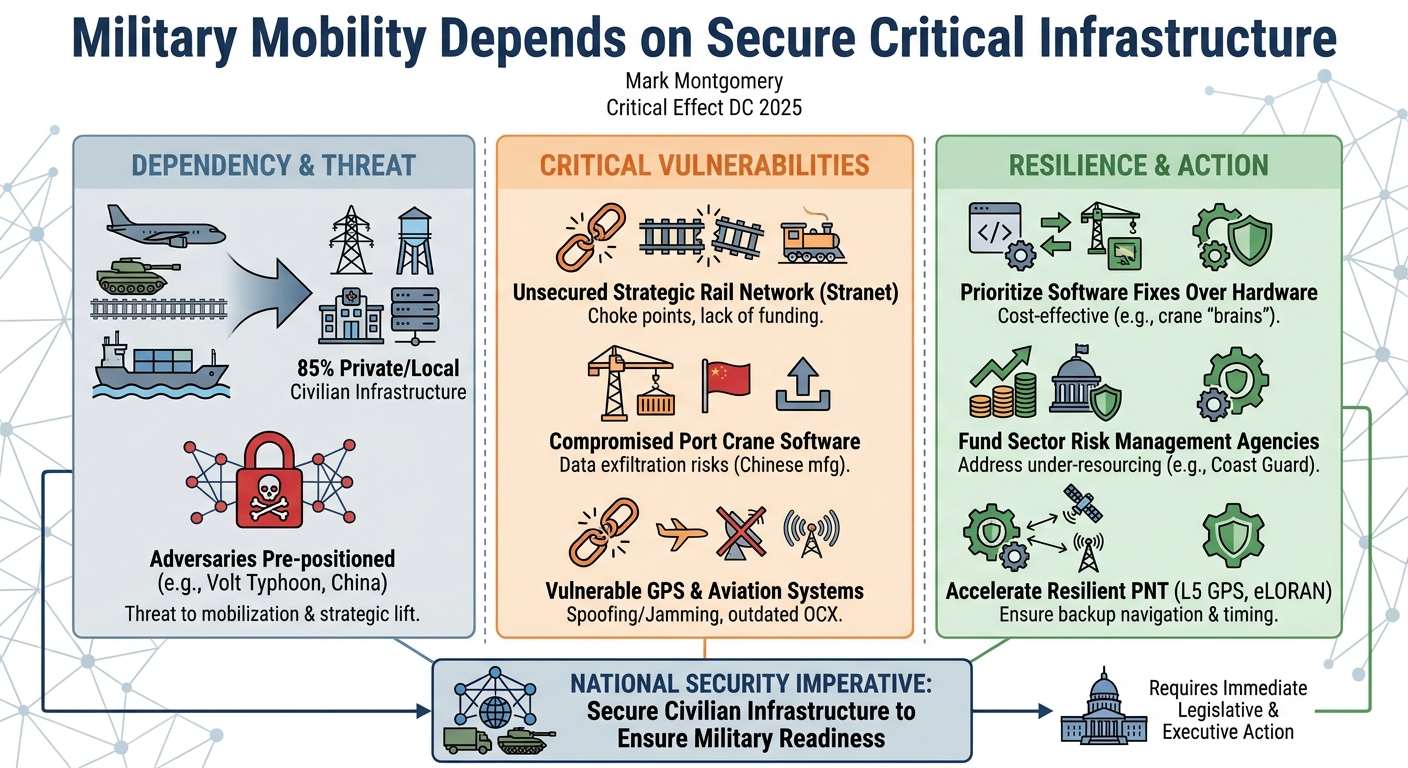
In a stark and urgent address at Critical Effect DC 2025, Mark Montgomery, Senior Director at the Foundation for Defense of Democracies (FDD), laid bare the profound and often overlooked vulnerabilities of the United States' critical infrastructure, arguing that its insecurity poses an immediate and existential threat to national security and military mobility. Montgomery, drawing on extensive experience in military operations and war planning, emphasized that the ability of the U.S. to project power and respond to global crises, particularly in scenarios involving adversaries like China, is directly hampered by the insecure state of civilian-owned and operated infrastructure. He highlighted that the very systems essential for moving troops, equipment, and supplies – including rail, ports, and aviation – are prime targets for nation-state cyberattacks.
Key moments
- 0:00 Introduction and US critical infrastructure vulnerability
- 2:45 China targets all 8 critical infrastructure sectors
- 4:10 85% of critical infrastructure is privately owned and vulnerable
- 9:30 "MadMax Thunderdome" of rail cyber security outside bases
- 12:00 Ports: Replace crane "brains" (software) not expensive hardware
- 20:00 Severely underfunded Sector Risk Management Agencies (SRMAs)
- 22:30 GPS spoofing/jamming is an "art," US GPS vulnerable
- 28:00 Q&A: Why no nation-state attack on critical infrastructure yet?
Military Mobility Depends on Secure Critical Infrastructure
Speakers: Mark Montgomery (Senior Director, Center on Cyber and Technology Innovation, Foundation for Defense of Democracies)
Conference: Critical Effect DC 2025
YouTube: https://www.youtube.com/watch?v=yVt50tsRCRA
Overview
In a stark and urgent address at Critical Effect DC 2025, Mark Montgomery, Senior Director at the Foundation for Defense of Democracies (FDD), laid bare the profound and often overlooked vulnerabilities of the United States' critical infrastructure, arguing that its insecurity poses an immediate and existential threat to national security and military mobility. Montgomery, drawing on extensive experience in military operations and war planning, emphasized that the ability of the U.S. to project power and respond to global crises, particularly in scenarios involving adversaries like China, is directly hampered by the insecure state of civilian-owned and operated infrastructure. He highlighted that the very systems essential for moving troops, equipment, and supplies – including rail, ports, and aviation – are prime targets for nation-state cyberattacks.
Montgomery's presentation transcended typical cybersecurity discussions by framing the issue not merely as one of public safety or economic prosperity, but as a critical military readiness challenge. He underscored the grim reality that while military bases themselves may be hardened, the moment personnel and matériel leave the immediate perimeter, they enter a "Mad Max Thunderdome of cybersecurity," exposed to a myriad of threats across civilian networks. The talk served as a clarion call for immediate, legislative, and well-funded action, warning that without a fundamental shift in approach, the U.S. risks severe operational paralysis in a conflict.
The core of Montgomery's argument rests on the premise that the U.S. is an "insanely vulnerable target" due to highly interconnected, insecure systems and a deep-seated aversion to regulation. He pointed to the widespread pre-positioning of advanced persistent threats (APTs) like Volt Typhoon within critical infrastructure, a threat publicly acknowledged by FBI Director Christopher Wray. The speaker contended that these vulnerabilities are not theoretical but represent active, strategic targeting by adversaries, designed to cripple the U.S. ability to mobilize its forces when it matters most.
Background
▶ Watch: Introduction and US critical infrastructure vulnerability (0:00)
Mark Montgomery's insights are deeply rooted in his extensive military career, including serving as head of operations in the Indo-Pacific, where he was responsible for war planning and war gaming across all military services. This background provides a unique perspective on the strategic implications of cyber vulnerabilities. He categorizes potential conflict scenarios into "most dangerous" (e.g., a cross-strait invasion of Taiwan) and "most likely" (e.g., a cyber-enabled economic warfare campaign by China against Taiwan, the U.S., Japan, and Australia). In both scenarios, an aggressive cyber and influence operation against the United States is a certainty.
Montgomery painted a stark picture of the U.S. as an "insanely vulnerable target" from a cyber perspective. He likened the nation's critical infrastructure to an "easiest target in the world" for a "targeteer," citing its high interconnectedness, inherent insecurity, and a cultural "deep aversion to regulation." This vulnerability became publicly undeniable in January, when FBI Director Christopher Wray confirmed the extensive pre-positioning of Chinese APTs, specifically referencing Volt Typhoon, within U.S. critical infrastructure. Montgomery clarified that Volt Typhoon is just one of likely many Chinese APT teams actively targeting all eight critical infrastructure sectors: water, power, ports, aviation, rail, healthcare, and finance. He warned that the resilience of U.S. systems and society would "collapse fairly rapidly" if even one of these sectors were significantly disrupted.
A critical, often overlooked, aspect of this vulnerability is the ownership structure of U.S. critical infrastructure. Montgomery stated that approximately 85% of civilian infrastructure is owned and operated by the private sector. This figure, initially an educated guess, was later mathematically proven to be "pretty damn close." Crucially, this 85% includes state and local government entities responsible for vital services like rural water and healthcare, which are often "poorer than private sector." These entities, described as the "two wood nickels club," lack the resources for adequate cybersecurity, leading to delayed actions and making them "the perfect target." For instance, a simple Microsoft patch might take 69 days to install in a rural water utility, a timeframe that would be considered a "win" in such under-resourced environments, starkly contrasting with the practices of major financial institutions. This fragmentation and under-resourcing create vast attack surfaces that adversaries are actively mapping, not just for nation-state objectives but also for criminal ransomware campaigns.
Key Findings
▶ Watch: 85% of critical infrastructure is privately owned and vulnerable (4:10)
The talk revealed several critical findings concerning the intersection of military mobility and civilian infrastructure vulnerabilities:
- Reliance on Civilian Infrastructure: The U.S. military relies almost entirely on civilian critical infrastructure for strategic lift and deployment. Military forces do not own extensive rail networks, major airfields, or a majority of commercial seaports. This dependence means that any compromise of civilian assets directly impacts the military's ability to mobilize.
- Vulnerable Strategic Rail Network (Stranet): Of the estimated 100,000 miles of U.S. rail network, 40,000 miles are designated as Stranet (Strategic Rail Network) by the Department of Defense (DoD) for wartime movement. Despite its critical role in all TransCom war plans, DoD provides "this much funding" (demonstrating zero funding) to secure this network. The system is characterized by numerous small, under-resourced operators ("Fred's Rural Rail Collective number 73" analogy) who lack cybersecurity awareness or funding, creating single points of failure just outside military bases.
- Compromised Port Cranes: 19 commercial seaports are vital for military sealift. A significant vulnerability lies in the automated container cranes, many of which are manufactured in China. These whammy dime cranes (costing around $100 million each) are fully automated, relying on Positioning, Navigation, and Timing (PNT) GPS signals for precise movements. While they receive automated updates for maintenance and efficiency, they also "feed back what they saw and did," raising serious data exfiltration concerns. The proposed solution of replacing cranes ($98 million per crane) is deemed incorrect; the actual fix is replacing the "brains" (software) with U.S. or Western alternatives, a far more manageable $98,000 per crane problem that has remained unaddressed.
- Insecure Aviation Infrastructure: Military personnel and equipment frequently fly out of 69 commercial airports (e.g., Columbus airport), not just dedicated military airfields. The Federal Aviation Administration (FAA) systems that manage air traffic control have known cyber vulnerabilities, as identified by CISA. A recent "minor software upgrade" to the air traffic control system 18 months prior caused significant disruption, requiring a retired expert to fix a patch installed on an unsupported system. The NextGen FAA modernization program has been "two years away from being two years away" for over a decade, indicating chronic delays.
- Ubiquitous GPS Vulnerability: An overarching vulnerability affecting cranes, trains, and planes is the reliance on GPS (Global Positioning System). The U.S. L1 frequency GPS system runs on 30-year-old satellites, leading to weak signals that cause devices (like phones) to frequently rely on European (Galileo) or Russian (GLONASS) systems. While new L5 system satellites have finally been launched, the critical Operational Control System (OCX), managed by Raytheon, is six years behind schedule (expected September fix). The talk highlighted the pervasive nature of GPS spoofing (e.g., tricking drones into landing at fake airports in Ukraine, Israel) and jamming (e.g., "curtains of jamming" in Russia), underscoring the urgent need for resilient and redundant PNT solutions.
- DoD's Reluctance to Own the Problem: The DoD, despite acknowledging the problem, is highly reluctant to "own an inch" of this civilian infrastructure security issue, fearing it will be forced to "own a mile" due to its massive budget. This leads to a hands-off approach, even to the point of discouraging tabletop exercises that might reveal the "dumpster fire" outside their bases and force action.
- Underfunded Sector Risk Management Agencies (SRMAs): Many Sector Risk Management Agencies (SRMAs), such as the Coast Guard (responsible for ports and maritime security), are severely underfunded. The Coast Guard receives less than $5 million to serve as an SRMA, a fraction of what agencies like the Department of Energy (which saw its budget cut from $205 million to $175 million) receive. This lack of resources for key agencies, along with the financial fragility of state and local utilities, exacerbates the overall vulnerability.
Technical Deep Dive
▶ Watch: Ports: Replace crane "brains" (software) not expensive hardware (12:00)
The technical vulnerabilities discussed by Montgomery span across operational technology (OT) and information technology (IT) systems crucial for military logistics.
The threat landscape is dominated by Advanced Persistent Threats (APTs) like Volt Typhoon, a Chinese state-sponsored group known for pre-positioning capabilities within critical infrastructure. This involves gaining persistent access to networks, often through living-off-the-land techniques, to maintain a low profile and avoid detection. The goal is not immediate disruption but establishing a foothold for future sabotage, specifically for "cyber-enabled economic warfare" or to impede military mobilization during a conflict. While initial reports focused on Guam and Hawaii, Montgomery stressed that these APTs are likely "all over" the U.S. mainland.
In the rail sector, the transition from older Radio Frequency (RF) signaling to modern, cyber-enabled wired signals for critical functions like "green means go, red means stop" has introduced new attack vectors. Small, rural rail operators, often lacking dedicated IT administrators or cybersecurity budgets, are prime targets. An adversary could exploit these vulnerabilities at critical choke points, such as the single rail line exiting a military base like Fort Cavazos (formerly Fort Hood). Disrupting this single point could effectively "jam every rail car" in transit, preventing the deployment of heavy armor like M1A1 Abrams tanks, Bradleys, and Strikers, which are too heavy for most roads and rely solely on rail for long-distance transport.
The security of seaport cranes presents a sophisticated operational technology challenge. These "whammy dime" cranes are highly automated, relying on precise Positioning, Navigation, and Timing (PNT) data, often derived from GPS signals, to perform complex tasks. The crane's internal software, which dictates its movements (e.g., lifting container 2357 and placing it in slot 2344 of ship 2721), is the critical component. The concern isn't just about potential remote control or disruption, but also the "feeding back what they saw and did" functionality. This implies telemetry and operational data, potentially including military cargo movements, being exfiltrated to foreign entities through automated updates designed for maintenance and efficiency. The proposed solution involves replacing this proprietary "brain" software with trusted, U.S. or Western-developed alternatives, a technical challenge that requires careful integration with the crane's existing mechanical and control systems.
Aviation systems are governed by the FAA's complex National Airspace System (NAS). This system relies on a vast network of interconnected hardware and software for air traffic control, navigation, and communication. The incident 18 months prior, where a "minor software upgrade" caused widespread disruption, highlights the fragility of these legacy systems. Many components may be running unsupported software or operating systems, making patching and modernization efforts risky and difficult. The perpetually delayed NextGen FAA program aims to modernize these systems with new technologies like ADS-B (Automatic Dependent Surveillance-Broadcast), but its slow rollout leaves current vulnerabilities exposed.
The overarching technical vulnerability is the reliance on GPS (Global Positioning System) for PNT. The current primary civilian signal, L1 frequency, emanates from older, 30-year-old satellites. This makes the signal susceptible to spoofing and jamming. Spoofing involves broadcasting fake GPS signals to deceive receivers about their location, as demonstrated in Ukraine and Israel where drones are tricked into landing at phantom airfields. Jamming involves overwhelming GPS signals with noise, creating "curtains of jamming" that render GPS receivers inoperable. While the U.S. has launched enough satellites for the more robust L5 system, the critical Operational Control System (OCX), developed by Raytheon, is six years behind schedule. Without OCX, the full capabilities and resilience of the L5 system cannot be realized. The technical solution requires not only fixing OCX but also ensuring that critical infrastructure components (cranes, trains, planes, and even airfield ground equipment) are equipped with L5 antennas and receivers or, alternatively, integrated with resilient, redundant PNT systems such as eLORAN (Enhanced Long-Range Navigation), which is less susceptible to GPS vulnerabilities.
Demo / Proof of Concept
▶ Watch: Severely underfunded Sector Risk Management Agencies (SRMAs) (20:00)
This technical article is based on a conference talk that primarily focused on policy analysis, strategic implications, and identified vulnerabilities within critical infrastructure. The speaker, Mark Montgomery, did not present a live technical demonstration or proof of concept during his address. His arguments were supported by real-world examples of cyberattacks and system failures, as well as hypothetical scenarios derived from his extensive background in military war planning and intelligence.
Defensive Implications
▶ Watch: Q&A: Why no nation-state attack on critical infrastructure yet? (28:00)
Montgomery outlined a clear, urgent roadmap for bolstering national security through critical infrastructure resilience, emphasizing that the current approach is insufficient. The primary defensive implication is the re-framing of critical infrastructure security as an imperative national security and military mobility issue. This is presented as the only effective way to compel Congressional action and secure necessary funding, moving beyond the "golf clap" response to public health and safety or economic prosperity concerns.
Key defensive strategies include:
- Properly Funding Sector Risk Management Agencies (SRMAs): Agencies like the U.S. Coast Guard, responsible for maritime and port security, are severely under-resourced, operating on budgets under $5 million for their SRMA functions. Similarly, TSA's cybersecurity role, and the vulnerabilities in state and local utilities, demand significant investment. Congress must provide adequate, sustained funding to these agencies, elevating them from "donkey" status to effectively manage their sectors.
- DoD Engagement and Ownership: While DoD is wary of "owning" civilian infrastructure, it must overcome this reluctance and actively define its requirements for resilience. This includes ensuring that the Strategic Rail Network (Stranet) is explicitly included in TransCom's resiliency annexes and that U.S. Coast Guard Captains of the Port are equipped with dedicated cyber specialists rather than funding them "out of hide." DoD needs to conduct realistic tabletop exercises that expose vulnerabilities outside base perimeters and use these findings to drive action.
- Securing Port Cranes: The focus must shift from costly crane replacement to replacing the "brains" (software) of existing cranes with trusted U.S. or Western-developed solutions. This $98,000 per crane solution, rather than the $98 million replacement, directly addresses the risks of data exfiltration and potential remote manipulation by foreign adversaries. Legislative efforts, like the "Fix the Cranes Act," must be successfully passed and funded.
- Enhancing Rail Security: Addressing the "Mad Max Thunderdome" effect requires targeting the weakest links: the numerous small, rural rail operators. This could involve direct funding, cybersecurity standards, and assistance programs to secure the 40,000 miles of Stranet that DoD relies upon. Identifying and hardening single points of failure near military bases is paramount.
- Modernizing Aviation Systems: Accelerating the NextGen FAA modernization program is critical. Furthermore, CISA and other agencies must continue to identify and mitigate cyber vulnerabilities in FAA-run systems, ensuring that commercial airports vital for military lift are adequately secured.
- Achieving GPS Resilience: The most pervasive defensive measure is to ensure resilient and redundant Positioning, Navigation, and Timing (PNT) capabilities. This means:
- Expediting the full operational deployment of the L5 GPS system by prioritizing the completion of the Operational Control System (OCX), currently six years behind schedule with Raytheon as the contractor.
- Encouraging and mandating the adoption of L5 antennas and receiving systems across critical infrastructure.
- Investing in and deploying alternative PNT solutions like eLORAN to provide a robust backup against GPS spoofing and jamming.
- Legislative and Funding Urgency: Montgomery stressed that solutions require immediate legislative action and funding, not planning for 2027. He advocated for embedding robust policy changes within "ash and trash" amendments to must-pass legislation like the National Defense Authorization Act (NDAA), ensuring that critical infrastructure security becomes law.
- International Cooperation: Recognizing that military mobility extends beyond U.S. borders, Montgomery highlighted the need to support international partners. While allies like Japan may only need technical advice, others like the Philippines require direct assistance to secure their power grids and other critical infrastructure that U.S. weapon systems would rely on in a conflict.
Key Takeaways
- Civilian Infrastructure is Military Infrastructure: U.S. military mobility and national security are inextricably linked to the cybersecurity posture of civilian-owned and operated critical infrastructure, particularly rail, ports, and aviation.
- Active Adversary Pre-positioning: Chinese APTs, exemplified by Volt Typhoon, are actively and extensively pre-positioning within all sectors of U.S. critical infrastructure, posing a direct threat to the nation's ability to mobilize and respond during a conflict.
- Systemic Vulnerabilities Across Sectors: Key vulnerabilities include unfunded small/rural rail operators creating choke points, Chinese-manufactured port cranes with exploitable software, and outdated or slow-to-modernize aviation and GPS systems.
- Urgent Need for PNT Resilience: The widespread reliance on a vulnerable GPS system necessitates immediate completion of the L5 Operational Control System (OCX) and the rapid adoption of resilient, redundant PNT alternatives like eLORAN across critical infrastructure.
- Political Will and Funding are Paramount: Addressing these issues requires reframing them as national security imperatives to drive Congressional action, securing proper funding for under-resourced Sector Risk Management Agencies (SRMAs), and overcoming DoD's reluctance to engage with civilian infrastructure security.
- Cost-Effective Solutions Exist, but Require Action: Many fixes, such as replacing crane software rather than entire cranes ($98K vs. $98M), are cost-effective but demand immediate legislative and executive action rather than prolonged planning.
About the Speaker(s)
Mark Montgomery is the Senior Director for the Center on Cyber and Technology Innovation at the Foundation for Defense of Democracies (FDD). He brings a wealth of experience from a distinguished military career, including serving as the head of operations in the Indo-Pacific for all U.S. military services, where he was responsible for developing war plans and conducting war gaming exercises. This background provides him with a deep understanding of military logistics, strategic deployment, and the critical role of infrastructure in national defense. At FDD, Montgomery focuses on analyzing and advocating for solutions to cyber and technology-related national security challenges, particularly those impacting critical infrastructure and military readiness. He frequently testifies before Congress and advises policymakers on these pressing issues.
Reviews
Dr. Zero (Offensive Security Researcher) — STRONG ACCEPT
Most strategic keynotes are a waste of oxygen, but Montgomery actually brought teeth to this one. He strips away the 'public-private partnership' bingo and lays out exactly how fragile the DoD's logistics tail really is. Strong accept for a policy talk that actually names failing programs and real dollar figures.
Heather Calloway (CISO) — MUST SEE
Mark Montgomery delivers a clear, structural analysis of how insecure civilian infrastructure guarantees military paralysis in a conflict. This isn't theoretical threat intelligence; it is a direct mapping of the attack surface Volt Typhoon is actively occupying. Required viewing for any board or security committee operating in transportation, logistics, or the defense industrial base.