No Sector is an Island
Andrew Krapf (Loudoun Water)
Critical Effect DC 2025 · Day 1 · Track II: Strategic Effect
Overview
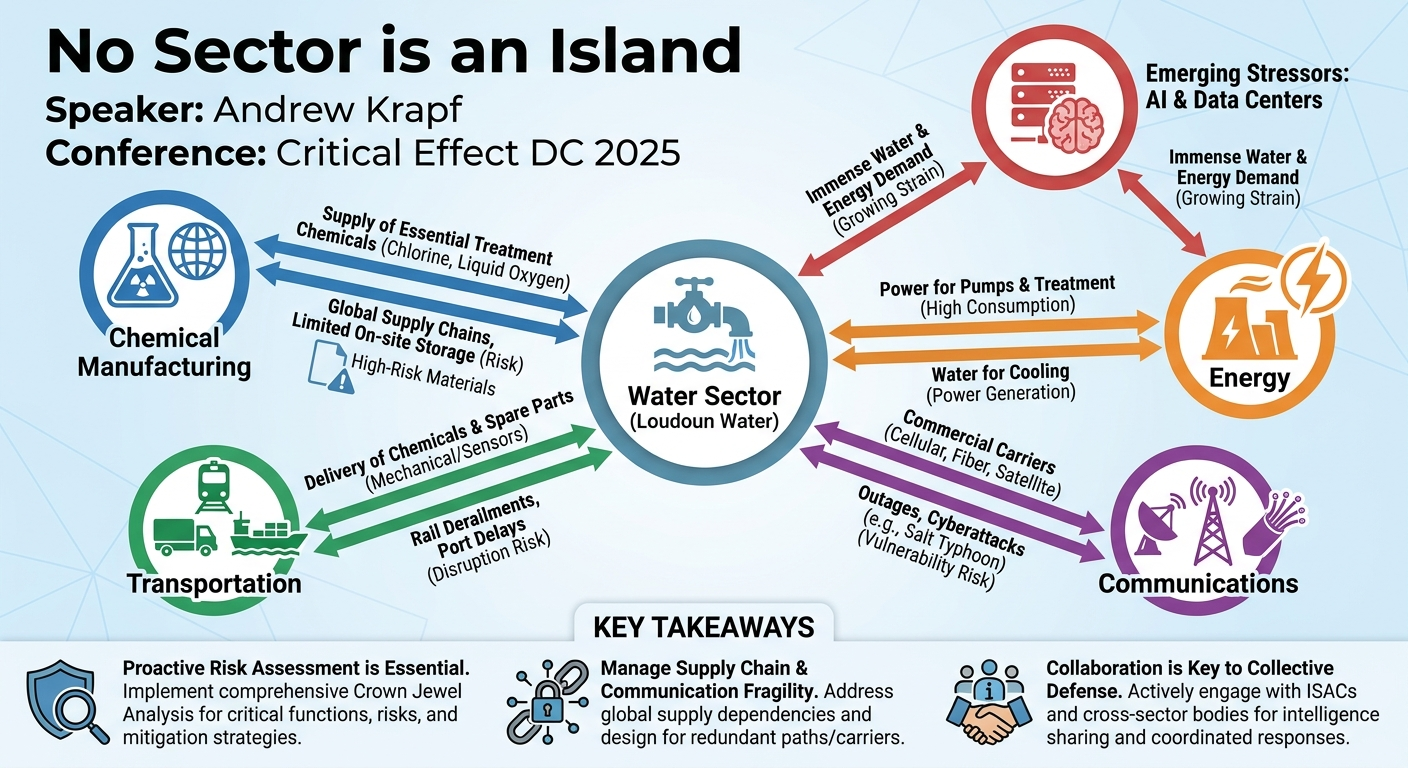
In his Critical Effect DC 2025 talk, "No Sector is an Island," Andrew Krapf, Director of Operations Technology for Loudoun Water, delivers a compelling analysis of the intricate interdependencies between the water sector and other critical infrastructure sectors. Krapf argues that modern critical infrastructure, particularly the water and wastewater utilities, cannot be viewed in isolation, as their resilience is inextricably linked to the stability of chemical, transportation, communication, and energy sectors. His presentation illuminates the cascading risks that arise from vulnerabilities in one sector, demonstrating how seemingly distant disruptions can have profound and immediate impacts on public health, safety, and economic stability.
Key moments
- 0:00 Introduction: Interdependencies between critical sectors
- 3:15 Water sector's critical reliance on chemical supply chains
- 8:00 East Palestine and Harpers Ferry rail incident impacts
- 12:00 Water sector vulnerability through commercial communications
- 17:30 AI and data centers: massive water and energy demand
- 20:30 Crown jewel analysis for critical function identification
- 24:30 Q&A: Mechanisms for cross-sector coordination
No Sector is an Island
Speakers: Andrew Krapf (Loudoun Water)
Conference: Critical Effect DC 2025
YouTube: https://www.youtube.com/watch?v=d9oeTi8xEvc
Overview
In his Critical Effect DC 2025 talk, "No Sector is an Island," Andrew Krapf, Director of Operations Technology for Loudoun Water, delivers a compelling analysis of the intricate interdependencies between the water sector and other critical infrastructure sectors. Krapf argues that modern critical infrastructure, particularly the water and wastewater utilities, cannot be viewed in isolation, as their resilience is inextricably linked to the stability of chemical, transportation, communication, and energy sectors. His presentation illuminates the cascading risks that arise from vulnerabilities in one sector, demonstrating how seemingly distant disruptions can have profound and immediate impacts on public health, safety, and economic stability.
Krapf's insights are particularly vital in an era of escalating cyber threats and increasingly complex global supply chains. As an experienced leader in the Operational Technology (OT) space and an active participant in the water ISAC cybersecurity committee, Krapf brings a practitioner's perspective to the theoretical challenges of critical infrastructure protection. His talk serves as a crucial call to action for defenders across all sectors to adopt a holistic, interconnected view of risk management, emphasizing proactive planning, robust resilience strategies, and collaborative defense mechanisms to safeguard essential services against a spectrum of threats.
Background
▶ Watch: Introduction: Interdependencies between critical sectors (0:00)
The concept of critical infrastructure is well-established, with the U.S. government identifying 16 distinct sectors essential for the functioning of society and the economy. These include everything from energy and communications to healthcare and manufacturing. Historically, these sectors might have been considered somewhat independent, each with its own specific operational technology (OT) and information technology (IT) systems. However, as technology has advanced and global supply chains have become more integrated, the lines between these sectors have blurred, leading to a complex web of dependencies. Krapf highlights this evolution, noting his own experience in the OT space "before it was called OT," underscoring the deep-rooted nature of these operational systems.
The problem, as Krapf articulates, stems from this very interconnectedness. A disruption in one sector can trigger a domino effect, causing failures in seemingly unrelated sectors. For the water sector, this means that while its primary mission is to deliver clean drinking water and manage wastewater, its ability to do so relies heavily on external factors. Chemical plants must supply treatment agents, transportation networks must deliver them, communication systems must enable remote monitoring and control, and power grids must fuel pumps and treatment processes. Any weakness in these supporting sectors translates directly into a vulnerability for water utilities. Krapf even posits that emerging technologies like Artificial Intelligence (AI) and space infrastructure might warrant designation as new critical sectors due to their rapidly growing foundational importance. This recognition of evolving dependencies underscores the dynamic nature of critical infrastructure risk and the continuous need for reassessment and adaptation in defense strategies.
Key Findings
▶ Watch: East Palestine and Harpers Ferry rail incident impacts (8:00)
The central thesis of Krapf’s presentation is that "No Sector is an Island" – a direct challenge to any siloed approach to critical infrastructure security. His key findings revolve around illustrating the profound and often overlooked interdependencies that bind the water sector to other critical sectors, revealing how vulnerabilities in one can create cascading failures across others.
Firstly, Krapf meticulously details the water sector's reliance on the chemical manufacturing sector. Water and wastewater treatment processes are impossible without a continuous supply of specialized chemicals, many of which are high-risk and globally sourced. He highlights the fragility of these supply chains, noting that utilities typically store only a limited supply (e.g., 30-60 days) on-site, making them acutely vulnerable to supply chain disruptions.
Secondly, the talk underscores the critical role of the transportation sector. The delivery of essential chemicals and spare parts, many of which are foreign-sourced, is entirely dependent on robust transportation networks. Krapf uses real-world examples like the East Palestine and Harpers Ferry train derailments to demonstrate how transportation disruptions, even without direct chemical spills, can cripple water utilities by cutting off supply lines or threatening downstream water sources.
Thirdly, Krapf identifies the growing vulnerability introduced by the communications sector. The shift from proprietary licensed radio systems to commercial carriers (cellular, fiber, satellite) has made water utilities susceptible to the same threats that plague telecommunications infrastructure, such as large-scale outages or cyberattacks like Salt Typhoon. This necessitates a re-evaluation of communication resilience and redundancy.
Finally, the presentation emphasizes the symbiotic relationship between the water and energy sectors. Water treatment and distribution are massive energy consumers, while power generation relies heavily on water for cooling. Krapf introduces the emerging challenge of data centers and Artificial Intelligence, which demand immense quantities of both energy and water, creating new points of stress and interdependency for local utilities. These findings collectively paint a picture of an interconnected ecosystem where a threat to any single component can imperil the entire system of essential services.
Technical Deep Dive
▶ Watch: Water sector vulnerability through commercial communications (12:00)
Krapf provides a detailed technical exploration of the specific interdependencies, grounding his arguments in concrete examples and statistical data.
The chemical manufacturing sector is foundational to water treatment. Krapf explains that utilities use a diverse array of chemicals, from common ones like chlorine gas (a highly noxious substance with historical use as a chemical weapon) to more specialized precursors like liquid oxygen for ozone generation, which is also used in rocket engines. Other essential chemicals include various acids and bases. A significant vulnerability arises from the fact that many of these critical chemicals and their precursors are not manufactured in bulk domestically but are foreign-sourced. Krapf references an EPA study that maps these chemical supply chains and their criticality. He stresses that utilities maintain limited on-site inventories—ranging from two weeks to 60 days, depending on the chemical. This creates a precarious situation: if a foreign adversary were to "turn off the spigot," all dependent jurisdictions would quickly face severe shortages, unable to borrow from neighbors who are in the same predicament.
The transportation sector acts as the circulatory system for these vital chemicals and spare parts. Krapf highlights that mechanical and automated system components, including specialized sensor technology often manufactured in Europe, rely on complex global supply chains. He specifically mentions major vendors like Rockwell Automation, Cisco, Palo Alto, and Dell, whose supply chains for chip manufacturing and other components are largely overseas. Delays due to tariffs or port slowdowns, or more severe disruptions like train derailments, can extend delivery times from weeks to months, potentially forcing utilities into "reduced service" if they lack sufficient spare parts inventory.
Krapf illustrates transportation risks with two stark examples:
- East Palestine, Ohio (2023): A train derailment released hazardous chemicals. While East Palestine's wells were fortunately located upstream from the contamination, the incident highlighted the potential for widespread impact. The chemicals, if they had influenced the wells, would have necessitated trucking in vast quantities of water. Moreover, the downstream effects on the Ohio River, a source for numerous drinking water entities, demonstrated the regional scale of potential contamination.
- Harpers Ferry (2019): A train derailment near the Potomac River, though without chemicals, served as a potent warning. Krapf notes that 25 to 40 trains traverse that trestle daily, some carrying bulk cargo like ethanol and other chemicals. A chemical spill there would directly impact major downstream entities like Leesburg, Frederick, WSSC, and Fairfax Water, affecting a significant population and potentially triggering societal panic.
The communications sector has also undergone a transformation, increasing the water sector's vulnerability. Krapf recalls early systems relying on licensed radio systems with low-and-slow serial communication, which were technically secure from external interference beyond jamming. Today, the shift to commercial carriers—cellular, fiber, satellite (e.g., Starlink), and microwave communications—means water utilities inherit the vulnerabilities of these broader networks. A large-scale cyberattack or natural disaster, such as a Salt Typhoon event, could cripple these commercial carriers, leaving water utilities unable to communicate with remote pump stations, wells, and treatment facilities. Krapf stresses the need for resiliency, including redundant communication paths and, crucially, redundant carriers (e.g., using both AT&T and Verizon) to prevent single points of failure.
The energy sector shares a profound nexus with water. Krapf provides striking statistics on water consumption for power generation:
- Open-loop nuclear power plants: 25,000 to 60,000 gallons per megawatt-hour produced.
- Coal plants: 20,000 to 50,000 gallons per megawatt-hour.
- Natural gas plants: nearly 3,000 gallons per megawatt-hour.
In 2020 alone, the U.S. energy sector consumed an astonishing 4,712 trillion gallons of water. Conversely, the water industry is a massive energy consumer. Krapf presents a graph illustrating energy consumption across various water operations: supply (surface water and wells), distribution, desalination (a growing component), wastewater treatment (an increasingly energy-intensive process), and transfer (conveyance systems). This symbiotic relationship means that disruptions in either sector can cripple the other.
A significant emerging challenge highlighted by Krapf is the demand from Artificial Intelligence (AI) and data centers. A recent GAO study estimated that 60 AI queries consume roughly a quarter-gallon of water. Scaled up, this translates to over 1 million gallons per day for 250 million queries. Northern Virginia, home to the world's largest data center corridor, exemplifies this strain. Loudoun Water alone supplies cooling water to 45 data centers, with many more under construction. Krapf recommends openinframap.org as a resource to visualize the sheer scale of data center infrastructure, underscoring their "huge impact" on water utilities.
Finally, Krapf touches upon the healthcare sector's dependency. Hospitals, particularly those with 100-200 beds, consume between 315 and 570 gallons per bed per day, totaling approximately 66,000 gallons daily for a 150-bed facility. Beyond drinking water, hospitals critically depend on wastewater services for medical waste disposal. Krapf emphasizes that most hospitals would shut down within hours due to a lack of sanitary services, highlighting that wastewater is as critical as potable water for public health infrastructure.
Demo / Proof of Concept
▶ Watch: Crown jewel analysis for critical function identification (20:30)
This talk was primarily a conceptual and analytical presentation, focusing on interdependencies and strategic recommendations rather than demonstrating specific tools or proof-of-concept exploits. Therefore, no live demo or technical proof-of-concept was presented during the session.
Defensive Implications
▶ Watch: Q&A: Mechanisms for cross-sector coordination (24:30)
Krapf transitions from problem identification to actionable defensive strategies, urging critical infrastructure operators to adopt a proactive and comprehensive approach. His primary recommendation is the implementation of Crown Jewel Analysis. This involves:
- Identifying most critical functions: What processes are absolutely essential for the utility's operation?
- Assessing associated risks: What threats could disrupt these functions?
- Developing mitigation strategies: How can these risks be reduced?
- Enhancing resilience: How quickly can systems recover?
- Prioritization: Which functions must be restored first?
This analysis should be conducted both internally (understanding one's own systems) and externally (understanding dependencies on other entities). Key activities include Business Impact Analysis (BIA), threat assessments, and risk assessments. Krapf strongly advocates for tabletop exercises, emphasizing the "we fight how we practice" mentality to ensure readiness for real-world events. An external communications plan is also vital for managing public perception and coordinating responses during crises.
For external dependencies, Krapf stresses the importance of regional Crown Jewel Analysis. This involves identifying key stakeholders, customers, and suppliers beyond an organization's immediate perimeter. Understanding recovery times for critical processes, assessing the duration a process can be offline, and determining if manual operation is feasible are all critical components. For instance, a water plant must have a pre-defined black start priority determined by operators and permit holders, not just IT staff.
Krapf also differentiates between risk and vulnerability, highlighting the concept of residual risk. After identifying initial risks and implementing controls, some level of risk will invariably remain. Identifying and understanding this residual risk is crucial for informing subsequent defensive actions, recognizing that risk management is an iterative process.
A core defensive mindset Krapf champions is combating the "it can't happen to me" fallacy. He lists common excuses: "too small," "not critical," "unimportant," "airgapped," or "protected by somebody else." Krapf unequivocally states that these assumptions are dangerous, as adversaries are often interested in the societal impact an organization has, regardless of its perceived size or direct criticality. The interconnected nature of critical infrastructure means that "their risk could be your risk."
Finally, Krapf emphasizes coordination with other entities. While formal mechanisms vary by region, he points to existing structures like the Metropolitan Washington Council of Governments (MWCOG) in the DC area. More broadly, ISACs (Information Sharing and Analysis Centers) play a vital role, often offering cross-sector coordination. The Multi-State ISAC (MS-ISAC), for example, includes various municipalities and other groups beyond traditional state governments. Furthermore, the National Council of ISACs, which comprises 25-26 different ISACs, provides a high-level coordination mechanism for addressing concerns across sectors. These collaborative platforms are essential for sharing threat intelligence, best practices, and coordinating responses to systemic risks.
Key Takeaways
- Interdependency is the New Reality: No critical infrastructure sector operates in isolation. Vulnerabilities in one sector (e.g., chemical supply, transportation, communications, energy) directly translate into risks for others, particularly the water sector.
- Proactive Risk Assessment is Essential: Implement comprehensive Crown Jewel Analysis to identify critical functions, associated risks, and develop robust mitigation, resilience, and recovery strategies, including internal and external stakeholder analysis.
- Supply Chain Fragility is a Major Threat: Recognize and manage dependencies on global supply chains for chemicals and spare parts. Limited on-site inventories make utilities highly susceptible to disruptions from foreign adversaries or transportation breakdowns.
- Modern Communications Introduce New Vulnerabilities: The shift to commercial communication carriers means water utilities inherit their risks. Design systems with redundant paths and redundant carriers to ensure operational continuity during outages or cyberattacks.
- AI and Data Centers are Emerging Stressors: The immense water and energy demands of AI and data center growth place significant stress on local utilities, necessitating proactive planning and resource management for these rapidly expanding sectors.
- Collaboration is Key to Collective Defense: Actively engage with regional coordination bodies, ISACs, and cross-sector groups to share intelligence, coordinate responses, and collectively enhance the resilience of critical infrastructure against evolving threats.
About the Speaker(s)
Andrew Krapf is the Director of Operations Technology for Loudoun Water, a combined water and wastewater utility located approximately 45 minutes west of Washington D.C. Krapf has extensive experience in the Operational Technology (OT) space, having worked in the field for many years, even before the term "OT" became widely used. He has a strong focus on cybersecurity within the water sector and actively participates in the water ISAC's cybersecurity committee. Krapf notes that Loudoun Water operates under a unique model, as it is not a municipality and its revenue is based on fee-for-service rather than taxes, which may differentiate some of its operational constraints and approaches from typical jurisdictions.
Reviews
Dr. Zero (Offensive Security Researcher) — SOLID
Krapf cuts through the usual critical infrastructure bullshit to deliver actual math on sector dependencies. It's a sobering look at supply chain fragility and the massive physical tax of AI data centers, delivered by a guy who actually runs the pipes.
Heather Calloway (CISO) — SOLID
Krapf delivers a mandatory wake-up call on critical infrastructure dependencies, mapping exactly how cyber and physical risks cascade across sectors. He moves beyond theoretical threat modeling to quantify the brittle supply chains and telecom dependencies keeping OT environments alive. Worth your risk committee’s time, especially if your business operations rely on uninterrupted power, water, or logistics.