Cybersecurity Threats and Policy Implications for Battery Energy Storage Systems
Emma Stewart (Idaho National Laboratory (INL))
Critical Effect DC 2025 · Day 1 · Track II: Strategic Effect
Overview
Emma Stewart from Idaho National Laboratory (INL) delivered a critical talk at Critical Effect DC 2025, shedding light on the alarming national security implications of the global battery energy storage system (BESS) supply chain. The presentation, a culmination of two decades of observation and recent intensive research, revealed a stark reality: approximately 90-95% of the digital control components for BESS, such as inverters and chipsets, are sourced from entities owned, made, or derived from the People's Republic of China (PRC). This pervasive dependency poses a significant and urgent threat to critical infrastructure, ranging from grid-scale energy storage to backup systems for hospitals, prisons, and communication sites.
Key moments
- 0:45 90-95% of battery control components are PRC-derived
- 2:20 Historical context: 20 years of offshore manufacturing, CATL dominance
- 4:30 Study outcomes: supply chain, policy, and design solutions
- 9:00 Attack scenario: firmware faults and uncontrolled updates
- 11:00 D&D-scale risk matrix for evaluating suppliers
- 14:00 Complex ownership and 'Who You Gonna Call?' problem
- 16:30 Why 'rip and replace' is not a feasible solution
- 19:40 Procurement guide: avoiding contract loopholes and modems
Cybersecurity Threats and Policy Implications for Battery Energy Storage Systems
Speakers: Emma Stewart (Idaho National Laboratory (INL))
Conference: Critical Effect DC 2025
YouTube: https://www.youtube.com/watch?v=rcbPT73mcDg
Overview
Emma Stewart from Idaho National Laboratory (INL) delivered a critical talk at Critical Effect DC 2025, shedding light on the alarming national security implications of the global battery energy storage system (BESS) supply chain. The presentation, a culmination of two decades of observation and recent intensive research, revealed a stark reality: approximately 90-95% of the digital control components for BESS, such as inverters and chipsets, are sourced from entities owned, made, or derived from the People's Republic of China (PRC). This pervasive dependency poses a significant and urgent threat to critical infrastructure, ranging from grid-scale energy storage to backup systems for hospitals, prisons, and communication sites.
Stewart emphasized that this situation is not a recent development but the result of two decades of policy and procurement decisions that favored cost efficiency over domestic manufacturing and supply chain resilience. The rapid proliferation of BESS across all sectors, driven by the demand for energy resilience and clean energy initiatives, has inadvertently introduced a systemic vulnerability into the nation's infrastructure. The talk underscored the urgent need for a multi-faceted approach, combining technical, policy, and design solutions, to mitigate these risks and foster a more secure and domestically resilient energy storage ecosystem.
Background
▶ Watch: 90-95% of battery control components are PRC-derived (0:45)
The current precarious state of the BESS supply chain is deeply rooted in historical economic and policy decisions spanning the last two decades. Stewart traced this trajectory back to the early 2000s, specifically referencing the American Recovery and Reinvestment Act (ARRA) era around 2004-2006. During this period, ambitious targets, such as achieving a "$1 a watt" cost for solar power, inadvertently incentivized a massive shift towards offshore manufacturing. US companies struggled to meet these aggressive cost targets domestically, leading to a flood of cheaper Chinese-made components, particularly solar panels, entering the market. This trend established a precedent, gradually shifting the majority of the power electronics supply chain manufacturing overseas.
The subsequent boom in energy storage technologies, fueled by renewable energy integration and grid modernization efforts, further exacerbated this dependency. Companies like CATL (Contemporary Amperex Technology Co. Limited), a Chinese battery giant, rapidly ascended to global dominance. Stewart cited a striking example from mid-2023, where a military base prominently displayed CATL batteries during a ribbon-cutting ceremony, highlighting a widespread lack of awareness regarding the origins and implications of these critical components. Efforts in mid-2024 to pivot towards US-based suppliers for BESS components largely failed, as utilities found no viable domestic alternatives for essential equipment, forcing them to continue procuring from foreign sources to maintain grid reliability. This historical context illustrates how a series of incremental decisions, driven by market forces and policy incentives, culminated in a systemic over-reliance on a single geopolitical competitor for essential energy infrastructure components, creating the profound national security challenge Stewart's research addresses.
Key Findings
▶ Watch: Study outcomes: supply chain, policy, and design solutions (4:30)
The comprehensive analysis conducted by Emma Stewart and her team at Idaho National Laboratory yielded several critical findings regarding the BESS supply chain vulnerability:
- Overwhelming PRC Dominance in Control Components: The most alarming discovery was that 90-95% of the digital control components for BESS, including inverters, chipsets, and other control hardware and software, originate from PRC-made, owned, or derived sources. This dependency is not limited to battery cells themselves but extends to the critical intelligence and operational layers of the systems.
- Lack of Domestic Alternatives: Despite growing awareness and attempts by utilities to source US-made components, the market currently offers insufficient domestic production capacity for advanced power electronics and controllers. This forces continued reliance on foreign suppliers, even for essential grid reliability projects.
- Systemic, Not Isolated, Problem: The issue transcends individual components, affecting the entire BESS ecosystem. Stewart emphasized that a battery system is a complex interplay of components (cells, Battery Management System (BMS), inverter, power conversion system), not just "dumb goo" (electrolyte). Vulnerabilities in any critical active component can compromise the entire system.
- Rapid Scaling of PRC Companies as a Threat: Chinese companies demonstrate an unparalleled ability to rapidly scale from manufacturing niche components to offering turnkey battery units, electric vehicle chargers, and integrated distribution transformers. This aggressive market expansion poses both a competitive challenge and a national security threat, as it consolidates control over diverse critical technologies.
- Operational Vulnerabilities from Unregulated Firmware Updates: A real-world incident in the Western US demonstrated that BESS systems could behave anomalously during grid events due to firmware faults. Manufacturers were able to push "hot fixes" to millions of devices without oversight, highlighting a critical lack of control and transparency over firmware updates. This revealed a potential vector for widespread system disruption if updates were malicious.
- Complex Ownership and Accountability Challenges: The ownership structures of large-scale BESS deployments are often convoluted, involving multiple financial entities, third-party Operations and Maintenance (O&M) providers, and intricate contractual agreements. This "spiderweb" of ownership makes it exceedingly difficult to identify responsible parties in the event of a technical issue or security incident, as demonstrated by a gigawatt-scale Texas site example.
- Contractual Barriers to Security: Many procurement contracts for BESS equipment contain clauses that effectively prevent asset owners from inspecting or analyzing the internal workings or firmware of the equipment. These clauses, often designed to protect the Intellectual Property (IP) of the foreign manufacturer, inadvertently create blind spots that hinder effective security assessments and mitigation efforts.
- The "Rip and Replace" Dilemma: A complete "rip and replace" strategy for existing PRC-sourced equipment is economically unfeasible and impractical. Stewart's calculations indicated a minimum cost of $12 billion (compared to the underfunded Huawei replacement program, which was meant to be $4 billion but only received $1 billion in its first year) and an estimated four years to replace batteries in just one state. Furthermore, the market's depth (approximately 70 Chinese-made battery options) means that banning a few suppliers would simply lead to others filling the void, potentially with even worse safety or security records.
These findings collectively paint a picture of a critical infrastructure sector deeply intertwined with a high-risk supply chain, necessitating urgent and strategic intervention beyond simple bans or reactive measures.
Technical Deep Dive
▶ Watch: D&D-scale risk matrix for evaluating suppliers (11:00)
The technical core of the BESS vulnerability, as presented by Stewart, lies not in the battery cells themselves, but in the advanced power electronics and digital control components that manage their operation and integration with the grid. These include inverters, Battery Management Systems (BMS), and Power Conversion Systems (PCS). While the electrolyte (jokingly referred to as "dumb goo") is largely inert from a control perspective, the inverters and associated controllers are the "brains" of the system, dictating how the battery interacts with the electrical network.
Stewart highlighted a crucial architectural point: BESS are complex systems, not monolithic units. They comprise multiple interconnected components, each with a specific function. The team undertook a rigorous technical approach to prioritize the most consequential components within these large-scale battery systems connected to the grid and substations. The focus was on identifying active components that could be prioritized for domestic manufacturing, thereby working backward from system-level security to component-level solutions.
A key technical vulnerability discussed was the mechanism of firmware updates. In a documented event in the Western US, numerous batteries and solar inverters exhibited anomalous behavior during a grid fault, performing the opposite of their intended function. While determined to be a firmware bug rather than a cyberattack, the incident exposed a critical control gap. Manufacturers were able to push "hot fixes" to millions of deployed devices without external oversight or formal notification to asset owners. This capability, while intended for rapid problem resolution, represents a significant back door into critical infrastructure. A malicious actor with access to a manufacturer's update mechanism could potentially push compromised firmware, leading to widespread system disruption, data exfiltration, or even physical damage. The "Sunsplat" exercise conceptualized this risk: a malicious firmware push could "brick" millions of inverters across the country, raising the critical question of who would be responsible for remediation, especially when the manufacturer is a foreign entity.
The talk also touched upon the technical implications of the rapid, vertically integrated scaling of PRC companies. These entities often start with a single component (e.g., an inverter) but quickly expand to offer turnkey solutions including the entire battery unit, EV chargers, and integrated transformers. This integration, while efficient, means that a single vendor could control multiple critical interfaces and components within a broad energy ecosystem, potentially centralizing vulnerabilities and making it harder to isolate or replace specific problematic elements.
To address the complex risk landscape, Stewart's team developed a novel risk classification framework, moving beyond a simplistic "vulnerable, malicious, or dominant" scale. They adopted a "Dungeons and Dragons" inspired 3D scale ranging from chaotic bad to lawful good. This framework assesses suppliers based on multiple technical and operational dimensions:
- Good safety record: Paramount for battery systems due to fire risks.
- Meeting security requirements: Adherence to established cybersecurity standards.
- Maturity: Stability and experience in the market, indicating robust development and support processes.
- PRC integrator owned/operated: Direct assessment of geopolitical and supply chain origin risk.
The "chaotic bad" quadrant represents the worst-case scenario: all PRC-sourced, immature, failing to meet security requirements, and having an unknown safety record – making them highly susceptible to control and safety incidents. Conversely, the "lawful good" unicorn represents an ideal, currently non-existent, US-sourced, mature, secure, and safe supplier. This technical framework provides a more nuanced way to evaluate the organizational and technical risks associated with different BESS integrators and guide strategic procurement and partnership decisions.
Finally, the discussion highlighted that many technical solutions for securing BESS already exist, focusing on proper configuration, secure communication protocols, and architectural segregation. The challenge is not a lack of technical knowledge, but rather the operational and contractual barriers preventing their widespread implementation. Stewart mentioned cyberformed engineering as a key methodology to integrate security into design from the outset, aiming to build better, inherently more secure systems rather than retrofitting security onto vulnerable ones.
Demo / Proof of Concept
▶ Watch: Complex ownership and 'Who You Gonna Call?' problem (14:00)
While the presentation did not feature a live, interactive demonstration in the traditional sense, Emma Stewart effectively presented a conceptual demonstration through the "Sunsplat" exercise and real-world event analysis.
The "Sunsplat" exercise served as a potent proof of concept for a large-scale cyberattack scenario. Stewart described a hypothetical situation where a malicious firmware update is pushed to "millions of inverters across the country," causing them to "brick." This thought experiment vividly illustrated the potential for widespread, simultaneous disruption across critical infrastructure. The primary question posed by this scenario—"who would you actually call?"—highlighted the severe lack of accountability and response mechanisms when the primary equipment manufacturers are foreign entities beyond immediate jurisdictional control. This conceptual demo underscored the systemic risk introduced by an unchecked supply chain.
Furthermore, Stewart referenced an actual grid event in the Western US where batteries and solar systems "behaved the wrong way" during a fault. This real-world incident, though attributed to a firmware bug rather than a cyberattack, functioned as an unintentional proof of vulnerability. It demonstrated that critical digital control components could indeed fail to perform as expected, and crucially, that manufacturers possessed the capability to push unmonitored "hot fixes" to a vast installed base. This real-world example validated the potential for widespread, covert manipulation or disruption of BESS through their digital control systems, reinforcing the urgency of the supply chain concerns.
The talk also described the hunt kit and technical assistance program as an ongoing "ground truth" demonstration. This involves INL teams actively going out to sites, inspecting deployed BESS, and identifying anomalous configurations or potential vulnerabilities. By analyzing retired equipment sent to the lab, they are continuously building a repository of real-world findings, effectively demonstrating the prevalence and nature of the issues in the field. While not a direct "demo" by the speaker, these initiatives serve as an active, continuous proof-of-concept for the vulnerabilities and the need for proactive inspection.
Defensive Implications
▶ Watch: Procurement guide: avoiding contract loopholes and modems (19:40)
The findings presented by Emma Stewart carry profound defensive implications for asset owners, policymakers, and security professionals tasked with protecting critical energy infrastructure. The pervasive presence of PRC-sourced digital control components in BESS necessitates a strategic shift from reactive incident response to proactive, holistic supply chain risk management and secure design.
- Prioritize Supply Chain Visibility and Control: Defenders must gain unprecedented visibility into their BESS supply chains, extending beyond the primary vendor to include sub-components, firmware origins, and software dependencies. This means moving beyond simply knowing who sold the equipment to understanding who made the critical control components and where they are maintained. The procurement guide developed by INL is a vital tool for asset owners, emphasizing the need to scrutinize contracts for clauses that limit inspection rights or mandate perpetual connections to foreign entities for warranty purposes. Defenders should actively negotiate for the right to inspect and audit firmware and hardware.
- Focus on Advanced Power Electronics and Inverter Security: The emphasis must shift from merely securing battery cells to robustly defending the inverters, BMS, and PCS—the intelligent components that control system behavior. This includes implementing stringent controls over firmware updates, potentially requiring independent verification, cryptographic signing, and secure update mechanisms that prevent unauthorized or malicious pushes. The NERC CIP expansion to Inverter-Based Resources (IBRs) is a step in the right direction, but defenders should aim for security measures beyond minimum compliance.
- Implement "Secure Around and Through" Strategies: Given the impracticality of immediate "rip and replace" for the vast installed base, defenders must adopt a "secure around and through" approach. This involves:
- Network Segmentation: Isolate BESS control networks from enterprise networks and other critical operational technology (OT) systems.
- Strong Access Controls: Implement granular access controls for remote management interfaces and physical access to devices.
- Anomaly Detection: Deploy robust monitoring solutions capable of detecting unusual communication patterns, unexpected system behaviors, or unauthorized configuration changes.
- Configuration Management: Rigorously manage and audit system configurations to ensure they align with security best practices and are not inadvertently exposing vulnerabilities (e.g., unintended modems or persistent connections).
- Cyberformed Engineering: Integrate security considerations from the earliest design phases for new deployments, ensuring that systems are built with resilience and defense-in-depth in mind, rather than as an afterthought.
- Enhance Due Diligence and Risk Assessment: The "Dungeons and Dragons" risk scale provides a practical framework for evaluating existing and prospective suppliers. Defenders should conduct comprehensive risk assessments that factor in not only technical security features but also supplier maturity, safety record, and geopolitical ties. Prioritize suppliers demonstrating lawful good attributes, even if they represent a "unicorn" today. For existing systems from high-risk suppliers, allocate additional defensive resources and implement compensating controls.
- Address Ownership and Accountability Gaps: The "who you gonna call" problem highlights the need for clear lines of responsibility for cybersecurity in complex BESS ownership structures. Contracts must explicitly define cybersecurity roles, responsibilities, and incident response procedures for all parties involved, including developers, owners, operators, and O&M providers. This requires legal and technical teams to collaborate closely.
- Support Domestic Manufacturing and Resilient Supply Chains: While a long-term goal, defenders can contribute by advocating for and supporting policies that incentivize domestic production of critical BESS components. This includes understanding the nuances of "Buy America" regulations and pushing for stronger requirements that ensure true domestic content, not just final assembly.
- Leverage Technical Assistance and Information Sharing: Actively participate in programs like INL's technical assistance and hunt kit initiatives. These programs provide invaluable on-the-ground intelligence and expertise to identify and remediate vulnerabilities in deployed systems. Sharing anonymized findings can help the broader community improve collective defense.
By proactively addressing these defensive implications, the energy sector can begin to harden its BESS infrastructure against the inherent risks posed by a compromised global supply chain, moving towards a more resilient and secure energy future.
Key Takeaways
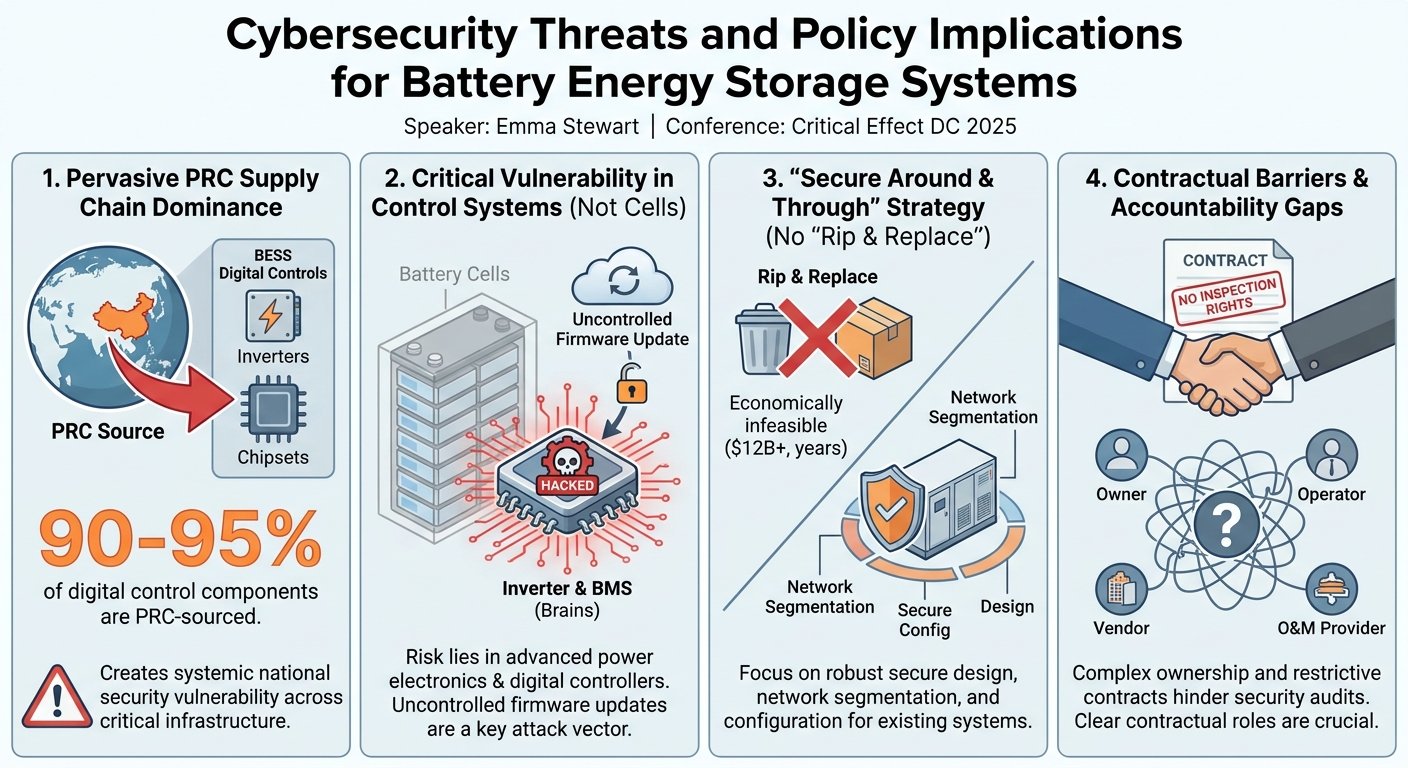
- Pervasive PRC Dependency: 90-95% of digital control components (inverters, chipsets) for BESS are from PRC sources, creating a systemic national security vulnerability across critical infrastructure.
- "Secure Around and Through" is Essential: A full "rip and replace" strategy is economically and logistically infeasible ($12B minimum, 4 years for one state). Focus must be on robust secure design, configuration, and operational practices for existing and new systems.
- Prioritize Control System Security: The core vulnerability lies in advanced power electronics and digital controllers (inverters, BMS), not just battery cells. Uncontrolled firmware updates represent a critical attack vector.
- Demand Supply Chain Visibility & Contractual Control: Asset owners must scrutinize procurement contracts to ensure the right to inspect equipment and firmware, preventing clauses that mandate persistent connections or limit security audits.
- Complex Ownership Creates Accountability Gaps: The "spiderweb" of ownership in large BESS projects makes incident response and accountability challenging. Clear contractual definitions of cybersecurity roles are crucial.
- Strategic Risk Assessment is Key: Utilize multi-dimensional frameworks (like INL's D&D scale) to assess supplier risk based on safety, security maturity, and geopolitical ties, guiding procurement and mitigation efforts.
About the Speaker(s)
Emma Stewart is a distinguished expert from the Idaho National Laboratory (INL). Her work focuses on the critical intersection of cybersecurity threats and policy implications for emerging technologies, particularly in the energy sector. With a background including a PhD in batteries and power systems, Stewart brings deep technical expertise to her analysis of supply chain vulnerabilities. Her extensive experience, including working in interconnection during the early 2000s, provides a long-term perspective on the evolution of energy infrastructure and the challenges of offshore manufacturing. At INL, she leads efforts to provide actionable technical, policy, and design solutions to secure critical energy storage systems against national security threats.
Reviews
Dr. Zero (Offensive Security Researcher) — STRONG ACCEPT
Stewart actually understands the ICS threat model. While policy wonks scream about Chinese battery chemistry, she correctly targets the real gun to our collective head: the PRC-authored firmware running the inverters and Battery Management Systems. A brutally honest, zero-bullshit reality check on the US grid's supply chain dependency.
Heather Calloway (CISO) — MUST SEE
Stewart delivers a stark, unsentimental breakdown of the vendor concentration and supply chain risk embedded in modern battery energy storage systems (BESS). With 90-95% of BESS digital controllers originating from PRC entities and 'rip and replace' financially impossible, this talk maps the exact contractual and architectural gaps leaders must close. Mandatory viewing for any leadership team managing grid-scale infrastructure, data center resilience, or OT environments.