Rethinking Cybersecurity: From Volt Typhoon to Resilience by Design
Mehdi Mirakhorli (Associate Professor, Department of Information and Computer Sciences · University of Hawaii), Kevin E. Greene (Chief Security Strategist · BeyondTrust), Kirk Lawrence (Section Chief, Secure by Design · CISA), Adam Robbie (Head of OT Threat Research · Palo Alto Networks)
Critical Effect DC 2025 · Day 1 · Track I: Critical Mass
Overview
Despite decades of substantial investment in cybersecurity tools, talent, and policies, critical infrastructure in the United States remains profoundly vulnerable. This pivotal panel discussion at Critical Effect DC 2025, moderated by Dr. Mehdi Mirakhorli, brought together leading experts to dissect this persistent challenge. The central question revolved around why, after billions spent and countless initiatives, the nation still grapples with fundamental weaknesses, exemplified by sophisticated campaigns like Volt Typhoon. The panelists explored critical failures in design, policy, and implementation, aiming to identify the type of innovation and research and development (R&D) that could genuinely move the needle for the US cybersecurity ecosystem.
Key moments
- 0:00 Introduction: Why critical infrastructure remains vulnerable
- 8:40 Fundamental failures: Not designed for conflict or failure
- 12:00 Secure by Design: Beyond compliance to real security
- 20:00 Secure by Design: Locking the front door, not end of risk
- 28:50 Moving beyond hardening: Building systems for resilience
- 34:00 Rethinking secure software development practices and impact
- 43:30 Quick wins for 12-18 months: Pizza and collaboration
Rethinking Cybersecurity: From Volt Typhoon to Resilience by Design
Speakers: Mehdi Mirakhorli (Associate Professor, Department of Information and Computer Sciences, University of Hawaii); Kevin E. Greene (Chief Security Strategist, BeyondTrust); Kirk Lawrence (Section Chief, Secure by Design, CISA); Adam Robbie (Head of OT Threat Research, Palo Alto Networks)
Conference: Critical Effect DC 2025
YouTube: https://www.youtube.com/watch?v=3JcYfjlR81A
Overview
Despite decades of substantial investment in cybersecurity tools, talent, and policies, critical infrastructure in the United States remains profoundly vulnerable. This pivotal panel discussion at Critical Effect DC 2025, moderated by Dr. Mehdi Mirakhorli, brought together leading experts to dissect this persistent challenge. The central question revolved around why, after billions spent and countless initiatives, the nation still grapples with fundamental weaknesses, exemplified by sophisticated campaigns like Volt Typhoon. The panelists explored critical failures in design, policy, and implementation, aiming to identify the type of innovation and research and development (R&D) that could genuinely move the needle for the US cybersecurity ecosystem.
The discussion moved beyond conventional problem identification to a deeper inquiry into the cultural, architectural, and incentive-based roots of the problem. It questioned whether the next breakthrough would originate from government, incubators, or the private sector, emphasizing the need for a paradigm shift from a reactive, hardening-focused approach to one built on resilience by design and the proactive assumption of compromise. The experts highlighted the critical need to re-evaluate current practices, align incentives, and foster a culture that prioritizes security from the foundational stages of system and software development.
This article delves into the core arguments, technical insights, and strategic recommendations put forth by the panelists. It examines the shortcomings of current cybersecurity postures, the imperative for a secure-by-design philosophy, and the transformative potential of embracing concepts like Zero Trust and software minimalism in an increasingly complex and threatened digital landscape. The conversation underscored that effective cybersecurity in the 21st century demands not just more tools, but a fundamental rethinking of how systems are conceived, built, operated, and defended.
Background
▶ Watch: Introduction: Why critical infrastructure remains vulnerable (0:00)
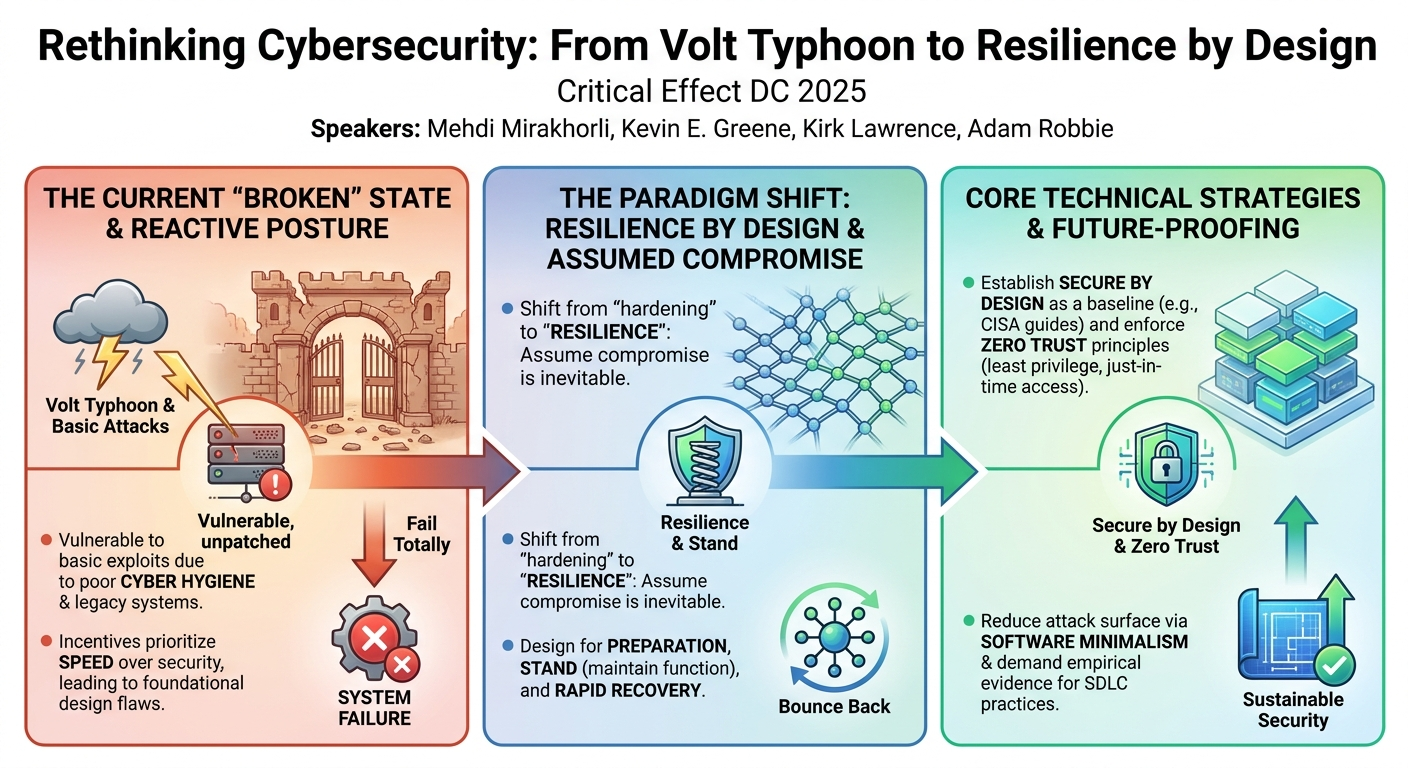
The panelists universally agreed that the current state of cybersecurity is "broken," a sentiment underscored by the pervasive impact of campaigns such as Volt Typhoon. Adam Robbie of Palo Alto Networks highlighted a fundamental disconnect: while researchers constantly seek "new ideas, new innovation, new technology," many critical infrastructure operators still rely on legacy solutions. This creates a gap where cutting-edge defenses fail to address old problems in old systems, suggesting a need to "take 10 steps back" to ensure innovation truly meets industry needs.
Kevin Greene from BeyondTrust pointed to a deep-seated cultural issue: the United States is risk-averse and reactive in its cyber posture, unlike adversaries who "fail fast" and constantly try new things. This leads to a neglect of basic cyber hygiene, which is "so essential in reducing the attack surface." Greene advocated for a shift to responsive cyber defense, being proactive and engaging "on the front end of an attack life cycle" rather than reacting after impact. He stressed the importance of codifying threat intelligence, such as that found in the MITRE ATT&CK knowledge base, into daily practices to build resilient protection mechanisms.
Kirk Lawrence, CISA's Secure by Design Section Chief, succinctly summarized the problem: "We've had it backwards in so many ways." He criticized policy for being reactive, "solving the problems of yesterday, not the problems of tomorrow," while simultaneously trying to protect "1990s architecture into a 2030s threat environment." Lawrence pinpointed misaligned incentives as a core issue, where "innovation" and "speed to market" are prioritized over "resilience and security" by software manufacturers. This results in foundational design flaws that adversaries exploit. He noted that threat actors like Volt Typhoon often don't require "novel zero days" but simply "outweigh us" with patience, exploiting the underinvestment in basic cyber hygiene across both IT and OT environments. The current digital ecosystem, he argued, is "designed for speed, designed for convenience, but we have not designed for conflict, and we have not designed for failure."
Key Findings
▶ Watch: Secure by Design: Beyond compliance to real security (12:00)
The discussion illuminated several critical findings regarding the state of cybersecurity and paths forward:
- Cultural Inertia: The US cybersecurity culture is fundamentally risk-averse and reactive, hindering proactive engagement with threats and failing to learn from adversary tactics of "failing fast."
- Neglect of Basics: Despite advanced threats, many breaches, including those from Volt Typhoon, exploit basic vulnerabilities due to poor cyber hygiene and a lack of diligence in fundamental security practices like patching and attack surface reduction.
- Policy Lag: Current cybersecurity policies are predominantly reactive, designed to address past incidents rather than anticipating future threats. This creates a perpetual struggle to secure legacy architectures against evolving sophisticated adversaries.
- Misaligned Incentives: The market prioritizes speed and innovation over security and resilience. Software manufacturers lack sufficient incentives to embed security by design, leading to foundational design flaws in critical products.
- Compliance as a Ceiling: Compliance frameworks are often treated as the maximum achievable security rather than a baseline. The rapidly evolving threat landscape outpaces compliance updates, rendering them insufficient for true defense.
- Secure by Design: A Baseline, Not a Panacea: While crucial for establishing foundational security, Secure by Design alone cannot fully protect against advanced persistent threats (APTs). It "locks the front door," making attacks harder but not impossible, and must be complemented by other strategies.
- Shift to Resilience and Assumed Compromise: Given that security is an "unattainable goal," the focus must shift from merely "hardening" systems to building resilience. This involves preparing for incidents, ensuring systems "stand" (remain operational) during an attack, and enabling rapid recovery. The underlying principle is to "assume compromise."
- Software Minimalism and Threat-Informed Design: Reducing the attack surface by building software with only essential components (software minimalism) and continuously informing design choices with current threat intelligence are vital for modern security.
- Zero Trust Imperative: Zero Trust principles (least privilege, just-in-time access, removal of zero standing privileges) are essential for reducing the attack surface and enhancing resilience, even though their implementation in OT environments presents unique challenges.
- Inadequacy of Traditional SDLCs: Conventional Secure Software Development Life Cycles (SDLCs) may not be sufficient for the complexity of modern software and the dynamic threat landscape. There is a need for empirical evidence to identify the most effective practices.
Technical Deep Dive
▶ Watch: Secure by Design: Locking the front door, not end of risk (20:00)
The conversation delved into several technical and architectural considerations crucial for rethinking cybersecurity. The pervasive threat of campaigns like Volt Typhoon, characterized by "living off the land" attacks and exploitation of basic vulnerabilities rather than "novel zero days," highlighted the need for robust foundational security.
Secure by Design (SbD) Initiatives: Kirk Lawrence detailed CISA's efforts, including the Secure by Design Buyer Guide. This guide, available in both IT and OT versions, aims to empower owners and operators to integrate product security as a "key evaluation factor" in purchasing decisions. CISA is also attempting to leverage federal procurement by influencing revisions to the Federal Acquisition Regulations (FAR), though this is a slow process (estimated "four years on a good day" to update). The goal is to align incentives, making "good security equal good business" and giving manufacturers prioritizing product security a "competitive advantage." Lawrence emphasized that SbD is a "baseline," not a "cure all," stating, "security by design is not the end of risk, it's the start of resilience."
Software Minimalism and Attack Surface Reduction: Kevin Greene passionately advocated for software minimalism, arguing that building software with only "essential components" is critical to "reduce the attack surface." This concept is foundational to building better resiliency capabilities. He stressed that threats are always evolving, and with the increasing complexity of AI and cloud environments, software gravity (where complexity and technical debt accumulate) creates vulnerabilities.
Zero Trust Architecture: The panel extensively discussed Zero Trust as a critical component of modern defense. Greene linked Zero Trust directly to resilience, noting its principles of least privilege, just-in-time access, and the removal of zero standing privileges. He highlighted that most attacks begin with identity compromise, making securing both human and non-human identities paramount. While Adam Robbie acknowledged its "lovely concept," he questioned its applicability in OT environments, suggesting it's more readily adopted in "upper layers" of the network. Greene countered that its core principles are universally applicable, emphasizing the need to "codify that into our daily operations."
Vulnerability Management and Adversary Tactics: Greene presented research indicating that threat actors frequently target specific Common Weakness Enumerations (CWEs) that enable privilege escalation. He noted a subset of 25 CWEs that commonly lead to elevation of privilege, allowing adversaries to bypass security controls that "erode over a period of time" if not properly configured and maintained. Adam Robbie echoed this, explaining that Palo Alto Networks' threat research includes not only identifying vulnerabilities but also predicting subsequent Tactics, Techniques, and Procedures (TTPs) that attackers might employ, such as lateral movement or credential compromise, to help stakeholders "hunt for these threats in your environment."
Evolution of Software Development Practices: The discussion touched upon the limitations of traditional Secure Software Development Life Cycles (SDLCs). Greene referred to a hypothetical "this week executive order from President Trump" (in the context of the 2025 conference) that rejects "unproven burdensome software accounting processes" in favor of a consortium demonstrating "secure software development and operation practices that actually work." He highlighted Microsoft's decision to "abandon their SDL" because it was "just not commensurate in keeping pace with what we see around modern software development." The implication is a need for empirical studies to identify the most effective practices, rather than relying on extensive, often ineffective, checklists. Dr. Mirakhorli also mentioned his own work on Common Architectural Weakness Enumeration (CAWE), a set of "design tactics that you can leverage as part of threat modeling and building the right protection mechanisms in software."
Demo / Proof of Concept
▶ Watch: Rethinking secure software development practices and impact (34:00)
While the talk discussed various technical concepts and strategies for improving cybersecurity and resilience, it did not feature a live demonstration or proof-of-concept of a specific tool, exploit, or defensive mechanism. Adam Robbie mentioned that his team at Palo Alto Networks educates the industry through "some demo use cases" at conferences, but this particular panel was a discussion-based format. The panelists' expertise and real-world observations served to illustrate the challenges and proposed solutions, drawing on their extensive experience with threat intelligence, policy development, and R&D.
Defensive Implications
▶ Watch: Quick wins for 12-18 months: Pizza and collaboration (43:30)
The panel discussion provided clear, actionable implications for defenders seeking to bolster their cybersecurity posture and achieve true resilience:
- Prioritize Basic Cyber Hygiene: The foundational message was to return to "basic blocking and tackling." Organizations must diligently implement and maintain patches, enforce strong access controls, and continuously work to reduce their attack surface. This seemingly simple step remains critical, as adversaries like Volt Typhoon often exploit fundamental weaknesses rather than sophisticated zero-days.
- Shift to Proactive and Responsive Defense: Defenders must move beyond a reactive stance. This means actively leveraging threat intelligence (e.g., from MITRE ATT&CK) to understand adversary TTPs and build protection mechanisms before attacks occur, placing defenses "on the front end of an attack life cycle."
- Embrace Secure by Design Principles: For both IT and OT environments, implementing Secure by Design as a baseline is essential. Defenders should utilize resources like CISA's Secure by Design Buyer Guide to influence procurement decisions, demanding products with built-in security. This creates market pressure for manufacturers to prioritize security.
- Adopt a Resilience-First Mindset: Acknowledge that compromise is inevitable ("assume a compromise"). Instead of solely focusing on hardening, build systems with resilience as a core objective, encompassing preparation for incidents, ensuring systems can stand (maintain critical functions) during an attack, and establishing robust recovery capabilities.
- Implement Zero Trust Architecture: Integrate Zero Trust principles across the enterprise. This involves rigorously securing all identities (human and non-human), enforcing least privilege, implementing just-in-time access, and eliminating zero standing privileges to significantly reduce the attack surface and limit lateral movement. While challenging in OT, the core concepts are vital.
- Modernize Legacy Systems: Actively work to modernize outdated "1990s architecture" that is ill-equipped for current threats. This may involve planned transitions off legacy systems, replacement, or incorporating stop-gap design concepts while working towards more sustainable security.
- Foster Cross-Organizational Collaboration: Break down silos between IT and OT teams. Encourage regular communication and shared understanding of security challenges and solutions. Adam Robbie's "free pizza" analogy highlights the importance of bringing diverse expertise together to collectively identify problems and devise holistic solutions.
- Demand Empirical Evidence for SDLC Practices: When evaluating software development practices, push for evidence-based approaches. Instead of blindly following extensive checklists, seek to identify and implement practices that are demonstrably effective in producing secure and high-quality software, as implied by the discussion around the hypothetical executive order and Microsoft's SDL shift.
- Learn from Safety-Critical Industries: Apply lessons from domains like aviation (e.g., FAA standards for safety-critical systems) to cybersecurity. This means setting rigorous resiliency requirements for software, expecting systems to function or recover even after a breach (e.g., encrypting data to protect it post-breach).
Key Takeaways
- Rethink the Core Problem: The persistent vulnerability of critical infrastructure stems not just from a lack of tools, but from a risk-averse culture, reactive policies, and misaligned incentives that prioritize speed over security.
- Resilience Over Hardening: True security requires a paradigm shift from merely "hardening" systems to building resilience by assuming compromise and designing for preparation, stand, and recovery.
- Basics Still Matter: Despite advanced threats like Volt Typhoon, neglecting fundamental cyber hygiene and failing to reduce the attack surface remains a primary cause of successful breaches.
- Secure by Design as a Foundation: Secure by Design (including CISA's initiatives) is essential to establish a baseline, but it must be complemented by Zero Trust principles, software minimalism, and continuous threat intelligence to achieve robust defense.
- Modernize and Validate Practices: Legacy systems are an Achilles' heel. Future-proofing requires aggressive modernization and an empirical approach to Secure Software Development Life Cycles (SDLCs) to identify and implement demonstrably effective security practices.
- Collaboration and Accountability: Breaking down IT/OT silos through improved communication is vital. Furthermore, exploring mechanisms for greater accountability and potentially liability for software manufacturers in critical infrastructure could drive significant change, echoing standards seen in safety-critical domains like aviation.
About the Speaker(s)
- Mehdi Mirakhorli: An Associate Professor in the Department of Information and Computer Sciences at the University of Hawaii, Dr. Mirakhorli specializes in cybersecurity R&D and innovation. He has a distinguished background supporting various US agencies, including the Department of Homeland Security, CISA, DARPA, DoD, Air Force, and DOT, in technology transition. He is also recognized for his work on Common Architectural Weakness Enumeration (CAWE).
- Kevin E. Greene: As the Chief Security Strategist at BeyondTrust and formerly public sector CTO, Kevin Greene brings extensive experience from both government and industry. He spent six years at DHS S&T leading R&D, focusing on software security, and later contributed to the MITRE ATT&CK framework at MITRE. With 25-30 years in cyber, his background spans R&D program leadership and building cyber resiliency for customers.
- Kirk Lawrence: Serving as the Section Chief for Secure by Design at CISA, Kirk Lawrence has dedicated almost 18 years to Homeland Security and its various cyber organizations. His deep institutional knowledge and focus on promoting secure by design principles are central to CISA's efforts to improve national cybersecurity posture.
- Adam Robbie: Adam Robbie leads the OT Threat Research team at Palo Alto Networks. His team's core mission involves identifying new attack vectors and vulnerabilities, with an additional focus on educating the industry about these threats through demo use cases and conference engagements. He actively gathers industry feedback while sharing insights into emerging threat actor techniques and observations.
Reviews
Dr. Zero (Offensive Security Researcher) — WEAK
Four talking heads spent an hour agreeing that Volt Typhoon is bad, patching is hard, and 'resilience' is good. Zero new policy mechanisms announced, zero novel threat intel dropped, and a whole lot of buzzwords thrown around to disguise the fact that this could have been a CISA press release.
Heather Calloway (CISO) — SOLID
A standard but necessary policy panel on why critical infrastructure remains vulnerable despite heavy investment. It tracks CISA's current push toward Secure by Design and hints at upcoming federal procurement shifts. Worth a listen for your procurement and third-party risk leads, but it won't fundamentally rewrite your board strategy today.