Individual and Regional Healthcare Impacts of Cyberattacks
Natalie Sullivan (Emergency Medicine Physician and Assistant Professor of Emergency Medicine)
Critical Effect DC 2025 · Day 1 · Track II: Strategic Effect
Overview
In an era where digital infrastructure underpins nearly every facet of modern life, the healthcare sector stands as a particularly vulnerable and critical target for cyberattacks. Dr. Natalie Sullivan, an emergency medicine physician and Assistant Professor of Emergency Medicine, delivered a compelling talk at Critical Effect DC 2025, dissecting the profound and often life-threatening consequences of cyber incidents on individual patient care and regional healthcare systems. Drawing from her unique perspective as a clinician who has experienced a hospital cyberattack firsthand, Dr. Sullivan illuminated the intricate dependencies of modern medicine on technology and the cascading failures that can ensue when these systems are compromised.
Key moments
- 0:00 Introduction to medical IoT and cyberattack impacts
- 2:00 Time-sensitive diagnoses and patient outcome risks
- 4:00 Challenges in studying cyberattack patient harm
- 6:00 Critical hospital dependencies on utilities
- 11:30 Disaster cycle framework for healthcare cybersecurity
- 14:00 Gaps in cyber mitigation and preparedness plans
- 18:00 Response: clinical-technical collaboration and recovery challenges
- 20:40 Q&A: Legal challenges for studying cyber incidents
Individual and Regional Healthcare Impacts of Cyberattacks
Speakers: Natalie Sullivan (Emergency Medicine Physician and Assistant Professor of Emergency Medicine)
Conference: Critical Effect DC 2025
YouTube: https://www.youtube.com/watch?v=TCG7RIgGH7E
Overview
In an era where digital infrastructure underpins nearly every facet of modern life, the healthcare sector stands as a particularly vulnerable and critical target for cyberattacks. Dr. Natalie Sullivan, an emergency medicine physician and Assistant Professor of Emergency Medicine, delivered a compelling talk at Critical Effect DC 2025, dissecting the profound and often life-threatening consequences of cyber incidents on individual patient care and regional healthcare systems. Drawing from her unique perspective as a clinician who has experienced a hospital cyberattack firsthand, Dr. Sullivan illuminated the intricate dependencies of modern medicine on technology and the cascading failures that can ensue when these systems are compromised.
The talk transcended typical cybersecurity discussions by grounding the abstract threat of cyberattacks in tangible, human terms: patient outcomes, medical timelines, and the fundamental ability of hospitals to provide care. Dr. Sullivan emphasized that these are not merely IT problems but fundamental threats to public health and safety, requiring a paradigm shift in how healthcare organizations prepare for, respond to, and recover from such events. Her insights underscore the urgent need for robust, integrated strategies that bridge the often-disparate worlds of clinical practice and cybersecurity.
Dr. Sullivan’s presentation resonated deeply with the conference's focus on critical infrastructure, highlighting healthcare as a sector where downtime isn't just an inconvenience—it can be a matter of life and death. The increasing reliance on connected medical devices and digital patient records means that a cyberattack can cripple a hospital's ability to diagnose, treat, and even communicate, with devastating effects that ripple across entire communities. This article delves into the core arguments, technical considerations, and critical implications presented in her talk, offering a comprehensive look at the multifaceted challenge of securing healthcare in the digital age.
Background
▶ Watch: Introduction to medical IoT and cyberattack impacts (0:00)
Modern healthcare, for better or worse, has embraced a vast array of technology, creating a complex and highly interconnected ecosystem often referred to as the Medical Internet of Things (IoMT). As Dr. Sullivan explained, this encompasses everything from devices taking vital signs and administering medications to automated systems for patient information, order entry, lab requests, and radiology diagnostics (00:00). While these technologies enhance efficiency and the standard of care, they introduce significant vulnerabilities, making any downtime extremely disruptive.
A central theme of Dr. Sullivan’s talk was the critical importance of time in medical care. Many life-threatening conditions are tied to very specific, evidence-based timelines, often referred to as "golden hours" or "door-to-needle" times. For instance, heart attack patients require a balloon time (door to cath lab) of 90 minutes. Stroke patients have a critical four-hour window from symptom onset to receive clot-busting medication. Trauma care operates on a golden hour, and severe sepsis demands antibiotics within three hours (02:00-04:00). Any delay in these processes, directly caused by system outages or disruptions, can lead to adverse patient outcomes.
Studying the direct link between cyberattacks and patient harm is challenging. Dr. Sullivan noted that legal protections and liability concerns often make hospitals reluctant to share incident data. This environment means that documents like the CISA report and a study by Christian and Jeff are rare examples of data-driven proof of patient harm (04:00). This lack of transparent data sharing hinders the industry's ability to learn and improve collective defenses.
The impact of a cyberattack extends beyond individual hospitals to entire regions. The concept of diversion, where ambulances are redirected from an overwhelmed hospital, is often mistakenly seen as a solution. However, as Dr. Sullivan clarified, diversion merely shifts the burden to nearby facilities, potentially overloading them and exacerbating the problem, especially in rural areas with limited healthcare options (04:00-06:00). A single hospital going down can strain an entire regional healthcare infrastructure.
Hospitals also exhibit profound dependencies on basic utilities. Water is indispensable for sterilizing equipment, running pharmacies and operating rooms, basic sanitation, fire suppression, HVAC systems, and dialysis. Dr. Sullivan cited a CDC paper estimating hospitals can last only about two hours without water access, and an entire region about four hours, before major problems arise. While the Joint Commission mandates a 96-hour water plan, there is no requirement to demonstrate actual reserves, often leading to vague plans like "using bottled water" or "evacuating," with evacuation being a rare and extremely difficult undertaking (06:00-08:00). Similarly, electricity is vital for HVAC, refrigeration (for medications and blood), security systems (electric locks), lighting, and nearly all medical equipment. Robust generators are common, but Dr. Sullivan shared an anecdote of a newly built hospital where generators were not correctly connected to the critical "red plugs" (08:00).
Beyond direct utility dependencies, hospitals often serve as safe havens during regional crises. If a hospital itself is compromised, or if a regional utility outage occurs, it faces a double burden: managing its own internal crisis while also potentially seeing an influx of patients whose home care (e.g., IVs, electronic systems) is disrupted. This creates intense competition for limited resources like generator fuel and water, further complicated by existing staffing shortages, particularly in nursing. Nurses, already operating at capacity, may be unable to come to work if their families at home lack basic utilities (10:00). This confluence of factors paints a grim picture of healthcare's inherent fragility in the face of sophisticated cyber threats.
Key Findings
▶ Watch: Challenges in studying cyberattack patient harm (4:00)
Dr. Sullivan's talk highlighted several critical findings regarding the impact of cyberattacks on healthcare:
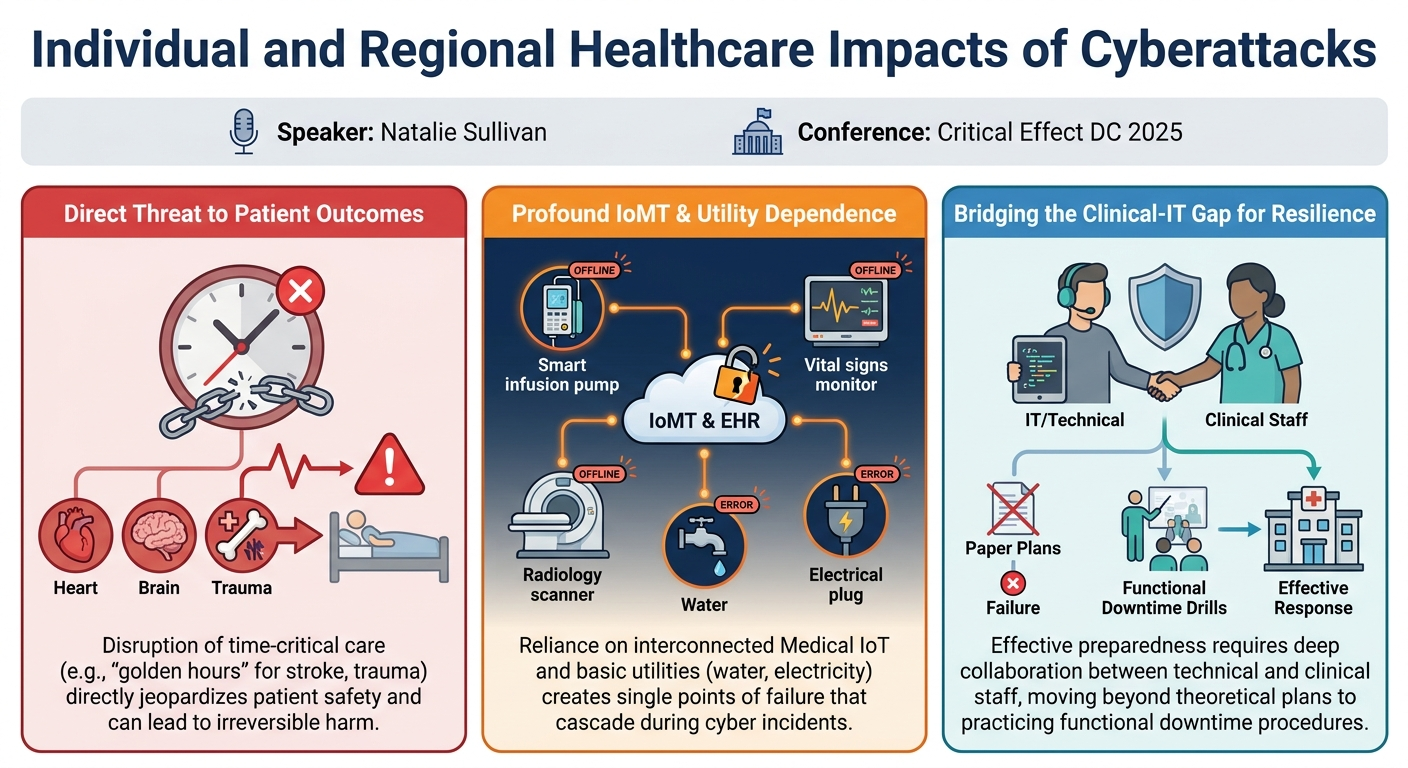
- Direct Threat to Patient Outcomes: Cyberattacks are not just data breaches or operational nuisances; they directly jeopardize patient safety by disrupting time-sensitive medical care for conditions like heart attacks, strokes, trauma, and sepsis. Delays in diagnosis and treatment due to system downtime can lead to irreversible harm or death.
- Profound IoMT and Utility Dependencies: Healthcare facilities are profoundly reliant on the Medical Internet of Things (IoMT) for clinical operations and on basic utilities (water, electricity) for fundamental function. These dependencies create extensive attack surfaces and single points of failure, making hospitals uniquely vulnerable to cascading failures during cyber incidents.
- Inadequate Preparedness Frameworks: Despite requirements like the Joint Commission's 96-hour plan for water, practical implementation of robust disaster preparedness, especially for cyber events, is often lacking. Many hospitals do not include cybersecurity prominently in their Hazard Vulnerability Analyses (HVAs) or Emergency Operating Procedures (EOPs) (14:00-16:00).
- Unique Challenges of Cyber Disasters: Cyberattacks present distinct challenges compared to traditional disasters like hurricanes. They have unclear and variable boundaries, an unpredictable cyber blast radius, and can compromise data, functionality, or communications, making traditional disaster planning models insufficient (12:00-14:00).
- Critical Collaboration Gap: There is a significant disconnect between technical (IT) and clinical staff during cyber incidents. Effective response is hampered by a lack of understanding between those who manage the systems and those who understand patient needs and prioritization (18:00).
- Barriers to Learning and Improvement: Legal and liability concerns create a strong disincentive for hospitals to share post-incident data, hindering the ability of the broader healthcare sector to learn from past attacks, identify common vulnerabilities, and develop more effective defenses (19:00-20:00).
Technical Deep Dive
▶ Watch: Disaster cycle framework for healthcare cybersecurity (11:30)
The technical ramifications of a cyberattack on a healthcare system are pervasive, directly impacting the intricate network of systems that support patient care. Dr. Sullivan, while not an IT expert, eloquently described the systemic failures from a clinician's perspective, emphasizing the critical interplay between technology and clinical workflow.
At the heart of modern healthcare is the Medical Internet of Things (IoMT) and the Electronic Health Record (EHR) system. These interconnected systems manage everything from patient registration and bed assignments to medication orders, lab results, and diagnostic imaging. In a cyberattack scenario, the immediate technical impact often involves the loss of access to these systems. This means clinicians cannot:
- Access current or historical patient information (e.g., a veteran's 20-year-old cath report at the VA, or any patient's records at other hospitals) (23:00-24:00).
- Place orders for labs, radiology, or medications digitally, leading to severe delays or inability to provide treatment (e.g., chemotherapy delays due to lack of records, as mentioned in the Q&A) (24:00).
- Monitor vital signs or administer medications using automated systems, requiring a reversion to manual, often less efficient and error-prone, methods (00:00).
- Communicate effectively between departments, as internal messaging and data transfer systems may be down.
The talk also highlighted the critical dependency on foundational infrastructure. Hospitals are highly reliant on utilities, specifically water and electricity, which are often overlooked in cybersecurity discussions but are fundamental to technical operations.
- Electricity: Beyond powering medical devices and IT infrastructure, electricity is crucial for HVAC systems (essential for maintaining sterile environments and equipment cooling), refrigeration (for medications, blood products, and lab samples), and physical security systems (e.g., electric door locks) (08:00). While hospitals have generators, Dr. Sullivan pointed out that these must be correctly integrated, noting an instance where red plugs (generator-backed outlets) were not properly connected (08:00). A regional power outage, potentially caused by a cyberattack on the grid, would compound the problem, draining limited generator fuel and competing for resources.
- Water: Sterilization of surgical instruments, operation of dialysis machines, and basic hygiene are all water-dependent. Labs and pharmacies cannot function without water. A cyberattack affecting a municipal water system, or even an internal hospital system, could render critical areas inoperable.
From a mitigation standpoint, Dr. Sullivan mentioned basic technical defenses like firewalls and physical barriers to prevent unauthorized network access. She specifically noted the importance of securing exposed network plugs, as unauthorized connections have occurred (14:00). The concept of system segmentation was also discussed, where critical medical devices might be isolated from the general hospital network. While some hospitals implement this, many do not, meaning that a breach in one area can quickly spread to vital clinical equipment. Even segmented machines can hold data that could be reconnected or compromised (22:00).
The unpredictable nature of the cyber blast radius—how far and wide an attack's impact spreads—makes technical planning uniquely challenging. Unlike a physical disaster with clear boundaries, a cyberattack can affect local systems, regional networks, or even national infrastructure, making it difficult to contain and recover from (14:00). This pervasive technical dependency underscores that cybersecurity in healthcare is not just about protecting data, but about safeguarding the very mechanisms of patient care.
Demo / Proof of Concept
▶ Watch: Gaps in cyber mitigation and preparedness plans (14:00)
Dr. Sullivan's presentation at Critical Effect DC 2025 was an analytical and educational discourse on the systemic impacts of cyberattacks on healthcare, rather than a demonstration of specific vulnerabilities, exploits, or defensive technologies. Her talk provided a critical overview of the problem space, drawing from clinical experience and disaster medicine principles, without featuring a live demo or a proof of concept for a cyberattack or a specific technical solution. The emphasis was on understanding the scale of the problem and proposing strategic frameworks for improvement, rather than showcasing technical implementation.
Defensive Implications
▶ Watch: Q&A: Legal challenges for studying cyber incidents (20:40)
The defensive implications derived from Dr. Sullivan’s talk are multifaceted, demanding a comprehensive approach that integrates cybersecurity into the broader framework of disaster preparedness and clinical operations. She advocated for utilizing the disaster cycle—mitigation, preparedness, response, and recovery—as a guiding principle, while acknowledging the unique complexities of cyber threats (12:00).
1. Mitigation:
- Technical Advancements: Hospitals must continuously update their systems, utilize the latest software, and ensure proper implementation of security measures like robust firewalls and secure network configurations. Training providers on basic security hygiene is also crucial (14:00).
- Physical Security: Beyond digital defenses, physical safeguards are necessary. This includes securing exposed network plugs and controlling physical access to critical infrastructure (14:00).
2. Preparedness (The "biggest area to work on"):
- Integrated Risk Assessment: Cybersecurity must be a prominent component of a hospital's Hazard Vulnerability Analysis (HVA). Dr. Sullivan cited a survey (2015-2017) where only about 10% of hospitals ranked cybersecurity in their top three hazards, and only 15% even included it in their HVA at all. This highlights a critical gap in recognizing the threat (14:00).
- Robust Emergency Operating Procedures (EOPs): Detailed, actionable EOPs specifically for cyber incidents are essential. Only about 35% of hospitals surveyed had such procedures in place (16:00). These "red books" must be practical and understood by all staff.
- Poly-Crisis Assessments: Planning must extend to poly-crisis scenarios, considering cyberattacks in conjunction with other disasters like power outages, water supply failures, or pandemics (e.g., a cyberattack during COVID-19). Existing government and non-government guidance (like the CDC's water preparedness booklet) should be integrated into these plans, despite the costs and space requirements (16:00).
- Drilling and Exercising: Regular, realistic drills and exercises are fundamental. This includes functional downtime training, where staff practice providing patient care without access to electronic systems, such as writing paper prescriptions. Dr. Sullivan noted that current downtime drills are often not taken seriously (17:00-18:00).
- Cyber Response Teams: Innovative approaches, such as developing dedicated cyber response teams (as proposed by Christian and Jeff), could provide alternative, resilient systems that allow clinicians to maintain their normal workflow during an attack, rather than completely reverting to paper (17:00).
3. Response:
- Technical-Clinical Collaboration: Bridging the gap between IT and clinical staff is paramount. Technical teams need to understand clinical priorities (e.g., which patient care timelines are most critical), and clinicians need to understand technical limitations. This collaboration ensures that system recovery efforts align with patient safety needs (18:00).
- Functional Downtime Proficiency: Ensuring all staff, including new residents, are proficient in manual, paper-based processes for medication administration, orders, and patient documentation is vital (18:00).
4. Recovery:
- Post-Incident Analysis (Hotwashing): Thorough analysis of what went wrong is critical for adapting downtime mechanisms and improving future resilience.
- Safe Data Mining: A major challenge is the lack of a safe mechanism for hospitals to share post-incident data without exposing themselves to legal liability. Dr. Sullivan emphasized the need to work with cyber security lawyers and management lawyers to create frameworks that allow for collective learning and improvement across the healthcare sector, without risking enormous lawsuits (19:00-22:00). Without this, the industry cannot truly learn and adapt effectively.
In essence, Dr. Sullivan's talk calls for a paradigm shift: cyber preparedness in healthcare must evolve from an IT-centric concern to an enterprise-wide, patient-centric strategic imperative, deeply integrated into all aspects of hospital operations and disaster management.
Key Takeaways
- Cyberattacks on healthcare systems pose a direct and severe threat to patient safety, particularly by disrupting time-sensitive medical care for critical conditions like heart attacks, strokes, trauma, and sepsis.
- Modern hospitals are critically dependent on the Medical Internet of Things (IoMT) and fundamental utilities (water, electricity), making them highly vulnerable to cascading failures during cyber incidents.
- Existing disaster preparedness frameworks and regulatory requirements (e.g., Joint Commission's 96-hour plan) often lack practical implementation and enforcement for cyber events and utility outages, creating significant gaps in resilience.
- Effective response to a healthcare cyberattack necessitates deep collaboration between technical (IT) and clinical staff, ensuring that recovery efforts are prioritized based on patient needs and that clinicians are proficient in functional downtime procedures.
- The unique characteristics of cyberattacks, including their unpredictable blast radius and varied impact (data vs. functionality), require specialized planning that goes beyond traditional disaster management models and includes poly-crisis assessments.
- Current legal and liability concerns significantly hinder hospitals from sharing post-incident data, impeding industry-wide learning and the development of collective, more effective defensive strategies. Safe data mining mechanisms are urgently needed.
About the Speaker(s)
Dr. Natalie Sullivan is an emergency medicine physician and an Assistant Professor of Emergency Medicine at George Washington University (GW) Hospital. While she works clinically at GW Hospital, which is owned by the for-profit entity UHS, she explicitly stated that she does not speak for the hospital. Dr. Sullivan also serves as the Assistant Director for GW's operational and disaster medicine program. Her interest in the critical impact of cyberattacks on healthcare was ignited after personally working at a hospital that experienced such an incident. This experience, combined with her subspecialty in disaster medicine, positions her uniquely to address the intersection of cybersecurity, emergency response, and patient care.
Reviews
Dr. Zero (Offensive Security Researcher) — MUST SEE
This isn't a technical talk, but it's a mandatory reality check if you defend clinical networks. Sullivan is an ER doc who actually lived through a hospital breach, and she translates abstract IT downtime into dead patients. It cuts through the risk-matrix bullshit and gives defenders the exact clinical 'golden hours' they need to prioritize recovery.
Heather Calloway (CISO) — STRONG ACCEPT
Dr. Sullivan translates technical outages into concrete clinical impacts, exposing the lethal gap between IT recovery goals and patient survival timelines. She delivers a necessary reality check on business continuity and the failure of current disaster frameworks. This is required viewing for any hospital board, risk committee, or CISO managing life-safety environments.