Reddit at Scale: Infrastructure, AI, and the Road to IPO
Steve Huffman (CEO & Co-Founder · Reddit)
Stanford CS153: Technology Entrepreneurship — Infra @ Scale (Winter 2025) · Day 1 · Jordan Hall 420-040
Overview
This talk, delivered by Steve Huffman, CEO and Co-Founder of Reddit, at the CS153 Infra @ Scale 2025 conference, provides a comprehensive look into the journey of one of the internet's most influential platforms. Huffman details Reddit's humble beginnings, its evolution through various crises, and its current strategic direction, particularly focusing on content moderation at scale, infrastructure resilience, and the burgeoning intersection with artificial intelligence. The discussion offers invaluable insights into the challenges and triumphs of building and sustaining a massive, user-generated content platform, culminating in its recent initial public offering (IPO).
Key moments
- 0:50 Reddit's original idea: Slashdot + Delicious mashup
- 2:40 Manually seeding Reddit and first organic growth
- 4:05 Paul Graham's blog post: Reddit's first traffic
- 5:15 Selling Reddit to Advance/Condé Nast in 2006
- 6:40 Reddit's near-death experience: down to one employee
- 7:15 Steve Huffman returns as CEO during crisis
- 8:00 Reddit's growth to 2,000 employees since 2015
Reddit at Scale: Infrastructure, AI, and the Road to IPO
Speakers: Steve Huffman (CEO & Co-Founder, Reddit)
Conference: CS153 Infra @ Scale 2025
YouTube: https://www.youtube.com/watch?v=yeA-opPcYxk
Overview
This talk, delivered by Steve Huffman, CEO and Co-Founder of Reddit, at the CS153 Infra @ Scale 2025 conference, provides a comprehensive look into the journey of one of the internet's most influential platforms. Huffman details Reddit's humble beginnings, its evolution through various crises, and its current strategic direction, particularly focusing on content moderation at scale, infrastructure resilience, and the burgeoning intersection with artificial intelligence. The discussion offers invaluable insights into the challenges and triumphs of building and sustaining a massive, user-generated content platform, culminating in its recent initial public offering (IPO).
The presentation is particularly relevant for anyone interested in the lifecycle of internet startups, the complexities of platform governance, and the strategic implications of emerging technologies like AI. Huffman's candid recounting of Reddit's near-death experiences, the evolution of its content policies, and its approach to data monetization provides a rare glimpse into the operational realities of a company that has navigated nearly two decades of rapid technological and cultural shifts. His insights underscore the critical importance of adaptable infrastructure, robust policy frameworks, and principled leadership in maintaining a thriving digital community.
Background
▶ Watch: Reddit's original idea: Slashdot + Delicious mashup (0:50)
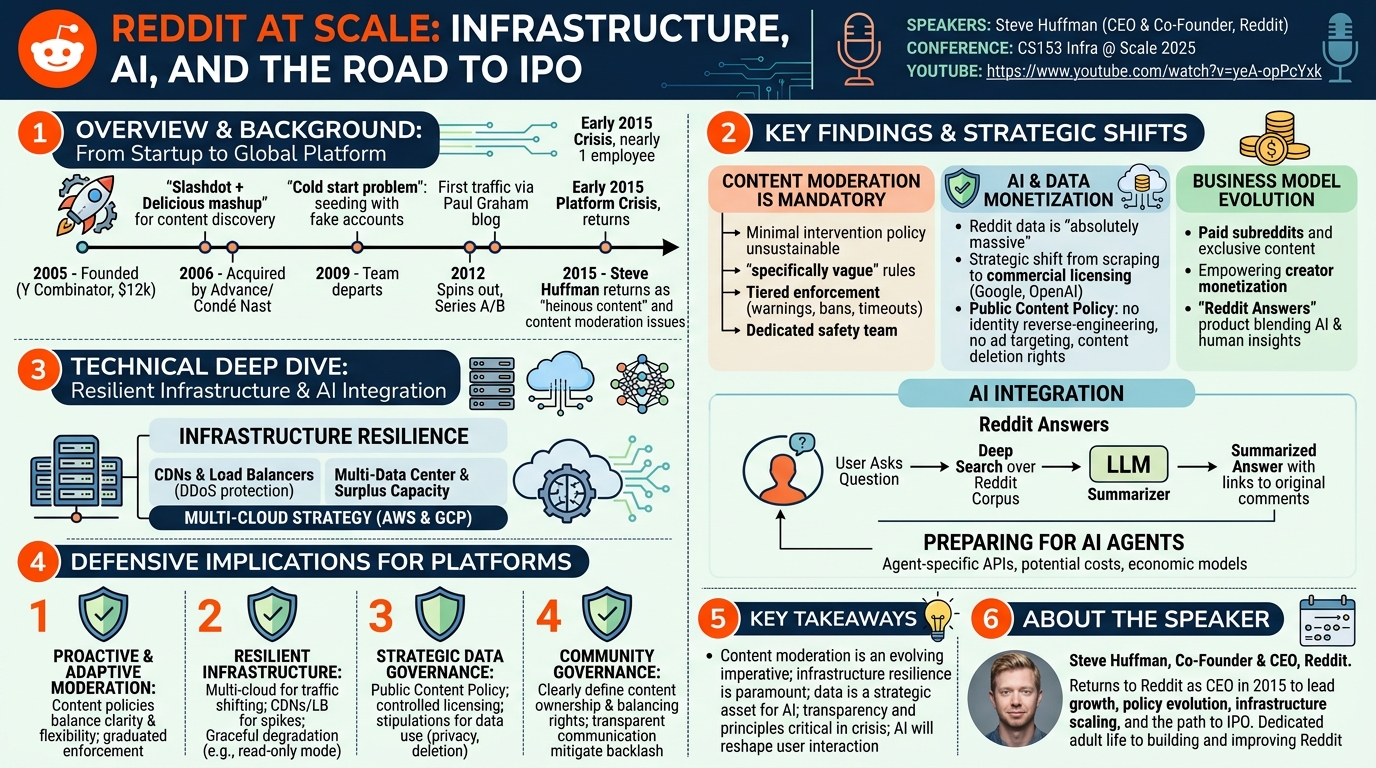
Reddit's genesis traces back to the summer of 2005, when Steve Huffman and Alexis Ohanian, recent graduates from the University of Virginia, applied to Y Combinator with an idea for a food delivery service—a concept far ahead of its time. After an initial rejection, Y Combinator invited them back, leading to the birth of Reddit. The original vision was to create a platform for discovering "new and interesting content online," a hybrid of Slashdot (for community-driven news) and Delicious (for social bookmarking and tagging). The core mechanic of user-submitted and user-ranked content was present from day one.
In its nascent stages, Reddit faced the classic "cold start problem" of user-generated content platforms. Huffman recalled running daily scripts to scrape content from other websites and submitting it under various fake accounts to populate the front page, creating the illusion of activity. This manual seeding continued for about two months until a pivotal moment in August 2005 when the site's front page was organically filled with links submitted by genuine, unknown users. The platform's first significant growth spurt came from Paul Graham, a Y Combinator founder and early investor, who linked to Reddit from his popular blog, driving an initial influx of 1,000-2,000 users.
The company's early financial backing was modest, starting with a $12,000 investment from Y Combinator, followed by an additional $70,000. Just 18 months after its founding, in October 2006, Reddit was acquired by Advance Publications (Condé Nast). Huffman and his team remained with Advance for three years before departing around the end of 2009. During their absence, Reddit experienced significant turmoil. It spun out from Advance in 2012, undergoing Series A and B funding rounds. However, by early 2015, the company was in crisis, having dwindled to a single employee at one point, Eric Martin, an astonishing testament to its resilience. Huffman returned as CEO in the summer of 2015, inheriting a team of approximately 70 people and a platform grappling with severe content moderation issues. The initial content policy, effectively "we don't remove things," had, with Reddit's growth, led to the proliferation of "heinous content" in certain communities, attracting negative press and threatening the platform's viability. This crisis spurred a fundamental rethinking of Reddit's approach to content governance and platform health.
Key Findings
▶ Watch: Paul Graham's blog post: Reddit's first traffic (4:05)
Steve Huffman's return to Reddit in 2015 marked a critical turning point, leading to several key findings and strategic shifts that have defined the platform's trajectory. The most prominent was the realization that a hands-off approach to content moderation was unsustainable at scale. The initial policy of minimal intervention, while rooted in a desire for user empowerment, had allowed problematic communities to flourish, jeopardizing the platform's reputation and long-term viability. Huffman's direct assessment was stark: "we are dying, and if we don't change it, we will die." This led to a significant overhaul, including substantial employee turnover (only 10-15 of the original 70 remained a year later) as the company pivoted to a more proactive stance on policy enforcement.
A crucial lesson in policy development was the need for rules that are "specifically vague." While aiming for clarity, Reddit found that overly specific rules were easily circumvented by bad actors. The current content policy comprises 10 core rules, including prohibitions against hate, harassment, violence, doxing, spam, illegal content, involuntary sexualization, content involving minors, and regulated marketplaces. Each word in these policies, Huffman noted, represents a hard-won lesson. The development of a dedicated safety team and a tiered enforcement system (warnings, temporary bans, permanent bans for users; temporary "timeouts" and permanent bans for subreddits) provided the necessary flexibility beyond the initial binary "ban or not" approach.
Another significant finding revolved around the platform's relationship with its vast corpus of user-generated content and the rise of artificial intelligence. Reddit's data, described as "absolutely massive" (generating the equivalent of English Wikipedia's tokens every two weeks), proved invaluable for training large AI models. This led to a strategic shift from historically permissive scraping to a model of commercial licensing. Deals with major players like Google and OpenAI formalized access to Reddit's public data, ensuring a "fair exchange of value." This move was accompanied by the creation of a Public Content Policy, a novel approach distinct from privacy policies, which outlines how public content may be used, including stipulations against reverse-engineering user identity, ad targeting, and requiring content deletion upon user request.
Finally, the talk highlighted the ongoing evolution of the platform's business model and user experience. Reddit is exploring paid subreddits and exclusive content areas, not by paywalling existing content, but by empowering creators to monetize new, exclusive offerings. This aims to attract and retain creators who currently must use other platforms for monetization. The integration of AI is also enhancing the user experience, particularly for "seekers" (information searchers). The "Reddit Answers" product, launched in December, demonstrates this by providing LLM-summarized answers to subjective questions, with direct links to the source Reddit comments, blending AI with human-generated insights. These findings underscore Reddit's continuous adaptation to technological advancements, market demands, and the inherent challenges of managing a global online community.
Technical Deep Dive
▶ Watch: Selling Reddit to Advance/Condé Nast in 2006 (5:15)
Reddit's infrastructure has evolved dramatically from its rudimentary beginnings to a sophisticated, multi-cloud environment capable of handling immense scale and traffic variability. In the earliest days, Steve Huffman recounted managing the platform on a single server, often resorting to "cowboy sysadmin" tactics like manually flipping the site into read-only mode when databases were overwhelmed to prevent data corruption and keep the site partially operational. This early, reactive approach highlighted the fundamental challenges of scaling a dynamic, user-generated content platform.
Today, Reddit employs a robust, layered infrastructure designed for resilience and efficiency. The frontline of defense against traffic spikes and Distributed Denial of Service (DDoS) attacks are Content Delivery Networks (CDNs) and load balancers, which can absorb and shed significant volumes of traffic. Beyond this, Reddit leverages multiple data centers and maintains surplus capacity, allowing for flexible scaling—both up during peak demand and down for cost savings during quieter periods.
A critical aspect of Reddit's modern infrastructure is its multi-cloud strategy, utilizing both Amazon Web Services (AWS) and Google Cloud Platform (GCP). This redundancy provides significant resilience. Huffman described an incident where a large chunk of AWS servers was lost due to an internal error, but Reddit was able to divert all affected traffic to GCP within approximately 20 minutes, maintaining site availability at a "world scale." This ability to rapidly shift traffic between cloud providers is a testament to a well-architected, resilient system. While the "read-only mode" might seem like an antiquated solution, Huffman admitted that in emergency situations where the platform is struggling, such degradation strategies are still valuable tools to keep the site online, emphasizing a pragmatic approach to operational stability.
The integration of Artificial Intelligence (AI) is also a significant technical undertaking. Reddit is actively building capabilities to make its vast content corpus more accessible and useful. The Reddit Answers product is a prime example. This feature, developed in 90 days and launched in December, combines traditional Reddit search with an LLM (Large Language Model) summarizer. When a user asks a subjective question, Reddit Answers performs a search, retrieves hundreds of relevant posts, and then synthesizes the information into a concise summary. Crucially, every factual statement in the summary is linked directly to the specific Reddit comment from which it originated, ensuring transparency and verifiability. This approach transforms Reddit from purely a community platform into a powerful knowledge base, leveraging AI to unlock the latent value within its historical conversations.
Looking ahead, Reddit is anticipating the proliferation of AI agents interacting with the internet. Huffman foresees an evolution where platforms will need to build APIs specifically designed for agents, moving beyond current web scraping methods. This raises new technical and commercial considerations, such as potential "agent API costs" or how agents might interact with advertising models. Reddit's preference remains to keep the platform "open and accessible even to AI bots or agents," but this openness must be balanced against operational costs and potential disruptions, representing a complex technical and strategic challenge for the future.
Demo / Proof of Concept
▶ Watch: Steve Huffman returns as CEO during crisis (7:15)
While the talk did not feature a traditional technical demonstration or a proof of concept for a security vulnerability, Steve Huffman did describe a newly launched product that serves as a practical demonstration of Reddit's strategic integration of AI.
The product, called Reddit Answers, was built and launched within 90 days in December. It functions as an LLM summarizer layered on top of Reddit's existing search capabilities. Users, when logged into Reddit (either via reddit.com/answers or through the mobile app's bottom navigation bar), can ask subjective questions. The system then performs a deep search across Reddit's extensive corpus, retrieving numerous relevant posts and comments. The LLM processes this information and generates a summarized answer. A key feature highlighted by Huffman is that every factual assertion made in the summary is directly linked back to the specific Reddit comment from which it was derived. This provides transparency and allows users to verify the information within its original community context.
This product demonstrates Reddit's commitment to leveraging AI to enhance the "seeker" use case—where users are looking for information rather than direct human interaction. It showcases how Reddit is transforming its vast archive of human conversation into an accessible, AI-powered knowledge base, while still preserving the authenticity and source attribution of its community-generated content.
Defensive Implications
▶ Watch: Reddit's growth to 2,000 employees since 2015 (8:00)
The detailed account of Reddit's journey, particularly concerning content moderation, infrastructure scaling, and data monetization, offers several critical defensive implications for platform operators and security professionals.
1. Proactive and Adaptive Content Moderation:
The most salient defensive implication is the absolute necessity of a robust and evolving content moderation strategy. Reddit's initial "no removal" policy, while ideologically driven, proved disastrous at scale. Defenders must understand that user-generated content platforms, especially as they grow, will inevitably attract malicious actors and problematic content.
- "Specifically Vague" Policies: Developing content policies that are specific enough to guide enforcement but vague enough to allow for interpretation is crucial. This flexibility helps combat adversaries who exploit literal interpretations of rules. Reddit's 10 rules, refined over a decade, exemplify this balance.
- Tiered Enforcement: A graduated system of warnings, temporary bans, and permanent bans (for users and communities) offers more nuanced control than a binary approach. The introduction of "subreddit timeouts" provides a valuable intermediate step for community rehabilitation.
- Dedicated Safety Teams: Relying solely on community moderation is insufficient. A professional, centralized safety team is essential for consistent enforcement, policy development, and handling complex edge cases.
- Principle-Driven Decision Making: Operating from core values and principles, rather than succumbing to external pressure, ensures consistency and builds long-term trust, even if individual decisions are controversial.
2. Resilient Infrastructure for Operational Continuity:
Reddit's experience underscores the importance of an infrastructure designed for extreme scale and resilience.
- Multi-Cloud Strategy: Leveraging multiple cloud providers (AWS and GCP in Reddit's case) allows for rapid traffic shifting during outages or performance degradations in one provider, significantly enhancing uptime and disaster recovery capabilities.
- Layered Defense against Traffic Spikes: Implementing CDNs and load balancers at the network edge is critical for absorbing DDoS attacks and managing unpredictable traffic surges, preventing them from overwhelming backend systems.
- Flexible Scaling and Capacity Planning: Building systems that can dynamically scale up and down not only manages cost but also ensures that surges in activity can be met without service degradation.
- Graceful Degradation: Having predefined mechanisms like "read-only mode" allows platforms to shed non-essential functionality during crises, preserving core services and maintaining partial availability rather than complete downtime. This is a crucial last resort for critical infrastructure.
3. Strategic Data Monetization and Policy Transparency:
The advent of AI has made platform data a valuable asset, necessitating clear policies for its use.
- Public Content Policy: Beyond privacy policies, platforms should consider a public content policy that explicitly states how user-generated public content can be accessed and used, especially by commercial entities or AI trainers.
- Controlled Access and Licensing: Implementing commercial licensing models for high-volume data access (e.g., for AI training) ensures fair compensation and allows platforms to set terms of use.
- Stipulations for Data Use: Critical defensive measures include prohibiting the reverse engineering of user identities, preventing data from being used for ad targeting, and mandating the deletion of content from licensed datasets if users remove it from the platform. These protect user privacy and control even when data is licensed.
- Arms Race Against Scraping: Acknowledging that blocking unauthorized scraping is an ongoing "arms race" means platforms must continuously invest in technical measures while simultaneously setting clear policy boundaries.
4. Community Governance and Rights Protection:
The API protest highlights the delicate balance between platform control and community autonomy.
- Clarity on Content Ownership: Platforms must clearly articulate that while users create content, the platform often hosts and curates it, and mods do not have the right to unilaterally remove years of user-generated content.
- Transparent Communication: Proactive and public communication about significant policy or technical changes (like API pricing) can mitigate backlash and allow for constructive dialogue.
- Balancing Rights: While protests are a legitimate form of expression, platforms must define boundaries to prevent indefinite service disruption that harms the broader user base.
In essence, defending a large-scale platform like Reddit involves a holistic approach encompassing robust technical infrastructure, continuously evolving policy frameworks, clear communication, and a principled stance on community governance and data stewardship.
Key Takeaways
- Content Moderation is an Evolving Imperative: A hands-off approach to user-generated content is unsustainable at scale. Platforms must proactively develop and adapt content policies, embracing "specifically vague" rules and tiered enforcement mechanisms (warnings, temporary bans, timeouts) to effectively manage problematic content and bad actors.
- Infrastructure Resilience is Paramount: A multi-cloud strategy (e.g., AWS and GCP), combined with CDNs, flexible capacity, and graceful degradation capabilities (like read-only mode), is crucial for handling massive traffic fluctuations, mitigating DDoS attacks, and ensuring continuous availability even during significant outages.
- Data is a Strategic Asset, Especially for AI: Platforms with vast content corpora should recognize the commercial value of their data for AI training. Implementing a Public Content Policy and establishing commercial licensing agreements for data access (with stipulations to protect user identity and content deletion rights) is a vital monetization and governance strategy.
- Transparency and Principled Leadership are Key in Crisis: Navigating platform crises, whether related to content moderation or API policies, requires transparent communication, a willingness to make tough decisions, and unwavering adherence to core principles and values, rather than succumbing to external pressure or short-term expediency.
- AI Will Reshape User Interaction and Platform Design: The rise of AI agents and LLMs will transform how users interact with platforms. Companies must adapt by building AI-powered features (like Reddit Answers) to enhance information retrieval and consider developing agent-specific APIs, while also addressing new economic and operational challenges related to AI consumption of resources.
About the Speaker(s)
Steve Huffman is the Co-Founder and CEO of Reddit, one of the internet's most influential and widely used platforms for community and discussion. He graduated from the University of Virginia and, alongside Alexis Ohanian, co-founded Reddit in the summer of 2005 after participating in Y Combinator. After selling Reddit to Advance (Condé Nast) in 2006, he and the original team departed the company in 2009. Huffman returned to Reddit as CEO in the summer of 2015, at a critical juncture when the company was facing significant challenges, including content moderation crises and organizational turmoil. Under his leadership, Reddit has grown substantially, evolving its content policies, scaling its infrastructure, and recently navigating its initial public offering (IPO). He has dedicated his entire adult life to building and improving Reddit, demonstrating a deep commitment to the platform's community and its future.
Reviews
Simon Wisk (Open Source Developer & AI Tooling Expert) — WEAK
A founder retrospective that reads more like a company history lesson than a technical talk. Huffman's candid about Reddit's near-death experiences and some of the policy evolution is genuinely interesting, but there's almost nothing here that helps an engineer build something differently tomorrow. The 'technical deep dive' amounts to 'we use multiple clouds and CDNs,' and the AI section is a product announcement dressed up as architecture.
Jensen Hitch (AI Compute Platform CEO) — WEAK
Steve Huffman tells an honest, candid story about Reddit's survival — content moderation crises, infrastructure fires, data licensing — but this is a platform operator's memoir, not a systems engineering talk. The infrastructure discussion stays at the level of 'we use AWS and GCP and CDNs,' which is table stakes. The AI integration described is a 90-day product sprint layering an LLM on top of search. There's no reasoning from physical constraints, no analysis of what actually makes this hard at Reddit's scale, and no platform-level insight that changes how engineers build. Interesting as a case study in organizational survival; thin as a contribution to infrastructure or AI systems…
→ Top-rated talks at Stanford CS153: Technology Entrepreneurship — Infra @ Scale (Winter 2025)
All talks from Stanford CS153: Technology Entrepreneurship — Infra @ Scale (Winter 2025)