Building Mistral: Open Frontier Models
Guillaume Lample (Co-Founder & Chief Scientist · Mistral AI)
Stanford CS153: Technology Entrepreneurship — Infra @ Scale (Winter 2025) · Day 3 · Jordan Hall 420-040
Overview
In this insightful talk from CS153 Infra @ Scale 2025, Guillaume Lample, Co-Founder and Chief Scientist of Mistral AI, provides a comprehensive look into the journey of building and deploying frontier open-source models. Lample, a pivotal figure in the development of Meta's groundbreaking Llama models, shares his unique perspective on the evolution of large language models (LLMs), the intricate infrastructure challenges involved in their training and deployment, and Mistral AI's strategic approach to the burgeoning AI market. The discussion delves into the technical intricacies, the financial realities of model development, and Mistral's distinct business model focused on custom, on-premise solutions for enterprise customers.
Key moments
- 0:40 Mistral AI: mission, open-source models, and custom solutions
- 3:20 Unsupervised machine translation research during PhD at Meta
- 4:15 Early AI for formal math before powerful LLMs
- 6:10 Leveraging LLMs to generate informal proofs for formal proving
Building Mistral: Open Frontier Models
Speakers: Guillaume Lample (Co-Founder & Chief Scientist, Mistral AI)
Conference: CS153 Infra @ Scale 2025
YouTube: https://www.youtube.com/watch?v=qzT8I-J8sQ8
Overview
In this insightful talk from CS153 Infra @ Scale 2025, Guillaume Lample, Co-Founder and Chief Scientist of Mistral AI, provides a comprehensive look into the journey of building and deploying frontier open-source models. Lample, a pivotal figure in the development of Meta's groundbreaking Llama models, shares his unique perspective on the evolution of large language models (LLMs), the intricate infrastructure challenges involved in their training and deployment, and Mistral AI's strategic approach to the burgeoning AI market. The discussion delves into the technical intricacies, the financial realities of model development, and Mistral's distinct business model focused on custom, on-premise solutions for enterprise customers.
Mistral AI stands out as an open-source company, committed to open-weight models, having released influential models like Mistral 7B, Mixtral 8x7B, and Mistral Small 3. Lample highlights Mistral's core offering: not just selling models, but providing advanced, custom AI solutions tailored to specific customer needs. This includes on-premise or private cloud deployments, sophisticated fine-tuning, and even custom pre-training for specialized use cases, such as models optimized for particular languages or edge devices. The talk underscores the significant shift in the AI landscape, from foundational research to the practical challenges of enterprise-grade deployment and the strategic importance of data.
Why this talk matters is multifaceted. It offers a rare glimpse into the practicalities of building state-of-the-art LLMs from the ground up, sharing lessons learned from both Meta and Mistral. Lample's narrative emphasizes the critical role of data curation, the often-underestimated cost of R&D beyond final training runs, and the evolving infrastructure requirements for both pre-training and inference. Furthermore, it illuminates Mistral's vision for a segment of the AI market that prioritizes privacy, control, and customization, particularly for sensitive industries. For anyone interested in the technical and business realities of large-scale AI, Lample's insights provide invaluable context and foresight into the future of open and custom AI solutions.
Background
▶ Watch: Mistral AI: mission, open-source models, and custom solutions (0:40)
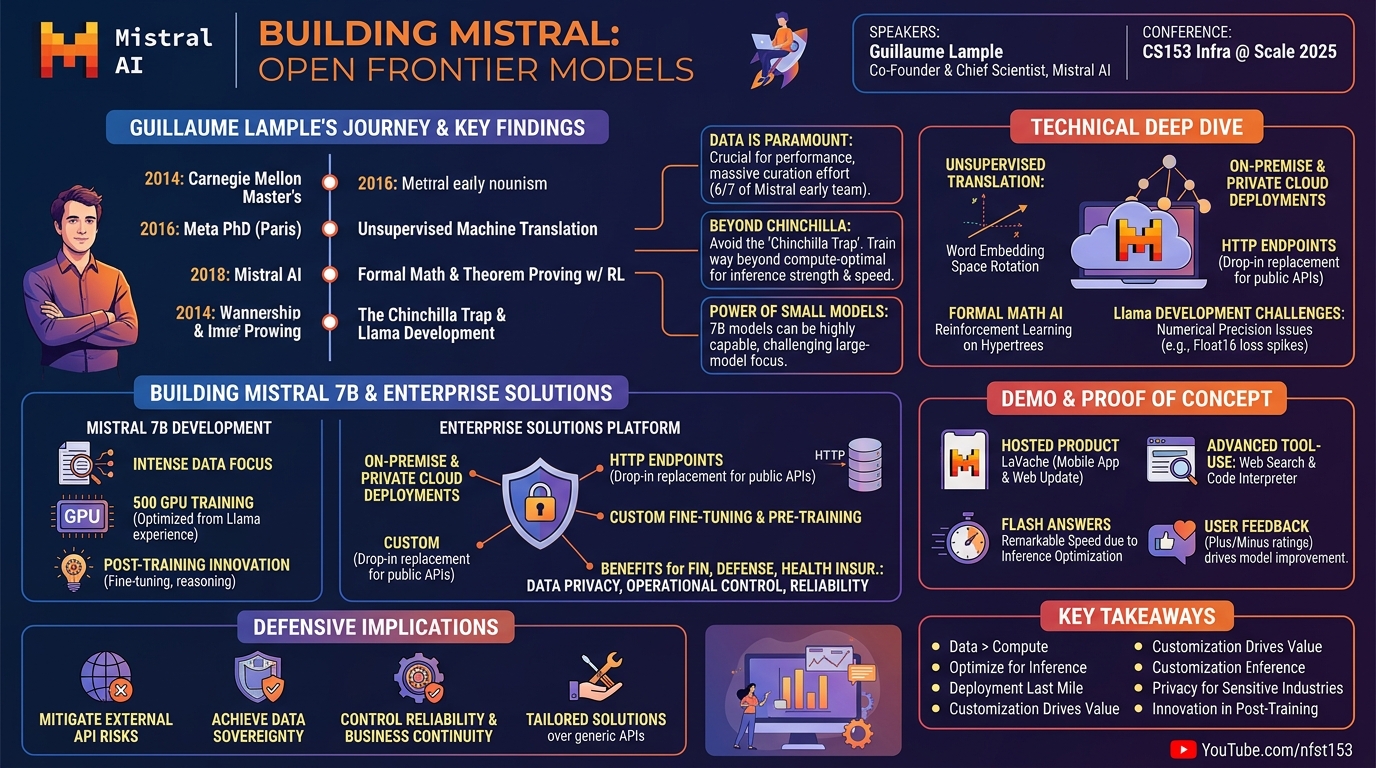
Guillaume Lample's journey into the forefront of AI research began with a Master's degree at Carnegie Mellon in 2014, followed by a PhD at Meta in Paris starting in 2016. This unique PhD program allowed him to access industrial resources while still a student, laying the groundwork for his extensive contributions to natural language processing (NLP). His early work focused on unsupervised machine translation, where he developed methods to translate between languages without parallel corpora. This involved training word embeddings in different languages and discovering that these high-dimensional vector spaces were largely congruent, separated primarily by a rotation that could be learned in an unsupervised manner.
Following his PhD, Lample continued as a full-time researcher at Meta, where he delved into AI formal math and theorem proving. This pioneering work, which predated the widespread popularity of reasoning in LLMs, aimed to apply reinforcement learning techniques, similar to DeepMind's AlphaZero for Go and Chess, to formal theorem proving. The environment was complex, involving "hypertrees" of goals rather than simple board states, and required significant engineering effort to build APIs connecting models to formal systems not designed for machine learning. This early experience, though challenging with 400 million parameter models, highlighted the potential of AI in rigorous mathematical reasoning.
A pivotal moment arrived with the emergence of powerful LLMs like GPT-3 and Google's Minerva. Recognizing the potential, Lample's team at Meta explored a hybrid approach: using LLMs (specifically OpenAI Codex via API) to generate informal proofs in LaTeX, which then guided a formal prover. This significantly improved formal theorem proving by leveraging the LLMs' ability to process vast amounts of informal mathematical text. The success of this approach underscored the need for in-house LLMs to conduct more sophisticated research, especially for techniques like Monte Carlo Tree Search (MCTS), which are prohibitive with external APIs.
This led directly to the development of Llama at Meta. Inspired by DeepMind's Chinchilla scaling laws paper, which provided a recipe for optimal model size given a fixed compute budget (e.g., 1.4 trillion tokens for a 7B parameter model), Lample's team embarked on training their own LLMs. They aimed to create a generic model that could later be fine-tuned for specialized tasks like math. The initial Llama 7B, 13B, and 30B models were trained on approximately 1 trillion tokens, revealing unexpected strength in smaller models. Lample noted a common misunderstanding, the "Chinchilla trap," where many interpreted the scaling laws as an upper bound, when in fact, training on significantly more tokens (e.g., 2 trillion) could yield much stronger models, especially critical for inference efficiency. The Llama project, which began in August 2022 and concluded in early 2023, involved substantial R&D, costing an estimated $7.5 to $10 million over six months, utilizing a cluster of 2,800 A100 GPUs. This foundational work at Meta provided Lample and his co-founders with the invaluable expertise and "tricks" necessary to establish Mistral AI.
Key Findings
▶ Watch: Unsupervised machine translation research during PhD at Meta (3:20)
The development of Llama at Meta revealed several crucial insights that shaped Guillaume Lample's perspective and Mistral AI's strategy. Foremost among these was the unexpected power and performance achievable with smaller language models, particularly the 7B parameter scale. Prior to Llama, the community often focused on ever-larger models, but Lample's team demonstrated that with sufficient data and careful training, a 7B model could achieve remarkable capabilities, challenging prevailing intuitions about model size. This finding significantly influenced Mistral's early focus on highly performant smaller models.
Another critical realization was the paramount importance of data. Lample explicitly states that "the data is really like the most important thing." During Mistral's early days, out of a team of seven, six individuals were dedicated solely to data curation, highlighting the massive effort required. This emphasis on high-quality, diverse training data proved to be a key differentiator, enabling Mistral 7B to achieve its impressive performance.
Lample also clarified a common misunderstanding surrounding the Chinchilla scaling laws, which he termed the "Chinchilla trap." The original paper aimed to identify the optimal model size for a fixed compute budget. However, many misinterpreted this as a definitive guide for all training scenarios. Lample argues that if the goal is to maximize inference performance and deploy strong models, one should train "way beyond" what is considered "compute optimal" by Chinchilla, meaning using significantly more tokens. This insight emphasizes that compute optimality for training does not equate to deployment optimality, where factors like model strength, inference speed, and cost-effectiveness are paramount.
A significant finding from Mistral's experience in the market is the profound difficulty enterprises face in deploying LLMs. Despite the availability of powerful pre-trained checkpoints, most companies lack the specialized expertise and infrastructure to efficiently deploy these models. This "last mile" problem, as Lample describes it, involves complex engineering to build stable, efficient APIs, manage rate limitations, and integrate models into existing systems. This gap became a core business opportunity for Mistral, leading them to develop and sell deployment platforms that customers can run on-premise or in private clouds.
Finally, the talk underscored the immense power of fine-tuning and customization. Lample notes that even a few hundred or thousand samples for fine-tuning can "significantly enhance the strength of the model." This implies that while large pre-trained models provide a strong foundation, their true value for specific enterprise use cases often comes from targeted adaptation. Mistral's approach of assisting customers with synthetic data generation and efficient fine-tuning pipelines directly addresses this finding, demonstrating that generic, off-the-shelf API solutions are often insufficient for specialized applications.
Technical Deep Dive
▶ Watch: Early AI for formal math before powerful LLMs (4:15)
Guillaume Lample's career has been marked by a deep engagement with complex technical challenges in AI, leading to the sophisticated models and infrastructure that define Mistral AI today.
His early work on unsupervised machine translation during his PhD at Meta involved groundbreaking techniques. The core idea was to translate between two languages (e.g., an "alien language" and English) given only monolingual corpora, without any parallel texts. Lample's team achieved this by training word embeddings for each language. They discovered that the resulting high-dimensional vector spaces, representing word meanings, were remarkably similar, differing primarily by a linear rotation. By learning this rotation in an unsupervised manner, they could map words from one language's embedding space to another, enabling translation. This method demonstrated an elegant way to leverage inherent structural similarities in language representations.
At Meta, Lample then shifted to AI formal math and theorem proving. This involved applying reinforcement learning (RL) to automatically prove mathematical theorems. Unlike board games like Go or Chess, where actions lead to a single new state, formal proving involves applying "tactics" that transform a set of goals into a new, often larger, set of sub-goals. This necessitated developing a system akin to DeepMind's AlphaZero but operating on hypertrees rather than simple game trees. The environment was a formal prover, and the agent had to navigate this complex state space to find a proof. This required building custom APIs to interface LLMs with formal systems that were not designed for machine learning, a task Lample described as "a lot of painful engineering" due to the lack of an established ecosystem.
The subsequent integration of LLMs for informal proof generation represented a significant technical leap. By using models like OpenAI Codex to first generate an informal proof in LaTeX, the formal prover could then leverage this human-readable guidance alongside the input theorem. This made the task of formal verification much more tractable, as LLMs excelled at generating natural language explanations based on vast informal math data, a capability largely absent in purely formal systems.
The training of Llama itself was a monumental undertaking, following the principles of Chinchilla scaling laws. The target 7B parameter model was trained on 1.4 trillion tokens of diverse data. The infrastructure involved a cluster of 2,800 NVIDIA A100 GPUs. Lample revealed that the project incurred $7.5 to $10 million in R&D costs over six months, not including the final training run. A key technical challenge encountered during Llama's development was numerical precision issues. For instance, parts of the model initially used Float16 precision, which appeared to perform identically to Float32 on small-scale experiments. However, after "maybe like two weeks of training" on the large cluster, the model's loss would unexpectedly increase. Pinpointing and resolving such subtle, scale-dependent bugs in an expensive, multi-week training run was a significant engineering feat.
Building Mistral 7B from scratch involved translating the lessons from Llama into a startup environment. While the meta-infrastructure (e.g., Slurm and Kubernetes for cluster management) was familiar, the primary technical differentiator for Mistral was an intense focus on data curation. Lample stated that six out of seven initial team members were dedicated to data, emphasizing its critical role in model performance. Mistral 7B was trained on 500 GPUs, demonstrating that with optimized data, impressive models could be built with fewer resources than the Llama project.
For customer deployments, Mistral developed a robust platform that enables companies to run their models on-premise or in private clouds. This platform provides HTTP endpoints, acting as a drop-in replacement for public APIs like OpenAI. The platform addresses the "last mile" problem of deploying LLMs efficiently, handling aspects like rate limiting and stability. Mistral's technical solutions engineers work with customers to generate synthetic data and implement efficient fine-tuning pipelines. This allows for significant performance gains even from "a few hundred, few thousand, but even a few samples," tailoring models for very specific use cases that generic APIs cannot meet.
Inference optimization is another key area for Mistral, particularly evident in their public-facing products like LaVache and Flash Answers. Lample acknowledged leveraging existing highly optimized inference solutions (likely referring to Text Generation Inference or similar frameworks) for their speed. While these solutions offer rapid response times, they can have trade-offs in terms of model update frequency and architectural flexibility. For instance, Flash Answers initially supported only text models, with ongoing work to extend this to vision models due to their "slightly different architecture." This highlights the continuous technical challenge of balancing performance, flexibility, and architectural support in deploying frontier models.
Demo / Proof of Concept
▶ Watch: Leveraging LLMs to generate informal proofs for formal proving (6:10)
While the talk did not feature a live technical demonstration in the traditional sense, Guillaume Lample extensively discussed Mistral AI's products and services, which serve as direct demonstrations and proof-of-concepts for their core capabilities and strategic approach. These offerings showcase the practical application of their advanced LLM research and deployment expertise.
The primary public-facing demonstration of Mistral's capabilities is their hosted product, LaVache. Lample mentioned the release of a mobile app for LaVache and a web update featuring "flash answers." The key characteristic highlighted was the remarkable speed of these flash answers. This demonstrates Mistral's significant investment in inference optimization, making their models respond faster than many competitors. Achieving this speed, as Lample explained, involves leveraging highly efficient inference engines, though this can sometimes come with trade-offs in terms of model update frequency and architectural flexibility (e.g., initial support only for text models, with vision model integration in progress).
Beyond raw speed, LaVache showcases several advanced tool-use capabilities that differentiate it from basic open-source models:
- Web Search: The model's ability to search the internet, open relevant pages, and iterate through multiple search operations to find answers.
- Code Interpreter: Functionality that allows the model to interpret and execute code, similar to advanced features found in other frontier models.
These features illustrate Mistral's commitment to building comprehensive "applications on top of models," rather than merely providing raw model weights. They demonstrate how Mistral transforms foundational LLMs into highly functional and interactive user experiences. Lample also noted that LaVache serves a dual purpose: it's a showcase for their technology and a vital mechanism for data collection and model improvement. User feedback (e.g., plus/minus one ratings) and usage patterns (e.g., 50% of English requests being about code) directly inform Mistral's research agenda, helping them identify weak spots and prioritize investments, such as enhancing code generation capabilities.
For enterprise customers, Mistral's custom solutions act as a "proof-of-concept" for their ability to deliver tailored, high-performance AI. This includes:
- On-premise/Private Cloud Deployments: Demonstrating the capability to deploy models securely within a customer's own infrastructure, providing HTTP endpoints for seamless integration. This proves their ability to handle complex enterprise IT environments, addressing critical concerns around privacy and control.
- Custom Fine-tuning and Pre-training: Mistral's engineers work with clients to create synthetic data and fine-tune models on specific datasets. Lample emphasized that even "a few hundred, few thousand, but even a few samples" can significantly enhance model strength for a particular use case. This capability demonstrates how Mistral can take a general-purpose LLM and transform it into a highly specialized tool, proving that generic models often require significant adaptation for real-world enterprise value. An example given was training a 7B model "90% on this specific language" or creating "edge models that have this particular modalities."
In essence, Mistral's product ecosystem and service offerings collectively serve as ongoing demonstrations of their technical prowess in both foundational model development and the intricate art of deploying and customizing AI for diverse and demanding applications.
Defensive Implications
Given that this talk was presented at an "Infra @ Scale" conference rather than a traditional cybersecurity conference, the "defensive implications" are best interpreted in the context of enterprise adoption and deployment of large language models, particularly concerning data privacy, operational control, and resilience against reliance on external services. Mistral AI's core business model directly addresses these "defensive" needs for organizations.
One of the most significant defensive implications highlighted by Lample is the ability to mitigate risks associated with external API dependencies. Many companies, especially in sensitive sectors, are hesitant to transmit proprietary or confidential data to third-party LLM APIs (e.g., OpenAI, Azure). Mistral's offering of on-premise or private cloud deployments directly counters this concern. By providing a platform that allows customers to run Mistral's models within their own controlled infrastructure, organizations gain complete data sovereignty. This "drop-in replacement of some like like open or something" ensures that sensitive information never leaves the company's network, thereby defending against potential data breaches, unauthorized access, or compliance violations that could arise from relying on external services.
Furthermore, on-premise deployment offers crucial operational control and reliability. Lample points out that companies with "critical system[s] in house" may not be "happy with your system relying on some API that you don't control." Deploying Mistral's models internally means the customer has full control over the model's uptime, performance, and updates. This defends against service outages, unexpected API changes, or rate limitations imposed by external providers. It allows organizations to manage their AI resources as an integral part of their own IT infrastructure, enhancing business continuity and system resilience.
Mistral's focus on customization and fine-tuning also provides a defensive advantage. Generic LLMs, even powerful ones, may not perform optimally for highly specialized or domain-specific tasks. Relying on an "out of the box general API solution" can leave an organization "stuck" if the model's performance is insufficient. Mistral's ability to fine-tune models, create synthetic data, and even perform custom pre-training for specific languages or modalities allows organizations to develop AI solutions that are precisely tailored to their needs. This defends against suboptimal performance, reduces the need for extensive prompt engineering workarounds, and ensures the AI system is a true asset rather than a generic tool with limited applicability. For industries like finance, defense, and health insurance, where "privacy not just privacy but also reliability" are paramount, these custom, controlled solutions are essential.
In essence, Mistral AI provides a defensive posture for enterprises looking to leverage cutting-edge LLMs without compromising on security, privacy, or operational independence. By empowering organizations to own and tailor their AI infrastructure, Mistral helps them defend against the inherent risks and limitations of generic, cloud-hosted AI services.
Key Takeaways
- Data is Paramount: High-quality, curated training data is the single most critical factor for developing powerful LLMs, even more so than raw compute power or model size. Mistral's early emphasis on data curation was a key to their models' success.
- "Chinchilla Trap" and Inference Optimization: While Chinchilla scaling laws guide compute-optimal training, for deployment and inference, models should be trained "way beyond" this optimal point on more tokens to achieve superior real-world performance. Inference speed is a key differentiator for user-facing applications.
- The "Last Mile" Problem of LLM Deployment: Enterprises face significant challenges in deploying and integrating LLMs efficiently and stably. Providing platforms for on-premise or private cloud deployment, with robust APIs, is a critical unmet need in the market.
- Customization Drives Value: Generic LLMs are often insufficient for specialized enterprise use cases. Fine-tuning with even small amounts of synthetic or proprietary data, or custom pre-training, can dramatically enhance model performance and unlock specific business value.
- Privacy and Control for Sensitive Industries: For sectors like finance, defense, and healthcare, on-premise or private cloud LLM deployments offer essential data privacy, operational control, and reliability, defending against the risks of external API dependencies.
- Post-Training Innovation is Key: The future of LLM development will see more innovation in post-training techniques (fine-tuning, reasoning, tool integration) rather than solely pre-training scaling. This shift democratizes innovation, favoring flexibility and smart approaches over brute-force compute.
About the Speaker(s)
Guillaume Lample is the Co-Founder and Chief Scientist of Mistral AI, a prominent open-source AI company. His distinguished career in artificial intelligence began with a Master's degree from Carnegie Mellon University in 2014. Following this, he pursued his PhD at Meta in Paris starting in 2016, where he specialized in natural language processing. During his PhD, Lample conducted pioneering work in unsupervised machine translation, a testament to his early innovative contributions to the field.
After completing his PhD, Lample continued as a full-time researcher at Meta, where he played a crucial role in developing advanced AI systems. He was deeply involved in AI formal math and theorem proving, exploring how reinforcement learning could be applied to complex mathematical reasoning. Most notably, Guillaume Lample was a key architect behind the original Llama models at Meta, a series of groundbreaking open-weight large language models. His expertise in scaling laws, data curation, and overcoming infrastructure challenges during Llama's development provided the foundational knowledge for his subsequent venture. In 2023, Lample co-founded Mistral AI, driven by the vision to build frontier open-source models and deliver custom AI solutions to enterprises, leveraging his extensive experience from Meta.
Reviews
Simon Wisk (Open Source Developer & AI Tooling Expert) — SOLID
Guillaume Lample is the real deal — he built Llama, he co-founded Mistral, and he clearly knows what he's talking about. But this talk, as summarized, reads more like a well-informed founder pitch than an engineering deep dive. The Chinchilla trap insight is genuinely useful, the data-first thesis is well-earned, and the framing of enterprise LLM deployment as a 'last mile' infrastructure problem is honest and underappreciated. What's missing is the implementation layer that would make this actionable for engineers rather than interesting to everyone.
Jensen Hitch (AI Compute Platform CEO) — SOLID
Lample is a credible engineer with real scars from building at scale — the Llama war stories, the float16 precision bugs that surface only after two weeks of training, the Chinchilla trap insight — these are the kind of things you only know if you've actually run the job. The talk is honest about cost, data, and the last-mile deployment problem. But it stays at the practitioner narrative level. It doesn't reason through the full system stack, doesn't surface a new constraint boundary, and the 'platform insight' — that enterprises need on-prem deployment and fine-tuning — is a business model observation, not an architectural one. Solid session for someone learning how frontier model shops…
→ Top-rated talks at Stanford CS153: Technology Entrepreneurship — Infra @ Scale (Winter 2025)
All talks from Stanford CS153: Technology Entrepreneurship — Infra @ Scale (Winter 2025)