Vercel and the Future of Frontend Infrastructure
Guillermo Rauch (CEO & Founder · Vercel)
Stanford CS153: Technology Entrepreneurship — Infra @ Scale (Winter 2025) · Day 4 · Jordan Hall 420-040
Overview
In this insightful talk at CS153 Infra @ Scale 2025, Guillermo Rauch, CEO and Founder of Vercel, delved into the strategic evolution of Vercel's infrastructure, its unique approach to cloud development, and its vision for the future, particularly concerning AI-native software. Rauch articulated Vercel's ambition to democratize the ability to build applications at the scale of tech giants like Google and Amazon, while offering the simplicity of platforms like Squarespace or Wix. This is achieved by inverting the traditional cloud development paradigm, starting with the application and automating the underlying infrastructure.
Key moments
- 0:00 Vercel's founding vision and early challenges
- 2:00 Inverting the cloud: Framework-defined infrastructure
- 4:00 Vercel's vision for AI-native software
- 5:00 Vercel's 'cloud compiler' mental model
- 5:30 Automating scaling and caching (e.g., ISR)
- 6:30 Empowering frontend engineers with invisible infra
Vercel and the Future of Frontend Infrastructure
Speakers: Guillermo Rauch, CEO & Founder, Vercel
Conference: CS153 Infra @ Scale 2025
YouTube: https://www.youtube.com/watch?v=9SqYFxp9yRM
Overview
In this insightful talk at CS153 Infra @ Scale 2025, Guillermo Rauch, CEO and Founder of Vercel, delved into the strategic evolution of Vercel's infrastructure, its unique approach to cloud development, and its vision for the future, particularly concerning AI-native software. Rauch articulated Vercel's ambition to democratize the ability to build applications at the scale of tech giants like Google and Amazon, while offering the simplicity of platforms like Squarespace or Wix. This is achieved by inverting the traditional cloud development paradigm, starting with the application and automating the underlying infrastructure.
Vercel positions itself as a critical bridge between developers and hyperscalers like AWS, abstracting away immense complexity and delivering highly optimized, globally distributed applications. Rauch discussed the company's journey from early infrastructure choices, the challenges faced, and the innovations developed to achieve its goals. The talk highlighted Vercel's commitment to an application-first philosophy, its deep integration with frameworks like Next.js, and its aggressive move into the burgeoning field of AI-native software development, exemplified by its rapidly growing v0.dev product. This discussion is crucial for anyone interested in the future of cloud architecture, developer experience, and the intersection of AI with infrastructure.
Background
▶ Watch: Vercel's founding vision and early challenges (0:00)
Guillermo Rauch’s journey into building Vercel stemmed from a tedious personal experience with cloud deployment. His vision was not merely to help people build websites, but to empower them to create applications with the scale and sophistication of industry leaders like Google and Meta, yet with the ease of consumer-friendly platforms. This ambitious goal faced initial skepticism from investors who deemed it impossible.
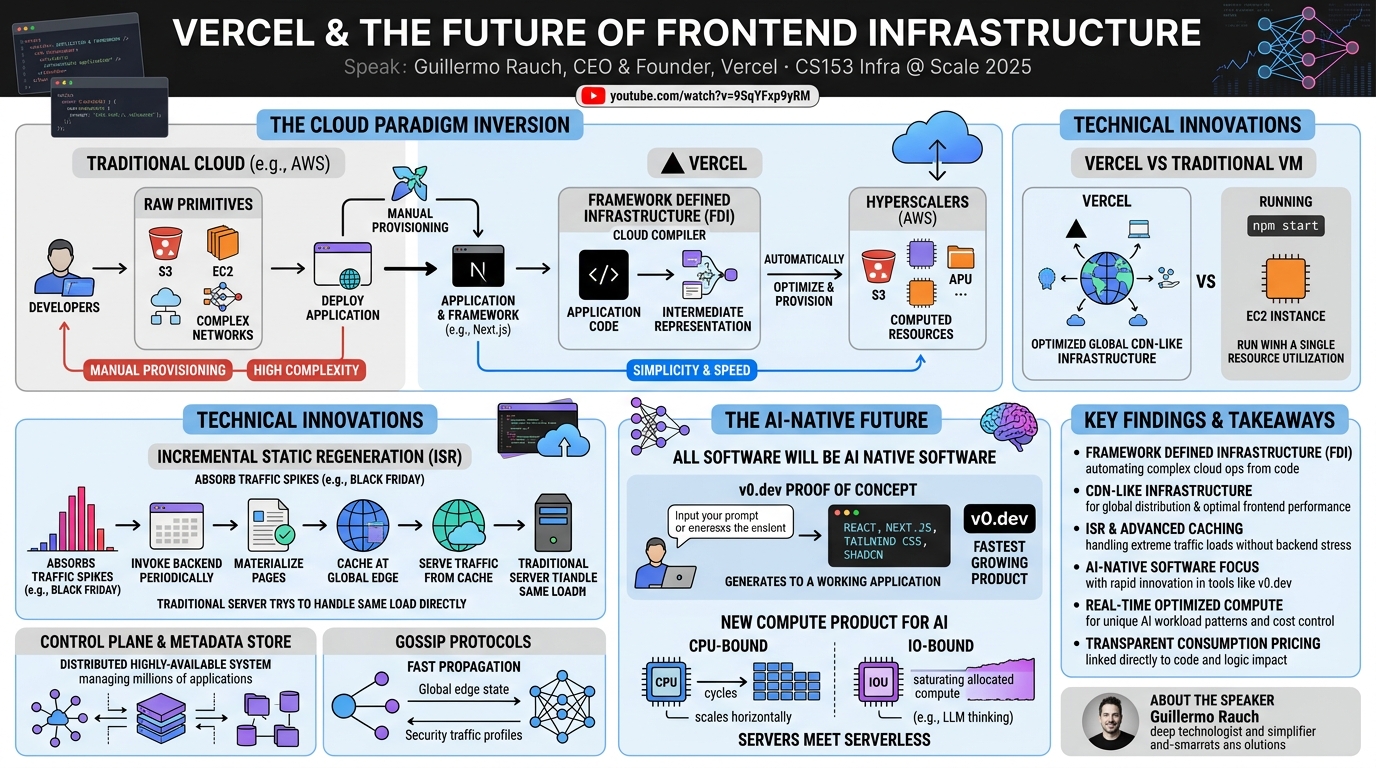
The traditional approach to cloud development, as exemplified by AWS, typically begins with infrastructure configuration. Developers are expected to navigate complex consoles, provision resources, and then deploy their applications. Vercel fundamentally inverted this process. Instead, it starts with the application, providing guard rails through frameworks like Next.js, and then automatically provisions and optimizes the necessary infrastructure upon deployment. This innovative methodology is termed Framework Defined Infrastructure (FDI), drawing inspiration from the Software Defined Networking revolution. Rauch noted that early attempts to achieve this with systems like Kubernetes proved too heavy, rigid, static, and slow for Vercel's ambitious scaling and deployment speed requirements.
Vercel's decision to build on top of hyperscalers like AWS, rather than competing directly, was strategic. Enterprises, while moving away from data centers, often struggle with the complexity of direct cloud adoption. Vercel acts as a crucial intermediary, virtualizing the cloud and making it accessible. Rauch emphasized that while AWS focused on providing raw primitives (like S3, EC2), Vercel recognized that these primitives were becoming commoditized, with standardized APIs (e.g., S3 APIs, OpenAI HTTP calling interface for models). This shift meant that the majority of value would accrue at the application layer and the frontend experience, precisely where Vercel chose to focus. The company's expansion into supporting AI-native software was a natural progression, driven by the belief that "all of software will be AI native software," requiring infrastructure that can adapt to new workload patterns and developer needs.
Key Findings
▶ Watch: Vercel's vision for AI-native software (4:00)
Vercel's operational philosophy and technical innovations are centered around several key findings that challenge conventional cloud development.
Firstly, the concept of Framework Defined Infrastructure (FDI) is paramount. Vercel treats application code as the input to a "cloud compiler," which then transforms this code into an intermediate representation and subsequently into optimized infrastructure. This abstraction allows developers to focus purely on their application logic, while Vercel handles the complexities of provisioning, scaling, and optimizing the underlying cloud resources.
Secondly, Vercel has developed specialized technologies to address specific performance and scalability challenges. A prime example is Incremental Static Regeneration (ISR), invented to handle massive traffic spikes, such as those experienced by e-commerce sites during Black Friday. ISR significantly reduces backend burden by allowing Vercel to invoke the backend periodically and then materialize pages at the edge of the network. This approach effectively absorbs and distributes traffic, leveraging multiple tiers of caching to serve content efficiently.
Thirdly, Vercel's infrastructure operates more akin to a Content Delivery Network (CDN) than a traditional virtual machine host like EC2. Rather than merely running a Next.js server in a VM, Vercel employs highly specialized infrastructure designed for global distribution, speed, and optimality. This allows for superior performance, reduced multi-tenancy issues, and more efficient resource utilization, especially critical for the 90% of workloads still not in the cloud due to perceived complexity.
Fourthly, Vercel is deeply committed to the future of AI-native software. Rauch stated a strong belief that "all of software will be AI native software." This conviction drives Vercel's support for multi-agent frameworks, integration with models from companies like Anthropic, and the development of tools like v0.dev, an AI-powered web development assistant. This strategic pivot ensures Vercel remains at the forefront of developer needs as the industry embraces AI.
Finally, Vercel emphasizes transparent, consumption-based pricing coupled with real-time observability. The platform provides minute-by-minute usage updates, giving engineers immediate feedback on the infrastructure costs incurred by their application logic. This fosters a direct connection between code and its operational impact, enabling developers to make informed optimization decisions. This philosophy extends to a new compute product, optimized for the unique, potentially long-running workloads characteristic of AI applications, intelligently scaling compute density based on whether a workload is CPU-bound or IO-bound.
Technical Deep Dive
▶ Watch: Vercel's 'cloud compiler' mental model (5:00)
Vercel's technical architecture is a sophisticated overlay designed to abstract and optimize cloud infrastructure for developers, fundamentally redefining how applications are deployed and scaled.
At its core, Vercel operates as a "cloud compiler." The developer's application code serves as the input, which Vercel then transforms into an intermediate representation. This representation is subsequently compiled into optimized cloud infrastructure, often leveraging highly scalable systems like S3 objects for static assets and various computational primitives. This compiler metaphor highlights how Vercel intelligently distills application requirements into the most efficient underlying cloud resources, complete with multiple tiers of caching.
The ISR (Incremental Static Regeneration) technology is a prime example of Vercel’s specialized infrastructure. For applications, particularly e-commerce sites experiencing unpredictable traffic surges like Black Friday, ISR allows Vercel to invoke the backend over a period of time, materializing and caching pages at the edge of its global network. This approach significantly reduces the direct load on customer backends, as Vercel effectively absorbs and serves the majority of traffic from its distributed cache. This automation handles complex caching patterns that developers would traditionally have to implement manually, such as configuring Memcached, PHP-FPM process pools, worker threads, horizontal scaling, and managing cache-compute communication.
Crucially, Vercel does not simply run a Next.js server inside a traditional virtual machine. Rauch provocatively stated, "Vercel does not run Next.js," meaning it doesn't just npm start a server in an EC2 instance. Instead, Vercel functions more like a CDN than an EC2 instance, specializing its infrastructure for global distribution, multi-tenancy, and optimal performance. This allows for faster deployments, lower resource consumption per tenant, and better overall responsiveness for globally distributed frontend workloads.
The platform relies on a sophisticated internal system that Guillermo Rauch describes as a "globally distributed highly available fast propagating metadata store" that is repurposed as a control plane and a mechanism for invoking compute. This system underpins Vercel's ability to ensure that "everything spins down to zero" and infrastructure "exists on demand," akin to a "React for infrastructure" model. The selection of underlying data stores for this metadata system was a significant challenge, requiring Vercel to iterate through four different databases to achieve the scale of millions of applications created daily. Rauch highlighted the "build versus buy" dilemma, concluding that procuring best-of-breed managed services from AWS was more effective than attempting to build and manage these foundational components internally.
Vercel leverages gossip protocols for critical internal functions. These protocols enable efficient, fast propagation of information across its distributed network. For instance, security systems utilize gossip protocols to analyze traffic profiles in real time and block attackers. Similarly, when a new deployment is made (e.g., stanford.edu pointing to an immutable deployment), the fact that this change needs to propagate worldwide to millions of computers is handled through an efficient gossip protocol, ensuring rapid and consistent updates across the global edge.
Looking ahead, Vercel is introducing a new compute product specifically optimized for AI workloads. These workloads often present unique challenges, such as requests that can take minutes to respond (e.g., an LLM inference). Vercel's intelligent compute density scaling will dynamically adjust resources based on the workload profile:
- For CPU-bound tasks, Vercel will aggressively scale horizontally to ensure reserved CPU cycles per request.
- For IO-bound tasks, where the system is waiting on external processes (e.g., "deep seek R1 to think"), Vercel will intelligently saturate the allocated compute, optimizing resource utilization during wait times.
This sophisticated load balancing aims to eliminate common cloud "horror stories" where customers are burdened with manual scaling configurations (e.g., tuning vps counts, instance sizes, Kubernetes pods, or CPU thresholds). By removing the total cost of ownership for infrastructure management, Vercel delivers on the efficiency profile of serverless computing while maintaining the control and performance typically associated with dedicated servers, effectively bringing "servers meet serverless." The obsession with immutable functional data structures and the goal of a "deployment per commit" has driven much of this research and innovation, pushing Vercel to solve novel problems in distributed systems.
Demo / Proof of Concept
▶ Watch: Automating scaling and caching (e.g., ISR) (5:30)
A standout demonstration of Vercel's vision for AI-native software is v0.dev, an innovative web development AI assistant. This platform allows users to input a natural language prompt, and in turn, it generates a working frontend application. Increasingly, v0.dev is evolving to create full-stack applications.
Guillermo Rauch highlighted that v0.dev has been meticulously trained to be an expert in the Vercel ecosystem, proficient with popular tools and frameworks such as React, Next.js, Tailwind CSS, and Shadcn. This deep integration ensures that the generated code is idiomatic and high-quality within the Vercel development paradigm.
The success of v0.dev has been remarkable; it is Vercel's fastest-growing product by a significant margin, having doubled its revenue three times within a period of 14 to 20 days. Rauch even mentioned an internal example where a colleague successfully recreated the entire Vercel dashboard using v0.dev, illustrating its power and potential for accelerating UI and product idea development.
The initial version of v0.dev was built on GPT-3.5 Turbo. However, to achieve the desired capabilities, Vercel had to innovate beyond the existing model limitations, including creating their own bespoke function calling system on top of the base models. This commitment to pushing the state-of-the-art demonstrates Vercel's hands-on approach to research and development, even when working with cutting-edge AI technologies. The rapid iteration and public research with customers, though sometimes painful, have been instrumental in achieving product-market fit and driving continuous innovation for v0.dev.
Defensive Implications
▶ Watch: Empowering frontend engineers with invisible infra (6:30)
For organizations and security professionals, Vercel's approach to frontend infrastructure and AI-native development presents several crucial defensive implications:
- Embrace Framework Defined Infrastructure (FDI): Organizations should seriously evaluate adopting FDI principles and platforms like Vercel. By abstracting infrastructure management, Vercel reduces the surface area for misconfigurations related to cloud resources, which are common vectors for security incidents. This allows security teams to focus higher up the stack.
- Leverage Edge Computing and Caching for Resilience: Vercel's heavy reliance on edge computing and advanced caching (like ISR) provides inherent defensive benefits. Distributing content globally and absorbing traffic spikes at the edge makes applications more resilient to DDoS attacks and improves performance, which can be critical during high-traffic events that attackers might try to exploit. Defenders should understand how these mechanisms protect their applications.
- Prioritize Application Layer Security: As infrastructure becomes increasingly commoditized and abstracted by platforms like Vercel, the focus of security efforts must shift more decisively to the application layer. This includes rigorous security testing of Next.js applications, securing API endpoints, managing dependencies, and ensuring robust authentication and authorization within the application logic. The "cloud compiler" model means the application code itself dictates the infrastructure, making secure coding practices paramount.
- Adopt AI-Native Security Best Practices: With the rise of AI-native software and tools like v0.dev, security teams must develop expertise in securing AI models, prompts, and generated code. This involves understanding risks like prompt injection, data poisoning, model evasion, and ensuring that AI-generated application code adheres to security standards. The bespoke function calling system developed by Vercel for v0.dev, for example, highlights the need for careful security considerations in custom AI integrations.
- Monitor Consumption for Anomaly Detection: Vercel's emphasis on real-time, minute-by-minute consumption metrics can be a powerful tool for security. Sudden, unexplained spikes in compute, bandwidth, or API token consumption could indicate a security incident, such as a DDoS attack, data exfiltration, or unauthorized use of AI models. Integrating these metrics into security monitoring systems can provide early warning signals.
- Understand Cloud Provider Intermediary Risks: While Vercel acts as a beneficial bridge to hyperscalers, it also introduces another layer in the supply chain. Organizations must understand the security posture of platforms like Vercel, including their internal security controls, incident response capabilities, and how they secure customer data and code. The use of gossip protocols for security systems within Vercel itself underscores the importance of distributed system security at this intermediary layer.
- Offload Infrastructure Scaling Burden Securely: Vercel removes the burden of manual infrastructure scaling, which often leads to misconfigurations or performance bottlenecks that can be exploited. This automation, however, requires trust in Vercel's underlying security. Defenders should ensure their applications are designed to leverage these automatic scaling benefits while maintaining least privilege and secure access patterns within their application code.
Key Takeaways
- Framework Defined Infrastructure (FDI) is Vercel's core innovation, inverting traditional cloud development by prioritizing the application (e.g., Next.js) and automating infrastructure provisioning, significantly simplifying deployment and scaling.
- Vercel functions more like a Content Delivery Network (CDN) than a traditional VM host, specializing its infrastructure for global distribution, speed, and optimal multi-tenancy, rather than simply running servers in virtual machines.
- Technologies like Incremental Static Regeneration (ISR) and multi-tier caching are critical for handling extreme traffic loads (e.g., Black Friday), abstracting complex scaling and performance challenges from developers.
- The future of software is AI-native, driving Vercel's expansion into AI development tools like v0.dev, an AI assistant that generates working applications from prompts, demonstrating rapid product-market fit and innovation.
- Real-time consumption-based pricing and granular observability provide engineers with immediate feedback on infrastructure costs, fostering a culture of cost-aware and efficient application development.
- Vercel's new compute product is specifically optimized for unique AI workloads (e.g., long-running LLM inferences), intelligently scaling compute density based on whether tasks are CPU-bound or IO-bound, removing the burden of manual resource tuning.
About the Speaker(s)
Guillermo Rauch is the CEO and Founder of Vercel, a company dedicated to simplifying cloud development and empowering developers to build at scale. His career began early, working online from a young age, which provided a unique foundational education in technology. Rauch is a deep technologist, having been a co-author of Vercel's initial schedulers, placement systems, and load balancers. His passion for understanding and building core systems led him to write his own clones of popular technologies like React and Kubernetes, and he was heavily involved in developing Vercel's metadata stores.
Rauch is known for his obsession with simplifying software development, pushing the boundaries of what's possible, such as his early vision for every Git commit to result in an immutable deployment. He is also an angel investor, having developed a hypothesis that many successful companies start as simple APIs, a belief that informed Vercel's own initial product launch. His work with v0.dev exemplifies his continuous drive to innovate and push the state-of-the-art, even building bespoke systems when existing technologies fall short.
Reviews
Simon Wisk (Open Source Developer & AI Tooling Expert) — WEAK
Guillermo Rauch clearly knows his systems deeply, and there are genuinely interesting engineering ideas buried in this talk — FDI as a 'cloud compiler,' the ISR edge-caching model, the metadata store-as-control-plane design. But this article is a summary written by someone who wasn't in the room, and it reads like a polished press release more than a technical writeup. The implementation details are named without being explained, the architectural claims are unverifiable, and the 'Defensive Implications' section at the end is pure filler that has almost nothing to do with what Rauch actually discussed.
Jensen Hitch (AI Compute Platform CEO) — WEAK
Guillermo Rauch is a sharp operator who built something real — Vercel abstracts genuine complexity and v0.dev is clearly finding product-market fit. But this talk is fundamentally about developer experience and platform positioning, not infrastructure at scale. The systems reasoning is shallow: physical constraints are never named, the unit of compute is never interrogated, and the 'AI-native infrastructure' pitch is mostly about workload routing heuristics dressed up as a paradigm shift. For an infra-at-scale audience, this is a go-to-market story with some distributed systems flavor, not an infrastructure talk.
→ Top-rated talks at Stanford CS153: Technology Entrepreneurship — Infra @ Scale (Winter 2025)
All talks from Stanford CS153: Technology Entrepreneurship — Infra @ Scale (Winter 2025)