Saudi Arabia's National AI Strategy
Abdullah Alswaha (Minister of Communications and Information Technology · Kingdom of Saudi Arabia)
Stanford CS153: Technology Entrepreneurship — Infra @ Scale (Winter 2025) · Day 5 · Jordan Hall 420-040
Overview
In an engaging and technically rich discussion at CS153 Infra @ Scale 2025, Abdullah Alswaha, the Kingdom of Saudi Arabia's Minister of Communications and Information Technology, outlined Saudi Arabia's ambitious national strategy for artificial intelligence. Drawing on his unique background as an engineer from Cisco in the Bay Area, Alswaha presented a vision for the Kingdom not merely as an adopter of AI, but as a significant global player in its foundational infrastructure, research, and application. The talk underscored a strategic pivot for Saudi Arabia, moving from an economy historically reliant on natural resources to one driven by innovation and advanced technology.
Key moments
- 0:00 Introduction of Abdullah Alswaha, his engineering background
- 2:00 Speaker's journey: learn, earn, return, and inspiration
- 4:00 AI hype cycle mirrors early internet age, software value
- 6:00 Technical challenge: Energy efficiency and new compute architecture
- 7:40 Call for transition from silicon to gallium nitride
- 8:00 High bandwidth memory is 40% of GPU cost
Saudi Arabia's National AI Strategy
Speakers: Abdullah Alswaha, Minister of Communications and Information Technology, Kingdom of Saudi Arabia
Conference: CS153 Infra @ Scale 2025
YouTube: https://www.youtube.com/watch?v=LriOr64E8D8
Overview
In an engaging and technically rich discussion at CS153 Infra @ Scale 2025, Abdullah Alswaha, the Kingdom of Saudi Arabia's Minister of Communications and Information Technology, outlined Saudi Arabia's ambitious national strategy for artificial intelligence. Drawing on his unique background as an engineer from Cisco in the Bay Area, Alswaha presented a vision for the Kingdom not merely as an adopter of AI, but as a significant global player in its foundational infrastructure, research, and application. The talk underscored a strategic pivot for Saudi Arabia, moving from an economy historically reliant on natural resources to one driven by innovation and advanced technology.
Alswaha's presentation went beyond high-level strategy, delving into the intricate technical challenges and market opportunities within the AI landscape. He emphasized the critical need for breakthroughs in compute architecture, energy efficiency, and memory solutions, positioning these as the next "hundred billion dollar market opportunities." The Minister articulated a clear rationale for Saudi Arabia's substantial investments in AI infrastructure, framing it as a "no regret" move for a nation with significant energy advantages, capital, and a substantial domestic market. This talk is crucial for understanding the Kingdom's role in shaping the future of global AI, particularly its focus on creating equitable access and driving real-world, GDP-impacting applications.
Background
▶ Watch: Introduction of Abdullah Alswaha, his engineering background (0:00)
Minister Abdullah Alswaha's journey from a Cisco engineer in San Jose, writing code for what was then the iOS (Cisco's Internetwork Operating System), to leading Saudi Arabia's Ministry of Communications and Information Technology, provides a unique lens through which to view the Kingdom's national AI strategy. He describes his career in three chapters: "learn, earn, and return," with his current role representing the "return" phase, giving back to his nation. This technocratic background, where leaders emerge from engineering and the private sector, mirrors historical patterns in other nations' infrastructure buildouts, such as early Singapore or the United States.
Alswaha drew parallels between the current AI revolution and the internet age of the late 1990s and early 2000s. He noted the initial hype around hardware in both eras, with a subsequent shift to software and services driving the real value and diffusion across industries. In the internet age, for every dollar made in hardware, $10 to $20 were made in software and services. He predicted a similar trajectory for AI, where initial focus on GPUs and NPUs will eventually yield to massive value creation in Generative AI and Agentic AI applications. The Kingdom's strategy is fundamentally rooted in this historical perspective, aiming to be agile and both shape and respond to the evolving AI market. This includes a transition from a factor-based economy, predominantly energy, to an innovation-driven one, necessitating significant investment in digital infrastructure and human capital.
Key Findings
▶ Watch: AI hype cycle mirrors early internet age, software value (4:00)
The Minister articulated several key findings and strategic imperatives for the advancement of AI, both within Saudi Arabia and globally:
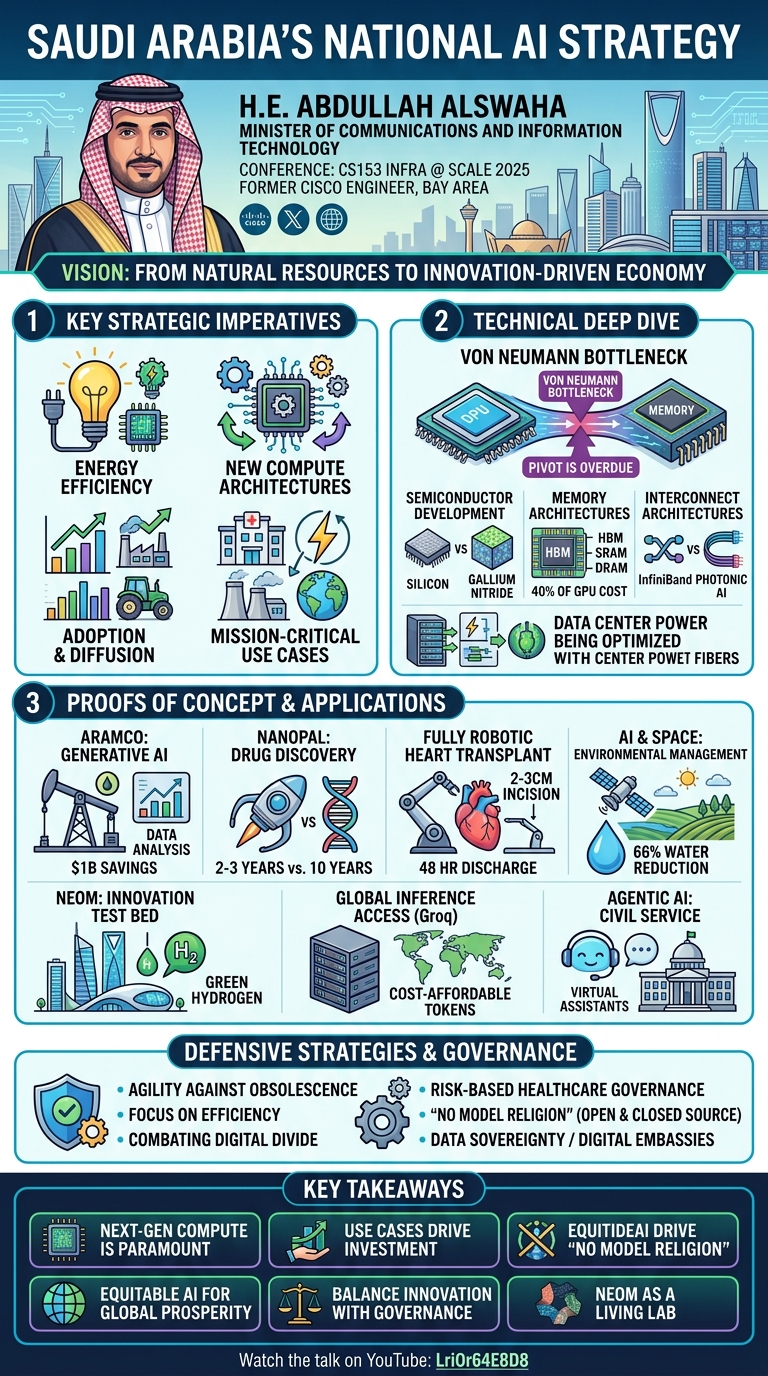
- Energy Efficiency as a Foundational Challenge: The current Von Neumann architecture for compute, separating execution from memory, is inherently inefficient. Solving this "memory wall" problem is paramount for sustainable AI growth, especially given the energy demands of large-scale AI models.
- The Need for New Compute Architectures: Significant innovation is required across semiconductor development (moving beyond silicon), memory architectures (pivoting from Von Neumann), and interconnects (transitioning from InfiniBand to photonic AI). These areas represent the next "hundred billion dollar market opportunities."
- Adoption and Diffusion Drive Real Value: Beyond model benchmarks (like MMLU), the true measure of AI's success lies in its ability to drive GDP growth, productivity, and job creation through widespread adoption and diffusion across industries.
- Strategic Investment in Mission-Critical Use Cases: Saudi Arabia is proactively investing in AI infrastructure by working backward from high-impact, mission-critical use cases in healthcare, energy, and environmental sustainability, rather than solely predicting compute architecture trends. This approach mitigates the risk of infrastructure obsolescence.
- "No Model Religion" and Open Source: The Kingdom embraces a pragmatic, model-agnostic approach, utilizing both closed-source and open-source models (e.g., Mistral, DeepSeek, Llama) based on their efficacy in solving specific problems. This acknowledges the rapid pace of innovation and the eventual convergence towards standardization.
- Addressing the Global Digital Divide: AI must be a general-purpose technology that benefits all of humanity, not an "exclusive club of the few." Strategic infrastructure investments, particularly for nations with energy, capital, and market advantages, are deemed "no regret" moves to ensure equitable access and foster global prosperity, preventing a repeat of the digital age's failure to equally distribute economic benefits.
Technical Deep Dive
▶ Watch: Technical challenge: Energy efficiency and new compute architecture (6:00)
Minister Alswaha's technical deep dive revealed a profound understanding of the bottlenecks and opportunities in AI infrastructure. He started by highlighting the fundamental inefficiency of the Von Neumann architecture, where a separate processing unit constantly fetches data and instructions from memory. This process is energy-intensive, with memory calls consuming picojoules and scaling to watts when multiplied by billions of accesses. Solid-state storage and interconnects further compound these energy losses.
To address this, Alswaha presented three critical areas for architectural innovation:
- Semiconductor Development:
- The current silicon architecture is reaching its limits. The voltage gap for distinguishing a '1' from a '0' in silicon, around 1.1 electron volts, is becoming restrictive.
- The call is for a transition to compound semiconductors, specifically mentioning gallium nitride, which offers a larger bandgap and faster switching capabilities. This enables denser transistor fabrication and more efficient operation, moving beyond the "leaky current" of traditional silicon valves.
- He explicitly linked this to the memory wall problem, a concept articulated by Stanford, where Moore's Law (doubling of transistors every two years, leading to a 60,000x increase in 20 years) has far outpaced improvements in memory and interconnect speeds (only doubling every 1.4-1.7 years). This disparity makes memory access the primary bottleneck for modern GPUs, NPUs, and LPUs.
- Memory Architectures:
- High-Bandwidth Memory (HBM) currently constitutes 40% of the cost of advanced AI accelerators. The industry is actively exploring three main archetypes:
- Memory on the chip: Leveraged by companies like Groq (spun out of Google by Jonathan Ross) with their Language Processing Units (LPUs), which utilize fast SRAM. While efficient for text processing, its application can be limited.
- Memory next to the chip: Explored with partners like Qualcomm for Neural Processing Units (NPUs), typically using DRAM.
- Memory on the side of the chip: The prevalent HBM architecture used by NVIDIA and AMD, calling on solid-state storage.
- The clear message is that a fundamental pivot from the Von Neumann architecture is "overdue" to optimize memory access.
- Interconnect Architectures:
- Alswaha, having worked on InfiniBand in the 1990s, acknowledged its continued use but stressed the need for next-generation solutions.
- Photonic AI architectures are considered "overdue" because every conversion from optical to electrical signals introduces losses and inefficiencies. Direct optical interconnects would significantly improve data transfer speeds and energy efficiency within and between compute nodes.
Beyond core compute, the Minister addressed broader data center inefficiencies. He noted the Kingdom's ambition to build 1.5 to 2 gigawatts of compute capacity. A significant challenge is the "tax" on power, with 50% of the energy in a data center not reaching the GPUs, instead being consumed by voltage translation, cooling systems (e.g., liquid cooling, immersion cooling), networking, and storage. The cost of a shell data center without compute is $8-12 million per megawatt, which jumps to $20-30 million per megawatt when compute is added, depending on the vendor (e.g., Groq, SambaNova, NVIDIA, AMD). The goal is to engineer architectures that direct more power directly to the GPUs, as they represent the highest computational value.
Finally, Alswaha highlighted in-memory computing and near-memory computing as particularly exciting paradigms. These approaches aim to merge computation closer to or directly within memory, fundamentally shifting away from the 1945 Von Neumann model. He projected that such architectures could achieve at least 50% energy savings for the same computational throughput, representing a significant breakthrough for the future of AI hardware.
Demo / Proof of Concept
▶ Watch: Call for transition from silicon to gallium nitride (7:40)
While the talk did not feature live software or hardware demonstrations in the traditional sense, Minister Alswaha presented several compelling real-world applications and initiatives that serve as "proofs of concept" for Saudi Arabia's AI strategy:
- Aramco's Generative AI for Oil Exploration: In collaboration with SambaNova, a generative AI model was developed to analyze the porosity of oil wells. This application enabled Aramco, one of the world's leading energy companies, to optimize drilling runs and operations, leading to an estimated $1 billion in savings. This demonstrates AI's direct impact on critical national industries and economic efficiency.
- Nanopal's Sickle Cell Drug Formulation: The Saudi startup Nanopal, operating within the National Labs, is leveraging generative AI and CRISPR gene-editing technology to accelerate drug formulation for sickle cell disease. This typically takes 10 years, but AI is reducing this to 2-3 years by optimizing permutations for designing nanorobots. Crucially, Alswaha noted that while AI cuts development time, the strict governance of healthcare still requires full clinical trials (Stage 1 for toxicity, Stage 2 for efficacy, Stage 3 for approval), highlighting the balance between innovation and responsible deployment.
- World's First Fully Robotics Heart Transplant: In the realm of physical AI, Saudi Arabia has pioneered the world's first fully robotics heart transplant. This procedure significantly reduces the invasiveness of traditional surgery, requiring an incision of only 2 to 3 centimeters compared to the typical 20-30 centimeters. Patients can be discharged in less than 48 hours, a dramatic improvement over the 6-8 weeks of ICU recovery often required. This showcases AI's potential to revolutionize critical healthcare procedures, address surgeon shortages, and enable remote surgery.
- AI and Space for Environmental Management: To combat desertification and inefficient water usage caused by "random farming," Saudi Arabia is using geospatial data fed into AI models with convolutional networks. This initiative has enabled the Kingdom to nudge and pivot farming practices, leading to a 66% reduction in underground water consumption within a year, demonstrating AI's power in environmental sustainability and resource optimization.
- Neom as an Innovation Test Bed: The futuristic city of Neom serves as a living laboratory for AI and advanced technologies. It is home to a 4-gigawatt green hydrogen plant, leveraging electrolyzers from the Red Sea to produce hydrogen fuel, moving the Kingdom towards green energy. Neom also aims to redefine urban design by building cities for people, not cars, with the goal of enabling residents to "work, live, play, and learn" within a 5-minute radius – a 20-30 year problem statement driven by AI-powered urban planning.
- Global Inference Access with Groq: Saudi Arabia has partnered to make Groq instances globally accessible, offering "the most cost-affordable tokens" for inference. This initiative supports the Kingdom's commitment to equitable AI access, allowing startups and nations worldwide to leverage advanced AI models (e.g., Llama, DeepSeek, Mistral, Kohi) at competitive price points, leveraging Saudi Arabia's energy, capital, and market advantages.
- Agentic AI for Civil Service Productivity: The Kingdom has launched a public Request for Information (RFI) for an agentic AI project aimed at enhancing and augmenting the productivity of civil servants. This initiative seeks to achieve "billions of productivity" by tackling the complexities of human-in-the-loop and data layer problems, distinguishing between AI-native players (who excel at data cleansing and business model integration) and AI-enhanced B2B SaaS players (who often achieve task-level augmentation but struggle with workflow-level multi-agent systems).
These examples collectively illustrate Saudi Arabia's proactive approach to not only investing in AI infrastructure but also deploying it to solve pressing national and global challenges, from economic diversification to healthcare and environmental protection.
Defensive Implications
▶ Watch: High bandwidth memory is 40% of GPU cost (8:00)
While the talk was not centered on cybersecurity, Minister Alswaha's discussion implicitly outlined several "defensive" strategies from a national and economic perspective – defending against obsolescence, inefficiency, and the risks of an inequitable AI future.
- Defending Against Technological Obsolescence: The rapid pace of AI innovation, with compute architectures evolving every 18-24 months (e.g., NVIDIA's Blackwell generations), poses a significant risk for long-term infrastructure investments. Saudi Arabia's "defense" against this is a strategy of agility and working backward from use cases. Instead of solely predicting hardware trends, they prioritize investing in infrastructure that supports critical, high-impact workloads in healthcare, energy, and space. This ensures that even if specific hardware becomes obsolete, the underlying use cases continue to derive value, making the infrastructure "resilient to the risk of going obsolete."
- Defending Against Inefficiency and Waste: The technical deep dive into energy consumption and the "50% tax" on power in data centers highlights a key defensive posture: relentless pursuit of energy efficiency. Investments in compound semiconductors, new memory architectures (in-memory/near-memory computing), and photonic interconnects are not just about performance, but about drastically reducing the operational costs and environmental impact of AI. This defends against the economic drain of inefficient infrastructure.
- Defending Against an Exclusive AI Future (Digital Divide): Alswaha passionately argued against AI becoming an "exclusive club of the few," echoing the unfulfilled promise of the digital age to be a social equalizer. Saudi Arabia's strategy is a "no regret" investment in infrastructure, particularly for nations with energy advantages, capital, and a captive market of 30 million+ population. This proactive investment, exemplified by making Groq's inference capabilities globally affordable, serves as a defense against a widening global economic disparity and aims to ensure AI's benefits are broadly distributed, fostering global health, prosperity, and peace.
- Defending Against Regulatory Stifling of Innovation: The Minister acknowledged the tension between rapid innovation and necessary governance, especially in critical sectors like healthcare. The example of Nanopal's sickle cell drug formulation demonstrates a defensive approach: while AI accelerates development from 10 years to 2-3, the Kingdom still mandates adherence to risk-based assessment and full clinical trial governance (toxicity, efficacy, approval). This balances innovation with safety and ethical responsibility, defending against potential harm and loss of public trust that could derail AI adoption.
- Defending Against Vendor Lock-in and Model Bias: The "no model religion" philosophy and the embrace of both open-source and closed-source models (Mistral, DeepSeek, Llama) is a strategic defense against over-reliance on any single provider or architectural approach. This promotes competition, flexibility, and the ability to choose the best tool for the job, ensuring the Kingdom can adapt to a rapidly changing market and leverage the collective intelligence of the AI community.
- Defending Data Sovereignty and Policy Adherence (Digital Embassies): The concept of "digital embassies" or data embassies was introduced as a defense mechanism for international collaboration. By allowing foreign entities (e.g., US startups) to run workloads in Saudi data centers while adhering to their home nation's policies, facilitated by mechanisms similar to Safe Harbor clauses for cloud services, Saudi Arabia defends the sovereignty and regulatory requirements of its partners. This fosters trust and enables global access to its advanced infrastructure without compromising national legal frameworks.
These "defensive" measures collectively aim to ensure Saudi Arabia's AI strategy is robust, sustainable, equitable, and capable of navigating the complex challenges of the intelligent age.
Key Takeaways
- Next-Gen Compute is Paramount: The current Von Neumann architecture is inefficient, requiring a paradigm shift towards compound semiconductors (e.g., gallium nitride), novel memory architectures (in-memory/near-memory computing), and photonic AI interconnects to unlock significant energy efficiency and performance gains. These are seen as "hundred billion dollar market opportunities."
- Use Cases Drive Infrastructure Investment: Saudi Arabia's strategy prioritizes working backward from mission-critical applications in healthcare, energy, and environmental sustainability. This approach, exemplified by SambaNova's work with Aramco and Nanopal's drug discovery, mitigates the risk of infrastructure obsolescence and ensures investments yield tangible economic and social benefits.
- "No Model Religion": The Kingdom embraces a pragmatic, model-agnostic approach, leveraging both open-source (Mistral, Llama, DeepSeek) and closed-source AI models based on their effectiveness for specific tasks, fostering agility in a rapidly evolving market.
- Equitable AI for Global Prosperity: Saudi Arabia is committed to preventing AI from becoming an "exclusive club," actively investing in affordable inference access (e.g., via Groq) and collaborating internationally to ensure the technology benefits all of humanity, particularly the Global South.
- Balance Innovation with Governance: While pushing the boundaries of AI (e.g., robotic heart transplants, accelerated drug discovery), the Kingdom maintains a strong emphasis on risk-based assessment and regulatory compliance, especially in sensitive sectors like healthcare, to ensure responsible and ethical deployment.
- Neom as a Living Lab: The futuristic city of Neom serves as a critical test bed for advanced AI applications, from green hydrogen production and sustainable urban design to robotics and intelligent infrastructure, pushing the boundaries of what's possible for human-centric living.
About the Speaker(s)
Abdullah Alswaha is the Minister of Communications and Information Technology for the Kingdom of Saudi Arabia. His unique background as an engineer, rather than a traditional public servant, deeply informs Saudi Arabia's national technology strategy. He began his career in the Bay Area at Cisco, where he was involved in writing code for iOS (Cisco's Internetwork Operating System), gaining firsthand experience in building foundational digital infrastructure. Alswaha describes his career journey through three phases: "learn, earn, and return," viewing his current ministerial role as an opportunity to give back to his nation.
His transition to public service was spurred by a 2016 meeting with His Royal Highness the Crown Prince, where Alswaha, then at Cisco, demonstrated how digital technologies could transform nations. Since then, under his leadership, Saudi Arabia's digital economy has grown to $135 billion, a 60% increase in seven years, and its tech workforce has doubled from 150,000 to 381,000. Alswaha is recognized as a technocrat who combines deep technical understanding with strategic vision, driving Saudi Arabia's ambition to become a global leader in the intelligent age, with a focus on sustainable, equitable, and impactful AI development.
Reviews
Simon Wisk (Open Source Developer & AI Tooling Expert) — WEAK
A technically literate minister gives a polished geopolitical pitch dressed up in hardware terminology. There's genuine fluency in the compute bottleneck discussion — Von Neumann inefficiency, HBM cost structure, photonic interconnects — but zero engineering substance behind the use cases and no path for anyone in the audience to build, reproduce, or extend anything shown. This is a sovereign wealth pitch with slides, not an engineering talk.
Jensen Hitch (AI Compute Platform CEO) — SOLID
Alswaha brings genuine technical literacy to a national strategy talk — the Von Neumann framing, memory wall articulation, and photonic interconnect discussion are real engineering, not buzzword theater. The use cases are concrete and the 'no model religion' posture is exactly the right strategic stance for a sovereign infrastructure play. But this is a vision and strategy talk, not a systems engineering talk. The constraint reasoning is real but stays at the survey level — it names the right problems without providing new signal on how to solve them. For engineers building AI infrastructure, this is context-setting, not actionable architecture insight.
→ Top-rated talks at Stanford CS153: Technology Entrepreneurship — Infra @ Scale (Winter 2025)
All talks from Stanford CS153: Technology Entrepreneurship — Infra @ Scale (Winter 2025)