Building the first open source hackable Quantum Sensor
Mark Carney, Victoria Kumaran
DEF CON 33 · Day 1 · Main Stage
Overview
Mark Carney and Victoria Kumaran, co-founders and co-organizers of Quantum Village at DEF CON, presented "Diamonds Are For Hackers" — a talk about building the world's first fully open source, hackabl
Key moments
- 2:29 Introduction: Building an open-source hackable quantum sensor
- 7:29 Atomic physics principles underlying the quantum sensor
- 3:00 Hardware design: components and build process
- 5:34 Software stack and open-source toolchain
- 22:29 Sensor calibration and measurement methodology
- 3:12 Live demonstration of the quantum sensor in operation
- 28:40 Practical applications: navigation, geology, security
- 2:27 Open-source release and community contribution model
- 3:35 Future development roadmap and capabilities
Building the First Open Source Hackable Quantum Sensor
Speakers: Mark Carney, Victoria Kumaran
Conference: DEF CON 33
YouTube: https://www.youtube.com/watch?v=ldgMBEnJxms
Slides: https://media.defcon.org/DEF%20CON%2033/DEF%20CON%2033%20presentations/Mark%20Carney%20Victoria%20Kumaran%20-%20Diamonds%20Are%20For%20Hackers%20Building%20the%20first%20fully%20open%20source%20and%20hackable%20Quantum%20Sensor.pdf
Overview
Mark Carney and Victoria Kumaran, co-founders and co-organizers of Quantum Village at DEF CON, presented "Diamonds Are For Hackers" — a talk about building the world's first fully open source, hackable quantum sensor based on nitrogen-vacancy (NV) centers in diamond. The project, called Uncut Gems, takes a technology previously confined to million-dollar laboratory setups and brings it into the hands of hackers, researchers, and students for approximately one thousand dollars. The sensor detects magnetic fields at the quantum level, making it relevant to security applications including TEMPEST-style emanation detection, side-channel analysis, covert communication detection, and fundamental physics experiments. The talk positions this as a democratization of quantum sensing: building open hardware so the security community can explore the intersection of quantum physics and practical security.
Background
▶ Watch: Open-source release and community contribution model (2:27)
Nitrogen-vacancy centers in diamond are atomic-scale defects where a nitrogen atom replaces two adjacent carbon atoms in a diamond lattice, leaving an electron spin that can be manipulated optically and read out with light. The physics was discovered and developed over decades in academic physics labs, and commercial quantum sensors based on NV centers exist — but they cost tens to hundreds of thousands of dollars and are not hackable.
NV center quantum sensors work by exploiting the quantum spin state of the NV defect. Under microwave excitation at the resonant frequency (approximately 2.87 GHz in a zero magnetic field), the brightness of the diamond's fluorescence under green laser illumination changes in a way that encodes the local magnetic field strength. By sweeping the microwave frequency and measuring the fluorescence dip — a measurement called Optically Detected Magnetic Resonance (ODMR) — the sensor can determine both the ambient magnetic field and, through Ramsey spectroscopy or related pulse sequences, achieve exceptionally sensitive magnetometry.
From a security and hacking perspective, magnetometry with this level of sensitivity opens doors that classical electronic sensors cannot enter. Electronic circuits emit magnetic fields through the current they carry. Quantum sensors can detect these fields at distances and sensitivities far beyond classical probes, enabling a new class of side-channel attacks and signals intelligence approaches.
Key Findings
▶ Watch: Hardware design: components and build process (3:00)
- The Uncut Gems platform is a fully open source quantum sensor based on NV centers in diamond, designed explicitly to be hackable. Hardware designs, firmware, and software are released as open source.
- Cost reduction by several orders of magnitude: Commercial NV-center sensors cost $10,000–$100,000+. The Uncut Gems design achieves comparable core functionality for approximately $1,000, primarily through careful component selection, open-source design, and using off-the-shelf optical components.
- ODMR has been successfully demonstrated on the platform, confirming that the core quantum sensing functionality works and that the sensitivity is sufficient for practical experiments.
- Security-relevant sensing applications are practical at this price point: detecting magnetic emanations from electronic devices, performing side-channel analysis on cryptographic hardware, and investigating RF/microwave signal environments.
- The hacker community has unique skills to contribute to quantum technology development — particularly in hardware hacking, signal processing, and creative application of sensing technology to adversarial contexts.
Technical Deep Dive
▶ Watch: Live demonstration of the quantum sensor in operation (3:12)
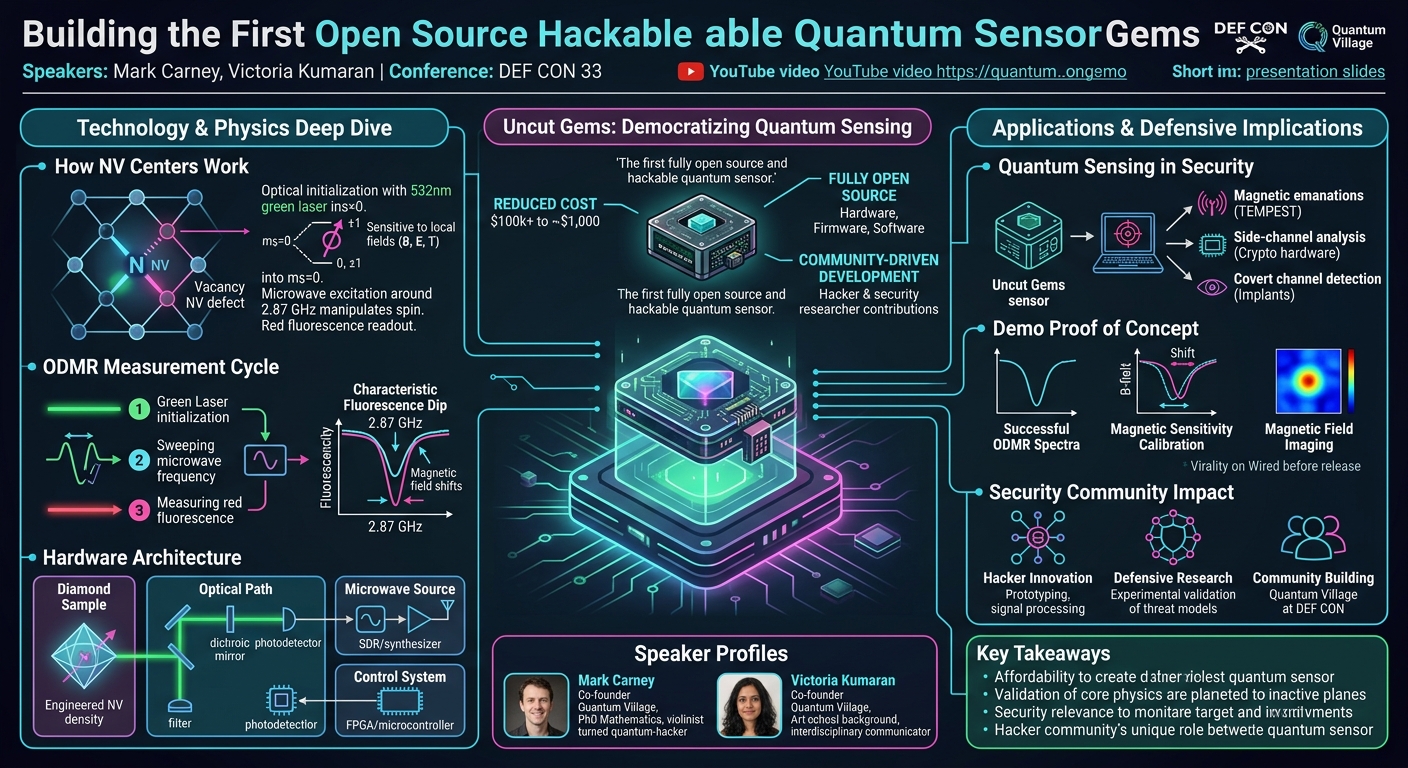
NV Center Physics: The nitrogen-vacancy center exists in a ground state with a spin quantum number of 1, split into three levels (ms = -1, 0, +1). At zero field, the ms = ±1 states are degenerate and separated from ms = 0 by approximately 2.87 GHz. This splitting is sensitive to local magnetic fields (Zeeman effect), electric fields, strain, and temperature. By applying microwave radiation and monitoring the optical fluorescence, changes in the resonance frequency directly encode local field information.
The ODMR measurement cycle:
- Illuminate the diamond with a green (532 nm) laser to initialize the NV spin into the ms = 0 ground state
- Apply a microwave pulse at a frequency near 2.87 GHz
- Read out the fluorescence (red, ~637-800 nm) — the brightness drops when the microwave is on resonance
- Sweep the microwave frequency and fit the dip to extract the resonant frequency
- Changes in resonant frequency map directly to changes in magnetic field (approximately 28 MHz per millitesla)
Hardware architecture of Uncut Gems:
- Diamond sample: Synthetic CVD diamond with engineered NV center density, selected for optimal fluorescence brightness and coherence time trade-offs
- Optical path: 532 nm laser diode, beam steering optics, dichroic mirror to separate excitation from emission, bandpass filter for NV fluorescence wavelength, photodetector
- Microwave source: Software-defined radio or dedicated microwave synthesizer, amplified and delivered to the diamond via a microwave resonator or stripline
- Control system: FPGA or microcontroller for timing the laser and microwave pulses and synchronously acquiring photodetector data
- Software stack: Python-based open source control software, data acquisition, ODMR fitting routines
Sensitivity and practical limits: The achievable sensitivity depends on diamond quality, optical collection efficiency, and measurement time. Research-grade systems achieve picoTesla per root-Hz sensitivities. A practical hacker-grade system is less sensitive but still in the nanoTesla range — sufficient to detect magnetic fields from centimeter-scale current loops at short range, which is exactly the scale relevant for emanation analysis of circuit boards and ICs.
Ramsey spectroscopy and pulsed measurements were discussed as advanced techniques beyond basic ODMR that can achieve significantly better sensitivity but require more precise timing control — achievable on the Uncut Gems platform with appropriate firmware.
Demo / Proof of Concept
▶ Watch: Software stack and open-source toolchain (5:34)
The speakers presented experimental results from the Uncut Gems prototype:
- Successful ODMR spectra showing the characteristic fluorescence dip at 2.87 GHz, confirming basic NV center operation
- Demonstration of magnetic field sensitivity by varying the applied magnetic field (using a calibrated coil) and observing the corresponding shift in resonant frequency
- A proof-of-concept magnetic imaging demonstration showing spatial variation in a magnetic field source — illustrating that the sensor can be scanned to image magnetic field distributions
The talk was described as "already going viral on Wired" before the session started, indicating significant pre-release interest in the project.
Defensive Implications
▶ Watch: Atomic physics principles underlying the quantum sensor (7:29)
The security implications of accessible quantum sensing cut in multiple directions:
TEMPEST and emanation security: If quantum magnetometers become accessible at the price points Uncut Gems targets, the threat model for emanation-based eavesdropping changes. Classical TEMPEST countermeasures (shielding, distance) were designed against classical electromagnetic probes. Quantum sensors have different sensitivity profiles and spatial resolution characteristics — security practitioners should begin understanding this threat model.
Side-channel analysis: NV center magnetometers have been demonstrated in academic literature as tools for magnetic side-channel analysis of cryptographic hardware. At millisecond temporal resolution, they can detect the magnetic signatures of cryptographic operations. For high-security applications (smart cards, HSMs, secure enclaves), this is a new threat class to evaluate.
Covert channel detection: Conversely, the same sensitivity that makes these sensors useful for attack can be used for detection — identifying unexpected magnetic emanations from hardware that may indicate a hardware implant or covert communication channel.
Democratization and defensive research: The availability of affordable quantum sensors enables the security research community to experimentally investigate these threat models rather than relying on speculation, which will improve both attack understanding and defensive design.
Key Takeaways
- NV center quantum sensing, previously accessible only to well-funded physics labs, can now be built for approximately $1,000 with fully open source hardware and software.
- The Uncut Gems platform achieves real ODMR measurements, validating the core physics at the hackerspace price point.
- Quantum magnetometry is directly relevant to security: TEMPEST-style emanation analysis, side-channel attacks on crypto hardware, and covert channel detection.
- The hacker community brings a unique combination of skills — hardware prototyping, signal processing, adversarial thinking — that can accelerate quantum technology development and application.
- The project is explicitly designed to be hackable and extended: open hardware, open firmware, open software, with Quantum Village as a community gathering point.
- The accessibility barrier between "quantum technology" and "security researcher" has meaningfully narrowed with this project.
About the Speaker(s)
▶ Watch: Practical applications: navigation, geology, security (28:40)
Mark Carney is a co-founder and co-organizer of Quantum Village at DEF CON. He holds a PhD in mathematics and has a background spanning classical music (violin) and security research. He describes his work as bringing quantum technology to a broader audience, particularly the hacker community.
Victoria Kumaran is also a co-founder and co-organizer of Quantum Village. She came to the field from an art school background and brings an interdisciplinary perspective to quantum technology communication and community building. Together they lead Quantum Village, a 501(c)(3) organization that brings quantum scientists, engineers, and hackers together at DEF CON and beyond.
Reviews
Dr. Zero (Offensive Security Researcher) — SOLID
Co-organizers of Quantum Village demonstrate a fully open-source, ~$1,000 quantum sensor based on nitrogen-vacancy centers in diamond, achieving real ODMR measurements and positioning the platform for security-relevant applications including TEMPEST-style emanation analysis and magnetic side-channel attacks on cryptographic hardware.
Heather Calloway (CISO) — WEAK
An open-source quantum sensor based on nitrogen-vacancy centers in diamond, built for approximately $1,000, with demonstrated ODMR measurements and theoretical security applications including emanation analysis, side-channel attacks on cryptographic hardware, and covert channel detection.