Hacking the High Seas — Making Maritime Cybersecurity Accessible to all
James Campbell (Red Team Operator · US Coast Guard)
DistrictCon 2026 (Year 1) · Day 2 · Disco In The Dark
Overview
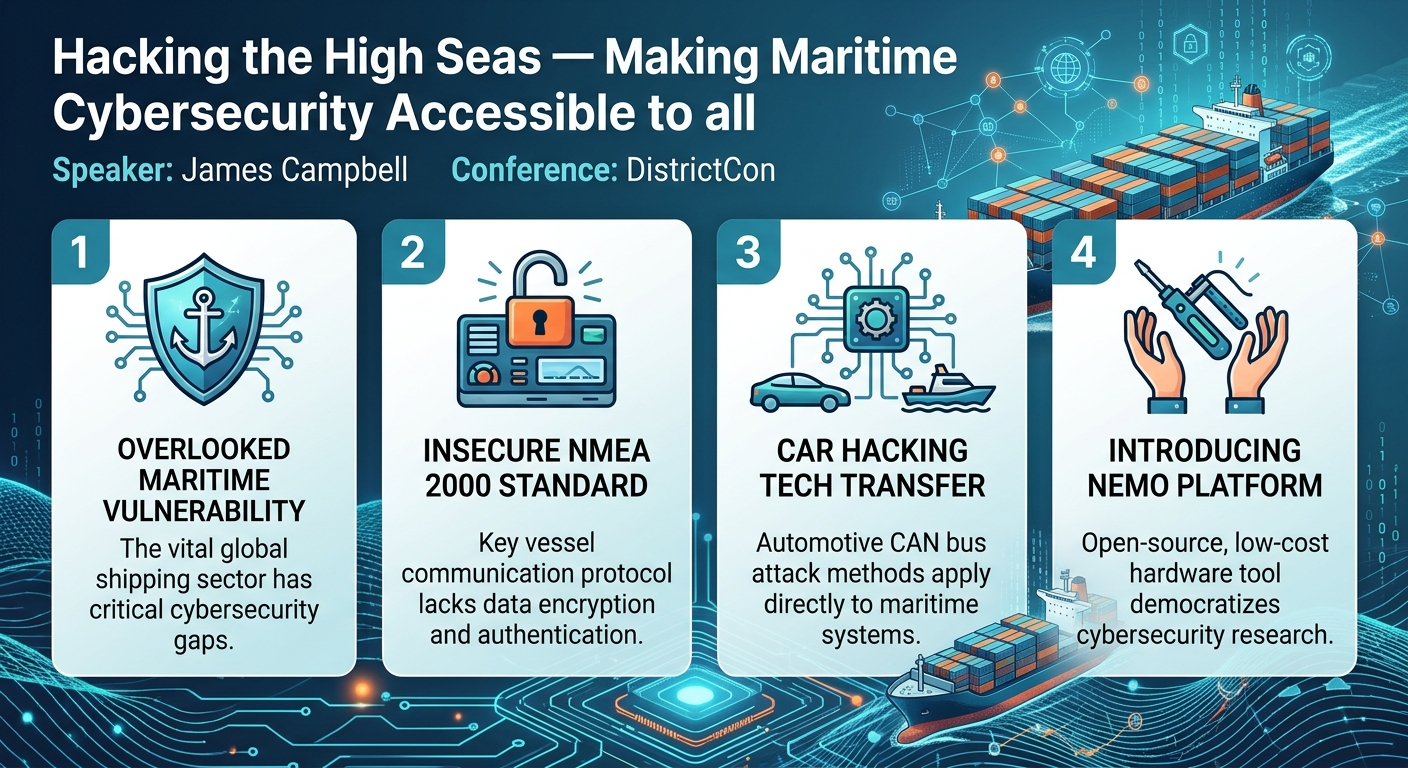
In his compelling DistrictCon presentation, "Hacking the High Seas — Making Maritime Cybersecurity Accessible to all," James Campbell, a Red Team Operator for the US Coast Guard, sheds light on the often-overlooked yet critically important domain of maritime cybersecurity. Campbell’s talk serves as a stark reminder that despite its foundational role in global commerce and infrastructure, the maritime sector remains significantly vulnerable to cyber threats, largely due to outdated protocols and a lack of accessible research tools. He argues that the principles of car hacking, which leverage vulnerabilities in the Controller Area Network (CAN) bus, are directly transferable to maritime systems, particularly those utilizing the NMEA 2000 standard.
Key moments
- 2:00 Importance of maritime cybersecurity and real-world incidents
- 9:30 NMEA 2000: No authentication, encryption, easy physical access
- 16:00 Nemo: An accessible, portable maritime hacking tool
- 24:00 Live demo: Spoofing ship heading on a real boat
- 26:00 Live demo: Causing Denial of Service on a ship
- 28:50 Easily accessible NMEA connector on a ship
- 30:00 Limitations of current defenses and future directions
- 38:00 Q&A: NMEA network as an entry point to ship's OT/ICS
Hacking the High Seas — Making Maritime Cybersecurity Accessible to all
Speakers: James Campbell (Red Team Operator, US Coast Guard)
Conference: DistrictCon
YouTube: https://www.youtube.com/watch?v=a4PtMN96Oew
Overview
In his compelling DistrictCon presentation, "Hacking the High Seas — Making Maritime Cybersecurity Accessible to all," James Campbell, a Red Team Operator for the US Coast Guard, sheds light on the often-overlooked yet critically important domain of maritime cybersecurity. Campbell’s talk serves as a stark reminder that despite its foundational role in global commerce and infrastructure, the maritime sector remains significantly vulnerable to cyber threats, largely due to outdated protocols and a lack of accessible research tools. He argues that the principles of car hacking, which leverage vulnerabilities in the Controller Area Network (CAN) bus, are directly transferable to maritime systems, particularly those utilizing the NMEA 2000 standard.
The urgency of this issue is underscored by real-world incidents, such as the Baltimore bridge collapse and the Suez Canal blockage, which, while not cyberattacks, illustrate the catastrophic cascade effects that disruptions to maritime operations can trigger. Campbell highlights that a coordinated cyberattack could amplify these impacts globally, causing far greater economic and infrastructural damage. To address the significant barriers to entry for researchers in this field—including high costs and proprietary information—Campbell introduces Nemo, an open-source, portable, and affordable hardware platform designed to democratize access to maritime cybersecurity research.
This talk is not merely an exposition of vulnerabilities; it is a call to action. By making tools like Nemo available, Campbell aims to foster a community of researchers capable of exploring, identifying, and ultimately mitigating the cyber risks threatening the high seas. His work demonstrates that foundational security flaws in critical maritime communication protocols, specifically NMEA 2000, leave vessels susceptible to various attacks, from spoofing vital navigation data to complete denial of service. The implications for global supply chains, national security, and environmental safety are profound, making Campbell's initiative a crucial step toward a more secure maritime future.
Background
▶ Watch: Importance of maritime cybersecurity and real-world incidents (2:00)
The maritime industry forms the backbone of global commerce, with an astonishing 12.3 billion tons of cargo shipped annually, accounting for approximately 85% of the total world commerce. Beyond direct cargo transport, the interconnectivity of ports with airports, rail systems, and other logistical networks means that disruptions to maritime infrastructure have far-reaching consequences. Recent incidents, such as a ship losing control for just 30 seconds before impacting the Baltimore bridge, or the Ever Given cargo ship blocking the Suez Canal for a week in 2021 (impacting 12% of world commerce), serve as potent reminders of this dependency. These events, while mechanical or human failures, underscore the potential for even greater, coordinated damage if similar disruptions were induced by cyber means.
The attack surface of modern maritime systems is rapidly expanding. The adoption of technologies like Starlink on commercial vessels, sophisticated ship-to-shore networking for port operations, and the proliferation of IoT devices (e.g., crane systems utilizing LoRa radios) introduce numerous new vectors for attack. Traditional maritime communication protocols also present significant vulnerabilities. AIS (Automatic Identification System), designed to broadcast vessel identity, position, and speed, is openly broadcast and lacks authentication, making it susceptible to spoofing that can confuse navigation and trigger unnecessary evasive maneuvers.
Internally, vessels primarily rely on two non-Ethernet-based communication protocols for their electronics: NMEA 0183 and NMEA 2000. NMEA 0183 is an older, serial, text-based protocol, akin to the output from a standard GPS sensor breakout board. The focus of Campbell's research, and this talk, is NMEA 2000, a CAN bus-based protocol that was released in 2001. The CAN bus, originally developed in the 1980s for automotive applications, prioritizes data error correction and integrity, allowing reliable data transmission even in electrically noisy environments. Key features of CAN include bus arbitration, where messages with lower CAN IDs (higher priority) take precedence, and robust error detection mechanisms like checksums, frame checks, and bit monitoring.
While NMEA 2000 leverages the robust physical layer of CAN, it introduces significant security shortcomings at the protocol level. Unlike faster automotive CAN (which can reach 1 megabit per second and has been extensively researched since 2010), maritime NMEA 2000 operates at a much slower rate (typically 125-250 kilobits per second) and uses a different message format with larger identifiers. Crucially, NMEA 2000 was designed for modularity and interoperability, allowing devices from different manufacturers (e.g., Garmin GPS, AirMar weather sensors, depth sensors) to easily connect and communicate on the same network. However, this convenience comes at a severe security cost: NMEA 2000 lacks both encryption and authentication. Any new device plugged into the network is inherently trusted, and physical access, facilitated by standard, easily accessible screw terminals and T-connectors, allows an attacker to tap into the bus and listen to or inject data without any validation. This fundamental design flaw means that the extensive research and attack methodologies developed for car hacking are almost directly applicable to maritime systems, yet the inaccessibility of boats has left this critical infrastructure largely unexplored by the cybersecurity community.
Key Findings
▶ Watch: Nemo: An accessible, portable maritime hacking tool (16:00)
James Campbell's research reveals critical vulnerabilities within the NMEA 2000 protocol, highlighting its inherent insecurity and the ease with which it can be exploited. The core problem stems from the protocol's design, which prioritizes interoperability and ease of integration over security. Specifically, NMEA 2000 offers no authentication for devices joining the network, meaning any connected device is implicitly trusted. Furthermore, there is no encryption for data transmitted across the bus, allowing anyone with physical access to passively monitor or actively inject malicious data. Physical access itself is remarkably simple, as NMEA 2000 networks utilize standard, easily accessible screw terminals and T-connectors, designed to facilitate modular expansion, but inadvertently creating convenient attack points.
Campbell demonstrates that common attack vectors from the automotive CAN bus environment are directly transferable to maritime NMEA 2000 networks. These include:
- Spoofing Attacks: Due to the lack of authentication, an attacker can simply start broadcasting data on the bus, impersonating a legitimate device or creating a new, fictitious one. This allows for the manipulation of critical navigation data such as GPS coordinates, depth readings, engine sensor data, and heading/compass information. Such manipulations could lead to groundings, collisions, or severe navigational errors, akin to the Suez Canal incident.
- Denial of Service (DoS) Attacks: Extensive research on CAN networks has shown that DoS can be achieved by monopolizing all available addresses on the bus. An attacker can repeatedly claim addresses with the lowest priority, forcing legitimate devices into an error state as they try to re-claim new addresses. This can render critical systems inoperable, requiring a full system restart, which could take 30 minutes or more on large vessels, leaving them blind to vital operational data like location or water depth during critical maneuvers.
- Data Manipulation/Impersonation Attacks: A more sophisticated approach involves passively listening to legitimate traffic, copying message headers and other identifying information, but altering the data fields. By replaying these modified messages at a faster rate than the original, the attacker can effectively impersonate a genuine sensor, displaying false information on the ship's Multi-Function Display (MFD) while appearing legitimate to the system.
A significant barrier to entry for maritime cybersecurity research has been the accessibility problem. Researchers face high costs, with home labs potentially costing upwards of $2,000, and even specialized Raspberry Pi hats costing around $300. Moreover, the official NMEA 2000 standard is proprietary, requiring a $1,000 purchase and a Non-Disclosure Agreement (NDA) to access, severely limiting open research. Compounding this, physical access to boats for testing is inherently difficult.
To address these challenges, Campbell developed Nemo, an open-source, portable, and affordable platform. Nemo's goal is to lower the bar for entry into maritime cybersecurity by providing:
- Accessible Hardware: Built with consumer-available components (e.g., TNC 4.0 chip), making it easy and cheap to build.
- Dual CAN Interfaces: Allows simultaneous sending and receiving of NMEA 2000 traffic, enabling self-contained lab testing without additional hardware.
- Sensor Simulation & Impersonation: Capable of simulating 12 different sensors and impersonating 11 different manufacturer IDs, offering a comprehensive testbed.
- Attack Modes: Includes pre-programmed attack modes to demonstrate device impersonation and denial of service, facilitating community research into prevention and detection.
Nemo stands as a crucial contribution, effectively democratizing access to maritime cybersecurity research and enabling the community to explore and address these pressing vulnerabilities.
Technical Deep Dive
▶ Watch: Live demo: Causing Denial of Service on a ship (26:00)
The NMEA 2000 protocol, the central focus of Campbell's research, represents a significant leap from its predecessor, NMEA 0183, but introduces critical security gaps. Released in 2001, NMEA 2000 was designed to replace the legacy serial NMEA 0183 networks, which required manual, point-to-point connections. The vision for NMEA 2000 was a modular, plug-and-play system where diverse sensors from different manufacturers—GPS, weather, depth—could seamlessly communicate on a shared network. This design, while enhancing interoperability and ease of installation, fundamentally sacrificed security by implementing no authentication and no encryption. Any device can join the network and broadcast messages, and every node on the bus receives all broadcasted information without validation.
Campbell's custom-built device, Nemo, is engineered to exploit these inherent weaknesses and provide a platform for research. The core of Nemo's architecture is the TNC 4.0 microcontroller, a readily available chip now manufactured by SparkFun, chosen for its reliability and, crucially, its two independent CAN interfaces. These dual interfaces are pivotal: one is dedicated to sending attack messages or simulated sensor data, while the other simultaneously receives and monitors network traffic. This allows Nemo to function as a self-contained testing environment, capable of both injecting data and observing its effects without requiring additional, expensive NMEA 2000 devices. Furthermore, Nemo provides a standard output to interface with real NMEA 2000 networks, enabling researchers to transition from lab environments to actual vessel testing.
Nemo's attack modes are designed to directly leverage the NMEA 2000 protocol's vulnerabilities:
- Device Impersonation: This attack capitalizes on the lack of authentication and validation. NMEA 2000 messages are broadcast to every node, and many devices accept the same message type from different sources. Nemo first passively listens to the bus to identify legitimate messages, learning their device IDs and other structural information. Once the message structure is understood (often identifiable by the Parameter Group Number, or PGN, in the message header), Nemo constructs its own malicious message. It copies the legitimate header information but modifies the data fields (e.g., changing depth or heading values). Because the display on the bridge typically refreshes at a low rate (e.g., 1 Hertz), Nemo can send its modified messages at a slightly faster rate. The display will then continuously update with the attacker's false data, effectively overriding the legitimate sensor's output without raising any flags about a "new" or "unauthorized" device. The system simply perceives the modified message as a valid update from the original device.
- Denial of Service (DoS): NMEA 2000 networks have a limited number of available addresses that devices must claim to operate. The DoS attack implemented in Nemo exploits this by continuously claiming every available address on the bus. As legitimate devices attempt to establish or re-establish their presence, Nemo quickly claims their intended addresses, forcing them into an error state. The only recovery method for these devices is often a full system restart. While this might be a mere 30-second inconvenience in a lab, Campbell emphasizes the severe implications for large commercial vessels like oil tankers or car carriers, where a full system restart could take 30 minutes or more. During this time, the vessel could lose critical data for navigation, potentially leading to groundings in shallow waters or collisions in busy harbors, causing immense financial and safety risks. This DoS attack, while simple in principle, adheres to the NMEA 2000 standard's rules, but in a malicious way, demonstrating how even standard-compliant behavior can be weaponized.
These technical details underscore how the foundational design choices of NMEA 2000, intended to foster interoperability, inadvertently created a highly insecure environment. Nemo provides the means to practically explore these theoretical vulnerabilities, serving as a vital tool for understanding and eventually mitigating maritime cyber risks.
Demo / Proof of Concept
▶ Watch: Easily accessible NMEA connector on a ship (28:50)
James Campbell's talk included several compelling demonstrations, progressing from controlled lab simulations to real-world testing on an actual vessel, vividly illustrating the practical impact of NMEA 2000 vulnerabilities and the effectiveness of the Nemo device.
The demonstrations began in a lab environment, showcasing Nemo's ability to interact with and manipulate NMEA 2000 data:
- Simulating a Sensor in a Lab: Campbell first demonstrated Nemo's capability to act as a legitimate NMEA 2000 device. By connecting Nemo to a display unit (MFD), he configured it to simulate a depth sensor. Using a potentiometer on the Nemo board, he was able to dynamically change the displayed water depth on the MFD. This immediate visual feedback of a fluctuating depth reading, potentially from 5 feet to 300 feet, highlighted how easily critical navigational information could be spoofed, causing significant alarm for a ship captain worried about groundings.
- Impersonating a Sensor in a Lab: Taking the simulation a step further, Campbell connected a real depth sensor to the NMEA 2000 network alongside Nemo. The goal was to demonstrate an impersonation attack where Nemo would override the legitimate sensor's data. Nemo successfully listened to the valid depth sensor's transmissions, then began broadcasting its own modified depth values at a faster rate. The MFD then displayed Nemo's manipulated data, even while the legitimate sensor was still actively transmitting, proving that an attacker could effectively inject false information and have it prioritized by the display.
The most impactful part of the demonstration involved testing Nemo on a real boat, moving beyond theoretical lab conditions:
- Physical Access to a Real Boat: Campbell highlighted the surprising ease of physical access to NMEA 2000 networks on vessels. He found standard NMEA connectors, complete with easy-to-use screw terminals, just outside a bathroom on a ship, not confined to the bridge. This crucial finding underscored that an attacker doesn't necessarily need to be on the bridge or have deep technical knowledge to tap into the network using readily available T-connectors.
- Simulating a Sensor on a Boat (Heading): With Nemo connected to the boat's NMEA 2000 network, Campbell targeted the vessel's heading sensor. Instead of merely impersonating, Nemo was configured to broadcast its own heading data louder and faster than the legitimate sensor. As Campbell manipulated the potentiometer, the ship's actual heading display started "going crazy," rapidly changing from, for example, 300 degrees down to 40 degrees. This dramatic visual effect on the bridge demonstrated how easily an attacker could induce navigational confusion, potentially leading to errors comparable to the Suez Canal incident.
- Denial of Service on a Real Ship: Campbell initiated a DoS attack using Nemo on the live NMEA 2000 network. The impact was immediate and widespread: all screens on the bridge began displaying error messages, and multiple sensors started emitting audible alarms. This "hilarious" (from a researcher's perspective) but critical outcome proved that a simple DoS attack, adhering to the NMEA 2000 standard's protocol for address claiming, could render an entire bridge's instrumentation untrustworthy, forcing a captain to lose confidence in their systems until an engineer could verify their integrity.
- Impersonating a Sensor on a Boat (Depth): Finally, Campbell demonstrated an impersonation attack on the boat's depth reading. Nemo listened for the valid depth sensor's data, then replayed modified values. He showed a dramatic change in depth for effect, but critically noted that an attacker could subtly alter these values over a long journey, making cross-referencing against charts difficult upon arrival at port. This subtle manipulation could lead to devastating consequences, such as groundings, if the captain is relying on inaccurate depth information.
These demonstrations unequivocally prove that NMEA 2000 networks are highly vulnerable to basic cyberattacks that can be executed with an affordable, open-source tool like Nemo, even from non-critical areas of a vessel. The ease of access and the immediate, critical impact on navigation and operational safety highlight the urgent need for enhanced maritime cybersecurity measures.
Defensive Implications
▶ Watch: Q&A: NMEA network as an entry point to ship's OT/ICS (38:00)
The findings presented by James Campbell paint a sobering picture for maritime cybersecurity, revealing that current defenses for NMEA 2000 and CAN-based attacks are largely insufficient. The original design philosophy of NMEA 2000 relied heavily on physical security as its primary safeguard. The assumption was that if no unauthorized individual could physically access the vessel, the network would remain secure. While physical security remains crucial—securing NMEA 2000 lines and ensuring they are only accessible in controlled environments—this defense is rapidly eroding. The increasing integration of internet-connected devices, such as those enabling Bluetooth music streaming that draw power from the NMEA network, creates new pathways for remote compromise, rendering physical security alone an inadequate barrier.
Furthermore, existing Intrusion Detection Devices (IDS) for CAN networks, some of which claim to offer protection, face significant limitations. Campbell notes that these devices are often expensive, limiting their adoption primarily to smaller yachts rather than the large commercial vessels that pose the greatest risk. More critically, they are primarily detection mechanisms rather than preventative ones. Even if an IDS successfully identifies malicious data on the network and triggers an alarm, the crew still faces the daunting task of locating and neutralizing the rogue device, consuming valuable time and further eroding trust in the bridge's data. There is no automated mitigation, only a noisy alert.
Looking ahead, Campbell outlines a strategic approach for developing more robust defenses, drawing inspiration from the red team mindset prevalent in enterprise security:
- Iterative Defense Development: This involves a continuous cycle of analyzing existing detection mechanisms, brainstorming and developing bypass techniques, testing their effectiveness, and then re-evaluating how those bypasses could be detected. This iterative process is essential for creating resilient security solutions that can adapt to evolving threats.
- Beyond Protocol-Level Analysis: Current detection often focuses on identifying anomalous NMEA message content. Campbell suggests moving beyond this, proposing research into the electrical characteristics of NMEA 2000 devices. Fingerprinting devices based on their unique electrical signatures could offer a more robust method of identifying malicious or impersonating hardware, as these characteristics are much harder to spoof than mere protocol data. However, he acknowledges that this area is still in very early development, with limited public research.
- Addressing the NMEA 1net Standard: While NMEA has released a newer Ethernet-based standard, NMEA 1net, first introduced around the 2010-2013 timeframe, its adoption is painfully slow. Campbell points out that it often takes 20 to 30 years for new maritime standards to be widely implemented. Many vessels, including new ones, still heavily rely on NMEA 2000, and even NMEA 1net is designed to interact with and rely on data from existing NMEA 0183 and NMEA 2000 networks. This backward compatibility means that the vulnerabilities inherent in the older protocols will continue to persist, making NMEA 1net an incomplete solution for immediate security challenges.
In summary, the maritime sector is in dire need of a paradigm shift in its approach to cybersecurity. Relying on outdated physical security assumptions and limited, reactive detection mechanisms is no longer viable. A proactive, research-driven approach, focusing on deeper technical analysis and the development of truly preventative measures, is essential to secure the high seas against increasingly sophisticated cyber threats. The open-source nature of tools like Nemo is critical in fostering the community engagement needed to drive this change.
Key Takeaways
- Maritime Cybersecurity is Critically Overlooked: Despite underpinning 85% of global commerce and being vital infrastructure, the maritime sector suffers from a significant lack of cybersecurity research and awareness, making it highly vulnerable.
- NMEA 2000 Lacks Fundamental Security: The prevalent NMEA 2000 protocol, designed for interoperability, inherently lacks encryption and authentication, making all connected devices implicitly trusted and all data openly readable.
- Car Hacking Techniques Apply Directly: Attack methodologies developed for automotive CAN bus systems, such as spoofing, denial of service, and data impersonation, are directly transferable and highly effective against NMEA 2000 networks.
- Physical Access is Easy and Potent: Physical access to NMEA 2000 networks, often found in accessible areas of a vessel via standard screw terminals and T-connectors, grants an attacker immediate and complete control over critical navigation and operational data.
- Nemo Lowers the Research Barrier: The Nemo project provides an affordable, portable, and open-source platform built on the TNC 4.0 chip, democratizing access to maritime cybersecurity research and enabling practical testing of NMEA 2000 vulnerabilities.
- Current Defenses Are Insufficient: Existing defenses, primarily physical security and limited, expensive detection-only IDS systems, are inadequate against the demonstrated attacks, highlighting the urgent need for new, proactive security measures.
- Newer Standards Face Slow Adoption and Legacy Dependencies: While NMEA 1net (Ethernet-based) exists, its adoption is slow, and its reliance on data from vulnerable NMEA 2000 and 0183 networks means that fundamental security issues will persist for decades.
About the Speaker(s)
James Campbell is a Red Team Operator for the US Coast Guard, where he specializes in standard red teaming activities, including Windows and enterprise network security. Outside of his official duties, James is deeply involved in the world of maritime cybersecurity. He dedicates his free time to personal projects, such as 3D printing his own boat for mapping PTOIC, and actively contributes to the Maritime Hacking Village. His experiences teaching maritime hacking at events like Defcon and in Tokyo inspired him to share his insights on a larger stage. James is also a proud dog dad to his "crackhead" dog, Pixel. He emphasizes that the views, research, and opinions expressed in his presentation are solely his own and do not represent the United States Coast Guard.
Reviews
Dr. Zero (Offensive Security Researcher) — SOLID
Solid applied security research that does exactly what it promises: takes known CAN bus attack techniques, ports them to maritime NMEA 2000, and wraps it in an open-source tool to lower the barrier for the community. Not groundbreaking exploitation research, but genuinely useful work in an underexplored critical infrastructure domain.
Heather Calloway (CISO) — STRONG ACCEPT
This is exactly the kind of infrastructure risk that boards and risk committees need briefed. Campbell identifies a critical sector (85% of global commerce) with negligible security controls on core operational systems, then delivers an open-source tool to prove it. If you run a shipping company, port operation, or critical logistics chain, this changes your third-party risk conversation.