Pixel Bureaucracy At The Scale Of Chaos - or: Torturing 286 People By Pretending To Be The Government
luap42, 9hax (lydia!)
Gulaschprogrammiernacht 24 (GPN24) · Day 4 · ZKM Kubus
Overview
This talk, "Pixel Bureaucracy At The Scale Of Chaos," presented by luap42 (Paul) and 9hax (Lydia) at GPN24, delves into a unique social and technical experiment that reimagines the popular "Pixel Flut" art project. Instead of allowing participants to quickly and freely place pixels on a communal canvas, the speakers introduced an elaborate, intentionally frustrating, and humorously accurate simulation of German bureaucracy. The project's core was to slow down the creative process, forcing participants to navigate complex forms, queuing systems, and even phone bots, all designed to mimic the inefficiencies and stringent formalism of real-world government agencies.
Key moments
- 0:00 Introduction: Pixel Bureaucracy at the Scale of Chaos
- 2:20 Project idea: Slowing down Pixel Flut with bureaucracy
- 4:00 The "Pixel Festsetzungantrag" form and invalid requests
- 8:10 GPN24 statistics: high invalid forms, phone bot impact
- 11:00 Deep dive into the "over-engineered" software stack
- 18:45 Challenges and realism of phone bot & queuing system
- 26:00 Live pixel session and audience Q&A begins
- 37:00 Acknowledgments and reflections on project's success
Pixel Bureaucracy At The Scale Of Chaos - or: Torturing 286 People By Pretending To Be The Government
Speakers: luap42, Government Agency Employee; 9hax (lydia!), Government-Affiliated Agency Employee
Conference: GPN24
YouTube: https://www.youtube.com/watch?v=7j9DE1vdndA
Overview
This talk, "Pixel Bureaucracy At The Scale Of Chaos," presented by luap42 (Paul) and 9hax (Lydia) at GPN24, delves into a unique social and technical experiment that reimagines the popular "Pixel Flut" art project. Instead of allowing participants to quickly and freely place pixels on a communal canvas, the speakers introduced an elaborate, intentionally frustrating, and humorously accurate simulation of German bureaucracy. The project's core was to slow down the creative process, forcing participants to navigate complex forms, queuing systems, and even phone bots, all designed to mimic the inefficiencies and stringent formalism of real-world government agencies.
Paul, an employee of a government agency with a penchant for "touching the law" and a love for the British bureaucratic satire "Yes Minister," partnered with Lydia, who works for a government-affiliated agency specializing in computers, to bring this vision to life. Their objective was not merely to build a technical system but to create an immersive, interactive experience that highlights the absurdities of bureaucracy through "stringent formalism." The project scaled significantly across multiple Chaos events, demonstrating both the resilience of their "over-engineered" systems and the surprising creativity and persistence of participants in navigating (or subverting) the imposed rules.
The talk is a fascinating blend of technical deep dive, social commentary, and comedic performance. It showcases how a seemingly simple concept—placing pixels—can be transformed into a complex, multi-layered interaction model. Beyond the humor, the project offers valuable insights into system design, user interaction, and the challenges of managing public-facing services, even when those services are intentionally designed to be difficult. It’s a testament to both the speakers' ingenuity and the Chaos community's willingness to engage with unconventional experiments.
Background
▶ Watch: Introduction: Pixel Bureaucracy at the Scale of Chaos (0:00)
The inspiration for "Pixel Bureaucracy" stemmed from the common "Pixel Flut" projects seen at Chaos Events. These projects typically involve a large digital canvas where attendees can rapidly place pixels, often leading to fast-paced, sometimes chaotic, collaborative art. Paul and Lydia, however, found this approach "too fast" and "stressful," desiring a more "chill" and fun experience. Their solution was to deliberately slow down the process by injecting a heavy dose of bureaucracy.
The conceptual foundation for this slowdown was drawn from two distinct sources. The first was RFC 1149, "IP over Avian Carriers" (IPOAC), an April Fools' joke specification that describes transmitting IP packets via carrier pigeons. While cursed and impractical for real-world networking, it was famously implemented twice in experiments, proving that even absurd specifications can be literally executed. This idea of a deliberately inefficient, yet functional, communication method resonated with their goal. The second, and perhaps more influential, inspiration was the "authentic German bureaucracy," known for its stringent formalism and often bewildering procedures, as well as the satirical British TV show "Yes Minister," which comically portrays the inner workings of government.
The speakers aimed to create a "horrificly accurate simulation of real-world bureaucracy," albeit an exaggerated one, where "stringent formalism" could be used to "be mean to people" in a silly way. Their primary tool for this was the Pixel Festsetzungantrag, a physical form that participants had to meticulously fill out. The challenge of this bureaucratic layer was to make it realistic enough to be frustrating, yet engaging enough to encourage participation. This involved strict validation of every detail, from the current date (which many struggled with) to correct coordinates and color codes. The project began at GPN 23, evolving significantly through Chaos Communication Congress (39C3) and GPN 24, each iteration adding more layers of complexity and technical sophistication to the bureaucratic simulation.
Key Findings
▶ Watch: The "Pixel Festsetzungantrag" form and invalid requests (4:00)
The "Pixel Bureaucracy" project yielded several key findings, demonstrating both the power of intentional system design and the unpredictable nature of human (and bot) interaction:
- High Engagement Despite Intentional Friction: Despite the project's explicit goal to "torture" participants with bureaucracy, engagement was remarkably high. At GPN 23, they processed a modest number of requests. This exploded at Chaos Communication Congress 39C3, where they received 1,287 change requests, resulting in approximately 7,000 pixels being changed on their 40x30 canvas (19,200 total pixels). By GPN 24, this surged further, with 4,682 changes and 107 forms filled out. This indicates that participants were willing to endure significant friction for the novelty and challenge of the experience.
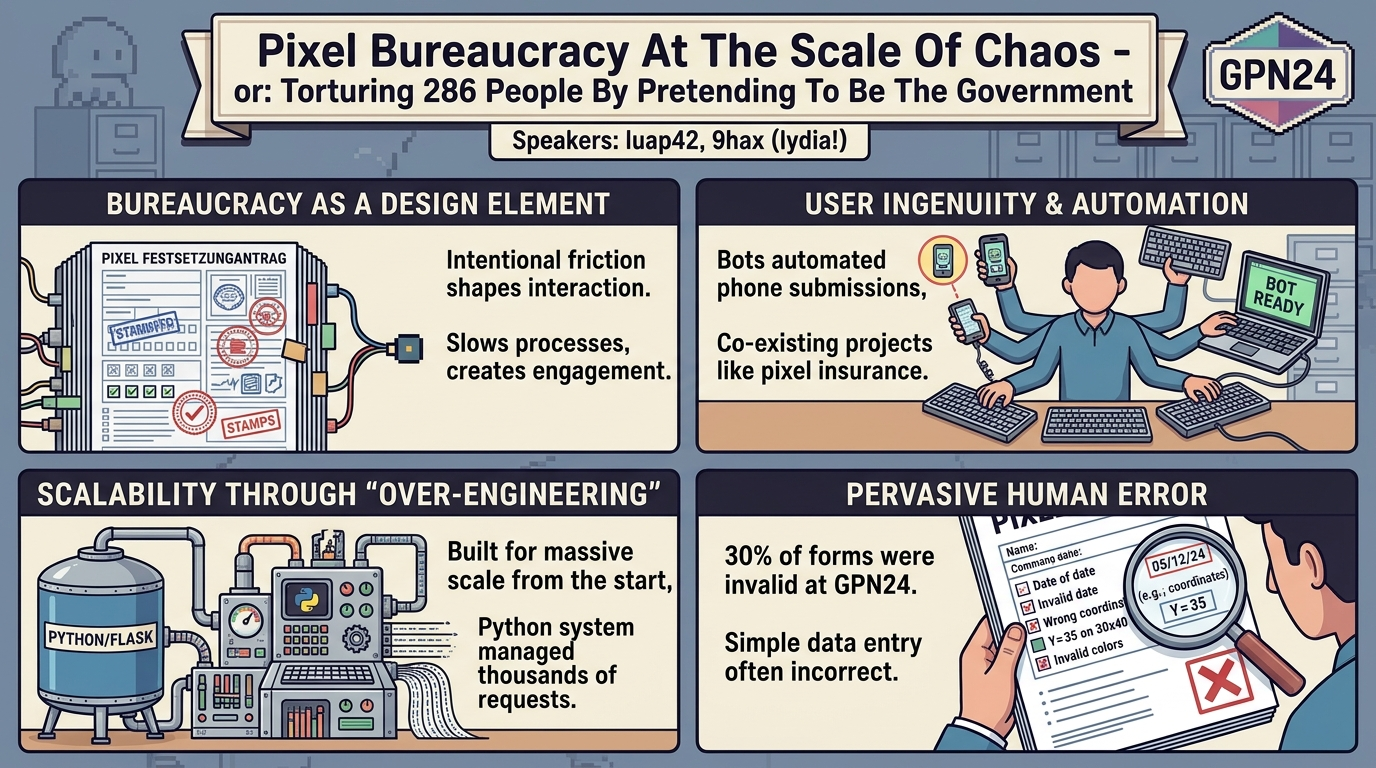
- Human Error is Pervasive: A significant finding was the high rate of human error in simple tasks. At GPN 24, 30% of submitted forms were invalid. Common mistakes included incorrect dates, wrong color codes (despite a provided table), and erroneous coordinates (e.g., requesting a pixel at Y=35 on a 30-pixel canvas). This underscores the real-world challenge of user input validation and the need for clear instructions, even when the system is designed to be frustrating.
- Automation and Subversion are Inevitable: Participants quickly adapted to and, in many cases, subverted the bureaucratic processes. While the physical forms were meant to be slow, the introduction of the phone bot led to massive automation. Speakers noted that at GPN 24, "people had the bots ready basically from hour one," leading to a disproportionately high number of changes via the phone bot. This highlights a common security and operational challenge: any accessible system will be automated if possible, often beyond its intended use. Co-existing projects, like a "pixel insurance" bot that automatically reset overwritten pixels, further demonstrated this ingenuity.
- "Over-Engineering" Fosters Scalability and Resilience: The speakers repeatedly described their systems as "massively over-engineered" for a project of this nature. This intentional design, built on Python and Flask, enabled the platform to handle multiple requests per second, export complex video renderings efficiently, and support features like multi-event management and fine-grained role-based access. This "over-engineering," though humorous in context, proved critical for the project's ability to scale from a few dozen forms to thousands of automated interactions without significant downtime.
- Bureaucracy as a Design Element: The project effectively demonstrated that bureaucratic friction can be a powerful, intentional design element. By enforcing "stringent formalism" and creating deliberate points of failure or delay (e.g., the phone bot's simulated queue, the physical form validation), the speakers shaped user behavior and interaction patterns. This provides a playful, yet insightful, model for understanding how system design choices can influence user experience and compliance, even when the goal is frustration rather than efficiency.
Technical Deep Dive
▶ Watch: Deep dive into the "over-engineered" software stack (11:00)
The "Pixel Bureaucracy" project was supported by a surprisingly robust and, as the speakers humorously admitted, "massively over-engineered" technical stack, primarily running in a virtualized environment. The core components included the main Pixel Epoch software, a phone bot, a queuing system, and various hidden infrastructure elements.
The Pixel Epoch software served as the brain of the operation. Written in Python using the Flask web framework, it managed the pixel canvas, hosted the project website (pixelapp.be), and handled all pixel setting logic. Despite its "looks like it's made in about 2 hours" interface, it was meticulously developed, capable of processing "multiple requests per second." Stress tests on a laptop demonstrated its ability to "override the whole canvas five times," showcasing its underlying scalability. It featured advanced functionalities like exporting videos of the canvas's evolution (optimized by concatenating 60-frame GIF chunks for speed) and extensive caching. The administrative interface was particularly feature-rich, supporting multiple events, dynamic canvas size changes, comprehensive user measurement, and a standardized API for external tools like the phone bot. A detailed role system allowed helpers to have fine-tuned access, preventing full administrative privilege exposure. The system also provided a fixed palette of 32 colors, displayed in multiple formats (RGB, CMYK), to encourage creativity within constraints. An intriguing addition was a secret 33rd color, "Z9," which, when selected, randomized the pixel's color every time the canvas was re-rendered, adding an element of surprise and further "torturing nerds."
Data collection was central to the system's operation and analysis. For every pixel, the system meticulously recorded its coordinates, color, the user who sent it, the system user who entered it, the source method, and a timestamp. This data was crucial for generating the detailed statistics page, rendering the time-lapse videos, and for identifying potential "bot abuse," allowing for measures like shadow banning. Importantly, the speakers emphasized privacy by design, stating they only collected necessary data and explicitly did not log sensitive information like source IP addresses for phone calls.
The phone bot was a critical interface for pixel submission, especially for automated interactions. It was implemented in Python 3 and relied on a VoIP library supporting SIP, making it compatible with various Chaos Event phone systems. However, this component was described as a "horrific mess" due to dependencies on an "unmaintained audio library" that inexplicably required MySQL (despite not saving data) and an "old broken pip build chain," limiting its deployment to older systems like Debian 12. Users calling the bot entered a "simulated waiting queue" before inputting coordinates and color. A key distinction was made between submission methods: forms allowed for 4x4 pixel blocks, while the phone bot allowed for single 1x1 pixels, rewarding the higher effort of form submission. The phone bot was also intentionally unstable, reflecting real-world government services. It frequently crashed due to the phone system sending IPv6 addresses as phone numbers, leading to an automated script that killed and restarted the bot every 20-30 minutes to ensure new calls could be accepted.
To further enhance the bureaucratic experience, a comprehensive queuing system was developed. This system replicated the process of obtaining a passport at a town hall, complete with 5-digit codes and on-screen displays. It was equally "over-engineered," featuring multiple ticket classes (including "premium tickets" for those who "bribed" the organizers), limits on queue size, vouchers for special queues, and a webhook and API for integration with physical buzzers. An accompanying ticket printing system used a receipt printer to issue queue tickets adorned with fun facts and even advertisements. This printer, designed for receipts, notably printed the color table in grayscale, adding another layer of humorous inconvenience.
The project's physical presence at events was also technically supported. They maintained high uptime using a UPS (Uninterruptible Power Supply) even when their physical tables were "stolen." An attempt was made to accept pixels via fax machine, but this proved to be a persistent technical challenge, with calls failing to arrive, eventually leading to the abandonment of the fax functionality due to unsupported software and broken licensing processes. The use of carbon copy forms for the Pixel Festsetzungantrag served not only as a physical record but also as a "defensive" measure, allowing the "government agency" to prove their decisions to disgruntled participants.
Demo / Proof of Concept
▶ Watch: Challenges and realism of phone bot & queuing system (18:45)
The "Pixel Bureaucracy" project itself served as a continuous, live demonstration and proof of concept across multiple Chaos Events. The speakers presented video compilations from past events, showcasing the evolution of the 40x30 pixel canvas at GPN 23, Chaos Communication Congress 39C3, and GPN 24. These time-lapse videos visually captured the community's creative output, from simple shapes to shaded images and event-specific artwork, all created under the project's bureaucratic constraints.
A central element of the talk at GPN 24 was a live pixel session. This interactive segment allowed audience members to directly participate in the "bureaucracy." Attendees could either approach "Harold" (a designated helper) to receive and meticulously fill out a physical Pixel Festsetzungantrag form, or they could call the infamous phone bot. The speakers then publicly processed these requests, providing real-time feedback on form validity (and often, invalidity). This direct engagement vividly demonstrated the project's core mechanics: the rigorous validation of forms, the deliberate slowness of manual processing, and the humorous frustration of participants whose requests were denied due to minor errors.
The physical setup at the conference booth was also part of the proof of concept. This included the large green buzzer for the queuing system, the receipt printer churning out tickets with fun facts, and the stack of carbon copy forms. These tangible elements made the bureaucratic simulation feel more real and immediate. The speakers' anecdotes about participants struggling with form details, the phone bot's intentional instability, and the sheer volume of bot-driven requests further illustrated the project's technical capabilities and the human-computer interaction challenges it presented. The project's ability to maintain operations, even in the face of physical disruptions like stolen tables (thanks to a UPS), underscored the robustness of their underlying infrastructure.
Defensive Implications
▶ Watch: Acknowledgments and reflections on project's success (37:00)
While "Pixel Bureaucracy" is primarily a humorous social experiment rather than a security talk, its design and operational challenges offer several valuable lessons applicable to defensive security and robust system design:
- Robust Input Validation is Paramount: The project highlighted the critical importance of strict input validation. With 30% of physical forms being invalid due to simple mistakes (dates, coordinates, colors), it demonstrates that users, even with clear instructions, will make errors. In a security context, insufficient input validation can lead to vulnerabilities like injection attacks, buffer overflows, or logical flaws. The project's intentional strictness, while frustrating, underscores how essential comprehensive validation is for maintaining system integrity.
- Anticipate and Manage Automation/Abuse: The rapid and widespread automation of the phone bot by participants, leading to thousands of pixel changes, illustrates that any accessible system will be probed and automated. Defenders must design systems with the expectation of bot traffic, whether malicious or benign. This includes implementing rate limiting, CAPTCHAs (though the project avoided these for humor), and detection mechanisms for unusual activity (like the project's "shadow banning" capability). The phone bot's intentional instability and automated restarts (every 20-30 minutes) acted as a crude form of rate limiting and resilience against excessive load.
- Resilience and Uptime in Hostile Environments: The project's infrastructure demonstrated practical resilience. Using a UPS to maintain uptime even when physical tables were "stolen" at an event, and implementing automated restart scripts for the phone bot to recover from crashes, are basic but effective defensive measures. This emphasizes the need for redundant power, automated service recovery, and monitoring to ensure continuous availability, especially in unpredictable environments.
- Privacy by Design: The speakers explicitly stated their commitment to privacy by only collecting necessary data and refraining from logging sensitive information like source IP addresses from phone calls. This "logging less is good" philosophy is a fundamental principle of privacy-by-design, reducing the attack surface and the potential impact of data breaches. It serves as a reminder that even in seemingly low-stakes projects, ethical data handling is crucial.
- Managing User Expectations and Friction: While the project intentionally created friction, it also showed that there's a balance. The speakers noted occasions where they had to "be a little bit more soft" on genuinely annoyed users, or help young children. In security, this translates to balancing strong security controls with user experience. Overly burdensome security measures can lead to user bypasses or frustration, ultimately undermining security goals. Understanding this trade-off is key for effective security implementation.
- Physical Security Considerations: The anecdote about stolen tables highlights that security extends beyond the digital realm. Physical assets, even temporary ones at an event, can be vulnerable. Planning for physical security, or at least resilience against physical disruption (like the UPS), is a practical consideration for any deployed system.
Key Takeaways
- Bureaucracy as a Feature: Intentional bureaucratic friction can be a powerful design element, capable of controlling user interaction, slowing processes, and even fostering unique forms of engagement, as demonstrated by the project's high participation despite its frustrating nature.
- Scalability Through "Over-Engineering": Even projects with humorous intent can benefit from robust, "over-engineered" technical foundations. The Python/Flask system, with its multi-event support, APIs, and efficient video rendering, proved capable of scaling from manual forms to thousands of automated requests without significant issues.
- User Ingenuity and Automation: Any accessible system will be subject to user ingenuity, including automation and "abuse." The phone bot's heavy use by bots and co-existing projects like "pixel insurance" highlight the need for designers to anticipate and plan for unexpected user behaviors and automated interactions.
- The Pervasiveness of Human Error: Simple tasks like filling out forms are prone to human error, with 30% of forms being invalid due to incorrect dates, coordinates, or colors. This underscores the critical need for clear instructions and rigorous input validation in any system.
- Resilience and Privacy are Universal: Fundamental principles like system resilience (e.g., UPS for uptime, automated restarts for service recovery) and privacy-by-design (e.g., logging only essential data, avoiding IP address collection) are crucial for any project, regardless of its primary goal or perceived stakes.
- Community Co-Creation: The project fostered a unique environment for community interaction, from creative pixel art with shading to the development of external "pixel insurance" bots, showcasing how well-designed interactive platforms can become sandboxes for collective creativity and social experimentation.
About the Speaker(s)
luap42 (Paul) is described as being "very good at touching computers" and "certified" in this field. He also has a notable interest in legal matters, having been "good at touching the law" and planning to do so again. Paul works for an unspecified "government agency." His inspiration for the project's bureaucratic elements stems from his appreciation for the British satirical show "Yes Minister," which focuses on the absurdities of bureaucracy. He is also characterized as "very silly."
9hax (Lydia), also known as Lydia, is similarly proficient with technology, being "very good at touching computers" and "soon" to be certified. She has "touched the law once" and works for a "government-affiliated agency" that specializes in computers. Lydia's lighter side is evident in her fondness for "Garfield" and her equally "silly" nature. Together, Paul and Lydia combined their technical skills and shared sense of humor to create the "Pixel Bureaucracy" project.
Reviews
Dr. Zero (Offensive Security Researcher) — STRONG ACCEPT
A genuinely funny talk that's actually about something — system design under adversarial user behavior, input validation at scale, and the social dynamics of intentional friction. The technical stack is more serious than the premise suggests, and the operational data from running this across multiple Chaos events gives it substance beyond the bit.
Heather Calloway (CISO) — SOLID
A clever, well-executed art/social experiment that's entertaining but has no security or governance relevance. Fun for the Chaos crowd; not a leadership priority.