Session 5: Watch the Channel!
Aydin Aysu (Session Chair · North Carolina State University), Mateus Simões (Paper author · STMicroelectronics), Lilian Bossuet (Paper author), Vincent Grosso (Paper author), Nicolas Bruneau (Paper author), Patrick Haddad (Paper author), Thomas Sarno (Paper author), Shuohang Peng (Paper author), Bohan Yang (Paper author), Shuying Yin (Paper author), Hang Zhao (Paper author), Cankun Zhao (Paper author), Shaojun Wei (Paper author), Leibo Liu (Paper author), Sofiane Takarabt (Paper author), Javad Bahrami (Paper author), Mohammad Ebrahimabadi (Paper author), Sylvain Guilley (Paper author), Naghmeh Karimi (Paper author)
IEEE International Symposium on Hardware Oriented Security and Trust (HOST) 2023 · Day 2 · Gateway Ballroom
Overview
The IEEE HOST conference session "Watch the Channel" delved into advanced techniques for securing cryptographic implementations against side-channel attacks. Chaired by Aydin Aysu from North Carolina State University, this session showcased three distinguished papers, including one best paper candidate. The presentations collectively addressed critical challenges in hardware security, ranging from designing low-latency, glitch-resistant masking schemes to optimizing randomness usage in lightweight cryptography and rigorously evaluating the practical security order of established masking techniques.
Key moments
- 0:00 Session 5 welcome and first paper introduction
- 4:09 Problem: Masking complex circuits with low latency
- 5:30 Solution: Click element for asynchronous masking
- 26:40 Technique to reduce randomness for masked Xoodyak
- 41:40 Parity leakage: LSB of Hamming weight reveals secret
- 47:20 Demonstrating high-order attacks on Present S-box
- 51:10 Q&A: General applicability of LSB leakage attack
Session 5: Watch the Channel!
Speakers: Aydin Aysu (Session Chair, North Carolina State University); Mateus Simões (Paper author, STMicroelectronics); Lilian Bossuet (Paper author); Vincent Grosso (Paper author); Nicolas Bruneau (Paper author); Patrick Haddad (Paper author); Thomas Sarno (Paper author); Shuohang Peng (Paper author); Bohan Yang (Paper author); Shuying Yin (Paper author); Hang Zhao (Paper author); Cankun Zhao (Paper author); Shaojun Wei (Paper author); Leibo Liu (Paper author); Sofiane Takarabt (Paper author); Javad Bahrami (Paper author); Mohammad Ebrahimabadi (Paper author); Sylvain Guilley (Paper author); Naghmeh Karimi (Paper author)
Conference: IEEE HOST
YouTube: https://www.youtube.com/watch?v=lbHOI40yKPg
Overview
The IEEE HOST conference session "Watch the Channel" delved into advanced techniques for securing cryptographic implementations against side-channel attacks. Chaired by Aydin Aysu from North Carolina State University, this session showcased three distinguished papers, including one best paper candidate. The presentations collectively addressed critical challenges in hardware security, ranging from designing low-latency, glitch-resistant masking schemes to optimizing randomness usage in lightweight cryptography and rigorously evaluating the practical security order of established masking techniques.
The session highlighted the continuous evolution of side-channel countermeasures and the sophisticated analytical methods required to assess their efficacy. The first paper introduced an innovative asynchronous design approach for masking, promising single-cycle operation with arbitrary protection order. The second focused on practical, low-randomness masking for the Xoodyak cryptographic algorithm, a NIST lightweight cryptography finalist. Finally, the third paper presented a compelling re-evaluation of the security order of gate-level masking, revealing intrinsic leakages that can be exploited by advanced attack methodologies even when schemes are theoretically proven secure.
Together, these talks provided a comprehensive perspective on the cutting edge of side-channel protection. They underscored the necessity for robust, efficient, and thoroughly validated masking implementations, emphasizing that theoretical security models must be continuously challenged and refined against the backdrop of real-world physical attacks. The insights shared are crucial for hardware designers, cryptographers, and security researchers striving to build truly resilient secure systems.
Background
▶ Watch: Session 5 welcome and first paper introduction (0:00)
Side-channel attacks, which exploit physical emanations like power consumption, electromagnetic radiation, or timing variations, pose a significant threat to cryptographic implementations. Masking is a primary countermeasure, involving splitting secret data into multiple random shares to decorrelate physical leakage from the original secret. While theoretically sound, practical masking implementations face several challenges.
One major hurdle is the latency overhead introduced by masking. Traditional masking schemes often require multiple clock cycles to process a single operation, especially non-linear functions like S-boxes, which can severely impact the performance of cryptographic algorithms. Furthermore, the presence of glitches—transient power consumption spikes due to uneven signal propagation—can inadvertently reintroduce data-dependent leakages, even in masked circuits. Addressing these issues often involves complex synchronization mechanisms and dedicated hardware, adding to design complexity and resource consumption.
Another critical aspect is the randomness requirement. Masking relies heavily on fresh random numbers to generate and refresh shares, and a continuous supply of high-quality randomness can be a bottleneck for resource-constrained devices, particularly in lightweight cryptographic contexts relevant to the Internet of Things (IoT). Minimizing randomness while maintaining security is thus a key optimization goal.
Finally, the theoretical security guarantees of masking schemes, often formalized under models like the probing model, do not always translate perfectly to real-world scenarios. Physical attacks often aggregate leakage from multiple internal signals, and the assumptions made in theoretical models may not fully capture the nuances of actual power or EM emanations. This discrepancy necessitates a deeper understanding of how physical characteristics, such as the Hamming weight leakage model, interact with masked designs and whether intrinsic leakages can circumvent formal proofs. The papers in this session directly tackle these foundational problems, pushing the boundaries of practical side-channel security.
Key Findings
▶ Watch: Solution: Click element for asynchronous masking (5:30)
This session presented three distinct papers, each contributing significant findings to the field of hardware security against side-channel attacks:
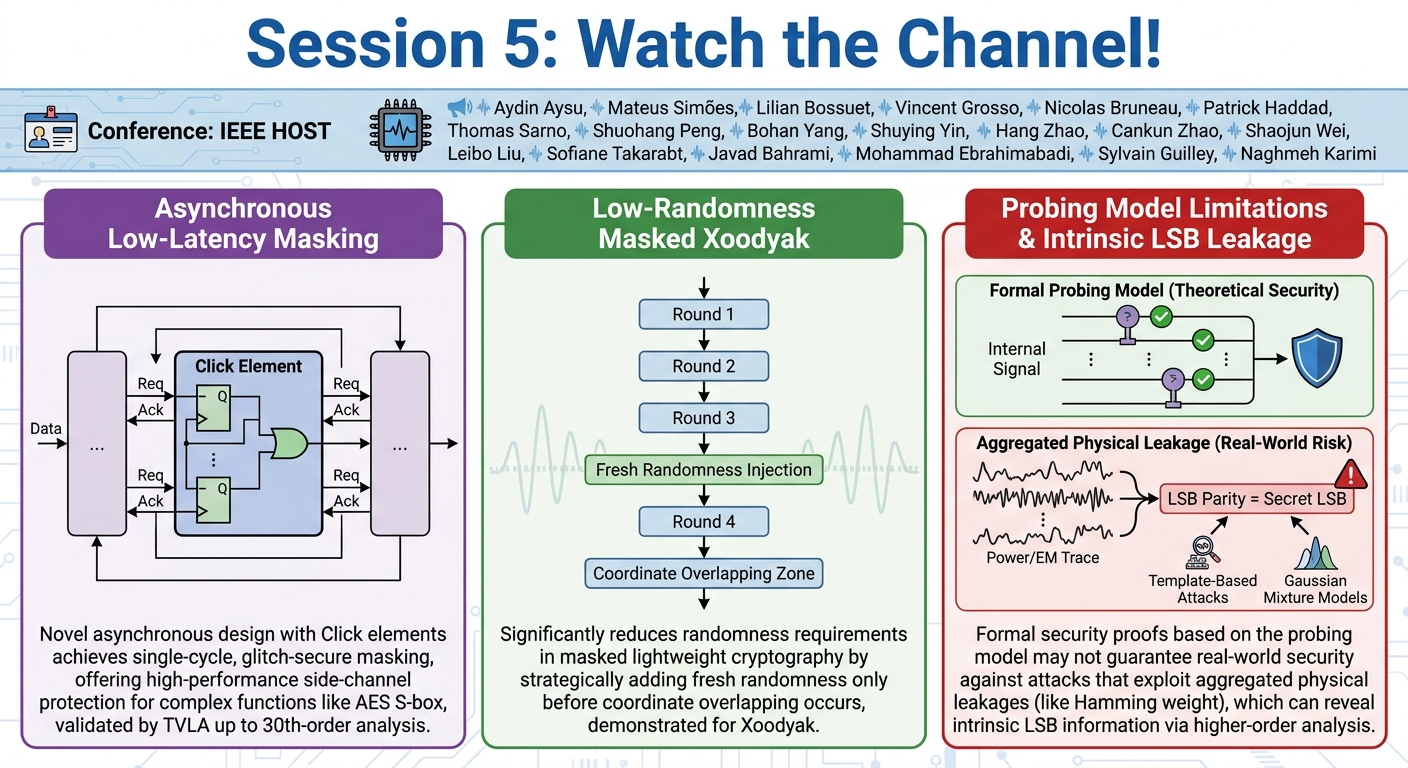
- Low-Latency Masking with Arbitrary Protection Order Based on Click Elements: This paper introduced a novel asynchronous design style utilizing Click elements to achieve single-cycle, glitch-secure masking for complex circuits like the AES S-box. Key findings include demonstrating a low-cost, area-efficient implementation (smallest among compared first-order masking solutions) and proving its security up to 30th-order analysis using Test Vector Leakage Assessment (TVLA). This approach offers a generic method to bridge synchronous and asynchronous design, enabling low-latency, arbitrary-order protection with commercial synthesis tools.
- A Low-Randomness First-Order Masked Xoodyak: This work presented a first-order masked implementation of Xoodyak, a NIST lightweight cryptography finalist, with a significant reduction in randomness requirements. The authors meticulously analyzed Xoodyak under a glitch-extended probing model to identify potential leakages, ensuring all cross-terms were secure. Their primary finding was a novel technique to reduce randomness by identifying and exploiting the rounds where coordinate overlapping occurs, requiring fresh randomness only before such overlaps. This resulted in a factor of three reduction in randomness for Xoodyak, achieving robust first-order security with notable improvements in resource overhead (19-40% reduction) and frequency (8.7-9.3% increase) compared to other protected implementations.
- Security order of gate-level masking schemes: This paper critically re-evaluated the security order of gate-level masking schemes, demonstrating an intrinsic leakage that can be exploited even in formally proven secure designs. The central finding is the identification of Least Significant Bit (LSB) leakage within the Hamming weight leakage model, where the parity of the Hamming weight directly reveals the unmasked secret value. Through detailed analysis and advanced template-based attacks on a first-order protected PRESENT S-box, the authors showed that while first-order attacks might fail due to identical mean power consumption, second-order and fourth-order attacks consistently succeed, bypassing the theoretical security claims of the probing model. This highlights a crucial gap between formal security proofs and practical attack realities, suggesting that aggregated physical emanations can reveal more information than individual signal probes.
Technical Deep Dive
▶ Watch: Technique to reduce randomness for masked Xoodyak (26:40)
The "Watch the Channel" session provided a deep dive into advanced side-channel countermeasures, each paper exploring distinct facets of secure hardware implementation.
Paper 1: Low-Latency Masking with Arbitrary Protection Order Based on Click Elements
Mateus Simões presented an innovative approach to overcome the inherent latency overhead of masking countermeasures, particularly for complex non-linear functions like the AES S-box. The core problem addressed is that traditional synchronous masking schemes, while effective against side-channel attacks, often require multiple clock cycles (e.g., 8 cycles for a masked AES S-box) and are susceptible to glitches, which can be sources of side-channel leakage.
The proposed solution leverages asynchronous circuit design principles, specifically two-phase bundled-data asynchronous circuits, centered around novel Click elements. Instead of a global clock, the design uses a handshake logic between sender and receiver, involving request and acknowledgment signals. A request signal indicates data readiness, and an acknowledgment confirms data evaluation, allowing new data to be sent. The "two-phase" protocol means transitions (positive or negative edges) on these signals define the operational phases, rather than logic levels.
The Click element itself is a simple, yet crucial, component constructed from standard logical gates and flip-flops. Flip-flops are critical because they enable the application of static timing analysis, a standard technique for computing propagation delays. This allows for precise delay matching: the propagation delay among Click elements on the request channel must accurately correspond to the combinatorial circuit's delay between registers. This matching is achieved by inserting chains of buffers and applying don't touch constraints during synthesis to preserve the intended architecture. The entire design process, from a synchronous secure design to an asynchronous single-cycle implementation, uses commercial tools like Design Compiler in an adaptive delay matching loop.
The implementation demonstrated for the AES S-box is globally synchronous at the pipeline level, but the S-box itself operates asynchronously. It consists of a source block generating handshake logic, a series of Click elements, and a sync module consuming the handshake signals. Performance results showed that this Click-based masking provides the smallest area footprint for first-order masking compared to the state-of-the-art, thanks to its low-cost Click elements and the use of Domain-Oriented Masking (DOM), which also contributes to relatively low randomness usage. While the initial operating frequency was modest (30 MHz for two shares), the authors are actively working on improving this. Security was rigorously assessed using Test Vector Leakage Assessment (TVLA) on 10 million simulated power traces. The implementation proved secure up to 30th-order analysis, maintaining a T-statistic below the 4.5 threshold, even with second-order masking configurations. This approach offers a generic, hardware-agnostic design style for implementing low-latency, glitch-secure masking with arbitrary protection orders.
Paper 2: A Low-Randomness First-Order Masked Xoodyak
Shuohang Peng presented a method for efficiently masking Xoodyak, a finalist in the NIST Lightweight Cryptography (LWC) standardization process, with a focus on reducing randomness requirements. Xoodyak is an authenticated encryption algorithm designed for resource-constrained environments like IoT devices, making side-channel protection paramount. The algorithm operates on a 384-bit intermediate state, structured into three 128-bit planes (X, Y, Z), and involves five main operations: Theta (mixes planes), Rho (shifts planes), Iota (adds a constant), Chi (the only non-linear operation, similar to an S-box), and Epsilon (shifts planes again).
The security analysis was performed under the glitch-extended probing model, which considers an adversary probing the input of combinational logic driving a propagate. The authors identified that, similar to Keccak (which inspired Xoodyak), specific cross-terms (e.g., bit 304 for bit 304) could leak information under this model. To ensure security, they meticulously derived the coordinate expressions of the internal state after each linear operation (Theta, Rho, Iota) to verify that the input bits for the Chi operation's cross-terms did not overlap for the two shares of the same bit. This analysis confirmed that for all bitwise and builder operations, at least one coordinate (X or Y) was different, guaranteeing the non-overlap of shares.
A significant challenge in masking is the high demand for fresh randomness. A normal masked Xoodyak implementation would require 384 bits of randomness per cycle. Existing randomness reduction techniques, such as "Changing of the Guard," are often not directly applicable to first-order Threshold Implementations (TI) or Domain-Oriented Masking (DOM) due to their different security objectives. The authors' key contribution is a novel technique that reduces randomness by observing how coordinate transformations affect the independence of shares across rounds. They found that after a certain number of rounds (specifically, round 4 for Xoodyak), bits in the intermediate state could return to their original positions, leading to an overlapping of shares (e.g., two shares of plan 1 in round 4 containing two shares of plan 2 from round 1). This phenomenon means the DOM input would no longer be independent.
The solution is to add fresh randomness only in the round immediately preceding this coordinate overlapping. Subsequent linear and non-linear operations will then sufficiently mix these fresh random numbers, re-establishing independence. This strategy effectively reduces the randomness requirement for Xoodyak by a factor of three.
The implementation used an on-the-fly DOM architecture, integrating data absorption directly into the permutation. To mitigate glitches, registers were strategically placed. The two shares were processed by duplicated circuits. Security was validated using TVLA: without a Pseudo-Random Number Generator (PRNG), significant first-order leakage was observed; however, with the PRNG enabled and 10 million traces, no first-order or second-order leakage was detected. The proposed masked Xoodyak implementation demonstrated substantial performance improvements over other protected versions, reducing resource overhead by 19-40% and increasing maximum frequency by 8.7-9.3%. Comparative analysis on Artix-7 and Spartan-7 FPGAs, as well as 65nm and 28nm ASIC processes, showed significant area reductions (e.g., 5x smaller area on 65nm, 4x smaller on 28nm) and frequency increases (up to 5.7x faster on 28nm) while maintaining robust security.
Paper 3: Security order of gate-level masking schemes
Sofiane Takarabt presented a critical analysis of the security order of gate-level masking schemes, challenging the assumptions of formal proofs in the face of practical side-channel attacks. While masking schemes like Threshold Implementation (TI) and Domain-Oriented Masking (DOM) are formally proven secure in the probing model (where an attacker can probe individual internal signals), real-world adversaries typically rely on aggregated physical leakages like power consumption or electromagnetic emanation, often modeled as the Hamming weight or Hamming distance.
The central finding of this paper is the identification of an intrinsic leakage mechanism: the Least Significant Bit (LSB) leakage within the Hamming weight model. The authors demonstrated that the parity of the Hamming weight of shared data is equivalent to the parity of the original unmasked secret value. This implies that if an attacker could accurately determine the parity of the Hamming weight, the unmasked secret's LSB would be directly revealed, potentially breaking the masking scheme even at first order. While direct parity extraction from noisy, floating-point real-world measurements is difficult, the question remains how this underlying leakage can be exploited.
To investigate this, the authors implemented a first-order protected PRESENT S-box based on TI principles, ensuring properties like non-completeness, uniformity, and correctness. They first analyzed simulated traces under the Hamming weight leakage model. By varying the key input to the S-box, they observed distinct leakage patterns for each key hypothesis, indicating a dependency between the leakage distribution and the secret key. The leakage was modeled as a multivariate Gaussian or Gaussian mixture distribution. Crucially, while the mean of the power consumption distributions for different secret values was the same (explaining why first-order Correlation Power Analysis - CPA might fail), the variance for each secret value was different. This suggested that second-order attacks, which exploit variance, should succeed.
The attack methodology employed template-based attacks combined with log-likelihood computations to determine the correct key hypothesis. Using only 200 simulated traces, the right key was recovered, achieving a 100% success rate after 400 traces. When compared against Multi-Channel Differential Power Analysis (MCDPA) with 25% noise, the results were consistent: second-order attacks succeeded, third-order attacks failed (due to the symmetric nature of the distributions for each cluster), and fourth-order attacks also succeeded. These findings were further validated on Azure Spice traces and real electromagnetic (EM) emanation measurements, which, despite higher noise levels (requiring 10,000 traces for EM attacks), exhibited the same behavior regarding the success/failure of different attack orders.
The conclusion is profound: the LSB leakage, previously identified, can indeed be exploited by advanced template-based attacks. The primary challenge in real measurements is precision. This work demonstrates that an implementation formally proven secure in the probing model can still be vulnerable to higher-order attacks that aggregate leakage, showing that physical defaults and the practical leakage model can circumvent theoretical guarantees. This calls for a re-evaluation of security orders and attack models for masking schemes.
Demo / Proof of Concept
▶ Watch: Demonstrating high-order attacks on Present S-box (47:20)
While no live, interactive demonstrations were explicitly presented in the session, each paper rigorously validated its claims through extensive experimental results and leakage assessments, serving as robust proofs of concept for their proposed techniques and analyses.
For the "Low-Latency Masking with Arbitrary Protection Order Based on Click Elements" paper, Mateus Simões presented detailed Test Vector Leakage Assessment (TVLA) results. By simulating 10 million power traces for a masked AES S-box implementation, they demonstrated that their Click-based asynchronous design achieved security up to 30th-order analysis, with T-statistics remaining below the critical threshold of 4.5. This statistical validation, performed for both first-order and second-order masking configurations, provided strong empirical evidence of the glitch-resistance and arbitrary-order protection capabilities of their novel architecture. The comparison of area and frequency overheads against state-of-the-art synchronous masked S-box implementations further underscored the practical viability and efficiency of their approach.
Similarly, in "A Low-Randomness First-Order Masked Xoodyak," Shuohang Peng's team utilized TVLA to validate the security of their masked Xoodyak implementation. They showed that without the Pseudo-Random Number Generator (PRNG), significant first-order leakage was present, but upon enabling the PRNG and analyzing 10 million simulated traces, their first-order masked design exhibited no detectable first-order or second-order leakage. This empirical proof, combined with detailed comparisons of resource overhead (e.g., 19-40% reduction in resource overhead, 8.7-9.3% increase in frequency compared to other protected designs) and performance on various FPGA targets (Artix-7, Spartan-7) and ASIC process nodes (65nm, 28nm), provided a comprehensive demonstration of their low-randomness masking technique's effectiveness and efficiency.
Finally, the paper "Security order of gate-level masking schemes" presented an exhaustive proof of concept for the exploitable nature of LSB leakage in masked circuits. Sofiane Takarabt's team demonstrated this through both theoretical simulations and practical attacks. They modeled the leakage from a first-order protected PRESENT S-box using Gaussian mixture distributions and successfully performed template-based attacks on these simulated traces, recovering the secret key with 100% success rate after just 400 traces. Critically, they extended this to more realistic scenarios by performing Multi-Channel Differential Power Analysis (MCDPA) on Azure Spice traces and actual electromagnetic (EM) emanation traces. These experiments consistently showed that while first-order attacks often failed, second-order and fourth-order attacks successfully recovered the key, thus empirically demonstrating that the identified LSB leakage, when aggregated, can circumvent the security guarantees of the probing model in real-world contexts.
Defensive Implications
▶ Watch: Q&A: General applicability of LSB leakage attack (51:10)
The insights from this session offer several critical defensive implications for hardware designers and security architects:
- Embrace Asynchronous Design for Low-Latency Masking: The "Click element" approach demonstrates a viable pathway to achieve single-cycle, glitch-secure masking for complex cryptographic operations. Defenders should consider integrating such asynchronous design styles to reduce latency overheads that often make masking impractical for high-throughput applications or round-based architectures. This method allows for arbitrary protection orders, providing flexibility in security levels, and can be synthesized using standard commercial tools, easing adoption.
- Optimize Randomness for Lightweight Cryptography: For resource-constrained devices, particularly those implementing lightweight cryptographic algorithms like Xoodyak, minimizing randomness consumption is crucial. The proposed technique of adding fresh randomness only in specific rounds (i.e., before coordinate overlapping occurs) offers a significant efficiency gain (e.g., a factor of three reduction for Xoodyak). Hardware architects should analyze their chosen cryptographic algorithms for similar opportunities to reduce randomness while maintaining robust side-channel protection, ensuring that the independence of shares is preserved only when truly necessary.
- Re-evaluate Masking Scheme Security Beyond Probing Models: The discovery of LSB leakage and its exploitation via advanced template-based attacks in gate-level masking schemes is a profound finding. It highlights that formal proofs based on the probing model may not fully capture the vulnerabilities arising from aggregated physical leakages (e.g., Hamming weight model). Defenders must understand that even formally "secure" implementations can be broken by higher-order attacks that exploit intrinsic, data-dependent variations in aggregated power or EM consumption. This necessitates:
- Holistic Leakage Assessment: Moving beyond simple first-order DPA and incorporating sophisticated statistical methods like TVLA and MCDPA, especially focusing on higher-order moments (variance, skewness, kurtosis) and multivariate analysis.
- Advanced Template Attacks: Recognizing that template attacks, with sufficient precision and accurate leakage models (like Gaussian mixture distributions), can be highly effective, potentially more so than traditional DPA.
- Physical Separation of Shares: The suggestion to move or separate different shares in the chip to physically decorrelate their power consumption signals is a concrete architectural countermeasure. By preventing the aggregation of leakage from different shares in a way that reveals sensitive information, designers can bolster the resilience of their masked implementations against such attacks.
- Continuous Validation with Realistic Attack Models: The session underscores the need for continuous, empirical validation of masked implementations using realistic attack models and measurement setups. Theoretical guarantees are a starting point, but practical security requires testing against real-world noise, glitches, and aggregated leakage phenomena. This includes simulating and measuring actual power/EM traces and employing diverse attack methodologies to uncover subtle vulnerabilities.
Key Takeaways
- Asynchronous Design for Performance: Novel asynchronous design with Click elements enables single-cycle, glitch-secure masking, offering a pathway to high-performance side-channel protection for complex cryptographic functions like AES S-box.
- Smart Randomness Management: Randomness requirements in masked lightweight cryptography can be significantly reduced by strategically introducing fresh randomness only when necessary (e.g., before coordinate overlapping), as demonstrated for Xoodyak.
- Probing Model Limitations: Formal security proofs based on the probing model may not guarantee real-world security against attacks that exploit aggregated physical leakages (like Hamming weight), due to intrinsic vulnerabilities such as LSB leakage.
- Higher-Order Leakage in Masked Schemes: Even first-order masked implementations can be vulnerable to second-order and fourth-order attacks due to differences in the variance (and other higher-order moments) of power consumption distributions for different secret values.
- Advanced Attack Techniques: Template-based attacks combined with sophisticated leakage modeling (e.g., Gaussian mixture distributions) are powerful tools for exploiting subtle side-channel leakages, potentially outperforming traditional DPA.
- Holistic Defensive Strategies: Effective side-channel defense requires a multi-faceted approach, combining low-latency masking designs, optimized randomness usage, rigorous empirical validation against advanced attacks, and architectural considerations like physical separation of shares.
About the Speaker(s)
The "Watch the Channel" session featured presentations and contributions from a distinguished group of researchers and engineers.
Mateus Simões, a presenter in this session, is pursuing his PhD in microelectronics at STMicroelectronics in collaboration with Hubert Curien Laboratory. He received his engineering degree from Ecole des Mines de Saint-Étienne, France, in 2019. His research is dedicated to the implementation of efficient and secure hardware masking countermeasures.
Shuohang Peng, another presenter, is a master's degree candidate from the School of Integrated Circuits at Tsinghua University. His research focuses on side-channel protection technology.
Sofiane Takarabt, the final presenter, holds a PhD in secure implementations and physical attacks from Telecom Paris. He joined Secure-IC in 2016 as a PhD student and R&D engineer, specializing in the analysis of cryptographic implementations against physical attacks. He currently leads Secure-IC's secure design and advanced cryptography program.
The session was chaired by Aydin Aysu, an assistant professor at North Carolina State University, who provided the introduction and managed the Q&A sessions. The papers also featured contributions from numerous other authors, including Lilian Bossuet, Vincent Grosso, Nicolas Bruneau, Patrick Haddad, Thomas Sarno (co-authors on the Click Elements paper); Bohan Yang, Shuying Yin, Hang Zhao, Cankun Zhao, Shaojun Wei, Leibo Liu (co-authors on the Xoodyak paper); and Javad Bahrami, Mohammad Ebrahimabadi, Sylvain Guilley, Naghmeh Karimi (co-authors on the gate-level masking security order paper), highlighting the collaborative nature of advanced hardware security research across academia and industry.
Reviews
Dr. Zero (Offensive Security Researcher) — SOLID
This is what actual hardware security research looks like when you strip away the vendor fluff. Three papers dragging side-channel countermeasures out of theoretical fairyland and into the physical reality of glitches, latency, and variance leakage. Takarabt's paper proving that formally secure masking schemes still bleed their secrets through LSB variance is worth the price of admission alone.
Heather Calloway (CISO) — SOLID
This is deep hardware cryptography research, well outside the day-to-day scope of most enterprise security programs. However, for organizations manufacturing hardware or deploying massive IoT fleets, it proves that theoretical cryptographic proofs do not survive physical reality.
All talks from IEEE International Symposium on Hardware Oriented Security and Trust (HOST) 2023