Session 13: Are You Trusting the Root?
Yinghua Hu (Session Chair · Synopsys), Yuanzhe Wu (Paper author · Red Balloon Security), Grant Skipper (Paper author), Ang Cui (Paper author), Rakin Muhammad Shadab (Paper author), Yu Zou (Paper author), Sanjay Gandham (Paper author), Mingjie Lin (Paper author), Anomadarshi Barua (Paper author), Mohammad Abdullah Al Faruque (Paper author), Adeen Ayub (Paper author), Nauman Zubair (Paper author), Hyunguk Yoo (Paper author), Wooyeon Jo (Paper author), Irfan Ahmed (Paper author)
IEEE International Symposium on Hardware Oriented Security and Trust (HOST) 2023 · Day 3 · Gateway Ballroom
Overview
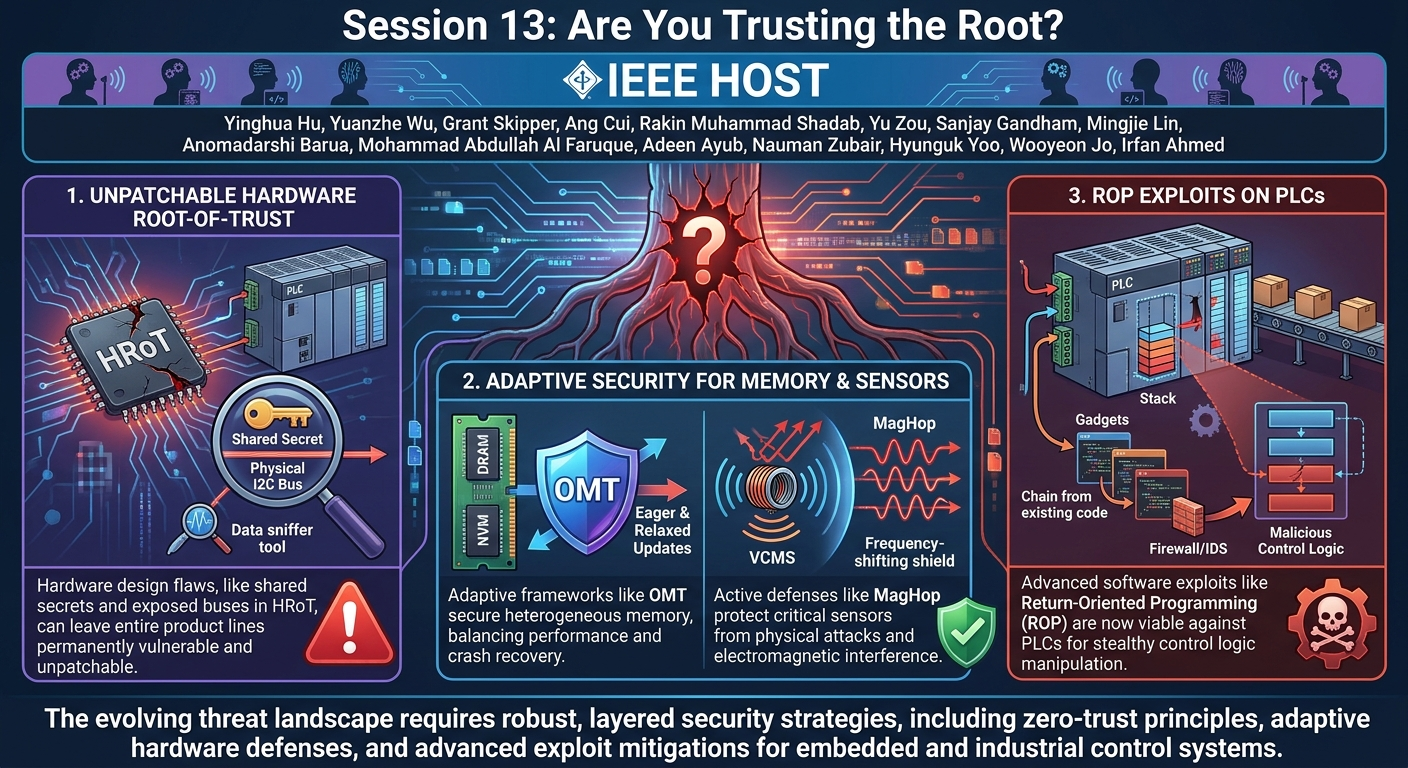
The IEEE HOST Session 13, aptly titled "Are You Trusting the Root?", presented a series of four compelling technical papers that collectively underscore the evolving landscape of security challenges in embedded and industrial control systems. This session delved into critical vulnerabilities and innovative defensive mechanisms across various layers of these foundational technologies. From uncovering unpatchable hardware flaws in widely deployed PLCs to pioneering adaptive memory authentication frameworks, and from securing physical sensors against electromagnetic attacks to demonstrating advanced software exploitation techniques like Return-Oriented Programming on industrial controllers, the talks highlighted the urgent need for robust, multi-faceted security strategies. The session brought together leading researchers to expose the often-overlooked attack surfaces and to propose forward-thinking solutions that are vital for safeguarding the critical infrastructure dependent on these systems.
Key moments
- 1:26 Hardware Root of Trust concepts and types
- 5:30 Novel cryo-mechanical memory extraction platform
- 13:00 Unpatchable hardware root-of-trust vulnerability impact
- 24:30 Introducing OMT: Adaptive authentication framework
- 44:00 MagHop: Magnetic spectrum hopping defense
- 54:00 MagHop Q&A: Attack at signal frequency
- 60:00 ROP attacks on PLCs: Contributions and challenges
- 67:30 ROP attack demonstrations on physical processes
Session 13: Are You Trusting the Root?
Speakers: Yinghua Hu (Session Chair, Synopsys); Yuanzhe Wu (Senior Research Scientist, Red Balloon Security); Rakin Muhammad Shadab (PhD Candidate, University of Central Florida); Anomadarshi Barua (PhD Candidate, University of California Irvine); Adeen Ayub (PhD Student, Virginia Commonwealth University)
Conference: IEEE HOST
YouTube: https://www.youtube.com/watch?v=v0wWyOiNork
Overview
The IEEE HOST Session 13, aptly titled "Are You Trusting the Root?", presented a series of four compelling technical papers that collectively underscore the evolving landscape of security challenges in embedded and industrial control systems. This session delved into critical vulnerabilities and innovative defensive mechanisms across various layers of these foundational technologies. From uncovering unpatchable hardware flaws in widely deployed PLCs to pioneering adaptive memory authentication frameworks, and from securing physical sensors against electromagnetic attacks to demonstrating advanced software exploitation techniques like Return-Oriented Programming on industrial controllers, the talks highlighted the urgent need for robust, multi-faceted security strategies. The session brought together leading researchers to expose the often-overlooked attack surfaces and to propose forward-thinking solutions that are vital for safeguarding the critical infrastructure dependent on these systems.
The presentations, delivered by Yuanzhe Wu, Rakin Muhammad Shadab, Anomadarshi Barua, and Adeen Ayub, showcased both the ingenuity of attackers in circumventing conventional defenses and the dedication of researchers in developing resilient countermeasures. A recurring theme was the inherent complexity and resource constraints of embedded systems, which often necessitate tailored security approaches that differ significantly from those used in general-purpose computing. The insights shared in this session are crucial for designers, engineers, and security professionals striving to enhance the trustworthiness and resilience of embedded systems against increasingly sophisticated threats.
Background
▶ Watch: Hardware Root of Trust concepts and types (1:26)
The security of embedded systems and Industrial Control Systems (ICS) has become a paramount concern, particularly given their pervasive role in critical infrastructure sectors such such as water processing, transportation, oil and gas, manufacturing, and nuclear facilities. These systems, often comprising Programmable Logic Controllers (PLCs), are specialized computers designed to control and monitor physical processes. Their direct interaction with the physical world makes them prime targets for cyberattacks, as famously demonstrated by the Stuxnet malware attack on Siemens PLCs.
A cornerstone of embedded system security is the Hardware Root of Trust (HRoT), which is designed to establish a secure foundation for initial execution, secure boot, firmware updates, and authentication. HRoTs typically provide three essential functions: secure key storage, cryptographic operations, and anti-tampering mechanisms. They can be integrated directly into a System-on-Chip (SoC) or implemented as dedicated external components like cryptographic authentication chips or FPGAs. While integrated solutions offer high security, resource constraints and compatibility issues in many embedded devices often necessitate dedicated HRoT solutions, which then depend on secure communication channels between the main microprocessor and the HRoT component.
Beyond the root of trust, memory integrity is critical. Modern embedded systems increasingly utilize hybrid memory architectures combining volatile DRAM with Non-Volatile Memory (NVM). NVM, while retaining data without power, presents challenges such as high write latency and limited write endurance. Protecting the integrity and confidentiality of data in such heterogeneous memory setups against sophisticated attacks, including those during off-power states, requires robust authentication methods. Bonsai Merkle Trees (BMTs) are a widely adopted solution for this, offering low memory overhead for integrity verification, particularly for encryption metadata like counters.
Another significant threat vector for ICS is the physical manipulation of sensors. Voltage and Current Magnetic Sensors (VCMS), which rely on magnetic fields as a transduction medium (e.g., Faraday's Law or Hall Effect sensors), are susceptible to Electromagnetic Interference (EMI) and direct magnetic field injection. Such attacks can corrupt sensor readings, leading to erroneous control decisions and potentially catastrophic physical consequences.
Finally, the realm of software exploitation, traditionally associated with general-purpose computing, has extended to embedded systems. Return-Oriented Programming (ROP), an advanced exploitation technique, allows attackers to execute arbitrary code by chaining together small instruction sequences (gadgets) already present in a program's memory. While ROP has been extensively studied in IT systems to bypass defenses like non-executable stacks, its application and implications in the unique context of PLCs, with their continuous scan cycles and distinct architectural features, present novel challenges and opportunities for attackers.
Key Findings
▶ Watch: Unpatchable hardware root-of-trust vulnerability impact (13:00)
The session unveiled several critical findings across the spectrum of embedded and industrial control system security:
13.1 Uprooting Trust: Learnings from an Unpatchable Hardware Root-of-Trust Vulnerability in Siemens S7-1500 PLCs
Researchers discovered a fundamental, unpatchable hardware root-of-trust vulnerability in Siemens S7-1500 PLCs. This flaw allows an attacker, with physical access, to perform an oracle attack on the cryptographic authentication chip, enabling them to decrypt, modify, re-encrypt, and re-authenticate tempered firmware. Crucially, this vulnerability impacts over 100 models across an entire product generation, and due to its hardware-centric nature, cannot be remediated through software updates, leaving millions of critical devices perpetually vulnerable.
13.2 OMT: A Run-time Adaptive Architectural Framework for Bonsai Merkle Tree-Based Secure Authentication with Embedded Heterogeneous Memory
This work presented OMT (Opportunistic Merkle Tree), a novel, runtime-adaptive, hardware-focused framework for Bonsai Merkle Tree (BMT)-based secure authentication in embedded systems with heterogeneous memory. OMT significantly reduces hardware resource consumption (by up to 44% in some metrics) compared to discrete implementations while providing a flexible and scalable architecture that supports both crash recovery and high runtime performance for memory-intensive applications. It achieves this by intelligently combining eager and relaxed update strategies.
13.3 MagHop: Magnetic Spectrum Hopping for Securing Voltage and Current Magnetic Sensors
The paper introduced MagHop, a groundbreaking magnetic spectrum hopping technique designed to secure Voltage and Current Magnetic Sensors (VCMS) against Electromagnetic Interference (EMI) and direct magnetic field injection attacks. MagHop effectively prevents sensor data corruption by dynamically shifting the signal's frequency spectrum, demonstrating robust defense without compromising the real-time measurement capabilities of the sensors. The defense was validated across various sensor types and in a practical solar inverter system.
13.4 Gadgets of Gadgets in Industrial Control Systems: Return Oriented Programming Attacks on PLCs
This research achieved the first successful demonstration of Return-Oriented Programming (ROP) attacks on PLCs. It showcased how attackers can reuse existing instruction sequences (gadgets) in the PLC's memory to create malicious control logic. This approach bypasses traditional security measures like Intrusion Detection Systems (IDS) and firewall rules, enabling stealthy and persistent manipulation of physical processes without sending large, detectable malicious code or writing directly to protected control logic areas.
Technical Deep Dive
▶ Watch: MagHop: Magnetic spectrum hopping defense (44:00)
13.1 Uprooting Trust: Learnings from an Unpatchable Hardware Root-of-Trust Vulnerability in Siemens S7-1500 PLCs
The Siemens S7-1500 PLCs are critical components in national infrastructure, from water treatment to nuclear facilities, and represent Siemens' advanced generation designed to resist attacks like Stuxnet. The research aimed to understand their security mechanisms, facing challenges like encrypted firmware, lack of debugging interfaces (e.g., JTAG, UI), and an opaque boot process.
To overcome these, the team developed a novel cryo-mechanical memory extraction platform. This platform leverages the data remanence effect, where cooling a chip to extreme temperatures (e.g., -40°C) significantly reduces electron dissipation speed, preserving memory content even after power-off. Unlike traditional cold boot attacks, this CNC-based platform can simultaneously remove and extract data from multiple soldered RAM chips (five in the S7-1500) with precise timing, reconstructing the runtime memory of the Adonis real-time operating system.
Analysis of the extracted memory revealed strings containing "atecc," leading to the identification of the Microchip ATECC108 crypto authentication chip as the HRoT component. This chip communicates with the PLC's main microcontroller via an exposed I2C bus. By attaching a pin header and using a digital analyzer, researchers sniffed the entire authentication process.
The discovered authentication process unfolds as follows:
- The bootloader requests cryptographic functions from the ATECC108.
- The ATECC108 generates and sends a random nonce to the bootloader via I2C.
- The bootloader calculates an expected response using a shared secret (residing in the bootloader) and the nonce, then sends it back.
- The ATECC108 verifies the response.
- After successful authentication, the bootloader sends firmware metadata.
- The ATECC108 generates a decryption key based on the metadata and sends it back to the bootloader, which then decrypts and boots the firmware.
Despite appearances, this implementation harbors critical flaws. The I2C bus's exposure allows observation of the entire authentication. More importantly, the ATECC chip acts only as a verifier of the shared secret, not the bootloader's authenticity itself. The shared secret is exposed in plain text within the bootloader. Furthermore, the firmware verification is asymmetric: while the ATECC protects the generation of the decryption key, the microcontroller blindly trusts and executes whatever data it decrypts, lacking a mechanism to verify the integrity of the decrypted firmware.
The most devastating finding is that the ATECC chip does not need to be soldered onto the PLC's PCB to operate. Researchers demonstrated an oracle attack by removing an ATECC chip and connecting it to a Raspberry Pi via I2C. A simple Python program could then falsely authenticate with the chip and leverage it as an oracle to decrypt, re-encrypt, and re-authenticate tempered firmware. This implies that an attacker with access to a single S7-1500 PLC can extract the shared secret and use its ATECC chip to compromise any other S7-1500 PLC from the affected generation, which includes over 100 models. Since this is a physical hardware vulnerability, it cannot be patched via software updates, rendering these critical systems perpetually vulnerable until physically replaced.
13.2 OMT: A Run-time Adaptive Architectural Framework for Bonsai Merkle Tree-Based Secure Authentication with Embedded Heterogeneous Memory
The proliferation of Non-Volatile Memory (NVM) alongside traditional DRAM in embedded systems creates heterogeneous memory architectures. While NVM offers data persistence, its high write latency and limited endurance necessitate careful integration. Both NVM and DRAM are susceptible to integrity and confidentiality attacks, requiring robust authentication. Bonsai Merkle Trees (BMTs) are a common choice for authenticating data integrity, particularly for encryption metadata like counters, due to their low memory overhead.
BMT updates typically follow two strategies:
- Eager Update: The entire data path from the modified counter up to the root node is updated. This guarantees crash recovery for NVM but introduces significant runtime overhead.
- Relaxed Update: Updates are propagated only up to a cached node. This offers better runtime performance but does not support crash recovery, making it unsuitable for NVM.
The challenge in hybrid systems is to achieve both crash recovery (for persistent data) and high performance (for regular data) without incurring excessive resource overhead or inflexible designs. The proposed solution is OMT (Opportunistic Merkle Tree), a hardware-focused, unified, and adaptive BMT framework.
OMT combines different BMT update logics while providing independent eager and relaxed update cores. Its core is the OMT controller, based on a scalable data flow architecture with dedicated compute stages for the counter, root, and N identical BMT stages for tree levels. A data and address management unit determines whether an incoming request is "persistent" (for NVM) or "non-persistent" (for DRAM) based on address mapping, and then activates the appropriate eager or relaxed update core.
A key innovation is the shared authentication engine and speculative buffer. The common authentication engine is utilized by both update cores, and the speculative buffer acts as a queue to store nodes currently being authenticated or updated, supporting multiple simultaneous operations. The hash module (e.g., SHA-1) is modular and replaceable. For an eager update, all BMT nodes in the update path are updated, potentially requiring uncached nodes to be brought into the cache and verified first. For a relaxed update, nodes are updated wherever they reside, and the update chain terminates if a node is found in the cache. Similarly, the common verification process searches for a cached node, stopping the verification chain as soon as one is found.
This adaptive design allows the BMT subsystem to be reconfigured easily without redesigning the authentication or update data path.
13.3 MagHop: Magnetic Spectrum Hopping for Securing Voltage and Current Magnetic Sensors
Voltage and Current Magnetic Sensors (VCMS) are essential in many industrial and cyber-physical systems. These sensors, whether Faraday's Law-based (using primary and secondary coils with magnetic coupling) or Hall Effect-based (using a Hall element in a magnetic field), rely on a magnetic field as the transduction medium to measure voltage or current signals. This reliance makes them vulnerable to Electromagnetic Interference (EMI) and direct magnetic field injection.
The threat model identifies three critical target locations for an attacker: the input conductor, the output conductor (both acting as antennas for EMI), and, most critically, the magnetic transduction medium itself. An attacker can inject strong EMI or magnetic fields, and if the attack bandwidth overlaps with the input signal's bandwidth, the sensor data becomes corrupted, as demonstrated by a 100mV DC shift and noise spikes in a current transformer test.
MagHop proposes a novel defense mechanism based on magnetic spectrum hopping. The core idea is to intentionally modulate the input signal's frequency spectrum by multiplying it with a carrier frequency, thereby creating a separation between the signal's bandwidth and potential attack frequencies. To prevent an attacker from tracking and jamming a static carrier frequency, MagHop continuously hops the carrier frequency across multiple channels.
The implementation of MagHop involves:
- A simple modulator (multiplier) at the sensor's input stage.
- A carrier frequency generator comprising an 8-bit Linear Shift Register (LSR) to produce 255 pseudo-random sequences (channels), a lookup table, and a Digital-to-Analog Converter (DAC) to generate sinusoidal carrier waves.
- A synchronous demodulator and low-pass filter at the output stage to reconstruct the original signal.
- A crucial check circuit that evaluates the integrity of a potential carrier frequency channel before switching to it. If a channel is found to be corrupted by an attacker, the system skips it and hops to the next uncorrupted channel in a pseudo-random fashion.
- A high-speed microprocessor synchronizes all these activities to ensure real-time coherency of the output signal.
The design addresses real-time measurement concerns. Each "modulation fragment" (a chunk of the analog signal, typically 0.1 to 2 milliseconds long) introduces approximately 25 nanoseconds of overloading. For sensors with a bandwidth of 200 kHz (microsecond range), this overhead is negligible, ensuring that MagHop does not hamper real-time measurement. The system coherently reassembles the demodulated fragments to produce an accurate, uncorrupted output.
13.4 Gadgets of Gadgets in Industrial Control Systems: Return Oriented Programming Attacks on PLCs
This research pioneers the application of Return-Oriented Programming (ROP) attacks against Programmable Logic Controllers (PLCs), demonstrating a stealthy method to manipulate industrial control logic. The motivation stems from the limitations of traditional attacks that involve sending large malicious code (detectable by IDS) or writing to protected control logic areas (blocked by firewalls). ROP circumvents these by reusing existing instruction sequences, or gadgets, already present in the PLC's memory.
ROP on PLCs presents unique challenges compared to IT systems:
- Determining Control Logic Location: Identifying the start and end addresses of the control logic in PLC memory is crucial for gadget discovery and stack manipulation.
- Malicious Gadget Chain Creation: Crafting effective gadget chains from the limited instruction sets typically found in PLC firmware.
- Stack Overwriting without Buffer Overflow: PLCs generally do not expose user-controlled remote input directly to the stack, making traditional buffer overflow techniques for stack manipulation unfeasible.
- Maintaining PLC Functionality: The attack must disrupt the physical process without causing the PLC itself to malfunction.
- Continuous Scan Cycle: PLCs operate in a continuous scan cycle. A ROP chain must execute repeatedly, not just once, to maintain persistent malicious control over the physical process.
- Persistent Control: The attacker needs a mechanism to update or change the nature of the attack over time.
The researchers exploited several PLC design features:
- Predictable Control Logic Location: In specific PLCs like the Schneider Electric M221, a configuration block holds the control logic's address. Other PLCs, like MicroLogix 1400, write control logic to fixed, known locations.
- Designated I/O Registers: CPU registers are often dedicated to I/O ports (e.g., R13 maps to output, R12 to input in M221), providing clear targets for gadget manipulation.
- Upload/Download Capability: This feature can be leveraged to manipulate the stack.
- Unprotected Stack: The PLC stack is often not randomized or protected against modification.
The proposed techniques include:
- Finding Useful Gadgets: Identifying instructions that operate on designated I/O registers.
- Stack Modification Code (SMC) Injection: A small, benign-looking code snippet appended to the legitimate control logic. This SMC executes in every scan cycle, ensuring the ROP chain's continuous operation.
- Stack Overwriting Technique: Instead of directly overwriting the active stack pointer, the technique involves decrementing the stack pointer to modify instructions that have already been executed. This ensures the PLC's current operation is not disrupted, preventing immediate malfunction.
- Persistent Control: Allocating a "buffer" (free space) within the PLC memory where the attacker can preload and update gadget chains.
Two main attack variants were demonstrated:
- ROP1 (Adds Gadgets to Existing Control Logic):
- Variant 1 (Single Gadget): A single gadget (e.g., setting bit 2 of R13) is injected to manipulate an output port (e.g., turning on output Q2). This offers limited control.
- Variant 2 (Gadget Chain): A hand-picked gadget chain provides greater control, allowing the attacker to assign specific values to output ports (e.g., putting
0x09into R13 to turn on output bits 1 and 4).
- ROP2 (Constructs Complete Malicious Control Logic): This advanced variant constructs an entire, new malicious control logic program solely from existing instruction sequences (gadgets) found in the PLC's memory.
Demo / Proof of Concept
▶ Watch: MagHop Q&A: Attack at signal frequency (54:00)
13.1 Uprooting Trust: Learnings from an Unpatchable Hardware Root-of-Trust Vulnerability in Siemens S7-1500 PLCs
The vulnerability was demonstrated by physically desoldering an ATECC108 crypto authentication chip from a Siemens S7-1500 PLC. This removed chip was then connected to a Raspberry Pi via the I2C bus. A custom Python program running on the Raspberry Pi successfully performed a firmware oracle attack. This involved using the ATECC chip to decrypt legitimate firmware, modify it (temper it), re-encrypt the modified firmware, and finally re-authenticate it, proving that an attacker could generate and install malicious yet authenticated firmware. The researchers confirmed that this issue affects over 100 models of the S7-1500 series PLCs, highlighting the widespread impact of this unpatchable hardware design flaw.
13.2 OMT: A Run-time Adaptive Architectural Framework for Bonsai Merkle Tree-Based Secure Authentication with Embedded Heterogeneous Memory
The OMT framework was implemented and evaluated on a Xilinx U200 FPGA. For testing purposes, NVM was emulated using embedded DRAM, and the system was configured to protect 120 Mbit of data using 5 levels of BMT.
- Hardware Utilization: OMT significantly reduced resource consumption, showing a nearly 50% reduction in lookup tables (LUTs), flip-flops, and block RAM compared to using two discrete eager and relaxed update BMT implementations.
- Execution Time: Benchmarking with applications like
streamandbinary search(memory-intensive) andfinandiir(compute-intensive) from the BBS and DSPStone suites revealed that OMT in relaxed update mode provided up to 22% faster execution for memory-intensive scenarios. For compute-intensive applications, its performance matched the baseline eager update mode. - Secure Access Latency: OMT in relaxed mode achieved up to a 14% reduction in secure access latency.
- System Bandwidth: For random write operations, OMT in relaxed mode delivered up to 47% higher bandwidth due to its adaptive nature leveraging cache hits to terminate update logic earlier. Sequential read/write bandwidths were similar across all systems due to high counter cache hit rates.
13.3 MagHop: Magnetic Spectrum Hopping for Securing Voltage and Current Magnetic Sensors
The MagHop defense was rigorously evaluated. First, a simple current transformer was subjected to attack: a strong electromagnet injected a DC magnetic field causing a 100mV upward shift, and EMI injection introduced noise spikes into the sinusoidal output. With MagHop enabled, the output signal was restored to its original clean sinusoidal shape, achieving a correlation coefficient close to 1 with the unattacked signal.
The defense was further tested on 10 different sensor types (including open-loop, closed-loop, Hall, voltage, current, and differential sensors) across their entire bandwidths, consistently yielding correlation coefficients close to 1, demonstrating its broad applicability.
For a practical system demonstration, MagHop was integrated into a 140W solar inverter. Without MagHop, an attacker could manipulate the inverter's reported power output from 124W down to 94W. With MagHop integrated, the attack failed, and the power reading remained stable at 124W, proving its effectiveness in a real-world scenario without introducing runtime overload or disconnections.
13.4 Gadgets of Gadgets in Industrial Control Systems: Return Oriented Programming Attacks on PLCs
The ROP attacks were demonstrated on a Schneider Electric M221 PLC controlling three fully functional physical processes:
- ROP1 (Variant 1) with an Elevator Model: A single gadget was injected to continuously set output bit 2 (Q2), which was connected to the elevator's motor. This caused the elevator to move continuously upward. Upon reaching its limit, the motor continued to rotate, eventually burning out, and the elevator subsequently fell. The PLC's scan time remained unaffected during the attack.
- ROP1 (Variant 2) with a Conveyor Belt Model: A more complex gadget chain was executed, which placed the value
0x09into the R13 register (mapped to output ports). This configuration ensured the conveyor belt kept running and a sorting valve remained in a forward position, preventing metal objects from being sorted. Both scan time and the overall program size (due to the small SMC) were negligibly affected. - ROP2 with a Compact Traffic Light System: An entire malicious control logic was constructed from scratch using ROP gadgets. This logic turned on output 1 (connected to a blue blinking light) whenever input 3 (an emergency toggle switch) was activated. As a result, when the emergency switch was toggled, the blue light blinked, and the normal red, orange, and green lights ceased to function, effectively disabling the traffic system.
Defensive Implications
▶ Watch: ROP attack demonstrations on physical processes (67:30)
The findings from this session offer critical insights for enhancing the security posture of embedded and industrial control systems:
For Hardware Root of Trust and Firmware Integrity (Uprooting Trust)
- Embrace Zero-Trust Principles: HRoT implementations must extend beyond merely trusting the secure hardware. A zero-trust approach is imperative, where both the device and its peripherals (including the HRoT chip) must mutually verify each other's integrity and authenticity.
- Implement Symmetric Verification: Trust mechanisms should be bidirectional. Not only should the HRoT verify the bootloader, but the bootloader or main microcontroller should also verify the HRoT's state and responses, and crucially, the integrity of the decrypted firmware before execution.
- Secure Communication Channels: Critical authentication buses like I2C must be physically protected and logically hardened. If such buses are exposed, stronger cryptographic protocols must be employed to prevent sniffing and manipulation.
- Unique Device Secrets: Sharing master key material across an entire product generation is a severe vulnerability. Each device should ideally possess unique, device-specific secrets to limit the impact of a compromise.
- Supply Chain Security: The physical nature of this vulnerability underscores the critical importance of securing the entire supply chain. Physical access at any stage can lead to unpatchable and widespread compromise.
For Memory Authentication in Hybrid Systems (OMT)
- Adopt Adaptive Authentication Frameworks: For systems utilizing heterogeneous memory (DRAM and NVM), adaptive BMT frameworks like OMT are essential. They provide efficient and robust integrity protection, balancing crash recovery needs with performance requirements without incurring high resource overhead.
- Prioritize Hardware-Centric Design: Security primitives in embedded systems, especially those on FPGAs, should be designed with hardware efficiency and scalability in mind. This means favoring architectures that are easily unrolled into RTL and can scale parametrically.
- Ensure Flexibility and Reconfigurability: Security architectures should be flexible enough to adapt to changes in memory configurations or system requirements without requiring a complete redesign of the authentication or update data paths.
For Sensor Security (MagHop)
- Implement Active Sensor Protection: Relying solely on passive EMI shielding is insufficient against sophisticated magnetic field injection attacks. Critical voltage and current sensors require active defense mechanisms, such as magnetic spectrum hopping, to dynamically protect their measurement integrity.
- Maintain Real-Time Performance: Any defensive mechanism for sensors must operate in real-time without introducing unacceptable latency or performance degradation that could disrupt the controlled process.
- Incorporate Integrity Checks for Defense Parameters: Crucially, defense parameters (e.g., carrier frequencies in MagHop) must themselves be protected and verified. Integrating "check circuits" to ensure the integrity of these parameters before use prevents attackers from circumventing the defense by corrupting its operational settings.
For PLC Exploitation and Control Logic Integrity (Gadgets of Gadgets)
- Robust Control Logic Integrity Checking: Implement granular and continuous integrity checks for PLC control logic. Even small, appended Stack Modification Code (SMC) should trigger alerts, as it can indicate an attempt to inject malicious functionality.
- Message Authentication for ICS Protocols: ICS communication protocols should incorporate strong message authentication codes to distinguish legitimate commands and data from attacker-supplied input, especially when interacting with areas that influence stack manipulation.
- Implement Address Space Layout Randomization (ASLR): Introducing ASLR into PLCs would randomize the memory addresses of instructions and gadgets. This would significantly complicate ROP attacks by making gadget discovery and chain construction non-deterministic and much harder for attackers.
- Enhanced Stack Protections: Beyond basic buffer overflow prevention, PLCs need more advanced stack protections, potentially including non-executable stacks (NX bit) for code segments and stack canaries to detect unauthorized stack modifications.
Key Takeaways
- Unpatchable Hardware Flaws are a Reality: Fundamental design flaws in hardware roots of trust, especially those with shared secrets and unidirectional verification, can lead to unpatchable vulnerabilities affecting entire product lines for years.
- Zero-Trust is Paramount for HRoT: Trusting hardware implicitly is a "double-edged sword." A true zero-trust approach, involving mutual authentication between devices and their peripherals, is critical to prevent exploitation.
- Adaptive Security for Heterogeneous Systems: Modern embedded systems with hybrid memory architectures demand adaptive and hardware-efficient security frameworks (like OMT) to balance performance, resource constraints, and data integrity needs.
- Physical Layer Attacks are Sophisticated: Critical sensors are vulnerable to advanced physical attacks like EMI and magnetic field injection. Active, real-time defenses (like MagHop) are necessary to secure these fundamental components of industrial control.
- ROP is a Viable Threat to PLCs: Advanced software exploitation techniques, specifically Return-Oriented Programming, can be successfully applied to PLCs, enabling stealthy and persistent control logic manipulation that bypasses traditional security measures.
- Layered Defense is Essential: A comprehensive security strategy for embedded and industrial control systems must include physical protection, robust hardware roots of trust, memory integrity, sensor protection, and advanced software exploitation mitigations like ASLR and strong integrity checking.
About the Speaker(s)
- Yuanzhe Wu is a Senior Research Scientist at Red Balloon Security, where he has contributed his expertise in embedded system security for over five years. His research interests include hardware, software, and firmware reverse engineering, as well as vulnerability research in embedded systems. He earned his Master of Science degree with a specialization in robotics and control from Columbia University.
- Rakin Muhammad Shadab is a PhD candidate from the Department of Electrical Engineering and Computer Engineering at the University of Central Florida.
- Anomadarshi Barua is a PhD candidate studying Computer Engineering at the University of California Irvine. He received his MS degree in embedded computing systems jointly from the University of Southampton and the Norwegian University of Science and Technology. His research focuses on system-level design of embedded and cyber-physical systems, with a special interest in CPS security, low-power design, and computer microarchitecture.
- Adeen Ayub is a PhD student at Virginia Commonwealth University. Her research interests include vulnerability discovery and exploit development in industrial control systems. She is a recipient of the early career research award by Virginia Commonwealth University and other accolades for her work.
Reviews
Dr. Zero (Offensive Security Researcher) — MUST SEE
This is exactly what hardware research is supposed to look like. Cryo-mechanically extracting memory to drop an unpatchable hardware zero-day on Siemens S7-1500 PLCs is top-tier engineering, and proving out ROP on bare-metal controllers pushes the ICS exploitation baseline forward. Skip the vendor keynotes and watch this.
Heather Calloway (CISO) — MUST SEE
An academic session that buries a massive OT security headline: flagship Siemens S7-1500 PLCs have an unpatchable hardware vulnerability. If you have a manufacturing, energy, or critical infrastructure footprint, your OT security leaders need to read this immediately to adjust their compensating controls and procurement plans.
All talks from IEEE International Symposium on Hardware Oriented Security and Trust (HOST) 2023