Session 12: Use Artificial Intelligence vs Leakage!
M. Tauhidur Rahman (Session Chair · Florida International University), Honggang Yu (Paper author), Shuo Wang (Paper author), Haoqi Shan (Paper author), Maximillian Panoff (Paper author), Michael Lee (Paper author), Kaichen Yang (Paper author), Yier Jin (Paper author), Anuj Dubey (Paper author), Rosario Cammarota (Paper author), Avinash L. Varna (Paper author), Raghavan Kumar (Paper author), Aydin Aysu (Paper author), Chenggang Wang (Paper author), Jimmy Dani (Paper author), Shane Reilly (Paper author), Austen Brownfield (Paper author), Boyang Wang (Paper author · University of Cincinnati), John Emmert (Paper author)
IEEE International Symposium on Hardware Oriented Security and Trust (HOST) 2023 · Day 3 · Gateway Ballroom
Overview
This session, "Use Artificial Intelligence vs Leakage!", presented at the IEEE HOST conference, delved into the evolving landscape of hardware security, specifically focusing on the intersection of side-channel attacks (SCA) and artificial intelligence. Chaired by Dr. M. Tauhidur Rahman, the session featured three distinct papers that collectively illustrated both the increasing sophistication of AI-driven attacks and the innovative defensive strategies emerging to counter them. The core theme revolved around the dual nature of AI: its potent capability to extract sensitive information through subtle physical leakages and its potential to fortify systems against such exploitation.
Key moments
- 1:58 TripletPower: Deep Learning Side-Channel Attacks with Few Traces
- 3:30 Challenge: Deep learning SCA requires many training traces
- 13:40 TripletPower significantly reduces required training traces
- 23:45 Hardware-Software Co-design for Side-Channel Protected NN Inference
- 27:00 Innovative features: Selective masking and data path reuse
- 44:00 Dual-Leak: Deep Unsupervised Active Learning for Cross-Device SCA
- 56:00 Dual-Leak attack: Only 10-20 traces needed for key recovery
Use Artificial Intelligence vs Leakage!
Speakers: M. Tauhidur Rahman (Session Chair, Florida International University); Honggang Yu, Shuo Wang, Haoqi Shan, Maximillian Panoff, Michael Lee, Kaichen Yang, Yier Jin (Dual-Leak authors); Anuj Dubey, Rosario Cammarota, Avinash L. Varna, Raghavan Kumar, Aydin Aysu (Hardware-Software Co-design authors); Chenggang Wang, Jimmy Dani, Shane Reilly, Austen Brownfield, Boyang Wang, John Emmert (TripletPower authors)
Conference: IEEE HOST
YouTube: https://www.youtube.com/watch?v=9On5Gi2u-fI
Overview
This session, "Use Artificial Intelligence vs Leakage!", presented at the IEEE HOST conference, delved into the evolving landscape of hardware security, specifically focusing on the intersection of side-channel attacks (SCA) and artificial intelligence. Chaired by Dr. M. Tauhidur Rahman, the session featured three distinct papers that collectively illustrated both the increasing sophistication of AI-driven attacks and the innovative defensive strategies emerging to counter them. The core theme revolved around the dual nature of AI: its potent capability to extract sensitive information through subtle physical leakages and its potential to fortify systems against such exploitation.
The talks highlighted critical challenges in modern hardware security, including the need for robust attack methodologies that demand fewer training traces, the imperative to protect valuable intellectual property embedded in machine learning models, and the development of adaptable defenses against cross-device and cross-domain side-channel leakage. Each paper contributed a unique perspective, ranging from novel deep learning architectures for efficient key recovery to comprehensive hardware-software co-design frameworks for securing neural network inferences. The discussions underscored the dynamic arms race between attackers leveraging advanced analytical tools and defenders striving for resilient and practical security solutions.
The first paper, "Dual-Leak," introduced an active learning approach to perform cross-device profiled side-channel leakage analysis with significantly fewer traces. Following this, "Hardware-Software Co-design" presented a robust defense mechanism for neural network inference, emphasizing selective masking and data path reuse. Finally, "TripletPower" detailed a deep learning side-channel attack leveraging triplet networks to achieve key recovery with a remarkably small number of training traces, showcasing the power of advanced machine learning in offensive capabilities.
Background
▶ Watch: TripletPower: Deep Learning Side-Channel Attacks with Few Traces (1:58)
Side-channel attacks (SCA) represent a formidable threat to the security of cryptographic implementations and, increasingly, to machine learning models deployed on embedded hardware. Unlike traditional cryptanalytic attacks that target mathematical weaknesses, SCA exploits unintentional information leakage from a device's physical operations, such as power consumption, electromagnetic (EM) emissions, or execution time. By analyzing these side channels, an attacker can infer secret data, most notably cryptographic keys. For instance, the correlation between power consumption and the Hamming weight of intermediate values during an AES encryption operation can reveal key bytes.
Historically, SCAs have relied on statistical methods like Differential Power Analysis (DPA), which often require extensive data pre-processing and a deep understanding of the target device's implementation. However, the advent of machine learning (ML) and particularly deep learning (DL) has revolutionized the field. DL-based SCAs offer several advantages: they can often operate with less reliance on manual feature engineering, automatically learn complex leakage patterns, and exhibit resilience against traditional countermeasures like random delays or basic masking. Despite these benefits, a significant challenge for DL-based attacks has been their typical requirement for a large number of training traces to build an effective model, a scenario not always feasible in real-world attack contexts, especially in non-profiling scenarios where an attacker cannot freely collect data from an identical device.
Beyond cryptographic implementations, the intellectual property (IP) inherent in machine learning (ML) models has become a high-value target. Developing sophisticated ML models involves substantial investment in research, proprietary training data, and specialized computational resources. When these models are deployed on user-facing hardware, they become vulnerable to side-channel attacks, allowing malicious actors to reverse-engineer their internal parameters (weights and biases). This threat has spurred research into hardware security for ML, aiming to protect these valuable assets from extraction. Existing defensive efforts often focus on designing side-channel-hardened hardware modules, but a more comprehensive, full-stack approach that integrates hardware and software protections is increasingly recognized as necessary.
The problem of requiring vast amounts of training data for DL models, both in attack and defense, has led to the exploration of active learning. Active learning is a machine learning paradigm where the learning algorithm can interactively query a user or other information source to obtain the desired outputs (labels) for new data points. In the context of SCA, this means strategically selecting the most informative traces for training, thereby reducing the overall number of traces required to achieve a high-performance model. This is particularly relevant for scenarios where data collection is costly, time-consuming, or restricted, pushing the boundaries of what's possible with limited resources.
Key Findings
▶ Watch: TripletPower significantly reduces required training traces (13:40)
The session presented three distinct papers, each offering significant contributions to the field of hardware security, whether in advancing attack methodologies or proposing novel defense mechanisms.
12.1 Dual-Leak: Deep Unsupervised Active Learning for Cross-Device Profiled Side-Channel Leakage Analysis
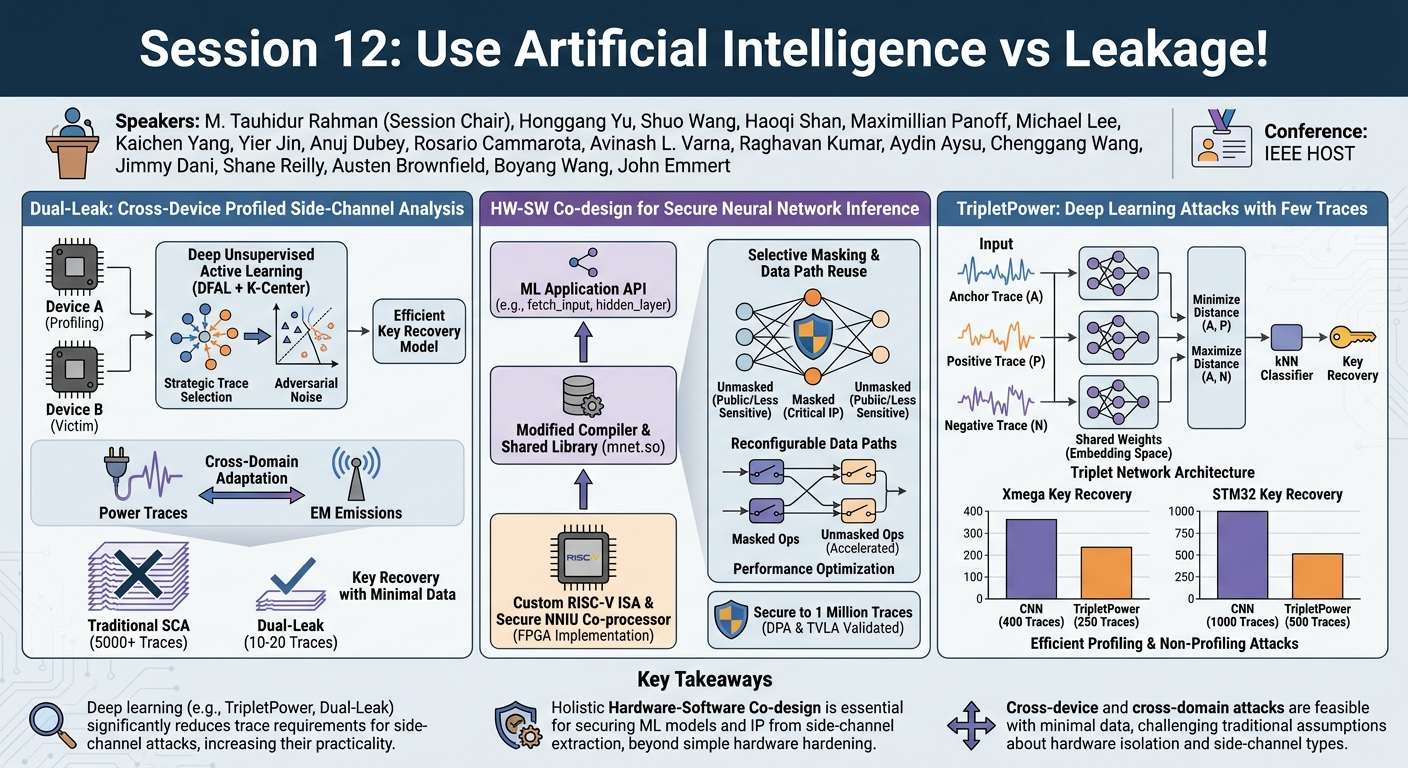
This paper, presented by Dr. Xiaolong Guo on behalf of the authors, introduced a novel deep unsupervised active learning framework, dubbed Dual-Leak, designed to significantly reduce the number of traces required for cross-device profiled side-channel leakage analysis. The key finding is that by employing sophisticated active learning strategies, particularly a combination of Deep Focused Active Learning (DFAL) and K-Center sampling, attackers can achieve successful key recovery with an unprecedentedly low number of traces—often as few as 10 to 20 during the attack phase. This represents a drastic reduction compared to traditional methods or even basic deep learning approaches that might require thousands of traces (e.g., 5,000 traces for original SCA). Furthermore, Dual-Leak demonstrated efficacy in cross-domain attacks, where a model trained on power traces could successfully attack a device using EM traces, thereby challenging the assumption that different side channels offer inherent protection. The research validated its approach across multiple microcontrollers (e.g., STM32, ATXmega) and various leakage types (power, EM).
12.2 Hardware-Software Co-design for Side-Channel Protected Neural Network Inference
Presented by Anuj Dubey, this work proposed the first hardware-software co-design framework specifically for side-channel protected neural network inference. The primary finding is that a full-stack approach, extending from the hardware instruction set to the application programming interface (API), can effectively secure machine learning models against side-channel attacks without prohibitive performance overheads. The framework incorporates two innovative techniques: selective masking and data path reuse. Selective masking allows developers to choose which layers of a neural network to protect, enabling significant performance and area savings, especially for transfer learning scenarios where initial layers might contain publicly known parameters. Data path reuse optimizes the hardware for both masked and unmasked operations, improving efficiency. Empirical validation on an FPGA-based system-on-chip (SoC) demonstrated that the design is secure to the first order against both DPA (model-based) and TVLA (model-less) attacks, even with 1 million traces, while maintaining performance comparable to existing hardware-only solutions. The authors also successfully taped out a chip using open-source PDKs.
12.3 TripletPower: Deep-Learning Side-Channel Attacks over Few Traces
Dr. Boyang Wang presented "TripletPower," a new deep learning side-channel attack that significantly mitigates the traditional requirement for a large number of training traces. The core finding is that triplet networks can learn a more robust embedding space for power traces, enabling effective profiling attacks (both same-device and cross-device) and non-profiling attacks with a remarkably small dataset. Specifically, for an Xmega microcontroller, TripletPower achieved key recovery with only 250 training traces, significantly outperforming traditional Convolutional Neural Network (CNN) approaches which required at least 400 traces. Similar results were observed for STM32, where TripletPower needed 500 traces compared to CNN's 1,000. The method was also extended to non-profiling attacks using on-the-fly labeling, demonstrating its versatility. This work confirms that advanced deep learning architectures can make side-channel attacks more practical and resource-efficient, even when profiling data is scarce.
Technical Deep Dive
▶ Watch: Hardware-Software Co-design for Side-Channel Protected NN Inference (23:45)
The session explored sophisticated techniques in both offensive and defensive hardware security, leveraging advanced machine learning and robust hardware design principles.
12.1 Dual-Leak: Deep Unsupervised Active Learning for Cross-Device Profiled Side-Channel Leakage Analysis
The "Dual-Leak" paper addresses the critical challenge of performing effective side-channel attacks (SCA) with limited profiling data, particularly in cross-device and cross-domain scenarios. The authors' core innovation lies in integrating active learning (AL) into the deep learning (DL) profiling process. Traditional DL-based SCA often suffers from high complexity and the need for vast amounts of labeled training data, especially when dealing with hardware variations between profiling and target devices, or when transitioning between different physical side-channel measurements (e.g., power vs. EM).
The foundational idea of Dual-Leak is to refine the dataset used for training the DL model by strategically selecting the most informative traces. This is achieved through various AL strategies:
- Random Sampling: A baseline where all collected traces are used.
- Uncertainty Sampling: Selects traces for which the model is most uncertain, aiming to improve decision boundaries.
- K-Center Sampling: Utilizes a greedy K-Center algorithm to choose a diverse subset of traces, maximizing coverage of the data space.
- Deep Focused Active Learning (DFAL): A more advanced method that introduces adversarial noise to push data points towards the decision boundary. By training on these "harder" examples, the model learns a more robust and generalized representation.
The authors tested several combinations of these strategies, finding that a two-stage approach combining DFAL followed by K-Center sampling yielded the most significant performance improvements. DFAL first pushes data points towards the decision boundary, and then K-Center sampling selects a representative subset of these boundary-proximal points, creating a highly efficient and refined training dataset.
The "Dual-Leak" framework operates by collecting traces from a profiling device and, crucially, also some unlabeled traces from the attacking victim device. These traces then undergo the chosen AL pre-processing (e.g., DFAL + K-Center) to form a refined dataset. This refined dataset is then used to train a deep learning model, which is subsequently deployed for key recovery on the target device.
For experimental validation, the researchers utilized a diverse set of five microcontrollers, including STM32 (32-bit) and ATXmega (8-bit) devices, to simulate cross-device scenarios. They considered both power traces (collected via a ChipWhisperer platform) and EM emissions (captured using a 3D position system and an R2DM probe). An oscilloscope was used for data acquisition. Each device yielded approximately 30,000 traces for both power and EM. The key finding was the dramatic reduction in the number of attack traces required: the DFAL + K-Center combination allowed successful key recovery with as few as 10-20 traces from the victim device, a stark contrast to the 5,000 traces often needed by original SCA methods. This highlights the power of active learning in overcoming data scarcity and device heterogeneity.
Furthermore, the paper demonstrated cross-domain attacks, where a model trained solely on power traces from a profiling device could successfully extract keys from a victim device based on its EM emissions, and vice-versa. This capability, achieved with only "several tens" of traces, implies that attackers can adapt models across different physical leakage types, further eroding traditional defensive assumptions. The inclusion of a public database for training also showed improved results compared to original SCA, even without direct victim device profiling.
12.2 Hardware-Software Co-design for Side-Channel Protected Neural Network Inference
This paper tackles the critical problem of securing valuable machine learning (ML) models deployed on user platforms against side-channel attacks (SCA). Presented by Anuj Dubey, the work proposes a hardware-software co-design framework that aims for a full-stack security solution, abstracting the complexity of side-channel protection from the application developer. This approach is analogous to how modern CPUs integrate AES-NI instructions for secure cryptographic operations, providing a seamless and secure inference capability for neural networks.
The motivation stems from the significant intellectual property (IP) value of ML models, which are costly to develop and vulnerable to parameter extraction via SCA on hardware. Unlike prior work that mainly focused on side-channel-hardened hardware modules, this research seeks to provide a comprehensive solution from the Risk-V toolchain to the ML application layer.
The core contributions include:
- First Hardware-Software Co-design Framework: This integrates custom instructions into the Risk-V Instruction Set Architecture (ISA), modifies the compiler, and provides a shared library (
mnet.so) with simple APIs (e.g.,fetch_input,input_layer,hidden_layer,output_layer) that resemble frameworks like Keras. Application developers can write C code that, when compiled, leverages these secure instructions for ML inference. - Selective Masking: This innovative feature allows ML developers to choose which neural network layers to mask. For instance, in transfer learning, only the final layers might contain proprietary information, while initial layers are public. Masking only critical layers significantly reduces the overhead in terms of performance and hardware area compared to masking the entire network.
- Data Path Reuse: The hardware design incorporates reconfigurable data paths that can be efficiently utilized for both masked and unmasked operations. This allows the system to accelerate unmasked inferences by using both data paths in parallel, effectively halving the time for certain operations.
The design focuses on binarized neural networks (BNNs), where weights and activations are restricted to +1/-1, making them suitable for embedded applications due to reduced area, power, and memory footprint. The security mechanism relies on hardware masking, splitting secret values into two statistically independent shares (Boolean for bit-wise, arithmetic for composite numbers) to break correlations between the secret and power traces. The co-processor, termed the Secure Neural Network Inference Unit (SNIIU), works alongside a Risk-V core, sharing memory and executing secure inference operations based on instructions from the core.
A significant aspect of the technical deep dive is the meticulous design of reconfigurable data paths to prevent any accidental leakage. The authors emphasized the delicate nature of masking, where even temporary glitches or unshared values can lead to side-channel vulnerabilities. For example, registers are strategically placed after input pixels are arithmetically masked and before they are multiplied with secret weights, ensuring that only shared values propagate. Similarly, registers are used at the input of masked activation functions to prevent temporary recombination of shares when the design is meant to be masked.
Exhaustive TVLA (Test Vector Leakage Assessment) and DPA (Differential Power Analysis) validations were performed on an FPGA implementation. The unmasked design showed clear leakages (e.g., DPA at ~6,000 traces), while the masked design exhibited no significant leakages, even with 1 million traces, demonstrating first-order security. The TVLA plots clearly illustrated the effectiveness of selective masking: when only input and output layers were masked, leakages appeared in the hidden layer, and vice-versa, confirming the precise control offered by the technique. The authors also addressed the handling of non-linear functions (e.g., ReLU, Maxpool) by building upon Dom (Domain-Oriented Masking) Gates from prior work (ModularNet), developing new masking gadgets for these functions to maintain security. The paper also mentioned a successful tape-out of the chip using SkyWater 130nm technology, indicating the practical feasibility of their solution.
12.3 TripletPower: Deep-Learning Side-Channel Attacks over Few Traces
"TripletPower," presented by Dr. Boyang Wang, addresses a major limitation of many deep learning (DL) based side-channel attacks (SCA): the requirement for a large number of training traces. This work introduces a novel DL attack strategy that leverages triplet networks to achieve key recovery with significantly fewer traces, making such attacks more practical in scenarios with limited data.
The fundamental setup for the attack involves an attacker monitoring the power consumption of a microcontroller running cryptographic algorithms, specifically AES-128. The leakage model assumes a correlation between power consumption and the Hamming weight (HW) of intermediate values, particularly the output of the AES S-box (sub-bytes) in the first round. The goal is to recover the 16-byte AES key, one byte at a time, meaning 256 possible key guesses for each byte. Points of interest (POIs) are identified as the power samples corresponding to the S-box operations. The evaluation metric used is key ranking or guessing entropy, where a rank of zero indicates successful key recovery.
The core of TripletPower is the triplet network architecture. Unlike traditional CNNs that classify single inputs, a triplet network processes three inputs simultaneously: an anchor trace (A), a positive trace (P), and a negative trace (N).
- The anchor and positive traces are selected from the same class (i.e., correspond to the same Hamming weight of the intermediate value).
- The anchor and negative traces are selected from different classes (i.e., different Hamming weights).
During training, the three parallel sub-networks (which share weights) learn an embedding space. The objective is to minimize the distance between the anchor and positive embeddings while maximizing the distance between the anchor and negative embeddings, typically with a margin. This creates a robust embedding where traces from the same class are clustered together, and traces from different classes are separated. After training, one of the sub-networks is extracted, and a simple classifier like K-Nearest Neighbors (kNN) is attached to perform the final classification for SCA.
The paper extends this profiling attack method to non-profiling attacks using an on-the-fly labeling technique. In this more challenging scenario, the attacker only has unlabeled traces from the target device. The process involves:
- Guessing a key byte (e.g., 0x00).
- Generating corresponding labels (Hamming weights) for all unlabeled traces based on this key guess.
- Training a triplet network classifier using these "guessed" labels.
- Testing the classifier's accuracy on a subset of traces.
This process is repeated 256 times (for each possible key byte). The assumption is that the classifier trained with the correct key guess will exhibit a significantly higher accuracy, allowing it to be distinguished from classifiers trained with incorrect guesses (which would have accuracy similar to random guessing). The authors emphasize the importance of using a Hamming weight model for this, as an Identity (ID) model would produce identical partitions for all key guesses, making distinction impossible.
The authors collected extensive data using a ChipWhisperer platform from Xmega and STM32 microcontrollers, including masked and unmasked AES-128 implementations, and also with random delays, accumulating nearly 1 million power traces.
Experimental results demonstrated TripletPower's efficiency:
- For Xmega, it required only 250 training traces to recover the key, whereas a standard CNN needed at least 400.
- For STM32, TripletPower succeeded with 500 traces, compared to CNN's 1,000.
These results were observed in profiling attacks (same-device setting). For non-profiling attacks, 500 unlabeled traces for Xmega masked AES were sufficient to distinguish the correct key, though some scenarios (e.g., Xmega with random delay) required more (2,000 unlabeled traces).
A acknowledged limitation is the longer training time for triplet networks. For instance, training with 500 Xmega traces took about 1,300 seconds, but extending to non-profiling attacks could take up to four days. Future work aims to optimize this. The study focused solely on power traces, though the authors noted ongoing work on EM. They also acknowledged a prior paper from CHES (2022) that independently explored triplet networks for template attacks, underscoring the growing interest in this architecture for SCA.
Demo / Proof of Concept
▶ Watch: Dual-Leak: Deep Unsupervised Active Learning for Cross-Device SCA (44:00)
While no live "demo" in the traditional sense was presented for each paper, the talks extensively detailed the empirical validation and implementation aspects, serving as robust proofs of concept for their respective contributions.
For 12.1 Dual-Leak, the proof of concept was established through comprehensive empirical validation using real-world data collected from multiple microcontroller platforms (STM32, ATXmega) and different side channels (power and EM). The authors meticulously presented quantitative results, comparing the number of traces required for successful key recovery across various active learning strategies and combinations. The visual correlation maps and trace plots provided clear evidence of the method's effectiveness in cross-device and cross-domain attack scenarios, particularly highlighting the dramatic reduction to 10-20 traces with the DFAL+K-Center approach. This extensive experimental setup and analysis served as the primary demonstration of Dual-Leak's capabilities.
The 12.2 Hardware-Software Co-design paper offered a strong proof of concept through its system-on-chip (SoC) implementation on an FPGA. The entire framework, including custom Risk-V instructions, modified compiler, software APIs, and the Secure Neural Network Inference Unit (SNIIU) hardware co-processor, was realized on a physical platform. The authors performed exhaustive TVLA (Test Vector Leakage Assessment) and DPA (Differential Power Analysis) to empirically validate the security of their design against first-order side-channel attacks. The presentation included detailed power and TVLA plots showing clear leakages in unmasked configurations and the absence of significant leakages in masked configurations, even up to 1 million traces. Furthermore, the successful tape-out of their chip using SkyWater 130nm technology underscored the practical viability and maturity of their defensive solution, moving beyond mere simulation to physical hardware.
For 12.3 TripletPower, the proof of concept relied on extensive empirical results derived from power traces collected using ChipWhisperer from Xmega and STM32 microcontrollers. The quantitative comparisons between TripletPower and traditional CNNs, showing the significant reduction in required training traces (e.g., 250 traces for Xmega vs. 400 for CNN), served as a compelling demonstration of the method's efficiency. The ability to perform both profiling and non-profiling attacks, with specific trace counts provided for each scenario, validated the practical applicability of triplet networks in side-channel analysis. The detailed analysis of key ranking and the ability to distinguish correct key guesses in non-profiling settings further reinforced the method's efficacy.
Defensive Implications
▶ Watch: Dual-Leak attack: Only 10-20 traces needed for key recovery (56:00)
The insights from this session carry profound implications for hardware security defenders, underscoring the escalating sophistication of side-channel threats and the necessity for robust, adaptable countermeasures.
The findings from 12.3 TripletPower and 12.1 Dual-Leak collectively demonstrate that deep learning-based side-channel attacks are becoming significantly more efficient and potent. Defenders can no longer assume that a scarcity of profiling data or device heterogeneity will inherently protect their systems. TripletPower's ability to achieve key recovery with as few as 250 training traces (for Xmega) means that even limited access to a profiling device can be sufficient for a sophisticated attacker. Dual-Leak takes this further, enabling cross-device and cross-domain attacks with an astonishing 10-20 traces during the attack phase. This implies that:
- Reduced Data Footprint: Traditional countermeasures that rely on increasing the cost or difficulty of collecting large datasets may be insufficient. Attackers with minimal access or observation capabilities can still mount successful attacks.
- Cross-Domain Adaptability: The demonstrated ability to train on one side-channel (e.g., power) and attack via another (e.g., EM) means that defenders must implement comprehensive protections across all potential leakage channels, rather than focusing on a single dominant one. Device-specific noise or unique physical characteristics may no longer offer reliable isolation.
- Need for Robust Masking/Hiding: The enhanced analytical power of deep learning means that subtle leakages, which might have been dismissed as noise by traditional statistical methods, can now be exploited. This necessitates the adoption of more robust masking and hiding techniques that are proven to be secure against advanced analytical methods, not just first-order statistical attacks.
Conversely, the 12.2 Hardware-Software Co-design paper offers a blueprint for a proactive and holistic defense strategy. This work is a direct response to the escalating threats and provides concrete guidance for securing embedded systems, particularly those incorporating valuable ML models. Defensive implications derived from this paper include:
- Embrace Hardware-Software Co-design: Relying solely on software-level obfuscation or generic hardware security features is insufficient. Defenders must adopt a full-stack, co-design approach where security is integrated from the instruction set architecture up to the application API. This ensures that security primitives are correctly and efficiently utilized by the application.
- Protect ML Intellectual Property: The value of ML models necessitates specific protections against parameter extraction. Solutions like the proposed framework, which secure parameters via hardware masking, are critical for commercializing ML models on untrusted platforms.
- Implement Selective Masking: For ML models, particularly those leveraging transfer learning, applying masking uniformly across all layers can introduce unnecessary performance and area overheads. Defenders should implement selective masking capabilities, allowing them to protect only the critical, proprietary layers while leaving public or less sensitive layers unmasked for efficiency. This requires careful threat modeling of the ML model itself.
- Thorough Validation Against Advanced Attacks: The rigorous TVLA and DPA validation up to 1 million traces demonstrates the level of scrutiny required for robust defenses. Defenders must ensure their countermeasures are not only theoretically sound but also empirically proven against state-of-the-art side-channel analysis techniques.
- Consider Custom Hardware for Security: While general-purpose processors might run secure code, custom hardware co-processors (like the SNIIU) specifically designed with side-channel resilience in mind offer higher assurance and performance for critical operations like ML inference.
In summary, the session highlights an urgent need for defenders to move beyond traditional assumptions. The bar for successful side-channel attacks has been lowered in terms of data requirements and cross-platform adaptability, making it imperative for security architects to implement deep, integrated, and validated hardware-software defenses capable of withstanding sophisticated AI-driven adversaries.
Key Takeaways
- Deep learning significantly lowers the barrier for side-channel attacks: Advanced DL techniques like triplet networks and active learning enable successful key recovery with dramatically fewer profiling traces (e.g., 250 for TripletPower, 10-20 for Dual-Leak), making attacks more practical and accessible.
- Cross-device and cross-domain attacks are increasingly feasible: Dual-Leak demonstrates that models can be adapted across different hardware platforms and even different physical leakage channels (power to EM), eliminating traditional assumptions of isolation based on hardware heterogeneity or side-channel type.
- Protecting machine learning intellectual property requires a holistic approach: The "Hardware-Software Co-design" paper emphasizes that securing ML models against side-channel extraction necessitates integrating security from the hardware instruction set to the software application layer, going beyond mere hardware hardening.
- Selective masking offers a practical optimization for secure ML inference: By allowing developers to choose which neural network layers to protect, selective masking reduces performance and area overhead, making hardware-secured ML more viable, especially in transfer learning scenarios.
- Robust empirical validation is crucial for defense: The extensive TVLA and DPA analyses performed on the hardware-software co-design framework, validating security up to 1 million traces, highlight the rigorous testing required to ensure effective side-channel countermeasures.
- Defenders must anticipate sophisticated, data-efficient adversaries: The capabilities demonstrated in the attack papers necessitate that defenders assume attackers can operate with limited data and leverage advanced AI to overcome traditional countermeasures, demanding more resilient and adaptive defensive strategies.
About the Speaker(s)
The session was chaired by M. Tauhidur Rahman, an Assistant Professor at Florida International University.
The first paper in the official program order, "Dual-Leak: Deep Unsupervised Active Learning for Cross-Device Profiled Side-Channel Leakage Analysis," was presented by Dr. Xiaolong Guo, an Assistant Professor in the Department of Electrical and Computer Engineering at Kansas State University. Dr. Guo earned his PhD from the University of Florida in 2019, with research expertise in formal verification, cross-layer security, and hardware-software co-verifications. He presented this paper on behalf of the authors: Honggang Yu, Shuo Wang, Haoqi Shan, Maximillian Panoff, Michael Lee, Kaichen Yang, and Yier Jin.
The second paper, "Hardware-Software Co-design for Side-Channel Protected Neural Network Inference," was presented by Anuj Dubey, a PhD student at North Carolina State University. His research interests lie in machine learning, physical science, and computer architecture, with numerous contributions in the area of side-channel security for machine learning hardware. The paper's authors also include Rosario Cammarota, Avinash L. Varna, Raghavan Kumar, and Aydin Aysu.
The third paper, "TripletPower: Deep-Learning Side-Channel Attacks over Few Traces," was presented by Dr. Boyang Wang, an Assistant Professor in the Department of Electrical and Computer Engineering at the University of Cincinnati. Dr. Wang holds two PhD degrees, one from the University of Arizona (2017) and another in cryptography from Xidian University (2014). His research focuses on general security and privacy, side-channel attacks, machine learning, network security, and applied cryptography, supported by NSF, IOTEX, and the Ohio Cyber Range. The co-authors of this paper are Chenggang Wang, Jimmy Dani, Shane Reilly, Austen Brownfield, and John Emmert.
Reviews
Dr. Zero (Offensive Security Researcher) — MUST SEE
This IEEE HOST session actually brought the goods instead of just simulated MATLAB garbage. Dual-Leak drops a cross-domain attack requiring 10-20 traces, and Dubey's crew actually taped out a RISC-V co-processor on SkyWater 130nm to selectively mask neural nets. When you show up with physical silicon and sub-20 trace cross-domain capabilities, you have my attention.
Heather Calloway (CISO) — STRONG ACCEPT
A deeply technical academic session demonstrating that AI has drastically lowered the physical access required for side-channel attacks. For leaders deploying edge AI or embedded systems, the core takeaway is that your hardware's cryptographic keys and proprietary machine learning models are significantly more exposed to physical extraction than they were five years ago.
All talks from IEEE International Symposium on Hardware Oriented Security and Trust (HOST) 2023