Session 20: Pull Down the Curtain, then Compute!
Rosario Cammarota (Session Chair · Intel), Tommy White (Paper author), Chengmo Yang (Paper author), Charles Gouert (Paper author), Nektarios Tsoutsos (Paper author), Mingfei Yu (Paper author), Giovanni De Micheli (Paper author), Md Shohidul Islam (Paper author), Behnam Omidi (Paper author), Ihsen Alouani (Paper author), Khaled Khasawneh (Paper author), Owen Millwood (Paper author · University of Sheffield), Fei Hongming (Paper author), Prosanta Gope (Paper author), Oğuz Narlı (Paper author), Meltem Kurt Pehlivanoğlu (Paper author), Elif Bilge Kavun (Paper author), Biplab Sikdar (Paper author)
IEEE International Symposium on Hardware Oriented Security and Trust (HOST) 2023 · Day 4 · Gateway Ballroom
Overview
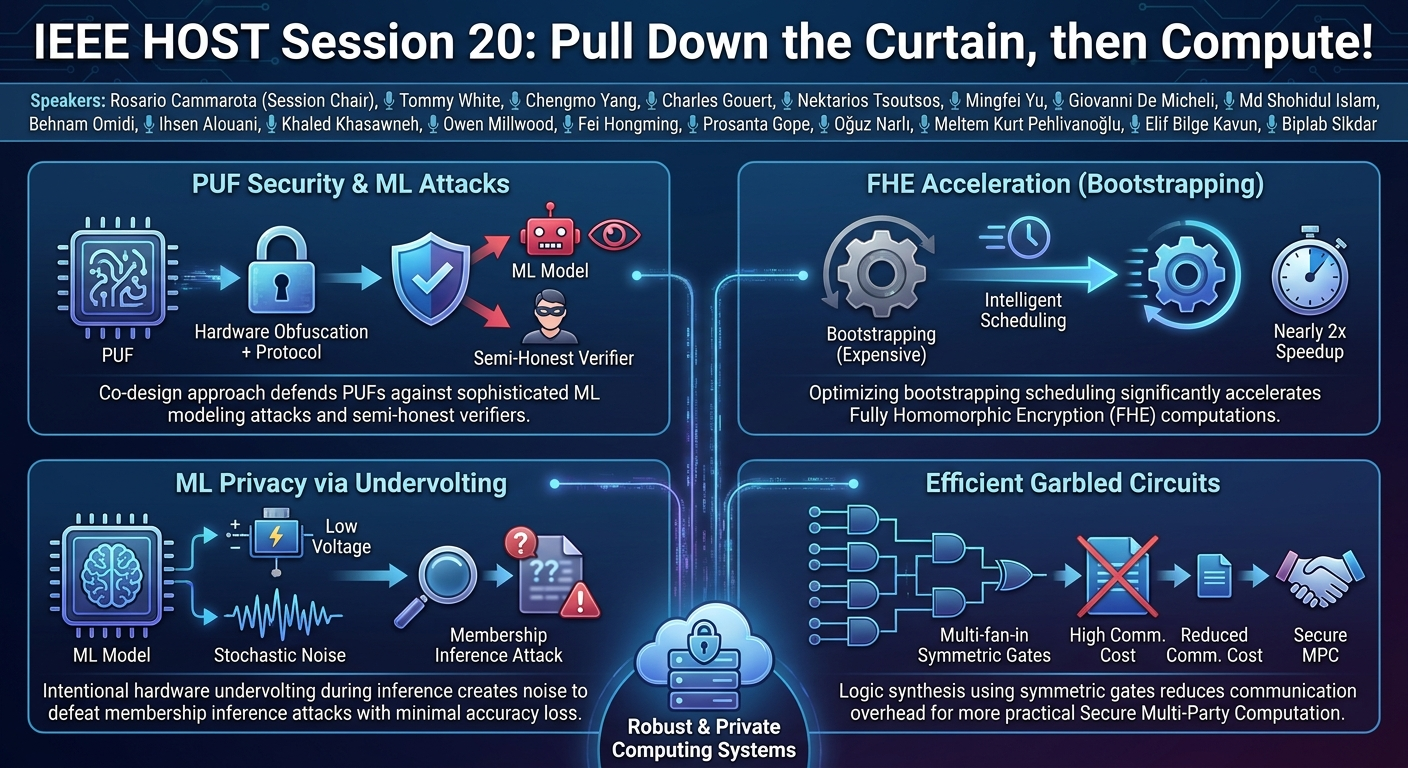
This detailed session from IEEE HOST showcased four distinct and impactful research papers, each addressing critical challenges in hardware security and privacy-preserving computation. The overarching theme revolved around securing sensitive data and computations, ranging from novel defenses against machine learning attacks on physically unclonable functions (PUFs) to significant performance enhancements for fully homomorphic encryption and more efficient garbled circuits for secure multi-party computation. The talks collectively highlight the cutting edge of research aimed at building more robust and private computing systems in an increasingly data-driven and interconnected world.
Key moments
- 8:00 Motivations: PUFs supplement cryptography, threat model
- 12:00 Proposed scheme: PUF crypto processor hardware design
- 26:00 Bootstrapping: FHE's expensive bottleneck operation
- 34:00 FHE-Booster results: Halving execution time
- 46:00 VPP proposal: Stochastic noise via undervolting
- 57:00 VPP results: High privacy, negligible accuracy loss
- 72:00 Novel approach: Multi-fan symmetric logic gates
Pull Down the Curtain, then Compute!
Speakers: Rosario Cammarota (Session Chair, Intel); Owen Millwood (Paper author, University of Sheffield); Tommy White (Paper author, University of Delaware); Md Shohidul Islam (Paper author, George Mason University); Mingfei Yu, Giovanni De Micheli (Paper authors, EPFL)
Conference: IEEE HOST
YouTube: https://www.youtube.com/watch?v=-z6OBGsv2R4
Overview
This detailed session from IEEE HOST showcased four distinct and impactful research papers, each addressing critical challenges in hardware security and privacy-preserving computation. The overarching theme revolved around securing sensitive data and computations, ranging from novel defenses against machine learning attacks on physically unclonable functions (PUFs) to significant performance enhancements for fully homomorphic encryption and more efficient garbled circuits for secure multi-party computation. The talks collectively highlight the cutting edge of research aimed at building more robust and private computing systems in an increasingly data-driven and interconnected world.
The session featured presentations on:
- Privacy-Preserving Protocol Level Approach to Prevent Machine Learning Modelling Attacks on PUFs in the Presence of Semi-Honest Verifiers by Owen Millwood.
- FHE-Booster: Accelerating Fully Homomorphic Execution with Fine-tuned Bootstrapping Scheduling by Tommy White.
- VPP: Privacy Preserving Machine Learning via Undervolting by Md Shohidul Islam.
- Generating Lower-Cost Garbled Circuits: Logic Synthesis Can Help by Mingfei Yu and Giovanni De Micheli (presented on their behalf by a colleague).
These works collectively offer innovative solutions to complex security and privacy problems, demonstrating advancements in both hardware-level defenses and algorithmic optimizations for cryptographic protocols.
Background
▶ Watch: Motivations: PUFs supplement cryptography, threat model (8:00)
20.4 Privacy-Preserving Protocol Level Approach to Prevent Machine Learning Modelling Attacks on PUFs in the Presence of Semi-Honest Verifiers
Physically Unclonable Functions (PUFs) are hardware security primitives that leverage inherent, uncloneable manufacturing variations in integrated circuits to generate unique, instance-specific responses to given challenges. These Challenge-Response Pairs (CRPs) are crucial for applications like key derivation, key management, and device authentication, particularly in resource-constrained environments where non-volatile memory (NVM) storage of keys is undesirable due to security risks. PUFs are broadly categorized into strong PUFs, which offer a large CRP space and typically low implementation overhead, and weak PUFs, which provide a smaller CRP space but are generally assumed to be highly secure against modeling attacks due to the complexity of their responses. A significant vulnerability of strong PUFs, however, is their susceptibility to machine learning (ML) modeling attacks. In such attacks, an adversary collects a subset of CRPs (either by physical access or eavesdropping) and trains an ML model to predict novel CRPs, thereby impersonating the PUF and breaking its security. Existing obfuscation techniques often add arbitrary logic, which may not fully address the underlying correlation between challenges and responses. Furthermore, traditional threat models often assume an attacker eavesdropping on a public channel, but the scenario of a semi-honest verifier—an entity with elevated privileges who might maliciously attempt to model the PUF—has received limited investigation.
20.1 FHE-Booster: Accelerating Fully Homomorphic Execution with Fine-tuned Bootstrapping Scheduling
Homomorphic Encryption (HE) is a cryptographic paradigm that enables computation on encrypted data without prior decryption. This capability is transformative for secure cloud computing, allowing clients to offload sensitive data processing to untrusted servers while maintaining data confidentiality. However, HE schemes face significant performance limitations, with encrypted operations taking considerably longer than unencrypted ones. A primary challenge in HE is noise management. Each cryptographic operation, particularly multiplication, introduces noise into the ciphertext. If this noise accumulates beyond a critical threshold, the ciphertext becomes undecryptable, rendering the computation invalid. Fully Homomorphic Encryption (FHE) schemes overcome this limitation by introducing an operation called bootstrapping. Bootstrapping takes a noisy ciphertext and refreshes it, reducing the noise to a lower, manageable level, thereby enabling an unlimited number of operations. Despite its power, bootstrapping is an extremely expensive operation, often consuming thousands of times more resources than other homomorphic operations, making it a major performance bottleneck for FHE programs. Previous work on scheduling in HE, such as Cheetah and Alchemy, primarily focused on leveled HE (schemes that do not use bootstrapping), while the few works addressing bootstrapping scheduling typically employed a simple "delay as much as possible" approach, performing bootstrapping only when the noise threshold was imminent.
20.3 VPP: Privacy Preserving Machine Learning via Undervolting
The widespread adoption of machine learning (ML), particularly with privacy-sensitive datasets (e.g., clinical records, genomic data, financial information), has brought forth significant privacy concerns. ML models are vulnerable to various privacy attacks, including property inference attacks (inferring global properties of the training dataset), model inversion attacks (reconstructing training data from model outputs), malicious training (where providers inject sensitive data), and membership inference attacks (MIAs). MIAs specifically aim to determine whether a particular data sample was part of the model's training dataset. This information can be exploited for curiosity, reconnaissance (to plan more sophisticated attacks), data extraction, or auditing privacy defenses. Existing defenses against MIAs include differential privacy (DP)-based methods (e.g., DP-SGD, PATE), which often suffer from lower model accuracy; regularization-based defenses (e.g., adversarial regularization, label smoothing, dropout), which also impact accuracy; output obfuscation methods (e.g., NameGuard), which maintain utility but offer limited privacy; and distillation-based defenses (e.g., DMP, Selena), which incur high computational costs due to the use of multiple models. There remains a need for defenses that can effectively mitigate MIAs while preserving high model utility and introducing minimal overhead.
20.2 Generating Lower-Cost Garbled Circuits: Logic Synthesis Can Help
Secure Multi-Party Computation (MPC) protocols enable multiple parties to jointly compute a function on their private inputs without revealing those inputs to each other. The Garbled Circuit (GC) protocol, originally proposed by Yao for two-party computation, is a foundational and widely adopted method for realizing MPC. In a GC protocol, the target computation is represented as a Boolean circuit. One party, the garbler, transforms this circuit into a "garbled" form, where each wire's signal (0 or 1) is represented by a pair of cryptographic labels. These labels are then used to encrypt the output labels for each logic gate in the circuit, forming an encrypted lookup table. The resulting garbled circuit is then sent to the other party, the executor, for evaluation. A significant bottleneck in large-scale, low-latency, and energy-efficient MPC applications, such as secure neural network inference, is the substantial data communication associated with transmitting the garbled circuit, often referred to as garbling cost. While advancements in protocol design have reduced the garbling cost per gate, particularly noting that XOR gates can be "free" due to specific label generation techniques, efforts to optimize the underlying Boolean circuit representation using logic synthesis are crucial. Specifically, the problem of multiplicative complexity (MC) reduction aims to minimize the number of AND gates in a circuit (since AND gates are typically the most expensive non-XOR gates to garble), but this problem is generally considered intractable.
Key Findings
▶ Watch: Bootstrapping: FHE's expensive bottleneck operation (26:00)
20.4 Privacy-Preserving Protocol Level Approach to Prevent Machine Learning Modelling Attacks on PUFs in the Presence of Semi-Honest Verifiers
Owen Millwood and his co-authors presented a novel hardware-software co-design scheme that effectively prevents machine learning modeling attacks on PUFs, even in the presence of a semi-honest verifier. Their key finding is that by combining a sophisticated PUF obfuscation design with a robust privacy-preserving protocol, they can achieve high resilience against ML attacks while providing mutual authentication and communication privacy. The proposed PUF crypto-processor dynamically generates challenge-response pairs and message data without requiring non-volatile memory for key storage, addressing a critical security vulnerability. Experimental results demonstrated a high level of ML resilience, with the best prediction rate achieved against a 16-bit Arbiter PUF being only 59% using a logistic regression attack, which is significantly better than the 70% typically considered the threshold for a binary PUF to be compromised. The scheme also maintains a reasonable hardware overhead, making it practical for resource-constrained devices.
20.1 FHE-Booster: Accelerating Fully Homomorphic Execution with Fine-tuned Bootstrapping Scheduling
Tommy White and his team introduced FHE-Booster, a framework that dramatically accelerates fully homomorphic execution by intelligently scheduling bootstrapping operations. The core finding is that by proactively analyzing the task graph and identifying "bootstrap segments" (paths of operations leading to noise accumulation), it's possible to minimize the total number of bootstraps required. Their methods, particularly the greedy heuristic for selecting bootstrapping points, achieved an average execution time reduction of nearly 50% (a 1.9x speedup) compared to the conventional "delay as much as possible" approach. This significant performance improvement directly correlates with a substantial reduction in the number of bootstrapping operations, transforming FHE from a theoretical construct into a more practical solution for real-world applications like logistic regression, where similar speedups were observed.
20.3 VPP: Privacy Preserving Machine Learning via Undervolting
Md Shohidul Islam and his colleagues discovered a novel hardware-based defense against membership inference attacks through undervolting. Their work, VPP (Privacy Preserving Machine Learning via Undervolting), found that introducing stochastic noise into deep learning models at inference time by intentionally undervolting the computational units can effectively "garble" attack features, confusing adversaries without significantly degrading model accuracy. The key finding is that this method achieves a privacy risk (measured by membership inference attack accuracy) close to 50%, which represents an ideal defense where an attacker cannot distinguish between trained and untrailed samples. Crucially, this high level of privacy is achieved with only a negligible loss in classification accuracy compared to baseline models and other state-of-the-art defenses, while simultaneously providing a byproduct of energy savings.
20.2 Generating Lower-Cost Garbled Circuits: Logic Synthesis Can Help
Presented on behalf of authors Mingfei Yu and Giovanni De Micheli, the paper reported findings that challenge the traditional focus on only two-input AND gates for garbled circuit optimization. Their research reveals that symmetric multi-fan-in logic gates, particularly wider AND gates (e.g., 3-input AND) and one-hot gates, can be garbled far more cost-efficiently than previously assumed, thanks to techniques like Garbled Gadget. By introducing the concept of MC compactness (multiplicative complexity divided by garbling cost), they quantitatively demonstrated that these multi-fan-in gates offer better "energy providers" in terms of garbling cost efficiency. Their proposed merging algorithm, which identifies and consolidates constructive ANDs into wider symmetric gates, consistently achieved a geometric mean improvement in garbling cost over state-of-the-art methods, especially for random control circuits. This opens new avenues for logic synthesis to significantly reduce the communication overhead of garbled circuits, making large-scale MPC more practical.
Technical Deep Dive
▶ Watch: FHE-Booster results: Halving execution time (34:00)
20.4 Privacy-Preserving Protocol Level Approach to Prevent Machine Learning Modelling Attacks on PUFs in the Presence of Semi-Honest Verifiers
The proposed scheme consists of a PUF obfuscation hardware design integrated with a privacy-preserving protocol.
The hardware design, termed a PUF crypto-processor, orchestrates the generation of obfuscated CRPs. It begins with a counter value, which is incremented through the protocol and serves as a seed for a pseudo-random number generator (PRNG). This PRNG generates challenges for both a strong PUF and a weak PUF (specifically, a DRAM PUF was used in experiments). The DRAM PUF's response is a large matrix, RM, which possesses high entropy and is crucial for configuring a one-way function. Concurrently, the strong PUF, upon receiving its challenge, generates measured message bits or key bits, denoted as RS. The one-way function is then configured by RM (acting as a lookup table with cryptographic significance) and processes RS to produce a final output, final. The uniformity of this final value, particularly when using the DRAM PUF for RM, was found to be strong enough to enable final to serve as a key derivation function (KDF). A secret key K is derived from final, which then fuels a lightweight symmetric encryption scheme (e.g., a Simple Simon block cipher with a 64-bit message length). The encrypted output, Delta, is the final response used for device authentication. The entire hardware implementation, tested on a Xilinx FPGA, utilized a 32-bit Arbiter PUF and a KECAC f200 PRF, demonstrating a relatively low footprint of 785 lookup tables (LUTs) and 898 flip-flops.
The protocol design is split into an enrollment phase and an authentication phase. The enrollment phase, assumed to occur in a secure environment, involves the device sending a unique identifier to the verifier. The verifier then generates random counter values and a temporary identifier, sending these back to the device. This ensures privacy preservation through a rolling temporary identifier, preventing network eavesdroppers from linking sessions. During authentication, the device sends its current temporary identifier. Both the device and the verifier execute the PUF function. Critically, the final output of the PUF function, along with the RM (memory PUF response), is sent to the verifier. This allows the verifier to independently configure its one-way function and derive the same shared secret. The verifier then generates a verification value (resV) using the session key, counters, and a nonce, sending it to the device. The device performs the same computation and compares its locally generated resV with the received value. If they match, authentication proceeds. In the final step of authentication, the device generates Delta using symmetric encryption, which is sent to the verifier for verification. The verifier decrypts to obtain the PUF response for the next round, and both parties store values to prepare for subsequent authentications.
20.1 FHE-Booster: Accelerating Fully Homomorphic Execution with Fine-tuned Bootstrapping Scheduling
The FHE-Booster framework optimizes the scheduling of bootstrapping operations within FHE programs. The process begins with an input FHE task graph that represents the computation without any pre-defined bootstrapping operations.
The first step is bootstrap segment generation. A bootstrap segment is defined as a sequence of operations in the task graph that, if executed without an intervening bootstrap, would lead to the ciphertext noise exceeding a critical threshold. This threshold is determined by the FHE parameters, specifically the maximum number of multiplications (I) allowed between bootstraps (e.g., I=9 in their experiments). The goal is to ensure that every such segment is "satisfied" by bootstrapping at least one ciphertext within it. By identifying all such segments, the framework ensures that noise never crosses the decryption threshold.
The next crucial step is bootstrapping point selection, where the framework decides which specific ciphertext outputs to bootstrap. Two methods were developed:
- Minimum Bootstrapping: This approach models the problem as a bipartite graph, where operations are on one side and bootstrap segments are on the other. An edge exists if an operation's output, if bootstrapped, would satisfy a given segment. The objective is to select the minimum number of operations to bootstrap such that all segments are covered. This is equivalent to the classic set cover problem, which is NP-hard, limiting its applicability to smaller task graphs.
- Score-Based Heuristic: For larger graphs, a more scalable heuristic was developed. This iterative method assigns a "score" to each operation based on how many currently unsatisfied segments it could satisfy if its output were bootstrapped. In each iteration, the operation with the maximum score is chosen for bootstrapping, and its covered segments are marked as satisfied. This process repeats until all segments are satisfied. The authors found that a simple greedy heuristic (choosing based on the number of unsatisfied segments an operation covers) worked best for scoring.
Once the bootstrapping points are determined, the information is passed to a custom scheduler. This scheduler employs a simple list scheduling algorithm to generate an assembly-like schedule for the FHE operations, including the newly placed bootstraps. Finally, the schedule is executed by FHE Runner, a C++ program built using the OpenFHE library, specifically utilizing the CKKS FHE scheme. The FHE Runner supports multi-threaded execution (configured for 4 threads in experiments) and verifies results by comparing encrypted and unencrypted computations to ensure noise constraints are never violated. Experiments were conducted on 25 synthetic task graphs and a real-world logistic regression program, demonstrating average execution time reductions of approximately 50% on a laptop platform.
20.3 VPP: Privacy Preserving Machine Learning via Undervolting
VPP (Privacy Preserving Machine Learning via Undervolting) introduces a novel, hardware-rooted defense against privacy attacks on machine learning models, specifically targeting membership inference attacks. The core technical approach involves injecting stochastic noise into the deep learning model at inference time through controlled undervolting of the underlying computational units.
The mechanism leverages the inherent instability of digital circuits when operated below their nominal voltage. By slightly reducing the supply voltage to specific computational units within an FPGA-based computation unit (as demonstrated in hardware implementation), the system intentionally induces transient faults or bit flips in intermediate calculations, particularly after activation layers. This randomness effectively garbles the internal computations of the model.
The critical aspect of VPP is the careful selection of noise parameters: the magnitude of the undervolting and the depth within the model where noise is injected. These parameters are determined through a multi-objective optimization problem that aims to maximize both classification accuracy (utility) and privacy (resistance to MIAs). This ensures that the injected noise is sufficient to confuse an attacker trying to infer membership without significantly degrading the model's primary task performance.
The defense operates exclusively during inference, meaning it does not require retraining the model, which is a significant advantage over many software-based differential privacy methods. The effect of VPP was demonstrated by analyzing the distribution of attack features (e.g., confidence vectors from the model's output). For unprotected models, the distributions for "member" and "non-member" samples are clearly separable. With VPP, these distributions show significant overlap, indicating that the attacker is "confused" and cannot reliably distinguish between the two. The privacy risk, measured by MIA accuracy, was reduced to approximately 50%, the ideal outcome for a defense. Furthermore, because undervolting reduces power consumption, VPP offers a byproduct of energy savings. The authors also explored an adaptive attack scenario where an attacker knows the defense and can query the model multiple times to average out the noise. While this slightly increases the privacy risk, the significantly higher query time required by the attacker makes such adaptive attacks impractical. The work demonstrated that both software and hardware implementations of VPP achieve similar levels of privacy and utility.
20.2 Generating Lower-Cost Garbled Circuits: Logic Synthesis Can Help
This work focuses on reducing the garbling cost (primarily communication overhead) of Garbled Circuits (GCs) by leveraging insights from logic synthesis. The core idea is to move beyond the conventional reliance on two-input AND gates as the primary expensive primitive and explore the efficiency of multi-fan-in symmetric logic gates.
The authors highlight the Garbled Gadget technique, which allows symmetric logic gates (whose output depends only on the Hamming weight of their inputs) to be garbled much more efficiently. Instead of requiring an encrypted lookup table with 2^N entries for an N-input gate, a symmetric gate can be interpreted as a modulo-N addition followed by a projector. This reduces the garbling cost from 2^N to N. For instance, a 3-input AND gate (N3), which conventionally requires an 8-entry encrypted table, can be garbled as a modulo-4 addition followed by a projection, needing only 4 entries. This makes N3 significantly more efficient than three 2-input AND gates (N2).
To quantify this efficiency, the concept of MC compactness is introduced, defined as the Multiplicative Complexity (MC) of a logic gate divided by its garbling cost. A higher MC compactness indicates a more cost-efficient gate for garbling. The analysis showed that N3 gates are more MC compact than N2 gates. This observation directly led to two key proposals:
- Using Wider AND Gates: The insight is to detect "constructive ANDs" in an existing XOR-AND graph (XAG) representation of a Boolean circuit and merge them into multi-fan-in AND gates (e.g., replacing multiple N2s with N3s or wider ANDs). The authors developed a merging algorithm that optimally decides the "cut frontier" for these merges, considering factors like inverters and multiple fan-outs, to achieve the best overall garbling cost reduction.
- Using One-Hot Gates: Further analysis revealed that one-hot gates (outputting true if only one input is true) and GAMBLE gates (outputting true if all inputs are 0 or all are 1) also offer high MC compactness. The proposal includes rewriting 2-input AND gates using one-hot gates to further reduce garbling costs.
The evaluation was conducted on the EPFL combinational circuit suite, which includes both arithmetic and random control circuits. The results consistently demonstrated that both the merging algorithm for wider ANDs and the use of one-hot gate optimization generated better results in terms of garbling cost compared to existing state-of-the-art methods, showing a clear improvement in the geometric mean of garbling cost.
Demo / Proof of Concept
▶ Watch: VPP results: High privacy, negligible accuracy loss (57:00)
20.4 Privacy-Preserving Protocol Level Approach to Prevent Machine Learning Modelling Attacks on PUFs in the Presence of Semi-Honest Verifiers
The proposed PUF crypto-processor and protocol were implemented and evaluated on a Xilinx FPGA. The hardware design incorporated a 32-bit Arbiter PUF as the strong PUF, a DRAM PUF as the weak/memory PUF, a KECAC f200 for the pseudo-random function, and a Simple Simon block cipher for lightweight symmetric encryption with a 64-bit message length. The resource overhead on the FPGA was reported as 785 lookup tables (LUTs) and 898 flip-flops, indicating a relatively low footprint suitable for embedded and resource-constrained applications. The system's resilience against machine learning attacks was tested using logistic regression and multi-layer perceptron (MLP) attacks. The objective was to predict the binary output of the PUF. The ideal prediction rate for a secure PUF should be 50% (a random coin flip). The best an attacker could achieve was a 59% prediction rate against the 16-bit Arbiter PUF using logistic regression, which is below the 70% threshold generally considered indicative of a compromised binary PUF. This demonstrates the practical effectiveness of the obfuscation design.
20.1 FHE-Booster: Accelerating Fully Homomorphic Execution with Fine-tuned Bootstrapping Scheduling
The FHE-Booster framework was implemented using C++ and the OpenFHE library (CKKS scheme). Experiments were conducted on a laptop platform (specific hardware details provided in the talk). The evaluation used 25 synthetic task graphs, designed to mimic realistic FHE programs, and a real-world logistic regression program as a benchmark. The FHE parameters were configured to allow nine multiplications between bootstraps. Schedules were generated to utilize four threads. The results showed a remarkable reduction in average execution time: from 82.9 seconds (using the "as late as possible" bootstrapping method) to 42.2 seconds (with minimum bootstrapping), representing a nearly two-fold speedup. The greedy heuristic for bootstrapping selection achieved results very close to the optimal minimum bootstrapping, demonstrating its practical utility. For the logistic regression program, similar performance improvements were observed, confirming the framework's effectiveness on real-world FHE applications.
20.3 VPP: Privacy Preserving Machine Learning via Undervolting
VPP was demonstrated with both software and hardware implementations. The hardware implementation specifically utilized an FPGA-based computation unit to showcase the feasibility and impact of undervolting. The defense was evaluated against membership inference attacks (MIAs) using metrics such as the distribution of attack features (e.g., confidence vectors) and MIA accuracy. The results clearly illustrated that VPP effectively confused attackers: the distributions of attack features for "member" and "non-member" samples, which were separable for baseline models, showed significant overlap for VPP-protected models. The MIA accuracy was reduced to approximately 50%, indicating that attackers could not reliably infer membership. Crucially, the model's classification accuracy remained largely unaffected, showing only a negligible loss compared to the baseline and outperforming or matching other defenses in terms of privacy-utility trade-off. The authors also presented data on the energy savings achieved as a byproduct of undervolting.
20.2 Generating Lower-Cost Garbled Circuits: Logic Synthesis Can Help
The proposed logic synthesis techniques for generating lower-cost garbled circuits were evaluated using the EPFL combinational circuit suite. This benchmark suite comprises a diverse set of arithmetic and random control circuits, providing a comprehensive testbed for the optimization algorithms. The evaluation focused on comparing the garbling cost (primarily communication overhead) of circuits optimized with their proposed merging algorithm (for wider AND gates) and one-hot gate optimization against existing state-of-the-art methods. The results consistently demonstrated an improvement in garbling cost, with the geometric mean of this improvement being notably positive. The authors highlighted that the extent of improvement varied depending on the benchmark's properties, with more considerable gains observed for random control circuits. This practical evaluation validated the theoretical advantages of using multi-fan-in symmetric logic gates and the effectiveness of the developed synthesis algorithms.
Defensive Implications
▶ Watch: Novel approach: Multi-fan symmetric logic gates (72:00)
20.4 Privacy-Preserving Protocol Level Approach to Prevent Machine Learning Modelling Attacks on PUFs in the Presence of Semi-Honest Verifiers
Defenders should recognize that relying solely on the inherent randomness of PUFs is insufficient against sophisticated ML modeling attacks, especially when a semi-honest verifier or insider threat is considered. This research provides a blueprint for integrating PUF obfuscation with robust cryptographic protocols to build more secure hardware-rooted authentication and key management systems. The ability to generate keys and messages dynamically without NVM storage significantly reduces the attack surface. Implementing such a hardware-software co-design, particularly in resource-constrained IoT devices, can provide enhanced device identity, mutual authentication, and resistance to impersonation, even against adversaries with significant data collection capabilities. Security architects should consider adopting dynamic, privacy-preserving PUF protocols rather than static CRP systems.
20.1 FHE-Booster: Accelerating Fully Homomorphic Execution with Fine-tuned Bootstrapping Scheduling
This work has profound implications for the practical deployment of Fully Homomorphic Encryption (FHE). Cloud service providers and organizations dealing with highly sensitive data can leverage FHE-Booster's techniques to make FHE computations significantly more efficient. By intelligently scheduling bootstrapping operations, the performance bottleneck is mitigated, enabling the execution of longer and more complex encrypted programs (e.g., extensive data analytics, AI model inference on encrypted data) that were previously impractical due to prohibitive latency. Defenders can now consider FHE as a more viable option for end-to-end data confidentiality in cloud environments, reducing the risk of data breaches and enhancing regulatory compliance. The framework provides a pathway to unlock the full potential of FHE for privacy-preserving computation at scale.
20.3 VPP: Privacy Preserving Machine Learning via Undervolting
VPP offers a novel and highly practical defense mechanism against membership inference attacks (MIAs), which are a growing concern for machine learning models trained on sensitive data. Defenders can integrate VPP by implementing controlled undervolting during the inference phase of ML models, particularly on FPGA-based accelerators or custom hardware. This hardware-rooted approach provides a strong privacy guarantee (reducing MIA accuracy to near 50%) with minimal impact on model utility. Crucially, it does not require model retraining, making it easy to deploy with existing models. The added benefit of energy savings makes it an attractive option for power-constrained edge devices. This research empowers organizations to deploy privacy-preserving ML models more confidently, mitigating a significant class of data leakage attacks without incurring substantial computational overhead or accuracy penalties.
20.2 Generating Lower-Cost Garbled Circuits: Logic Synthesis Can Help
This research directly benefits the implementation of Secure Multi-Party Computation (MPC) protocols, particularly those based on Garbled Circuits (GCs). Defenders and developers building MPC systems can leverage the insights into MC compactness and the use of multi-fan-in symmetric logic gates during the logic synthesis phase to significantly reduce the communication overhead (garbling cost). This reduction makes large-scale MPC applications, such as secure neural network inference or secure collaborative data analysis, more feasible and efficient. By optimizing the underlying Boolean circuit representations, the overall performance of MPC can be dramatically improved, lowering the barrier to entry for practical, privacy-preserving computations among multiple distrusting parties. This allows for the deployment of MPC in scenarios where communication bandwidth or latency was previously a limiting factor.
Key Takeaways
- Holistic PUF Security: Effective PUF security requires a co-design approach, integrating hardware obfuscation with robust cryptographic protocols to counter sophisticated ML modeling attacks and insider threats (semi-honest verifiers) without relying on non-volatile memory for key storage.
- FHE Performance Breakthrough: Intelligent scheduling of bootstrapping operations in Fully Homomorphic Encryption (FHE) can nearly double execution speed, making FHE a much more practical solution for secure cloud computing and complex privacy-preserving data analytics.
- Hardware-Rooted ML Privacy: Intentional undervolting during ML model inference can introduce stochastic noise that effectively defeats membership inference attacks, offering a novel, low-overhead, and energy-efficient hardware-based defense without sacrificing model accuracy or requiring retraining.
- Efficient Garbled Circuits via Logic Synthesis: Optimizing the logic synthesis of Garbled Circuits by leveraging multi-fan-in symmetric gates (like wider ANDs and one-hot gates) significantly reduces garbling costs, thereby improving the practicality and scalability of Secure Multi-Party Computation for complex applications.
- Bridging Hardware and Cryptography: The session demonstrates a strong trend towards synergistic approaches, where hardware-level properties (PUFs, undervolting) are tightly integrated with cryptographic primitives (FHE, Garbled Circuits, symmetric encryption) to achieve stronger and more efficient security and privacy guarantees.
About the Speaker(s)
Owen Millwood is a PhD student at the University of Sheffield. His research focuses on hardware security, particularly privacy-preserving techniques to defend Physically Unclonable Functions (PUFs) against machine learning modeling attacks.
Tommy White is a PhD student at the University of Delaware. His work centers on optimizing the performance of Fully Homomorphic Encryption (FHE) schemes, specifically addressing the bottleneck of bootstrapping operations to enhance the practicality of secure computation.
Md Shohidul Islam is a student at George Mason University. His research explores novel defenses against privacy attacks on machine learning models, with a particular focus on hardware-based solutions like undervolting to preserve data privacy during inference.
Mingfei Yu and Giovanni De Micheli (EPFL) are the authors of the garbled-circuits paper, which was presented on their behalf by a colleague introduced by the session chair.
Reviews
Dr. Zero (Offensive Security Researcher) — SOLID
Four heavyweight academic hardware security papers crammed into a single IEEE HOST session. Zero vendor bullshit here—just raw math, intentional FPGA abuse, and cryptographic optimizations that actually move the needle on homomorphic encryption.
Heather Calloway (CISO) — WEAK
This is a dense, academic session covering hardware-level cryptography and machine learning privacy optimizations. It is not for your leadership team or your security operations center. However, for organizations investing heavily in privacy-preserving computation, it offers a useful preview of where the performance bottlenecks in Fully Homomorphic Encryption (FHE) are finally starting to break.
All talks from IEEE International Symposium on Hardware Oriented Security and Trust (HOST) 2023