Session 19: Secure Quantum Computing
Xiaolong Guo (Session Chair · Kansas State University), Sanjay Deshpande (Paper author · Yale University), Chuanqi Xu (Paper author · Yale University), Theodoros Trochatos (Paper author · Yale University), Hanrui Wang (Paper author · MIT), Ferhat Erata (Paper author), Song Han (Paper author · MIT), Yongshan Ding (Paper author · Yale University), Jakub Szefer (Paper author · Yale University), Kaitlin Smith (Paper author), Joshua Viszlai (Paper author), Lennart Maximilian Seifert (Paper author), Jonathan Baker (Paper author), Fred Chong (Paper author), Daniel Volya (Paper author), Tao Zhang (Paper author), Nashmin Alam (Paper author), Mark Tehranipoor (Paper author), Prabhat Mishra (Paper author)
IEEE International Symposium on Hardware Oriented Security and Trust (HOST) 2023 · Day 4 · Gateway Ballroom
Overview
The IEEE HOST session 19, "Secure Quantum Computing," presented three distinct but interconnected research papers addressing critical security challenges in the nascent field of quantum computing. As quantum devices transition from laboratory curiosities to cloud-accessible resources, understanding and mitigating their unique vulnerabilities becomes paramount. This session highlighted both intrinsic quantum security concerns and the often-overlooked classical security implications within hybrid classical-quantum systems.
Key moments
- 2:00 Motivation: Crosstalk vulnerability in multi-programming quantum systems
- 7:00 Demonstrating effective crosstalk attacks on quantum algorithms
- 11:00 Design and deployment of the Quantum Computer Antivirus
- 20:00 Why security is crucial for cloud-based NISQ quantum computers
- 27:00 Identifying qubit frequency as a stable hardware fingerprint
- 46:00 Classical and quantum security vulnerabilities in cloud quantum computing
- 53:00 Intrinsic quantum security vulnerability: Insecure qubit reset
Secure Quantum Computing
Speakers: Xiaolong Guo (Session Chair, Kansas State University); Sanjay Deshpande, Chuanqi Xu, Theodoros Trochatos, Hanrui Wang, Ferhat Erata, Song Han, Yongshan Ding, Jakub Szefer, Kaitlin Smith, Joshua Viszlai, Lennart Maximilian Seifert, Jonathan Baker, Fred Chong, Daniel Volya, Tao Zhang, Nashmin Alam, Mark Tehranipoor, Prabhat Mishra (Paper authors from Yale University, MIT, University of Chicago, Duke, Infleqtion, University of Florida)
Conference: IEEE HOST
YouTube: https://www.youtube.com/watch?v=UP1hq9FUA88
Overview
The IEEE HOST session 19, "Secure Quantum Computing," presented three distinct but interconnected research papers addressing critical security challenges in the nascent field of quantum computing. As quantum devices transition from laboratory curiosities to cloud-accessible resources, understanding and mitigating their unique vulnerabilities becomes paramount. This session highlighted both intrinsic quantum security concerns and the often-overlooked classical security implications within hybrid classical-quantum systems.
The talks covered the spectrum from direct quantum hardware vulnerabilities, such as crosstalk-based attacks in multi-tenant environments and methods to combat them with a quantum computer antivirus, to the crucial need for hardware-based fingerprinting to authenticate cloud-based Noisy Intermediate-Scale Quantum (NISQ) devices. Furthermore, the session provided a holistic perspective on the security landscape of classical-quantum systems, dissecting vulnerabilities in the classical control plane, the implementation of post-quantum cryptography (PQC), and additional quantum hardware-level attack vectors like insecure resets and pulse-level electromagnetic leakage.
Collectively, these presentations underscored that while the promise of quantum computing is immense, its secure deployment requires a multi-faceted approach, integrating robust classical security practices with novel quantum-specific defensive mechanisms. The insights shared are vital for both quantum hardware designers and software developers, as well as for security professionals tasked with protecting future quantum infrastructure and its sensitive applications.
Background
▶ Watch: Motivation: Crosstalk vulnerability in multi-programming quantum systems (2:00)
Quantum computing represents a revolutionary paradigm, promising to solve problems intractable for even the most powerful classical supercomputers. However, this nascent technology, particularly the current generation of Noisy Intermediate-Scale Quantum (NISQ) devices, introduces an entirely new set of security considerations. Unlike classical computers, quantum systems operate on principles of superposition and entanglement, making them susceptible to unique forms of interference and manipulation.
The increasing accessibility of quantum computers through cloud platforms, where multiple users can share resources, or where algorithms are run on remote, untrusted hardware, exacerbates these security concerns. Issues like crosstalk, where operations on one qubit unintentionally affect others, become significant vulnerabilities in multi-tenant environments. Moreover, the inherent variability and noise in NISQ devices—stemming from fabrication imperfections and environmental interactions—present both challenges and potential opportunities for unique hardware-based security primitives. Simultaneously, the classical infrastructure that controls and interacts with quantum processors remains a critical attack surface, demanding a comprehensive security approach that bridges both domains. The development of post-quantum cryptography (PQC) aims to secure classical communications against future quantum adversaries, but even these new cryptographic schemes are not immune to side-channel attacks when implemented on classical hardware. Addressing these challenges is crucial to ensure the trustworthiness and integrity of future quantum computation.
Key Findings
▶ Watch: Design and deployment of the Quantum Computer Antivirus (11:00)
19.1 Design of Quantum Computer Antivirus
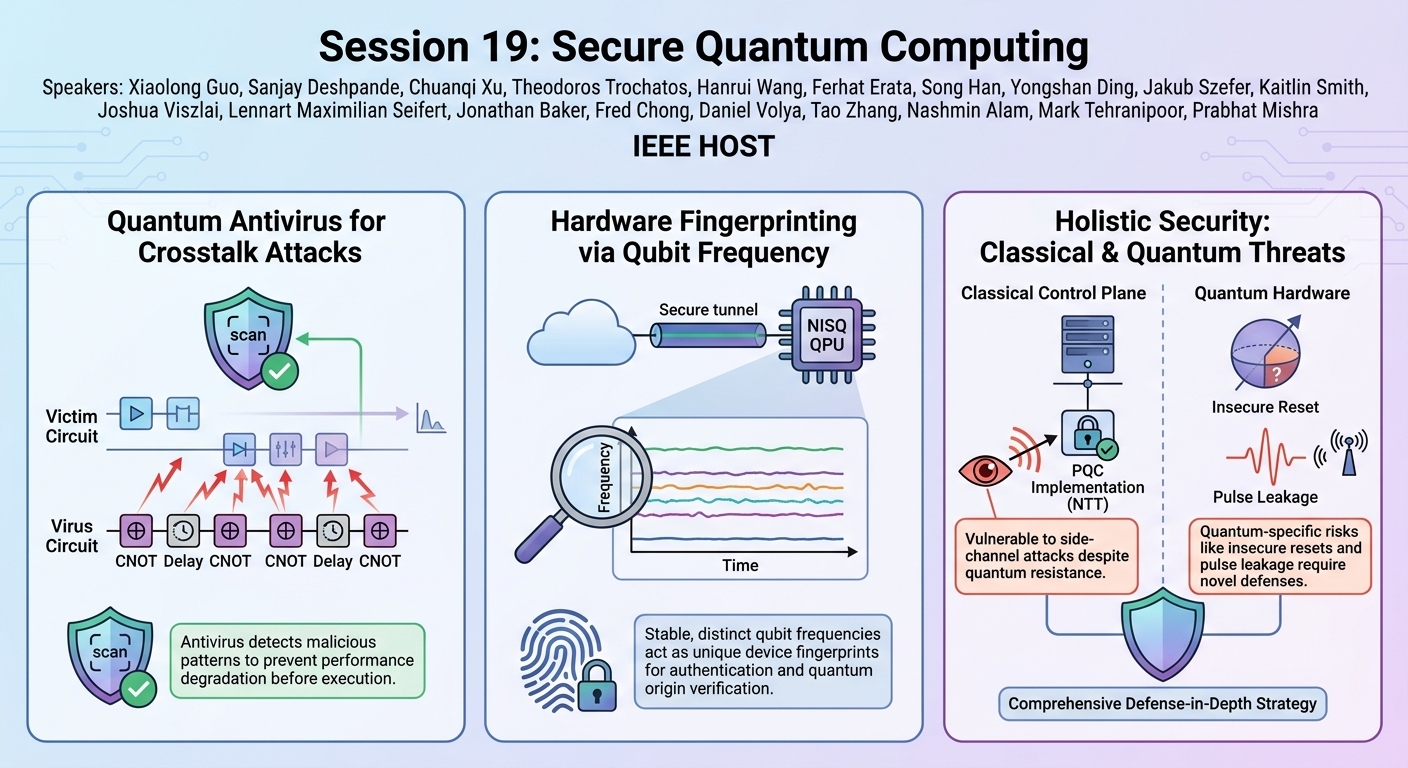
Sanjay Deshpande, presenting on behalf of a collaborative team from Yale and MIT, highlighted the critical vulnerability of crosstalk-based attacks in multi-programming quantum environments. The team successfully demonstrated that malicious quantum circuits (termed "virus circuits") could significantly reduce the correct output probability of legitimate "victim circuits" running in parallel. This was achieved by developing a novel method to bypass the transpiler optimization of quantum compilers, which typically remove or simplify series of CNOT gates that are known to cause significant crosstalk. By strategically inserting "delay functions" between CNOT gates, they tricked the transpiler into preserving the malicious circuit's structure, thereby enabling the attack. Their experiments on IBM Q Lima and IBM Q Casablanca devices showed successful attacks against Grover's algorithm, Deutsch-Jozsa algorithm, and Bernstein-Vazirani algorithm, reducing their output probabilities by a measurable margin. To counter this, they proposed and evaluated a quantum computer antivirus capable of detecting these malicious circuit patterns with 100% accuracy.
19.2 Fast Fingerprinting of Cloud-based NISQ Quantum Computers
Kaitlin Smith, representing a team from University of Chicago, Duke, Yale, and Infleqtion, presented research on fast fingerprinting of cloud-based NISQ quantum computers. The core finding was the identification of qubit frequency as a highly stable, collision-resistant, and reliable intrinsic hardware property suitable for uniquely identifying quantum devices. Through extensive data-driven analysis of tens of thousands of calibration records from IBM Q devices (ranging from 5 to 127 qubits), the team demonstrated that while other metrics like CNOT infidelity, T1, T2, and readout error exhibit significant day-to-day variability and overlap across different devices, qubit frequency remains remarkably consistent over time and distinct between individual quantum processing units (QPUs). This stability makes qubit frequency an ideal candidate for developing Physically Unclonable Functions (PUFs) for quantum hardware, enabling authentication of cloud-based QPUs and verification of quantum results against potential malicious impersonators or random number generators.
19.3 Towards Secure Classical-Quantum Systems
Daniel Volya, from the University of Florida, presented a comprehensive overview of security vulnerabilities across classical-quantum hybrid systems. The key findings underscored that security must be approached holistically, addressing both the classical control infrastructure and the quantum device itself. On the classical side, vulnerabilities include side-channel attacks (power, electromagnetic radiation, timing) to extract sensitive information from encrypted quantum jobs, and fault injection attacks (power, clock, EM, laser) to tamper with server-side accelerators. Volya also highlighted that while Post-Quantum Cryptography (PQC) aims to resist quantum attacks, its classical implementations are often susceptible to existing side-channel attacks, particularly those targeting the Number Theoretic Transform (NTT), a core component of many PQC algorithms. On the quantum side, the presentation detailed pulse-level electromagnetic leakage, where control pulses can be exploited; insecure qubit resets, allowing recovery of previous computation states; and crosstalk (as also discussed in the first paper). The work emphasizes the need for robust countermeasures across all these layers, from secure hardware implementations of PQC to pulse optimization and improved qubit reset protocols.
Technical Deep Dive
▶ Watch: Why security is crucial for cloud-based NISQ quantum computers (20:00)
19.1 Design of Quantum Computer Antivirus
The research on quantum computer antivirus delves into the intricate mechanisms of crosstalk and its exploitation in multi-tenant quantum environments. Crosstalk occurs when an operation on one or more qubits unintentionally affects neighboring qubits, a phenomenon particularly pronounced with multi-qubit gates like the CNOT gate due to the complex pulse sequences required for their execution. The initial work by Ghosh et al. demonstrated this effect, but the team identified a critical limitation: standard Kisket transpilation processes often optimize away or decompose series of CNOT gates, effectively mitigating the crosstalk effect before execution.
To overcome this, the authors engineered "virus circuits" by strategically inserting delay functions between CNOT gates. These delays effectively "trick" the transpiler into treating each CNOT gate as a distinct, unoptimizable operation, ensuring the malicious sequence remains intact during compilation. The experimental setup involved fixing two qubits (q0, q1) to run a victim circuit (e.g., Grover's, Deutsch-Jozsa, Bernstein-Vazirani) and two adjacent qubits (q2, q3) to run the virus circuit. They quantified the attack's success by measuring the reduction in the victim circuit's correct output probability. For example, for Grover's algorithm, the expected output probability for the |11⟩ state was significantly reduced when the virus circuit ran concurrently. Various virus circuits (V1-V10) were designed, ranging from two to four qubits, and tested on IBM Q Lima (5-qubit machine) and IBM Q Casablanca (7-qubit machine). The results showed a clear drop in output fidelity for the victim circuits, confirming the efficacy of their improved crosstalk attack method.
The proposed quantum computer antivirus operates by taking a quantum circuit and a pattern to be tested as input. It converts the quantum circuit object into a directed acyclic graph (DAG) with a non-commutative representation, which is crucial for accurately representing quantum gate sequences. It then employs a subgraph isomorphism algorithm to identify instances of known malicious patterns within the user's submitted circuit. The output indicates the qubits on which the pattern was observed and the number of occurrences. For deployment, two primary recommendations were made: either integrate the antivirus directly into the cloud provider's transpilation pipeline, or provide compiler support that runs within a trusted execution environment (TEE) like Intel SGX (using Grameen). In the latter case, an attestation node is added to the circuit, which can be verified by the cloud provider to ensure the circuit was checked in a trusted environment. The evaluation demonstrated 100% accuracy in detecting the predefined virus patterns across various victim circuits.
19.2 Fast Fingerprinting of Cloud-based NISQ Quantum Computers
The technical deep dive into fast fingerprinting of cloud-based NISQ quantum computers centers on leveraging the inherent physical variations in quantum hardware for identification and authentication. The core challenge is to find stable and unique device characteristics amidst the high noise and variability of NISQ devices. The methodology involved a large-scale, data-driven analysis of calibration records from IBM Q devices, which provide daily measurements of various qubit properties. The goal was to identify features that are: 1) stable over time for a given device, 2) distinct between different devices, and 3) scalable across different processor revisions (e.g., Falcon, Hummingbird, Eagle classes).
The researchers meticulously filtered out features that exhibited high day-to-day variability or significant overlap between devices. For instance, CNOT gate infidelity was found to be a poor candidate due to its high fluctuation over time and substantial overlap in distributions across different machine sizes (e.g., 27-qubit, 65-qubit, 127-qubit machines). This was visually represented using box-and-whisker plots, illustrating the lack of clear separation. In contrast, qubit frequency emerged as a superior feature. Qubit frequency, which is determined by the physical dimensions and material properties of the Josephson junctions within fixed-frequency transmon qubits, shows remarkable stability over hundreds of calibration cycles. The Hamming distance analysis revealed that the distance between calibrations for the same device's qubit frequencies was very low, while the distance between the frequencies of different devices was consistently high. This indicates high intra-device consistency and high inter-device distinctiveness, which are ideal properties for a hardware fingerprint.
The ultimate application of this finding is the development of a challenge-response framework, analogous to a classical Physically Unclonable Function (PUF). In this framework, a cloud provider could issue a quantum challenge, and the quantum device would respond based on its unique frequency-based fingerprint. This response would be a one-way mapping, making it difficult to clone or predict. This mechanism could serve several critical security functions: authenticating the specific QPU a user is interacting with, validating the origin of quantum computation results (i.e., proving they came from a real quantum device, not a simulated or malicious one), and potentially generating memory keys for secure communication of quantum results. The Q&A session further explored the extension of this technique to other quantum platforms, noting that the general methodology of surveying intrinsic properties and analyzing their stability and distinctiveness would still apply, even if the specific "best" feature (like frequency) might differ.
19.3 Towards Secure Classical-Quantum Systems
The technical depth of "Towards Secure Classical-Quantum Systems" lies in its holistic examination of attack vectors across the entire hybrid classical-quantum stack. The talk emphasizes that a quantum computer is not a standalone entity but is deeply integrated with sophisticated classical control systems.
On the classical side, the vulnerabilities are multi-layered. When a user submits a quantum job to a cloud provider, that job is processed by classical computers before being translated into control pulses for the quantum hardware. This classical processing is susceptible to well-known attacks:
- Side-channel attacks: Techniques like power analysis, electromagnetic (EM) radiation analysis, and timing attacks can be used to extract sensitive information (e.g., cryptographic keys) from the classical server or even the user's local machine during encryption/decryption or computation.
- Fault injection attacks: Methods such as power injection, clock injection, EM fault injection, and laser fault injection can be employed to tamper with the classical accelerators or processors, potentially escalating privileges or causing incorrect computations on the server side.
- Post-Quantum Cryptography (PQC) implementation vulnerabilities: While PQC algorithms (e.g., those selected by NIST like CRYSTALS-Dilithium) are designed to be quantum-resistant, their classical implementations often fall prey to side-channel attacks. A prime example is the Number Theoretic Transform (NTT), a fundamental building block for multiplying large polynomials in many lattice-based PQC schemes. NTT implementations are particularly vulnerable to side-channel leakage. Even countermeasures like masking (randomly adding noise to computations) can be defeated by advanced techniques such as deep learning frameworks that can extract the underlying randomness. The paper proposes RTL-level countermeasures to address these implementation-specific weaknesses.
On the quantum side, the paper identifies several intrinsic vulnerabilities:
- Pulse-level attacks and EM leakage: The precise microwave pulses used to control qubits can themselves be a source of leakage. For instance, in silicon double quantum dot architectures, the manipulation of electrons via control electrodes (L, R, G gates) involves sending specific EM pulses. Attackers could potentially detect and analyze these pulses. A proposed countermeasure involves pulse optimization to avoid high-amplitude jumps and create more uniform pulses, thereby minimizing detectable EM leakage and simultaneously optimizing for leakage avoidance.
- Insecure qubit reset: Before each quantum computation, qubits must be reset to a known initial state (typically |0⟩). However, if the reset is incomplete, residual information from previous computations can remain. Research by Jakub Szefer's group demonstrated that a machine learning model could be trained to extract this leftover information and reconstruct the previously executed quantum circuit. This is often due to the indirect nature of measurement, where a detector qubit couples with the computational qubit, and the interaction might not fully dissipate. The countermeasure is to perform multiple consecutive resets to ensure complete state randomization.
- Crosstalk: As highlighted in the first paper, crosstalk remains a significant quantum vulnerability. The suggested defense is compiler optimization to schedule CNOT gates carefully and minimize their parallel execution, potentially using advanced pulse optimization techniques to reduce interference.
The presenter also briefly touched upon his own work, which explores exploiting the entropy of detector qubits and entanglement back-action for arbitrary state preparation, suggesting that even architectural features can be leveraged for security enhancements.
Demo / Proof of Concept
▶ Watch: Classical and quantum security vulnerabilities in cloud quantum computing (46:00)
19.1 Design of Quantum Computer Antivirus
The paper presented a clear demonstration of its core findings. While a live, interactive demo was not shown in the recording, the presentation included experimental results from running the virus circuits on actual IBM Q quantum computers. The efficacy of the improved crosstalk attack was demonstrated through graphs showing a significant reduction in the expected output probabilities for victim algorithms like Grover's, Deutsch-Jozsa, and Bernstein-Vazirani. The quantum computer antivirus itself was evaluated against 10 different virus circuits across various victim circuits, achieving a 100% detection accuracy for the patterns it was designed to identify. The availability of the software code in a public repository (link provided in the talk) serves as a proof of concept for the antivirus's implementation.
19.2 Fast Fingerprinting of Cloud-based NISQ Quantum Computers
This work did not involve a live demo, but its proof of concept is strongly supported by extensive data analysis and statistical validation. The presentation included detailed box-and-whisker plots and distance metrics that visually and quantitatively demonstrated the stability of qubit frequency over time for individual devices and its distinctiveness across different quantum processors. These analyses, based on thousands of real-world calibration records from IBM Q devices, serve as compelling evidence for the feasibility of using intrinsic qubit properties for hardware fingerprinting. The proposed challenge-response framework is a conceptual extension, building upon these validated hardware characteristics.
19.3 Towards Secure Classical-Quantum Systems
This presentation provided a broad overview of security vulnerabilities and solutions rather than a specific demonstration or proof of concept for a single attack or defense. However, it referenced and built upon existing research that includes practical demonstrations of attacks like side-channel attacks on PQC implementations and insecure qubit reset exploitation. For instance, the reference to Jakub Szefer's group's work on insecure reset provided experimental data showing how a machine learning algorithm could extract information from incompletely reset qubits. The work on PQC side channels also implicitly refers to demonstrations of breaking masked NTT implementations using deep learning.
Defensive Implications
▶ Watch: Intrinsic quantum security vulnerability: Insecure qubit reset (53:00)
19.1 Design of Quantum Computer Antivirus
For quantum defenders, the "Design of Quantum Computer Antivirus" paper highlights the immediate threat of crosstalk-based attacks in multi-programming quantum environments. The primary defensive implication is the urgent need for enhanced quantum compiler security. Compilers must evolve to not only optimize circuits for performance but also to proactively identify and neutralize malicious patterns that exploit hardware vulnerabilities like crosstalk. This could involve more sophisticated analysis of circuit graphs to detect suspicious gate sequences or patterns known to induce crosstalk.
Furthermore, cloud providers operating multi-tenant quantum machines should consider implementing the proposed quantum computer antivirus as a mandatory check during the job submission and transpilation pipeline. This ensures that potentially malicious circuits are flagged and prevented from running. On the hardware scheduling side, recommendations include intelligent gate scheduling to avoid parallel execution of interfering gates (especially CNOTs) and physically isolating parallel circuits by leaving buffer qubits in between them, although this may increase overall circuit execution time. The integration with trusted execution environments (TEEs) like Intel SGX offers a robust way to ensure that the antivirus checks are performed in a tamper-proof manner, even when the user's local machine might be compromised.
19.2 Fast Fingerprinting of Cloud-based NISQ Quantum Computers
The findings on "Fast Fingerprinting of Cloud-based NISQ Quantum Computers" offer a foundational defensive primitive for securing quantum infrastructure. The key implication is the ability to establish hardware-rooted trust for cloud-based QPUs. Defenders should explore implementing Physically Unclonable Functions (PUFs) based on stable intrinsic properties like qubit frequency. This would allow users and cloud providers to:
- Authenticate the quantum device: Verify that a quantum job is indeed running on the intended, certified QPU and not on an imposter or a simulated system.
- Certify quantumness: Provide a mechanism to prove that results are genuinely generated by a quantum computer, countering the threat of malicious parties returning random classical data disguised as quantum computations.
- Secure sensitive applications: For critical cryptographic or financial applications, ensuring the integrity and origin of the quantum hardware is paramount. PUFs can underpin memory key generation for secure transmission of quantum results.
This approach necessitates collaboration between hardware manufacturers and security researchers to standardize methods for extracting and validating these quantum hardware fingerprints, ensuring they are both robust and difficult to clone or emulate.
19.3 Towards Secure Classical-Quantum Systems
The "Towards Secure Classical-Quantum Systems" talk provides a holistic roadmap for defenders, emphasizing that security in the quantum era requires addressing both classical and quantum attack surfaces. Key defensive implications include:
- Robust Classical Infrastructure Security: Implement comprehensive defenses against side-channel attacks (power, EM, timing) and fault injection attacks on the classical control systems. This includes secure hardware design for classical accelerators, cryptographic key management, and robust server hardening.
- Side-Channel Resistant PQC Implementations: Developers of Post-Quantum Cryptography (PQC) algorithms must prioritize side-channel resistance in their classical implementations. This means moving beyond basic masking techniques, which can be broken by advanced deep learning attacks, and exploring more robust countermeasures, potentially at the RTL (Register-Transfer Level).
- Enhanced Quantum Hardware Security:
- Pulse Optimization: Design control pulses for qubits not just for functionality but also to minimize electromagnetic leakage, making pulse-level attacks harder to execute.
- Secure Qubit Reset Protocols: Implement and verify robust qubit reset procedures, potentially involving multiple consecutive resets, to prevent information leakage from prior computations.
- Crosstalk Mitigation: Integrate advanced compiler optimizations and scheduling algorithms that minimize crosstalk by intelligently placing and sequencing quantum gates, or by enforcing physical separation between concurrently running circuits.
- Architectural Exploitation: Explore how intrinsic architectural features, such as detector qubits and entanglement, can be leveraged to enhance the security and integrity of quantum operations.
In essence, securing classical-quantum systems demands a "defense-in-depth" strategy, securing every layer from the user interface down to the quantum chip itself, and considering both classical and quantum-specific threats.
Key Takeaways
- Crosstalk is a significant, exploitable vulnerability in multi-programming quantum computers: Malicious circuits can leverage crosstalk, particularly with CNOT gates, to degrade the performance of legitimate quantum algorithms.
- Quantum compilers need security enhancements: Current transpilation processes can be tricked; compilers must integrate security checks, such as the proposed quantum computer antivirus, to detect and prevent malicious circuit patterns.
- Intrinsic hardware properties can fingerprint quantum devices: Qubit frequency is a stable and distinct feature suitable for creating Physically Unclonable Functions (PUFs) to authenticate cloud-based NISQ quantum computers and verify the origin of quantum results.
- Security for quantum computing is a hybrid classical-quantum problem: Attack surfaces exist not only on the quantum chip but also extensively in the classical control infrastructure, including side-channel vulnerabilities in Post-Quantum Cryptography (PQC) implementations.
- Comprehensive defense requires multi-layered strategies: Addressing quantum security demands secure classical hardware, side-channel resistant PQC, secure qubit reset protocols, pulse-level attack mitigation, and advanced crosstalk prevention at both hardware and software levels.
About the Speaker(s)
The session was chaired by Xiaolong Guo from Kansas State University.
The first paper, "Design of Quantum Computer Antivirus," was presented by Sanjay Deshpande, a second-year Ph.D. student at Yale University, advised by Professor Jakub Szefer. His research focuses on secure and efficient hardware architectures for post-quantum cryptography algorithms and quantum computer security. He collaborated with Chuanqi Xu, Theodoros Trochatos, Yongshan Ding, and Jakub Szefer from Yale, and Hanrui Wang and Song Han from MIT, along with Ferhat Erata.
The second paper, "Fast Fingerprinting of Cloud-based NISQ Quantum Computers," was presented by Kaitlin Smith, who is currently a Quantum Software Manager at Infleqtion. Previously, she was an IBM postdoctoral scholar at the University of Chicago, advised by Professor Fred Chong. She is set to join Northwestern University's Department of Computer Science as an Assistant Professor in January 2024. Her collaborators included Joshua Viszlai, Lennart Maximilian Seifert, Jonathan Baker, Jakub Szefer (also an author on the first paper), and Fred Chong from institutions including University of Chicago, Duke, Yale, and Infleqtion.
The final paper, "Towards Secure Classical-Quantum Systems," was presented by Daniel Volya, a Ph.D. candidate at the University of Florida. His research centers on the hardness and power of noisy quantum computers, focusing on developing practical applications that are resilient to errors and exploiting quantum mechanical phenomena for inference robustness. His work was done in collaboration with his colleagues Tao Zhang, Nashmin Alam, Mark Tehranipoor, and Prabhat Mishra.
Reviews
Dr. Zero (Offensive Security Researcher) — SOLID
The first two papers carry this session by focusing on real hardware-software co-design exploitation. Tricking a quantum compiler to preserve hardware-level crosstalk is genuine vulnerability research, even if the third paper was just a taxonomy.
Heather Calloway (CISO) — SOLID
This session aggregates three academic papers on quantum hardware security, covering crosstalk, device fingerprinting, and hybrid vulnerabilities. It won’t change your budget this quarter, but it previews the third-party risk questions we will be forcing on quantum cloud providers in five years. Worth the time for architecture teams currently mapping out Post-Quantum Cryptography (PQC) transitions.
All talks from IEEE International Symposium on Hardware Oriented Security and Trust (HOST) 2023