Session 18: HW/SW Forensic Analysis
Jiafeng Xie (Session Chair · Villanova University), Md Sadik Awal (Paper author · Florida International University), Md Tauhidur Rahman (Paper author), Brooks Olney (Paper author), Robert Karam (Paper author), Devanshi Upadhyaya (Paper author), Maël Gay (Paper author), Ilia Polian (Paper author)
IEEE International Symposium on Hardware Oriented Security and Trust (HOST) 2023 · Day 4 · Gateway Ballroom
Overview
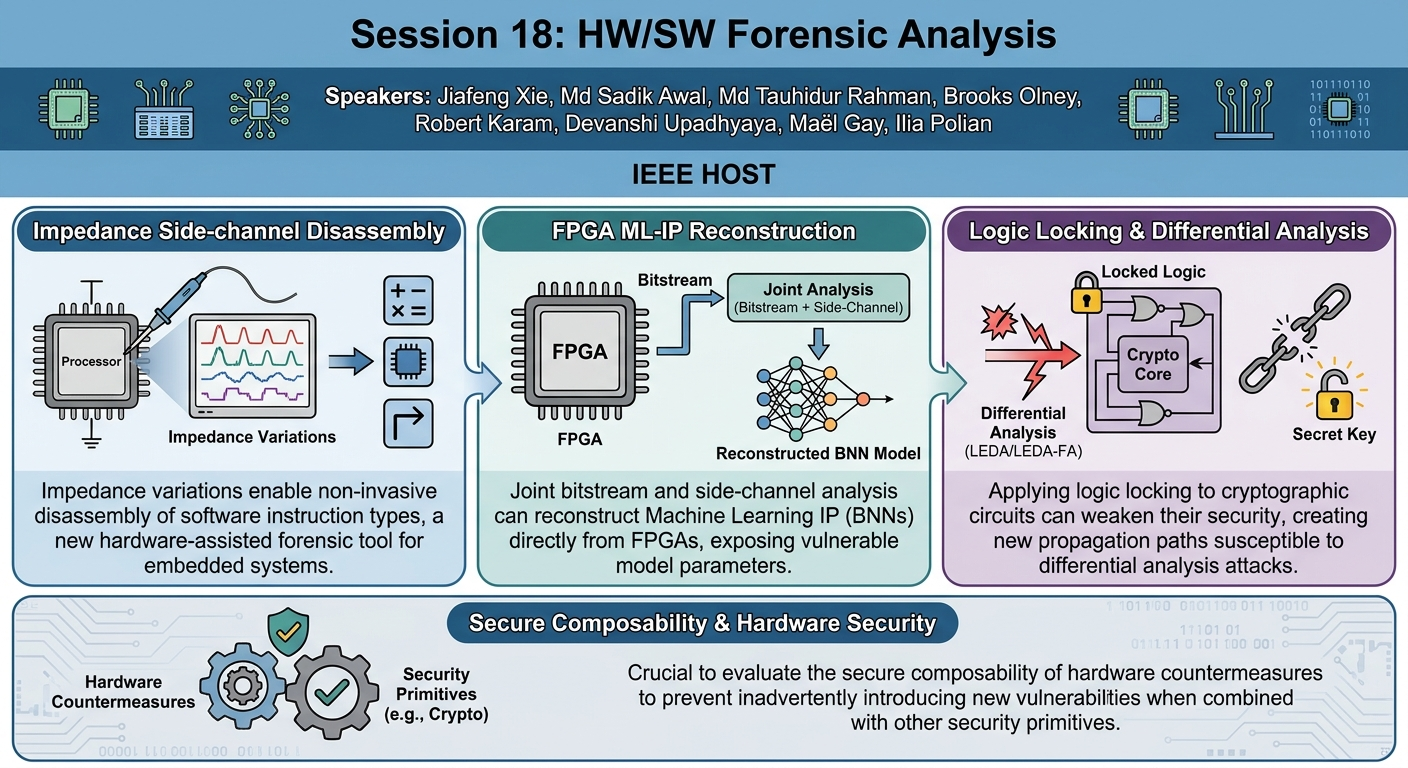
This IEEE HOST session, "HW/SW Forensic Analysis," delves into advanced techniques for hardware and software security analysis, presenting three distinct but interconnected research papers. The talks collectively highlight the increasing sophistication of attacks targeting integrated circuits (ICs) and the critical need for robust forensic methodologies. From exploring novel side channels for software instruction analysis to reconstructing machine learning intellectual property (IP) from FPGA bitstreams, and even demonstrating how hardware countermeasures can inadvertently introduce new vulnerabilities in cryptographic circuits, this session covers a broad spectrum of contemporary hardware security challenges.
Key moments
- 5:30 Introduction of Impedance as a Side Channel
- 11:58 Q&A: Runtime vs. earlier phase analysis
- 14:00 Reconstructing FPGA ML-IP: Introduction & Problem
- 20:00 Bitstream parsing and Block RAM reconstruction
- 25:50 Joint bitstream and side-channel analysis
- 40:00 LEDA/LEDFA attack methodology on cryptographic circuits
- 44:50 Analysis: Why LEDA attacks weaken crypto circuits
- 53:50 Q&A: Logic locking as a separate layer
Session 18: HW/SW Forensic Analysis
Speakers: Jiafeng Xie (Session Chair, Villanova University); Md Sadik Awal (Paper author, Florida International University); Md Tauhidur Rahman (Paper author); Brooks Olney (Paper author); Robert Karam (Paper author); Devanshi Upadhyaya (Paper author); Maël Gay (Paper author); Ilia Polian (Paper author)
Conference: IEEE HOST
YouTube: https://www.youtube.com/watch?v=Kcmc5PBq6hY
Overview
This IEEE HOST session, "HW/SW Forensic Analysis," delves into advanced techniques for hardware and software security analysis, presenting three distinct but interconnected research papers. The talks collectively highlight the increasing sophistication of attacks targeting integrated circuits (ICs) and the critical need for robust forensic methodologies. From exploring novel side channels for software instruction analysis to reconstructing machine learning intellectual property (IP) from FPGA bitstreams, and even demonstrating how hardware countermeasures can inadvertently introduce new vulnerabilities in cryptographic circuits, this session covers a broad spectrum of contemporary hardware security challenges.
The session underscores the persistent threat landscape where traditional software-based security measures often fall short, necessitating hardware-assisted solutions and deeper insights into physical characteristics of devices. The presented research offers significant contributions by introducing innovative analytical frameworks, leveraging open-source tools for reverse engineering, and critically evaluating the secure composability of hardware countermeasures. These findings are crucial for both defenders seeking to fortify systems against emerging threats and researchers pushing the boundaries of hardware security.
The presented papers address distinct facets of hardware-software co-analysis: the first investigates impedance as a new side channel for software instruction disassembly, the second proposes a joint bitstream and side-channel analysis approach to reconstruct machine learning models on FPGAs, and the third introduces Locking Enabled Differential Analysis (LEDA) to expose vulnerabilities when logic locking is applied to cryptographic primitives. Each paper contributes unique insights into the complex interplay between hardware design, software execution, and security vulnerabilities.
Background
▶ Watch: Introduction of Impedance as a Side Channel (5:30)
The landscape of cyber threats has evolved significantly, with attacks increasingly targeting the hardware layer, which forms the root of trust for any computing system. Traditional software-based security solutions, such as antivirus programs and intrusion detection systems, operate at higher levels of the system stack and often lack visibility into low-level firmware or hardware modifications. This gap creates opportunities for sophisticated malware, firmware rootkits, and counterfeit devices to introduce malicious code or compromise sensitive data, with global ransomware damages projected to exceed \$265 billion by 2031. Addressing these threats necessitates a shift towards hardware-assisted security and advanced forensic techniques.
Side-channel analysis (SCA) has emerged as a powerful methodology to infer internal operations of a device by observing its physical emanations, such as power consumption or electromagnetic (EM) radiation. While highly effective, traditional SCA techniques often come with limitations: EM analysis requires sensitive equipment and an EM-free environment, and power analysis typically demands physical modifications to the IC (e.g., cutting traces) and provides an aggregated view of current flow, making it challenging to isolate specific operations. The search for less invasive, more granular side channels is a continuous area of research.
In parallel, the proliferation of Field-Programmable Gate Arrays (FPGAs) in edge computing, particularly for accelerating Machine Learning (ML) workloads, introduces unique IP protection challenges. Developing state-of-the-art ML models requires substantial investment, making their intellectual property highly valuable. Model theft attacks, often leveraging SCA, aim to extract architectural parameters and weights of these deployed networks. While bitstream reverse engineering has been explored for other malicious purposes (e.g., Hardware Trojans), its application to ML model extraction, especially in conjunction with SCA, has remained underexplored.
Finally, hardware countermeasures like logic locking have been developed to protect intellectual property against reverse engineering, counterfeiting, and IP piracy in the increasingly decentralized IC design supply chain. Logic locking schemes modify a circuit's netlist by inserting additional gates controlled by a secret key, rendering the circuit functionally incorrect until the correct key is applied. However, the secure composability of these countermeasures—whether protecting against one threat might inadvertently introduce vulnerabilities to another—is a critical, often overlooked, area of research, particularly when applied to highly sensitive cryptographic circuits.
Key Findings
▶ Watch: Reconstructing FPGA ML-IP: Introduction & Problem (14:00)
Paper 1: Disassembling Software Instruction Types through Impedance Side-channel Analysis
Md Sadik Awal presented research demonstrating the novel application of impedance as a side channel to disassemble software instruction types. The core finding is that different instruction types executing on a processor induce distinct changes in the device's impedance characteristics. By measuring these impedance variations, researchers can classify the type of instruction being executed with high accuracy. This opens a new avenue for hardware-assisted malware detection and anomaly monitoring, particularly for resource-constrained embedded devices where traditional side-channel analysis might be impractical or too invasive. The methodology achieved an impressive 98.6% accuracy in classifying instruction types, showcasing impedance's potential as a powerful forensic tool.
Paper 2: Bits to BNNs: Reconstructing FPGA ML-IP with Joint Bitstream and Side-Channel Analysis
Brooks Olney presented a significant contribution to the field of ML IP security by demonstrating that a substantial amount of information about a deployed Binarized Neural Network (BNN) can be extracted directly from an FPGA's bitstream, particularly when combined with side-channel analysis. The research highlighted that open-source FPGA device databases, such as Project X-Ray, can be leveraged to reverse engineer the contents and configuration of Block RAMs, which often store neural network weights. This work is the first to directly hint at the possibility of reconstructing complex ML models purely from the bitstream, challenging the prevailing assumption that such models are inherently difficult to reverse engineer from this data alone. The findings reveal a critical vulnerability for ML models deployed on FPGAs, especially those using frameworks like Xilinx's FINN.
Paper 3: LEDA: Locking Enabled Differential Analysis of Cryptographic Circuits
Devanshi Upadhyaya presented groundbreaking research on the unexpected security implications of applying logic locking to cryptographic circuits. The key finding is that, contrary to its intended purpose of enhancing security, logic locking can actually weaken the cryptographic strength of a circuit, making it more vulnerable to differential analysis attacks. The proposed attacks, Locking Enabled Differential Analysis (LEDA) and its fault-assisted variant LEDA-FA, demonstrate that an incorrectly unlocked cryptographic circuit can function with reduced cryptographic strength, making it easier to extract the secret cryptographic key. The study revealed that some locking schemes, particularly anti-SAT logic locking, create new, cryptographically insecure propagation paths, making the circuits significantly more susceptible to attack than their unlocked counterparts, achieving up to 100% success rate with optimized attacks on LED.
Technical Deep Dive
▶ Watch: Joint bitstream and side-channel analysis (25:50)
Paper 1: Disassembling Software Instruction Types through Impedance Side-channel Analysis
The research by Md Sadik Awal and Md Tauhidur Rahman explores the unique electrical characteristics of a running processor to infer software operations. Their hypothesis posits that the impedance of an integrated circuit changes in correspondence with the specific instruction being executed. This is rooted in the principle that different instructions activate different parts of the chip, leading to variations in the internal circuitry's equivalent impedance. For instance, an adder/subtractor circuit controlled by a multiplexer will exhibit different impedance profiles depending on the selected operation.
The authors formulated an analytical model for CMOS inverters and NAND gates, demonstrating how their impedance changes with different input states. A CMOS inverter, transitioning between its two states, would present distinct impedance values. Similarly, a NAND gate would exhibit four different impedance values corresponding to its four input combinations.
The experimental setup utilized an Arduino as the target platform and a Vector Network Analyzer (VNA) to collect data. The VNA measures the S-parameters (scattering parameters) of the device, which are then converted into impedance signals. A coax cable connected the VNA to the peripheral of the Arduino. The instructions were categorized into four types based on the circuits they utilize.
The workflow involved several stages of signal processing:
- S-parameter measurements were collected from the VNA.
- These were converted into impedance signals.
- Frequency selection was performed to identify relevant frequency points that best describe the instruction types. Out of 10,000 collected frequency points, 2,700 were deemed adequate.
- Principal Component Analysis (PCA) was applied to reduce the dimensionality and complexity of the signals, identifying 1,200 features sufficient for differentiation.
- Finally, various machine learning algorithms such as Support Vector Machine (SVM), k-Nearest Neighbors (KNN), AdaBoost, and Linear Discriminant Analysis (LDA) were used for classification. The SVM with a RBF (Radial Basis Function) kernel achieved the highest accuracy of 98.6%, with a low false positive rate of 0.4%.
The authors acknowledged that the VNA's sweep time makes this solution currently unsuitable for runtime attacks, instead proposing it for earlier-phase instruction disassembly before system deployment. This early work highlights impedance as a promising, less invasive side channel for hardware forensics.
Paper 2: Bits to BNNs: Reconstructing FPGA ML-IP with Joint Bitstream and Side-Channel Analysis
Brooks Olney's research focuses on the reverse engineering of Binarized Neural Networks (BNNs) implemented on FPGAs, specifically targeting the Xilinx FINN framework. BNNs are popular for FPGA deployment due to their memory efficiency, quantizing weights and activations to a single bit, often stored in Block RAMs (BRAMs).
The attack methodology combines bitstream reverse engineering with side-channel analysis (SCA). The Xilinx 7-Series FPGA bitstream consists of 32-bit words, with 101 words forming a configuration frame. The Frame Address Register (FAR) points to the configuration block, location (row, column, top/bottom), and interface. Configuration data for logic and interconnects appears first, followed by BRAM initialization contents.
The bitstream parsing involves:
- Extracting configuration frame data from an unencrypted bitstream.
- Utilizing open-source FPGA bitstream databases, notably Project X-Ray, which provides crucial information on frame layout, bit definitions for component enablement, and interconnectivity. Key files from Project X-Ray include:
part.json: Defines the distribution of frames across FPGA regions (rows, columns, configuration buses).tilegrid.json: Specifies the base address and word count for each component's configuration data slice.segbitsfiles: Detail which specific bits within frames enable or disable particular configuration elements, such as BRAM read widths.
BRAM content reconstruction is a critical step. Xilinx BRAMs are 36-kilobit primitives, composed of two 18-kilobit primitives. Their initialization data is spread across init and parity vectors. When Error Correcting Code (ECC) is not used, parity vectors also store memory contents. The process involves:
- Interleaving contents from the two 18-kilobit memories.
- Concatenating parity vectors to the initialization vectors.
- Reshaping the data into rows (e.g., 256 + 32 bits for parity).
- Pruning zeroized rows and columns (for underutilized BRAMs or over-allocated read widths) to obtain the actual
N x Marray stored.
The data within these BRAMs is stored row-by-row, corresponding to the weight matrix of a neural network layer, with the amount determined by FINN's folding parameters.
Grouping BRAMs into layers is achieved by mapping interconnect tiles using Tcl commands within Vivado and analyzing pseudo programmable interconnect points (P-Pips) from Project X-Ray. A Depth-First Search (DFS) algorithm is used, starting from an allocated BRAM and traversing connected BRAMs to form groups, each representing a network layer.
While bitstream analysis reveals the number of layers, BRAMs per layer, and total read/depth width, side-channel analysis (SCA) is necessary to fully reconstruct the model:
- Simple Power Analysis (SPA): Used to determine which BRAM group corresponds to which layer, effective for fully connected networks where layer execution is distinct.
- Differential Power Analysis (DPA): Employed to determine the correct ordering of BRAMs within a group. A template function based on the binary multiply-accumulate operation is used, calculating a partial Hamming weight for each processing element to guess BRAM order iteratively.
The evaluation used two FINN-generated networks (a fully connected and a convolutional BNN) with single-bit activations and weights on a ChipWhisperer 305 board with an Artix-7 FPGA. The attack successfully recovered hyper-parameters (number and sizes of layers) from the bitstream. While DPA partially narrowed down the BRAM ordering search space (e.g., from 32! to a much smaller number for a layer with 32 BRAMs), further work is needed for full ordering reconstruction. The potential for neural network Trojan insertion by flipping weight bits was highlighted as a future implication.
Paper 3: LEDA: Locking Enabled Differential Analysis of Cryptographic Circuits
Devanshi Upadhyaya's research introduces Locking Enabled Differential Analysis (LEDA) and LEDA-FA (fault-assisted LEDA) to investigate the security implications of applying logic locking to cryptographic hardware. The work focuses on extracting the secret cryptographic key (K), not the logic locking key (LK).
The study considers two broad families of logic locking schemes:
- Preset/Post-side Logic Locking: Involves inserting gates (e.g., XOR/XNOR, AND/OR) at random locations in the netlist, controlled by the logic locking key. The circuit is functionally correct only when the correct LK is applied. Two variants were tested: random AND/OR insertions and random XOR/XNOR insertions.
- Point Function Based Logic Locking: These schemes introduce a single point of perturbation based on a point function
y, which is dependent on the correct LK. Two types were studied:
- Anti-SAT Logic Locking: Inserts a logic locking block whose output flips if an incorrect LK is applied, based on a subset of primary inputs.
- Stripped Functionality Logic Locking: Similar to anti-SAT but the point function also depends on intermediate wires.
The overall attack methodology proceeds as follows:
- A hardware implementation of a cryptographic primitive (e.g., LED, Present, or a small-scale AES) is chosen.
- The circuit is unrolled into a one-cycle implementation using time frame expansion.
- This expanded circuit is then locked using NEOS (an open-source netlist encryption and obfuscation suite) according to chosen locking parameters.
- For LEDA, the locked circuit is "unlocked" using a randomly generated incorrect logic locking key (LK'). This incorrectly unlocked cipher is then used for encryptions.
- An attack formula is constructed using the algebraic fault attack framework AutoFold, performing differential analysis on these encryptions (with LEDA-FA, faults are also injected).
- The formula is converted to Conjunctive Normal Form (CNF) via Shannon transform and fed to a SAT solver to extract the secret cryptographic key
K.
LEDA Results:
- LEDA-FA (with fault injections and incorrect LK) significantly reduced attack complexity compared to traditional Differential Fault Analysis (DFA). For Present with 5 fault injections, DFA took ~1300 seconds, while LEDA-FA with 128 random AND/OR insertions took only ~6 seconds. For AES with 2 fault injections, DFA took ~15000 seconds, while LEDA-FA with 64-bit anti-SAT locking took ~2500 seconds.
- LEDA (without fault injections, using multiple incorrect LKs) showed that logic locking can make circuits vulnerable to classical algebraic analysis. It achieved an average 50% success rate for random logic locking schemes and an average 70% success rate for anti-SAT schemes. Stripped functionality logic locking initially showed 0% success, and full-scale AES was not attackable with random attacks.
Analysis of Attack Success:
- Random Logic Locking: Incorrect LK's act like single-bit flip faults. If these gates are at "desirable locations" (e.g., critical rounds), they simplify the attack formula. However, two simultaneous bit flips can cancel each other out, explaining the lower 50% success rate. The authors demonstrated this by hand-picking incorrect LKs for specific key bits (LK 11, 24, 27, 47, 62) affecting round 29 of LED, achieving a 100% success rate compared to 26% with random keys.
- Point Function Based Logic Locking (Anti-SAT): These schemes introduce a separate logic locking block at the end of the circuit, which creates a new, smaller, and cryptographically insecure propagation path between the cryptographic key and the circuit outputs. For example, LED has ~67,000 gates, while a 64-bit anti-SAT block adds only ~67 gates. The "tree input set"
X(a subset of primary inputs for anti-SAT, or primary inputs and intermediate wires for stripped functionality) can contain cryptographic key bits. The more cryptographic key bits in this tree input set, the more vulnerable the circuit becomes. For Present with 128-bit anti-SAT, recoveringKtook 105 seconds when 51 key bits were inX, compared to 1800 seconds when only 24 bits were inX. Critically, for full-scale AES locked with 128-bit stripped functionality, successful extraction (in 10427 seconds) was achieved when 65 key bits were part ofX, demonstrating attacks are possible even on previously resistant schemes and full-scale implementations under specific conditions.
The research concludes that logic locking, when applied to cryptographic circuits, can inadvertently reduce their cryptographic strength, creating new vulnerabilities that can be exploited by differential analysis.
Demo / Proof of Concept
▶ Watch: LEDA/LEDFA attack methodology on cryptographic circuits (40:00)
Paper 1: Disassembling Software Instruction Types through Impedance Side-channel Analysis
The proof of concept for this paper involved a carefully constructed experimental setup rather than a live demonstration of an attack. The researchers utilized an Arduino board as the target embedded system, programmed to execute different types of software instructions. A Vector Network Analyzer (VNA) was used as the primary measurement instrument, connected to the Arduino's peripheral via a coax cable. This setup allowed for the collection of S-parameter measurements which were then converted into impedance values. The distinct impedance responses observed for the four different instruction types in specific frequency regions served as the core demonstration of impedance's viability as a side channel. The subsequent data processing pipeline, including frequency selection, Principal Component Analysis (PCA), and machine learning classification, constituted the analytical proof of concept, showing that the collected impedance data could indeed differentiate instruction types with high accuracy.
Paper 2: Bits to BNNs: Reconstructing FPGA ML-IP with Joint Bitstream and Side-Channel Analysis
The demonstration for this work centered on the partial reconstruction of Binarized Neural Networks (BNNs) deployed on FPGAs. The researchers evaluated their methodology using two distinct BNN models generated by Xilinx's FINN framework: a fully connected network and a convolutional network, both quantized to single-bit activations and weights. The proof of concept showed that the hyper-parameters of these models, such as the number of layers and the size of each layer, could be accurately derived purely from the FPGA bitstream using open-source tools like Project X-Ray. The integration of side-channel analysis (SCA), performed using a ChipWhisperer 305 board with an Artix-7 FPGA, further demonstrated the ability to determine which bitstream-derived BRAM group corresponded to which neural network layer. While full reconstruction of BRAM ordering within a layer proved challenging, the approach significantly narrowed down the search space, illustrating the potent combination of bitstream and SCA for ML IP extraction.
Paper 3: LEDA: Locking Enabled Differential Analysis of Cryptographic Circuits
The proof of concept for LEDA and LEDA-FA involved applying the proposed attacks to hardware implementations of various cryptographic primitives: LED, Present, and a small-scale variant of AES. The demonstration highlighted the effectiveness of these attacks under different logic locking schemes, including random AND/OR, random XOR/XNOR, and point-function-based schemes like anti-SAT and stripped functionality logic locking. The key aspect of the demonstration was the successful extraction of the secret cryptographic key for these ciphers, even with a randomly generated incorrect logic locking key. The results quantified the reduction in attack complexity (e.g., from ~1300 seconds to ~6 seconds for Present with LEDA-FA) and the achieved success rates (up to 100% for optimized attacks on LED). This empirically demonstrated that logic locking, when applied to cryptographic circuits, can indeed introduce new vulnerabilities and weaken their security, contrary to its intended purpose.
Defensive Implications
▶ Watch: Q&A: Logic locking as a separate layer (53:50)
Paper 1: Disassembling Software Instruction Types through Impedance Side-channel Analysis
The findings regarding impedance as a viable side channel for disassembling software instruction types present several defensive implications. First, it reinforces the critical need for hardware-assisted malware detection mechanisms. Since impedance analysis operates at a physical layer, it can potentially detect low-level attacks that evade software-based antivirus or intrusion detection systems, such as firmware rootkits or malicious bootloaders. Defenders should consider incorporating novel physical side channels, like impedance, into their threat models for embedded and resource-constrained devices, where other SCA methods might be too complex or invasive. While currently an early-phase technique, future advancements could enable runtime anomaly monitoring by continuously profiling impedance signatures. This would allow for the detection of unexpected instruction sequences, indicative of malware execution or system compromise. Furthermore, the ability to disassemble instructions at an earlier stage could aid in supply chain security by verifying the integrity of pre-loaded firmware before deployment.
Paper 2: Bits to BNNs: Reconstructing FPGA ML-IP with Joint Bitstream and Side-Channel Analysis
This research highlights a significant vulnerability for Machine Learning Intellectual Property (ML-IP) deployed on FPGAs. Defenders must recognize that relying solely on bitstream encryption may not be sufficient to protect ML models, as even unencrypted bitstreams, especially when combined with SCA, can yield substantial information. Key defensive measures include:
- Enhanced Bitstream Protection: While bitstream encryption is a baseline, designers should consider additional obfuscation techniques for critical ML model parameters within the bitstream itself.
- Secure BRAM Utilization: Implementations should minimize the storage of sensitive model weights in easily reconstructible BRAM structures, or employ advanced obfuscation techniques for BRAM contents.
- Anti-Side-Channel Design: Incorporate SCA countermeasures into FPGA designs, such as power randomization or noise injection, to make the DPA portion of the attack more difficult.
- Toolchain Awareness: Be aware of the capabilities of open-source FPGA bitstream reverse engineering projects like Project X-Ray. While beneficial for open-source hardware, these tools can be weaponized for IP theft.
- Layer-Specific Obfuscation: Develop methods to obfuscate or randomize the structural mapping between neural network layers and their corresponding BRAM groups, making SPA-based layer identification more challenging.
- Proactive Threat Modeling: ML model developers should proactively threat model their FPGA deployments against combined bitstream and side-channel attacks, not just against traditional software attacks.
Paper 3: LEDA: Locking Enabled Differential Analysis of Cryptographic Circuits
The findings of LEDA and LEDA-FA have profound defensive implications for the design and deployment of hardware security countermeasures, particularly logic locking. The core takeaway is that logic locking should not be applied to cryptographic circuits. If a cryptographic circuit is part of a larger IP core that requires protection, the cryptographic block itself should be explicitly excluded from the locking scheme. Specific recommendations include:
- Segregation of Cryptographic IP: Isolate cryptographic modules from logic locking mechanisms. If logic locking is essential for other parts of a larger design, a secure wrapper or architectural separation should be implemented to prevent any interaction with the cryptographic core.
- Avoid Critical Key Gate Placement: Designers must ensure that logic locking gates are not inserted at critical locations within cryptographic circuits, as these can inadvertently simplify differential analysis.
- Prevent Crypto Key Bit Feeding: Crucially, cryptographic key bits should never be fed directly into the logic locking sub-circuits or used as part of the "tree input set" for point-function-based locking schemes. This creates a direct and vulnerable propagation path that significantly weakens the cipher.
- Secure Composability Evaluation: Any hardware countermeasure (e.g., watermarking, camouflaging, logic locking) must undergo rigorous evaluation for its secure composability, meaning its interaction with other security primitives or existing vulnerabilities. Protecting against one threat should not inadvertently introduce new ones.
- Advanced Locking Schemes: Future logic locking schemes could be extended to detect recurring applications of an incorrect logic locking key, similar to fault injection or tampering detection, to mitigate these types of attacks. However, the fundamental principle of not weakening cryptographic strength remains paramount.
Key Takeaways
- Novel Side Channel Discovery: Impedance analysis presents a promising, non-invasive side channel for disassembling software instruction types, offering a new avenue for hardware-assisted anomaly detection in embedded systems with 98.6% accuracy.
- ML IP Vulnerability on FPGAs: Machine Learning intellectual property (IP) deployed on FPGAs is vulnerable to reconstruction through a combination of bitstream reverse engineering (leveraging tools like Project X-Ray) and side-channel analysis, challenging the assumption of bitstream security alone.
- Logic Locking's Double-Edged Sword: Applying logic locking to cryptographic circuits can paradoxically weaken their security, making them highly susceptible to differential analysis attacks (LEDA/LEDA-FA) by creating new, exploitable propagation paths.
- Importance of Secure Composability: Hardware countermeasures must be meticulously evaluated for secure composability, ensuring they do not inadvertently create new vulnerabilities when combined with other security primitives or applied to sensitive components like cryptographic circuits.
- Hardware-Assisted Security is Paramount: The limitations of software-only security solutions necessitate a continuous focus on hardware-level forensics and hardware-assisted defenses to combat sophisticated attacks targeting the root of trust.
- Protecting Sensitive Data in Hardware: Designers must be acutely aware of how sensitive data, such as neural network weights or cryptographic keys, are stored and processed in hardware, and implement robust protection mechanisms against both passive (side-channel, bitstream) and active (logic locking manipulation) attacks.
About the Speaker(s)
The session featured several distinguished researchers and academics contributing to the field of hardware and software security.
Jiafeng Xie served as the Session Chair from Villanova University, facilitating the presentations.
Md Sadik Awal, a PhD student at Florida International University, presented the first paper, "Disassembling Software Instruction Types through Impedance Side-channel Analysis." His research explores novel side-channel analysis techniques. He co-authored this paper with Md Tauhidur Rahman.
Brooks Olney, a PhD candidate at the University of South Florida, presented the second paper, "Bits to BNNs: Reconstructing FPGA ML-IP with Joint Bitstream and Side-Channel Analysis." His research focuses on hardware security, reconfigurable computing, and adversarial machine learning. He was graduating in May and planning to join MIT Lincoln Lab as a Hardware Security Researcher. He co-authored this paper with his advisor Robert Karam.
Devanshi Upadhyaya, a PhD student at the University of Stuttgart, presented the third paper, "LEDA: Locking Enabled Differential Analysis of Cryptographic Circuits." Her work centers on the secure composability of cryptographic hardware and other aspects of hardware and network security. She co-authored this paper with Maël Gay and Ilia Polian.
Reviews
Dr. Zero (Offensive Security Researcher) — SOLID
This is what an academic hardware track should look like. No marketing, just pure structural reverse engineering and algebraic attacks on silicon. You show up for Olney ripping neural nets out of bitstreams and stay to watch Upadhyaya prove that IP protection mechanisms fatally weaken cryptographic primitives.
Heather Calloway (CISO) — SOLID
This is deep academic hardware research, not a leadership briefing. However, organizations deploying highly valuable, proprietary machine learning models to edge devices need to understand the IP extraction risks demonstrated here.
All talks from IEEE International Symposium on Hardware Oriented Security and Trust (HOST) 2023