Session 11: The Power of Sneaky Power!
Naghmeh Karimi (Session Chair · University of Maryland, Baltimore County), Guilhèm Assael (Paper author), Philippe Elbaz-Vincent (Paper author), Guillaume Reymond (Paper author), Minyan Gao (Paper author), Domenic Forte (Paper author), Yunkai Bai (Paper author), Jungmin Park (Paper author), Mark Tehranipoor (Paper author)
IEEE International Symposium on Hardware Oriented Security and Trust (HOST) 2023 · Day 3 · Gateway Ballroom
Overview
This IEEE HOST session, "The Power of Sneaky Power!", delved into advanced hardware security vulnerabilities and attack methodologies, presenting three distinct papers that push the boundaries of side-channel analysis and microprobing attacks. The talks collectively highlight the increasing sophistication of adversaries targeting integrated circuits, from cryptographic implementations to the physical layout of chips, and explore novel techniques for both attack and assessment. The research underscores the critical need for robust, multi-layered defenses that consider not just algorithmic security but also the physical and electromagnetic emanations of computing devices.
Key moments
- 0:00 Introduction to single-trace attacks on NTT
- 1:00 Explaining belief propagation and factor graph attack modeling
- 17:45 Detour: Layout-aware reroute attack vulnerability assessment
- 24:00 D2R framework for reroute attack vulnerability assessment
- 40:16 Real-time dual-channel EM/Power attack motivation
- 42:00 Introducing RECP: coin-sized real-time dual channel platform
- 51:30 Real-time experiment results and performance comparison
- 56:30 Q&A: How combining EM/Power generates new insights
The Power of Sneaky Power!
Speakers: Naghmeh Karimi (Session Chair, University of Maryland, Baltimore County); Guilhèm Assael, Philippe Elbaz-Vincent, Guillaume Reymond (Paper 1); Minyan Gao, Domenic Forte (Paper 2); Yunkai Bai, Jungmin Park, Mark Tehranipoor, Domenic Forte (Paper 3)
Conference: IEEE HOST
YouTube: https://www.youtube.com/watch?v=iaGivfLFbo8
Overview
This IEEE HOST session, "The Power of Sneaky Power!", delved into advanced hardware security vulnerabilities and attack methodologies, presenting three distinct papers that push the boundaries of side-channel analysis and microprobing attacks. The talks collectively highlight the increasing sophistication of adversaries targeting integrated circuits, from cryptographic implementations to the physical layout of chips, and explore novel techniques for both attack and assessment. The research underscores the critical need for robust, multi-layered defenses that consider not just algorithmic security but also the physical and electromagnetic emanations of computing devices.
The session began with an exploration of enhanced single-trace side-channel attacks against optimized cryptographic implementations, specifically targeting the Number-Theoretic Transform (NTT) within the Kyber post-quantum cryptography algorithm on Cortex-M4 microcontrollers. This was followed by a comprehensive analysis of reroute probing attacks, introducing a framework for assessing layout-level vulnerabilities in integrated circuits. The session concluded with a presentation on a novel dual-channel electromagnetic (EM) and power analysis attack, demonstrating its real-time implementation for efficient key extraction on a compact, custom-designed platform.
Together, these presentations paint a vivid picture of the evolving threat landscape in hardware security. They showcase how sophisticated mathematical models, precise physical manipulation, and intelligent signal processing can be leveraged to compromise sensitive data. For security professionals, researchers, and hardware designers, the insights from this session are invaluable, providing a deeper understanding of current attack vectors and informing the development of next-generation defensive strategies against these potent threats.
Background
▶ Watch: Introduction to single-trace attacks on NTT (0:00)
The field of hardware security is a constant arms race, with attackers developing increasingly sophisticated methods to exploit vulnerabilities at the physical and electrical levels of integrated circuits. This session addresses several facets of this ongoing challenge, building upon decades of research in side-channel analysis and microprobing.
Side-Channel Attacks: These attacks exploit information leaked inadvertently by a physical implementation of a cryptosystem. Common side channels include power consumption, electromagnetic (EM) emissions, timing information, and even acoustic signals. Traditional side-channel attacks often fall into two categories: vertical attacks, which require thousands or millions of traces to build statistical models, and horizontal attacks, which aim to extract secrets from a single or very few executions. The evolution of cryptographic algorithms, particularly the emergence of post-quantum cryptography (PQC) like Kyber, and their optimized implementations on constrained devices such as Cortex-M4 microcontrollers, necessitates continuous re-evaluation of attack efficacy. Previous work has demonstrated the vulnerability of NTT implementations to side-channel attacks, but new optimizations often introduce new leakage patterns or require adapted attack methodologies.
Microprobing Attacks: These are highly invasive physical attacks that involve direct manipulation of the integrated circuit (IC) die. Tools like the Focused Ion Beam (FIB) enable adversaries to precisely cut, deposit, and modify connections at the nanoscale. Earlier microprobing techniques, often termed bypass attacks, focused on finding existing gaps between protective layers to access target wires. However, the ability of FIB to deposit material opens up more potent attack vectors. This capability allows for the creation of new conductive paths, leading to what are known as reroute attacks. These attacks can actively modify the circuit layout to expose sensitive signals, bypassing or even disabling existing countermeasures like shield nets. The lack of comprehensive tools and methodologies for assessing reroute attack vulnerabilities at the pre-silicon design stage represents a significant gap in hardware security.
Dual-Channel Side-Channel Attacks: While power analysis and EM analysis are well-established side-channel techniques, they are often treated as separate attack vectors. However, both emanations originate from the same underlying physical phenomena—the switching activity of transistors within the IC. Research has explored combining information from multiple side channels, but often through simple concatenation or summation methods. The challenge lies in effectively fusing these distinct but related data streams to maximize information gain while minimizing computational overhead, especially for real-time implementations on resource-constrained platforms. The need for compact, deployable, and efficient attack platforms is driven by the proliferation of IoT devices and Cyber-Physical Systems (CPS), which often operate in environments where traditional lab equipment is impractical.
This session directly addresses these challenges by presenting advanced research that:
- Adapts a powerful horizontal attack technique (belief propagation) to a new, optimized PQC implementation.
- Introduces a novel framework for quantifying the threat of advanced microprobing attacks (reroute attacks) at the design stage.
- Develops a real-time, dual-channel side-channel attack platform leveraging advanced signal processing (mutual information) for enhanced efficiency.
Key Findings
▶ Watch: Detour: Layout-aware reroute attack vulnerability assessment (17:45)
The session presented several significant findings across the three distinct papers, collectively advancing the understanding of hardware security vulnerabilities and attack methodologies.
Paper 1: Improving Single-Trace Attacks on the Number-Theoretic Transform for Cortex-M4
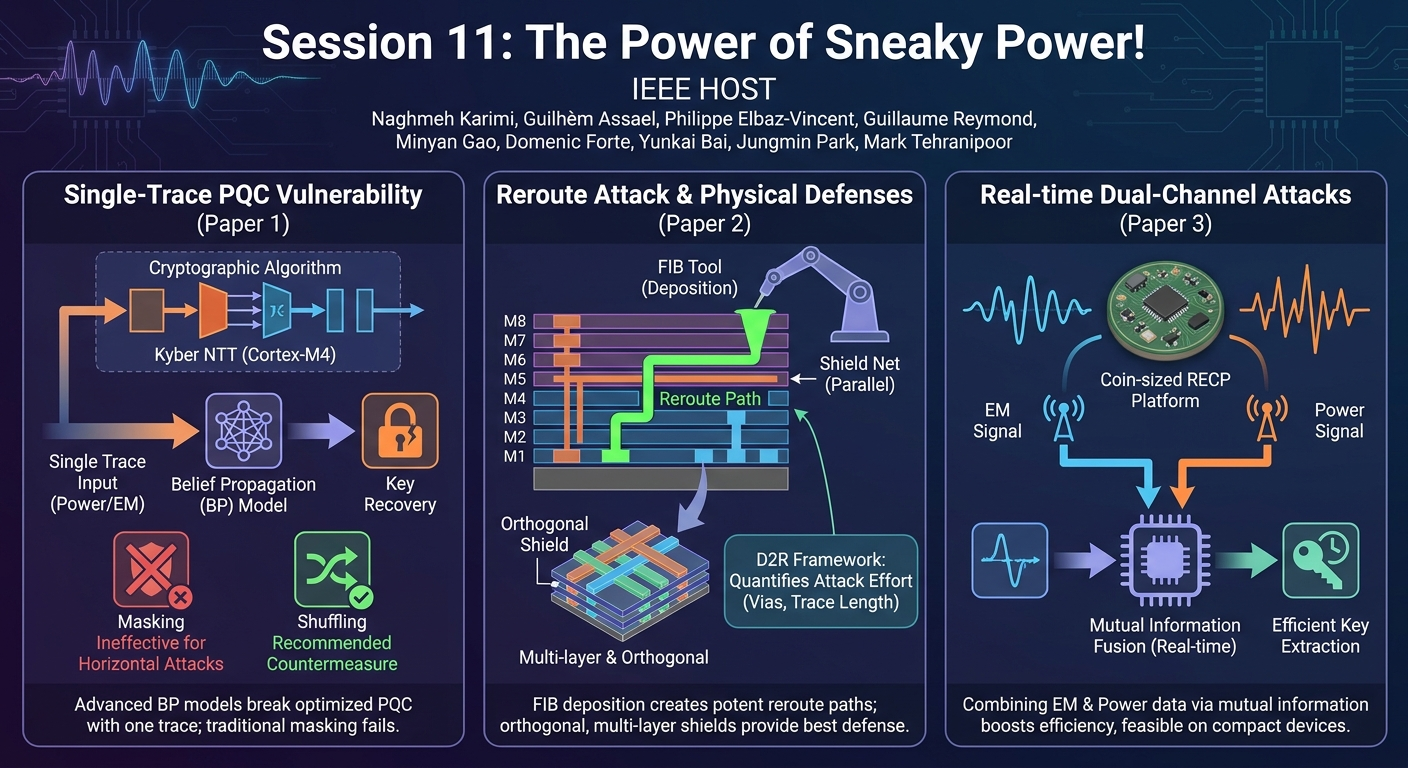
This paper demonstrated the efficacy of belief propagation (BP) for single-trace side-channel attacks against the Number-Theoretic Transform (NTT) function within the Kyber post-quantum cryptography algorithm, specifically targeting its optimized Cortex-M4 implementation. Key findings include:
- High Success Rates with Accurate Modeling: When the noise level (standard deviation
sigma_m) of the leakage model was accurately known, the attack achieved a 100% perfect success rate in recovering coefficients forsigma_mvalues up to 4. Even atsigma_m= 5, a 75% success rate was observed. - Robustness to Noise Estimation: In a more realistic scenario where the exact noise level is unknown, fixing the attack's assumed noise (
sigma_f) to 4 and varying the truesigma_mstill yielded high success rates. The research found that overestimating the noise (sigma_f>sigma_m) resulted in better attack performance than underestimation, providing a practical guideline for real-world scenarios. - Computational Efficiency: Despite the complexity, successful attacks could be completed in less than three hours for
sigma_mvalues up to 4, demonstrating the practical feasibility of this technique. - Targeted Information Retrieval: The attack can be leveraged during the encryption phase of Kyber to retrieve the plaintext or during key generation to extract sensitive key components like
sande. - Ineffectiveness of Masking: For horizontal (single-trace) attacks, masking countermeasures were found to be ineffective. While masking reduces the signal-to-noise ratio, an attacker can iterate more, attacking share by share and recombining them, thereby merely reducing the attack's noise tolerance rather than preventing it.
- Recommendation for Shuffling: Shuffling operations, which randomize the execution order of NTT computations, were suggested as a more effective countermeasure by decorrelating timing with data.
- Novelty in Adaptation: The primary contribution was the successful adaptation of belief propagation to this specific, optimized Cortex-M4 implementation of Kyber, highlighting the continued vulnerability of modern PQC implementations to adapted side-channel techniques.
Paper 2: Detour: Layout-aware Reroute Attack Vulnerability Assessment and Analysis
This research introduced the D2R framework for comprehensively assessing and quantifying the vulnerability of IC physical designs to reroute probing attacks at the pre-silicon stage. Major findings include:
- Reroute Attacks are More Potent: The study confirmed that reroute attacks, which leverage FIB deposition to create new conductive paths, are significantly more dangerous and potent than conventional bypass attacks, which passively search for exploitable space.
- Quantifiable Vulnerability Metrics: The D2R framework provides a linear programming-based approach to quantify attack efforts, considering metrics such as the number of vias and traces to be added, and the total length of added traces. This allows designers to understand "how vulnerable" their physical design is.
- Optimal Shield Configuration: Experiments on an SOC benchmark (developed by MIT) synthesized with a 32nm Synopsis library revealed that specific shield net configurations significantly impact protection. Designs with shield nets plus other nets (non-shield wires) offered the best protection. Furthermore, using M6 and M7 metal layers for shields demonstrated the highest protection against reroute attacks.
- Multi-Layer and Orthogonal Shields are Superior: The framework showed that two-layer shield structures (e.g., M6+M7 or M6+M8) provide substantially greater attack effort costs (i.e., better protection) than single-layer shields. Additionally, orthogonal shield configurations were found to perform better than parallel ones, increasing the complexity for attackers.
- Impact of Dependent Probing: The study highlighted that in realistic scenarios, attackers might have a limited number of probe types, leading to overlapping circuit edits. The D2R framework demonstrated that accounting for these dependencies and the need to iterate to find non-overlapping probing areas increases attack efforts (e.g., more iterations, sub-optimal reroute paths) compared to assuming independent probes.
- Quantified Overhead of Countermeasures: While adding security, the implementation of shield nets introduces overheads. The research indicated that routing overhead is the most significant, potentially increasing by more than 20%, while area and power overheads are typically less than 10%.
Paper 3: Dual Channel EM/Power Attack Using Mutual Information and its Real-time Implementation
This paper presented a novel dual-channel EM/power side-channel attack methodology leveraging mutual information for feature selection and demonstrated its real-time implementation on a custom, compact platform. Key findings include:
- Enhanced Efficiency with Combined Channels: The core finding is that combining information from both EM and power channels significantly reduces the number of traces required to achieve 100% key recovery for an AES-128 implementation compared to using either channel alone.
- Mutual Information for Optimal Feature Selection: The proposed mutual information-based feature selection method effectively quantifies the benefits of combining EM and power channels and selects the most informative features. This approach was shown to be more efficient than previous methods like simple concatenation or sum-of-squares.
- Real-time Implementation on RECP: The research successfully implemented the methodology on a custom, coin-sized PCB named the Real-time Dual Channel Platform (RECP). This platform can simultaneously collect EM and power traces, perform real-time processing, and transmit data remotely via Bluetooth, enabling in-situ key extraction.
- Performance Comparison (Offline vs. Real-time):
- Offline Mode (Oscilloscope/EM Probe): EM analysis generally performed better than power analysis. The combined channel attack showed 43% and 22% improvement over single power and EM channels, respectively, in differential attacks, and 61% and 34% improvement in machine attacks.
- Real-time Mode (RECP): Due to the RECP's integrated EM antenna design (split into four parts), which affected the SNR ratio, power analysis was found to be more effective than EM analysis in real-time. However, the combined channel still outperformed single channels, showing 23% and 56% improvement over power and EM, respectively, in real-time differential attacks.
- Memory and Computational Optimization for Real-time: The real-time implementation on the FPGA-based RECP (Spartan 3 500) necessitated significant optimizations to save memory and bypass complex calculations, leading to the use of integer calculations and processing traces one by one. This also led to giving up the correlation attack algorithm in real-time due to its memory demands.
- Scalability and Future Work: The RECP demonstrates a new perspective for side-channel attack communities by enabling real-time, remote, and compact attack capabilities. Future work includes designing new RECP versions, upgrading malware/Trojan detection from single to dual channels, and testing on RISC-V implementations.
Technical Deep Dive
▶ Watch: Real-time dual-channel EM/Power attack motivation (40:16)
The session provided a deep dive into the technical underpinnings of each attack and assessment methodology.
Paper 1: Improving Single-Trace Attacks on the Number-Theoretic Transform for Cortex-M4
The core of this attack lies in belief propagation (BP), a message-passing algorithm used to compute marginal distributions of variables in a factor graph. The presenter, Mateus Simões, detailed how the NTT function in Kyber's optimized Cortex-M4 implementation is modeled as such a graph. This specific implementation processes two 16-bit coefficients simultaneously within a 32-bit word, allowing for two butterfly operations at once.
The factor graph model consists of:
- Variable Nodes: Representing unknown quantities, specifically the 256 coefficients of the NTT.
- Factor Nodes: Modeling the relationships between variables and observed leakages. Four types were identified for one layer of NTT, comprising two butterfly operations:
- L (Leakage) Nodes: Model leakages from load/store operations on 32-bit registers or RAM, linking to two 16-bit coefficient variables.
- I (Individual) Nodes: Model leakage from operations on a single coefficient.
- V (Pair) Nodes: Model leakage from operations on a pair of coefficients.
- Butterfly Nodes: Model the arithmetic relationships (butterfly operations) between two coefficients.
The leakage model is based on Hamming weights of the 32-bit words written to registers or RAM. A configurable Gaussian noise (sigma_m) is added to these simulated measurements. The attack proceeds in an iterative "ping-pong" manner: messages (representing probability distributions) are passed between factor and variable nodes, from inputs to outputs and back, until convergence.
Two optimization techniques were employed:
- Message Damping: To prevent oscillations in probability distributions and ensure convergence, weights are added to messages, incorporating the last sent message. This helps to "unbalance" oscillations.
- Message Pruning: To speed up the attack, low probability outcomes are ignored, reducing the computational burden.
The entire setup was simulated in Python 3 with JIT compilation (Numba) and utilized 32 cores for acceleration. Traces were generated by sampling random inputs and measuring noisy Hamming weights. The attacker then used these noisy values to reconstruct the factor graph and iterate to find the highest probability outcomes for the secret coefficients.
The paper distinguished between three outcomes: convergence to a secret, reaching an iteration limit (100 iterations), or complete failure (zero probability outcome). The success rates were evaluated under two scenarios:
- Known Noise:
sigma_f(factor graph noise) matchedsigma_m(measurement noise). - Unknown Noise (Realistic):
sigma_fwas fixed (e.g., to 4), whilesigma_mvaried. Results showed that overestimatingsigma_mimproved success rates, providing a practical heuristic for real-world attacks.
Paper 2: Detour: Layout-aware Reroute Attack Vulnerability Assessment and Analysis
Minyan Gao presented the D2R framework, a linear programming (LP)-based approach for quantifying IC design vulnerability to reroute attacks. Unlike bypass attacks, reroute attacks leverage the FIB's deposition capabilities to actively create new connections, making them far more potent.
The D2R framework's workflow involves three main parts:
- Probing Area Calculation: Identifying all target nets (e.g., encryption keys, data bus, obfuscation keys) carrying security assets within a specified layout region.
- Shield Nets Extraction: Locating all existing shield nets relative to the identified target nets. Shield nets are typically top-layer wires designed to protect underlying sensitive signals by making them harder to probe.
- Reroute Attack Efforts Estimation: This is the core LP problem. Given a probing area and the shield/target nets, the framework minimizes the total attack effort. Attack effort is quantified by the number of vias and traces that need to be added, and their total length.
- Constraints: The LP model incorporates technology-dependent design rules, such as minimum distances between vias, between vias and nets, and other physical design constraints.
The framework's output includes the calculated number of vias, added trace lengths, and a visualization of the optimal (worst-case for the defender) reroute paths. The goal is to find the minimum effort an attacker needs, which then represents the vulnerability score of the design.
The experiments used a common SOC benchmark (developed by MIT) synthesized with a 32nm Synopsis library. Target nets included AES encryption keys, processor-to-AES data bus nets, and processor obfuscation key nets. Four groups of designs were compared: no shield nets, previous work's shield configurations, only shield nets, and shield nets plus other routing nets.
A crucial aspect explored was dependent probing, where an attacker might have a limited number of FIB probe types, preventing simultaneous probing of multiple target nets if their required circuit edits (e.g., added vias) overlap on the topmost metal layers. The framework iteratively identifies non-overlapping probing areas, showing that this dependency significantly increases attack efforts, as new, potentially sub-optimal probing locations must be found. Visualization tools were used to illustrate how probing areas might need to be shifted to avoid such overlaps.
The work also quantified the design overhead introduced by security countermeasures. While area and power overheads were typically less than 10%, routing overhead could exceed 20%, indicating a significant trade-off that designers must consider.
Paper 3: Dual Channel EM/Power Attack Using Mutual Information and its Real-time Implementation
Yunkai Bai detailed a novel approach to combine EM and power side-channel information for more efficient key extraction, specifically focusing on real-time implementation. The fundamental principle is that EM and power emanations, while related, can contain complementary information at different time points, originating from the same MOSFET switching transitions.
The methodology is based on mutual information (MI), which quantifies the amount of information obtained about one random variable by observing another. Here, MI is used to build a relationship between combined EM/power features and secret sub-key values. The goal is to find optimal linear coefficients (alpha) to combine power (P) and EM (EM) features into a single combined feature (F_alpha = alpha P + (1-alpha) EM) such that the mutual information I(F_alpha; Subkey) is maximized.
- Gaussian Distribution Approximation: For simpler calculations, the entropy and mutual information formulations were approximated using Gaussian distributions, allowing the problem to be framed in terms of standard deviations and linear algebra.
- Linear Coefficient Optimization: By taking the derivative of the mutual information with respect to
alphaand finding its zero point, the optimalalphathat maximizes information gain from the combined channel can be determined.
The overall workflow involves:
- Feature Collection: Loading a template (known plaintext) into the target board (e.g., Arduino Uno) and simultaneously collecting EM and power traces.
- Feature Ranking and Coefficient Calculation (Offline Training): Calculating standard deviations of training traces, ranking features, and determining the optimal
alphaand feature indices using the MI-based linear coefficient optimization. - Real-time Testing: On the Real-time Dual Channel Platform (RECP), testing EM and power traces are collected, shrunk based on the trained indices, normalized, and combined using the trained
alpha. These combined traces are then fed into attack algorithms.
The RECP itself is a coin-sized PCB built around an FPGA (Spartan 3 500). Its compact size and Bluetooth communication enable remote, in-situ deployment. Due to the FPGA's limited memory, significant optimizations were necessary for real-time implementation:
- Decimal to Integer Conversion: All calculations were converted to integer arithmetic.
- Trace-by-Trace Processing: Traces are processed one by one to reduce memory footprint.
- Algorithm Selection: Only machine attack (profiling-based, using pre-trained models) and differential attack were implemented in real-time, while correlation attack was omitted due to its higher memory requirements.
Experiments were conducted in both offline (using an oscilloscope and EM probe) and real-time (using RECP) modes against an Arduino Uno board running AES-128. Results consistently showed that the combined channel required fewer traces for key extraction. The performance difference between EM and power channels varied between offline and real-time modes, attributed to the RECP's integrated EM antenna design influencing the signal-to-noise ratio. The work demonstrated that this method is more efficient than previous related works that used simpler concatenation or summation of channels.
Demo / Proof of Concept
▶ Watch: Introducing RECP: coin-sized real-time dual channel platform (42:00)
Each paper presented a form of demonstration or proof of concept to validate its claims.
Paper 1: Improving Single-Trace Attacks on the Number-Theoretic Transform for Cortex-M4
This paper's proof of concept was a simulation-based attack. The entire process, from trace generation to key recovery, was implemented and executed in a simulated environment using Python 3 with Numba for just-in-time compilation, leveraging 32 CPU cores for speed.
- Trace Generation: Random inputs were used to simulate the execution of the NTT function on a Kyber implementation for Cortex-M4. The Hamming weight leakage model was applied to variables written to registers, and Gaussian noise was added to these simulated leakages.
- Attack Execution: The belief propagation algorithm, with its factor graph model, message damping, and message pruning optimizations, was then applied to these simulated noisy traces.
- Results: The success rates (e.g., 100% up to
sigma_m= 4, 75% atsigma_m= 5) and computation times (less than three hours) were derived from these simulated experiments, demonstrating the attack's feasibility and effectiveness under various noise conditions. While not a physical demonstration on hardware, the simulation provided a robust and controlled environment to validate the theoretical and algorithmic advancements.
Paper 2: Detour: Layout-aware Reroute Attack Vulnerability Assessment and Analysis
Minyan Gao's presentation included visualization results from the D2R framework to illustrate how reroute attacks are assessed.
- Layout Visualizations: The talk showed graphical representations of IC layouts, highlighting target nets (e.g., encryption keys in an AES module), existing shield nets, and the proposed reroute paths an attacker would create.
- Overlapping Circuit Edits: Specific examples were shown contrasting independent probing (where attack edits don't overlap) with dependent probing scenarios where added vias for multiple target nets would overlap on the top metal layers. The visualizations clearly depicted how the framework would identify these overlaps and necessitate shifting probing areas to avoid them, demonstrating the increased complexity and effort for the attacker.
- Worst-Case Scenarios: The visualizations effectively showed the "worst-case scenarios" (from the defender's perspective, representing the minimum attack effort) identified by the linear programming approach, providing intuitive insights into the framework's output. The framework's ability to provide a quantifiable "attack cost" (number of vias, trace length) for these visualized reroute paths constituted the practical demonstration of its utility.
Paper 3: Dual Channel EM/Power Attack Using Mutual Information and its Real-time Implementation
Yunkai Bai presented a tangible real-time implementation of their dual-channel attack methodology.
- RECP Device: The central demonstration was the Real-time Dual Channel Platform (RECP), a coin-sized PCB designed for in-situ side-channel attacks. A physical comparison between the RECP and a coin was shown, emphasizing its compact form factor, suitable for covert deployment in IoT or CPS devices.
- Real-time Key Extraction: The RECP was demonstrated collecting both EM and power traces simultaneously from an Arduino Uno board running an AES-128 encryption. It performed real-time processing, including feature selection based on mutual information, trace combination, and execution of differential or machine learning attacks, to extract the AES key.
- Remote Communication: The RECP's ability to transmit processed data remotely via Bluetooth was highlighted, showcasing its capability for covert operations without direct physical access to traditional lab equipment.
- Performance Comparison: The presentation provided experimental results comparing the efficiency (traces to disclosure) of single EM, single power, and the combined dual-channel attack in both offline (lab-grade oscilloscope) and real-time (RECP) environments, quantitatively proving the benefits of the dual-channel approach and the RECP's functionality.
Defensive Implications
▶ Watch: Q&A: How combining EM/Power generates new insights (56:30)
The findings from this session offer crucial insights for hardware designers, cryptographers, and security architects aiming to build more resilient systems. The increasing sophistication of attacks demands a multi-pronged defensive strategy.
For Side-Channel Attacks (Paper 1 & 3)
The first and third papers underscore the enduring threat of side-channel attacks, even against optimized cryptographic implementations and in resource-constrained, real-time scenarios.
- Rethink Masking for Horizontal Attacks: The finding that masking is ineffective against horizontal (single-trace) attacks on the NTT for Kyber is significant. Designers relying solely on masking for protection against all side-channel threats need to re-evaluate their strategies. Masking may still be effective against vertical attacks, but for horizontal attacks, it merely reduces the noise tolerance, allowing attackers to iterate more to recover shares.
- Prioritize Shuffling and Randomization: Shuffling operations, which randomize the execution order of sensitive computations like NTT, are presented as a more effective countermeasure. By decorrelating the timing of operations with the data being processed, shuffling can significantly increase the attacker's effort to isolate individual operations and their associated leakages. Implementing robust, truly random shuffling mechanisms should be a priority.
- Holistic Leakage Analysis: The success of belief propagation and mutual information-based attacks highlights the need for comprehensive leakage analysis that considers subtle correlations across multiple channels (EM and power) and complex algorithmic structures (factor graphs). Designers should use advanced leakage assessment tools that can identify and quantify information leakage beyond simple Hamming weight models.
- Consider Combined Channel Attacks: The RECP's real-time dual-channel capability proves that attackers can leverage both EM and power channels simultaneously for greater efficiency. Countermeasure design should therefore consider the combined leakage from multiple physical channels, rather than optimizing defenses for individual channels in isolation. Techniques like noise injection or power balancing should aim to obscure information across all relevant channels.
- Robustness Against Imperfect Attack Setups: The finding that attacks can succeed even with imperfect knowledge of the noise model (e.g., overestimating noise) indicates that defenders cannot rely on the assumption that attackers will always have perfect information. Countermeasures must be robust enough to withstand attacks performed with suboptimal parameters.
- Secure Hardware Design for IoT/CPS: The development of the coin-sized RECP platform emphasizes the emerging threat of deployable, real-time side-channel attack devices. This necessitates designing IoT and CPS hardware with inherent side-channel resilience, including physical shielding, randomized operations, and potentially even on-chip noise generation, to prevent key extraction in uncontrolled environments.
For Microprobing and Reroute Attacks (Paper 2)
The D2R framework and its analysis of reroute attacks provide critical guidance for physical design security.
- Proactive Vulnerability Assessment: Designers must adopt tools like the D2R framework at the pre-silicon stage to proactively assess their physical design's vulnerability to reroute attacks. Integrating such a framework into existing EDA development flows can help identify and mitigate weaknesses before fabrication.
- Strategic Shield Net Design:
- Multi-Layer Shields: Two-layer shield structures (e.g., M6+M7) are significantly more effective than single-layer shields. Designs should incorporate multiple, strategically placed shield layers.
- Orthogonal Routing: Employing orthogonal routing for shield nets (where adjacent layers run perpendicular to each other) provides better protection than parallel routing. This increases the complexity for an attacker attempting to create a bypass or reroute path.
- Beyond Simple Shielding: The best protection was found in designs with "shield nets plus other nets," suggesting that security is not just about dedicated shield structures but also about integrating security considerations into the overall routing strategy of the IC.
- Account for FIB Deposition: Designers must recognize that FIB tools can perform both mining (cutting) and deposition (adding material). This means that traditional bypass-only assumptions for microprobing attacks are insufficient. Countermeasures must account for the attacker's ability to actively modify the circuit.
- Manage Design Overheads: While security measures like extensive shield nets introduce overheads (especially routing, which can exceed 20%), these costs must be weighed against the catastrophic impact of a successful reroute attack. Designers need to find optimal trade-offs that provide sufficient security without unduly impacting performance or area.
- Mitigate Overlapping Attack Edits: Understanding that attackers may face constraints leading to overlapping circuit edits for multiple targets can inform defensive strategies. Designers could potentially introduce features that intentionally complicate finding non-overlapping probing areas, thereby increasing the attacker's effort.
In summary, the session highlights that hardware security requires a continuous, adaptive approach. Defenders must move beyond traditional countermeasures, embrace advanced analysis techniques, and integrate security considerations throughout the entire design lifecycle, from cryptographic algorithm implementation to physical layout.
Key Takeaways
- Belief Propagation is Potent for Single-Trace Attacks: Advanced mathematical models like belief propagation can effectively break optimized post-quantum cryptography (Kyber NTT on Cortex-M4) with a single trace, achieving high success rates even with imperfect noise knowledge.
- Masking is Insufficient for Horizontal Attacks: Traditional masking countermeasures are largely ineffective against single-trace attacks, as attackers can often recover shares iteratively, making shuffling a more critical defense for these scenarios.
- Reroute Attacks are a Major Physical Threat: Microprobing attacks leveraging FIB deposition to create new circuit paths (reroute attacks) are more dangerous than passive bypass attacks, demanding new, layout-aware vulnerability assessment tools.
- Strategic Shield Design is Crucial: Effective physical protection against reroute attacks requires multi-layer, orthogonally routed shield nets, and comprehensive integration of security into the overall IC routing strategy, with quantifiable overheads.
- Dual-Channel Analysis Enhances Side-Channel Efficiency: Combining information from multiple side channels (e.g., EM and power) using techniques like mutual information significantly reduces the number of traces needed for key extraction.
- Real-time, Compact Attack Platforms are Emerging: The development of devices like RECP demonstrates the feasibility of real-time, in-situ, and remote side-channel attacks, posing a significant threat to IoT and Cyber-Physical Systems.
About the Speaker(s)
The session featured presentations from lead authors and contributions from a broader team of researchers.
Mateus Simões presented the first paper on behalf of its authors, providing an overview of the improved single-trace attacks on NTT for Cortex-M4. The paper's authors include Guilhèm Assael, Philippe Elbaz-Vincent, and Guillaume Reymond.
Minyan Gao presented the second paper, "Detour: Layout-aware Reroute Attack Vulnerability Assessment and Analysis." Minyan received her BS from Northwest University Xi'an, China, and a master's degree in electrical engineering from the University of Virginia. At the time of the presentation, she was working toward her PhD in electrical engineering at the University of Florida. Her research interests include hardware security and trust, VLSI CAD, and VLSI physical design. Domenic Forte is also listed as an author on this paper.
Yunkai Bai delivered the third presentation, "Dual Channel EM/Power Attack Using Mutual Information and its Real-time Implementation." Yunkai is a PhD candidate at the University of Florida. His research focuses on dual-channel EM/power attacks and their real-time implementation. The paper's co-authors include Jungmin Park, Mark Tehranipoor, and Domenic Forte.
Naghmeh Karimi, from the University of Maryland, Baltimore County, served as the Session Chair, overseeing the presentations and facilitating the question-and-answer segments.
Reviews
Dr. Zero (Offensive Security Researcher) — STRONG ACCEPT
Three heavy-hitting academic papers that actually translate to real-world offensive hardware operations. The session moves from single-trace attacks on PQC to a deployable Bluetooth side-channel tap. If you are taping out silicon or writing crypto for edge devices, this is mandatory viewing.
Heather Calloway (CISO) — MUST SEE
This is a deep-technical hardware security session covering side-channel and microprobing attacks, normally outside my core lane. However, for any organization manufacturing IoT devices or deploying edge computing, the research on coin-sized, real-time attack platforms and single-trace post-quantum crypto extraction is required reading. It proves that physical access still equals total compromise, and our hardware lifecycle assumptions must reflect that.
All talks from IEEE International Symposium on Hardware Oriented Security and Trust (HOST) 2023