Plugins on Fire
Colin
purplecon 2024 · Day 1 · Main Room
Overview
In the talk "Plugins on Fire" at purplecon, security researcher Colin presents a comprehensive guide to discovering zero-day vulnerabilities in WordPress plugins and themes. The talk cuts through the initial whimsical narrative of a budding hacker to deliver a practical, step-by-step methodology suitable for both beginners and experienced security professionals looking to hone their web application security skills. Given that WordPress powers an astounding 43% of all websites globally, and relies heavily on an ecosystem of add-ons, the security of these components is paramount.
Key moments
- 0:00 Dramatic intro: Your WordPress site gets hacked!
- 4:50 Focus: Discovering new vulnerabilities in plugins (0-days)
- 5:30 Why hack plugins? Skills, recognition, money, and Wordfence
- 7:00 Setting up your test environment: TasteWP and Docker
- 9:00 Learning WordPress and finding vulnerabilities (e.g., XSS)
- 11:20 Strategies for choosing plugins to hack and target
- 13:40 Reporting bugs and managing expectations for outcomes
Plugins on Fire
Speakers: Colin
Conference: purplecon
YouTube: https://www.youtube.com/watch?v=_Q7l4Q8FiB8
Overview
In the talk "Plugins on Fire" at purplecon, security researcher Colin presents a comprehensive guide to discovering zero-day vulnerabilities in WordPress plugins and themes. The talk cuts through the initial whimsical narrative of a budding hacker to deliver a practical, step-by-step methodology suitable for both beginners and experienced security professionals looking to hone their web application security skills. Given that WordPress powers an astounding 43% of all websites globally, and relies heavily on an ecosystem of add-ons, the security of these components is paramount.
Colin highlights a critical paradox: while plugins offer unparalleled customization and functionality, their open development model—where "anyone can make one"—also makes them a significant source of security vulnerabilities. The presentation focuses specifically on uncovering new vulnerabilities (0-days) rather than exploiting known flaws or cracking administrative passwords. This distinction is crucial, as it positions the talk as a valuable resource for those aiming to contribute to web security by proactively identifying and responsibly disclosing previously unknown weaknesses that could impact millions of sites.
The core message of "Plugins on Fire" is an empowering one: with the right approach and tools, individuals can effectively contribute to making the web a safer place. By demystifying the process of vulnerability research in WordPress, Colin provides a clear roadmap for setting up a testing environment, understanding WordPress internals, identifying common vulnerability patterns, and responsibly reporting discoveries. The talk underscores that this endeavor, while challenging, offers significant rewards, including public recognition through CVEs, potential bug bounties, and a substantial boost in practical web security expertise.
Background
▶ Watch: Dramatic intro: Your WordPress site gets hacked! (0:00)
The ubiquitous nature of WordPress, powering nearly half of the internet, makes it a prime target for security researchers and malicious actors alike. Its appeal lies in its extensibility, allowing users to customize virtually every aspect of their site without needing to write code, primarily through the vast array of themes and plugins. However, this very strength introduces a significant security surface area. As Colin succinctly puts it, "plugins are amazing because anyone can make one, but also they're terrible because anyone can make one." This democratic development model, while fostering innovation, also leads to a proliferation of code that may not adhere to robust security standards, particularly among smaller, less scrutinized add-ons.
The speaker carefully disambiguates what "hacking WordPress" entails within the context of this talk. Often, the term refers to leveraging known vulnerabilities in specific versions of WordPress core, plugins, or themes, or brute-forcing administrator credentials—a task commonly aided by tools like WPScan. However, "Plugins on Fire" specifically delves into the more challenging and impactful domain of discovering new, previously unknown vulnerabilities, often referred to as 0-days, within these extensions. While core WordPress vulnerabilities exist, they are significantly harder to find and are beyond the scope of this particular discussion. The emphasis is squarely on the open-source nature of plugins listed on wordpress.org, which provides an accessible entry point for code review and vulnerability hunting.
Colin outlines several compelling reasons why individuals might be interested in pursuing this type of research. Firstly, it serves as an excellent pathway for building practical web security skills, particularly in source code review, making it ideal for beginners. The sheer volume of open-source plugins provides an almost endless supply of "easy targets," especially the smaller ones. Secondly, successful vulnerability discovery can lead to public recognition through the assignment of a CVE (Common Vulnerabilities and Exposures) record, establishing credibility within the security community. Thirdly, while not a guaranteed path to riches, finding vulnerabilities, especially at scale, can lead to bug bounties paid by platforms like Wordfence (which Colin recommends as "beginner friendly"). Finally, the speaker highlights the inherent "dopamine boost" that comes with solving a real-world security puzzle, akin to successfully completing a CTF (Capture The Flag) challenge. These motivations collectively underscore the value proposition of diving into WordPress plugin security research.
Key Findings
▶ Watch: Why hack plugins? Skills, recognition, money, and Wordfence (5:30)
While "Plugins on Fire" is not a presentation of specific exploit findings, its core contribution lies in presenting a structured and actionable methodology for discovering zero-day vulnerabilities in WordPress plugins and themes. The "Key Findings" are therefore the practical strategies and insights shared by Colin, empowering researchers to conduct their own vulnerability hunts effectively. The overarching finding is that the WordPress plugin ecosystem, despite its widespread adoption, remains a fertile ground for novel security discoveries, particularly in less popular extensions where security scrutiny may be lower.
The talk's primary finding is a clear, step-by-step framework for aspiring vulnerability researchers:
- Establishing a Robust Test Environment: The speaker identifies the critical need for a controlled sandbox for testing, advocating for both quick, temporary solutions like TasteWP for initial exploration and more powerful, controllable environments like Docker containers for in-depth debugging and server interaction. This addresses a fundamental hurdle for many beginners.
- Iterative Learning of WordPress Internals: Rather than advocating for a complete upfront mastery of WordPress, Colin promotes an iterative learning process. By focusing on specific features (e.g., shortcodes) and then delving into related concepts (e.g., user roles and capabilities), researchers can gradually build a comprehensive understanding of potential vulnerability hotspots. This approach makes the learning curve less daunting.
- Leveraging Publicly Disclosed Vulnerabilities for Learning: A key insight is to use past mistakes as learning opportunities. By studying vulnerable code examples found on platforms like WPScan's website, researchers can identify common security pitfalls and understand how patches mitigate them. This provides a practical education in secure coding and common vulnerability patterns.
- Strategic Plugin Selection: Colin provides several effective strategies for choosing targets, moving beyond random selection. These include code searching for vulnerable patterns, analyzing plugin install counts to balance ease of discovery with potential impact, targeting specific features prone to security errors (like custom access controls), and even identifying developers with a history of repeating similar vulnerabilities across their portfolio.
- Understanding the Responsible Disclosure Process: The talk clarifies how to report findings through bug bounty platforms like Wordfence, emphasizing the importance of clear reproduction steps and understanding the scope. It also manages expectations regarding outcomes, acknowledging that not every submission will result in a bounty or a 0-day acceptance.
In essence, the talk's "findings" are a practical, distilled set of best practices and mental models that significantly lower the barrier to entry for WordPress plugin vulnerability research, making it accessible and structured for a broader audience.
Technical Deep Dive
▶ Watch: Setting up your test environment: TasteWP and Docker (7:00)
The technical core of "Plugins on Fire" revolves around setting up an effective research environment, understanding key WordPress components, and employing systematic methods for identifying vulnerable code. Colin emphasizes that the journey into discovering 0-days in WordPress plugins primarily involves PHP code review, a language he humorously warns might be an "allergy" for some.
Test Environment Setup:
A foundational element for any vulnerability research is a controlled environment. Colin presents two primary options:
- TasteWP: This is presented as the "easy mode," offering a temporary WordPress site with just a few clicks. Its main advantage is speed and convenience for quick tests. However, it comes with significant drawbacks for deep technical analysis: limited interaction with the underlying server (e.g., file system access, running commands), and critically, difficulty in setting up debugging. Debugging is crucial for understanding code execution flow and identifying where vulnerabilities might manifest.
- Docker Containers: For more serious research, Docker is the recommended choice. Docker addresses the "it works on my machine" problem by providing isolated, lightweight environments (containers) that encapsulate an application and its dependencies. This ensures consistency across different machines. For WordPress research, Docker allows for:
- Total control over the WordPress server, including file system access and the ability to run arbitrary commands.
- Easy setup of debugging tools, which is indispensable for dynamic analysis and understanding complex plugin logic.
- While requiring a bit more initial setup than TasteWP, the benefits of full control and debugging capabilities make it "totally worth it." The speaker notes that performance might vary depending on system RAM.
Iterative Learning of WordPress Internals:
Colin advocates for an iterative learning approach rather than trying to absorb all of WordPress at once. He illustrates this with a practical example:
- Shortcodes: These are WordPress-specific "macros" enclosed in square brackets (e.g.,
[gallery id="123"]). They allow users to embed dynamic content by typing a simple tag into a post or page. The speaker demonstrates how a shortcode like[myshortcode attribute="value"]can transform into "fancy content" upon page publication. - Vulnerability Context: The crucial technical point here is that shortcode attributes often process user-supplied input. If this input is not properly escaped, it can lead to vulnerabilities like Cross-Site Scripting (XSS). XSS allows attackers to inject malicious client-side scripts into web pages viewed by other users. This is highlighted as a "very, very common mistake" in plugin development.
- User Roles and Capabilities: Understanding who can do what in WordPress is critical for identifying privilege escalation vulnerabilities. Researchers need to learn about different user levels (e.g., administrator, editor, author, contributor, subscriber) and their associated capabilities (permissions). A plugin might inadvertently grant a less privileged user the ability to perform an action typically reserved for an administrator, creating a security flaw.
Identifying Vulnerable Code Patterns:
Learning from past mistakes is a cornerstone of effective vulnerability research. Colin advises:
- WPScan's Website: This resource often publishes details of known vulnerabilities, sometimes with direct links to the vulnerable code. This allows researchers to see real-world examples of insecure implementations.
- Code Comparison: When direct links aren't available, researchers can compare the vulnerable version of a plugin with its fixed version to identify the security patch. This helps in understanding the specific changes made to mitigate the vulnerability and learn secure coding practices.
Strategic Plugin Selection:
Choosing which plugin to analyze is not a random process; Colin offers several strategic approaches:
- Code Search: Since most plugins are open source, their code can be downloaded and analyzed. This involves searching for specific vulnerable patterns using:
- Keywords: Identifying functions or parameters commonly associated with insecure operations.
- Simple Regular Expressions (regex): Pattern matching for known insecure function calls or input handling.
- Custom Rules and Code Scanning Tools: The speaker mentions "zre," which, in the context of "custom rules and rexes," refers to advanced static analysis tools capable of finding complex patterns. While "zre" isn't a widely recognized tool name, the principle is using automated static analysis to scan large codebases for potential flaws.
- WP Directory: An online tool that performs regex searches across thousands of plugins quickly. A caveat is that its data might be cached and not always up-to-date.
- Plugin Install Counts: This parameter helps balance effort with potential impact:
- Less Popular Plugins: Often have fewer eyes on their code, making them "shallow ends" for beginners to build confidence and find easier vulnerabilities.
- Highly Popular Plugins (e.g., 5 million+ installs): Represent a "jackpot" for impact and recognition, but are also more heavily scrutinized, making 0-day discovery much harder.
- Specific Features: Certain plugin functionalities are inherently more prone to security flaws:
- Custom User Hierarchies / Access Controls: Plugins that introduce new user roles (e.g., Learning Management Systems) often implement their own access control logic, which frequently contains bugs or bypasses.
- Input Processing: Any plugin that takes and processes user input (e.g., form builders, comment systems, shortcode handlers) is a potential target for XSS, SQL Injection, or other injection vulnerabilities.
- Developer History (Meme Threats): A "meme threat" refers to the observation that a specific developer might repeatedly make the same type of vulnerability across different plugins. By identifying such developers, researchers can target their other creations, often finding similar "unpatched" issues.
This deep dive into the technical aspects provides a robust framework for anyone looking to engage in WordPress plugin security research, from environment setup to targeted code analysis.
Demo / Proof of Concept
▶ Watch: Strategies for choosing plugins to hack and target (11:20)
Colin's talk, "Plugins on Fire," serves as a comprehensive methodological guide rather than a live demonstration of a specific exploit or proof of concept. While the speaker walks through theoretical examples of shortcode vulnerabilities and the process of setting up test environments, no direct, real-time exploitation or demonstration of a newly discovered vulnerability was performed during the presentation. The emphasis was instead on empowering the audience with the knowledge and tools to conduct their own vulnerability research and create their own proofs of concept.
Defensive Implications
▶ Watch: Reporting bugs and managing expectations for outcomes (13:40)
The insights shared in "Plugins on Fire" offer crucial defensive implications for various stakeholders within the WordPress ecosystem, from site administrators to plugin developers and the broader security community. Understanding the methodologies for discovering 0-day vulnerabilities is key to building more resilient defenses.
For WordPress Site Administrators and Users:
- Awareness of Plugin Risks: The talk underscores that plugins, while powerful, are a primary attack vector. Administrators should be acutely aware that even seemingly innocuous or smaller plugins can harbor critical vulnerabilities, as "anyone can make one" often translates to varying levels of security expertise in development.
- Strategic Plugin Selection: When choosing plugins, administrators should prioritize those from reputable developers with a strong security track record. While Colin's talk focuses on finding flaws in less popular plugins, this also implies that such plugins are higher risk for users.
- Regular Updates: Although the talk focuses on 0-days, the implication is that once a vulnerability is found and patched, updating plugins promptly is paramount to protect against exploitation of known flaws.
- Layered Security: Utilizing security services, such as Wordfence (mentioned as a bug bounty platform, but also a prominent WordPress security plugin), can provide an additional layer of defense, including firewalls and malware scanning, which might mitigate the impact of certain 0-days or known vulnerabilities.
- Understanding User Roles: Site administrators should ensure that user roles and capabilities are configured with the principle of least privilege, minimizing the potential impact of any privilege escalation vulnerabilities in plugins.
For WordPress Plugin Developers:
- Secure Coding Practices: The talk implicitly highlights common pitfalls like improper input sanitization and escaping (e.g., for XSS in shortcodes) and flawed access control logic. Developers must adopt secure coding practices from the outset, especially when handling user input and implementing custom permissions.
- Learning from Past Vulnerabilities: Developers should actively study publicly disclosed vulnerabilities (e.g., via WPScan) to understand common attack patterns and ensure their code avoids similar mistakes. Regularly reviewing their own code against known vulnerability types is crucial.
- Thorough Testing: Beyond functional testing, developers should incorporate security testing into their development lifecycle, including static analysis (using tools like those employing custom rules and regex, as mentioned by Colin) and peer code reviews.
- Consider Bug Bounty Programs: Participating in or monitoring bug bounty programs, or even running their own, can provide invaluable external security feedback, helping to identify and remediate vulnerabilities before they are exploited in the wild.
For the Broader Security Community:
- Responsible Disclosure: The talk emphasizes the importance of using platforms like Wordfence for responsible disclosure. This ensures that vulnerabilities are reported to the affected vendors and patched before public release, minimizing harm.
- Knowledge Sharing: Colin's talk itself is an act of knowledge sharing, encouraging more individuals to participate in vulnerability research. A larger, more skilled community of ethical hackers ultimately contributes to a more secure web.
- Focus on 0-Days: By focusing on 0-day discovery, the talk encourages proactive security, pushing the boundaries of defense beyond simply reacting to known threats. This pushes the entire ecosystem towards higher security standards.
In summary, "Plugins on Fire" serves as a wake-up call and a guide, emphasizing that a proactive, informed approach to security, driven by both users and developers, is essential for securing the vast and complex WordPress landscape.
Key Takeaways
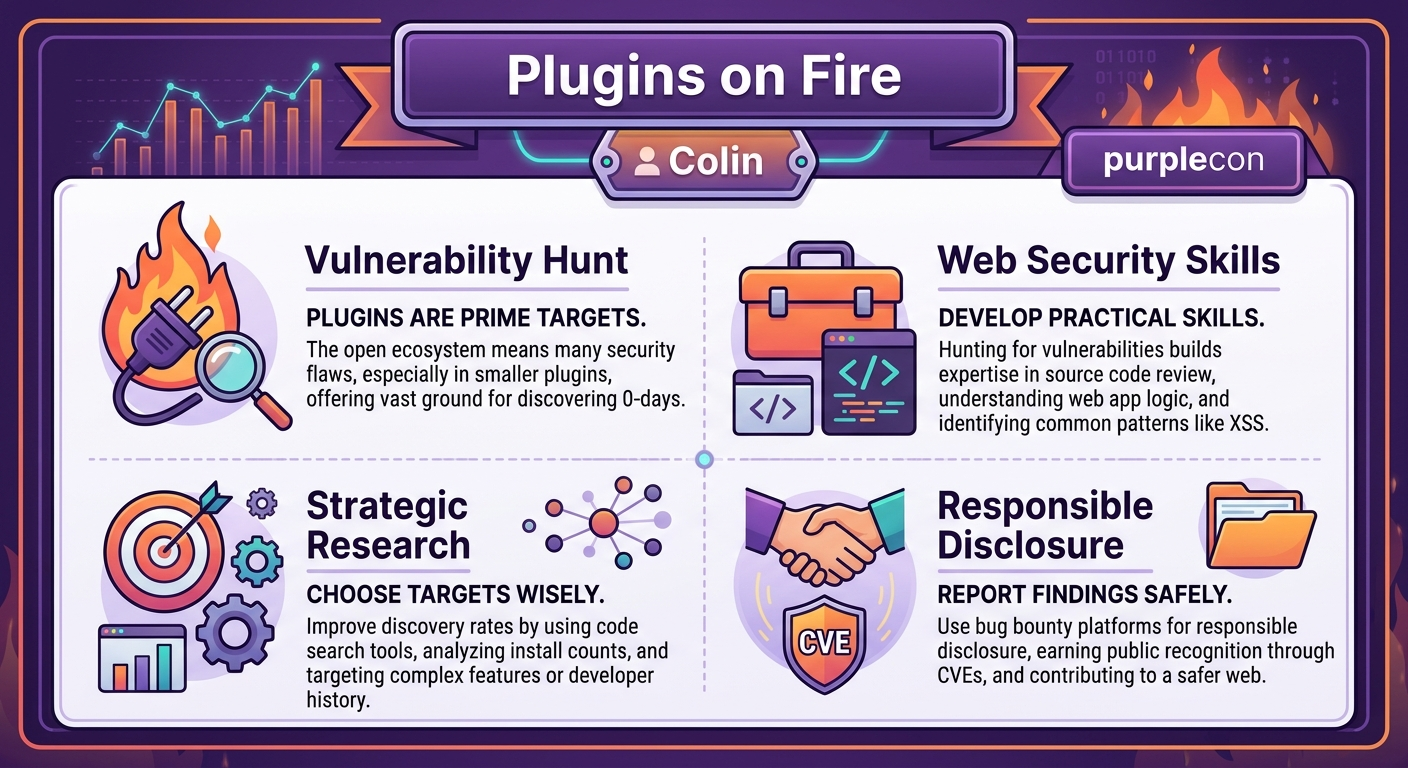
- WordPress plugins are a prime target for 0-day vulnerabilities: With WordPress powering 43% of all websites, and its plugin ecosystem being open to anyone, security flaws (especially in smaller plugins) are abundant, offering fertile ground for ethical hacking.
- Vulnerability research builds critical web security skills: Hunting for plugin vulnerabilities is an excellent way to develop practical skills in source code review, understanding web application logic, and identifying common security patterns like XSS and privilege escalation.
- Effective research requires a robust environment and iterative learning: Setting up dedicated test environments (Docker is recommended for full control and debugging) and learning WordPress internals (e.g., shortcodes, user roles) iteratively are fundamental steps for successful discovery.
- Strategic plugin selection enhances discovery rates: Employing methods like code search (e.g., with WP Directory), analyzing install counts, targeting specific features (like custom access controls), and identifying developers with a history of repeated flaws can significantly improve the chances of finding vulnerabilities.
- Responsible disclosure is crucial and rewarding: Utilizing bug bounty platforms like Wordfence for responsible disclosure offers public recognition (CVEs), potential financial rewards, and ensures vulnerabilities are patched, contributing to a safer web.
- Persistence and a learning mindset are key to success: Finding 0-days often requires luck, patience, and a willingness to learn continuously. It's normal to spend significant time learning without immediate findings, and duplicates are a common occurrence.
About the Speaker(s)
The talk "Plugins on Fire" was delivered by Colin. While specific titles or company affiliations were not provided in the talk metadata or transcript, Colin presents himself as a professional with a humorous and self-deprecating style, acknowledging that he is "not some hermit that they poured out of a basement." He approaches WordPress plugin hacking as a serious hobby, demonstrating a deep practical understanding of vulnerability research, web application security, and the responsible disclosure process. His insights are grounded in personal experience, emphasizing the learning journey and the "dopamine boost" derived from solving real-world security challenges. Colin's presentation style is engaging and accessible, effectively guiding both beginners and more experienced researchers through the intricacies of uncovering 0-day vulnerabilities.
Reviews
Dr. Zero (Offensive Security Researcher) — SOLID
Competent beginner-level walkthrough of WordPress plugin bug hunting. Nothing wrong with it, nothing new either. If you've ever grepped a plugin directory or submitted to Wordfence, you've seen this talk.
Heather Calloway (CISO) — SOLID
Competent practitioner-level walkthrough of WordPress plugin vulnerability research. Useful for junior security staff or anyone building web app security skills, but nothing here changes how a mature security program operates.