Tips to Build and Repair Empathy with Other Teams
cait m (Consultant · Red Hat)
purplecon 2024 · Day 1 · Main Room
Overview
In a field often dominated by technical prowess and complex systems, cait, a consultant at Red Hat, presented a compelling case for the critical role of empathy in cybersecurity. Their talk, "Tips to Build and Repair Empathy with Other Teams," delivered at purplecon, underscored that effective security is not solely about code and configurations, but fundamentally about people and their interactions. cait highlighted that many cybersecurity functions, such as vulnerability patching, server building, or incident reporting, are inherently collaborative, relying on the cooperation and understanding between diverse teams within an organization. Without strong inter-team empathy, these crucial processes can become fraught with friction, delays, and misunderstandings, ultimately weakening an organization's security posture.
Key moments
- 0:00 Introduction and talk structure overview
- 2:00 Signs of inter-team relationship strain
- 4:30 Understanding conflicting team priorities (Phoenix Project example)
- 6:00 Communication styles, neurodiversity, and defensiveness
- 10:00 Building genuine working relationships with individuals
- 14:00 Structural change: automating interactions and systems
- 17:00 Main takeaways and supporting each other
Tips to Build and Repair Empathy with Other Teams
Speakers: cait m, Consultant, Red Hat
Conference: purplecon
YouTube: https://www.youtube.com/watch?v=m44WRYfPdiM
Overview
In a field often dominated by technical prowess and complex systems, cait, a consultant at Red Hat, presented a compelling case for the critical role of empathy in cybersecurity. Their talk, "Tips to Build and Repair Empathy with Other Teams," delivered at purplecon, underscored that effective security is not solely about code and configurations, but fundamentally about people and their interactions. cait highlighted that many cybersecurity functions, such as vulnerability patching, server building, or incident reporting, are inherently collaborative, relying on the cooperation and understanding between diverse teams within an organization. Without strong inter-team empathy, these crucial processes can become fraught with friction, delays, and misunderstandings, ultimately weakening an organization's security posture.
The presentation offered a pragmatic framework for fostering and mending inter-team relationships, whether starting from scratch or addressing deeply embedded issues. cait structured their discussion around actionable tips and frameworks, emphasizing the importance of understanding oneself, others, and the surrounding pressures. They argued that developing this understanding is essential for improving interactions across different groups and functions, a skill often overlooked but vital for the success of any security program. The talk serves as a timely reminder that while technical skills are foundational, the 'purple' aspect of cybersecurity—the integration of red and blue team mindsets—extends to the broader organizational ecosystem, demanding a nuanced approach to human dynamics.
cait's insights are particularly relevant for security professionals who frequently find themselves in adversarial positions, often perceived as the "team of no." By equipping attendees with strategies to cultivate empathy, the talk aimed to bridge communication gaps, mitigate conflict, and foster a more collaborative environment where security goals are integrated rather than imposed. It positioned empathy not as a soft skill luxury, but as a strategic imperative for enhancing operational efficiency and bolstering organizational resilience against cyber threats.
Background
▶ Watch: Introduction and talk structure overview (0:00)
The necessity for empathy in cybersecurity arises from the inherent friction points that characterize modern organizational structures. Development teams prioritize rapid feature delivery, operations teams focus on system stability and uptime, and security teams aim to minimize risk and enforce compliance. These often-conflicting priorities create natural tension, leading to misunderstandings, blame games, and a breakdown in effective collaboration. cait articulated this common dilemma, noting how a development team's drive to "get code out the door" can clash with an operations team's desire for service stability, while cybersecurity seeks to prevent breaches. The speaker referenced the acclaimed book The Phoenix Project as a prime example, where a Security Officer (CISO) initially screams about vulnerabilities but eventually learns to align security advice with executive Key Performance Indicators (KPIs) and broader business objectives, demonstrating a critical shift from technical decree to empathetic influence.
Beyond conflicting KPIs, cait delved into the psychological and social factors contributing to inter-team strain. They highlighted how burnout, as discussed in other purplecon talks, can significantly impede the ability to assume positive intentions, leading individuals to default to negativity and isolation. This state of mind exacerbates communication issues, turning minor disagreements into major conflicts. Furthermore, M touched upon neurodiversity and differing communication styles, explaining how seemingly innocuous interactions, like the preference for or aversion to "small talk" in emails, can be misinterpreted as disinterest or even disrespect. A direct, concise email from someone who values efficiency might be perceived as rude by someone who expects more social pleasantries, creating unintended offense and eroding trust.
Defensiveness was identified as a common, yet frustrating, response to feedback or perceived criticism. cait explained that individuals might deny, deflect, or argue when called out, often due to busyness, forgetfulness, or a feeling of being unfairly targeted. Recognizing this as a natural human reaction, rather than a personal attack, is crucial for navigating these interactions. The speaker also stressed that a healthy mental headspace is a prerequisite for engaging in empathetic practices. Burnout, negativity, and isolation make it incredibly difficult to apply the principles of empathy, underscoring the importance of personal well-being strategies like mindfulness or professional psychological support. This foundational understanding of underlying pressures, communication nuances, and psychological states forms the bedrock upon which empathy can be built and repaired.
Key Findings
▶ Watch: Understanding conflicting team priorities (Phoenix Project example) (4:30)
cait's talk didn't present traditional research findings but rather offered a structured, actionable framework for cultivating and restoring inter-team empathy. The core "finding" was a practical, two-phase approach: Observing the current state of relationships and Influencing positive change. This framework serves as a guide for security professionals to proactively address relational challenges that impact security outcomes.
The Observing phase emphasizes a mindful and analytical approach to understanding team dynamics. Key insights here include:
- Identifying Relationship Strain Indicators: Recognizing signs such as feeling stressed after specific emails, hearing frequent complaints, or noticing general frustration within or between teams. These are critical "triggers" to initiate the empathy-building process.
- Contextual Understanding: The importance of delving beyond surface-level conflicts to uncover underlying factors like conflicting KPIs, management priorities, and workload pressures unique to each team. M stressed that a security team's urgent vulnerability fix might be a lower priority for a development team grappling with critical feature releases under tight deadlines.
- Communication Analysis: Paying close attention to common problem points in communication, including recurrent stressful email topics, potential misunderstandings stemming from different communication styles (e.g., direct vs. elaborate), and the pervasive issue of defensiveness. The speaker highlighted the difficulty, yet necessity, of striving to "assume positive intentions," especially when personal burnout or existing strained relationships predispose individuals to negative interpretations.
- Self-Awareness: Recognizing one's own role and reactions, including personal tendencies towards defensiveness or the impact of one's own mental state (e.g., burnout) on interactions. M emphasized that a "good head space" is foundational for effective empathetic engagement.
The Influencing phase outlines concrete actions to effect change:
- Building Individual Relationships: The power of genuine interest, active listening, and "small talk" to build unrelated trust. This foundational trust allows for better assumptions about each other's intentions and contexts.
- Challenging Problematic Behaviors: Providing structured feedback using models like Situation, Behavior, Impact (SBI), even when initial reactions are dismissive. The "finding" here is that while immediate acceptance is rare, the feedback often prompts later reflection.
- Implementing Structural Changes: Identifying and removing negative interactions through automation (e.g., APIs for system queries), streamlining processes, or even strategically duplicating efforts if it improves overall team flow and reduces costly friction, as suggested by the Team Topologies framework. This highlights that sometimes systemic changes are more effective than individual interventions.
- Establishing Healthy Boundaries and Recognizing "Glue Work": Acknowledging that empathy work can be emotionally taxing and disproportionately fall on certain individuals. A key finding is the need to distribute this "glue work" more equitably and ensure those undertaking it are recognized, preventing individual burnout and promoting collective responsibility.
In essence, cait's key finding is that empathy is not merely a feeling but a disciplined practice, requiring both observational acumen and strategic intervention, underpinned by personal well-being and a commitment to understanding the multifaceted pressures on other teams.
Technical Deep Dive
▶ Watch: Communication styles, neurodiversity, and defensiveness (6:00)
While cait's talk doesn't delve into traditional "technical" elements like code, protocols, or architectures in the cybersecurity sense, it provides a deep dive into the methodological framework for building and repairing empathy, which can be viewed as a "technical" approach to human interaction within an organizational system. This framework is structured into two main phases: Observing and Influencing.
The Observing Phase functions much like a system diagnostic. It begins by identifying "symptoms" of inter-team strain, such as frequent frustrating emails or team complaints. M suggested a "body scan" approach, akin to mindfulness exercises, to locate where "tension is being held" within the organizational body, asking "what or who is looking stressed and what pressures or contexts might be contributing?" This involves:
- Understanding Conflicting Priorities: cait used the example of development teams prioritizing code releases against operations teams prioritizing service uptime, and security teams aiming for no hacks. They underscored that each team operates under different KPIs and management pressures. The speaker cited The Phoenix Project, where the CISO, John, shifts from demanding immediate vulnerability fixes to interviewing executives to understand their KPIs, allowing him to tailor security advice that aligns with broader company success. This is a critical "technical" insight into organizational dynamics: security advice must be translated into the language of business value.
- Analyzing Communication Styles: cait highlighted that misunderstandings often stem from differing communication styles, particularly in the context of neurodiversity. For example, some individuals might find "small talk" in emails unnecessary, preferring to get straight to the point, while others might perceive its absence as rude or uncaring. This "technical" aspect of communication involves recognizing and adapting to these variations to avoid unintended offense.
- Addressing Defensiveness: cait explained defensiveness (denial, deflection) as a common human response to being called out, often due to busyness or forgetfulness. They advised against taking it personally, treating it as a predictable system output rather than a personal attack. They also emphasized self-observation, noting that one might also exhibit defensiveness when under pressure.
- Prioritizing Mental Headspace: A crucial "prerequisite" for effective observation and influence is a healthy mental state. cait explicitly linked burnout and negativity to reduced capacity for empathy. They recommended resources like professional psychologists and mindfulness apps, specifically mentioning Smiling Minds, an Australian non-profit app that offers non-judgmental guided meditations, acknowledging that "if you've forgotten what you're doing that's fine that's what your brain does." This is a "technical requirement" for the human operator in this empathy system.
The Influencing Phase outlines the "interventions" to repair and build relationships:
- Building Individual Working Relationships: This involves proactive engagement: showing genuine interest in others' work, asking questions to validate assumptions about their context (KPIs, workload, restructures), and engaging in small talk to build non-work-related trust. This trust forms a "baseline" for positive assumptions in future interactions. For example, asking "If I'm understanding correctly, you're prioritizing this for a release in 3 weeks?" or "I heard there's a restructure, what's happening with your team?"
- Challenging Problematic Behaviors: cait introduced the Situation, Behavior, Impact (SBI) feedback model. An example provided was: "When I called about the project status, I heard you call our team stupid, and that made me feel awful." They acknowledged that the ideal response ("I'm sorry, it won't happen again") is rare, and dismissive responses ("I didn't mean it that way") are more common. The "technical" insight here is that feedback, even if initially rejected, can prompt later reflection, and persistence (or knowing when to step away) is part of the strategy. M also provided options when empathy isn't enough: accepting the situation, reducing interactions, or stepping away (e.g., quitting).
- Structural Change as an Influence Mechanism: This is the most "technical" intervention. cait advocated for removing negative interactions by automating them, cleaning up unnecessary steps, or recognizing that some interactions "weren't ever necessary in the first place." Their prime example was replacing manual email-based requests to query systems with an API. If a security team constantly emails another team to "query the Rune systems for this indicator," creating a queue and delays, building an API that allows the security team to query directly eliminates the friction, leading to a "well-designed system" and happier teams. They even suggested that duplicating efforts might be a valid strategy if interactions have soured significantly, referencing the Team Topologies framework, which acknowledges that sometimes redundant systems are preferable to dysfunctional inter-team communication.
- Healthy Boundaries and "Glue Work": cait highlighted the concept of "glue work"—the often-unrecognized effort of fostering team cohesion and communication. They warned against the unequal distribution of this work, which can impact the KPIs and burnout of the "friendly face" of the team. This "technical" aspect involves recognizing, valuing, and distributing this essential, yet often invisible, labor to ensure sustainability and prevent individual overload.
In summary, while not about traditional cybersecurity "tech," the talk offered a sophisticated, systematic approach to optimizing human interactions within an organization, treating communication channels, team structures, and individual well-being as critical components of an overall operational system that directly impacts security effectiveness.
Demo / Proof of Concept
▶ Watch: Structural change: automating interactions and systems (14:00)
cait's presentation did not include a traditional technical demonstration or a live proof of concept in the sense of showcasing code, exploiting a vulnerability, or demonstrating a security tool. Instead, the "demo" was conceptual, illustrating the practical application of their empathy-building framework through relatable, real-world scenarios and a clear, actionable example.
The primary proof of concept for structural change was the API automation example. cait described a common pain point: a security team repeatedly sending emails to another team to "query the Rune systems for this indicator." This manual interaction creates a bottleneck, with emails entering a queue, causing delays and frustration for both parties. The proposed solution, and the conceptual "demo" of impact, was to "set up an API so you can just do it yourself." This structural change eliminates the need for human-to-human interaction for a repetitive task, transforming a source of friction into an efficient, automated process. As cait explained, with an API, the security team can perform the query "happily in the background," with "the only delay is the computer delay," resulting in a "well-designed system." This example effectively demonstrated how a technical solution (an API) can be leveraged to resolve inter-team communication issues and build empathy by removing a point of contention.
Another "proof of concept" was the Situation, Behavior, Impact (SBI) feedback model. While not a live demo, cait walked through a clear example: "When I called about the project status, I heard you call our team stupid, and that made me feel awful." They then contrasted the ideal, empathetic response ("Oh, I didn't realize it had that effect, I'm sorry, it won't happen again") with more common, dismissive replies ("I didn't mean it that way"). This served to demonstrate the application of the model and to temper expectations about immediate positive outcomes, while still affirming the long-term value of structured feedback.
Therefore, while there were no executable scripts or live system interactions, the talk effectively "demonstrated" the principles through vivid, practical examples that resonated with the audience, showcasing how the proposed strategies translate into tangible improvements in team dynamics and operational efficiency within a security context.
Defensive Implications
▶ Watch: Main takeaways and supporting each other (17:00)
The defensive implications of cait's talk are profound, particularly for cybersecurity teams often perceived as blockers or enforcers. By integrating empathy, security professionals can transform their roles from adversarial to collaborative, significantly enhancing an organization's overall defensive posture.
Firstly, improved vulnerability management and patching is a direct outcome. Security teams frequently struggle to get development and operations teams to prioritize patching or address vulnerabilities. By understanding the conflicting KPIs, workload pressures, and release cycles of these teams (as highlighted by The Phoenix Project example), security professionals can tailor their communication and requests. Instead of simply demanding fixes, an empathetic approach involves understanding why a patch is delayed, validating their team's context ("I heard your team was under a lot of stress recently"), and then framing the security need in terms of their priorities (e.g., "This fix will reduce the likelihood of a production outage, which aligns with your uptime KPIs"). This shifts the dynamic from accusation to partnership, leading to faster remediation.
Secondly, enhanced incident response. During a security incident, rapid and effective cross-functional collaboration is paramount. An empathetic security team that has pre-built strong relationships through genuine interest and understanding will find other teams more willing to cooperate, share information, and act quickly under pressure. If "unrelated trust" has been established through "small talk" and validated assumptions, there's a higher likelihood of assuming positive intent during stressful situations, preventing miscommunication and blame from derailing the response effort.
Thirdly, proactive security advice and secure-by-design principles. When security teams are seen as partners rather than auditors, they are more likely to be involved earlier in the development lifecycle. By understanding the development team's goals and constraints, security can offer practical, integrated solutions rather than imposing late-stage, disruptive requirements. This "shift left" in security is heavily reliant on the ability of security professionals to build rapport and demonstrate value from the perspective of their internal "customers."
Fourthly, reducing friction through structural change. The "API automation" example is a powerful defensive implication. If security teams can automate repetitive queries or data exchanges that currently require manual intervention from other teams, they not only gain efficiency but also remove a source of inter-team friction. This allows other teams to focus on their core tasks without constant interruptions, fostering goodwill and making them more receptive to security's more complex, human-intensive requests. Identifying and eliminating "unnecessary interactions" or even strategically "duplicating efforts" (as per Team Topologies) to improve flow can directly reduce the "attack surface" of human error and communication breakdowns.
Finally, building a culture of security awareness and ownership. When security professionals demonstrate empathy, they foster a more inclusive and supportive environment. This encourages other teams to proactively report suspicious activities, seek security advice, and integrate security into their daily workflows, rather than viewing it as an external burden. Recognizing and supporting individuals who perform "glue work" (the relational effort) within their teams can also strengthen the overall organizational fabric, making the entire enterprise more resilient against threats by enhancing internal communication and collective responsibility. In essence, empathy transforms security from a compliance checklist into a shared organizational value.
Key Takeaways
- Empathy is a Strategic Imperative, Not a Soft Skill Luxury: Effective cybersecurity relies heavily on inter-team collaboration. Understanding and addressing the human dynamics, conflicting priorities, and communication styles of other teams is critical for successful vulnerability management, incident response, and proactive security.
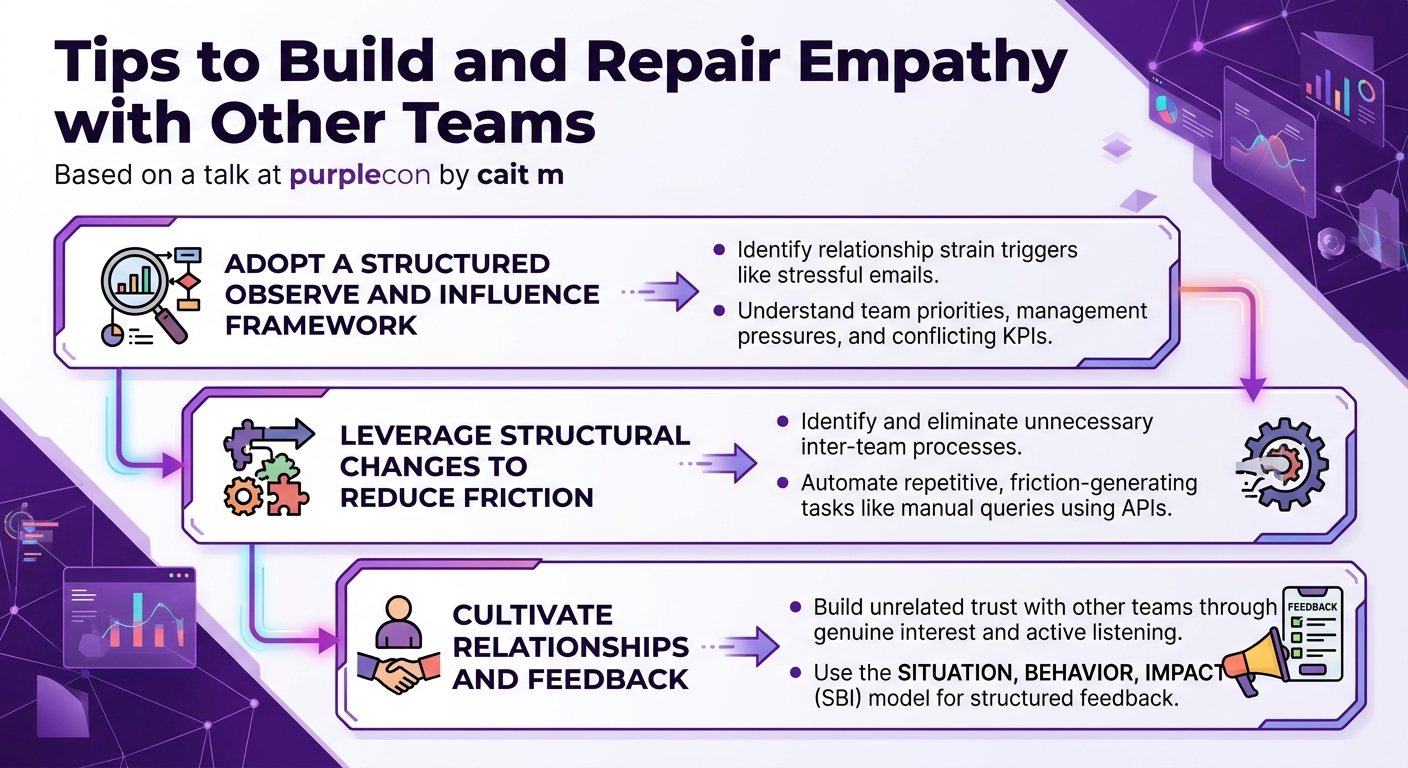
- Adopt a Structured "Observe and Influence" Framework: Approach inter-team challenges systematically. First, observe by identifying signs of strain, understanding underlying contexts (KPIs, workload, burnout), and analyzing communication patterns. Then, influence through individual relationship building, structured feedback (SBI model), and strategic structural changes.
- Prioritize Understanding Context and Challenging Assumptions: Don't just demand; seek to understand. Validate assumptions about other teams' pressures and priorities. Recognize that defensiveness is often a natural reaction, and strive to "assume positive intentions," even when difficult, especially when personal burnout might skew perceptions.
- Leverage Structural Changes to Reduce Friction: Automate repetitive, friction-generating interactions (e.g., using APIs instead of manual email requests). Identify and eliminate unnecessary processes. Consider strategic system duplication if it significantly improves inter-team flow and reduces costly human-interaction friction, as suggested by frameworks like Team Topologies.
- Cultivate Individual Relationships and Practice Mindful Communication: Build "unrelated trust" through genuine interest, active listening, and even "small talk." Be aware of differing communication styles (including neurodiversity) to avoid misunderstandings. When giving feedback, use structured methods like SBI, acknowledging that immediate acceptance may not occur but reflection often follows.
- Support Each Other and Maintain Personal Well-being: Empathy work can be emotionally taxing. Recognize and distribute "glue work" fairly. Prioritize your own mental health (e.g., through mindfulness apps like Smiling Minds or professional support) as a prerequisite for effectively engaging in empathetic interactions and sustaining positive inter-team relationships.
About the Speaker(s)
cait is a consultant with Red Hat, specializing in supporting and improving team culture and practices. Originally from New Zealand, they have a diverse background, having lived across various locations including the Gold Coast, Canberra, and Melbourne. cait uses they/them pronouns. Their work as a consultant frequently places their in new teams, giving their a fresh perspective to identify and address frictions and difficulties in inter-team dynamics. This unique vantage point inspired their talk on building and repairing empathy, drawing from their extensive experience in fostering collaboration and understanding within complex organizational environments.
Reviews
Dr. Zero (Offensive Security Researcher) — SOLID
Competent soft-skills talk that packages known team-dynamics wisdom (SBI feedback, conflicting KPIs, glue work) into a usable framework for security practitioners. Nothing new for anyone who's read The Phoenix Project or a management book, but it's clearly presented and appropriate for a purple-team audience that skews technical and may not have encountered this material.
Heather Calloway (CISO) — SOLID
Practical framework for cross-functional collaboration that security leaders can use immediately. The content is sound but unremarkable — this is organizational hygiene dressed up as strategy. Worth the time for newer managers or anyone inheriting a team with burned bridges.