Initial Access in 2026 – The Power of the Spoken Word
Mike Bailey (Director of IT · Rotas Security), Ariyan Suroosh (Principal Security Consultant · Rotas Security)
RVAsec 2026 · Day 2 · Grand Ballroom F/G
Overview
In an era where digital perimeters are increasingly fortified and traditional cyberattack vectors are becoming less effective, the human element remains a critical vulnerability. This talk, "Initial Access in 2026 – The Power of the Spoken Word," presented by Ariyan Suroosh and Mike Bailey of Rotas Security, delves into the resurgence and sophisticated application of vishing (voice phishing) as a primary method for achieving initial access in red team operations. The speakers, drawing from extensive experience in physical penetration testing and IT infrastructure, argue that as other attack surfaces shrink, the direct exploitation of human trust via telephone calls will continue to be a dominant and often underestimated threat vector by 2026.
Key moments
- 4:00 Why traditional initial access methods are failing
- 19:00 Psychological techniques for convincing vishing calls
- 30:30 Using Quick Assist for devastating remote access
- 36:30 Building a PBX to spoof caller ID
- 39:00 How STIR/SHAKEN affects call spoofing effectiveness
- 47:00 Effective defense strategies against vishing attacks
- 48:50 Funniest impersonation story from a red team engagement
Initial Access in 2026 – The Power of the Spoken Word
Speakers: Mike Bailey (Director of IT, Rotas Security); Ariyan Suroosh (Principal Security Consultant, Rotas Security)
Conference: RVAsec
YouTube: https://www.youtube.com/watch?v=iAFIx2yazNE
Overview
In an era where digital perimeters are increasingly fortified and traditional cyberattack vectors are becoming less effective, the human element remains a critical vulnerability. This talk, "Initial Access in 2026 – The Power of the Spoken Word," presented by Ariyan Suroosh and Mike Bailey of Rotas Security, delves into the resurgence and sophisticated application of vishing (voice phishing) as a primary method for achieving initial access in red team operations. The speakers, drawing from extensive experience in physical penetration testing and IT infrastructure, argue that as other attack surfaces shrink, the direct exploitation of human trust via telephone calls will continue to be a dominant and often underestimated threat vector by 2026.
The presentation focuses heavily on the red team perspective, outlining the tactics, techniques, and procedures (TTPs) involved in executing highly effective vishing campaigns. From meticulous target selection and scenario crafting to the technical infrastructure required for advanced call spoofing, Suroosh and Bailey provide a detailed blueprint for bypassing modern security controls. They highlight how, despite advancements in security technology, the inherent psychological aspects of human interaction make vishing a potent and enduring threat, capable of circumventing even robust multi-factor authentication (MFA) and achieving deep network compromise.
The talk is particularly relevant for security professionals, red teamers, and defenders seeking to understand the evolving landscape of initial access. By dissecting the methodology behind successful vishing attacks, including the challenges posed by new regulatory frameworks like STIR/SHAKEN, the speakers offer invaluable insights into proactive defense strategies. Their emphasis on the human factor serves as a crucial reminder that technology alone cannot secure an organization if its people are not adequately prepared for sophisticated social engineering attempts.
Background
▶ Watch: Why traditional initial access methods are failing (4:00)
The journey to initial network access has become progressively challenging for red teams and malicious actors alike. Ariyan Suroosh and Mike Bailey articulate how traditional methods, once highly effective, have seen their "golden ages" pass. Web application vulnerabilities are scarcer due to improved development practices and fewer custom sites. Spear phishing emails, while still a threat, face increasingly sophisticated filters that prevent malicious links from reaching inboxes. Physical device drops are difficult to execute legally for testers and are expensive, while advanced techniques like SIM jacking require significant time and resources, often beyond the scope of typical engagements.
Even more recent popular methods, such as exploiting vulnerabilities in collaboration platforms like Microsoft Teams, have seen their effectiveness wane as defenses adapt. This continuous hardening of digital and physical perimeters has led to a strategic pivot back to the fundamental, yet often overlooked, vulnerability: the human being. The speakers cite compelling evidence for this shift, including a Unit 42 report from May 2024 to May 2025, which found that 36% of all incident response cases involved social engineering tactics. They specifically highlight the MGM breach in 2023, where attackers gained access by tricking a help desk into resetting a password, achieving domain admin privileges in under 40 minutes using only pre-built tools and social pretexts.
This return to vishing, or phone pretexting, is driven by its ability to bypass technical controls by exploiting human trust and process gaps. Key enablers identified include over-permissive access, insufficient behavioral visibility, and, most critically, unverified user trust in human processes. As Bailey succinctly puts it, "You can't patch a person." The challenge for defenders lies not just in technical safeguards but in addressing the inherent susceptibility of individuals to manipulation, especially when presented with a convincing, seemingly legitimate request.
Key Findings
▶ Watch: Using Quick Assist for devastating remote access (30:30)
The central finding of this talk is the enduring and re-emerging power of sophisticated vishing as a primary initial access vector, especially when other methods are increasingly difficult to execute legally and effectively. Ariyan Suroosh and Mike Bailey demonstrate that by 2026, direct voice interaction will remain a critical vulnerability, largely due to its ability to bypass technical controls and exploit human psychology.
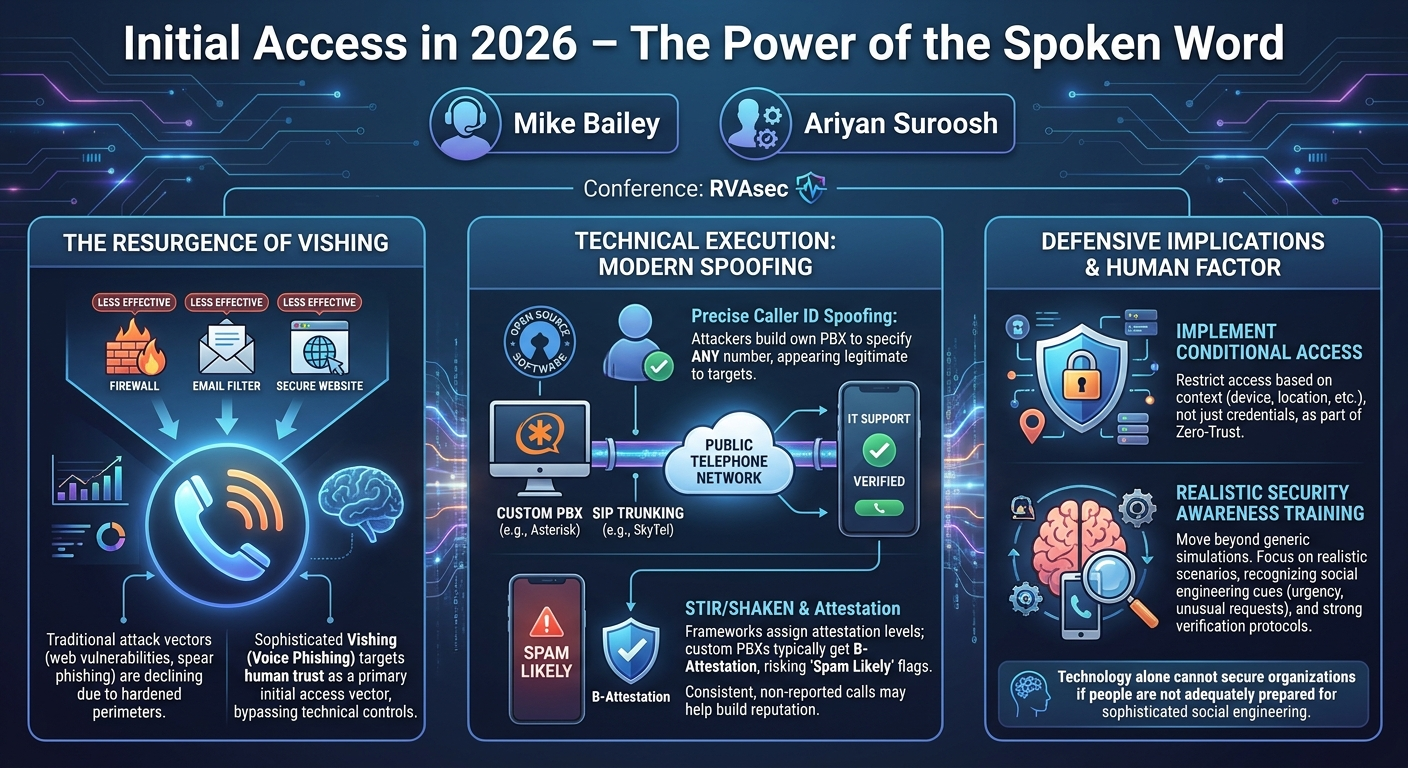
A significant technical finding is the method for reliable caller ID spoofing in the face of modern telecommunications regulations. While consumer-grade services like SpoofCard no longer allow specific number spoofing, the speakers reveal that red teams can overcome this by building their own private branch exchange (PBX) using open-source software like Asterisk and SIP trunking services (e.g., SkyTel). This setup allows attackers to specify any desired caller ID, making calls appear to originate from internal departments, specific employees, or even emergency services.
Crucially, the talk uncovers the implications of the TRACED Act and the STIR/SHAKEN framework on call delivery. They explain that calls are assigned an "attestation" level (A, B, or C) based on the originating carrier's verification of the caller ID. While an A-attestation (full verification) is ideal, their custom PBX typically results in a B-attestation (provider knows caller but cannot fully verify the spoofed number). The key insight is that the termination carrier then decides how to handle B-attestation calls, often flagging them as "spam likely." However, the speakers suggest that consistent, non-reported calls can gradually build trust for a number, potentially moving it closer to A-attestation or at least reducing spam flagging. This adaptive approach to evading carrier-level spam detection is a novel and critical aspect of successful vishing campaigns.
Furthermore, the speakers emphasize that successful vishing relies heavily on a structured, yet flexible, social engineering framework, rather than rigid scripts. This adaptability, combined with meticulous target selection (new employees, non-technical roles, remote workers) and compelling pretexts (e.g., "new AI policy," "update server sync issues"), significantly increases the success rate. The ability to seamlessly integrate phone calls with malicious emails (a "pincer maneuver") further enhances credibility and bypasses email filters.
Technical Deep Dive
▶ Watch: Building a PBX to spoof caller ID (36:30)
The technical core of effective red team vishing, as presented by Suroosh and Bailey, revolves around meticulous infrastructure setup and a deep understanding of telecommunications protocols. The goal is to create a believable ecosystem that supports a "pincer maneuver," where a phone call can be seamlessly followed by a malicious email or vice-versa, lending credibility from multiple angles.
Infrastructure for Credibility:
The foundation for a successful vishing operation starts with a robust, multi-faceted infrastructure:
- Domain Selection: Prioritizing .com domains is crucial, as less technical targets are less suspicious of them compared to .net or .io. Generic, non-typosquatted names (e.g., "eastcoastservers.com," "Canadiancloud") are preferred, as they are easier to spell out over the phone and less likely to be flagged by AI tooling designed to detect typosquatting.
- Domain Aging: Domains need to appear legitimate over time. Red teamers are advised to buy domains early and hold them, or acquire pre-aged domains, though the latter can be expensive and hard to match with a convincing pretext. A burned domain must be replaced immediately.
- Email Infrastructure: Setting up email services that can bypass filters is essential. Even if an email lands in spam, a skilled vishing operator can leverage the phone call to convince the target that their email is in spam because the target is now "outside the organization" due to the supposed IT issue.
- Content Delivery Networks (CDNs): Using services like Cloudflare can lend authority and trustworthiness to domains, but they also introduce higher scrutiny, leading to potential "whack-a-mole" scenarios where legitimate-looking sites are quickly identified and blocked.
The Evolution of Caller ID Spoofing:
The ability to spoof caller ID is paramount for vishing. Historically, services like SpoofCard allowed attackers to specify any outgoing number. However, regulatory changes have eliminated this capability, leaving attackers with only a list of random numbers, drastically reducing effectiveness.
The modern solution, as detailed by the speakers, is to "build your own phone company" by setting up a custom PBX (Private Branch Exchange).
- Asterisk: This open-source PBX software is the most common choice, known for its flexibility and ease of setup (now often a one-shot script).
- SIP Trunking: Commercial SIP (Session Initiation Protocol) trunk providers (e.g., SkyTel) are used to acquire phone lines. These providers handle the routing of calls over the internet.
- Softphones/VoIP Applications: Any standard VoIP application can be configured to connect to the Asterisk PBX.
The critical feature of this setup is the ability to programmatically specify the caller ID that appears on the recipient's phone. This allows the attacker to display a corporate IT number, a specific employee's number, or any other number that lends credibility to the pretext. For modern cell phones, if the spoofed number is in the target's address book, it will often display the associated contact name, further enhancing legitimacy.
Navigating STIR/SHAKEN:
The effectiveness of caller ID spoofing is now heavily influenced by the TRACED Act (Telephone Robocall Abuse Criminal Enforcement and Deterrence Act), passed in 2019, which empowered the FCC to combat robocalls. This led to the implementation of the STIR/SHAKEN (Secure Telephone Identity Revisited / Signature-based Handling of Asserted Information Using Tokens Standard) framework.
- Attestation Levels: STIR/SHAKEN introduces a cryptographic signing process for caller IDs, assigning an "attestation" level to each call:
- A-Attestation (Full Verification): The originating carrier fully verifies both the caller and their right to use the caller ID. This is typically for traditional landlines or direct corporate lines.
- B-Attestation (Partial Verification): The originating carrier knows the caller (e.g., the SIP trunk provider knows the PBX owner) but cannot fully verify the spoofed number. This is the typical attestation level for calls from a custom PBX where a different number is being presented.
- C-Attestation (Gateway/Blind): The originating carrier has no relationship with the caller or the number, often associated with high-risk spam calls.
- Termination Carrier Decision: The crucial point is that the termination carrier (the recipient's phone company) uses the STIR/SHAKEN attestation level to decide how to handle the call. A B-attestation often leads to calls being flagged as "spam likely."
- Mitigation: The speakers hypothesize that consistent, non-reported calls from a B-attestation number can gradually build a reputation of trustworthiness with carriers, potentially reducing spam flagging. This "trust-building" is similar to how domain reputation is established for emails.
Payload Delivery and Execution:
Once initial access is established (often via remote access or guiding the user to a malicious link), the payload needs to be delivered and executed.
- Quick Assist: This Windows built-in remote assistance tool was a "devastatingly effective" method. Attackers would guide targets to open Quick Assist and provide a code, granting remote access. However, its widespread abuse by ransomware operators has led to increased blocking and awareness.
- Alternative Remote Access: Less convenient options like ScreenConnect are often blocked.
- Malicious Files: MSI (Microsoft Installer) files are excellent for payloads as they appear as standard download files. Attackers can instruct targets to download and run these, often under the guise of an "update" or "resyncing program."
- Sideloading/Scriptjacking: These techniques involve embedding malicious code within legitimate applications or scripts.
- Delivery Mechanisms: S3 buckets (Amazon Web Services) are a favored method for hosting malicious payloads, providing reliable and often hard-to-block download locations.
- Example Payload: The speakers recall using Loki C2 (Command and Control) as a payload, disguised within a seemingly innocuous program that the user was instructed to "keep running and minimize."
Phishing Tools for Credential Capture:
While the talk focuses on vishing for remote access, credential phishing tools also play a role in the pincer maneuver.
- Evil Jinx 2: A classic and continuously updated transparent proxy tool, but it's now "extremely well known" and requires extensive customization to avoid detection. Domains used with Evil Jinx 2 are often quickly "burned."
- Graph Spoof: Highlighted as a "really great" and effective tool for device code phishing, though details were reserved for a future talk.
- Evil no VNC: A newer technique where the target unknowingly controls the attacker's browser, allowing for session hijacking without direct credential entry.
This technical deep dive demonstrates that initial access via vishing in 2026 is far from a simple phone call; it's a sophisticated operation requiring significant technical investment, continuous adaptation, and a deep understanding of both human psychology and telecommunications infrastructure.
Demo / Proof of Concept
▶ Watch: Effective defense strategies against vishing attacks (47:00)
While the talk did not feature a live, real-time demonstration of a successful vishing attack during the presentation, the speakers extensively detailed their proven methodology and the technical proof of concept for their approach. The "coolest part" of their talk, as they put it, was explaining how they overcame the recent challenges in caller ID spoofing, which is a critical component of their vishing success.
Their proof of concept for advanced caller ID spoofing involved:
- Setting up a custom PBX: Using Asterisk, an open-source private branch exchange, which Mike Bailey confirmed is now much easier to deploy, sometimes with a "one-shot script."
- Acquiring SIP Trunking: Utilizing a service like SkyTel to provide the necessary phone lines (trunks) that connect their PBX to the public telephone network.
- Configuring a Softphone: Connecting a standard Voice over IP (VoIP) application to their Asterisk server.
- Specifying Caller ID: The core capability demonstrated was the ability to programmatically set any desired caller ID number within their Asterisk PBX. This allowed them to make calls appear to originate from an internal IT department, a specific employee, or any other number that would lend credibility to their pretext.
They described testing this system by calling each other and other friends, observing how calls would sometimes appear as "spam likely" due to the STIR/SHAKEN B-attestation. This practical testing confirmed the technical viability of their spoofing method, while also highlighting the real-world challenges posed by carrier-level spam detection. Their discussion of overcoming these challenges through reputation building for phone numbers further illustrates their adaptive, proof-of-concept approach to maintaining vishing effectiveness.
For payload delivery, Ariyan Suroosh described how he would offer targets a choice: "Do you want me to walk you through the process or would you rather I just remote in knock it out for you?" The overwhelming majority chose remote access. He would then guide them to open Quick Assist and provide a code. Once remote access was established, he would navigate to his S3 bucket to pull down an MSI payload (e.g., running Loki C2), disguised as a "resyncing program" or other legitimate software. This step-by-step account of their successful infiltration tactics serves as the practical demonstration of their methodology.
Defensive Implications
▶ Watch: Funniest impersonation story from a red team engagement (48:50)
The insights shared by Ariyan Suroosh and Mike Bailey underscore the critical need for robust, multi-layered defensive strategies against sophisticated vishing attacks. Since the human element remains the weakest link, traditional technical controls alone are insufficient.
Key defensive implications include:
- Enforcing Conditional Access: Organizations must implement stringent conditional access policies. This means that even if credentials are compromised via social engineering, access to sensitive systems should be restricted based on device health, location, network, and other contextual factors. This is a foundational aspect of a zero-trust architecture, which the speakers emphasize is "a lot harder than it seems" to truly implement.
- Implementing Identity Threat Detection and Response (IDTDR): Advanced IDTDR solutions, potentially leveraging AI, are crucial for detecting anomalous behavior indicative of compromised accounts. This includes flagging unusual login times, locations, or access patterns that deviate from a user's baseline.
- Revamping Security Awareness Training: The speakers critically note that much of current security awareness training is "comically bad" and treated as a mere checklist exercise. Defenders need to move beyond generic, easily identifiable phishing simulations (e.g., "FishMe") and implement training that:
- Focuses on realistic scenarios: Training should simulate the sophisticated pretexts and psychological manipulation tactics used in red team vishing.
- Educates on social engineering cues: Employees need to be trained to recognize subtle indicators of social engineering, such as unusual urgency, requests for unusual actions, or deviations from standard procedures, even when the caller ID appears legitimate.
- Emphasizes verification protocols: Strong internal protocols for verifying unexpected requests, especially those involving password resets, remote access, or software installations, are paramount. This could involve calling back on a known, official number or using an out-of-band verification method.
- Auditing and Disabling Unnecessary Remote Tools: Organizations should regularly audit their systems for remote assistance tools like Quick Assist and disable them if not actively needed or if more secure, managed alternatives are in place. The widespread abuse of Quick Assist highlights the risk of easily accessible built-in tools.
- Strengthening Help Desk Procedures: The MGM breach serves as a stark reminder that help desks are prime targets. Procedures for password resets and account recovery must incorporate multi-factor verification beyond simple identity confirmation, potentially requiring a physical presence, pre-registered security questions, or supervisor approval for sensitive changes.
- Monitoring Call Logs and Reputation: While challenging, organizations could explore ways to monitor call logs for suspicious activity or work with carriers to understand and improve their phone number's attestation rating to prevent legitimate calls from being flagged as spam.
Ultimately, defending against advanced vishing requires a holistic approach that integrates robust technical controls, continuous monitoring, and, most importantly, highly effective and realistic human-centric training that empowers employees to be the front line of defense.
Key Takeaways
- Vishing is the New Old Go-To for Initial Access: As digital and physical perimeters harden, sophisticated vishing (voice phishing) has re-emerged as a highly effective and difficult-to-defend initial access vector, often bypassing advanced technical controls.
- Custom PBX is Key for Modern Spoofing: Overcoming limitations of commercial spoofing services, red teams can build their own PBX (e.g., Asterisk with SIP trunking) to precisely control and spoof caller IDs, making calls appear legitimate to targets and even leveraging existing contact book entries.
- STIR/SHAKEN Attestation Affects Call Delivery: The STIR/SHAKEN framework assigns attestation levels (A, B, C) to calls, impacting whether spoofed calls are flagged as "spam likely." While custom PBXs typically achieve B-attestation, consistent, non-reported calls may help build reputation and reduce spam flagging.
- Social Engineering Relies on Flexible Frameworks, Not Scripts: Successful vishing requires psychological acumen, adaptable conversation frameworks, and meticulous target selection (e.g., new employees, non-technical roles) rather than rigid scripts, allowing operators to "adjust fire" during calls.
- Perimeter Defense Alone is Insufficient: The continued success of vishing, exemplified by incidents like the MGM breach, highlights that even robust technical defenses are vulnerable when human trust and process gaps are exploited.
- Security Awareness Training Needs a Drastic Overhaul: Current security awareness training is often ineffective. Organizations must implement realistic, scenario-based training that teaches employees to recognize sophisticated social engineering tactics and adhere to strong verification protocols, rather than relying on "comically bad" simulations.
About the Speaker(s)
Ariyan Suroosh is a Principal Security Consultant at Rotas Security. He specializes in physical facility penetration tests, a field in which he has previously presented at RVAsec. His passion and core expertise, however, lie in achieving initial access during red team and purple team engagements, focusing on the initial rung of network compromise. His insights in this talk are heavily informed by his extensive experience in social engineering and human manipulation techniques.
Mike Bailey is the Director of IT at Rotas Security. With a long-standing career in information technology, Mike brings a deep understanding of systems and infrastructure building to the discussion. His perspective complements Ariyan's, providing crucial context on how IT systems are built, secured, and, in turn, how they can be exploited or defended against sophisticated initial access techniques. He acknowledges his lengthy career in IT, humorously noting his eventual desire to transition out of the field.
Reviews
Dr. Zero (Offensive Security Researcher) — SOLID
Bailey and Suroosh slap a '2026' label on Asterisk PBX setups we've been running for a decade, but the operational realities they describe are dead accurate. Finessing B-attestations to bypass STIR/SHAKEN spam filters is exactly how modern access brokers are burning MFA today. It's a highly competent TTP briefing for blue teams who still think vishing is just a guy with a SpoofCard.
Heather Calloway (CISO) — STRONG ACCEPT
This talk breaks down exactly how attackers are bypassing technical perimeters by exploiting the help desk and manipulating telecom infrastructure. It is required viewing for whoever owns your identity, access management, and IT support functions.