Unlocking Awareness: How an Escape Experience made Security Fun, Engaging, and Approachable
Joanna Behan (Information Security Analyst · FRB of Richmond)
RVAsec 2026 · Day 2 · Madison / Jefferson / Monroe
Overview
In a landscape often dominated by highly technical deep dives into vulnerabilities and exploits, Joanna Behan, an Information Security Analyst at the Federal Reserve Bank (FRB) of Richmond, presented a refreshing and critically important talk at RVAsec. Her presentation, "Unlocking Awareness: How an Escape Experience made Security Fun, Engaging, and Approachable," detailed a novel approach to cybersecurity awareness training: a physical, escape room-style "box" designed to educate and engage non-technical staff. This initiative stands out by deliberately eschewing complex technology in its design, instead focusing on human-centric engagement to demystify security concepts and foster a positive relationship between employees and their InfoSec team.
Key moments
- 4:00 Why a non-technical security escape box?
- 5:00 Goals and gamification strategy for security awareness
- 11:00 Tangible cultural shift in security perception
- 12:30 Practical resources for building your own box
- 22:30 Multi-Factor Authentication (MFA) puzzle demonstration
- 26:30 Essential lessons for building an effective escape box
- 36:00 Measuring the value and impact of the escape box
Unlocking Awareness: How an Escape Experience made Security Fun, Engaging, and Approachable
Speakers: Joanna Behan, Information Security Analyst, FRB of Richmond
Conference: RVAsec
YouTube: https://www.youtube.com/watch?v=KO0zayq4-A
Overview
In a landscape often dominated by highly technical deep dives into vulnerabilities and exploits, Joanna Behan, an Information Security Analyst at the Federal Reserve Bank (FRB) of Richmond, presented a refreshing and critically important talk at RVAsec. Her presentation, "Unlocking Awareness: How an Escape Experience made Security Fun, Engaging, and Approachable," detailed a novel approach to cybersecurity awareness training: a physical, escape room-style "box" designed to educate and engage non-technical staff. This initiative stands out by deliberately eschewing complex technology in its design, instead focusing on human-centric engagement to demystify security concepts and foster a positive relationship between employees and their InfoSec team.
The core of Behan's talk revolved around combating the pervasive "security fatigue" and negative perceptions often associated with mandatory security training. By transforming abstract security policies into an interactive, collaborative, and enjoyable game, her team at the FRB of Richmond aimed to make cybersecurity awareness a memorable and impactful experience. This innovative strategy not only succeeded in educating participants on critical security principles but also fostered teamwork, improved communication, and significantly shifted the cultural perception of the Information Security department from a "department of no" to a helpful and approachable partner.
The significance of this talk lies in its practical demonstration of how creative, low-tech solutions can address high-stakes problems in cybersecurity. While technical defenses are crucial, the human element remains a primary attack vector, as highlighted by statistics like the 2025 Verizon Data Breach Investigations Report, which attributes 60% of data breaches to human error. Behan's escape box offers a scalable and reusable model for organizations to proactively strengthen their human firewall, proving that effective security awareness doesn't always require cutting-edge software, but rather a deep understanding of human psychology and engagement.
Background
▶ Watch: Why a non-technical security escape box? (4:00)
The genesis of the escape box project stemmed from a common challenge faced by Information Security teams worldwide: the struggle to make security awareness training engaging and effective. Behan articulated the prevalent sentiments among employees: "Not another training," "Security is here to say no," "Am I in trouble?" and "I don't have time for security." These reactions underscore a fundamental disconnect between InfoSec teams and the broader workforce, where security is often perceived as an impediment rather than a facilitator. Traditional training methods, often relying on passive lectures or click-through modules, frequently fail to create lasting behavioral change or foster a positive security culture.
Recognizing these pain points, Behan and her team at the FRB of Richmond identified several key goals and opportunities for a new approach. Their primary objective was to leverage Cybersecurity Awareness Month (October) to launch a light and fun activity that would not make light of security's importance but rather present it as a team sport. Crucially, they wanted an activity that required no prior knowledge, serving as an educational opportunity where the InfoSec team was there to help, not to police. The initiative also aimed to engage employees across different branches, overcoming geographical barriers inherent in distributed organizations. The overarching mantra became "think outside the box" – literally and figuratively.
To achieve these goals, the team embraced gamification, a strategy supported by industry research. Behan cited Brian Burke from Gartner, emphasizing that "gamification creates entirely new engagement models, targeting new communities of people and motivating them to achieve goals they may not even know they have." The solution arrived in the form of a physical escape box, chosen for its mobility, scalability, reusability, customizability, and affordability. Unlike a full escape room, a box could be easily transported to participants, scaled by building multiple units (they started with one and ended up with four, even leaving two with branches), and adapted for various events by tweaking just a few puzzles. The project was executed by a dedicated team of five (Joanna Behan, Carolyn, Brian, Brendan, and Lori), who, like many security professionals, juggled this additional responsibility with their primary duties, dedicating only about an hour a week to its development. This collaborative, resource-conscious approach underscored the team's commitment to making security awareness a priority, even without a full-time dedicated staff.
Key Findings
▶ Watch: Tangible cultural shift in security perception (11:00)
The implementation of the escape box yielded significant and multi-faceted positive outcomes, transforming how security awareness was perceived and absorbed within the Federal Reserve Bank of Richmond. Both the participants and the InfoSec team experienced profound benefits, culminating in a demonstrable shift in organizational culture.
For the Participants:
- Security Can Be Fun: The most immediate and evident finding was that employees genuinely enjoyed learning about security. This was a stark contrast to the typical dread associated with mandatory training. The fun atmosphere led to spontaneous laughter, collaboration, and a competitive spirit, with groups vying for the best escape times (ranging from 14 minutes to 50 minutes).
- Enhanced Learning and Retention: The experiential nature of the escape box created "moments which create memories," making the learned concepts stick far better than passive reading or training modules. Participants explicitly stated, "I didn't know I couldn't do that," but in a positive, informed way.
- Improved Communication and Delegation: The puzzles were designed to require teamwork. Groups that communicated effectively, delegated tasks based on individual strengths, and collaborated seamlessly consistently achieved better times. This fostered valuable soft skills in addition to security knowledge.
- Networking and Collaboration: The activity encouraged inter-departmental networking, with some participants joining groups of strangers and leaving as laughing, joking colleagues. This strengthened internal social capital.
- Thinking Outside the Box: Players often solved puzzles in ways unintended by the designers, demonstrating diverse problem-solving approaches and reinforcing the idea that security challenges can have multiple solutions.
- High Demand: The success of the initial rollout in October led to continued requests to play the box even after Cybersecurity Awareness Month concluded, indicating genuine enthusiasm and a desire for more engaging security activities.
For the InfoSec Team:
- Fresh Approach to InfoSec: The project allowed the InfoSec team to engage with their mission in a novel, creative way, reigniting their passion for security awareness.
- Expanded Network and Understanding: Interacting with diverse groups of employees provided the team with insights into different fields and perspectives within the organization, broadening their internal network.
- Creative Problem Solving: The process of designing and building the box pushed the team to think creatively, leading to innovative solutions for conveying complex security concepts in an accessible manner.
- Enhanced Team Communication and Delegation: As a side project, the team had to meticulously plan, communicate, and delegate tasks (e.g., puzzle design, building, scheduling, laminating) to efficiently manage their time and resources.
- Cultural Shift and Improved Perception: Perhaps the most impactful finding was the dramatic change in the perception of the InfoSec department. Participants' initial trepidation ("Security is here to say no") transformed into positive feedback like "That was so much fun!" and "I was hoping for more." The team observed people smiling at them in the hallways, indicating a shift from fear and intimidation to trust and partnership.
- Measurable Impact on Security Posture: While largely qualitative, Behan shared a compelling quantitative result: the Richmond branch achieved its "best score ever" in the first quarter phishing test following the escape box initiative, with significantly fewer clicks and more reports. This strongly suggests a direct correlation between the engaging awareness activity and improved real-world security behavior.
The escape box demonstrated that by embracing fun, interaction, and collaboration, security awareness can transcend its traditional, often negative, connotations and become a powerful tool for building a proactive, security-conscious culture.
Technical Deep Dive
▶ Watch: Practical resources for building your own box (12:30)
While the talk deliberately highlighted a "no technology" approach for the physical escape box itself, the underlying principles and the content of the puzzles were deeply rooted in fundamental cybersecurity concepts and common human-element vulnerabilities. The "technical deep dive" here refers to the security principles taught and the ingenious, low-tech methods used to convey them.
The overarching narrative, crafted with the aid of AI for inspiration, centered around Alice, an artificial intelligence programmed to protect the "Most Fun Ever Formula." The storyline cleverly integrated a critical statistic from the 2025 Verizon Data Breach Investigations Report (DBIR): 60% of data breaches occur due to the human element. This immediately set the stage for participants to understand the importance of their role in cybersecurity. Their mission was to prove their information security acumen to Alice to regain access to the formula.
The box contained a series of sequential puzzles, each designed to teach a specific security concept:
- Puzzle 1: "Don't Do This" Visuals & Numbers
- Concept: Identifying and avoiding common insecure behaviors.
- Mechanism: Players found several cartoon-style images (created using PowerPoint's built-in assets) depicting various actions. They had to identify the actions that represented poor security practices.
- Specifics:
- Don't share your device screen unnecessarily.
- Don't leave your laptop unlocked when away from it.
- Report phishing – a nuance emphasized was that simply not clicking a malicious link (as depicted by a character saying "I won't click on that link") is a good first step, but reporting it is the crucial next step.
- Don't dispose of sensitive data in a trash can, emphasizing proper data handling.
- Solution: The back of the identified "don't do" puzzle pieces had numbers, which, when arranged correctly, formed the code for the first lock.
- Puzzle 2: The Folder – Terminology, Concepts, and Definitions
- Once the first lock was opened, participants found a folder containing three simultaneous puzzles, encouraging teamwork.
- Sub-puzzle A: Word Bank & Word Search
- Concept: Learning key cybersecurity terminology.
- Mechanism: A word bank provided definitions for various security terms, many more than were actually in the accompanying word search grid. Players had to match definitions to words, then find those words in the grid.
- Solution: As words were found and highlighted, a pattern emerged, revealing the first digit of the second lock's code.
- Sub-puzzle B: Kids Puzzle & Riddle
- Concept: Understanding metaphorical security principles.
- Mechanism: A 60-piece children's puzzle accompanied by a riddle: "Cyber security can be a prickly business (hedgehog). You'll have to practice and pay attention to earn your stripes (zebra). Remember to take things slow so you don't make careless mistakes (sloth/turtle). And when you master these techniques, you'll be able to stay afloat (duck)."
- Solution: Assembled, the puzzle revealed an image. A clear container (a Target bin) was then used as an overlay. By flipping the container over, letters on its bottom combined with the puzzle image to form a word or number, providing the second digit of the lock code.
- Sub-puzzle C: Crossword Puzzle & Overlay
- Concept: Reinforcing security phrases and definitions.
- Mechanism: A standard crossword puzzle with clues related to security.
- Solution: Once completed, a clear overlay (initially hidden in the same envelope) was placed over the crossword. Specific boxes on the overlay highlighted letters that, when read in order, provided the third digit for the second lock.
- Puzzle 3: The Orange Box – Passwords
- Concept: Best practices for strong password creation and management.
- Mechanism: Inside an orange box, participants found true/false statements about passwords, a grid, and instructions: "If it's true, color it through. If it's not, don't give it a spot." The statements were cut into three sections, allowing multiple people to work simultaneously.
- Solution: Correctly identifying true statements and coloring the corresponding sections on the grid revealed a visual pattern or code, which solved the third lock.
- Puzzle 4: Multi-Fun Adventure (MFA) – Multi-Factor Authentication & Encryption
- Concept: The importance of Multi-Factor Authentication (MFA) and a basic introduction to encryption.
- Mechanism: This puzzle involved two connected "amaloos" (a term likely referring to puzzle components or containers). The primary goal was to convey the "something you know" (password, derived from the previous lock code: 014) and "something you have" (a physical key to be discovered) aspects of MFA.
- Initial Step: Using the code from the password puzzle (014), a black bag was opened.
- Content of Black Bag: A piece of paper with a theme from October's Cybersecurity Awareness Month: "Wow, looking back, these four things can secure our world."
- Hidden Message: Throughout the previous puzzle readouts, specific capitalized and colored letters were embedded. Collecting these letters spelled "SAFE" (from Software updates, strong pAsswords, multi-Factor authentication, and rEport phishing).
- Encryption Challenge: Alice then posed a question about encryption. The clue provided a simplified definition: "Encryption is a process that transfers readable data into an unreadable format. Ciphers can be used to encrypt some of the text." It hinted that "it's easier to wrap your head around than you might think."
- Scytale Cipher: Participants found a ribbon with letters and a dowel rod (which was an early discovery in the box). The "something you know" (the word "SAFE") was to be wrapped around the dowel rod. By aligning the letters on the ribbon with the dowel rod, they could decrypt the word "SAFE" using a Scytale cipher (a transposition cipher used by ancient Spartans). The resulting decrypted word was the final password for a letter lock.
- Escape: Entering the correct Scytale-decrypted password unlocked the final lock, granting access to a green bag and signifying "escape success."
The design cleverly integrated foundational security practices into an engaging, tactile experience. The affordability was maintained by using readily available materials from Amazon and Target, and the reusability was ensured through lamination and dry-erase markers. The genius lay not in cutting-edge tech, but in the thoughtful pedagogical design, making complex ideas accessible and fun.
Demo / Proof of Concept
▶ Watch: Essential lessons for building an effective escape box (26:30)
The entirety of Joanna Behan's presentation served as an elaborate and engaging demonstration of the escape box's design and functionality. Instead of merely describing the concept, Behan virtually walked the RVAsec audience through the full "escape experience," puzzle by puzzle, as if they were playing it themselves. This immersive approach effectively acted as a live proof of concept, showcasing how the physical box worked and how it delivered its security awareness lessons.
Behan began by setting the scene for potential players, displaying the introductory screen that encourages participants to "look inside the box, divide and conquer, communicate, and if you need a hint, ask the host." She emphasized that the InfoSec team's role was to help, ensuring that the goal was for everyone to escape, with competitiveness only stemming from the time taken.
She then introduced the central narrative of Alice and the Most Fun Ever Formula, explaining the AI's role and the critical context of the Verizon Data Breach Investigations Report statistic regarding human error. From there, Behan meticulously unveiled each puzzle component:
- Puzzle 1: She showed the clear top of the box with tools and puzzle pieces, then revealed the "Don't Do This" cartoon images, explicitly walking through each scenario (e.g., sharing screens, unlocked laptops, reporting phishing, data disposal) and explaining why each action was a security risk. She then demonstrated how the numbers on the back of the correct pieces formed the first lock's code.
- Puzzle 2 (Folder): Behan presented the three sub-puzzles concurrently. For the word search, she showed the word bank, the definitions, and how the solved puzzle revealed the first number. For the kids' puzzle, she displayed the riddle, the assembled image, and explained the clever use of the clear container overlay to reveal the second number. The crossword puzzle was shown completed, followed by the crucial clear overlay that highlighted the letters forming the third number.
- Puzzle 3 (Orange Box - Passwords): The true/false statements about passwords were shown, along with the grid, and the "color it through" instruction, illustrating how the pattern formed the next lock's solution.
- Puzzle 4 (MFA): She explained the "something you know, something you have" concept. Behan then detailed the "Wow, looking back, these four things can secure our world" message, revealing how the capitalized and colored letters spelled "SAFE." Finally, she demonstrated the Scytale cipher, showing the ribbon and dowel rod, and explaining how "SAFE" was encrypted to produce the final password.
Throughout the demonstration, Behan included images of the actual puzzle components, clearly illustrating their design and how they were physically manipulated. She also shared anecdotes from actual play sessions, such as groups solving puzzles in unintended ways or the competitive spirit that emerged. Crucially, she mentioned that the physical escape box was present at the conference for attendees to inspect and interact with after the talk, providing a tangible "proof of concept" beyond the verbal walkthrough. This comprehensive "virtual play-through" effectively conveyed the immersive and educational power of the escape box.
Defensive Implications
▶ Watch: Measuring the value and impact of the escape box (36:00)
The "Unlocking Awareness" escape box presents a compelling model for bolstering an organization's defensive posture, particularly against human-centric security vulnerabilities. Its implications for cybersecurity defense extend beyond mere training, fostering a proactive and positive security culture.
- Shifting Security Culture: The most significant defensive implication is the transformation of the InfoSec team's perception. By making security fun and approachable, the team is no longer seen as an adversarial "department of no" but as a helpful partner. This shift in perception is critical for fostering trust and open communication. Employees are more likely to report suspicious activities, ask questions, and adhere to policies when they view the security team as an ally rather than an enforcer. This proactive reporting mechanism is a cornerstone of a robust defense.
- Enhanced Human Firewall: The puzzles directly address common human-element vulnerabilities, such as phishing awareness (emphasizing reporting, not just avoiding clicks), password hygiene, device security (locking laptops, screen sharing), and data handling. By making these concepts experiential, the box creates memorable learning moments that translate into improved real-world behavior. The reported improvement in phishing test scores at the FRB of Richmond after the initiative serves as a tangible metric of this enhanced human firewall.
- Proactive and Engaging Education: Moving beyond passive, mandatory training, the escape box offers a proactive and highly engaging educational tool. It leverages experiential learning, which is proven to be more effective for retention and behavioral change than traditional methods. This ensures that critical security information is not just consumed but truly understood and internalized.
- Scalable and Adaptable Awareness Programs: The design of the physical escape box makes it highly scalable and reusable. Organizations can build multiple boxes, deploy them across different branches or departments, and easily customize puzzles to address specific, evolving threats or compliance requirements. This flexibility allows for continuous and relevant security awareness campaigns without significant re-investment in new platforms or content.
- Fostering Teamwork and Communication: The collaborative nature of the puzzles inherently promotes teamwork and communication skills among participants. In a real-world security incident, effective communication and coordinated response are paramount. By practicing these skills in a low-stakes environment, employees are better prepared to act decisively and cooperatively during actual security events.
- Leadership Engagement and Support: The recommendation to have leaders play the box highlights another defensive implication. When leadership actively participates, it signals the organization's commitment to security, reinforcing its importance from the top down. This can lead to increased budget allocation, policy enforcement, and overall support for security initiatives.
- Alignment with Compliance Controls: Behan noted that this activity aligns with the AT family (Security and Awareness Training) controls, demonstrating that innovative awareness programs can directly contribute to meeting regulatory and compliance requirements, albeit with a broader scope than system-specific training.
In essence, the escape box transforms security awareness from a checkbox exercise into a living, breathing component of an organization's defense strategy. By making learning enjoyable and fostering a positive relationship between employees and InfoSec, it cultivates a more resilient and security-conscious workforce, ultimately reducing the attack surface attributable to human error.
Key Takeaways
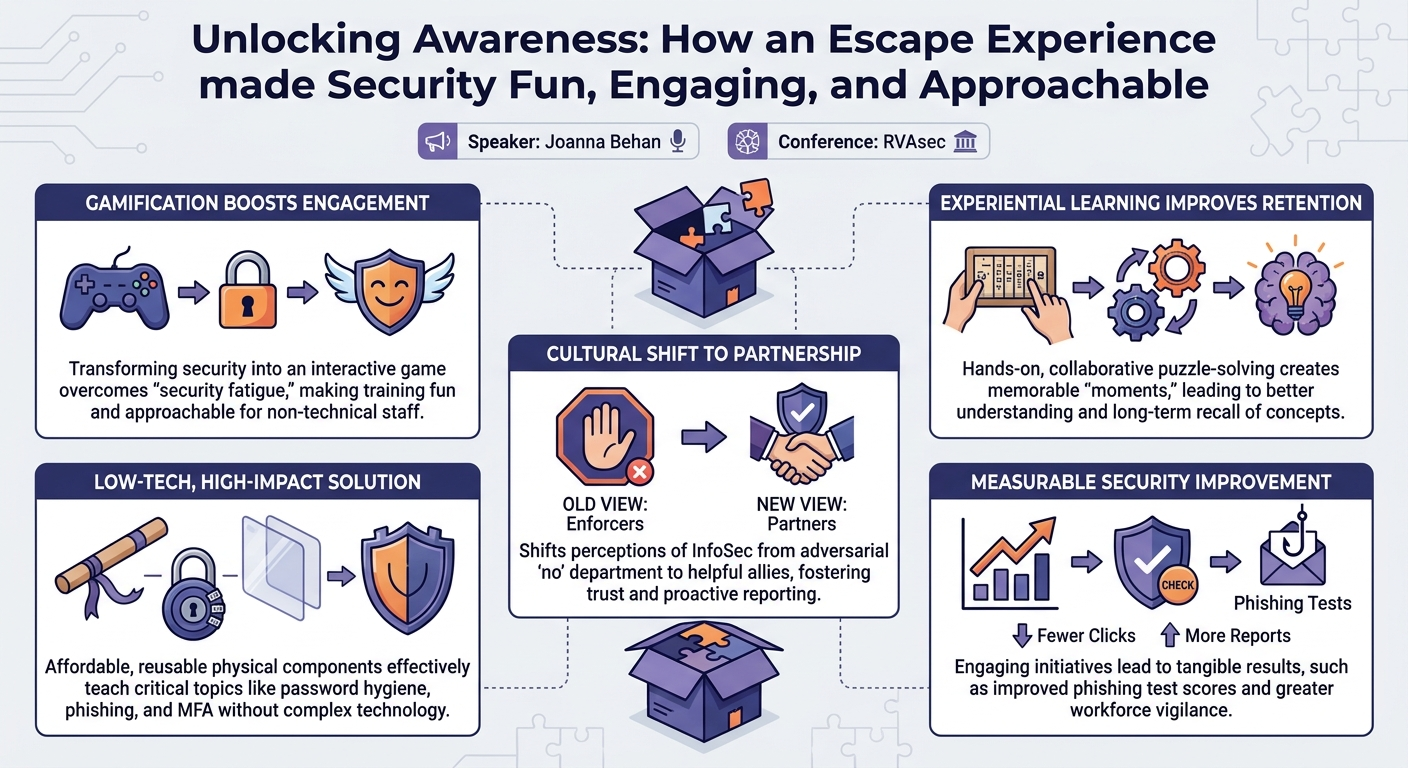
- Gamification is a Powerful Security Awareness Tool: Transforming security education into an interactive game, like an escape box, dramatically increases engagement, enjoyment, and retention, especially for non-technical audiences.
- Experiential Learning Creates Lasting Impact: Hands-on, collaborative puzzle-solving fosters memorable learning moments that lead to better understanding and application of security principles compared to passive training methods.
- Positive Perception Drives Security Culture: Making security fun and approachable shifts the InfoSec team's image from "enforcers" to "partners," encouraging open communication, trust, and proactive reporting of security concerns.
- Low-Tech Solutions Can Yield High-Impact Results: Effective security awareness doesn't require complex technology; well-designed, affordable, and reusable physical components can effectively teach critical concepts like password hygiene, phishing recognition, and MFA.
- Teamwork and Communication are Critical: Both in designing the awareness program and participating in it, effective communication and delegation are essential for success, mirroring the collaborative nature required for robust organizational security.
- Measurable Improvements are Achievable: Engaging awareness initiatives can lead to tangible security improvements, such as higher phishing test scores and a more vigilant workforce, demonstrating a clear return on investment.
About the Speaker(s)
The primary speaker for "Unlocking Awareness: How an Escape Experience made Security Fun, Engaging, and Approachable" was Joanna Behan, an Information Security Analyst at the Federal Reserve Bank (FRB) of Richmond. Behan brings a unique blend of creativity and security expertise to her role. She holds an art major from James Madison University ("Go Dukes!") and has over 20 years of professional experience. Her commitment to the information security space is further underscored by her certifications, including the GCRC and CISSP. Beyond her professional accomplishments, Behan is an avid traveler (with a notable trip to Iceland), a fan of full solar eclipses, a proud owner of three pets (Stella, Oliver Rainbow, and Duke Silver – a nod to Parks and Recreation), and a passionate collector of Lego.
Joanna Behan emphasized that the escape box project was not a solo endeavor but a collaborative effort by a dedicated team at the FRB of Richmond. She specifically acknowledged the contributions of her colleagues: Carolyn (their manager), Brian, Brendan, and Lori, as well as Daniel, who assisted with the project. This team, like many security professionals, juggled the development and execution of the escape box as an additional responsibility, dedicating limited time each week to its creation. Their collective passion for making security engaging was a driving force behind the project's success and its positive impact on organizational culture.
Reviews
Dr. Zero (Offensive Security Researcher) — WEAK
Joanna Behan built a physical escape box full of word searches and ciphers to trick Federal Reserve employees into caring about security. If you are an awareness coordinator desperate to gamify October's mandatory training, here is your blueprint. If you actually work in defense, this is an hour of corporate team-building theater you can safely skip.
Heather Calloway (CISO) — SOLID
This is a practical, low-cost play for your security awareness and culture teams. It won't replace technical controls, but it successfully attacks the adversarial stigma that suppresses early incident reporting. Hand this to whoever owns your training compliance and internal communications.