AI SOC and Securing your Environment
Ryan Bird (Security Engineer · GuidePoint Security)
RVAsec 2026 · Day 2 · Madison / Jefferson / Monroe
Overview
In his RVAsec talk, "AI SOC and Securing your Environment," Ryan Bird, a Delivery Engineer at GuidePoint Security, delves into the burgeoning role of Artificial Intelligence within the Security Operations Center (SOC). Bird addresses the critical questions organizations face today: how to effectively integrate AI tools, secure them against novel threats, and leverage them to enhance defensive capabilities without succumbing to prohibitive costs or new vulnerabilities. Drawing from an "end-user perspective," Bird champions a philosophy of enablement over replacement, advocating for AI as a force multiplier for security analysts rather than a substitute.
Key moments
- 2:00 The need for creativity and securing AI in SOC
- 7:50 Empowering analysts: AI bridges skill gaps, fosters ingenuity
- 11:00 Cost-effective EDR log collection using custom scripts
- 16:00 Attack vector: Exhausting AI tokens with mass triggers
- 18:30 Insider threat: Extracting environment data with local LLMs
- 27:00 Mitigating token costs by hosting your own LLMs
- 35:20 Q&A: How local LLMs save money on token costs
AI SOC and Securing your Environment
Speakers: Ryan Bird, Security Engineer, GuidePoint Security
Conference: RVAsec
YouTube: https://www.youtube.com/watch?v=c6eheyVgwd4
Overview
In his RVAsec talk, "AI SOC and Securing your Environment," Ryan Bird, a Delivery Engineer at GuidePoint Security, delves into the burgeoning role of Artificial Intelligence within the Security Operations Center (SOC). Bird addresses the critical questions organizations face today: how to effectively integrate AI tools, secure them against novel threats, and leverage them to enhance defensive capabilities without succumbing to prohibitive costs or new vulnerabilities. Drawing from an "end-user perspective," Bird champions a philosophy of enablement over replacement, advocating for AI as a force multiplier for security analysts rather than a substitute.
The presentation provides a comprehensive examination of both the opportunities and significant risks presented by AI in cybersecurity. Bird outlines how AI can bridge skill gaps, automate mundane tasks, and foster innovation among defensive teams, while simultaneously exposing organizations to sophisticated new attack vectors, such as token exhaustion and adversarial environment extraction. His insights are particularly relevant in an industry grappling with talent shortages and increasing attack sophistication, offering practical guidance on architecting secure AI environments and strategically deploying localized large language models (LLMs) to maintain control and manage costs.
Bird’s talk is a timely and pragmatic guide for security professionals navigating the complexities of AI adoption. By highlighting specific technical challenges, potential attack scenarios, and actionable defensive strategies, he equips the audience with the knowledge to make informed decisions about AI implementation. The core message emphasizes that while AI promises significant advancements for the SOC, its integration demands careful planning, a deep understanding of its operational nuances, and a commitment to continuous adaptation to new threats and capabilities.
Background
▶ Watch: The need for creativity and securing AI in SOC (2:00)
Ryan Bird's journey into cybersecurity, beginning with a military background in the Navy and subsequent roles in special warfare training and maritime security, has imbued him with a practical, problem-solving mindset. His academic pursuit at UMGC, culminating in a summa cum laude graduation, coupled with analyst roles at RSM Defense, the Department of State's Personal Security Device program, and supporting FEMA's Elastic onboarding, provides a rich foundation for his "end-user perspective" on security challenges. This background informs his central thesis: the cybersecurity industry, particularly the SOC, is often reactive, burdened by technical debt, and struggling to innovate effectively with new tools.
The rapid proliferation of AI, especially large language models (LLMs), has introduced a new paradigm. Initially, users interacted with browser-based AI, relying on manual copy-pasting and "vibe coding" – an inefficient process. The emergence of agentic AI platforms marked a significant shift, enabling AI to directly interact with systems and execute tasks, drastically reducing the steps between ideation and execution. However, this advancement also brought new challenges. Bird points to the widely publicized incident where Uber reportedly exhausted its AI tokens within the first four months of adoption as a stark warning of the financial implications and lack of control many organizations face when relying solely on external, token-based AI services.
Bird clarifies foundational AI terminology, touching on concepts like MCP servers (which he implies are central to managing local models), RAG (Retrieval Augmented Generation), and LoRA (Low-Rank Adaptation), suggesting these are key to understanding advanced AI deployment. Crucially, he frames the adoption of AI not as a means to replace human analysts, especially Level 1 SOC personnel, but to enable them. This philosophy stems from the recognition that while experienced engineers may be hesitant to adopt new AI tools, AI can serve as an invaluable training and enablement tool for newer analysts, bridging the expertise gap and allowing teams to tackle long-standing, resource-intensive problems like expensive 24/7 endpoint log ingestion into a Security Information and Event Management (SIM) system. The core problem AI can address, according to Bird, is the pervasive issue of time, cost, and lack of experience hindering organizations from fixing their security posture.
Key Findings
▶ Watch: Cost-effective EDR log collection using custom scripts (11:00)
Ryan Bird's presentation unearths several critical findings regarding AI in the SOC, spanning both its transformative potential and the emergent threats it introduces:
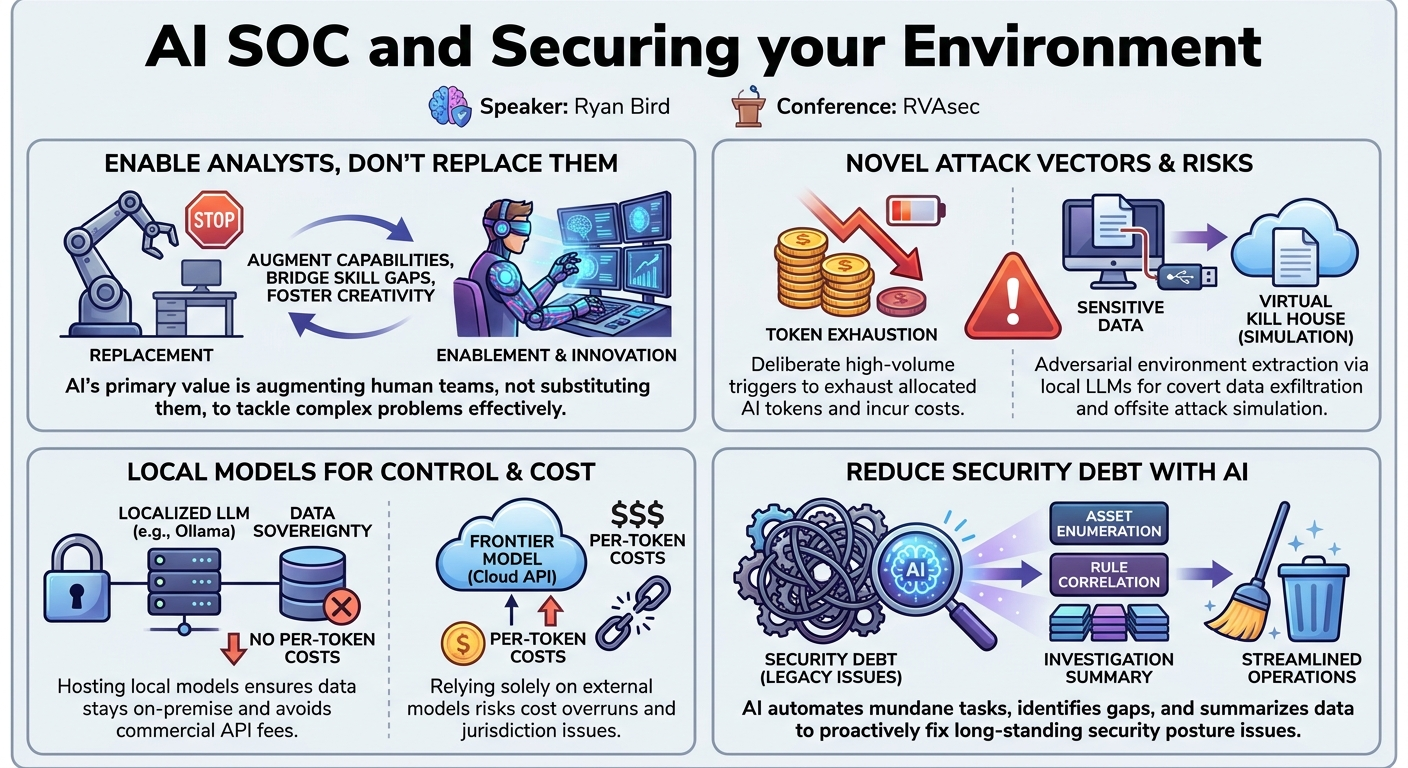
- AI as an Analyst Enabler, Not Replacer: A foundational finding is that AI’s primary value lies in augmenting human capabilities rather than replacing them. Bird argues that AI can bridge the knowledge gap between seasoned experts and new analysts, providing "infinite patience" in training and allowing junior personnel to achieve outcomes previously only expected from experienced professionals. This enablement fosters agency, creativity, and bespoke security controls tailored to specific environments, making an organization less predictable to attackers.
- Novel Attack Vectors Emerge: The adoption of AI introduces entirely new categories of attacks:
- Token Exhaustion Attack: Attackers can identify an organization's automated AI workflows and deliberately trigger them at high volume. The goal is not to breach the system but to exhaust the organization's allocated AI tokens, thereby incurring significant financial costs and potentially degrading or disabling defensive AI capabilities. This turns AI operational costs into a direct attack surface.
- Adversarial Environment Extraction: This sophisticated insider threat scenario involves an attacker using a local LLM (potentially low-and-slow or a zero-install portable version on a USB) to extract sensitive environmental data. This data could include Group Policy, Active Directory configurations, file access patterns, and EDR exclusion lists. The extracted information is then encoded (potentially in a custom, hard-to-detect format) and exfiltrated. The attacker can then use cloud-hosted GPUs offsite to build a "virtual kill house" – a simulated replica of the target environment – to validate and refine attack vectors before launching a rapid, pre-validated attack.
- The High Cost of Frontier Models and the Solution of Local LLMs: Bird highlights the prohibitive cost of relying exclusively on frontier models (commercial, cloud-hosted LLMs) due to token costs. The Uber token exhaustion incident serves as a cautionary tale. A key finding is that hosting localized LLMs (e.g., using Ollama) provides a crucial alternative. This approach allows organizations to control data jurisdiction, implement custom guardrails, and eliminate per-token costs, shifting the expense to infrastructure and maintenance.
- AI Can Actively Reduce Security Debt: Beyond defensive operations, AI can be a powerful tool for proactively addressing long-standing security challenges. Bird suggests AI can help enumerate and fix issues like end-of-life servers, identify gaps in asset inventories, correlate disparate security rules, and summarize preliminary investigations at machine speed, thereby significantly reducing an organization’s accumulated security debt.
- Supply Chain Risks and Model Poisoning: The integrity of AI models is a significant concern. Bird notes that a model can be effectively poisoned with as few as 250 documents, regardless of its size or initial training data. This model or document poisoning poses a critical supply chain risk, emphasizing the need for robust validation and patching mechanisms, similar to traditional software. The lack of standardized digital signature mechanisms for LLMs further compounds this challenge.
Technical Deep Dive
▶ Watch: Attack vector: Exhausting AI tokens with mass triggers (16:00)
The technical core of Ryan Bird's talk revolves around the practical implementation and security implications of AI, particularly Large Language Models (LLMs), within a SOC environment. He differentiates between basic browser-based AI, which is inefficient due to manual intervention, and agentic AI, which allows for direct interaction with security tools and automated execution, significantly enhancing operational speed and analyst efficiency.
A crucial concept introduced is the localized model, where an organization hosts its own LLM instance rather than relying solely on third-party frontier models. This approach, often managed via what Bird refers to as MCP servers (though not explicitly defined, implying a form of managed compute platform for AI), is presented as a fundamental shift for cost control and data sovereignty. By hosting models locally, organizations avoid per-token costs associated with commercial APIs and retain full control over their data's jurisdiction and the model's behavior. Examples like Ollama are cited as platforms that facilitate local LLM deployment.
Bird provides a concrete example of AI-enabled efficiency through a PowerShell script he developed. This script, designed for EDRs like CrowdStrike and Microsoft Defender, addresses the high cost of continuous endpoint log ingestion into a SIM. Instead of ingesting all telemetry 24/7, the script is triggered by an EDR detection. Upon detection, it collects a targeted amount of historical log data (e.g., seven days) into a JSON file on the local endpoint and then forwards only this relevant context to the SIM. This method significantly reduces ingestion costs while providing critical forensic data when an alert fires, demonstrating how AI principles (even if the script itself isn't AI, it embodies an AI-driven efficiency mindset) can optimize traditional security operations.
The talk details two novel attack vectors with significant technical implications:
- Token Exhaustion Attack: This attack leverages the operational cost model of AI. Attackers first perform OSINT (Open-Source Intelligence) to identify an organization's vendor stack and infer its automated AI workflows. They then generate high volumes of "noise" – benign but detectable activities like suspicious DNS queries or brute-force attempts – designed to trigger the target's automated AI defenses. Each triggered response consumes AI tokens, and the attacker's goal is to rapidly exhaust these tokens, driving up costs and potentially degrading the defensive AI's ability to respond to genuine threats. Monitoring consumption rate as security telemetry (e.g., anomalous spikes in AI investigation volume) is proposed as a defensive measure.
- Adversarial Environment Extraction: This sophisticated attack relies on an insider threat or compromised endpoint. The attacker deploys a local LLM on the target machine, operating "low and slow" to avoid detection by traditional Shadow AI monitoring tools that often focus on SaaS solutions. This local LLM is used to systematically extract sensitive environmental data – such as Group Policy configurations, Active Directory details, file access permissions, EDR exclusion lists, and SIM correlation logic. This data is then used to create "training pairs" for the LLM. To exfiltrate this data covertly, the attacker might encode it in custom formats (e.g., a "Ryan Bird version of Morse code") to bypass traditional DLP solutions. Once exfiltrated, the data is used offsite with cloud-hosted GPUs to build a virtual kill house – a precise simulation of the target environment. This allows the attacker to validate and refine specific attack vectors without touching the live production network, enabling a rapid, highly effective, and pre-tested attack. Defenses include baselining query volume per identity, monitoring outbound traffic to known cloud GPU providers, and classifying detection rules as sensitive data.
Bird also emphasizes the importance of guardrails for AI implementation. This includes setting up MCP servers for controlled agent access, configuring API-level controls, and designing agentic workflows on a case-by-case basis. He advocates for a hybrid approach: utilizing clean open-source models as a foundation, supplemented by frontier models for building out bespoke, in-house LLMs with custom tools and skills. This strategy mitigates risks associated with unknown API jurisdictions, variable change cadences, and potential upstream degradations inherent in relying solely on external services. The threat of model or document poisoning (where as few as 250 documents can compromise a model) highlights the critical need for continuous patching and maintenance of LLMs, akin to traditional software.
Finally, Bird touches on the AI supply chain problem, noting the current lack of robust digital signature mechanisms for LLMs. He mentions ongoing efforts by industry leaders like Google and Nvidia to address this, underscoring it as a vital area for future security development.
Demo / Proof of Concept
▶ Watch: Mitigating token costs by hosting your own LLMs (27:00)
While Ryan Bird's talk did not feature a live, interactive demonstration in the traditional sense, he effectively presented a proof of concept through a detailed description of a PowerShell script he developed. This script exemplifies the philosophy of using AI-inspired efficiency to address a common and costly security challenge: the continuous ingestion of endpoint logs into a Security Information and Event Management (SIM) system.
Bird explained that he created versions of this script for both CrowdStrike and Microsoft Defender EDR platforms. The core functionality of the script is to collect endpoint logs only upon detection of a security event by the EDR. Instead of ingesting all endpoint telemetry 24/7 (which can be prohibitively expensive due to high data volume), the script waits for a detection to occur. Once an EDR alert is triggered, the PowerShell script then performs a "context dump," collecting a configurable amount of historical data (e.g., the last seven days) related to that specific event. This data is stored locally as a JSON file on the endpoint’s hard drive – a resource typically underutilized. Only this targeted, relevant log data is then sent to the SIM for investigation.
This approach offers several key benefits, serving as a practical demonstration of how an organization can:
- Reduce Costs: By avoiding constant, full-volume log ingestion, the organization saves significantly on SIM data processing and storage fees.
- Increase Telemetry: Simultaneously, it ensures that critical forensic data is still available when needed, potentially providing deeper context than the EDR's native alert alone.
- Enhance Efficiency: It streamlines the incident response process by delivering pre-filtered, relevant data to analysts, allowing them to focus on deeper investigations rather than sifting through noise.
Bird underscored the simplicity and elegance of this solution, emphasizing that it represents the kind of innovation that empowered analysts, supported by leadership, can bring to an organization's security posture. While not an AI tool itself, the script embodies the "AI mindset" of intelligent automation and resource optimization that Bird advocates for in the modern SOC.
Defensive Implications
▶ Watch: Q&A: How local LLMs save money on token costs (35:20)
The insights shared by Ryan Bird carry significant defensive implications for organizations grappling with AI adoption. The core message for defenders is to proactively adapt to the changing threat landscape shaped by AI, rather than reactively chasing new vulnerabilities.
- Monitor AI Consumption as a Security Metric: Organizations must integrate AI token usage and investigation volume into their security telemetry. Anomalous spikes in AI activity, even if not tied to a direct breach, could indicate a token exhaustion attack. Security teams need visibility into these metrics, which traditionally reside with IT or finance departments, to detect and respond to such economic denial-of-service attacks.
- Implement Robust AI Guardrails and Control Data Flow: To prevent adversarial environment extraction and ensure data integrity, organizations must establish stringent controls around AI usage. This includes setting up MCP servers with granular access controls for agents, implementing API-level security, and carefully defining agentic workflows on a case-by-case basis. Critically, organizations should explore hosting localized LLMs (e.g., using Ollama) to control data jurisdiction, reduce token costs, and implement custom security policies that external frontier models cannot guarantee.
- Baseline and Monitor User Behavior for Shadow AI and Insider Threats: Traditional security principles remain vital but must be applied to new AI contexts. Defenders should baseline query volume and breadth per identity/role within AI tools. For instance, an HR employee accessing Group Policy or Active Directory information via an internal LLM should trigger alerts. Furthermore, organizations need to audit and monitor endpoints for Shadow AI – unauthorized or locally installed LLMs – especially zero-install portable versions that might evade traditional software inventory.
- Secure the AI Supply Chain: The threat of model or document poisoning means organizations must treat AI models and their training data with the same criticality as other software components. This necessitates robust validation, integrity checks, and a patching regimen for LLMs. Organizations should actively track developments in digital signature mechanisms for AI models, as proposed by industry leaders, to ensure the authenticity and integrity of deployed AI.
- Leverage AI to Reduce Security Debt: Instead of viewing AI solely as a new attack surface, defenders should harness its power to address existing security debt. AI can automate the enumeration of end-of-life systems, assist in correlating disparate security rules, summarize preliminary investigations, and take rapid containment actions. By freeing analysts from mundane tasks, AI enables them to conduct deeper, more strategic investigations and develop custom security controls that are unpredictable to attackers.
- Foster an AI-Enabled Security Culture: Leadership must actively encourage and support analysts in experimenting with and deploying AI solutions. This "enablement over replacement" philosophy allows analysts to develop bespoke security controls tuned to their specific environment, creating a more resilient and less predictable defense. Trust but verify, ensuring appropriate dev team oversight for new solutions.
- Document Manual Fallback Procedures: In a world where AI workflows can be degraded by attacks like token exhaustion or model poisoning, having clear, well-documented manual fallback procedures is crucial. Defenders need to know what to do if their automated AI defenses go "quiet."
By adopting these defensive strategies, organizations can not only mitigate the risks posed by AI but also transform their SOC into a more efficient, proactive, and resilient security operation.
Key Takeaways
- AI for Analyst Empowerment: AI should be viewed as a tool to enable and augment security analysts, bridging skill gaps and fostering innovation, rather than a means to replace human roles.
- New Attack Vectors Demand New Defenses: Organizations must prepare for novel attacks like token exhaustion, which leverages AI operational costs, and adversarial environment extraction, which uses local LLMs and cloud GPUs for covert data exfiltration and simulated attacks.
- Control Costs and Data with Local LLMs: To manage prohibitive token costs and maintain data sovereignty, organizations should prioritize hosting localized LLMs and strategically integrate them with vendor solutions that allow for this flexibility.
- Monitor AI Behavior as Critical Telemetry: Proactive defense requires monitoring AI consumption rates for anomalous spikes, baselining user interaction with AI tools, and auditing endpoints for Shadow AI to detect misuse or attack.
- Harness AI to Reduce Security Debt: AI offers a powerful capability to address long-standing security debt by automating asset enumeration, correlating security rules, and streamlining investigations, freeing analysts for higher-value tasks.
- Prioritize AI Supply Chain Security: The threat of model poisoning and the current lack of robust digital signatures for LLMs necessitate rigorous validation, patching, and careful consideration of the AI supply chain to ensure model integrity.
About the Speaker(s)
Ryan Bird is a Delivery Engineer at GuidePoint Security, bringing a diverse and practical background to the field of cybersecurity. His career began in the military, serving in the Navy, followed by specialized training with Obsidian Solutions Group where he developed ASAT Level 1 special warfare courses for personnel at Fort Bragg. After a stint in maritime security, which was impacted by the COVID-19 pandemic, Ryan pursued higher education, graduating summa cum laude from UMGC in 2023. His professional experience includes roles as an analyst at RSM Defense, a Level 2 analyst supporting the Department of State's Personal Security Device program, and assisting FEMA with their Elastic onboarding efforts, where he gained significant experience with the platform from an analyst's perspective. This varied background informs his unique "end-user perspective" on security challenges and the practical application of emerging technologies like AI in the SOC.
Reviews
Dr. Zero (Offensive Security Researcher) — WEAK
Bird’s heart is in the right place regarding SOC costs, but this talk is a prime example of forcing AI framing onto traditional problems. When your 'AI demo' is actually just a PowerShell script doing conditional log forwarding, you've lost the plot.
Heather Calloway (CISO) — STRONG ACCEPT
This talk bridges the gap between AI hype and SOC reality by focusing on the economics of defense. Bird highlights how relying on cloud-based AI can turn operational costs into a direct attack surface, offering practical architectural alternatives like local models. It's highly recommended for any security leader currently modeling the budget and risk of injecting LLMs into their operations.