Swatting Flies With Sledgehammers: Broken TPRM Programs and How To Fix Them
Brian Markham (CISO · EAB Global, Inc.)
RVAsec 2026 · Day 2 · Grand Ballroom D/E
Overview
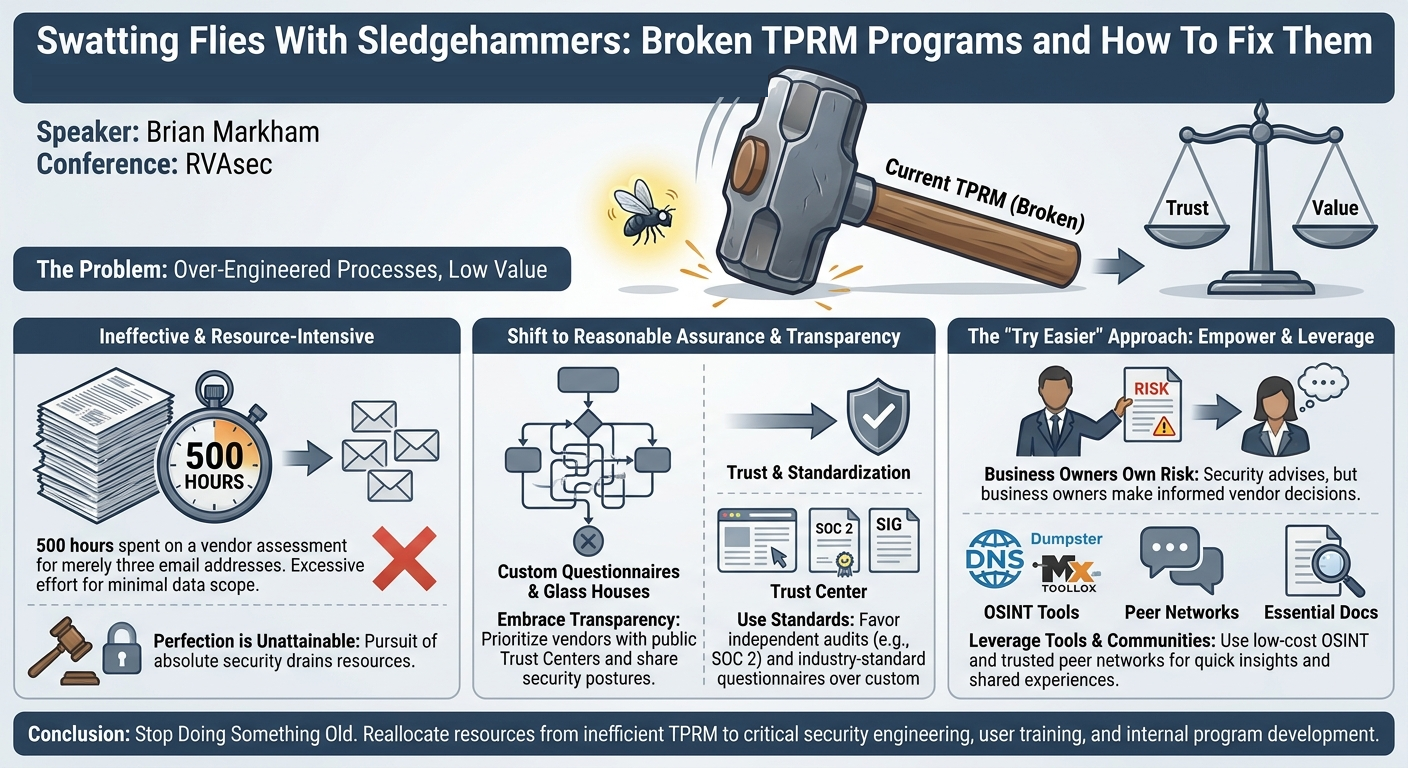
In his RVAsec talk, "Swatting Flies With Sledgehammers: Broken TPRM Programs and How To Fix Them," Brian Markham, CISO at EAB Global, Inc., delivers a provocative and essential critique of contemporary Third-Party Risk Management (TPRM) practices. Markham argues that many organizations are trapped in over-engineered, inefficient, and ultimately ineffective TPRM programs that consume vast resources without delivering proportionate security value. He challenges the audience to fundamentally rethink their approach, moving away from a pursuit of unattainable perfection towards a model built on reasonable assurance, transparency, and trust.
Key moments
- 2:00 500 hours for three email addresses: TPRM's broken reality
- 4:25 TPRM is about reasonable assurance and trust, not perfection
- 6:15 Childcare analogy: Trusting strangers with high stakes
- 18:00 Critique of SOC 2 audits and 'compliance in weeks'
- 32:00 Next-gen TPRM: Know your vendor's security team
- 35:00 Allow risk to sit with the business owner
- 37:00 Leverage trusted communities for quicker risk assessments
- 45:30 Speaker's ideal TPRM review time: three hours
Swatting Flies With Sledgehammers: Broken TPRM Programs and How To Fix Them
Speakers: Brian Markham, CISO, EAB Global, Inc.
Conference: RVAsec
YouTube: https://www.youtube.com/watch?v=AZgczztn2Lw
Overview
In his RVAsec talk, "Swatting Flies With Sledgehammers: Broken TPRM Programs and How To Fix Them," Brian Markham, CISO at EAB Global, Inc., delivers a provocative and essential critique of contemporary Third-Party Risk Management (TPRM) practices. Markham argues that many organizations are trapped in over-engineered, inefficient, and ultimately ineffective TPRM programs that consume vast resources without delivering proportionate security value. He challenges the audience to fundamentally rethink their approach, moving away from a pursuit of unattainable perfection towards a model built on reasonable assurance, transparency, and trust.
The talk is a rallying cry for security professionals to reclaim their time and resources, redirecting efforts from redundant vendor assessments to more impactful security initiatives. Markham opens with a stark anecdote: his company once spent 500 hours over 15 months to complete a financial institution's vendor risk assessment, only to discover the scope of data involved was merely three employee email addresses. This egregious example sets the stage for his core thesis: current TPRM methodologies are often akin to "swatting flies with sledgehammers," causing significant productivity hits for both buyers and sellers, and diverting precious time from genuinely enhancing an organization's security posture.
Markham's objective is not merely to highlight problems but to empower security leaders to instigate meaningful change. He advocates for a pragmatic, community-driven, and business-aligned approach to TPRM, emphasizing that the ultimate goal is not just security, but the cultivation of trust in an increasingly interconnected digital ecosystem. By challenging long-held assumptions and offering actionable alternatives, Markham aims to equip attendees with the conviction to streamline their TPRM programs and foster more collaborative, value-driven relationships with their third-party partners.
Background
▶ Watch: 500 hours for three email addresses: TPRM's broken reality (2:00)
The genesis of modern TPRM can be traced back to the 1990s, primarily driven by the financial services sector. Organizations like BITS (Business & Information Technology Strategies) emerged from this era, eventually leading to initiatives like Shared Assessments and its widely adopted Standardized Information Gathering (SIG) questionnaire. Financial institutions, with their significant exposure to sensitive customer data and regulatory scrutiny, were among the first to formalize processes for vetting third-party suppliers, aiming to prevent data breaches and fraud.
Over the decades, the landscape of supply chain risk has expanded dramatically, a trend reflected in the increasing mentions of "supply chain" within security frameworks such as NIST 800-53. Markham notes that with each revision, new controls and considerations are added, but rarely are antiquated ones removed. This cumulative approach has resulted in a "jalopy with more and more suitcases on top," burdening organizations with an ever-growing list of requirements that often lack a critical re-evaluation of their necessity or effectiveness. The speaker emphasizes that while industry standards like CIS Controls v8.1 and proposed SEC rules acknowledge the critical importance of supply chain and third-party risk, they also implicitly recognize the "productivity hit" caused by extensive auditing.
The core problem, as Markham articulates, is a collective pursuit of perfection rather than reasonable assurance. Organizations engage in exhaustive, often redundant, assessment processes driven by a fear of "what if" rather than a clear understanding of actual risk. This leads to a cycle where buyers demand extensive proof of security, and sellers must spend exorbitant hours providing it, only for the information to be underutilized or, worse, for the process to yield negligible security improvements. Markham questions whether current TPRM truly prevents breaches or merely serves as a compliance checkbox. His talk aims to break this cycle by advocating for a shift in mindset: from adversarial "glass houses pointing at each other" to a collaborative network built on mutual trust and transparency.
Key Findings
▶ Watch: Childcare analogy: Trusting strangers with high stakes (6:15)
Markham's talk reveals several critical findings about the state of TPRM and proposes a path forward:
- Over-engineered Processes Lead to Low Value: The current paradigm of TPRM, exemplified by the 500-hour assessment for minimal data, demonstrates that excessive effort often yields disproportionately low security value. This drains resources from more impactful security initiatives.
- Perfection is an Unattainable Goal: The pursuit of absolute perfection in TPRM is futile. Instead, organizations should strive for reasonable assurance, acknowledging that some level of risk is inherent and must be managed, not eliminated entirely.
- Transparency is the Future of TPRM: Proactive and open sharing of security posture by vendors (e.g., through Trust Centers) is paramount. Buyers have the power to demand this transparency, which benefits all parties by streamlining assessments and fostering trust.
- Industry Standards Outperform Custom Questionnaires: While custom questionnaires might seem tailored, they are often redundant and inefficient. Independent third-party audits (like SOC 2, ISO 27001) and industry-standard questionnaires (like SIG or HECVAT) should be preferred as they offer a time-tested, consistent basis for evaluation.
- Buyers Hold the Power to Drive Change: As buyers, organizations dictate the terms of TPRM. This leverage can be used to simplify processes, demand transparency, and foster a more collaborative ecosystem, rather than perpetuating burdensome practices.
- Trust, Not Just Security, is the Ultimate Currency: Markham argues that security is the means to an end, while trust is the ultimate goal. Building trust with third parties, akin to how parents choose childcare, involves practical vetting, community recommendations, and direct relationships, not just checklists.
- TPRM Steals Resources from Core Security Functions: Overly complex TPRM programs divert time, budget, and personnel from critical activities like security engineering, user engagement, internal networking, and even research, ultimately weakening the overall security program.
Technical Deep Dive
▶ Watch: Next-gen TPRM: Know your vendor's security team (32:00)
Markham meticulously dissects the four primary methods of TPRM, highlighting their strengths, weaknesses, and how they contribute to the "sledgehammer" problem. He then outlines a "try easier" approach for the next generation of TPRM.
Current Methods and Their Problems
- Independent Audits (e.g., SOC 2, ISO 27001):
- Pros: These audits are conducted by vetted assessors following standard methodologies, providing a recognized, time-tested framework for evaluating security controls. They require continuous performance of good security practices.
- Cons: Markham acknowledges that SOC 2 audits, while valuable, are not without flaws. He points to the rise of "SOC 2 puppy mills" and services claiming "SOC 2 compliance in weeks" (e.g., Polaro Labs), which fundamentally undermine the rigor required. He cites the Deep Delver Substack expose on companies like Delve, which allegedly fabricated audit documentation. A legitimate SOC 2 Type 2 report typically takes months (e.g., nine months at his company) and even a clean report isn't a guarantee of future performance. Buyers must perform due diligence on the audit firm (peer-reviewed status) and assess the plausibility of the vendor's claims given their operational history (e.g., a 6-month-old startup should not have a SOC 2 Type 2).
- Cybersecurity Risk Rating Services (e.g., Bitsight, SecurityScorecard, Black Kite, UpGuard):
- Pros: These services offer high ease and low time-to-value. They leverage OSINT, internet scans, and proprietary signals to generate a "security credit score." They provide quick insights and allow monitoring of both third parties and one's own organization.
- Cons: A major issue is false positives, where vulnerabilities are misattributed or irrelevant. The ratings can be subjective or proprietary, lacking the transparency of models like FAIR. They can also be expensive, incentivizing organizations to only monitor a subset of vendors. Furthermore, the data sources for these ratings are often unclear to the third parties being assessed, making it difficult for them to remediate reported issues.
- Industry Standard Questionnaires (e.g., CAIQ, HECVAT, SIG, Google's VSAQ):
- Pros: These questionnaires are designed to be filled out once and used across multiple customers, saving effort for sellers. They are time-tested, widely accepted, and often updated. Markham specifically praises Google's Vendor Security Assessment Questionnaire (VSAQ) for its more reasonable length.
- Cons: Despite their standardization, these questionnaires are still incredibly time-consuming to complete and keep current (e.g., CAIQ v4 has 261 questions, HECVAT has ~300, and the SIG full version can reach 2500 questions). Critically, they often do not exempt vendors from having to complete custom questionnaires, leading to redundant work.
- Custom Questionnaires:
- Pros: Theoretically, they can be tailored to specific organizational needs.
- Cons: Markham considers these the most problematic. They are born from a belief that one's own organization knows better than industry experts, which is rarely true. They demand significant time and effort from vendors, often asking questions that overlap with standard questionnaires. Worse, they can penalize transparency. Markham gives an example where providing a pentest report led to further demands for resumes of the testers, effectively punishing the vendor for being open. He argues that a willingness to share a legitimate, unredacted pentest report should be seen as a strong signal of trustworthiness.
The Next Generation: "Try Easier" TPRM
Markham proposes a "try easier" approach, focusing on efficiency and value:
- Know What You're Buying and Standardize Risk Assessment: Develop a clear, standard approach to evaluate vendor risk based on the data and services involved. Be comfortable making quick, informed decisions based on risk appetite (e.g., "collects email addresses, don't want to see a breach").
- Learn from M&A Due Diligence: Adopt the ruthless efficiency of M&A due diligence, which is time-limited, transparent, and focused on identifying compensating controls and budgeting for accepted risks. The deal will close; security's role is to advise on managing post-acquisition risk, not to kill the deal.
- Know the Vendor's Security Team: Establish direct contacts with the CISO or security leadership of key vendors. Markham highlights Asana's Trust Center as an example of transparently listing security leadership. He recounts having to find TeamViewer's CISO on LinkedIn during an incident, underscoring the need for proactive relationship building.
- Examine Documentation That Really Matters: Focus on essential artifacts like SOC 2 reports, ISO certifications, pentest reports, Software Bill of Materials (SBOMs) (though their adoption is still nascent), remediation SLAs, and vulnerability disclosure policies. Avoid requesting a "library" of documents; prioritize high-signal information.
- Evaluate Online Presence (OSINT): Leverage free and low-cost Open Source Intelligence (OSINT) tools for quick insights. Markham suggests DNS Dumpster for backend infrastructure, Hacker Target for domain enumeration, targeted Google searches (e.g.,
site:domain.com security), and MX Toolbox to check for DMARC reject policies as a strong indicator of security hygiene. - Allow Risk to Sit with the Business Owner: Security's role is to advise on risk, not own it. Business owners introduce risk and must ultimately make informed decisions on vendor engagement. Markham shares an email template demonstrating how to clearly communicate risks and transfer decision-making responsibility to the business.
- Leverage Trusted Communities: Where appropriate and respecting NDAs, consult peers and trusted communities (e.g., ISACs, closed invite-only groups, portfolio company networks) for shared experiences with common vendors (e.g., assessing CrowdStrike Falcon). He draws a parallel to how parents evaluate childcare: relying on friends, family, references, facility walkthroughs, and even "vibes." This community intelligence can drastically reduce assessment time.
Demo / Proof of Concept
▶ Watch: Allow risk to sit with the business owner (35:00)
While the talk did not feature a live technical demonstration or a traditional Proof of Concept (PoC) involving code execution or a tool walkthrough, Brian Markham effectively demonstrated the concept of "trying easier" through practical, real-world examples and actionable strategies.
He showcased how an organization could implement a streamlined TPRM by highlighting specific tools and approaches:
- Asana's Trust Center: Presented as a best practice for vendors to transparently list their security leadership, enabling direct contact and fostering trust.
- OSINT Tools: Mentioned tools like DNS Dumpster, Hacker Target, targeted Google searches, and MX Toolbox as readily available resources for quick, low-cost external security posture evaluation. This illustrates how defenders can gather critical intelligence without relying on lengthy questionnaires.
- Email Template: Shared an actual email he uses to formally advise business owners on vendor risks, clearly transferring the ultimate decision-making and risk ownership to them. This serves as a conceptual PoC for shifting the CISO's role from risk owner to risk advisor.
These examples, drawn from Markham's own experience and industry observations, served as compelling evidence that the "try easier" philosophy is not only feasible but demonstrably effective in practice.
Defensive Implications
▶ Watch: Speaker's ideal TPRM review time: three hours (45:30)
The implications of Markham's "Swatting Flies With Sledgehammers" talk for security defenders are profound, advocating for a fundamental shift in how TPRM is approached:
- Re-evaluate and Rationalize Current TPRM Processes: Defenders must critically assess their existing TPRM programs. The core question to ask is: "What are we trying to achieve, and are we achieving it?" Identify and eliminate low-value, time-consuming activities that do not genuinely enhance security. This involves challenging the "way it's always been done" mindset.
- Demand Vendor Transparency and Trust Centers: Instead of endless questionnaires, security teams should actively seek and demand transparent security information from vendors. Encourage and prioritize vendors who provide public Trust Centers with clear security postures, certifications, and direct contact information for their security teams. This shifts the burden of proof to the vendor in a much more efficient manner.
- Prioritize Independent Audits and Industry Standards: Defenders should actively prefer and accept established certifications like SOC 2 Type 2 and ISO 27001, along with recognized questionnaires like the SIG or HECVAT, over custom, bespoke assessments. This requires trusting the rigor of these external audits, while still performing due diligence on the audit firm's credibility.
- Empower and Educate Business Owners on Risk: Security professionals must transition from owning risk to advising on it. Clearly communicate identified risks to business owners, providing them with the necessary information to make informed decisions about vendor engagement. Document this transfer of risk ownership to ensure accountability.
- Integrate OSINT into Vendor Assessments: Incorporate free and low-cost Open Source Intelligence (OSINT) tools (e.g., DNS Dumpster, Hacker Target, MX Toolbox for DMARC analysis) into the initial stages of vendor assessment. This provides quick, objective insights into a vendor's external security posture without direct engagement.
- Leverage Trusted Peer Networks and Communities: Actively participate in and leverage security communities, ISACs, and peer networks to share experiences and insights on common vendors. This collaborative approach can significantly reduce redundant assessment efforts and provide valuable context that no questionnaire can capture.
- Define "Reasonable Assurance" for Your Organization: Rather than pursuing an elusive "perfection," security leaders must define what "reasonable assurance" means for their specific organization based on its risk appetite, industry, and resources. This pragmatism allows for tailored, effective TPRM programs that align with business objectives.
- Foster Relationships with Vendor Security Teams: Proactively identify and connect with security contacts at key vendors. Building these relationships fosters trust and provides direct channels for communication during assessments, incidents, or general inquiries, moving beyond transactional interactions.
- Embrace "Stop Doing Something Old" Mentality: As Peter Drucker's quote suggests, to start doing something new and more effective, security teams must be willing to stop doing outdated, inefficient tasks. This liberation of resources can then be reallocated to critical security engineering, user training, and internal program development that directly enhances organizational resilience.
By adopting these defensive implications, organizations can transform their TPRM from a burdensome, resource-draining exercise into a strategic enabler of secure business operations, fostering trust and efficiency across their supply chain.
Key Takeaways
- Prioritize Reasonable Assurance Over Perfection: TPRM programs should aim for pragmatic, reasonable assurance of security, acknowledging that absolute perfection is an unattainable and resource-intensive goal.
- Demand and Utilize Vendor Transparency: Actively seek out vendors who offer transparent Trust Centers and proactively share their security posture, certifications, and direct contact information for their security teams, making assessments more efficient for all.
- Shift from Custom to Standardized Assessments: Favor independent audits (e.g., SOC 2, ISO 27001) and industry-standard questionnaires (e.g., SIG, HECVAT, Google VSAQ) over custom, often redundant, questionnaires to streamline the assessment process.
- Empower Business Owners with Risk Decisions: Security professionals should act as advisors, clearly communicating risks to business owners, who ultimately own the decision to engage with a third party.
- Leverage OSINT and Peer Networks: Integrate low-cost OSINT tools (like DNS Dumpster, MX Toolbox for DMARC) and engage with trusted professional communities to gain quick insights and shared experiences, reducing individual assessment burdens.
- Reallocate Resources from Inefficient TPRM: Identify and eliminate over-engineered TPRM tasks to free up valuable time and personnel for more impactful security initiatives, such as engineering, user education, and internal program development.
About the Speaker(s)
Brian Markham is the CISO at EAB Global, Inc. With a background that includes significant experience in higher education, where he previously served as a CISO, Markham brings a unique perspective to third-party risk management, having navigated the complexities of both buying and selling services within various organizational contexts. He is a passionate advocate for challenging conventional, often inefficient, security practices. Markham has co-presented on this topic at prestigious conferences like RSA, demonstrating his commitment to driving meaningful change in the industry. His insights are grounded in practical experience, including successfully implementing streamlined TPRM processes within his own organization, giving him the courage to share his controversial but impactful viewpoints with the broader security community.
Reviews
Dr. Zero (Offensive Security Researcher) — STRONG ACCEPT
Markham takes a sledgehammer to the compliance-industrial complex, and it's about damn time. This isn't a zero-day drop, but for any CISO bleeding hundreds of hours into useless vendor spreadsheets, it's a lifeline that replaces performative security with actionable checks.
Heather Calloway (CISO) — STRONG ACCEPT
Markham articulates exactly why the spreadsheet-industrial complex of third-party risk management is failing us. By advocating for an M&A-style approach to vendor due diligence, he provides a blueprint to reclaim security headcount and force risk accountability back onto the business. This is required viewing for any security leader whose team is drowning in custom questionnaires.