Everything Everywhere All At Once: Untangling Security & Privacy Risks Across Today’s AI Tools
Jon Waldman (President · SBS CyberSecurity)
RVAsec 2026 · Day 2 · Grand Ballroom D/E
Overview
In an era where Artificial Intelligence (AI) permeates every facet of business operations, organizations face the daunting challenge of navigating its rapidly evolving landscape while safeguarding critical data and maintaining privacy. Jon Waldman, President of SBS CyberSecurity, addressed this complexity in his RVAsec talk, "Everything Everywhere All At Once: Untangling Security & Privacy Risks Across Today’s AI Tools." The session provided a crucial roadmap for businesses grappling with the secure and private deployment of AI, moving beyond personal use cases to focus squarely on enterprise-level considerations.
Key moments
- 0:00 Introduction: Safely deploying AI for business
- 4:00 Building vs. Buying AI tools for business
- 10:00 AI as a permissions multiplier and data access
- 16:00 Critical: Always use enterprise AI licensing
- 16:50 Microsoft Copilot: Security, privacy, and use cases
- 41:00 Warning: Do NOT use DeepSeek AI for business
- 44:00 Summary of AI tools and key security takeaways
- 46:00 Q&A and the "googly eyes" takeaway
Everything Everywhere All At Once: Untangling Security & Privacy Risks Across Today’s AI Tools
Speakers: Jon Waldman, President, SBS CyberSecurity
Conference: RVAsec
YouTube: https://www.youtube.com/watch?v=mGsFEyzmeJQ
Overview
In an era where Artificial Intelligence (AI) permeates every facet of business operations, organizations face the daunting challenge of navigating its rapidly evolving landscape while safeguarding critical data and maintaining privacy. Jon Waldman, President of SBS CyberSecurity, addressed this complexity in his RVAsec talk, "Everything Everywhere All At Once: Untangling Security & Privacy Risks Across Today’s AI Tools." The session provided a crucial roadmap for businesses grappling with the secure and private deployment of AI, moving beyond personal use cases to focus squarely on enterprise-level considerations.
Waldman underscored the dynamic nature of AI, highlighting the continuous emergence of new models like Claude's Mythos/Fable, alongside a constant flux of associated risks, threats, and opportunities. For businesses aiming to strategically leverage AI, understanding the intricate security and privacy implications of various tools is paramount. This talk aimed to demystify the process, offering actionable insights and comparative analysis of leading generative AI platforms to help organizations make informed decisions and deploy AI safely and securely, transforming the overwhelming "everything everywhere all at once" feeling into a clear, actionable path.
Background
▶ Watch: Introduction: Safely deploying AI for business (0:00)
The pervasive integration of AI into business workflows presents a dual challenge: harnessing its transformative potential while mitigating inherent security and privacy risks. Waldman framed the core problem around the rapid advancement of generative AI models, which, despite offering immense opportunities for efficiency and innovation, also introduce complex considerations regarding data handling, access controls, and regulatory compliance. The talk established a fundamental distinction between two primary approaches for organizations to adopt AI: building custom models or buying licenses to existing commercial platforms.
The "build" approach, while offering maximum customization and control, entails significant investment in time and resources. It involves sourcing models (e.g., from Hugging Face, which boasts over two million AI models), establishing and securing dedicated infrastructure, ensuring the availability of high-quality data for training, and committing to ongoing maintenance and retraining. This path is often prohibitively complex and expensive for many organizations. Conversely, the "buy" approach, utilizing licensed generative AI tools, offers a more accessible entry point, typically through monthly or annual subscriptions. However, this convenience immediately raises critical questions about the safety, security, and privacy posture of third-party vendors and their respective AI models.
Regardless of the build-versus-buy decision, several foundational principles were emphasized as critical for any AI deployment. Firstly, the quality of data is paramount; as Waldman stated, "AI is only as good as the data it works off of." This necessitates meticulous data curation to ensure AI models access relevant and appropriate information, preventing scenarios where legacy, uncurated data (e.g., from file server migrations to Microsoft 365 SharePoint) inadvertently fuels AI responses. Secondly, correct permissions are non-negotiable. AI acts as a "permissions multiplier," exposing existing, often unknown, access rights. Users might inadvertently access sensitive information simply by asking an AI tool, highlighting pre-existing vulnerabilities in access management. This extends to non-human identities such as AI agents, APIs, OAuth tokens, and service accounts, all of which require careful management of their data access and transmission privileges. Finally, the human element remains crucial: continuous employee training on safe and responsible AI use is essential, akin to ongoing cybersecurity awareness programs, to ensure users understand the guardrails and best practices for interacting with these powerful tools.
Key Findings
▶ Watch: AI as a permissions multiplier and data access (10:00)
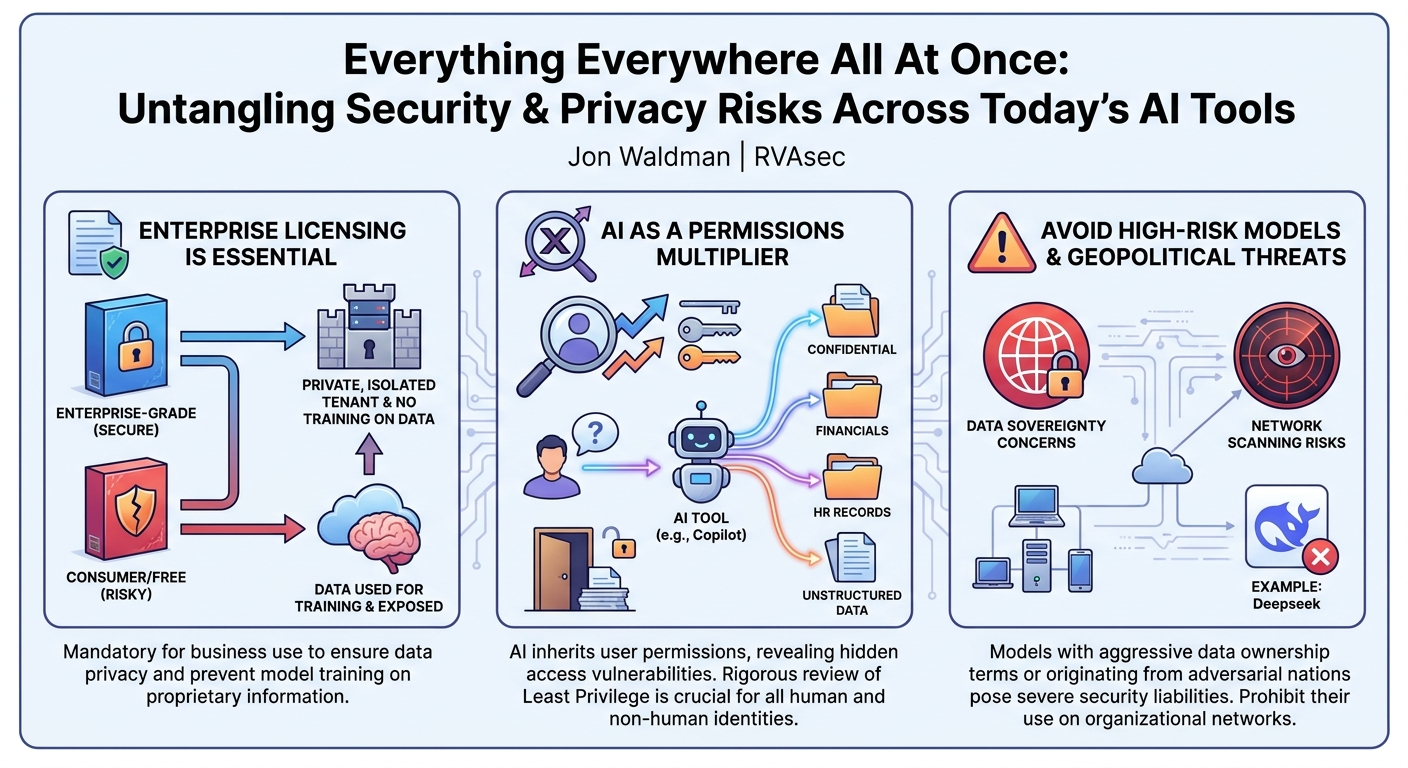
The central and most critical finding from Waldman's analysis is the unequivocal necessity of enterprise licensing for any organization deploying AI for business purposes. Throughout the talk, this point was reiterated as the primary differentiator between secure, compliant AI usage and risky, potentially data-compromising implementations. Consumer or free versions of AI tools, almost without exception, utilize user data (prompts and responses) for model training, a practice deemed unacceptable for sensitive business information. Enterprise-tier licenses, in contrast, consistently offer assurances that customer data remains private, is not used for model training, and is often confined within the customer's dedicated tenant or ecosystem.
Another significant finding highlighted the amplified risk of existing over-permissioning. AI tools, by design, inherit the permissions of the users interacting with them. This means that if an employee has overly broad access rights within a system (e.g., Microsoft 365), an AI tool like Copilot can inadvertently reveal confidential information that the employee technically had access to but didn't know how to locate. This transforms AI into a powerful tool for uncovering hidden access vulnerabilities, necessitating rigorous review and tightening of user permissions.
The "bot battle" segment yielded specific comparative findings across leading AI models:
- Microsoft Copilot: Positioned as a natural first step for organizations already invested in the Microsoft 365 ecosystem. Its enterprise versions integrate with existing data protection frameworks, ensuring data remains within the Microsoft tenant. Notably, Copilot leverages underlying models from ChatGPT and Claude Sonnet, with Microsoft's proprietary business guardrails.
- ChatGPT: While the most popular AI platform globally, its consumer versions were strongly cautioned against. Enterprise, Business, or API licensing, however, provides robust data privacy, including data residency options, custom retention policies, and explicit guarantees against model training on user data. It boasts a strong developer community and extensive integration options.
- Google Gemini: Recommended for Google Workspace users, Gemini stands out for its strong compliance certifications, including ISO 42001 (the world's first AI management system certification) and FedRAMP High Ready status. Its enterprise offerings provide granular administrative controls and integration with Vault for eDiscovery.
- Claude: Developed by Anthropic, Claude was presented as having the strongest privacy posture and a more "moralistic" or ethical approach to AI development. It excels at handling large datasets and is highly regarded for its code development capabilities (Claude Code). Enterprise versions guarantee zero data retention by default (starting at 7 days) and non-use of client data for training. However, the presence of multiple CVEs and a lack of co-work activity in audit logs were noted as considerations.
- Perplexity: Identified as a leading "deep research" AI model, excellent for real-time regulatory and market intelligence. However, its security functionality was deemed less robust than other major platforms. Concerns were raised regarding an ongoing class-action lawsuit alleging embedded tracking software and data sharing with Meta and Google, coupled with a lack of ISO certification. It was suggested as potentially better suited for a "build" model rather than entrusting it with all organizational data.
- Deepseek: This model received the strongest cautionary advice, with a firm recommendation against its use for business. Originating from the People's Republic of China, its terms and conditions stipulate that any data input becomes the property of the PRC. Furthermore, Deepseek’s terms allow it to access all other devices connected to the same network as the device running the application, effectively turning it into a network scanner. Despite strong compute power and low cost per token, these profound data sovereignty and network security risks make it unsuitable for enterprise deployment.
In summary, the key findings underscore that while AI offers immense potential, its secure adoption hinges on strategic licensing choices, rigorous data and access management, and a thorough understanding of each vendor's security and privacy commitments.
Technical Deep Dive
▶ Watch: Microsoft Copilot: Security, privacy, and use cases (16:50)
The technical core of Waldman's presentation revolved around dissecting the practical implications of AI deployment, primarily through the lens of build versus buy strategies and the granular security features (or lack thereof) in popular generative AI models.
For organizations opting to build their own AI capabilities, the technical overhead is substantial. This involves selecting and downloading open-source or commercially available models, often from platforms like Hugging Face, which currently hosts over two million diverse AI models. Beyond mere acquisition, organizations must design and secure the underlying infrastructure, which includes compute resources, storage, and networking. Crucially, the quality and security of the training data are paramount; AI models are inherently susceptible to garbage in, garbage out, meaning biased, inaccurate, or insecure data will lead to flawed or compromised outputs. The continuous cycle of model training, fine-tuning, maintenance, and retraining demands significant technical expertise and financial investment, making this path viable primarily for larger enterprises with dedicated AI engineering teams.
The "buy" approach, while simplifying initial deployment, shifts the technical burden to vendor evaluation. Waldman emphasized that the most robust security features are invariably tied to enterprise licensing tiers. This "pay-to-play" model, common in the SaaS industry, dictates that higher-tier subscriptions unlock critical controls such as enhanced data protection, granular access management, and compliance certifications.
A recurring technical theme across all major platforms is the critical role of data management and permissions. In a Microsoft 365 environment, for instance, Copilot integrates deeply, inheriting user permissions managed by Entra ID (formerly Azure Active Directory). This means Copilot can access any document, email, or data point that the user themselves has permission to see. This capability, while powerful, transforms Copilot into a "permissions multiplier," highlighting pre-existing over-permissioning. Users who previously didn't know how to navigate file shares to find sensitive documents can now simply ask Copilot, instantly exposing information they were never intended to access, despite having the underlying permissions. Defenders must recognize that deploying AI necessitates a comprehensive review of least privilege principles for both human and non-human identities (AI agents, APIs, OAuth tokens, service accounts) that interact with data.
Specific technical considerations for each AI model included:
- Microsoft Copilot: Enterprise versions (e.g., Microsoft 365 Copilot) are integrated with Microsoft's broader enterprise data protection mechanisms, including Perview for compliance and eDiscovery. This ensures data processed by Copilot remains within the customer's Microsoft 365 tenant. Copilot itself is not a proprietary foundational model but rather orchestrates capabilities from ChatGPT and Claude Sonnet models, augmented by Microsoft's business-focused guardrails. The recent introduction of Work IQ has further refined how Copilot intelligently blends web and work-specific data access, moving away from explicit user toggles.
- ChatGPT: For business use, OpenAI offers Business, Enterprise, and API licensing. These tiers technically guarantee that user prompts and data are not used for training the foundational models. They also provide features like data residency options, custom data retention policies, and a zero data retention model for API calls, ensuring data is purged immediately after transmission. This stands in stark contrast to consumer versions, which actively learn from user interactions.
- Google Gemini: Similar to Microsoft, enterprise versions of Gemini integrate with Google Workspace, offering robust compliance including ISO 42001 and FedRAMP High Ready. Technical features include granular administrative controls for managing AI access and usage, as well as integration with Google Vault for eDiscovery and audit logging. By default, enterprise Gemini does not train its models on customer data.
- Claude: Developed by Anthropic, Claude places a strong emphasis on privacy. Its enterprise offerings, which can be integrated into platforms like AWS Bedrock and Google Vertex, include a default 7-day data retention policy (which can be extended) and explicit assurances that client data is never used for model training. While praised for its ethical stance and capabilities with large datasets and code generation (Claude Code), Waldman noted the existence of multiple CVEs (Common Vulnerabilities and Exposures) associated with Claude and a current limitation where "co-work activity" is not captured in its audit logs, presenting a potential blind spot for security teams.
- Perplexity: While excelling at deep research and providing attributed sources, Perplexity's technical security posture was presented as less mature than the enterprise offerings of Microsoft, OpenAI, or Google. The ongoing class-action lawsuit concerning tracking software and data sharing with Meta and Google, combined with the absence of an ISO certification, raises technical trust issues for enterprise deployment, suggesting it might be better suited for internal "build" use cases where data egress can be tightly controlled.
- Deepseek: This model was highlighted for its severe technical security risks. Originating from the People's Republic of China, its terms and conditions explicitly state that any data input becomes the property of the PRC. More alarmingly, Deepseek's application terms grant it access not only to the device it's installed on but also to every other device connected to the same network, effectively functioning as a network scanner. Despite its low cost per token and high compute power, these profound data sovereignty and network infiltration risks render Deepseek technically unacceptable for any business use.
The technical deep dive reinforced that the choice of AI model and its corresponding licensing tier directly dictates the level of data security, privacy, and compliance an organization can achieve.
Demo / Proof of Concept
▶ Watch: Warning: Do NOT use DeepSeek AI for business (41:00)
The conference talk did not include a live demonstration or a proof of concept. Instead, Jon Waldman presented a comparative analysis of various AI models, which he termed the "AI bot battle," based on their documented security, privacy features, and use cases. This analysis relied on reviewing available vendor documentation and leveraging his expertise to assess the suitability of each platform for business deployment under regulated conditions.
Defensive Implications
▶ Watch: Q&A and the "googly eyes" takeaway (46:00)
The insights from Jon Waldman's RVAsec talk carry significant defensive implications for organizations looking to securely integrate AI into their operations. The most critical defensive measure is the mandatory adoption of enterprise-grade licensing for all AI tools used in a business context. This ensures that fundamental security and privacy features, such as data isolation, non-use of proprietary data for model training, and robust access controls, are in place. Consumer or free versions inherently pose unacceptable risks due to their data handling practices.
Organizations must prioritize rigorous data governance and curation. Before integrating AI with internal data sources, a thorough audit of existing data is essential. This includes identifying and segregating sensitive information, implementing data loss prevention (DLP) policies, and ensuring that AI models only have access to the specific, curated datasets necessary for their intended function. The "permissions multiplier" effect of AI necessitates an immediate and comprehensive review of user access permissions across all integrated systems, particularly within environments like Microsoft 365. Defenders should proactively implement and enforce the principle of least privilege for all human users and, critically, for non-human identities such as AI agents, APIs, and service accounts, which can have broad programmatic access.
Continuous employee training is another vital defensive layer. Users must be educated not only on how to effectively use AI tools but also on their limitations, potential biases, and the types of information that should never be input into a model (especially consumer versions). Training should cover the distinction between enterprise-approved AI tools and personal or unapproved alternatives, emphasizing the critical security differences.
Furthermore, robust vendor management practices are indispensable. Organizations must conduct thorough due diligence on all AI service providers, scrutinizing their compliance certifications (e.g., ISO, FedRAMP), data residency options, data retention policies, and incident response capabilities. Understanding how each vendor handles data in transit and at rest, and their commitment to transparency regarding model training, is paramount. For platforms like Claude, where multiple CVEs have been identified, security teams must ensure timely patching and mitigation strategies are in place. The noted absence of "co-work activity" in Claude's audit logs also highlights the need for supplementary monitoring solutions if detailed user activity tracking is required.
Finally, a firm defensive stance against high-risk models like Deepseek is non-negotiable. The inherent data sovereignty risks (data becoming property of the PRC) and its aggressive network scanning capabilities (accessing all connected devices) make it an unacceptable security liability for any business. Defenders must establish clear policies prohibiting its use on organizational networks and devices. For highly sensitive data or unique operational security requirements, exploring a "build" approach with internally hosted and air-gapped models, despite the higher cost, might be the only defensible strategy.
Key Takeaways
- Enterprise Licensing is Non-Negotiable: For any business use of AI, investing in enterprise-grade licenses is paramount. Consumer or free versions of AI tools are inherently risky as they typically use your data for model training, compromising privacy and security.
- AI Amplifies Permission Issues: AI tools inherit user permissions, acting as a "permissions multiplier." This means existing over-permissioning can inadvertently expose sensitive data. Organizations must conduct rigorous reviews and enforce least privilege across all systems, for both human and non-human identities, before and during AI deployment.
- Data Quality and Curation are Foundational: The effectiveness and security of AI are directly tied to the quality and relevance of the data it accesses. Implementing strong data governance and ensuring data is properly curated prevents AI from drawing on outdated, inaccurate, or inappropriate information.
- Continuous Employee Education is Vital: Just like cybersecurity awareness, ongoing training for employees on safe, ethical, and effective AI usage is crucial. This includes understanding the differences between approved enterprise tools and risky consumer alternatives, and knowing what types of information should never be shared.
- Microsoft Copilot is a Strategic Starting Point for M365 Users: For organizations already deeply embedded in the Microsoft 365 ecosystem, Copilot with enterprise licensing offers a natural and relatively secure first step, keeping data within the established Microsoft security and compliance framework.
- Deepseek Poses Unacceptable Risks: Models like Deepseek, originating from geopolitical adversaries and featuring terms that claim ownership of user data and grant broad network access, represent severe data sovereignty and network security threats. Their use in any business context should be strictly prohibited.
About the Speaker(s)
Jon Waldman is the President of SBS CyberSecurity, a firm he co-founded 22 years ago, based out of South Dakota. A seasoned expert in cybersecurity, Waldman is a returning presenter to RVAsec, demonstrating his commitment to sharing crucial insights with the security community. He is recognized for his practical, business-focused approach to cybersecurity, particularly in the rapidly evolving domain of AI, aiming to help organizations navigate complex technological landscapes safely and securely.
Reviews
Dr. Zero (Offensive Security Researcher) — WEAK
This is a procurement webinar wearing a trench coat. Waldman spends a session telling attendees that pasting corporate secrets into free ChatGPT is a bad idea—a warning that was stale in Q1 2023. If your executive team just woke up from a two-year coma, hand them this transcript; otherwise, you're wasting cycles.
Heather Calloway (CISO) — SOLID
This is a baseline primer on enterprise generative AI risk, focusing on vendor procurement, licensing tiers, and access control. It correctly identifies AI as an identity and access management (IAM) multiplier rather than a novel technical threat. It serves as a useful orientation for IT directors, but it likely covers ground your security leadership has already operationalized.