A Primer on Cyber Insurance and Insight Into Zurich vs. Mondelez
Nicole Becher (Security Consultant)
Swiss Cyber Storm 2019 · Day 1 · Management
Overview
In an era defined by escalating cyber threats, the role of cyber insurance has become increasingly critical yet complex. Nicole Becher, a seasoned security consultant with a background in financial regulation and technical cybersecurity, delivered a foundational talk at Swiss Cyber Storm, demystifying the intricate world of cyber insurance. Her presentation, "A Primer on Cyber Insurance and Insight Into Zurich vs. Mondelez," not only traced the historical evolution of insurance but also delved into the specifics of modern cyber policies, culminating in a critical analysis of the landmark legal battle between Zurich Insurance and Mondelez International.
Key moments
- 0:00 Introduction to cyber insurance and speaker's background
- 8:00 How insurance incentivizes better engineering and behavior
- 10:00 Philosophical question: Can cyber risk truly be made whole?
- 14:00 Cyber insurance often falls into unregulated "excess lines"
- 22:00 The debate: Is it rational for insurers to pay ransom?
- 26:00 Zurich vs. Mondelez: The "act of war" exclusion
- 28:00 Q&A: Is cyber insurance a viable risk transfer strategy?
A Primer on Cyber Insurance and Insight Into Zurich vs. Mondelez
Speakers: Nicole Becher, Security Consultant
Conference: Swiss Cyber Storm
YouTube: https://www.youtube.com/watch?v=DL8Xh2yPZ14
Overview
In an era defined by escalating cyber threats, the role of cyber insurance has become increasingly critical yet complex. Nicole Becher, a seasoned security consultant with a background in financial regulation and technical cybersecurity, delivered a foundational talk at Swiss Cyber Storm, demystifying the intricate world of cyber insurance. Her presentation, "A Primer on Cyber Insurance and Insight Into Zurich vs. Mondelez," not only traced the historical evolution of insurance but also delved into the specifics of modern cyber policies, culminating in a critical analysis of the landmark legal battle between Zurich Insurance and Mondelez International.
Becher's talk is particularly pertinent for anyone grappling with the financial implications of cyber risk. She provides a comprehensive vocabulary for understanding insurance policies, clarifies the roles of various market participants, and highlights the crucial distinctions between different types of coverage. The core of her discussion, however, revolves around the contentious "act of war" exclusion — a clause traditionally found in insurance policies that is now being tested by nation-state-sponsored cyberattacks. The outcome of the Zurich vs. Mondelez case, currently unfolding in the courts, stands to profoundly reshape the landscape of cyber insurance, determining what organizations can expect to be covered in the face of increasingly sophisticated and politically motivated cyber events.
This article aims to provide a detailed technical and analytical deep dive into Becher's insights, exploring the historical underpinnings, market dynamics, policy intricacies, and the profound defensive implications of cyber insurance. It underscores the vital importance of understanding these policies, not just as a financial safety net, but as a critical component of an organization's overall cybersecurity posture.
Background
▶ Watch: Introduction to cyber insurance and speaker's background (0:00)
To truly grasp the complexities of modern cyber insurance, Nicole Becher first established a historical context, illustrating how the concept of risk transfer has evolved over millennia. The earliest written insurance policy, part of the ancient Code of Hammurabi, introduced bottomry, where ship owners could be exonerated from liability if their vessel was lost to pirates or sunk at sea. This rudimentary form of insurance laid the groundwork for collective risk mitigation.
Moving into medieval times, guilds emerged, providing a form of group coverage for craftsmen against perils like fire, theft, or death, incentivizing specialization beyond farming. This concept of pooling risk among a group remains a dominant structure in insurance today, exemplified by employer-sponsored healthcare. The 17th century saw the informal beginnings of modern underwriting at Edward Lloyd's coffee shop in London, which evolved into the renowned Lloyd's of London. Here, investors gathered intelligence on ships and captains before funding voyages, marking the genesis of systematic risk assessment. The development of the theory of probability and actuarial tables in later centuries further refined risk assessment, accelerating the growth of the insurance industry.
Significant historical events spurred the creation of new insurance products. The Great Fire of London in 1666, which destroyed 14,000 buildings, led maritime insurers to expand into fire and life insurance. In the United States, Benjamin Franklin founded the Philadelphia Contributionship, notably refusing to insure houses deemed fire hazards. This act, Becher highlighted, was an early form of incentivizing better behavior and building standards, a principle that resonates strongly with cybersecurity today. Similarly, the frequent and deadly explosions of steam boilers during the Industrial Revolution prompted the Hartford Steam Boiler Inspection and Insurance Company to offer coverage only to well-engineered boilers, drastically reducing incidents and demonstrating insurance's power to drive safety and quality.
Cyber insurance, however, is a much more recent phenomenon. It initially grew out of Errors and Omissions (E&O) policies in the 1980s and 1990s, which covered technology errors. Events like the Y2K scare, coupled with increasing regulatory fines and the rising costs of data breaches (such as the TJ Maxx settlement of $177 million in 2014), rapidly accelerated its development. Traditional general liability insurance proved inadequate for specific cyber risks, necessitating dedicated cyber insurance products. Becher noted the market's explosive growth, reaching $2 billion in premiums by 2017 and projected to grow to $20 billion by the end of the decade. The U.S. market drives 80-85% of this growth, influenced heavily by regulatory regimes like GDPR and the ever-increasing cost of data breaches.
A fundamental question Becher posed is whether cyber risk is truly insurable under the traditional "make whole doctrine." While physical assets like a house or car can be tangibly replaced, quantifying the loss of intellectual property, reputational harm, or customer trust after a cyber event remains a philosophical and practical challenge for the industry. This difficulty in precise quantification contributes to the unique characteristics and challenges of the cyber insurance market.
Key Findings
▶ Watch: Philosophical question: Can cyber risk truly be made whole? (10:00)
Becher meticulously dissected the structure and mechanisms of the cyber insurance industry, identifying three major participant groups: brokers, carriers, and reinsurers. Brokers act as middlemen, connecting organizations with suitable carriers. Interestingly, Becher observed a growing trend where major brokers are acquiring cybersecurity companies, offering services like incident response planning and penetration testing as value-adds to their insurance offerings. Carriers are the core insurers, holding the risk and paying out claims. Prominent examples include Travelers, Zurich, AIG, and Beasley. Their primary goal is to maintain a diverse pool of insureds to spread risk effectively. Finally, reinsurers provide insurance for insurance companies, allowing carriers to offload excessive risk in specific areas (e.g., hurricane exposure in Florida). Major reinsurers include Swiss Re and Gen Re. This multi-layered structure is designed to distribute risk as widely as possible, limiting the impact of any single catastrophic event.
The types of insurance companies also vary significantly. Standard lines carriers must submit their policies to regulators for approval, a process common for traditional insurance products like homeowners' or auto policies. In contrast, much of cyber insurance falls under the excess lines market (or surplus lines). This category covers esoteric or rapidly changing risks, like insuring a celebrity's singing voice, and operates with less regulatory oversight. This lack of pre-approval for cyber policies, Becher suggested, is "a little bit alarming" given the rapid evolution of the cyber threat landscape. Other structures include captives (organizations self-insuring by pooling risk, e.g., FedEx and DHL), direct sellers, and the unique structure of Lloyd's of London, which is a market of syndicates rather than a single company.
A critical distinction for understanding cyber policies is between first-party coverage and third-party coverage. First-party coverage addresses costs directly incurred by the insured organization due to a cyber event. This includes expenses for incident response, legal and regulatory costs, forensics, communication and PR, privacy and breach management, and even ransom payments (though this is a contentious area). Third-party coverage, conversely, protects against liabilities arising from claims made by others against the insured. Examples include network security liability (e.g., transmitting malware to a vendor), management liability (e.g., lawsuits against executives for negligence), regulatory fines (e.g., PCI fines, though government fines are typically excluded), and media liability.
Becher then detailed key policy terms: coverage (the scope of protection), limits (the maximum dollar amount the insurer will pay), and crucially, sub-limits (specific caps for certain types of incidents, such as wire transfer fraud being limited to $250,000 within a $2 million policy). The most critical term, however, is exclusions – specific carve-outs where the insurer will not pay.
This led to a discussion of incentive misalignment. While the FBI advises against paying ransom to avoid perpetuating criminal organizations, insurers sometimes find it more "rational" to pay a ransom (e.g., Baltimore City's refusal to pay a $76,000 ransom ultimately cost them $18 million in recovery). This creates a dilemma: do insurers inadvertently fuel the ransomware ecosystem by facilitating payments? Becher emphasized that incentivizing better defense should always be the priority, but evaluating the "robustness" of a cybersecurity program remains a challenge for insurers.
The most contentious exclusions include property damage, bodily injury, intellectual property loss, and most notably, war and terrorism. Becher cited examples: Stuxnet, a cyber weapon causing centrifuges to explode, would fall under property damage exclusion. The 2000 Hunter Water Tech incident, where a former employee hacked a SCADA system to dump sewage, would be excluded as third-party property damage. The Lodz tram incident, where a student rewired tram lines causing a derailment and injuries, would be excluded under bodily injury. The loss of a "secret recipe" like Coca-Cola's would be excluded as intellectual property loss due to the difficulty of quantification.
The war and terrorism exclusion became the central focus through the Zurich vs. Mondelez case. Mondelez International, a snack food company, suffered over $100 million in damages from the NotPetya attack in 2017. Zurich Insurance denied the claim, asserting NotPetya was an "act of war" attributed to Russia by the U.S. government. Mondelez subsequently sued Zurich in Illinois, arguing the exclusion was invalid. This case is pivotal: if Zurich prevails, it could set a precedent where large-scale, nation-state-attributed cyberattacks are not covered by existing policies, forcing a re-evaluation across the entire market. Becher noted that Marsh, a large broker, argued that cyber warfare should entail "casualties or wreckage" to qualify, suggesting NotPetya felt more like "criminal activity" than an act of war. The outcome of this legal battle remains unclear but promises to redefine the boundaries of cyber insurance.
Technical Deep Dive
▶ Watch: Cyber insurance often falls into unregulated "excess lines" (14:00)
While Becher's talk primarily focused on the legal and financial structures of cyber insurance, the discussion implicitly engaged with several critical technical concepts and their profound implications for policy coverage. The core technical event driving the Zurich vs. Mondelez case was NotPetya, a destructive wiper malware disguised as ransomware. In June 2017, NotPetya rapidly spread globally, initially targeting Ukrainian organizations via a compromised accounting software update. It leveraged exploits like EternalBlue (a vulnerability in SMB protocols, famously leaked by the Shadow Brokers) to propagate laterally across networks. Unlike typical ransomware, NotPetya's primary goal was data destruction, rendering systems unbootable rather than merely encrypting files for ransom. The U.S. government, alongside other nations, formally attributed NotPetya to the Russian military, specifically its GRU intelligence agency. This attribution, central to Zurich's defense, transformed a seemingly criminal act into a potential "act of war," directly invoking the policy exclusion.
The challenge of attribution in cyberspace is a recurring technical hurdle with significant legal ramifications. Proving beyond doubt that a specific cyberattack originated from a nation-state actor, especially in a court of law, is immensely difficult. Nation-state actors often employ sophisticated techniques to mask their origins, including using proxies, false flags, and exploiting vulnerabilities in third-party software. Zurich, as the insurer, bears the burden of proving Russia's involvement to uphold its "act of war" defense, a task that typically requires access to classified intelligence. This highlights the inherent tension between the technical realities of cyber warfare and the precise language required for legal contracts.
Becher also referenced other cyber events that underscore the limitations of traditional insurance policies when confronted with digital threats. The Stuxnet worm, discovered in 2010, was a sophisticated cyber weapon designed to target specific SCADA (Supervisory Control and Data Acquisition) systems, specifically centrifuges in Iran's nuclear program. Stuxnet caused physical damage by manipulating industrial control systems, making the centrifuges spin out of control. Becher noted that the "cost of the damaged centrifuges would not be covered by a cyber insurance policy" due to the property damage exclusion. This illustrates a crucial point: while the cause was cyber, the effect was physical property damage, which falls outside the scope of many cyber policies.
Similarly, the Hunter Water Tech incident in Australia in 2000, where a former employee used a radio controller to compromise a SCADA system and dump sewage into local waterways, further exemplifies the property damage exclusion, particularly for third-party losses. The resulting environmental damage and potential lawsuits would not be covered by a standard cyber policy. The Lodz tram incident in Poland, where a student hacked into tram control systems causing derailments and injuries, highlights the bodily injury exclusion. Even if a cyberattack directly causes physical harm, most cyber policies are not designed to cover such liabilities, which typically fall under workers' compensation or general liability.
The philosophical question of "insurability" of intangible assets like intellectual property (IP) and reputational harm also has technical underpinnings. While the loss of a physical asset can be quantified by its replacement cost, determining the monetary value of a stolen "secret recipe" or the long-term impact of a damaged brand image is incredibly complex. This difficulty in precise quantification is a key reason why many cyber insurance policies are structured with sub-limits or outright exclusions for such losses, and why much of the cyber insurance market operates in the less-regulated excess lines space.
Becher's historical examples, such as Benjamin Franklin's refusal to insure fire-prone houses or the Hartford Steam Boiler's insistence on well-engineered boilers, demonstrate how insurance has historically incentivized better technical practices. In the cyber realm, this translates to the need for insurers to effectively evaluate and reward robust cybersecurity programs. However, assessing the "robustness" of a complex digital defense infrastructure is far more challenging than inspecting a physical building or a steam engine. It requires deep technical understanding of an organization's architecture, security controls, incident response capabilities, and threat landscape, pushing insurers to develop new models for underwriting cyber risk.
Demo / Proof of Concept
▶ Watch: Zurich vs. Mondelez: The "act of war" exclusion (26:00)
This particular talk did not include a live demonstration or a proof of concept. Nicole Becher focused on the theoretical, historical, and legal aspects of cyber insurance, using real-world cyber incidents as case studies rather than performing technical demonstrations.
Defensive Implications
▶ Watch: Q&A: Is cyber insurance a viable risk transfer strategy? (28:00)
Nicole Becher’s analysis of cyber insurance carries profound implications for cybersecurity defenders. The most critical takeaway is that cyber insurance is a risk transfer mechanism, not a substitute for robust cybersecurity defenses. As Becher emphasized, "defense wins here." Organizations cannot simply purchase a policy and consider their cyber risks fully mitigated. A mature cybersecurity program remains the "name of the game."
Defenders must prioritize building robust defensive programs that include comprehensive incident response plans. This encompasses everything from technical detection and containment to legal, PR, and regulatory notification strategies. Regular and verifiable backups are paramount, as they can significantly reduce the impact of ransomware attacks and avoid the difficult decision of paying a ransom. Becher highlighted the Baltimore City example, where refusing a $76,000 ransom ultimately led to $18 million in recovery costs, illustrating the complex calculus organizations face. While the FBI recommends against paying ransom, the reality for many organizations is that restoring from potentially outdated or inaccessible backups can be far more costly and time-consuming.
A key action item for defenders is to thoroughly understand their cyber insurance policies, paying particular attention to exclusions and sub-limits. Many organizations assume broad coverage, only to find critical incidents like wire transfer fraud are subject to significantly lower sub-limits (e.g., $250,000 instead of a $2 million overall policy limit). More critically, the "act of war" exclusion, currently being tested in the Zurich vs. Mondelez case, could render policies void for nation-state-sponsored attacks. Defenders need to assess their exposure to such sophisticated threats and understand how their policies would respond. If the outcome of the Mondelez case favors Zurich, many existing policies will need to be re-evaluated, potentially leaving organizations vulnerable to the very large-scale, destructive attacks that cause the most significant financial damage.
Becher drew an insightful parallel to Benjamin Franklin's fire insurance company, which refused to insure fire hazards, thereby incentivizing better building practices. In the cyber realm, this implies that insurers should ideally drive better security hygiene. For defenders, this means demonstrating a proactive and mature security posture could potentially lead to better policy terms or lower premiums. Organizations should be prepared to articulate the strength of their controls, their adherence to security frameworks, and their incident response capabilities during the underwriting process.
Ultimately, defenders must view cyber insurance as one layer in a multi-layered risk management strategy. It provides a financial safety net for specific, agreed-upon perils, but it does not absolve the organization of its fundamental responsibility to protect its assets, data, and operations through proactive and resilient cybersecurity measures. The ongoing evolution of cyber threats, coupled with the legal uncertainties surrounding exclusions, means that vigilance and continuous improvement in defensive capabilities are non-negotiable.
Key Takeaways
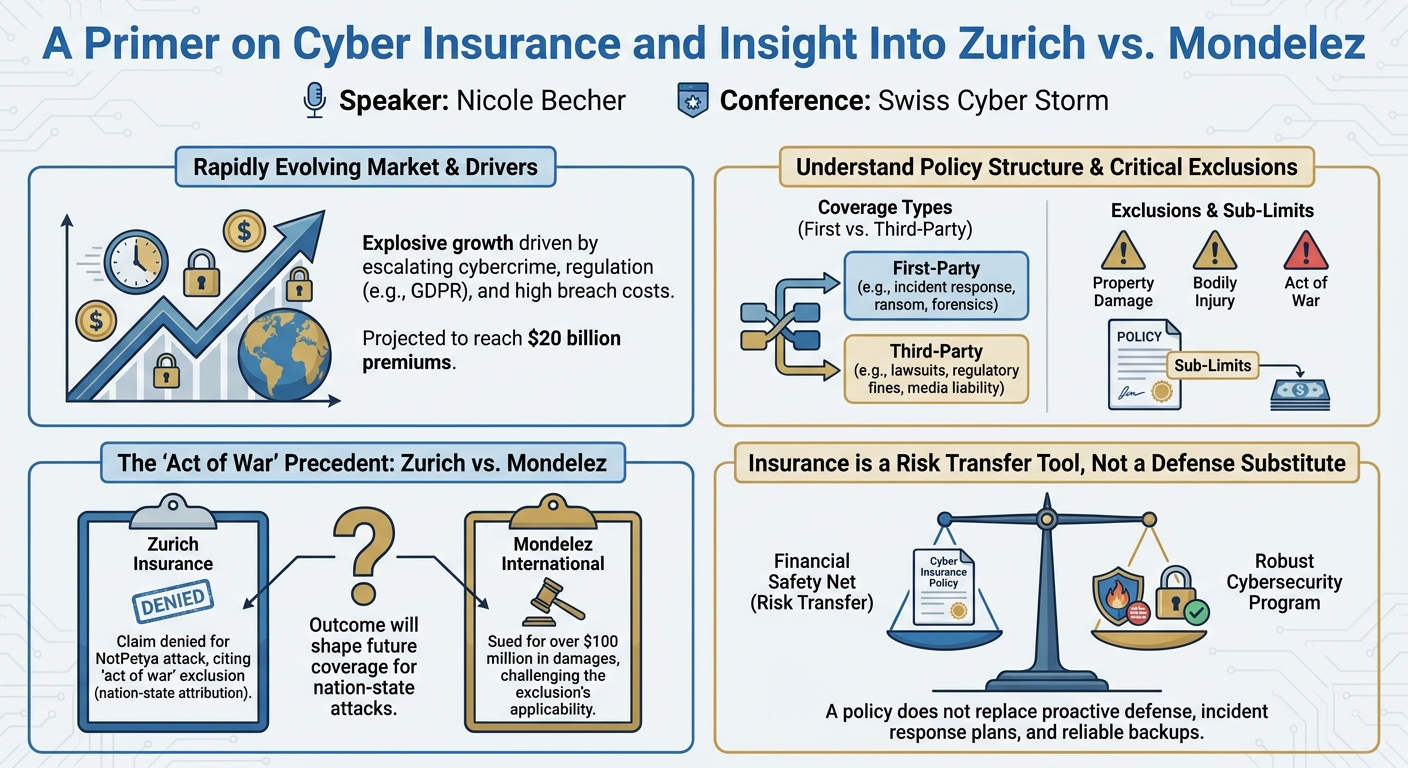
- Rapidly Evolving Market: The cyber insurance industry is experiencing explosive growth, projected to reach $20 billion in premiums, driven by increasing cybercrime, regulatory pressures like GDPR, and the escalating costs of data breaches.
- Understand Policy Structure: Organizations must differentiate between first-party coverage (costs incurred by the insured, e.g., incident response, ransom) and third-party coverage (liability to others, e.g., lawsuits, regulatory fines).
- Critical Role of Exclusions: Pay meticulous attention to exclusions (e.g., property damage, bodily injury, intellectual property loss) and sub-limits (specific caps for certain events like wire transfer fraud), as these can significantly impact claim payouts.
- The "Act of War" Precedent: The Zurich vs. Mondelez case, centered on the NotPetya attack and the "act of war" exclusion, is a landmark legal battle that will profoundly shape future cyber insurance coverage for nation-state-sponsored cyberattacks.
- Insurance is Not a Substitute for Defense: While cyber insurance is a vital risk transfer tool, it does not replace the need for a robust cybersecurity program, including strong defensive measures, comprehensive incident response plans, and reliable backups.
- Incentive Alignment Challenges: The debate over paying ransoms highlights a misalignment of incentives within the industry, as insurers sometimes find it more rational to pay, potentially perpetuating cybercrime, while organizations struggle with the true cost of recovery versus payment.
About the Speaker(s)
Nicole Becher is an accomplished Security Consultant based in New York. Her unique background blends deep technical cybersecurity expertise with significant experience in financial regulation. She spent time working for a financial regulator in the U.S., specifically the New York State Department Financial Services, where she gained extensive knowledge of the cyber insurance market, its participants, and regulatory frameworks.
Beyond her regulatory work, Becher has a strong technical foundation, having worked as a pen tester and currently teaching at NYU. She is also actively involved in the cybersecurity community, participating in various fellowships and being part of OWASP (Open Worldwide Application Security Project). Her diverse experience provides her with a comprehensive perspective on the intersection of technology, risk, and policy in the cybersecurity landscape.
Reviews
Dr. Zero (Offensive Security Researcher) — STRONG ACCEPT
This is exactly what a policy talk should be: devoid of thought-leadership bullshit and heavy on the actual mechanics of how defenders are going to get screwed on payouts. Becher leverages her NY DFS background to explain exactly how carriers are weaponizing nation-state attribution, making the Zurich vs. Mondelez fight required context for any CISO.
Heather Calloway (CISO) — STRONG ACCEPT
Becher provides a mandatory primer on the structural realities of cyber insurance, culminating in the Zurich versus Mondelez "act of war" dispute. This is exactly the conversation you need to be having with your CFO and General Counsel right now. If your board thinks your cyber policy is a blanket get-out-of-jail-free card for a destructive state-sponsored attack, they are operating on outdated assumptions.